
How Much Should I Pay Myself From My Business? A Simple 5-Step Guide for Australian Business Owners

How Much Should I Pay Myself From My Business? A Simple 5-Step Guide for Australian Business Owners

The jobs are booked out. The team’s been paid. The suppliers have been paid. The BAS is lodged. And you? You’ll take something “when things settle down”. If “how much should I pay myself from my business?” is the question you keep putting off, this one’s for you.

If that sounds familiar, you’ve got company. In Xero’s 2026 research, almost a third (32%) of Australian small business owners surveyed said they aren’t regularly paying themselves a wage (Xero).

32%

of Australian small business owners surveyed aren’t regularly paying themselves a wage. (Xero, 2026)

12%

is the super guarantee rate from 1 July 2025, if your company pays you wages or director’s fees. (ATO)

THE SHORT ANSWER

How much should I pay myself from my business?

Pay yourself a regular base pay that’s the lower of two numbers: what it would cost to replace you in the business, and what the business can afford after tax, super and a cash buffer. Then add a profit share each quarter when the numbers allow. Your structure decides how that money is paid.

Why do so many business owners pay themselves last?

I totally get this. When you’ve got staff relying on you, it feels selfish to take your share first. So you pay everyone else, then take what’s left. And some months, there isn’t much left.

Here’s the thing… paying yourself last doesn’t protect the business. It hides what’s really going on. If the business can only run because you’re working for free, it isn’t as profitable as it looks. That’s information, not failure. It usually points to pricing, costs or cash flow, and every one of those can be fixed. (If revenue is strong but profit isn’t, start with Why Is My Business Making Revenue but No Profit?)

In my 40 years in financial services, I’ve watched owners carry this for years. The ones who change it don’t suddenly earn more. They put a simple system in place and stick to it.

Wage, drawings or dividends: how does your structure change how you’re paid?

Before we talk numbers, it helps to know how money can leave the business. Your accountant should confirm what suits you, but here’s the plain-English version.

If you’re a sole trader or in a partnership

You can’t pay yourself a wage. Money you take out is called drawings, and it isn’t a business expense. You pay tax on the business profit through your own tax return, whether you take the money out or not (ATO). You also don’t have to pay super guarantee for yourself, though you can make your own contributions (ATO).

If you run a company

The company is a separate legal entity. You can be paid a wage or director’s fees through payroll (with PAYG withholding and super), receive dividends from profit, or both (Tax, Super + You). From 1 July 2025 the super guarantee rate is 12% of ordinary time earnings (ATO).

Check this first: If you take money from a company without it being set up as wages, director’s fees or a dividend, it can be treated as a loan or a deemed dividend under Division 7A (ATO). That’s a costly surprise, so talk to your accountant before you move money.

If you have a trust

Trust distributions are decided by the trustee, usually at the end of the financial year. Many owners still take a regular amount during the year, then their accountant works out the distribution later.

Whatever your structure, the method below works the same way. It tells you how much. Your accountant tells you how.

How do you work out how much to pay yourself? My 5-step method

Let me show you exactly how I walk business owners through this. Grab your last 12 months of numbers and a cuppa, and by Step 5 you’ll have your own answer to “how much should I pay myself from my business?”
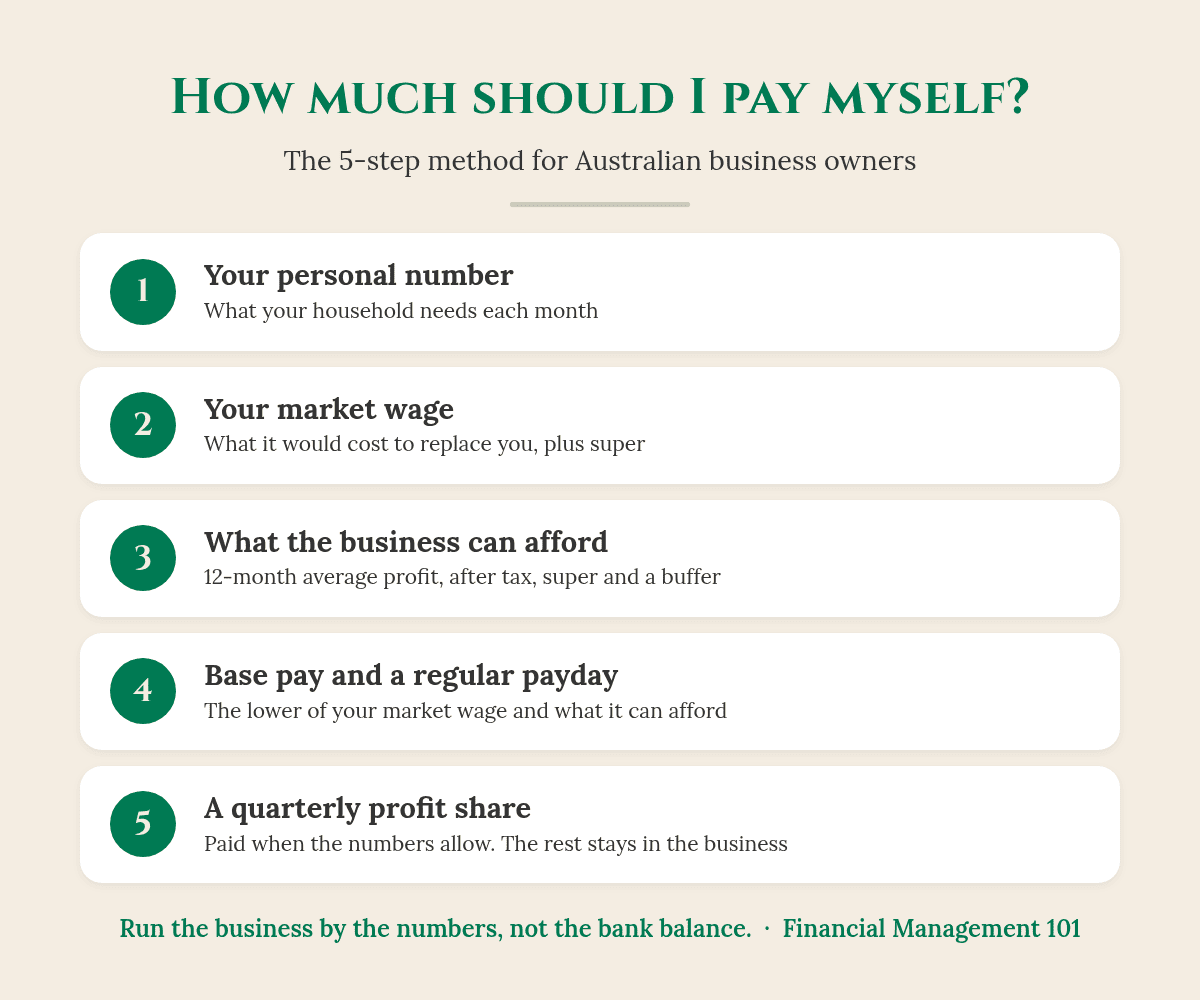
Graphic titled "How much should I pay myself? The 5-step method": 1 Your personal number, what your household needs each month; 2 Your market wage, what it would cost to replace you, plus super; 3 What the business can afford, 12-month average profit after tax, super and a buffer; 4 Base pay and a regular payday, the lower of your market wage and what the business can afford; 5 Quarterly profit share, when the numbers allow. Financial Management 101.
The 5-step method at a glance. Your accountant confirms how the money is paid for your structure.

Step 1: What’s your personal number?

Start with your life, not your business. Add up what it costs to run your household each month: mortgage or rent, groceries, utilities, insurance, car costs, school fees and loan repayments. Then add a realistic amount for living, because life is more than bills.

Check this first: Most owners have never written this down. They just know it feels “not enough”. Seeing the real figure takes the fog away, and it’s often less scary than you think.

Step 2: What is your role worth?

Put on your owner’s hat. If you had to hire someone to do your job tomorrow, what would you pay them? If you’re on the tools three days a week and running the office the other two, price a qualified tradesperson plus an operations manager for part of the week. Add super on top, because that’s what an employer pays.

What to look for: This is your market wage. It’s what the business should be able to pay for the work you do.

Step 3: What can the business actually afford?

Look at your average monthly profit over the last 12 months before paying yourself anything. Twelve months smooths out the busy and quiet periods. From that average, take away:

  • money you need to set aside for tax (GST, PAYG and income tax), plus super if you’re paid through a company
  • loan repayments that aren’t already in your expenses
  • a small amount to build a cash buffer

What’s left is what the business can realistically pay you right now. For the tax piece, my post What Numbers Should a Small Business Owner Track? shows which figures to watch.

Step 4: Set your base pay and a regular payday

Compare your three numbers: your personal number, your market wage, and what the business can afford.

  • If the business can afford more than your market wage: pay yourself your market wage. Anything above it is true profit (Step 5).
  • If it sits between your personal number and your market wage: set your base at what the business can afford. Your home life is covered and you’ve got a clear target to grow towards.
  • If it’s below your personal number: set your base at what the business can afford, even if it’s small, and read the section below.

Then pick a regular payday, weekly, fortnightly or monthly, and pay yourself on that day, every time, the same as you’d pay your team.

Step 5: Add a profit share each quarter

Your base pay is for doing the work. But you also own the business, and owners deserve a reward when it performs. Once a quarter, look at the profit left after your base pay, tax set-asides and buffer. Then decide on a share to pay yourself, and leave the rest in the business for growth or a rainy day.

Why it works: Your base pay gives your household stability. The quarterly profit share means you benefit when things go well, without putting cash flow at risk. For more on building this habit, read Pay Yourself Like a Boss: The Owner Pay System That Builds Profit, Not Burnout.

So what does this actually look like?

Here’s an illustrative example (the numbers are made up to show the method, not a real client). An electrical contracting company has been trading for 9 years, turns over about $1.4 million and has 8 staff. The owner runs jobs, quotes and manages the team.

  • Personal number: $9,000 a month for the household.
  • Market wage: a project manager-electrician to replace the owner would cost about $11,500 a month, plus 12% super.
  • What the business can afford: averaged over 12 months, profit before paying the owner is $19,000 a month. After setting aside for tax, the owner’s super and a buffer, about $10,500 a month is comfortably available.
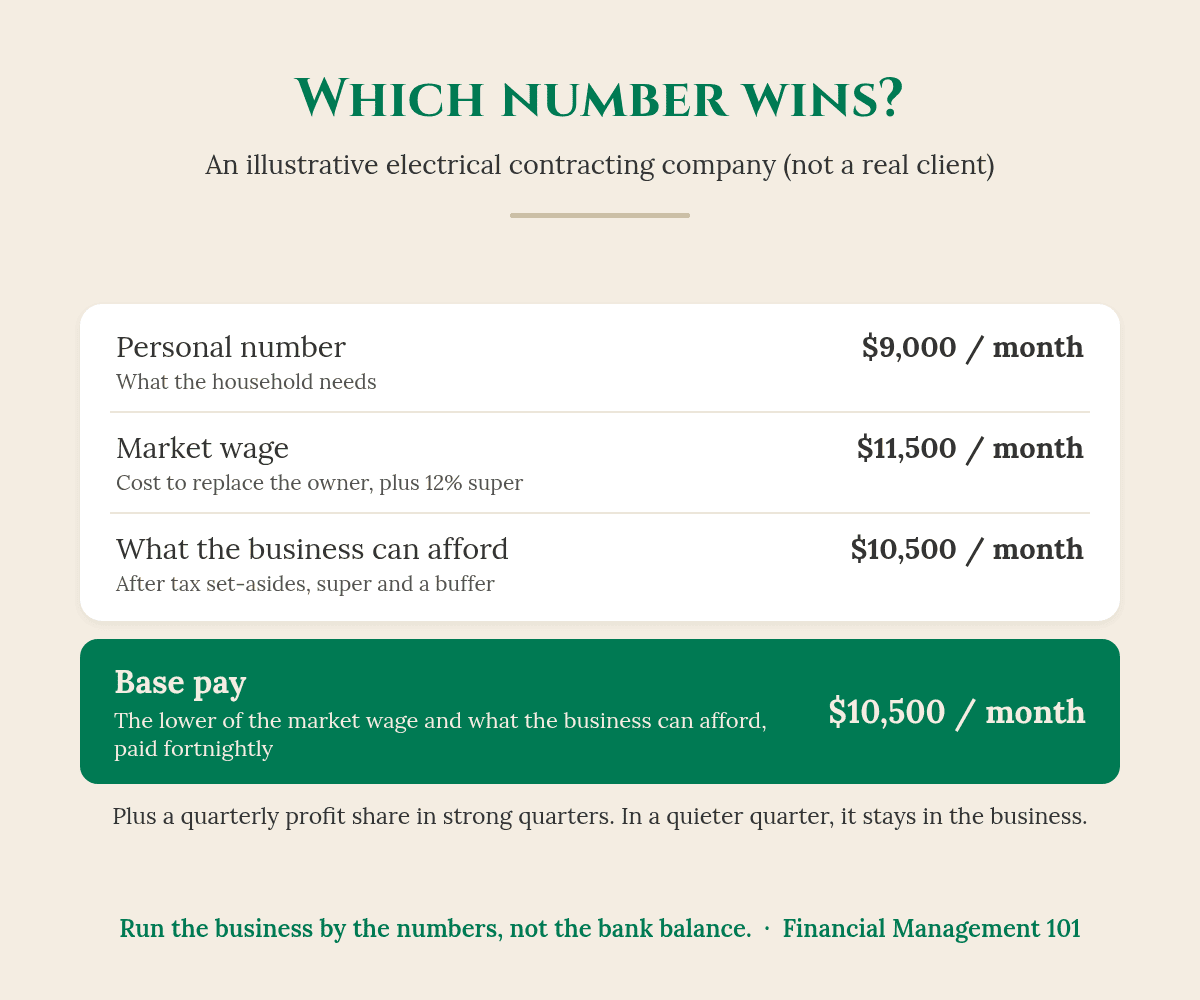
Graphic titled "Which number wins?" showing an illustrative electrical contracting company: personal number $9,000 a month; market wage $11,500 a month plus 12% super; what the business can afford $10,500 a month after tax, super and a buffer; result, base pay $10,500 a month, paid fortnightly, with a quarterly profit share when profit allows. Illustrative example, not a real client. Financial Management 101.
Illustrative example only (not a real client). The base is the lower of the market wage and what the business can afford.

So the owner sets a base pay of $10,500 a month through payroll, paid fortnightly. It covers the household with breathing room, and there’s a clear target: lift the business so it can pay the full market wage. Each quarter, the owner and their accountant look at what’s left. In a strong quarter, there’s a profit share. In a quieter one, it stays in the business.

The biggest change isn’t the dollar amount. It’s that the question at home moves from “Can I take money out this week?” to “What’s our plan for the profit?”

What if the business can’t afford to pay me much yet?

You’re not alone in this, and it doesn’t mean you’ve failed. It means the numbers are telling you something, and now you can listen. A big gap between what you need and what the business can afford usually points to one of these:

  • Pricing: you may be undercharging for your time, skill or materials.
  • Costs: some expenses may have crept up without anyone noticing.
  • Cash flow: money may be tied up in unpaid invoices, retentions or stock.
  • Capacity: you may be doing too much low-value work yourself.

In the meantime, start paying yourself something regular, even if it’s small, and increase it as the business improves. A small regular amount builds the habit, and habits are what change businesses.

Your takeaway

  • Your business isn’t truly profitable until you’re paid for the work you do.
  • Set a base pay that’s the lower of your market wage and what the business can afford, and pay it on a regular payday.
  • Add a quarterly profit share when the numbers allow.
  • Your structure decides how you’re paid. Your accountant and bookkeeper are your partners in setting it up properly.

Run the business by the numbers, not the bank balance.

Your accountant makes sure the numbers are right. Your bookkeeper makes sure the records are right. My job is to help you know what to do with them.

Not sure what your business can afford to pay you?

Start with The EDGE Business Health Check. It’s a $47 workbook that takes about 20 minutes. You score 30 quick statements across five areas: Profit & Pricing, Cashflow, CEO Visibility, Systems & Freedom, and Growth. Then the Profit Leak Calculator shows where money may be slipping away, and the 7-Day Reset gives you clear next steps.

The EDGE Business Health Check by Karen G. Adams, Financial Management 101. What if the problem isn't what you think it is? Uncover hidden profit leaks, cashflow pressures and growth bottlenecks in less than 20 minutes.

Rather talk it through first? Get in touch and book a call with me.

Frequently asked questions

How much should a business owner pay themselves in Australia?

There’s no single figure. A sound starting point is the lower of what it would cost to replace you and what the business can afford after tax, super and a cash buffer. Pay that as a regular base, then add a quarterly profit share when profit allows.

Should I pay myself a salary or dividends?

If you run a company, you can be paid wages or director’s fees, dividends, or a mix. Wages come with PAYG withholding and super. Dividends are paid from company profit. The right mix depends on your situation, so ask your accountant.

Do I have to pay myself super?

If you’re paid wages or director’s fees by your company, the company generally has to pay super guarantee for you, at 12% from 1 July 2025. Sole traders and partners don’t have to pay super guarantee for themselves, but can make personal contributions.

What percentage of profit should I pay myself?

Rather than a fixed percentage, set a base pay from your market wage and what the business can afford, then decide a quarterly profit share. Many owners take part of the profit and leave the rest in the business for growth and a buffer.

Are drawings taxed?

For sole traders and partners, drawings themselves aren’t taxed or deductible. You pay tax on the business profit through your own return, whether you take the money out or not. Money taken from a company works differently, so check with your accountant.


You’ve built something real. Financial confidence starts with clarity.

Karen G. Adams
Small Business Performance Strategist, Financial Management 101


This article is general education only. It isn’t financial, tax or legal advice, and it doesn’t take your personal circumstances into account. The electrical business example is illustrative, not a real client. Tax and super rules change, so check the details with your accountant, BAS agent or the ATO before you change how you pay yourself.
How Often Should I Review My Business Numbers? A Weekly, Monthly and Quarterly Rhythm

How Often Should I Review My Business Numbers? A Weekly, Monthly and Quarterly Rhythm

If you only look at your numbers when your accountant asks for something, or when the bank balance gives you a fright, you’re not alone. Most owners I work with didn’t go into business to read reports. So it’s a very common question: how often should I review my business finances? The honest answer is a little bit, often. A simple weekly, monthly and quarterly rhythm takes the dread out of it.

This post gives you that rhythm: what to look at each week, each month and each quarter, roughly how long it takes, and how your bookkeeper and accountant fit in.

THE SHORT ANSWER

How often should I review my business finances?

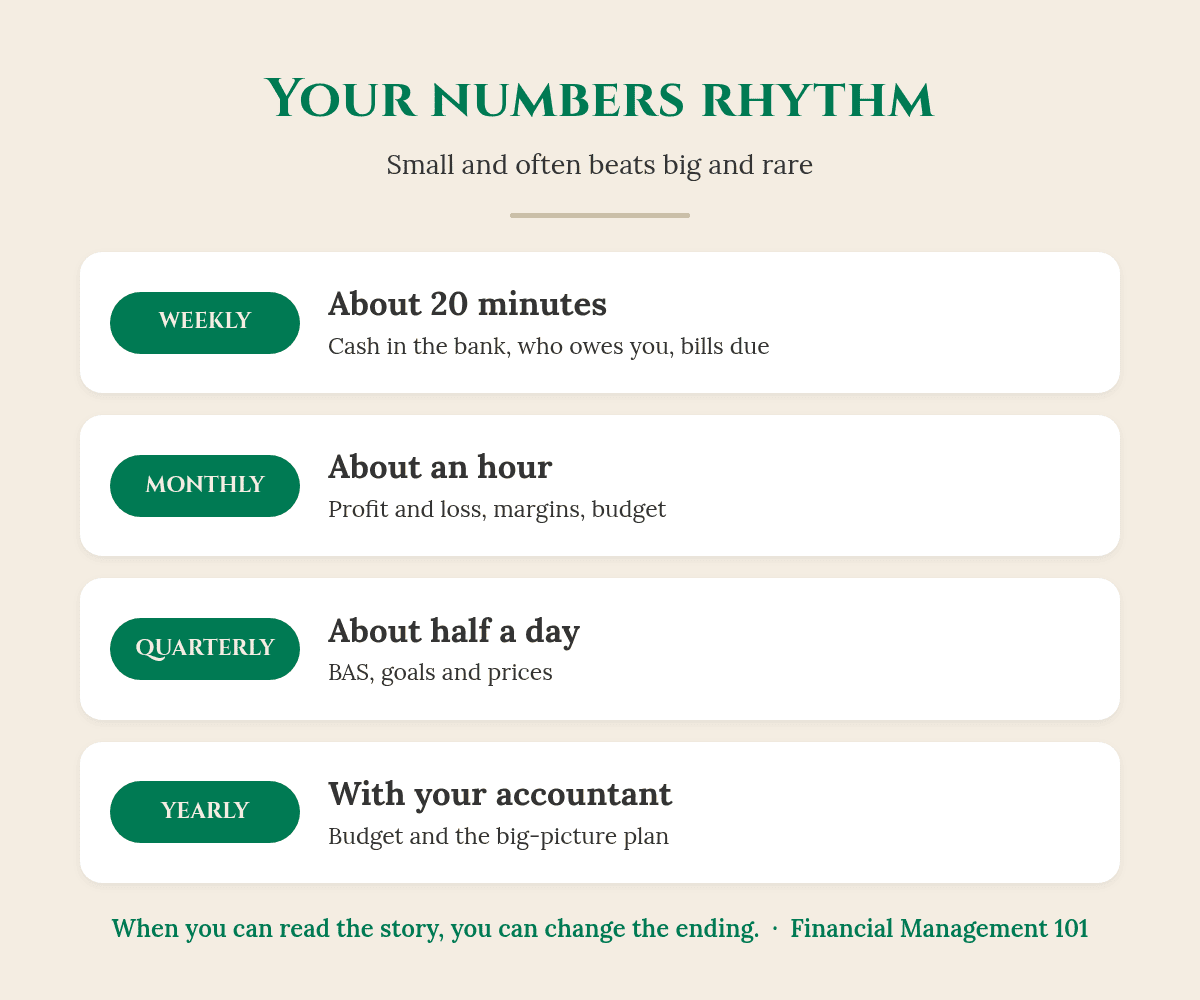
Check your cash and who owes you every week. Review your profit and loss and margins every month. Look at your BAS, your goals and your prices every quarter. Then set your budget once a year with your accountant. Short, regular check-ins beat one big, stressful catch-up.

Graphic titled "Your numbers rhythm": Weekly, about 20 minutes, cash in the bank, who owes you and bills due; Monthly, about an hour, profit and loss, margins and budget; Quarterly, about half a day, BAS, goals and prices; Yearly, budget and big-picture plan with your accountant. Financial Management 101.
Four check-ins. Small and often beats big and rare.

Why a rhythm works better than a big catch-up

business.gov.au recommends you review your financial activity regularly to spot any trends or problems early, and schedule time each month to check your spending against your budget (business.gov.au). That’s the whole idea: small problems are easy to fix when you see them early.

It also helps with the feeling side. Xero’s 2026 research found 41% of small business owners are too afraid to ask questions about financial management because they feel they should already know the answers, and 22% feel overwhelmed when dealing with business finances (Xero). A routine means you never have to face a whole year at once.

35%

of small business owners don’t often know if they made a profit last month. (Xero, 2026)

41%

are too afraid to ask questions about financial management. (Xero, 2026)

22%

feel overwhelmed dealing with business finances. (Xero, 2026)

Good to know: If you’re not sure which numbers matter most, start with my post on what numbers a small business owner should track. This post is about when to look at them.

Weekly: cash and debtors (about 20 minutes)

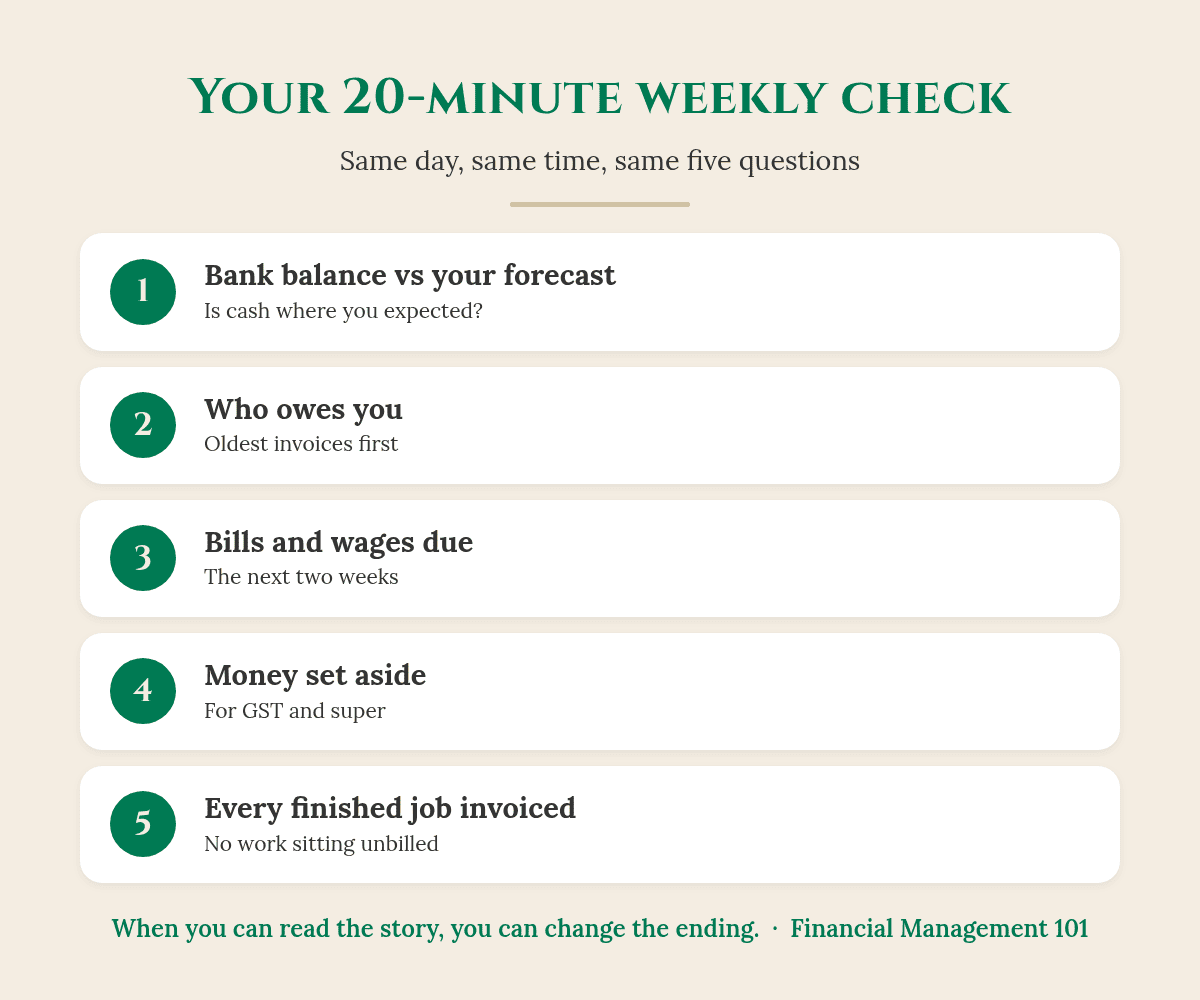
Graphic titled "Your 20-minute weekly check": 1 Bank balance against your cash flow forecast; 2 Who owes you, oldest invoices first; 3 Bills and wages due in the next two weeks; 4 Money set aside for GST and super; 5 Every finished job invoiced. Financial Management 101.
Same day, same time, same five questions.

This is your early warning system. Pick the same day each week, Monday morning works well for many owners, and answer five questions.

  1. Bank balance against your forecast. Is cash where you expected? If you don’t have a forecast yet, my post on how to do a cash flow forecast walks you through a simple 13-week method.
  2. Who owes you? Run your aged receivables report and start with the oldest invoices.
  3. What’s due out? Bills, wages and loan repayments for the next two weeks.
  4. Money set aside. Is your GST and super money sitting somewhere separate, so it’s there when it’s due?
  5. Is every finished job invoiced? Work that hasn’t been billed can’t be paid.

Why it works: Cash problems rarely arrive overnight. A weekly look shows you a slow-paying customer or a tight fortnight while you still have time to do something about it.

Monthly: profit and margins (about an hour)

Once a month, after your bookkeeper has reconciled the accounts, sit down with your profit and loss. business.gov.au notes you usually complete a profit and loss statement every month, quarter or year, and that it tells you how much profit you’re making, or how much you’re losing (business.gov.au). Monthly is the sweet spot for most small businesses.

  • Did we make a profit? It sounds basic, but Xero’s research found 35% of small business owners don’t often know whether they made a profit in the last month (Xero).
  • Gross profit margin: is it steady, or drifting?
  • Overheads: anything creeping up that you didn’t plan for?
  • Actuals against budget: business.gov.au suggests comparing your actuals (real income and costs) with your budget (business.gov.au).
  • Your own pay: did you pay yourself as planned?

Check this first: Make sure the month is reconciled before you review it. Reviewing half-finished numbers can send you after problems that aren’t there. Ask your bookkeeper when the month will be ready, and put your review in the diary for the day after.

So what does this actually look like?

Here’s an illustrative example (made-up numbers to show the method, not a real client). Mia runs a landscaping business.

  • Monday weekly check: the bank shows $48,000. Customers owe $36,000, and $9,500 of that is more than 30 days old, so Mia makes two friendly follow-up calls. Wages and bills for the next fortnight come to $22,000. Her GST money is in its own account.
  • Monthly review: October revenue was $95,000 and gross profit was $33,250, a margin of 35% ($33,250 ÷ $95,000 × 100). Her budget assumed 38%. So she looks at two jobs where materials ran over the quote.
  • Quarterly review: her October to December BAS is due 28 February, so in early February she checks her set-aside account against her bookkeeper’s BAS estimate, and reviews her prices for the new year.

Total time across the month: about two hours. No surprises, and every decision is based on numbers she’s already seen.

Quarterly: BAS, goals and prices (about half a day)

Most small businesses lodge a quarterly BAS. The ATO’s quarterly due dates are 28 October (July to September), 28 February (October to December), 28 April (January to March) and 28 July (April to June) (ATO). If you lodge online you may be eligible for an extra two weeks, and you may also get extra time if you lodge through a registered tax or BAS agent/accountant. That later date doesn’t apply to the October to December quarter, because 28 February already includes an extension (ATO). If you report monthly, your BAS is due on the 21st of the following month.

Use the quarter as a bigger-picture check-in:

  • BAS ready: is the money set aside to cover it?
  • Goals: are you on track for the year? What needs to change next quarter?
  • Prices: Business Queensland suggests scheduling formal price reviews, for example monthly, quarterly or half-yearly (Business Queensland). The quarter is a natural time.
  • Forecast: business.gov.au suggests updating your forecast more often than your budget, monthly or quarterly (business.gov.au).

For a simple way to run this check, use my quarter report card with its three questions.

Watch out: If you can see you won’t be able to pay your BAS on time, don’t wait. The ATO asks you to contact them, or your registered tax professional, before the due date to find out what support is available, and says it will work with you to find a solution (ATO).

Yearly: the budget and the big picture

Once a year, set your budget. business.gov.au suggests writing your budget once a year and considering a mid-year review (business.gov.au). This is a great conversation to have with your accountant, alongside your tax planning.

Where do my bookkeeper and accountant fit in?

They’re your partners in this rhythm, not a replacement for it. Your bookkeeper keeps the records up to date, so the numbers you look at each week and month are real. Your agent/accountant makes sure the numbers are right, lodges what needs lodging, and helps you plan the year ahead.

My job is to help you know what to do with those numbers. The rhythm is what makes that possible: when you look regularly, your questions for your bookkeeper and accountant get sharper, and your conversations with them get more useful.

When you can read the story, you can change the ending.

Your takeaway

  • Weekly, about 20 minutes: cash, who owes you, bills due, money set aside, everything invoiced.
  • Monthly, about an hour: profit and loss, margins, overheads and actuals against budget.
  • Quarterly, about half a day: BAS, goals, prices and your forecast.
  • Yearly: your budget and the big picture, with your accountant.
  • Put each one in your diary. Same day, same time.

Want to see where your profit is really going?

Start with The EDGE Business Health Check. It’s a $47 workbook that takes about 20 minutes. You score 30 quick statements across five areas: Profit & Pricing, Cashflow, CEO Visibility, Systems & Freedom, and Growth. Then the Profit Leak Calculator shows where money may be slipping away, and the 7-Day Reset gives you clear next steps.

The EDGE Business Health Check by Karen G. Adams, Financial Management 101. What if the problem isn't what you think it is? Uncover hidden profit leaks, cashflow pressures and growth bottlenecks in less than 20 minutes.

Rather talk it through first? Get in touch and book a call with me.

Frequently asked questions

How often should a small business owner look at their bank balance?

Most owners look at their bank balance often. The key is to compare it with a forecast each week, so you know whether it’s where it should be, not just what it is today.

Should I review my profit and loss monthly or quarterly?

Monthly works best for most small businesses, once your bookkeeper has reconciled the month. business.gov.au notes profit and loss statements are usually completed every month, quarter or year.

When is my quarterly BAS due?

The ATO’s quarterly dates are 28 October, 28 February, 28 April and 28 July. Lodging online or through a registered tax or BAS agent/accountant may give you more time, except for the October to December quarter.

How long does a weekly money check take?

Once it’s a habit, about 20 minutes. The first few may take longer while you find the reports you need.

What if I don’t have a bookkeeper?

The rhythm still works. You’ll just need to reconcile your accounts before your monthly review. If that’s taking up hours each month, it may be time to talk to a bookkeeper.


You’ve built something real. Financial confidence starts with clarity.

Karen G. Adams
Small Business Performance Strategist, Financial Management 101
Too Big To Wing It. Too Small To Need A CFO.


This article is general education only. It isn’t financial, tax or accounting advice, and it doesn’t take your personal circumstances into account. Mia’s landscaping business and all its figures are illustrative, not a real client. BAS due dates are from the ATO website as at November 2026; check your own dates with the ATO or your bookkeeper or agent/accountant.

How Do I Raise My Prices Without Losing Customers?

How Do I Raise My Prices Without Losing Customers?

You know your prices need to go up. Your materials cost more, your insurance renewal was a shock, and you haven’t touched your rates in a while. But every time you go to send the email, you picture your best customer reading it and quietly going elsewhere. If that’s you, you’re not alone, and you’re not being greedy. Learning how to raise prices well is mostly about timing, order and a few clear words.

This post walks you through when to raise your prices, who to tell first, what to say, and what to do if someone pushes back. You’ll also see, with some simple illustrative maths, why a small rise can matter more to your profit than you’d expect.

THE SHORT ANSWER

How do I raise prices without losing customers?

Check your numbers first, give clear notice, tell your team and your key customers before anyone else, keep the message short and calm, and honour quotes you’ve already sent. Most of the stress comes from surprise, so take the surprise out of it.

How do I know it’s time to raise my prices?

business.gov.au suggests reviewing your prices at least once a year, or whenever your costs or market conditions change (business.gov.au). Business Queensland goes further and suggests scheduling formal price reviews, for example monthly, quarterly or half-yearly, to keep up with changes in your costs, your customers’ expectations and your competitors (Business Queensland).

Your profit and loss report is the best place to start. business.gov.au says you can use it to help develop sales targets and an appropriate price for your goods or services (business.gov.au). If you haven’t looked at yours lately, you’re in good company. Xero’s 2026 research found more than one in three Australian small business owners (35%) don’t often know whether they made a profit in the last month (Xero).

35%

of Australian small business owners don’t often know if they made a profit last month. (Xero, 2026)

Yearly

business.gov.au suggests reviewing your prices at least once a year. (business.gov.au)

5%

an illustrative price rise that lifts net profit by 50% in our example. (Illustrative)

  • Your costs have gone up, but your prices haven’t moved in 12 months or more.
  • Your gross profit margin is drifting down month by month. My post on what a good gross profit margin looks like shows you how to check it.
  • You’re flat out, booked weeks ahead, and still not seeing it in the bank.
  • Your quotes are being accepted almost instantly, every time.

Good to know: This post is about raising existing prices. If you want to work out what your prices should be from scratch (costs, profit and value), start with my earlier post, How to Price Your Products or Services Properly (Without Undervaluing Yourself).

Why does a small price rise matter so much?

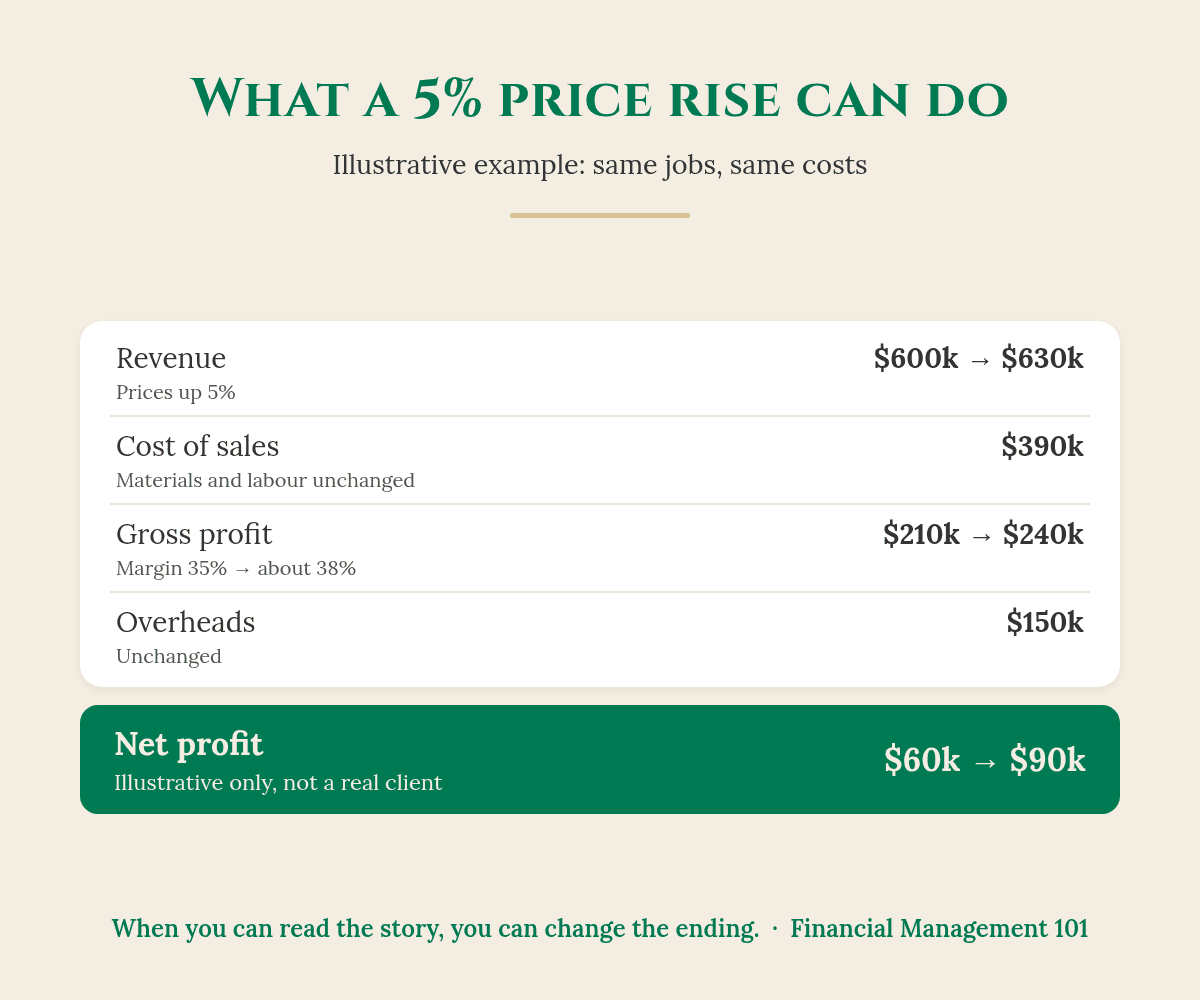
Graphic titled "What a 5% price rise can do", an illustrative example, not a real client: revenue $600,000 rises to $630,000 for the same jobs; cost of sales stays at $390,000; gross profit rises from $210,000 to $240,000, a margin of 35% rising to about 38%; overheads stay at $150,000; net profit rises from $60,000 to $90,000. Financial Management 101.
Illustrative numbers only. Same jobs, same costs, prices up 5%.

Here’s an illustrative example (the numbers are made up to show the method, not a real client). A plumbing business turns over $600,000 a year. Its cost of sales (materials, subcontractors and the labour on the jobs) is $390,000, so its gross profit is $210,000, a 35% margin. After $150,000 of overheads, the net profit is $60,000.

Now the owner raises prices by 5% and, for the sake of the example, does exactly the same jobs at exactly the same cost. Revenue becomes $630,000. The extra $30,000 doesn’t buy more materials or more labour, so all of it drops through to profit. Net profit goes from $60,000 to $90,000. A 5% price rise, in this example, lifts net profit by 50%.

So what does this actually look like?

On a single job, it’s easier to see. Say a hot water system replacement is quoted at $2,000, with $1,300 of materials and labour. The gross profit is $700, or 35%.

  • Raise the price by 5% and the job is $2,100. Costs are still $1,300, so gross profit is $800.
  • That’s $100 more on the job, and 14% more gross profit, for a price rise most customers will barely notice.
  • The new margin is $800 ÷ $2,100 × 100, or about 38%. Business Queensland’s formula is gross profit ÷ total revenue × 100 (Business Queensland).

Why it works: Your costs don’t go up when your price does. So every extra dollar of price is extra gross profit. It’s why Business Queensland describes gross profit as a valuable measure of whether your pricing, sales volume and cost of goods sold will make your business a profit (Business Queensland).

What if I lose a few customers?

It’s a fair worry, so run the numbers. In the illustrative business, every $1 of work used to leave 35 cents of gross profit. After a 5% rise, the same work brings in $1.05 and leaves 40 cents. So the business could do 12.5% less work (35 ÷ 40 = 87.5%) and still make the same gross profit. That’s not a target, and losing customers is never the goal. It’s simply a reality check: a small rise gives you more room than most owners expect.

Watch out: Your numbers will be different. Your margin, your mix of work and your customers all matter. Business Queensland notes that if demand is elastic, a price change can have a significant effect on demand (Business Queensland). Run this with your own figures, ideally with your bookkeeper or agent/accountant, before you decide.

When is the best time to raise prices?

There’s no perfect day, but some times are easier than others.

  • At a natural reset point: the start of a new financial year, a calendar year or a new season.
  • When costs have clearly moved: for example, after a supplier increase you can point to.
  • With notice: give your regular customers time to plan. Many businesses give around 30 days, but choose what suits your customers and check any agreements you have.
  • Not in the middle of a job: honour any quote you’ve already sent, for as long as it’s valid.

Check this first: If you have written agreements or ongoing contracts with customers, read what they say about price changes before you send anything. If you’re unsure, ask your legal adviser.

How do I tell customers about a price rise?

Graphic titled "Your price rise in 5 steps": 1 Check your numbers, know your costs and your margin; 2 Pick your timing and give notice, honouring quotes already sent; 3 Tell your team first so they can answer questions; 4 Tell key customers personally, then everyone else in writing; 5 Update everywhere your prices appear, such as quotes, price lists and your website. Financial Management 101.
Five steps, in this order, so nobody is caught by surprise.

Order matters. Business Queensland’s advice is to communicate price changes clearly to customers and update them wherever your prices appear (Business Queensland). Here’s a calm way to do it.

  1. Tell your team first. Anyone who quotes, answers the phone or sends invoices needs to know the new prices, the date and the reason, so they can answer questions without being caught out.
  2. Call or meet your key customers. Your long-standing or biggest customers deserve to hear it from you personally, before the email arrives.
  3. Then tell everyone else in writing. A short email or letter, with the date the new prices start.
  4. Update everywhere your prices appear. Business Queensland suggests keeping a checklist of where your prices are published, such as sales kits, price lists, brochures and websites (Business Queensland). Add your quote templates and accounting software too.

What should I actually say?

Keep it short, warm and factual. You don’t need to justify every cost or apologise. Something like this:

“Hi Sam, thanks for working with us this year. I wanted to let you know personally that from 1 February our rates will increase by 5%. Like many businesses, our costs for materials and insurance have gone up, and this change lets us keep doing the work to the standard you expect. Any quotes we’ve already sent you will be honoured. If you have any questions, just give me a call.”

What to look for: Three things in every message: the date, the change, and one honest sentence about why. Leave out long explanations and anything that sounds like an apology.

What if a customer pushes back?

Most customers accept a fair, well-explained rise. If someone does push back, take a breath. It’s a conversation, not a verdict.

  • Listen first. Ask what’s worrying them. Sometimes it’s timing, not the price itself.
  • Restate the value, briefly. Remind them what they get: reliability, quality, turning up when you say you will.
  • Offer options rather than discounts. Could the scope change? Could they book the work before the new prices start?
  • Know your floor before the call. Decide in advance the lowest price that still works for your business, so you don’t decide under pressure.
  • Let some customers go, kindly. If a customer only works with you because you’re the cheapest, it may be fine for them to move on.

Watch out: Never talk to competitors about putting prices up together. business.gov.au is clear that agreeing with competitors to set prices is illegal (business.gov.au). And make sure your new prices are displayed clearly and accurately, so they aren’t misleading.

When you can read the story, you can change the ending.

Your takeaway

  • Review your prices at least once a year, or whenever your costs change.
  • Run the maths on your own numbers. A small rise often matters more than you’d expect.
  • Give notice, honour existing quotes, and tell your team and key customers first.
  • Keep the message short: the date, the change, and one honest reason.
  • If someone pushes back, listen, offer options and know your floor.

Your agent/accountant and your bookkeeper are great partners here. They can help you see your real margins, so your price rise is based on your numbers, not a guess. Then keep an eye on the result. My post on what numbers a small business owner should track shows where your margin fits.

Want to see where your profit is really going?

Start with The EDGE Business Health Check. It’s a $47 workbook that takes about 20 minutes. You score 30 quick statements across five areas: Profit & Pricing, Cashflow, CEO Visibility, Systems & Freedom, and Growth. Then the Profit Leak Calculator shows where money may be slipping away, and the 7-Day Reset gives you clear next steps.

The EDGE Business Health Check by Karen G. Adams, Financial Management 101. What if the problem isn't what you think it is? Uncover hidden profit leaks, cashflow pressures and growth bottlenecks in less than 20 minutes.

Rather talk it through first? Get in touch and book a call with me.

Frequently asked questions

How much notice should I give before raising my prices?

There’s no single rule for every business. Many give regular customers around 30 days’ notice, and honour any quotes already sent. Check any written agreements you have, as they may set out what’s required.

How much should I raise my prices by?

Start from your numbers, not a round figure. Work out what your costs have done and what margin you need, then test the rise on your own profit and loss. Your agent/accountant can help you model it.

Should I explain why my prices are going up?

Yes, briefly. One honest sentence about rising costs or keeping your standards is enough. Long explanations can sound like an apology.

Is it better to raise prices a little each year or a lot at once?

Many owners find small, regular rises easier for customers to accept than a big jump after years of no change. business.gov.au suggests reviewing prices at least once a year.

What do I do if my best customer says no?

Listen, then talk options: timing, scope or booking work before the new prices start. Decide your lowest workable price before the conversation so you’re not deciding on the spot.


You’ve built something real. Financial confidence starts with clarity.

Karen G. Adams
Small Business Performance Strategist, Financial Management 101
Too Big To Wing It. Too Small To Need A CFO.


This article is general education only. It isn’t financial, legal, tax or accounting advice, and it doesn’t take your personal circumstances into account. The plumbing business, the hot water job and all their figures are illustrative, not a real client. Check your own numbers with your bookkeeper or agent/accountant, and get legal advice about any contracts.

Why I Won’t Put My Business Financials Into AI (And What I Do Instead)

Why I Won’t Put My Business Financials Into AI (And What I Do Instead)

Everyone’s telling you it’s fine. Paste your profit and loss into a chatbot, click off a setting, tick a box, and you’re done. Well, I don’t agree. I’m not anti-AI. I use it every day and I love it. But when it comes to your business financials, I’ve landed somewhere different, and I want to show you why.

In my latest video I share the three reasons I hold this line, the research behind each one, and a look inside a real client’s CEO Dashboard that answers the questions owners are hoping a chatbot will answer, without pasting anything anywhere.

Watch: Don’t Paste Your Business Financials Into ChatGPT. Here’s Why. (8:17). Watch on YouTube

Last week I wrote about four questions to ask before you let ChatGPT or Claude into your Xero. That was the “if you’re going to do it, do it on purpose” version. This one is different. This is where I’ve landed, and why.

THE SHORT ANSWER

Should you paste your business financials into a public AI chatbot?

I wouldn’t. Settings help, but once your numbers leave your hands, you can’t fully control where they go or take them back. Your financials also hold your team’s and your clients’ information, not just yours. And a chatbot can only guess from what you paste in on the day. Use AI for your emails, marketing and ideas, and keep your financials somewhere safe and built for your business.

Why have I landed here when I use AI every day?

I’ve been in financial services for 40 years and I’ve seen plenty of new tools arrive. AI is one of my favourites. I recently spent over 40 hours learning a new AI tool for my own business, and I wrote about what those 40 hours gave me back. So this isn’t fear of the new. It’s a line I’ve drawn on purpose, for three reasons.

Reason 1: Why isn’t changing a setting enough?

Most of the advice out there is about settings: turn off training, use a temporary chat, delete your history. I get why. It feels like you’re in control. But look at what the companies themselves say happens after you press enter.

  • Google’s own Gemini privacy page says: “Please don’t enter confidential information that you wouldn’t want a reviewer to see or Google to use to improve our services, including machine-learning technologies.” It also says chats that reviewers look at can be kept for up to three years, and that even with activity turned off, chats are kept for 72 hours (Google).
  • Anthropic says that on its consumer Claude plans, chats can be kept for up to five years if you allow them to be used to improve its models, and 30 days if you don’t (Anthropic).
  • In 2025, a US court order in The New York Times’ lawsuit against OpenAI required OpenAI to keep consumer ChatGPT conversations, including deleted ones. OpenAI says that obligation ended on 26 September 2025, but it’s still holding a limited set of conversations from April to September 2025 under legal hold (OpenAI).

None of this is a company doing something sneaky. Google and Anthropic, for example, both say they don’t sell your personal information. It’s policy, courts and normal business. But it does mean delete doesn’t always mean gone.

Our own privacy regulator, the OAIC, puts it this way. Talking about personal information entered into publicly available AI tools, it says that “depending on the relevant privacy settings”, it can be “very difficult to track or control how it is used, and potentially impossible to remove” (OAIC).

So for me, the question isn’t which setting I tick. It’s whether I’m comfortable with my numbers sitting somewhere I can’t see or control. There’s no guarantee they stay private.

Reason 2: Whose information is really in your financials?

Here’s what most people miss. Your financials aren’t just yours.

  • Your payroll has your team’s wages in it.
  • Your debtors list has your clients’ names.
  • Your bank feed shows who you pay and when.

That’s other people’s information sitting in your business. And even good people in big companies slip up.

  • A 2025 global study by KPMG and the University of Melbourne surveyed 32,352 employees in 47 countries. Almost half (48%) admitted uploading sensitive company or customer information into public AI tools (The Conversation). Here in Australia, only 30% of employees said their organisation had a policy on generative AI use (KPMG Australia).
  • In 2023, Samsung temporarily restricted generative AI tools on company devices after staff uploaded internal source code to ChatGPT (The Verge).
  • In 2025, nearly 4,500 shared ChatGPT conversations turned up in Google search results (Fast Company). People had ticked a box to make a shared link discoverable without realising what that meant. OpenAI removed the feature (TechCrunch).
  • In January this year, a popular third-party AI chat app, Chat & Ask AI, had a misconfigured database. A researcher reported that around 300 million messages from more than 25 million users were exposed (404 Media). The developer’s own estimate of the people affected was far lower, and it fixed the problem within hours (Malwarebytes). But for a while, those chats were sitting where they shouldn’t have been.

I’m not telling you this to scare you. I’m telling you because, as the owner, you’re the one who carries it.

Good to know: if your business turns over more than $3 million a year, the Privacy Act generally applies to you. Some smaller businesses are covered too, such as health service providers and businesses that trade in personal information (OAIC). The Australian Cyber Security Centre’s guide to AI for small business also warns that uploading customer or staff details without removing identifying information can expose it, and suggests checking a tool’s settings, terms and privacy policy first.

Reason 3: Can a chatbot really answer your money questions?

So why do people paste their numbers in? I get it. They want answers. Am I actually making money? Why is cash always tight? Can I afford that new ute?

Those are brilliant questions. But a chatbot can only guess from whatever you’ve pasted in on the day, with no idea whether your books are right or up to date, or what you’re trying to build. As I say in the video, “I want you AI-ready, not AI-guessing.”

What do I do instead? A look inside a real client’s CEO Dashboard

Here’s where it gets good. In the video I walk through The CEO Dashboard for Demo Cleaning Co. It’s a real client, with names and some figures changed for privacy, showing four months of data.

So what does this actually look like for a cleaning business?

  • Revenue: $75.3K over four months, with $3.1K in net profit. That’s a 4.1% margin.
  • The weekly briefing: a “What your numbers are saying” box, written from their own numbers. September was up 14%, but at a 4.1% margin, the briefing shows a 6% drop in sales would push them into a loss.
  • Regular cleans: the bread-and-butter work brought in $32K and lost $1,234. Labour was taking 73 cents of every dollar. As the dashboard puts it, that’s a pricing problem, not a business problem.
  • Quotes versus reality: they quoted $50.0K of work that cost $55.9K to deliver. 288 of 424 cleans ran over budget. One two-bedroom unit in East Perth was quoted at $238 and cost $421 to do.

What’s actually safe to pay yourself?

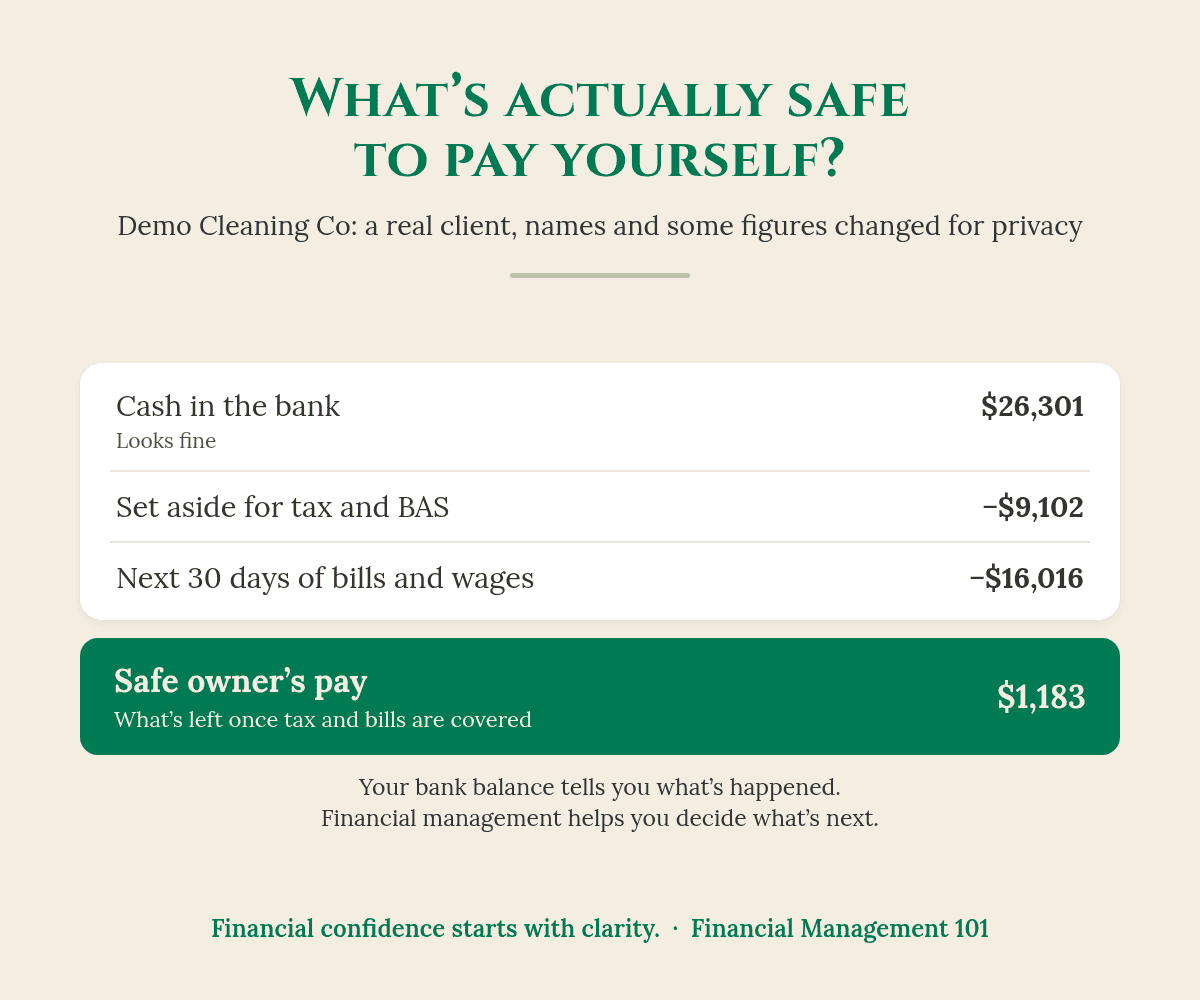
Graphic titled "What's actually safe to pay yourself?", subtitled "Demo Cleaning Co: a real client, names and some figures changed for privacy": cash in the bank $26,301; less set aside for tax and BAS $9,102; less the next 30 days of bills and wages $16,016. Safe owner's pay: $1,183. Note: your bank balance tells you what's happened. Financial management helps you decide what to do next. Financial Management 101.
Demo Cleaning Co had $26,301 in the bank, but after tax, BAS and the next 30 days of bills and wages, the safe owner’s pay was $1,183. A real client, with names and some figures changed for privacy.

Cash in the bank was $26,301, which looks fine. But take out the $9,102 set aside for tax and BAS and the $16,016 for the next 30 days of bills and wages, and the safe owner’s pay was $1,183. Your bank balance tells you what’s happened. Financial management helps you decide what to do next. If that idea is new to you, have a read of What Can’t Your Bank Balance Tell You?

Can they hire another cleaner or buy that extractor?

This is the page owners love. Can they hire another cleaner? The data says not yet. The cash buffer is seven weeks and the rule is eight. A $6.5K carpet extractor? It pays for itself in 11 months, but tax and bills need to be covered after the deposit is paid first. These rules are set with me and reviewed every month with the owner. So it’s not a guess, it’s a decision.

Why it works: nobody pasted a bank statement into a chatbot. It’s the owner’s own dashboard, built with them. It isn’t a public AI tool, and they decide who has access to it. And if you run a trade business, there’s a trade version of the same thing. You can take a look at The CEO Dashboard – New Look.

Not sure which numbers matter most? What Numbers Should A Small Business Owner Track? is a good place to start.

So should you stop using AI?

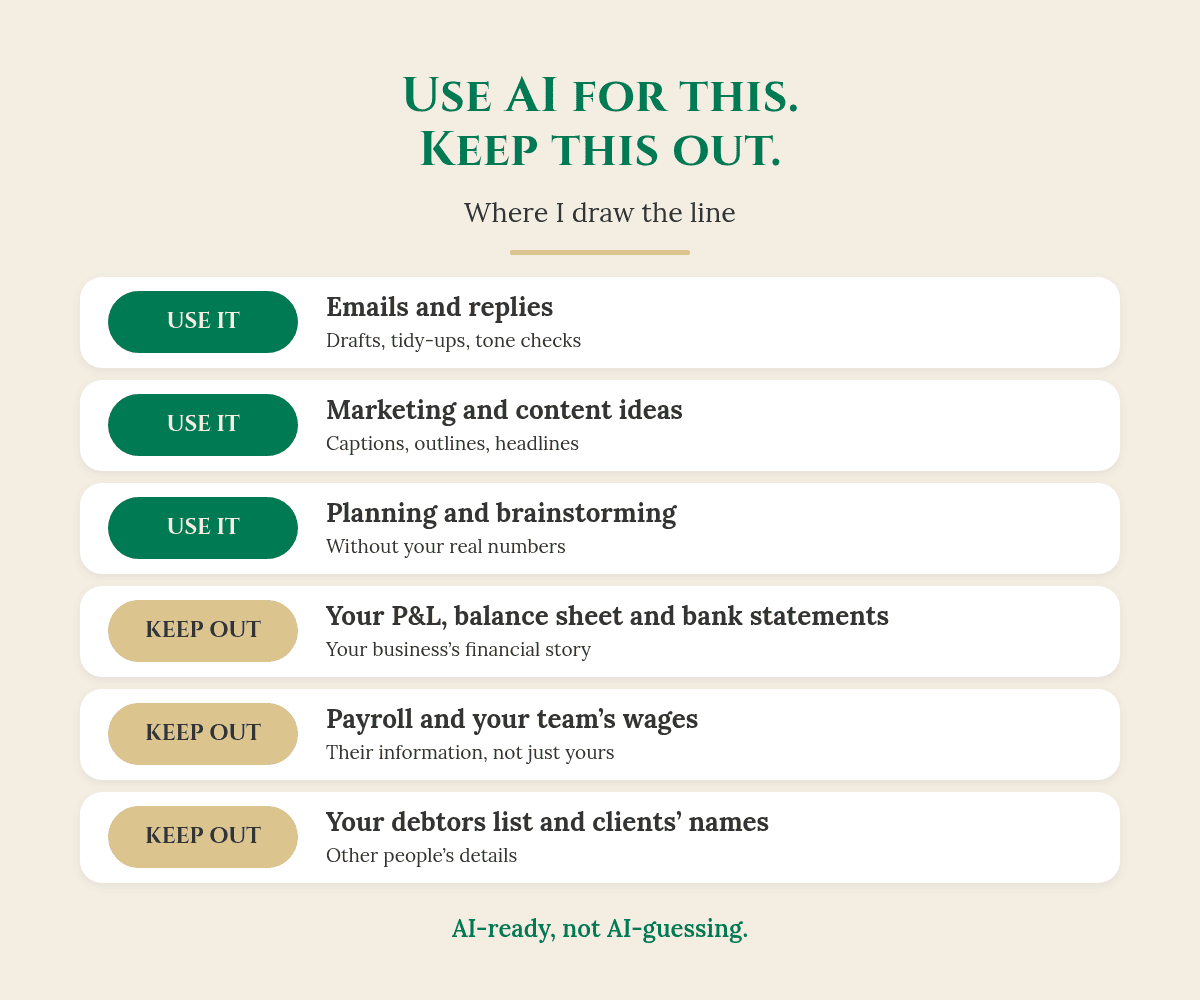
Graphic titled "Use AI for this. Keep this out", subtitled "Where I draw the line": Use it: emails and replies; marketing and content ideas; planning and brainstorming. Keep out: your P&L, balance sheet and bank statements; payroll and your team's wages; your debtors list and clients' names. Footer: AI-ready, not AI-guessing. Financial Management 101.
Where I draw the line: use AI for emails, marketing and ideas. Keep your financials, payroll and client details out of public chatbots.

No. Use it for your emails, your marketing and your ideas. Just keep your financials somewhere safe and built for you. When you can read the story in your numbers, you can change the ending.

I want you AI-ready, not AI-guessing.

Your takeaway

  • The paste is the decision. Settings help, but once your numbers leave your hands, you can’t take them back.
  • It’s not just your information. It’s your team’s and your clients’ too.
  • You don’t need a chatbot to understand your numbers. You need a clear view built for your business alone.
  • Use AI for emails, marketing and ideas. Keep your P&L, payroll and client details out of public chatbots.

Want answers from your numbers without the guesswork?

Take a look at The CEO Dashboard – New Look to see how it brings your numbers together in one place, built for your business.

Then book your CEO Dashboard chat. It’s a 20-minute call to see what your own dashboard could show you. You’re too big to wing it and too small to need a CFO, and that’s exactly who this is for.

Know a business owner who’s been pasting their P&L into a chatbot? Send them this post.

Frequently asked questions

Is it safe to paste my P&L into ChatGPT or another chatbot?

I wouldn’t. Even with training turned off, providers can keep chats for a period, some chats may be seen by human reviewers, and court orders can require chats to be kept. Your P&L can also reveal your team’s wages and your clients’ names. Keep your financials in a tool built for them.

If I delete a chat, is it gone?

Not always straight away. Each provider has its own retention rules. Google says chats are kept for 72 hours even with activity turned off, and reviewed chats for up to three years. In 2025 a US court order required OpenAI to keep deleted ChatGPT chats for a time. Check the provider’s own privacy pages.

Does the Privacy Act apply to my small business?

Generally, if your annual turnover is more than $3 million. Some smaller businesses are covered regardless, such as health service providers and businesses that trade in personal information. The OAIC’s small business page explains the rules. Check with your adviser if you’re not sure.

Can I still use AI in my business?

Yes. I use it every day. Use it for emails, marketing and ideas. Just keep your financials, payroll and client details out of public AI chat tools.

Is the cleaning business in the video real?

Yes. Demo Cleaning Co is a real client, with names and some figures changed for privacy.


You’ve worked hard for those numbers. Keep them somewhere safe, and make them work for you.

Karen G. Adams
Small Business Performance Strategist, Financial Management 101


This article is general information only. It isn’t legal, privacy, cyber security or financial advice, and it doesn’t take your circumstances into account. Provider policies change, so check each tool’s current privacy terms. Demo Cleaning Co is a real client, with names and some figures changed for privacy.

You Started a Business to Make More Money. So Why Are You Broke?

You Started a Business to Make More Money. So Why Are You Broke?

You started your business because you were good at what you did. You wanted more freedom, more control, more time with family, and to make more money than you could working for someone else. So why, when you’re flat out and booked solid, do you look at the bank account and wonder where all the money has gone? If you’re busy but broke, you’re not alone, and it’s usually not because you’re bad at what you do.

In my latest video I walk through it with Dave. Dave is a fictional example, but as I say in the video, “this situation is very real with business owners that I speak with.”

Watch: You Started a Business to Make More Money. So Why Are You Broke? (8:45). Watch on YouTube

This post goes through Dave’s numbers, why money coming in isn’t money you’re making, the three questions I’d want every owner to answer, and a simple check you can do with last month’s numbers.

THE SHORT ANSWER

Why am I busy but broke?

Because sales aren’t the same as what you keep. Once the business pays for the work, the running costs, the tax and the timing of cash, there can be far less left for you than the busy calendar suggests. More work isn’t necessarily the answer. Knowing your numbers, pricing for the whole business and paying yourself on purpose usually is.

Meet Dave: a good sparky with a full calendar

Dave is an electrician who’s been running his own business for about 18 months. He’s a good sparky. His customers like him, he gets plenty of referrals, and his calendar is full. Dave’s business brings in about $20,000 a month in sales, excluding GST. That’s $240,000 a year.

On the surface, that looks great. He’s busy and he’s even thinking about getting some help. But the bank account is nowhere near what he expected. He pays his suppliers, his fuel, his insurance, his vehicle costs, his software and his tools of trade, then his BAS comes in, and he’s wondering where the money went.

Where does Dave’s $20,000 a month go?

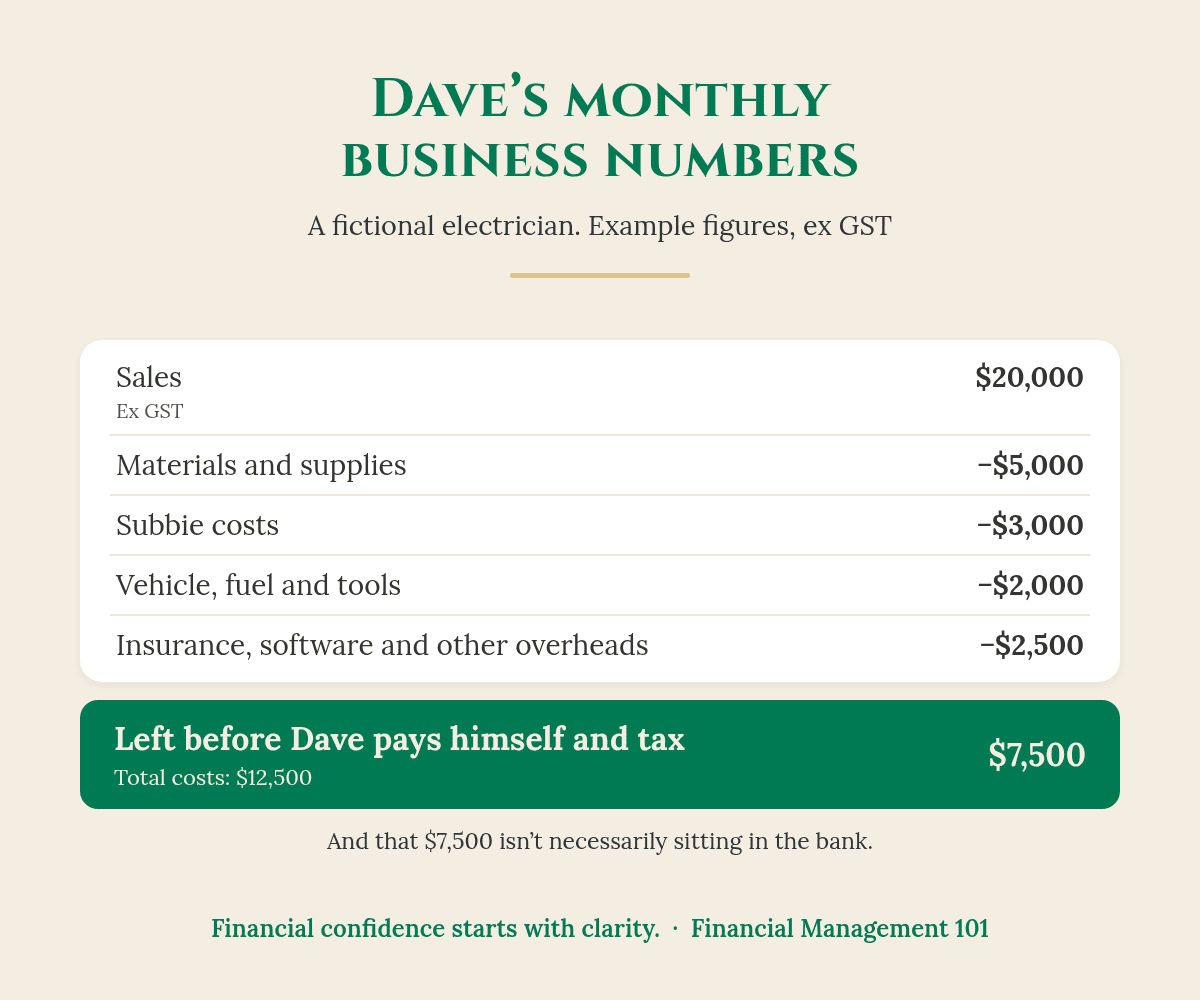
Graphic titled "Dave's monthly business numbers", subtitled "A fictional electrician. Example figures, ex GST": Sales $20,000; less materials and supplies $5,000; less subbie costs $3,000; less vehicle, fuel and tools $2,000; less insurance, software and other overheads $2,500. Left before Dave pays himself and tax: $7,500. Note: $12,500 in costs. And the $7,500 isn't necessarily sitting in the bank. Financial Management 101.
Dave’s month: $20,000 in sales, $12,500 in costs, $7,500 left before he pays himself and tax. Dave is a fictional example and the figures are illustrative, ex GST.

Here’s a typical month for Dave. The figures are an illustration, all excluding GST.

So what does this actually look like?

  • Sales: $20,000
  • Materials and supplies: $5,000
  • Subbie costs: $3,000
  • Vehicle, fuel and tools: $2,000
  • Insurance, software and other overheads: $2,500
  • Total costs: $12,500
  • Left before Dave pays himself and tax: $7,500

So Dave’s $20,000 month has become $7,500, and he hasn’t paid himself yet or put anything aside for tax.

Good to know: the figures are ex GST for a reason. At $240,000 a year, Dave is well over the $75,000 GST turnover at which the ATO says you must register for GST (ATO). The GST he charges sits on top of his $20,000 and isn’t his to spend. It goes out with his BAS, so it’s a cash timing issue to plan for, not extra money.

Why isn’t the $7,500 sitting in the bank?

As I say in the video, that “doesn’t necessarily mean $7,500 sitting in the bank.” Some of it may be held up in:

  • customers who haven’t paid yet
  • bills from last month
  • loan repayments
  • GST he’s collected and has to pay
  • equipment purchases

Profit and cash are related, but they’re not the same thing. If this is the part that keeps catching you out, have a read of Why Is Cashflow Always Tight?

Has Dave just bought himself a very expensive job?

Dave isn’t only the electrician. He’s the business owner, the salesperson, the accounts department, the scheduler and, as I put it in the video, “the bloke answering the phone on a Sunday.” So when he looks at what he’s earning for all those hours and all that responsibility, it’s fair to ask: has he just bought himself a very expensive job?

Money coming in isn’t money you’re making

This is one of the biggest traps I see. Just because a customer pays you $5,000, it doesn’t mean you’ve made $5,000. That’s revenue. What matters is how much you keep after the cost of doing that work and running the business.

That’s why more work isn’t necessarily the answer. If each job doesn’t leave enough behind, more jobs can simply mean more hours, more stress and more money flowing through the account without much staying there. I go deeper on this in Why Is My Business Making Revenue, But No Profit?

Good to know: it isn’t only a tradie thing. In 2024–25, external administrators’ initial reports to ASIC nominated “inadequate cash flow or high cash use” as a cause of failure in 5,446 of 9,585 reports, and “trading losses” in 4,772. More than one cause can be listed in each report (ASIC).

Are you pricing the job but forgetting the business?

A lot of owners price a job like this: the materials, plus the hours, plus a bit on top. But did you allow for:

  • insurance
  • vehicle costs
  • time spent quoting jobs you didn’t win
  • hours chasing customers who haven’t paid
  • bookkeeping and software
  • replacing equipment

Watch out: if a cost isn’t built into your pricing, guess who’s paying for it? As I say in the video, “You are, out of your own pocket.”

Why do so many owners pay themselves last?

Look at who gets paid in Dave’s business: suppliers, subcontractors, insurance, the accountant. And then there’s Dave, the person taking all the risk.

Depending on your structure and your advice, you might pay yourself through wages, drawings or another arrangement. For example, the ATO explains that a sole trader can employ workers but can’t employ themselves (ATO), while a company or trust can pay you a salary, wages or directors’ fees (ATO). Your BAS or tax agent/accountant can tell you what fits your situation.

However you do it, paying yourself shouldn’t be an afterthought. Your business needs to be able to support you, not just everybody else around you. My post Pay Yourself First: The Habit That Transforms Your Business (and Your Life) covers how to build that habit.

What three questions should you ask about your numbers?

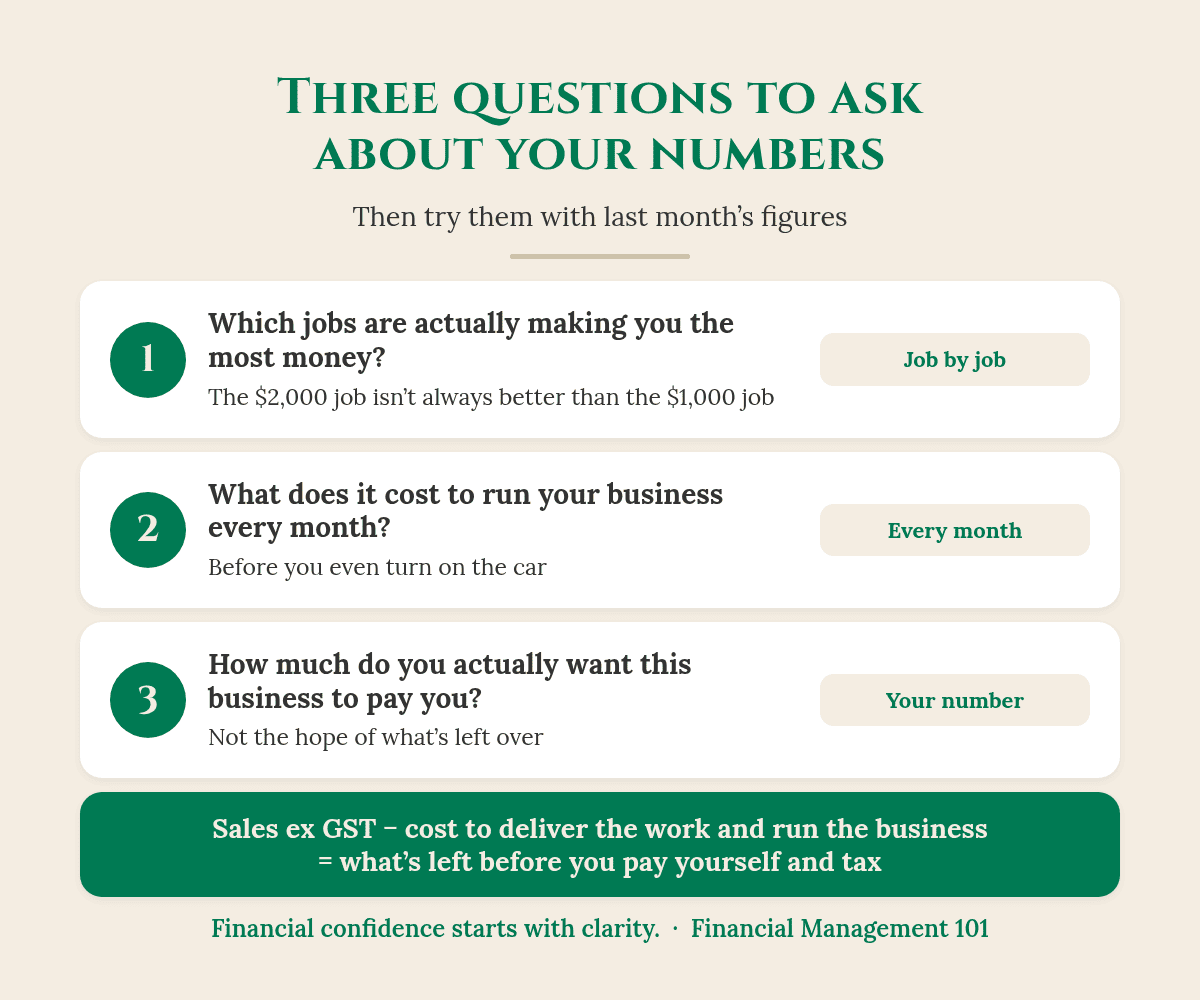
Graphic titled "Three questions to ask about your numbers", subtitled "Then try them with last month's figures": 1 Which jobs are actually making you the most money? Tag: job by job. 2 What does it cost to run your business every month, before you turn on the car? Tag: every month. 3 How much do you actually want this business to pay you? Tag: your number. Footer box: Sales ex GST, less the cost to deliver the work and run the business, equals what's left before you pay yourself and tax. Financial Management 101.
Three questions to ask about your numbers, and the simple sum to try with last month’s figures.

In the video, I give you three questions to sit down with.

  1. Which jobs are actually making you the most money? The $2,000 job isn’t necessarily a better one than the $1,000 job.
  2. What does it cost to run your business every month, before you even turn on the car? If you don’t know that number, how can you confidently work out what you should be charging?
  3. How much do you actually want this business to pay you? Not the hope of what’s left over. A real number, based on your hours, your responsibility and the risks you take.

If you’re not sure which numbers to start with, What Numbers Should A Small Business Owner Track? is a good next read.

What could Dave do differently?

Once Dave can see his numbers clearly, he can start making better decisions. He might:

  • adjust his pricing, especially if he hasn’t updated it in 12 months while his material and labour costs have gone up
  • stop taking jobs that don’t pay properly. As I say in the video, “You’re not a charity case. You’re a business owner.”
  • tighten up his expenses
  • get customers paying sooner by bringing his payment terms in

The point isn’t to be perfect. It’s to make those decisions now based on numbers, not on guesswork.

Try this with last month’s numbers

Here’s a simple exercise you can do this week.

  1. Take last month’s numbers.
  2. Write down your sales, excluding GST.
  3. Write down what it cost to deliver the work and keep the business running.
  4. Work out what was left before you paid yourself and tax.
  5. Then ask yourself: if I’d worked this many hours for someone else, would I be happy with what I’m earning?

Check this first: make sure you’re not counting any cost twice. For example, don’t include a supplier bill once as materials and again as an overhead.

It’s not a perfect financial analysis, but it’s a really good, comfortable place to start. It might tell you something you’ve been too busy to notice. If something doesn’t look right, take it to your bookkeeper or accountant. They’re the right people to check the detail with you.

As I say at the end of the video, “You didn’t start your business just to be busy. You started to make money, create opportunities, and hopefully enjoy a little bit more freedom.”

Being good at your trade and being good at running a business are two completely different skill sets. And nobody automatically teaches you the second one.

Your takeaway

  • Money coming in isn’t money you’re making. What matters is what you keep.
  • Price for the whole business, not just the materials and the hours.
  • Pay yourself on purpose, not with whatever’s left over.
  • Answer the three questions, then try the check with last month’s numbers.
  • More work isn’t always the answer. Clear numbers and better decisions usually are.

Want to see where your money is actually going?

Take a sneak peek at The CEO Dashboard – New Look and see how it brings your numbers together in one place.

If you’re flat out and the bank account isn’t matching the effort, book a call with me. It’s a 20-minute chat.

Not ready for a call? Start with The EDGE Business Health Check. It’s a $47 workbook that takes about 20 minutes, covering Profit & Pricing, Cashflow, CEO Visibility, Systems & Freedom, and Growth, with the Profit Leak Calculator to show where money may be slipping away.

The EDGE Business Health Check by Karen G. Adams, Financial Management 101. What if the problem isn't what you think it is? Uncover hidden profit leaks, cashflow pressures and growth bottlenecks in less than 20 minutes.

Know a business owner who’s busy but broke? Send them this post.

Frequently asked questions

Why is my business busy but I have no money?

Usually because sales aren’t the same as what you keep. Materials, subbies, vehicles, insurance, software, tax and the timing of customer payments all come out first, and many owners don’t build every cost into their pricing or pay themselves on purpose.

Is Dave a real client?

No. Dave is a fictional electrician I use in the video to explain the numbers. The figures are illustrative and exclude GST, but the situation is one I see with real business owners.

Is revenue the same as profit?

No. Revenue is the money customers pay you. Profit is what’s left after the cost of doing the work and running the business. As I say in the video, a $5,000 payment doesn’t mean you’ve made $5,000.

How should I pay myself from my business?

It depends on your structure and circumstances. You might pay yourself through wages, drawings or another arrangement. Talk to your BAS or tax agent/accountant about what fits your situation, and make your pay a planned number rather than whatever’s left over.

What’s a quick way to check if my business is paying me enough?

Take last month’s sales ex GST, take away what it cost to deliver the work and run the business (without counting anything twice), and look at what’s left before you pay yourself and tax. Then ask if you’d be happy earning that for the same hours working for someone else.


You’ve built something real. Financial confidence starts with clarity.

Karen G. Adams
Small Business Performance Strategist, Financial Management 101


This article is general education only. It isn’t financial, tax or legal advice, and it doesn’t take your personal circumstances into account. Dave is a fictional example and his figures are illustrative only, excluding GST. Check your own obligations with your BAS or tax agent/accountant or the ATO.

What Does the RBA Rate Rise Mean for My Small Business? A Cash Flow Plan for This Month

What Does the RBA Rate Rise Mean for My Small Business? A Cash Flow Plan for This Month

If cash was already tight before Melbourne Cup Day, this week’s rate rise probably landed hard. You might be juggling supplier bills, a BAS and a quiet patch, and now the Reserve Bank has lifted rates again. Take a breath. You’re not alone in this, and there’s a plan for it.

In my latest video I talk through what this rate rise means for your profit. This post answers the questions business owners are asking me right now, puts the rise into dollars a month, and gives you a simple four-week plan for the rest of November.

Watch: RBA Rate Rise to 4.85%: What It Means for Your Small Business (8:42). Watch on YouTube

This is general information, not financial advice. Your accountant, broker or lender can help with your own situation, and I’d encourage you to talk to them.

THE SHORT ANSWER

What does the RBA rate rise mean for my small business?

More of your cash goes to interest each month, through your business loans and overdraft, your home loan, and what your customers and suppliers pass on to you. Every extra dollar of interest comes straight off profit, so it takes more than a dollar of sales to win back. The fix starts with cash flow: see every debt, forecast the next 13 weeks, check your margin and pricing, and talk to your team early.

What exactly did the RBA decide on 3 November 2026?

4.85%

The new cash rate target, up 0.25 percentage points (RBA media release)

4 Nov

The day it took effect, Wednesday 4 November 2026 (RBA cash rate table)

6–3

The Board’s vote. Three members voted to hold at 4.60%

5th

Rise this year, up from 3.60% in January. The highest cash rate since 2008

Two lines in the Board’s statement matter for business owners. First: “The economy is slowing, housing prices have fallen significantly and the unemployment rate has risen.” That’s your customers. Second: “Liaison indicates that many firms are experiencing cost pressures and are either increasing the prices of their goods and services in response or looking to do so.” That’s your suppliers, and quite possibly you.

Will my business loan repayments go up?

If your loan or overdraft is on a variable rate, your repayments usually go up when your lender passes the rise on. Lenders set their own rates and timing, so log in this week and check the actual rate on each facility rather than guessing. Fixed-rate loans don’t change until the fixed term ends.

In my 40 years in financial services, I’ve seen plenty of rate rises come and go, and they rarely land in just one place. As I say in the video, it shows up in about six:

  • Business loans on a variable rate.
  • Equipment and vehicle finance. Often fixed for the term, but the replacement ute or machine will likely be financed at today’s higher rates.
  • Your overdraft. Usually variable, and often the facility you lean on hardest when cash is tight.
  • Your home loan. When the mortgage goes up, the household needs more out of the business, and that puts pressure on your drawings.
  • Your customers. They have mortgages too, so jobs get pushed back or put on hold.
  • Your suppliers. They’re paying more for their own debt, fuel and energy, and some of it comes back to you.

How much more will I actually pay each month?

Graphic titled "What this rise costs you each month", subtitled "Illustrative figures. Swap in your own": business debt of $400,000 at plus 0.25% is about $83 a month; home loan of $600,000 at plus 0.25% is $125 a month; together about $208 a month, or $2,500 a year. Note: at a 40% gross margin, the business interest alone takes $2,500 of extra sales a year to cover. Financial Management 101.
This one 0.25% rise on $400,000 of business debt and a $600,000 home loan is about $208 a month between them. Illustrative figures.

Here’s an illustrative example, so swap in your own figures. Say your business has $400,000 of variable-rate debt across a loan, an overdraft and some other finance, and you have a $600,000 mortgage on the family home.

So what does this actually look like in dollars?

  • Business debt: 0.25% of $400,000 is $1,000 a year, about $83 a month.
  • Home loan: 0.25% of $600,000 is $1,500 a year, or $125 a month.
  • Together: about $208 a month, or $2,500 a year, from this one rise.
  • Sales to cover the business interest: at a 40% gross margin, every $1,000 of sales leaves $400, so you need $2,500 of extra sales to cover that $1,000.

Good to know: if your lender has passed on all 1.25 percentage points since January, that same $400,000 is costing around $5,000 a year more than it was, about $417 a month. Check your own statements, because lenders don’t all move the same way.

As I say in the video, money doesn’t just disappear. It goes unmanaged. So here’s how to manage it, one week at a time.

My cash is already tight. What should I do first?

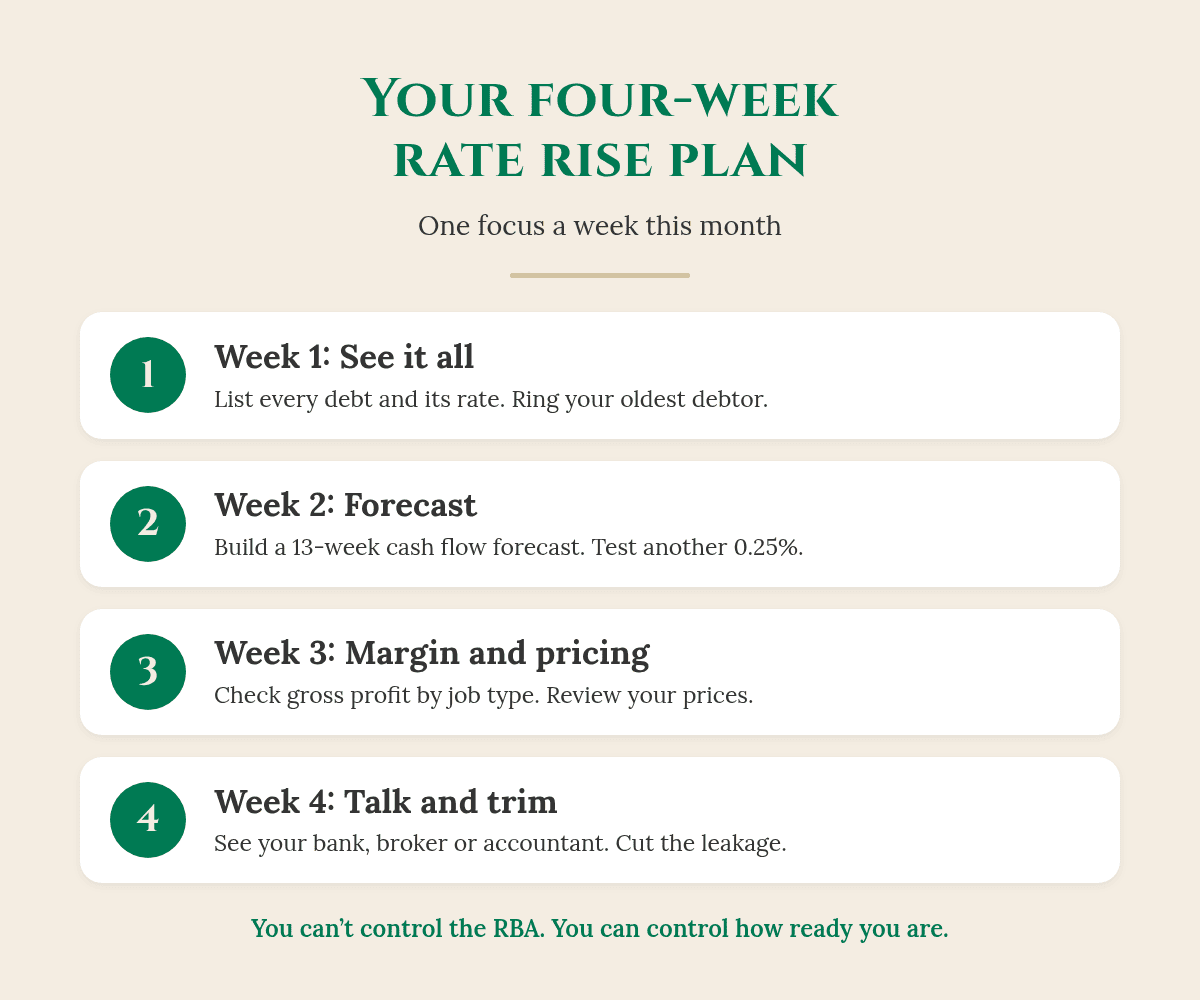
Graphic titled "Your four-week rate rise plan", subtitled "One focus a week this month": Week 1, see it all: list every debt and its rate, and ring your oldest debtor. Week 2, forecast: build a 13-week cash flow forecast and test another 0.25%. Week 3, margin and pricing: check gross profit by job type and review your prices. Week 4, talk and trim: see your bank, broker or accountant with your list, and cut the leakage. Footer: You can't control the RBA. You can control how ready you are. Financial Management 101.
Your four-week rate rise plan: one focus a week for the rest of this month.

If you’re already stretched, a list of ten things to fix is the last thing you need. So give each week of November one focus. Small, steady steps beat one big panic.

Week 1: See it all, and bring in some cash

Write down every loan, finance contract, the overdraft, the credit cards and the home loan if it’s secured against the business. Next to each, note the balance, the rate, fixed or variable, and when it ends. Most owners I meet have never seen all their debt on one page. It can feel confronting, but you can’t manage what you can’t see.

Then ring your oldest debtor. Not an email, a phone call. Here’s an illustrative example: $60,000 of overdue invoices sitting on an overdraft at around 10% is about $6,000 a year, roughly $500 a month, in interest you’re paying to fund your customers.

Week 2: Build your 13-week cash flow forecast

One spreadsheet, 13 weeks, money in and money out, week by week. Include your BAS, super, loan repayments and the extra the household now needs. It shows you the tight weeks before you get to them, so you’re deciding, not reacting. My post How Do I Do a Cash Flow Forecast for My Small Business? walks you through it step by step.

Check this first: add another 0.25% to your variable debt in the forecast. On $400,000 that’s about $83 a month. If the forecast still works, you’ve got breathing room. If it doesn’t, you’ve found out now, not in February.

Week 3: Check your margin, then your pricing

Pull up your profit and loss and look at gross profit by job type or service line. Revenue is the headline, but profit is the real story. One type of job might be quietly carrying the business while another barely covers its costs. If that rings a bell, read Why Is My Business Making Revenue, But No Profit?

Then review your prices. If your costs have gone up and your prices haven’t, your margin has gone down. In the video’s illustrative example, a business turning over $1.2 million that lifts its prices by just 1% and keeps its customers adds $12,000 to gross profit. That’s more than double the $5,000 a year of extra interest if every rise this year has flowed through on $400,000.

Week 4: Talk to your team and trim the leakage

Book time with your bank, broker or accountant, and take your debt list and your forecast with you. Early is the key word, so go before a repayment becomes a problem. They’re your team, so use them. If the ATO is part of the pressure, How Do I Set Up an ATO Payment Plan for My Business? explains how payment plans work and what they cost.

Then look for the leakage: unbilled variations, subscriptions nobody uses, materials not charged back to the job. Small amounts add up. Once you’ve freed up some cash, ask your accountant whether paying down your highest-cost debt first makes sense for you.

Should I cut my marketing to save cash?

Please don’t panic and cut it. When customers get careful, the businesses that stay visible and keep their pipeline full are the ones still standing when things pick up. For more on why cash can feel tight even in a good month, see Why Is Cashflow Always Tight?

Trim the waste, absolutely, but keep the phone ringing.

What if I can’t keep up with my repayments?

Talk to your lender before you miss a payment, and ask what options they have for customers in financial difficulty. Bring your accountant or broker into the conversation. If you’d like independent help, the Small Business Debt Helpline (1800 413 828) has financial counsellors for small business owners, at no cost to you.

Your takeaway

  • The cash rate is now 4.85%, effective 4 November 2026, after a 6–3 vote.
  • On $400,000 of business debt and a $600,000 home loan, this one rise is about $208 a month.
  • Every extra dollar of interest takes more than a dollar of sales to win back. At a 40% margin, it’s $2.50.
  • Give November one focus a week: see your debt, forecast 13 weeks, check margin and pricing, then talk to your team.
  • You can’t control the Reserve Bank. You can control how ready your business is.

Where is the pressure in your business?

Before the next rate decision, find out where your business is strong and where it’s stretched. Start with The EDGE Business Health Check. It’s a $47 workbook that takes about 20 minutes and looks at your Profit & Pricing, Cashflow, CEO Visibility, Systems & Freedom, and Growth. It includes the Profit Leak Calculator, so you can see where money may be slipping away and where to focus first.

The EDGE Business Health Check by Karen G. Adams, Financial Management 101. What if the problem isn't what you think it is? Uncover hidden profit leaks, cashflow pressures and growth bottlenecks in less than 20 minutes.

Know an owner who’s feeling the squeeze this month? Send them this post.

Frequently asked questions

When does the new 4.85% cash rate start?

It took effect on Wednesday 4 November 2026, the day after the Reserve Bank Board’s decision on 3 November. Your lender sets its own timing for passing it on, so check your own loans.

Was the RBA decision unanimous?

No. It was a 6–3 vote. Six Board members voted to lift the cash rate to 4.85%, and three voted to hold it at 4.60%.

Will interest rates go up again?

No one can say for sure. The Board said it “will be attentive to the data and the evolving assessment of the outlook and risks to guide its decisions”. The practical step is to test another 0.25% in your 13-week cash flow forecast, so you know where you stand either way.

How do I work out what the rate rise costs my business each month?

Take your variable-rate debt, multiply it by 0.25%, then divide by 12. On $400,000 that’s $1,000 a year, about $83 a month. Add your home loan if the household relies on the business: on $600,000 it’s $125 a month. These are illustrative figures, so use your own.

Should I use my overdraft to get through the tight weeks?

It can bridge a short gap, but it’s usually variable, so it costs more after each rise. Chase your oldest debts first, use your 13-week forecast to see how long the gap really is, and talk to your accountant or broker about the best option for you.

How do I tell customers I’m putting my prices up?

Tell them early, keep it simple and give them a date. Explain that your costs have gone up, apply the new prices to new quotes from that date, and start with the work that’s underpriced. A price rise only adds to profit if you keep the work, so look after your best customers.


If you’re doing it tough right now, you’re not alone. Rate rises are stressful, but a business that knows its numbers can steer through almost anything. I’ve got your back. You’re too big to wing it and too small to need a CFO.

Karen G. Adams
Small Business Performance Strategist, Financial Management 101


This article is general information only. It isn’t financial, credit, tax or legal advice, and it doesn’t take your personal circumstances into account. All dollar figures are illustrative examples. Speak with your accountant, broker or lender about your own situation.