
You’re busy, the jobs keep coming, and the revenue line looks healthy. So why doesn’t the bank account feel like it? Very often the answer sits in one number: your gross profit margin. It tells you how much of every dollar you invoice is left after the direct cost of doing the work.
Here’s the good news. You don’t need a finance degree to check it. You need your profit and loss report, a calculator and about 15 minutes. By the end of this post you’ll know how to calculate yours, how to sense-check it against the ATO’s industry benchmarks, and what to look at first if it’s lower than you’d like.
THE SHORT ANSWER
What is gross profit margin?
Gross profit margin is the percentage of your revenue left after you take away your cost of sales (the direct costs of the jobs, such as materials, subcontractors and the labour that goes into them). Business Queensland’s formula is gross profit ÷ total revenue × 100. It shows whether your pricing covers the work before overheads and your own pay.
What’s the difference between gross profit and net profit?
Think of your profit and loss as a story told in two chapters. business.gov.au says a profit and loss statement includes your total sales, cost of goods sold and gross profit, and that net profit is the money left over after you’ve paid your expenses (business.gov.au).
- Gross profit = revenue minus the direct cost of the jobs. It answers: “Is the work itself priced well?”
- Net profit = gross profit minus your overheads (rent, insurance, software, vehicles, office wages and so on). It answers: “Is the whole business making money?”
Business Queensland describes gross profit as a valuable measure of whether your pricing, sales volume and cost of goods sold will make your business a profit (Business Queensland). If the gross profit isn’t there, no amount of overhead trimming will fix it.
How do I calculate my gross profit margin?
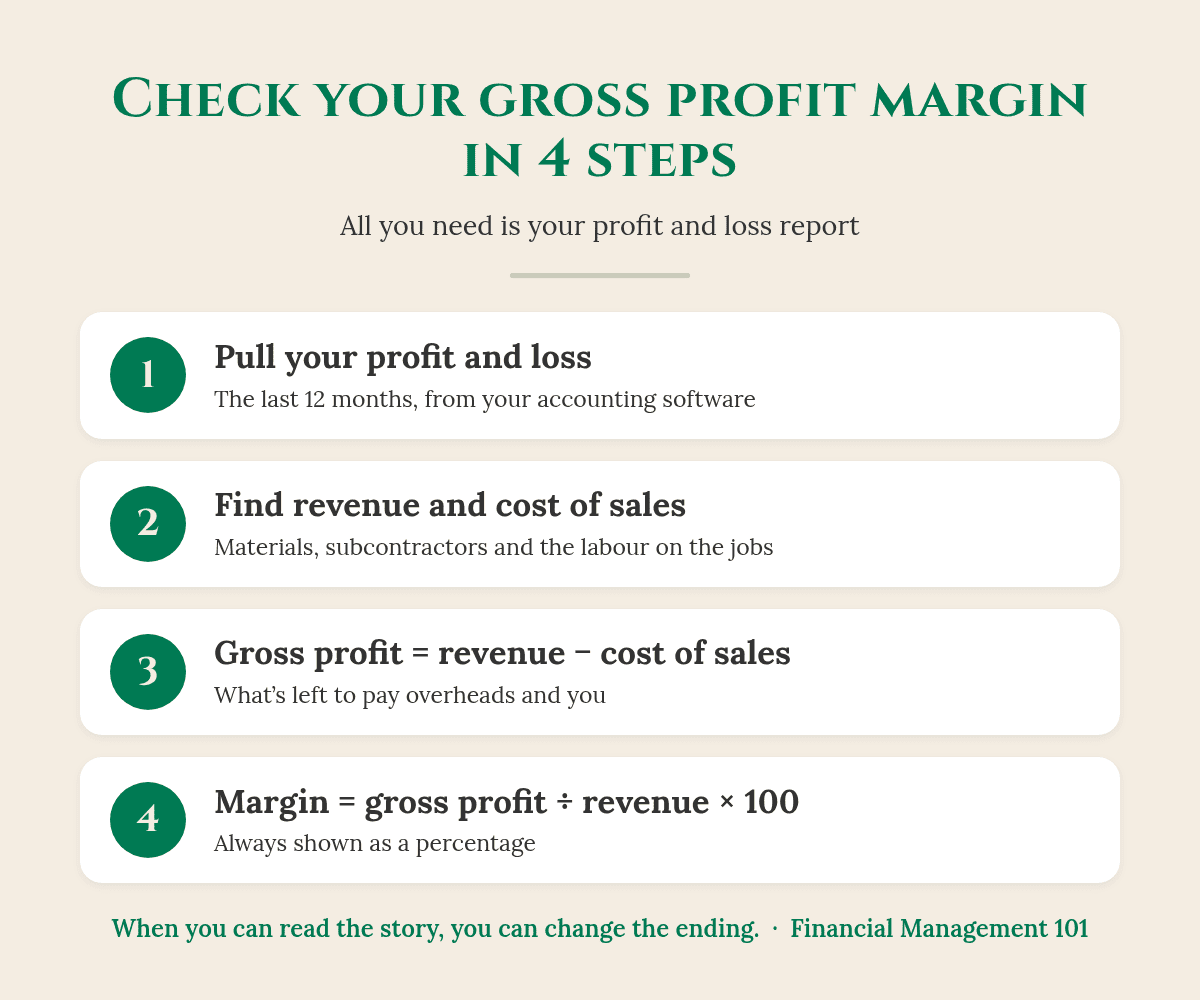
Business Queensland sets out the formula as gross profit ÷ total revenue × 100, and notes that margins are always shown as a percentage (Business Queensland). Here’s how to do it from your own numbers.
- Pull your profit and loss for the last 12 months from Xero, MYOB or QuickBooks. A full year smooths out the busy and quiet months.
- Find your revenue (sometimes called income, sales or turnover). Check whether your figures are GST-inclusive or exclusive and use the same basis throughout. business.gov.au says your profit and loss should state which it is (business.gov.au).
- Find your cost of sales (also called cost of goods sold or direct costs): materials, parts, subcontractors and the wages and super of the people doing the jobs.
- Subtract, then divide. Revenue minus cost of sales is your gross profit. Divide it by revenue and multiply by 100.
Check this first: Where does your field team’s labour sit? In many accounting files it’s buried in overheads, which makes gross profit look better than it really is. Ask your bookkeeper to show it in cost of sales so the number tells you the truth about each job.
So what does this actually look like?
Here’s an illustrative example (the numbers are made up to show the method, not a real client). An electrical business turns over $900,000 a year.
- Materials and parts: $315,000. Field wages, super and subcontractors: $270,000. Cost of sales: $585,000.
- Gross profit: $900,000 − $585,000 = $315,000. Gross profit margin: $315,000 ÷ $900,000 × 100 = 35%.
- Overheads: $225,000. Net profit: $315,000 − $225,000 = $90,000, or 10% of revenue.
- On a single $4,000 job with $1,400 of materials and $1,200 of labour, that’s $1,400 of gross profit, or 35%.
Now watch what a small shift does. If the same business lifts its margin from 35% to 38% on the same revenue, gross profit rises by $27,000. That’s $27,000 more to cover overheads, pay the owner properly or build a cash buffer, without one extra job.
What is a good gross profit margin for a trades business?
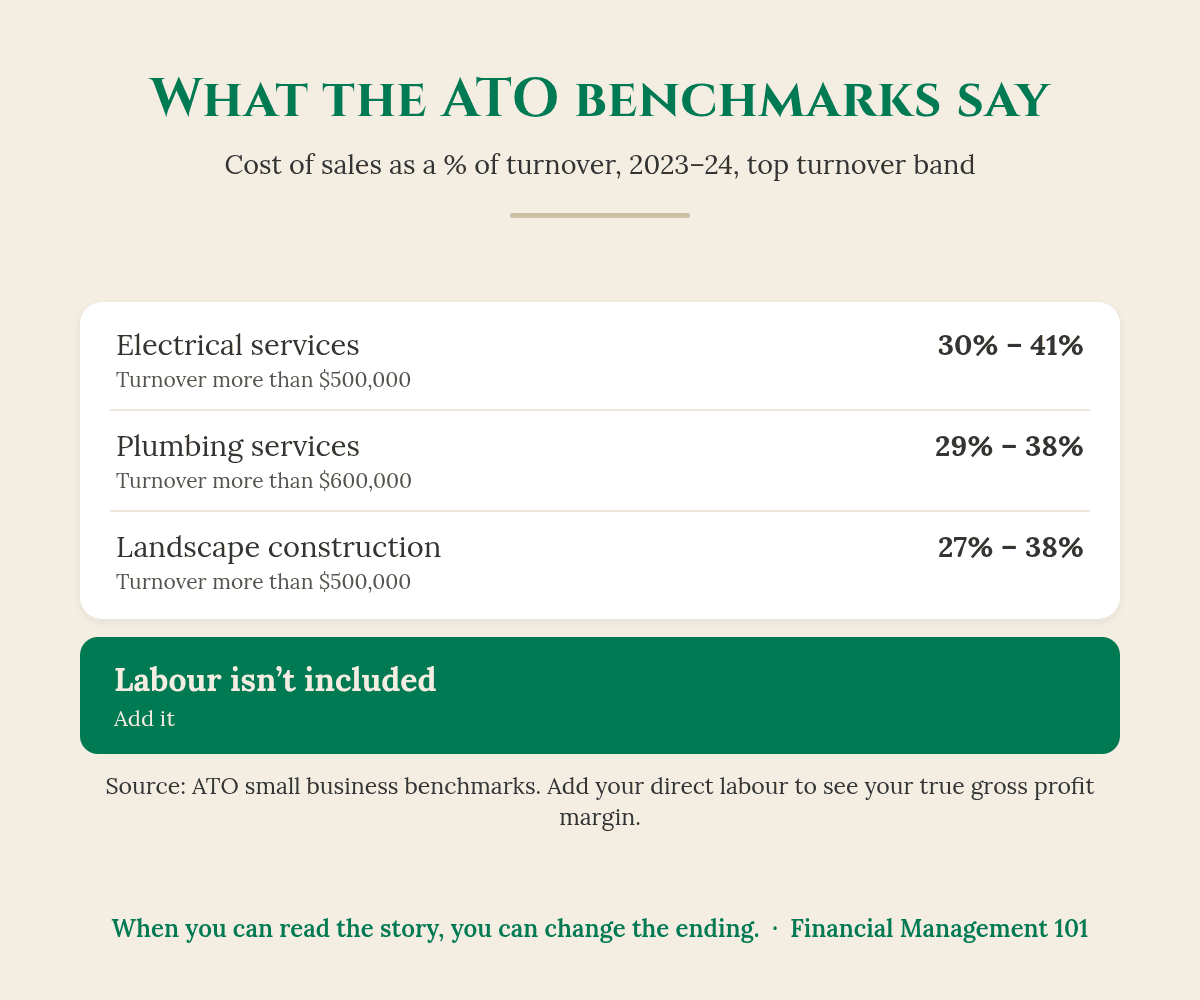
There’s no single right number. It depends on your industry, the mix of labour and materials in your work, and how your accounts are set up. But you can sense-check yours against the ATO’s small business benchmarks, which are built from tax return data for the 2023–24 financial year (ATO).
For businesses turning over more than $500,000 (more than $600,000 for plumbers), the ATO publishes these cost of sales to turnover ranges:
30–41%
cost of sales to turnover, electrical services over $500,000. (ATO)
29–38%
cost of sales to turnover, plumbing services over $600,000. (ATO)
27–38%
cost of sales to turnover, landscape construction over $500,000. (ATO)
- Electrical services: 30% to 41% (ATO)
- Plumbing services: 29% to 38% (ATO)
- Landscape construction: 27% to 38% (ATO)
Watch out: The ATO’s cost of sales benchmark excludes labour (ATO). Labour is a separate benchmark. For example, the ATO’s labour to turnover range for electrical services over $500,000 is 23% to 34% (ATO). So don’t read 100% minus 35% as a 65% gross profit margin. Once you add the people doing the work, your true margin will be lower.
Your industry may be different. The ATO publishes performance benchmarks for 100 industries in its benchmarks A–Z, each with its own turnover bands, so find yours and compare like with like.
What if my numbers sit outside the ATO range?
The ATO says that if you fall outside the range for your industry, your business may have room to improve (ATO). When costs are high relative to sales, it suggests checking things like wastage, whether you could buy materials for less, and whether your mark-up is lower than your competitors’ (ATO).
Good to know: The ATO also uses benchmarks as one of the tools to identify businesses that may be avoiding their tax obligations (ATO). Another reason to make sure your records are complete and your agent/accountant is across them.
When you can read the story, you can change the ending.
Is markup the same as margin?
No, and this one trips up a lot of good operators. Markup is calculated on your cost. Margin is calculated on your price.
Say a job costs you $2,600 in materials and labour and you add a 50% markup. You quote $3,900. Your gross profit is $1,300, but your margin is $1,300 ÷ $3,900, or 33.3%, not 50%. If your target margin is 40%, a 50% markup won’t get you there.
What do I do if my gross profit margin is too low?
If your business is busy but the profit isn’t showing up, Why Is My Business Making Revenue but No Profit? is a good companion read. Start with the jobs, not the overheads. Business Queensland suggests checking the margin on specific products or services, not just the overall figure, so you can see which ones are pulling their weight (Business Queensland).
- Pricing: When did you last review your rates? Costs have moved; have your prices? My post on how to price your products or services properly walks through it.
- Quoting: Compare quoted hours and materials with actual hours and materials on your last 10 jobs. The gap is often where margin slips.
- Materials: Check supplier pricing, wastage and whether variations and call-outs are being charged.
- Labour: Look at non-chargeable time, travel and rework. Each hour that can’t be invoiced comes straight out of gross profit.
Then track it monthly. A gross profit margin that drifts down two or three points over a few months is an early warning, long before it shows up in the bank. What Numbers Should a Small Business Owner Track? shows where it fits in your weekly and monthly numbers.
How does gross profit margin connect to break-even?
Directly. Business Queensland gives a simple break-even formula: fixed costs ÷ gross profit margin (Business Queensland). In the illustrative example, $225,000 of overheads ÷ 35% means the business needs about $643,000 of revenue just to break even. Lift the margin to 38% and that falls to about $592,000.
Your takeaway
- Gross profit margin = gross profit ÷ revenue × 100. It tells you whether the work itself is priced well.
- Put field labour in cost of sales, so the number tells you the truth.
- Use the ATO small business benchmarks as a sense check, remembering their cost of sales figure excludes labour.
- If it’s low, look at pricing, quoting, materials and non-chargeable time first, then track it every month.
Your accountant makes sure the numbers are right. Your bookkeeper makes sure the records are right. My job is to help you know what to do with them, so your margin works as hard as you do.
Want to see where your profit is really going?
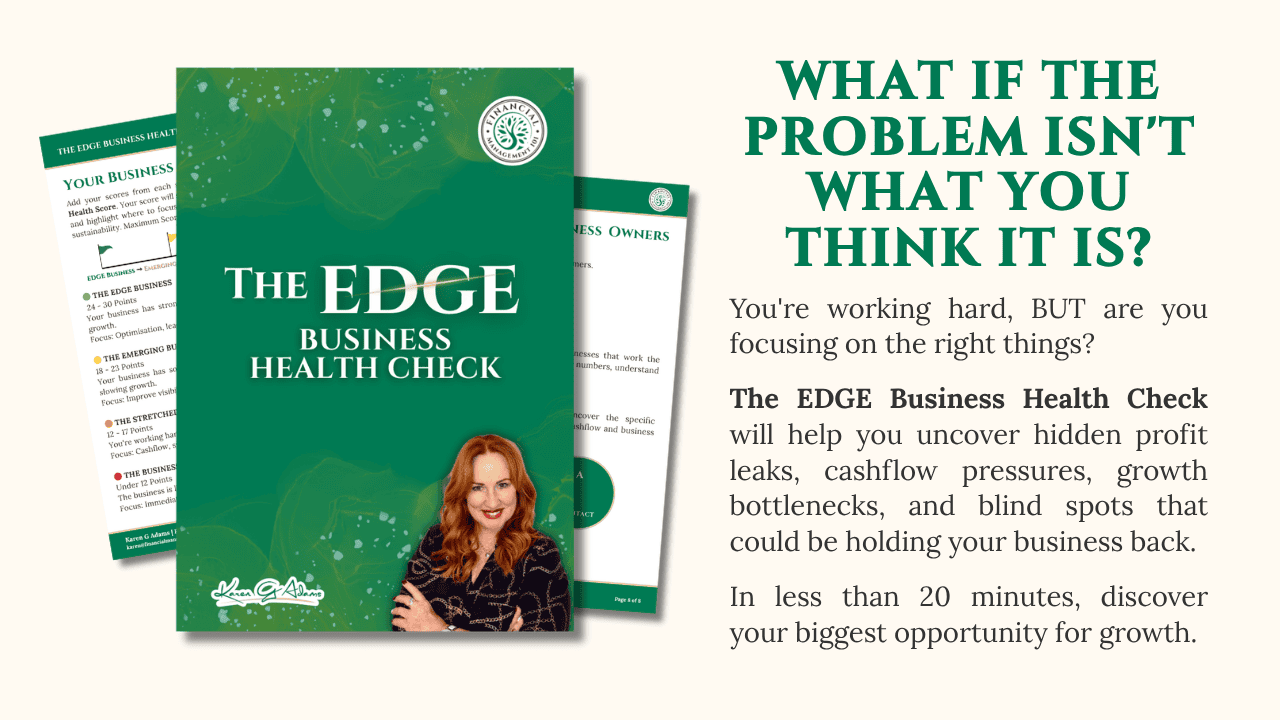
Start with The EDGE Business Health Check. It’s a $47 workbook that takes about 20 minutes. You score 30 quick statements across five areas: Profit & Pricing, Cashflow, CEO Visibility, Systems & Freedom, and Growth. Then the Profit Leak Calculator shows where money may be slipping away, and the 7-Day Reset gives you clear next steps.
Rather talk it through first? Get in touch and book a call with me.
Frequently asked questions
What is a good gross profit margin for a small business?
There’s no single figure for every business. It depends on your industry and how your accounts treat labour. Check your own trend over 12 months, sense-check it against the ATO small business benchmarks for your industry, and make sure your gross profit comfortably covers your overheads and a fair wage for you.
How do I calculate gross profit margin?
Take your revenue, subtract your cost of sales (materials, subcontractors and the labour on the jobs) to get gross profit, then divide gross profit by revenue and multiply by 100. For example, $315,000 ÷ $900,000 × 100 = 35%.
What’s the difference between gross profit and net profit?
Gross profit is what’s left after the direct costs of the work. Net profit is what’s left after all your other expenses too, like rent, insurance, vehicles and office wages.
Do the ATO benchmarks include labour in cost of sales?
No. The ATO’s cost of sales to turnover benchmark excludes labour, which has its own labour to turnover benchmark. Add the two together if you want to compare against your own direct costs.
Is a 50% markup the same as a 50% margin?
No. A 50% markup on cost gives you a 33.3% gross profit margin. To earn a 50% margin, you’d need to double your cost, which is a 100% markup.
You’ve built something real. Financial confidence starts with clarity.
Karen G. Adams
Small Business Performance Strategist, Financial Management 101
This article is general education only. It isn’t financial, tax or accounting advice, and it doesn’t take your personal circumstances into account. The electrical business example and all its figures are illustrative, not a real client. Check your own numbers with your bookkeeper or agent/accountant.