

You know your prices need to go up. Your materials cost more, your insurance renewal was a shock, and you haven’t touched your rates in a while. But every time you go to send the email, you picture your best customer reading it and quietly going elsewhere. If that’s you, you’re not alone, and you’re not being greedy. Learning how to raise prices well is mostly about timing, order and a few clear words.
This post walks you through when to raise your prices, who to tell first, what to say, and what to do if someone pushes back. You’ll also see, with some simple illustrative maths, why a small rise can matter more to your profit than you’d expect.
THE SHORT ANSWER
How do I raise prices without losing customers?
Check your numbers first, give clear notice, tell your team and your key customers before anyone else, keep the message short and calm, and honour quotes you’ve already sent. Most of the stress comes from surprise, so take the surprise out of it.
How do I know it’s time to raise my prices?
business.gov.au suggests reviewing your prices at least once a year, or whenever your costs or market conditions change (business.gov.au). Business Queensland goes further and suggests scheduling formal price reviews, for example monthly, quarterly or half-yearly, to keep up with changes in your costs, your customers’ expectations and your competitors (Business Queensland).
Your profit and loss report is the best place to start. business.gov.au says you can use it to help develop sales targets and an appropriate price for your goods or services (business.gov.au). If you haven’t looked at yours lately, you’re in good company. Xero’s 2026 research found more than one in three Australian small business owners (35%) don’t often know whether they made a profit in the last month (Xero).
35%
of Australian small business owners don’t often know if they made a profit last month. (Xero, 2026)
Yearly
business.gov.au suggests reviewing your prices at least once a year. (business.gov.au)
5%
an illustrative price rise that lifts net profit by 50% in our example. (Illustrative)
- Your costs have gone up, but your prices haven’t moved in 12 months or more.
- Your gross profit margin is drifting down month by month. My post on what a good gross profit margin looks like shows you how to check it.
- You’re flat out, booked weeks ahead, and still not seeing it in the bank.
- Your quotes are being accepted almost instantly, every time.
Good to know: This post is about raising existing prices. If you want to work out what your prices should be from scratch (costs, profit and value), start with my earlier post, How to Price Your Products or Services Properly (Without Undervaluing Yourself).
Why does a small price rise matter so much?
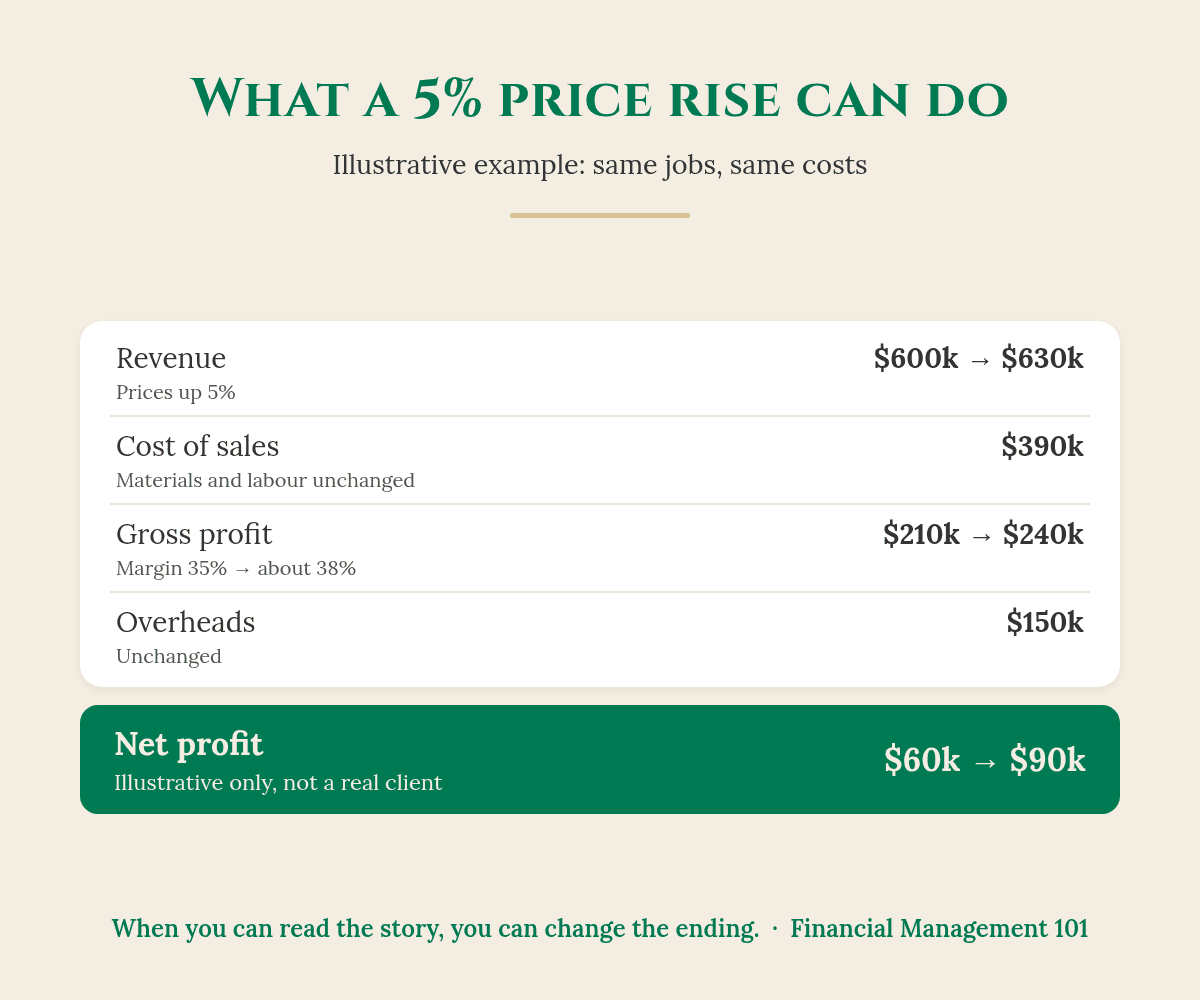
Here’s an illustrative example (the numbers are made up to show the method, not a real client). A plumbing business turns over $600,000 a year. Its cost of sales (materials, subcontractors and the labour on the jobs) is $390,000, so its gross profit is $210,000, a 35% margin. After $150,000 of overheads, the net profit is $60,000.
Now the owner raises prices by 5% and, for the sake of the example, does exactly the same jobs at exactly the same cost. Revenue becomes $630,000. The extra $30,000 doesn’t buy more materials or more labour, so all of it drops through to profit. Net profit goes from $60,000 to $90,000. A 5% price rise, in this example, lifts net profit by 50%.
So what does this actually look like?
On a single job, it’s easier to see. Say a hot water system replacement is quoted at $2,000, with $1,300 of materials and labour. The gross profit is $700, or 35%.
- Raise the price by 5% and the job is $2,100. Costs are still $1,300, so gross profit is $800.
- That’s $100 more on the job, and 14% more gross profit, for a price rise most customers will barely notice.
- The new margin is $800 ÷ $2,100 × 100, or about 38%. Business Queensland’s formula is gross profit ÷ total revenue × 100 (Business Queensland).
Why it works: Your costs don’t go up when your price does. So every extra dollar of price is extra gross profit. It’s why Business Queensland describes gross profit as a valuable measure of whether your pricing, sales volume and cost of goods sold will make your business a profit (Business Queensland).
What if I lose a few customers?
It’s a fair worry, so run the numbers. In the illustrative business, every $1 of work used to leave 35 cents of gross profit. After a 5% rise, the same work brings in $1.05 and leaves 40 cents. So the business could do 12.5% less work (35 ÷ 40 = 87.5%) and still make the same gross profit. That’s not a target, and losing customers is never the goal. It’s simply a reality check: a small rise gives you more room than most owners expect.
Watch out: Your numbers will be different. Your margin, your mix of work and your customers all matter. Business Queensland notes that if demand is elastic, a price change can have a significant effect on demand (Business Queensland). Run this with your own figures, ideally with your bookkeeper or agent/accountant, before you decide.
When is the best time to raise prices?
There’s no perfect day, but some times are easier than others.
- At a natural reset point: the start of a new financial year, a calendar year or a new season.
- When costs have clearly moved: for example, after a supplier increase you can point to.
- With notice: give your regular customers time to plan. Many businesses give around 30 days, but choose what suits your customers and check any agreements you have.
- Not in the middle of a job: honour any quote you’ve already sent, for as long as it’s valid.
Check this first: If you have written agreements or ongoing contracts with customers, read what they say about price changes before you send anything. If you’re unsure, ask your legal adviser.
How do I tell customers about a price rise?

Order matters. Business Queensland’s advice is to communicate price changes clearly to customers and update them wherever your prices appear (Business Queensland). Here’s a calm way to do it.
- Tell your team first. Anyone who quotes, answers the phone or sends invoices needs to know the new prices, the date and the reason, so they can answer questions without being caught out.
- Call or meet your key customers. Your long-standing or biggest customers deserve to hear it from you personally, before the email arrives.
- Then tell everyone else in writing. A short email or letter, with the date the new prices start.
- Update everywhere your prices appear. Business Queensland suggests keeping a checklist of where your prices are published, such as sales kits, price lists, brochures and websites (Business Queensland). Add your quote templates and accounting software too.
What should I actually say?
Keep it short, warm and factual. You don’t need to justify every cost or apologise. Something like this:
“Hi Sam, thanks for working with us this year. I wanted to let you know personally that from 1 February our rates will increase by 5%. Like many businesses, our costs for materials and insurance have gone up, and this change lets us keep doing the work to the standard you expect. Any quotes we’ve already sent you will be honoured. If you have any questions, just give me a call.”
What to look for: Three things in every message: the date, the change, and one honest sentence about why. Leave out long explanations and anything that sounds like an apology.
What if a customer pushes back?
Most customers accept a fair, well-explained rise. If someone does push back, take a breath. It’s a conversation, not a verdict.
- Listen first. Ask what’s worrying them. Sometimes it’s timing, not the price itself.
- Restate the value, briefly. Remind them what they get: reliability, quality, turning up when you say you will.
- Offer options rather than discounts. Could the scope change? Could they book the work before the new prices start?
- Know your floor before the call. Decide in advance the lowest price that still works for your business, so you don’t decide under pressure.
- Let some customers go, kindly. If a customer only works with you because you’re the cheapest, it may be fine for them to move on.
Watch out: Never talk to competitors about putting prices up together. business.gov.au is clear that agreeing with competitors to set prices is illegal (business.gov.au). And make sure your new prices are displayed clearly and accurately, so they aren’t misleading.
When you can read the story, you can change the ending.
Your takeaway
- Review your prices at least once a year, or whenever your costs change.
- Run the maths on your own numbers. A small rise often matters more than you’d expect.
- Give notice, honour existing quotes, and tell your team and key customers first.
- Keep the message short: the date, the change, and one honest reason.
- If someone pushes back, listen, offer options and know your floor.
Your agent/accountant and your bookkeeper are great partners here. They can help you see your real margins, so your price rise is based on your numbers, not a guess. Then keep an eye on the result. My post on what numbers a small business owner should track shows where your margin fits.
Want to see where your profit is really going?
Start with The EDGE Business Health Check. It’s a $47 workbook that takes about 20 minutes. You score 30 quick statements across five areas: Profit & Pricing, Cashflow, CEO Visibility, Systems & Freedom, and Growth. Then the Profit Leak Calculator shows where money may be slipping away, and the 7-Day Reset gives you clear next steps.

Rather talk it through first? Get in touch and book a call with me.
Frequently asked questions
How much notice should I give before raising my prices?
There’s no single rule for every business. Many give regular customers around 30 days’ notice, and honour any quotes already sent. Check any written agreements you have, as they may set out what’s required.
How much should I raise my prices by?
Start from your numbers, not a round figure. Work out what your costs have done and what margin you need, then test the rise on your own profit and loss. Your agent/accountant can help you model it.
Should I explain why my prices are going up?
Yes, briefly. One honest sentence about rising costs or keeping your standards is enough. Long explanations can sound like an apology.
Is it better to raise prices a little each year or a lot at once?
Many owners find small, regular rises easier for customers to accept than a big jump after years of no change. business.gov.au suggests reviewing prices at least once a year.
What do I do if my best customer says no?
Listen, then talk options: timing, scope or booking work before the new prices start. Decide your lowest workable price before the conversation so you’re not deciding on the spot.
You’ve built something real. Financial confidence starts with clarity.
Karen G. Adams
Small Business Performance Strategist, Financial Management 101
Too Big To Wing It. Too Small To Need A CFO.
This article is general education only. It isn’t financial, legal, tax or accounting advice, and it doesn’t take your personal circumstances into account. The plumbing business, the hot water job and all their figures are illustrative, not a real client. Check your own numbers with your bookkeeper or agent/accountant, and get legal advice about any contracts.