
If you only look at your numbers when your accountant asks for something, or when the bank balance gives you a fright, you’re not alone. Most owners I work with didn’t go into business to read reports. So it’s a very common question: how often should I review my business finances? The honest answer is a little bit, often. A simple weekly, monthly and quarterly rhythm takes the dread out of it.
This post gives you that rhythm: what to look at each week, each month and each quarter, roughly how long it takes, and how your bookkeeper and accountant fit in.
THE SHORT ANSWER
How often should I review my business finances?
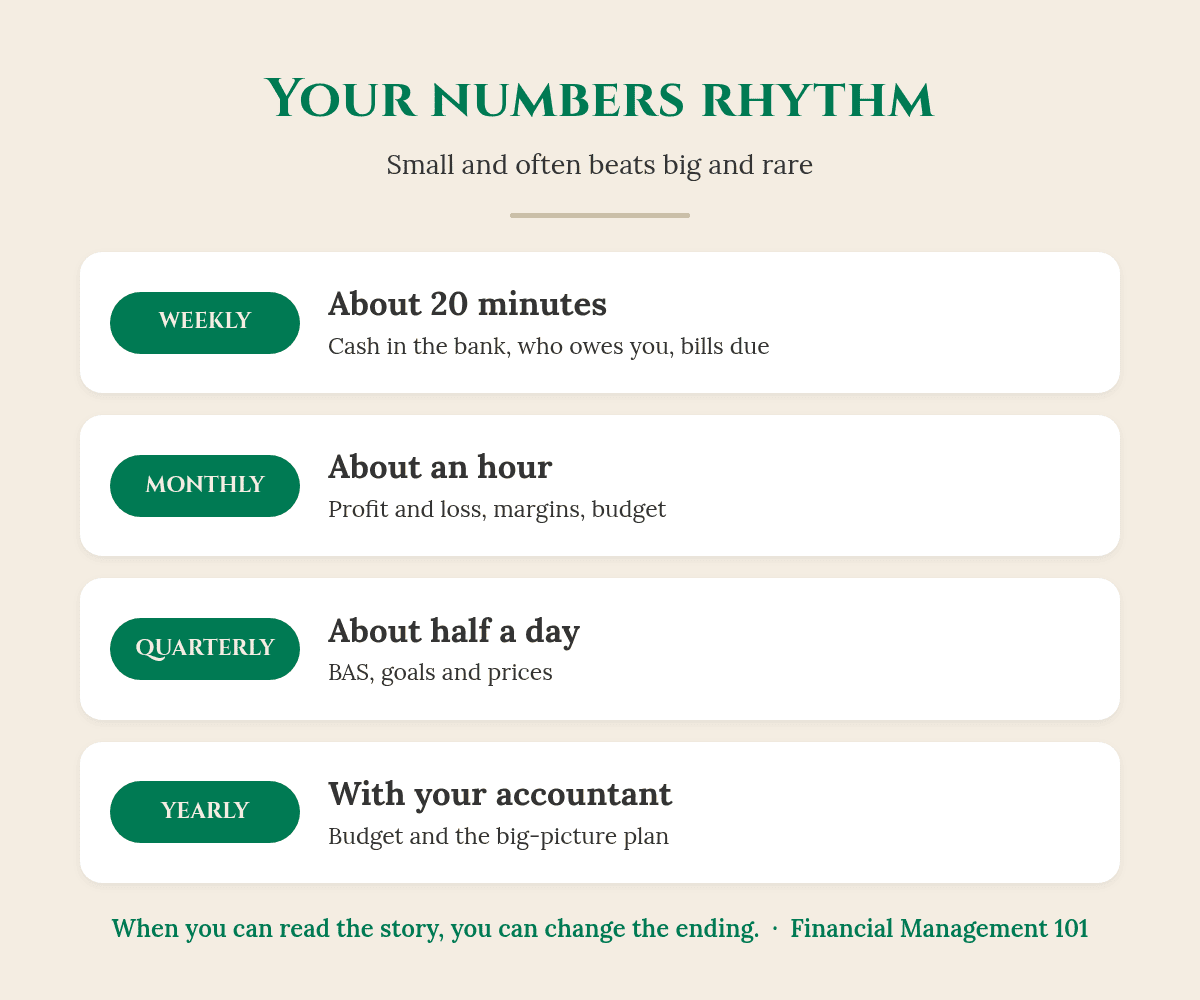
Check your cash and who owes you every week. Review your profit and loss and margins every month. Look at your BAS, your goals and your prices every quarter. Then set your budget once a year with your accountant. Short, regular check-ins beat one big, stressful catch-up.
Why a rhythm works better than a big catch-up
business.gov.au recommends you review your financial activity regularly to spot any trends or problems early, and schedule time each month to check your spending against your budget (business.gov.au). That’s the whole idea: small problems are easy to fix when you see them early.
It also helps with the feeling side. Xero’s 2026 research found 41% of small business owners are too afraid to ask questions about financial management because they feel they should already know the answers, and 22% feel overwhelmed when dealing with business finances (Xero). A routine means you never have to face a whole year at once.
35%
of small business owners don’t often know if they made a profit last month. (Xero, 2026)
41%
are too afraid to ask questions about financial management. (Xero, 2026)
22%
feel overwhelmed dealing with business finances. (Xero, 2026)
Good to know: If you’re not sure which numbers matter most, start with my post on what numbers a small business owner should track. This post is about when to look at them.
Weekly: cash and debtors (about 20 minutes)
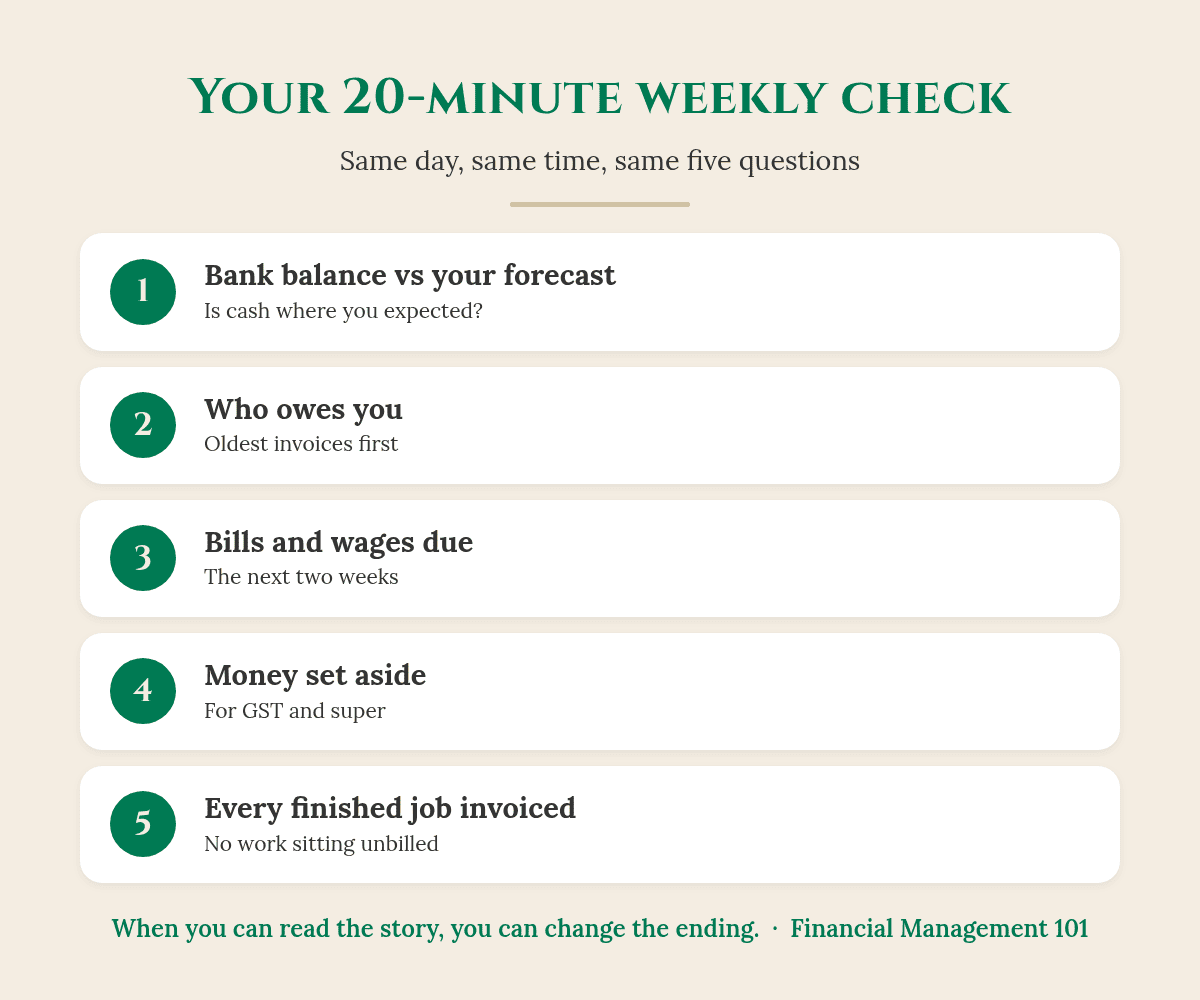
This is your early warning system. Pick the same day each week, Monday morning works well for many owners, and answer five questions.
- Bank balance against your forecast. Is cash where you expected? If you don’t have a forecast yet, my post on how to do a cash flow forecast walks you through a simple 13-week method.
- Who owes you? Run your aged receivables report and start with the oldest invoices.
- What’s due out? Bills, wages and loan repayments for the next two weeks.
- Money set aside. Is your GST and super money sitting somewhere separate, so it’s there when it’s due?
- Is every finished job invoiced? Work that hasn’t been billed can’t be paid.
Why it works: Cash problems rarely arrive overnight. A weekly look shows you a slow-paying customer or a tight fortnight while you still have time to do something about it.
Monthly: profit and margins (about an hour)
Once a month, after your bookkeeper has reconciled the accounts, sit down with your profit and loss. business.gov.au notes you usually complete a profit and loss statement every month, quarter or year, and that it tells you how much profit you’re making, or how much you’re losing (business.gov.au). Monthly is the sweet spot for most small businesses.
- Did we make a profit? It sounds basic, but Xero’s research found 35% of small business owners don’t often know whether they made a profit in the last month (Xero).
- Gross profit margin: is it steady, or drifting?
- Overheads: anything creeping up that you didn’t plan for?
- Actuals against budget: business.gov.au suggests comparing your actuals (real income and costs) with your budget (business.gov.au).
- Your own pay: did you pay yourself as planned?
Check this first: Make sure the month is reconciled before you review it. Reviewing half-finished numbers can send you after problems that aren’t there. Ask your bookkeeper when the month will be ready, and put your review in the diary for the day after.
So what does this actually look like?
Here’s an illustrative example (made-up numbers to show the method, not a real client). Mia runs a landscaping business.
- Monday weekly check: the bank shows $48,000. Customers owe $36,000, and $9,500 of that is more than 30 days old, so Mia makes two friendly follow-up calls. Wages and bills for the next fortnight come to $22,000. Her GST money is in its own account.
- Monthly review: October revenue was $95,000 and gross profit was $33,250, a margin of 35% ($33,250 ÷ $95,000 × 100). Her budget assumed 38%. So she looks at two jobs where materials ran over the quote.
- Quarterly review: her October to December BAS is due 28 February, so in early February she checks her set-aside account against her bookkeeper’s BAS estimate, and reviews her prices for the new year.
Total time across the month: about two hours. No surprises, and every decision is based on numbers she’s already seen.
Quarterly: BAS, goals and prices (about half a day)
Most small businesses lodge a quarterly BAS. The ATO’s quarterly due dates are 28 October (July to September), 28 February (October to December), 28 April (January to March) and 28 July (April to June) (ATO). If you lodge online you may be eligible for an extra two weeks, and you may also get extra time if you lodge through a registered tax or BAS agent/accountant. That later date doesn’t apply to the October to December quarter, because 28 February already includes an extension (ATO). If you report monthly, your BAS is due on the 21st of the following month.
Use the quarter as a bigger-picture check-in:
- BAS ready: is the money set aside to cover it?
- Goals: are you on track for the year? What needs to change next quarter?
- Prices: Business Queensland suggests scheduling formal price reviews, for example monthly, quarterly or half-yearly (Business Queensland). The quarter is a natural time.
- Forecast: business.gov.au suggests updating your forecast more often than your budget, monthly or quarterly (business.gov.au).
For a simple way to run this check, use my quarter report card with its three questions.
Watch out: If you can see you won’t be able to pay your BAS on time, don’t wait. The ATO asks you to contact them, or your registered tax professional, before the due date to find out what support is available, and says it will work with you to find a solution (ATO).
Yearly: the budget and the big picture
Once a year, set your budget. business.gov.au suggests writing your budget once a year and considering a mid-year review (business.gov.au). This is a great conversation to have with your accountant, alongside your tax planning.
Where do my bookkeeper and accountant fit in?
They’re your partners in this rhythm, not a replacement for it. Your bookkeeper keeps the records up to date, so the numbers you look at each week and month are real. Your agent/accountant makes sure the numbers are right, lodges what needs lodging, and helps you plan the year ahead.
My job is to help you know what to do with those numbers. The rhythm is what makes that possible: when you look regularly, your questions for your bookkeeper and accountant get sharper, and your conversations with them get more useful.
When you can read the story, you can change the ending.
Your takeaway
- Weekly, about 20 minutes: cash, who owes you, bills due, money set aside, everything invoiced.
- Monthly, about an hour: profit and loss, margins, overheads and actuals against budget.
- Quarterly, about half a day: BAS, goals, prices and your forecast.
- Yearly: your budget and the big picture, with your accountant.
- Put each one in your diary. Same day, same time.
Want to see where your profit is really going?
Start with The EDGE Business Health Check. It’s a $47 workbook that takes about 20 minutes. You score 30 quick statements across five areas: Profit & Pricing, Cashflow, CEO Visibility, Systems & Freedom, and Growth. Then the Profit Leak Calculator shows where money may be slipping away, and the 7-Day Reset gives you clear next steps.

Rather talk it through first? Get in touch and book a call with me.
Frequently asked questions
How often should a small business owner look at their bank balance?
Most owners look at their bank balance often. The key is to compare it with a forecast each week, so you know whether it’s where it should be, not just what it is today.
Should I review my profit and loss monthly or quarterly?
Monthly works best for most small businesses, once your bookkeeper has reconciled the month. business.gov.au notes profit and loss statements are usually completed every month, quarter or year.
When is my quarterly BAS due?
The ATO’s quarterly dates are 28 October, 28 February, 28 April and 28 July. Lodging online or through a registered tax or BAS agent/accountant may give you more time, except for the October to December quarter.
How long does a weekly money check take?
Once it’s a habit, about 20 minutes. The first few may take longer while you find the reports you need.
What if I don’t have a bookkeeper?
The rhythm still works. You’ll just need to reconcile your accounts before your monthly review. If that’s taking up hours each month, it may be time to talk to a bookkeeper.
You’ve built something real. Financial confidence starts with clarity.
Karen G. Adams
Small Business Performance Strategist, Financial Management 101
Too Big To Wing It. Too Small To Need A CFO.
This article is general education only. It isn’t financial, tax or accounting advice, and it doesn’t take your personal circumstances into account. Mia’s landscaping business and all its figures are illustrative, not a real client. BAS due dates are from the ATO website as at November 2026; check your own dates with the ATO or your bookkeeper or agent/accountant.