Everyone’s telling you it’s fine. Paste your profit and loss into a chatbot, click off a setting, tick a box, and you’re done. Well, I don’t agree. I’m not anti-AI. I use it every day and I love it. But when it comes to your business financials, I’ve landed somewhere different, and I want to show you why.
In my latest video I share the three reasons I hold this line, the research behind each one, and a look inside a real client’s CEO Dashboard that answers the questions owners are hoping a chatbot will answer, without pasting anything anywhere.
Last week I wrote about four questions to ask before you let ChatGPT or Claude into your Xero. That was the “if you’re going to do it, do it on purpose” version. This one is different. This is where I’ve landed, and why.
THE SHORT ANSWER
Should you paste your business financials into a public AI chatbot?
I wouldn’t. Settings help, but once your numbers leave your hands, you can’t fully control where they go or take them back. Your financials also hold your team’s and your clients’ information, not just yours. And a chatbot can only guess from what you paste in on the day. Use AI for your emails, marketing and ideas, and keep your financials somewhere safe and built for your business.
Why have I landed here when I use AI every day?
I’ve been in financial services for 40 years and I’ve seen plenty of new tools arrive. AI is one of my favourites. I recently spent over 40 hours learning a new AI tool for my own business, and I wrote about what those 40 hours gave me back. So this isn’t fear of the new. It’s a line I’ve drawn on purpose, for three reasons.
Reason 1: Why isn’t changing a setting enough?
Most of the advice out there is about settings: turn off training, use a temporary chat, delete your history. I get why. It feels like you’re in control. But look at what the companies themselves say happens after you press enter.
- Google’s own Gemini privacy page says: “Please don’t enter confidential information that you wouldn’t want a reviewer to see or Google to use to improve our services, including machine-learning technologies.” It also says chats that reviewers look at can be kept for up to three years, and that even with activity turned off, chats are kept for 72 hours (Google).
- Anthropic says that on its consumer Claude plans, chats can be kept for up to five years if you allow them to be used to improve its models, and 30 days if you don’t (Anthropic).
- In 2025, a US court order in The New York Times’ lawsuit against OpenAI required OpenAI to keep consumer ChatGPT conversations, including deleted ones. OpenAI says that obligation ended on 26 September 2025, but it’s still holding a limited set of conversations from April to September 2025 under legal hold (OpenAI).
None of this is a company doing something sneaky. Google and Anthropic, for example, both say they don’t sell your personal information. It’s policy, courts and normal business. But it does mean delete doesn’t always mean gone.
Our own privacy regulator, the OAIC, puts it this way. Talking about personal information entered into publicly available AI tools, it says that “depending on the relevant privacy settings”, it can be “very difficult to track or control how it is used, and potentially impossible to remove” (OAIC).
So for me, the question isn’t which setting I tick. It’s whether I’m comfortable with my numbers sitting somewhere I can’t see or control. There’s no guarantee they stay private.
Reason 2: Whose information is really in your financials?
Here’s what most people miss. Your financials aren’t just yours.
- Your payroll has your team’s wages in it.
- Your debtors list has your clients’ names.
- Your bank feed shows who you pay and when.
That’s other people’s information sitting in your business. And even good people in big companies slip up.
- A 2025 global study by KPMG and the University of Melbourne surveyed 32,352 employees in 47 countries. Almost half (48%) admitted uploading sensitive company or customer information into public AI tools (The Conversation). Here in Australia, only 30% of employees said their organisation had a policy on generative AI use (KPMG Australia).
- In 2023, Samsung temporarily restricted generative AI tools on company devices after staff uploaded internal source code to ChatGPT (The Verge).
- In 2025, nearly 4,500 shared ChatGPT conversations turned up in Google search results (Fast Company). People had ticked a box to make a shared link discoverable without realising what that meant. OpenAI removed the feature (TechCrunch).
- In January this year, a popular third-party AI chat app, Chat & Ask AI, had a misconfigured database. A researcher reported that around 300 million messages from more than 25 million users were exposed (404 Media). The developer’s own estimate of the people affected was far lower, and it fixed the problem within hours (Malwarebytes). But for a while, those chats were sitting where they shouldn’t have been.
I’m not telling you this to scare you. I’m telling you because, as the owner, you’re the one who carries it.
Good to know: if your business turns over more than $3 million a year, the Privacy Act generally applies to you. Some smaller businesses are covered too, such as health service providers and businesses that trade in personal information (OAIC). The Australian Cyber Security Centre’s guide to AI for small business also warns that uploading customer or staff details without removing identifying information can expose it, and suggests checking a tool’s settings, terms and privacy policy first.
Reason 3: Can a chatbot really answer your money questions?
So why do people paste their numbers in? I get it. They want answers. Am I actually making money? Why is cash always tight? Can I afford that new ute?
Those are brilliant questions. But a chatbot can only guess from whatever you’ve pasted in on the day, with no idea whether your books are right or up to date, or what you’re trying to build. As I say in the video, “I want you AI-ready, not AI-guessing.”
What do I do instead? A look inside a real client’s CEO Dashboard
Here’s where it gets good. In the video I walk through The CEO Dashboard for Demo Cleaning Co. It’s a real client, with names and some figures changed for privacy, showing four months of data.
So what does this actually look like for a cleaning business?
- Revenue: $75.3K over four months, with $3.1K in net profit. That’s a 4.1% margin.
- The weekly briefing: a “What your numbers are saying” box, written from their own numbers. September was up 14%, but at a 4.1% margin, the briefing shows a 6% drop in sales would push them into a loss.
- Regular cleans: the bread-and-butter work brought in $32K and lost $1,234. Labour was taking 73 cents of every dollar. As the dashboard puts it, that’s a pricing problem, not a business problem.
- Quotes versus reality: they quoted $50.0K of work that cost $55.9K to deliver. 288 of 424 cleans ran over budget. One two-bedroom unit in East Perth was quoted at $238 and cost $421 to do.
What’s actually safe to pay yourself?
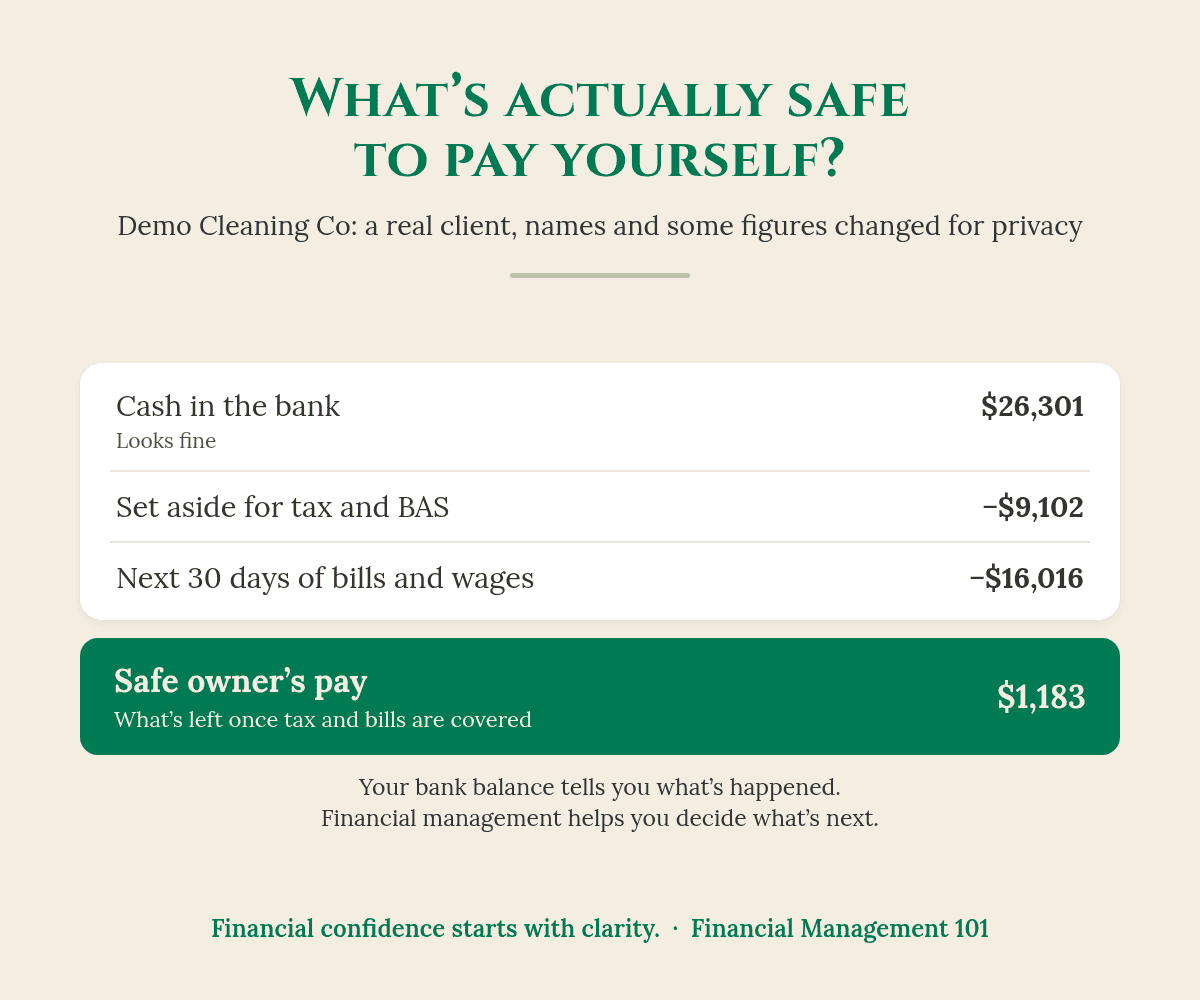
Cash in the bank was $26,301, which looks fine. But take out the $9,102 set aside for tax and BAS and the $16,016 for the next 30 days of bills and wages, and the safe owner’s pay was $1,183. Your bank balance tells you what’s happened. Financial management helps you decide what to do next. If that idea is new to you, have a read of What Can’t Your Bank Balance Tell You?
Can they hire another cleaner or buy that extractor?
This is the page owners love. Can they hire another cleaner? The data says not yet. The cash buffer is seven weeks and the rule is eight. A $6.5K carpet extractor? It pays for itself in 11 months, but tax and bills need to be covered after the deposit is paid first. These rules are set with me and reviewed every month with the owner. So it’s not a guess, it’s a decision.
Why it works: nobody pasted a bank statement into a chatbot. It’s the owner’s own dashboard, built with them. It isn’t a public AI tool, and they decide who has access to it. And if you run a trade business, there’s a trade version of the same thing. You can take a look at The CEO Dashboard – New Look.
Not sure which numbers matter most? What Numbers Should A Small Business Owner Track? is a good place to start.
So should you stop using AI?
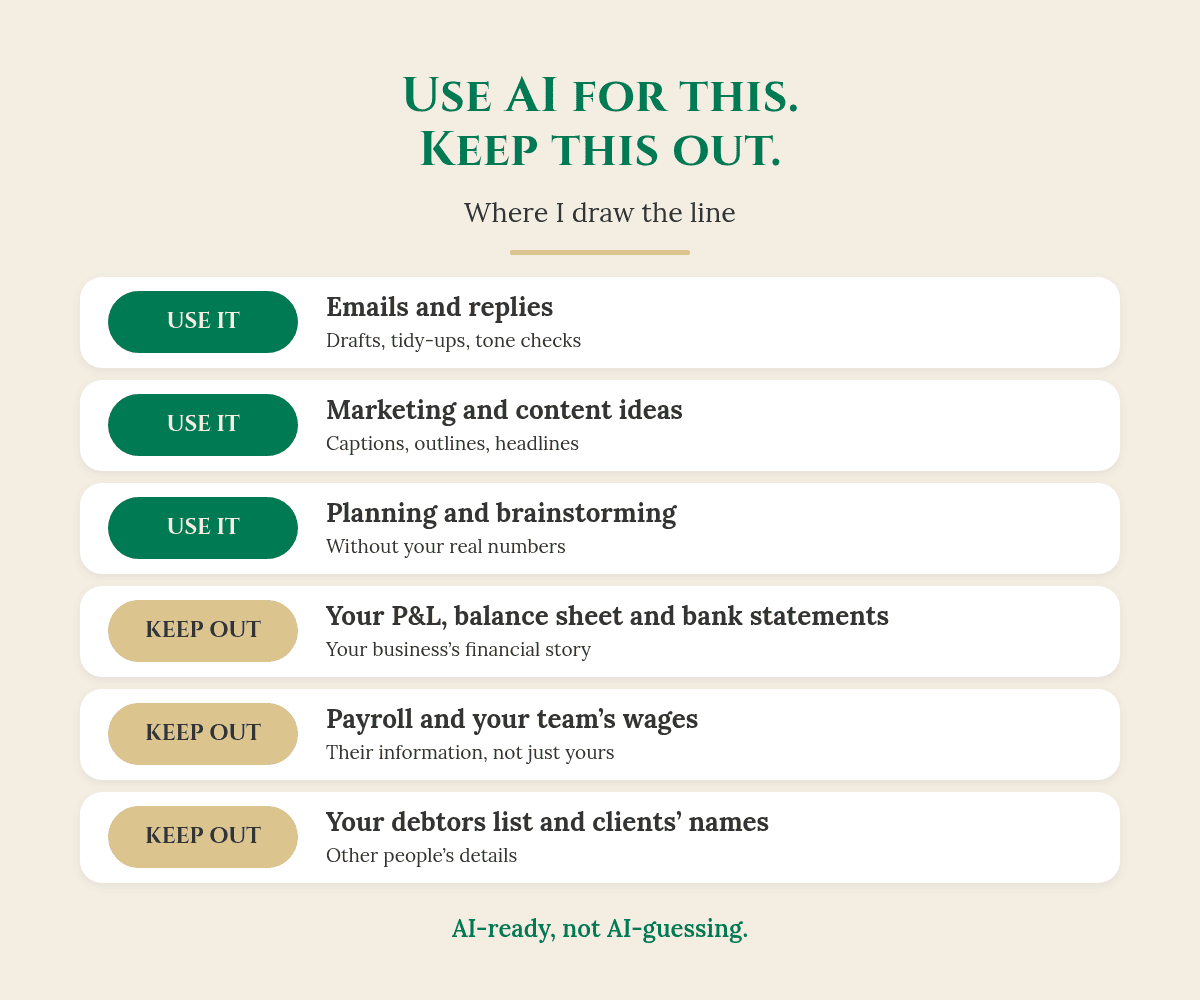
No. Use it for your emails, your marketing and your ideas. Just keep your financials somewhere safe and built for you. When you can read the story in your numbers, you can change the ending.
I want you AI-ready, not AI-guessing.
Your takeaway
- The paste is the decision. Settings help, but once your numbers leave your hands, you can’t take them back.
- It’s not just your information. It’s your team’s and your clients’ too.
- You don’t need a chatbot to understand your numbers. You need a clear view built for your business alone.
- Use AI for emails, marketing and ideas. Keep your P&L, payroll and client details out of public chatbots.
Want answers from your numbers without the guesswork?
Take a look at The CEO Dashboard – New Look to see how it brings your numbers together in one place, built for your business.
Then book your CEO Dashboard chat. It’s a 20-minute call to see what your own dashboard could show you. You’re too big to wing it and too small to need a CFO, and that’s exactly who this is for.
Know a business owner who’s been pasting their P&L into a chatbot? Send them this post.
Frequently asked questions
Is it safe to paste my P&L into ChatGPT or another chatbot?
I wouldn’t. Even with training turned off, providers can keep chats for a period, some chats may be seen by human reviewers, and court orders can require chats to be kept. Your P&L can also reveal your team’s wages and your clients’ names. Keep your financials in a tool built for them.
If I delete a chat, is it gone?
Not always straight away. Each provider has its own retention rules. Google says chats are kept for 72 hours even with activity turned off, and reviewed chats for up to three years. In 2025 a US court order required OpenAI to keep deleted ChatGPT chats for a time. Check the provider’s own privacy pages.
Does the Privacy Act apply to my small business?
Generally, if your annual turnover is more than $3 million. Some smaller businesses are covered regardless, such as health service providers and businesses that trade in personal information. The OAIC’s small business page explains the rules. Check with your adviser if you’re not sure.
Can I still use AI in my business?
Yes. I use it every day. Use it for emails, marketing and ideas. Just keep your financials, payroll and client details out of public AI chat tools.
Is the cleaning business in the video real?
Yes. Demo Cleaning Co is a real client, with names and some figures changed for privacy.
What does The CEO Dashboard cost?
The CEO Dashboard starts from $5,000. Every dashboard is built for your business, so book a CEO Dashboard chat and we’ll talk through what yours would include.
You’ve worked hard for those numbers. Keep them somewhere safe, and make them work for you.
Karen G. Adams
Small Business Performance Strategist, Financial Management 101
This article is general information only. It isn’t legal, privacy, cyber security or financial advice, and it doesn’t take your circumstances into account. Provider policies change, so check each tool’s current privacy terms. Demo Cleaning Co is a real client, with names and some figures changed for privacy.