Super used to be the quiet line on the payslip that nobody checked until a statement turned up months later. Since 1 July 2026, it’s paid every payday, which makes it far easier to check your super is actually arriving. For employers, it’s also a simple way to build trust with your team.
This post is written for employees and for the employers who look after them. It covers what changed, what your payslip should show, how to check your super in a few minutes, what to do if a payment is missing, and how employers can make the whole thing easy.
THE SHORT ANSWER
How do I know my super is being paid?
Check your payslip for the super amount and fund name, then check your super fund’s app or online account, or ATO online services through myGov. Under Payday Super, your super should reach your fund within 7 business days of payday. If it hasn’t, ask your employer first, then report it to the ATO (Moneysmart).
7
business days after payday for super to reach your fund. (Moneysmart)
12%
of qualifying earnings. The amount hasn’t changed. (ATO)
1
working day after payday for your payslip to arrive. (Fair Work)
What changed with Payday Super?
Before 1 July 2026, employers only had to pay super into your account every 3 months. Now your employer must pay your super at the same time as your wages, and it should reach your super account within 7 business days of payday (Moneysmart). For the first contribution for a new employee, or to a new fund, the deadline is 20 business days (ATO).
What hasn’t changed: who gets super, how much your employer must pay, and your employer’s responsibility to pay it (Moneysmart). The super guarantee is 12%, now worked out on what the ATO calls qualifying earnings (ATO). Some employers pay more (Moneysmart).
Good to know: If you’re under 18, the ATO says you need to work more than 30 hours a week to be eligible for super (ATO).
What should my payslip show about super?
Fair Work says payslips must be given within 1 working day of payday. For super, they must show the amount of contributions made during the pay period (or the amount the employer intends to make) and the name, or name and number, of the super fund (Fair Work Ombudsman).
So the payslip tells you what should go in. Your super fund tells you what actually arrived. As Moneysmart puts it, you don’t need to rely on your payslip alone (Moneysmart).
How do I check my super is being paid?
Here are five checks, drawn from Moneysmart and the ATO’s super health check. They take a few minutes after each payday.
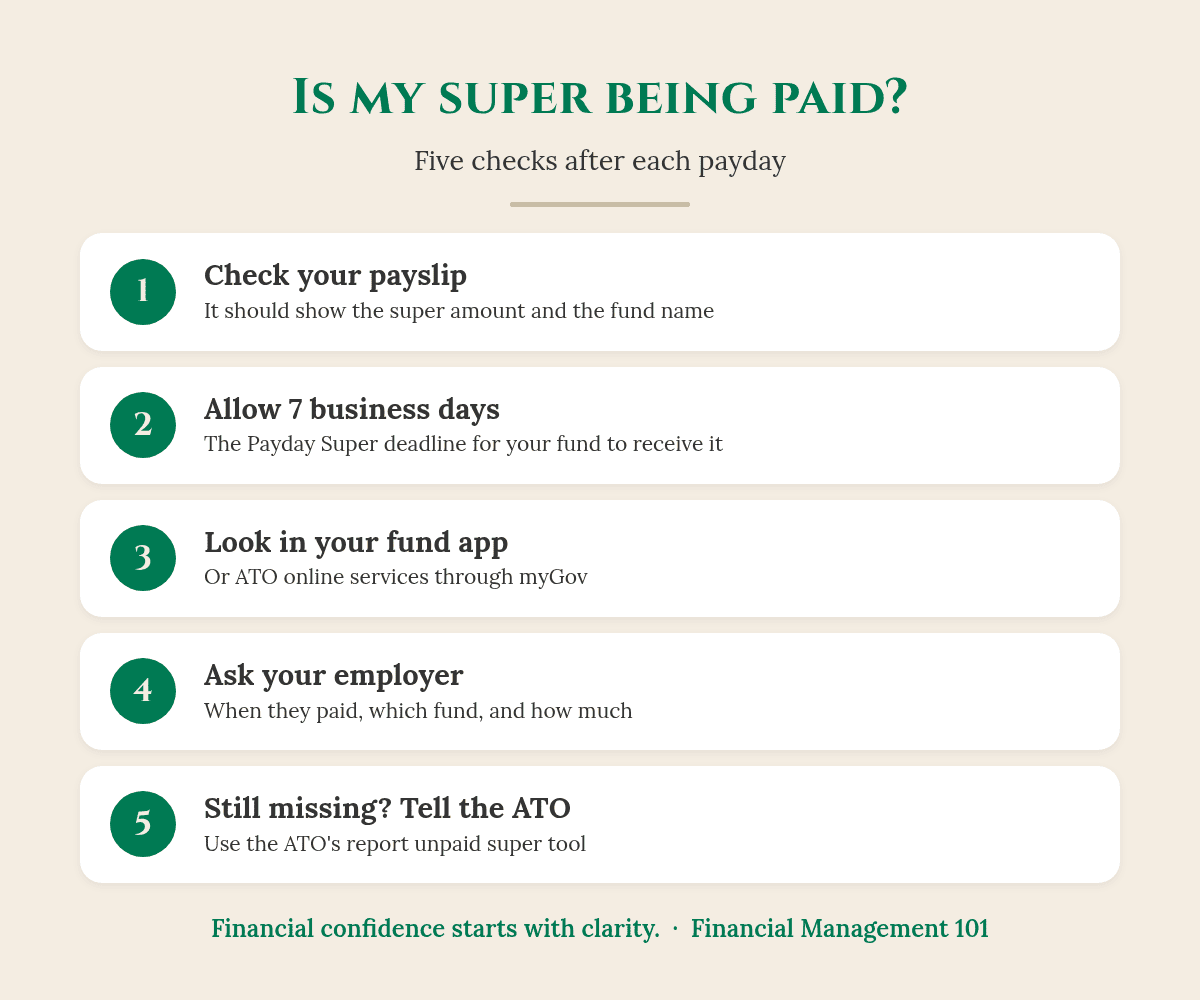
- Check your payslip. Note the super amount and the fund it’s going to.
- Allow 7 business days. It may take a few business days to appear, because your fund has to receive and process it first (Moneysmart).
- Look in your super fund’s app or online account for the new payment and your balance.
- Or use ATO online services through myGov. Select Super, then Information, then Employer contributions, and Transactions to see each contribution separately (ATO). The ATO notes balances there may differ from your fund’s current balance.
- Not sure which fund your money is in? Ask your employer, or link myGov to the ATO to see all your super accounts (Moneysmart).
Behind the scenes, Single Touch Payroll helps. Each time your employer reports through STP, they tell the ATO how much super they’re required to pay, and your fund tells the ATO when it receives the payment (ATO).
So what does this actually look like?
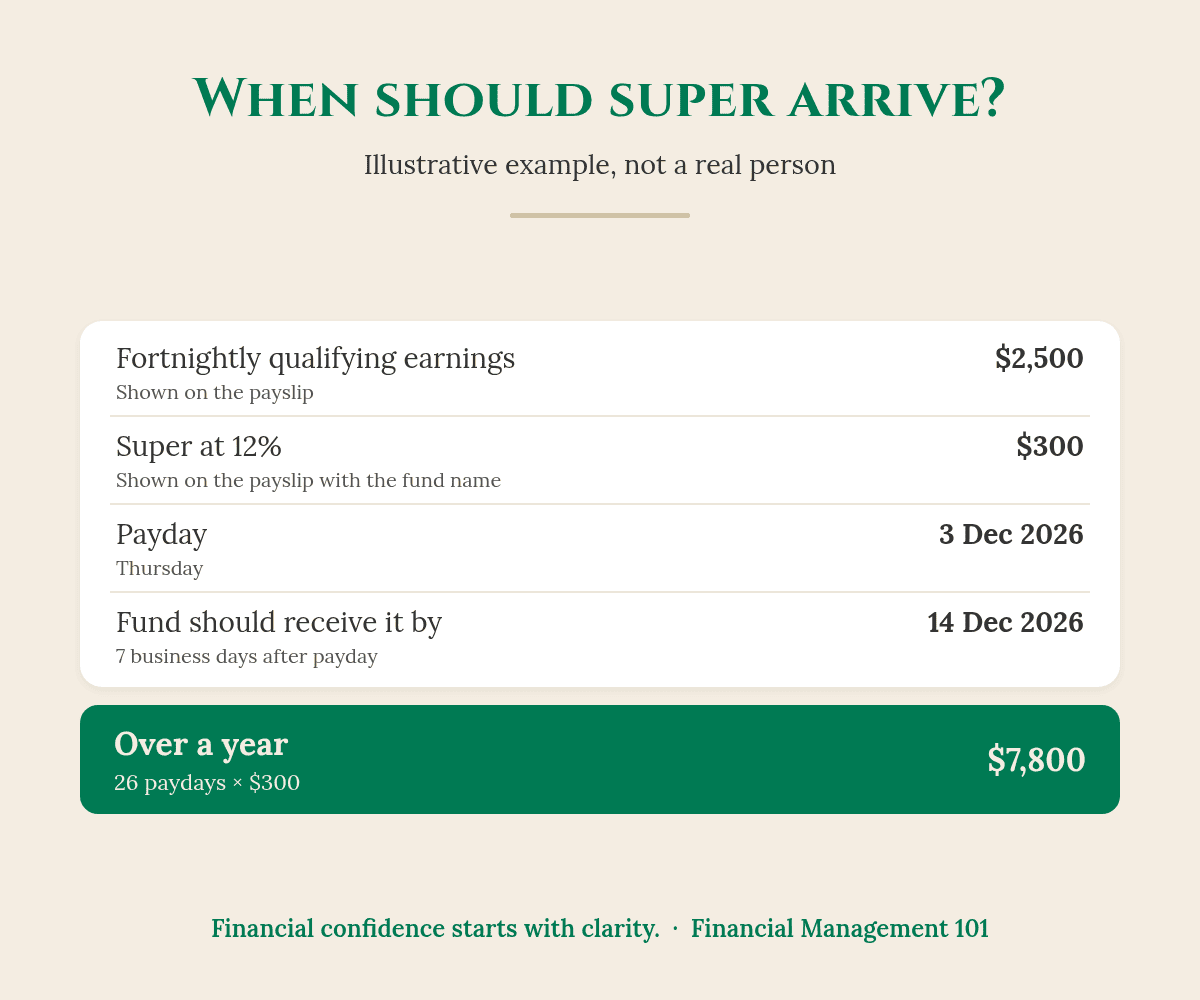
Here’s an illustrative example (made-up numbers, not a real person). Priya works in the office of a plumbing business and is paid fortnightly. Her payslip shows qualifying earnings of $2,500, so her super is $2,500 × 12% = $300, going to her named fund.
She’s paid on Thursday 3 December 2026. Counting 7 business days after payday takes her to Monday 14 December. On the 15th she opens her fund’s app and sees the $300 has arrived. Over a year, that’s 26 paydays and $7,800 of super she can watch arrive, rather than waiting for quarterly statements.
Check this first: Next payday, put a reminder in your phone for 7 business days later. One quick look, and you’ll know.
What if my super is missing or late?
Don’t assume the worst. Issues can come from simple errors or delays (Moneysmart). Wrong fund details are a common cause, and funds now have 3 business days to allocate or return a contribution, so errors come back to your employer faster (ATO). Work through these steps:
- Check again with your fund. There can sometimes be a short delay.
- Ask your employer when they paid your super, which fund they paid it into, and how much they paid (ATO).
- If it still isn’t sorted, report it to the ATO using its online tool to report unpaid super contributions (ATO).
The ATO says employers who don’t pay super in full, on time and to the right fund must pay the super guarantee charge, and the ATO then pays the super and interest into your account (ATO). Entitlements above the super guarantee rate, such as under an award, are a matter for the Fair Work Ombudsman.
While you’re there: the rest of your super health check
The ATO’s super health check suggests a few more checks once a year or so (ATO):
- Your contact details and TFN are up to date with the ATO and your fund. This helps prevent lost super.
- Lost or unclaimed super. All your accounts, including lost and ATO-held super, show in ATO online services.
- More than one account? Combining may reduce fees, but check the fund suits you and the insurance cover still fits your needs. Moneysmart can help you compare.
- Your nominated beneficiary. Most binding nominations expire every 3 years, and super isn’t covered by your will.
Watch out: Before you move or combine super, check what insurance you’d lose. If you’re unsure, talk to your fund or get independent financial advice. This post is education, not advice about any fund.
For employers: make it easy for your team
Payday Super is a chance to show your people their super is being looked after. A few small things help:
- Tell your team super now goes out every payday, and how to check it. Share this post, or the ATO and Moneysmart pages.
- Get fund details right at onboarding. You must offer a choice of fund, and if you don’t get a choice form you can request the employee’s stapled fund details from the ATO (ATO).
- Make sure payslips show the super amount and fund name every pay (Fair Work Ombudsman).
- Fix errors fast when a fund returns a payment, and tell the employee what happened.
- Plan the cash. Super now leaves with every pay run. My post on what Payday Super means for your cash flow covers the employer side.
Your payslip shows what should go in. Your super fund shows what arrived.
Your takeaway
- Since 1 July 2026, super is paid each payday and should reach your fund within 7 business days (20 for a new employee’s first contribution).
- Your payslip must show the super amount and the fund name.
- Check your fund’s app or ATO online services through myGov after each payday.
- Missing? Check with your fund, ask your employer, then report it to the ATO.
- Once a year, do the rest of the ATO’s super health check: details, lost super, multiple accounts and beneficiaries.
- Employers: tell your team, get fund details right and fix errors quickly.
Want help building money confidence in your team?
I run practical, judgement-free financial wellbeing sessions for workplaces, so your people understand their pay, their super and their options, and your managers feel confident answering questions. If you’d like to explore what that could look like for your team, book a call with me.
Frequently asked questions
How long does super take to reach my fund under Payday Super?
From 1 July 2026, your employer’s contribution should reach your super fund within 7 business days after payday. For a new employee’s first contribution, or a new fund, it’s 20 business days.
How do I check if my employer is paying my super?
Check your payslip for the super amount and fund name, then look for the payment in your super fund’s app or online account. You can also log in to ATO online services through myGov and select Super, Information, then Employer contributions.
What should I do if my super hasn’t been paid?
Check with your fund first, as there can be a short delay. Then ask your employer when they paid, which fund and how much. If it still isn’t sorted, use the ATO’s online tool to report unpaid super.
Has the amount of super changed with Payday Super?
No. Payday Super changes when super is paid, not how much. The super guarantee is 12%, now calculated on qualifying earnings. Some employers pay more.
Why does the balance in myGov look different from my fund’s app?
The ATO says funds report balances when they receive payments, so balances shown in ATO online services may differ from your actual current balance. Your fund’s app or account is the most up to date.
Does my payslip have to show my super?
Yes. Fair Work says payslips must show the super contributions for the pay period (or the amount the employer intends to make) and the name, or name and number, of the fund.
Your people are your business. Looking after them starts with clarity.
Karen G. Adams
Small Business Performance Strategist, Financial Management 101
Too Big To Wing It. Too Small To Need A CFO.
This article is general education only. It isn’t financial, tax or legal advice, and it doesn’t recommend any super fund or product. Priya and her figures are illustrative, not a real person. Payday Super timing, the super health check and unpaid super steps are from the ATO and Moneysmart, and payslip rules are from the Fair Work Ombudsman, as at 9 November 2026. For advice about your own super, talk to your fund or a licensed financial adviser.