The jobs were steady all quarter. The bank balance looked healthy. Then the BAS lands and it’s a number you weren’t expecting, right when you’ve got wages and suppliers to pay. Let’s work out how much to set aside for BAS, so next quarter the money’s already waiting.
If that’s you, you’re far from alone. At 30 June 2025, small businesses owed $35.9 billion of the ATO’s $54.2 billion collectable debt (ATO Annual Report 2024–25). The ATO has said $24.7 billion of that small business debt is activity statement debt (ATO).
$54.2B
collectable debt owed to the ATO at 30 June 2025. (ATO Annual Report 2024–25)
$35.9B
of that was owed by small businesses. (ATO Annual Report 2024–25)
$24.7B
of small business debt is activity statement debt, the BAS. (ATO)
THE SHORT ANSWER
How much should I set aside for BAS?
Set aside everything your BAS will ask for, as the money comes in: the GST in your sales (one-eleventh of GST-inclusive income) less GST on your business purchases, all PAYG withheld from wages, and any PAYG instalment. Move it to a separate tax account every week, so it’s there when your BAS is due.
Why am I always short of cash when my BAS is due?
I totally get this. It’s one of the most common things I hear from trades and service business owners, and it’s rarely because they’re doing anything wrong. In my 40 years in financial services, I’ve seen the same five reasons again and again.
1. The GST was never your money
When a customer pays you $1,100, $100 of that is GST you’re collecting for the ATO. But it lands in the same account as everything else, so it looks like yours. By the time the BAS is due, it’s been spent on wages, materials and fuel.
2. You’re paying GST on money you haven’t received yet
If you account for GST on a non-cash (accrual) basis, you report GST when you issue the invoice, not when the customer pays. With 30-day terms or retentions, you can owe GST on money still sitting in a customer’s bank account. On a cash basis, you report GST when you’re paid (ATO).
3. PAYG withholding gets spent
The tax you withhold from your team’s pay belongs to them and the ATO. It’s easy to treat it as part of your cash because it doesn’t leave the account until the BAS is paid.
4. PAYG instalments get forgotten
If you’re in the PAYG instalment system, there’s a prepayment of your income tax on the BAS too. It isn’t linked to this quarter’s sales, so it often catches owners by surprise.
5. You’re running the business by the bank balance
Here’s the thing… the bank balance tells you what’s in the account, not what’s yours. A busy quarter makes it look healthy, then the BAS, super and supplier bills all land at once. For more on that pattern, read Why Is Cashflow Always Tight?
Money doesn’t disappear. It just goes unmanaged.
How do I work out what to set aside for BAS?
Let me show you exactly how much to set aside for BAS. Your bookkeeper or accounting software can give you most of these numbers. You’re looking for four things.
- GST on sales: one-eleventh of your GST-inclusive income for the period.
- Less GST credits: the GST included in your business purchases (as long as you have valid tax invoices).
- PAYG withholding: the tax withheld from wages for the period.
- PAYG instalment: the amount or rate on your activity statement, if you’re in the system.
Add GST on sales and PAYG withholding, take away GST credits, then add your instalment. That’s what your BAS is likely to ask for.
What to look for: If you want a simple rule while you get set up, put aside one-eleventh of every GST-inclusive payment you receive, plus every dollar of PAYG withheld on payday. Then look at your instalment separately. It’s a little more than you’ll need for GST, because it ignores your credits, and that small cushion is a good thing.
So what does this actually look like?
Here’s an illustrative example (the numbers are made up to show the method, not a real client). A plumbing business with 6 staff brings in $330,000 including GST in a quarter.
- GST on sales: $330,000 ÷ 11 = $30,000
- GST credits on purchases: $12,000
- PAYG withheld from wages: $21,000
- PAYG instalment: $6,000
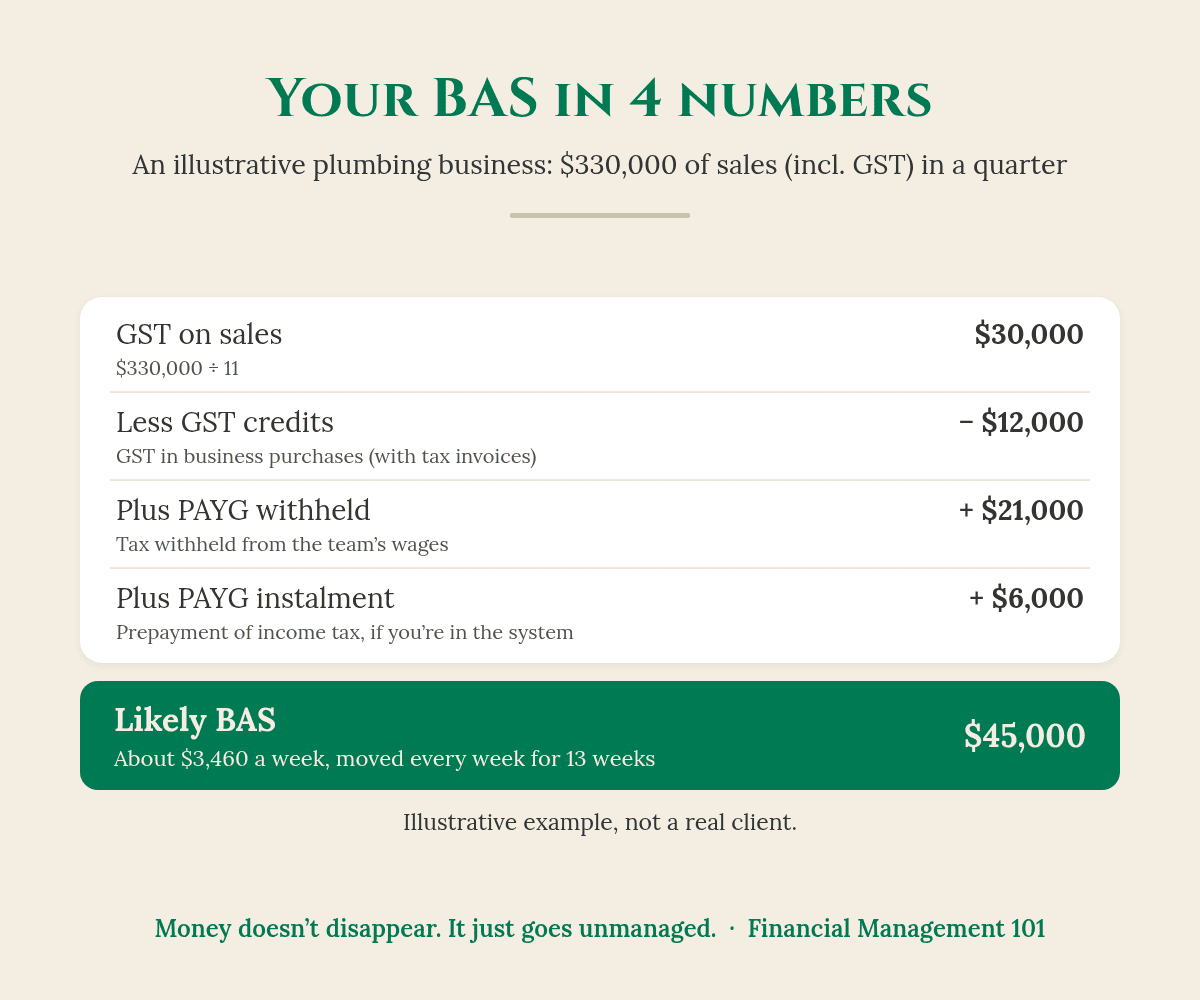
So the BAS is about $45,000 ($30,000 − $12,000 + $21,000 + $6,000). Spread over a 13-week quarter, that’s about $3,460 a week moved into a tax account. When the BAS arrives, the money’s already there. No scramble, no overdraft, no sleepless night.
How do I make sure the money is there when my BAS is due?
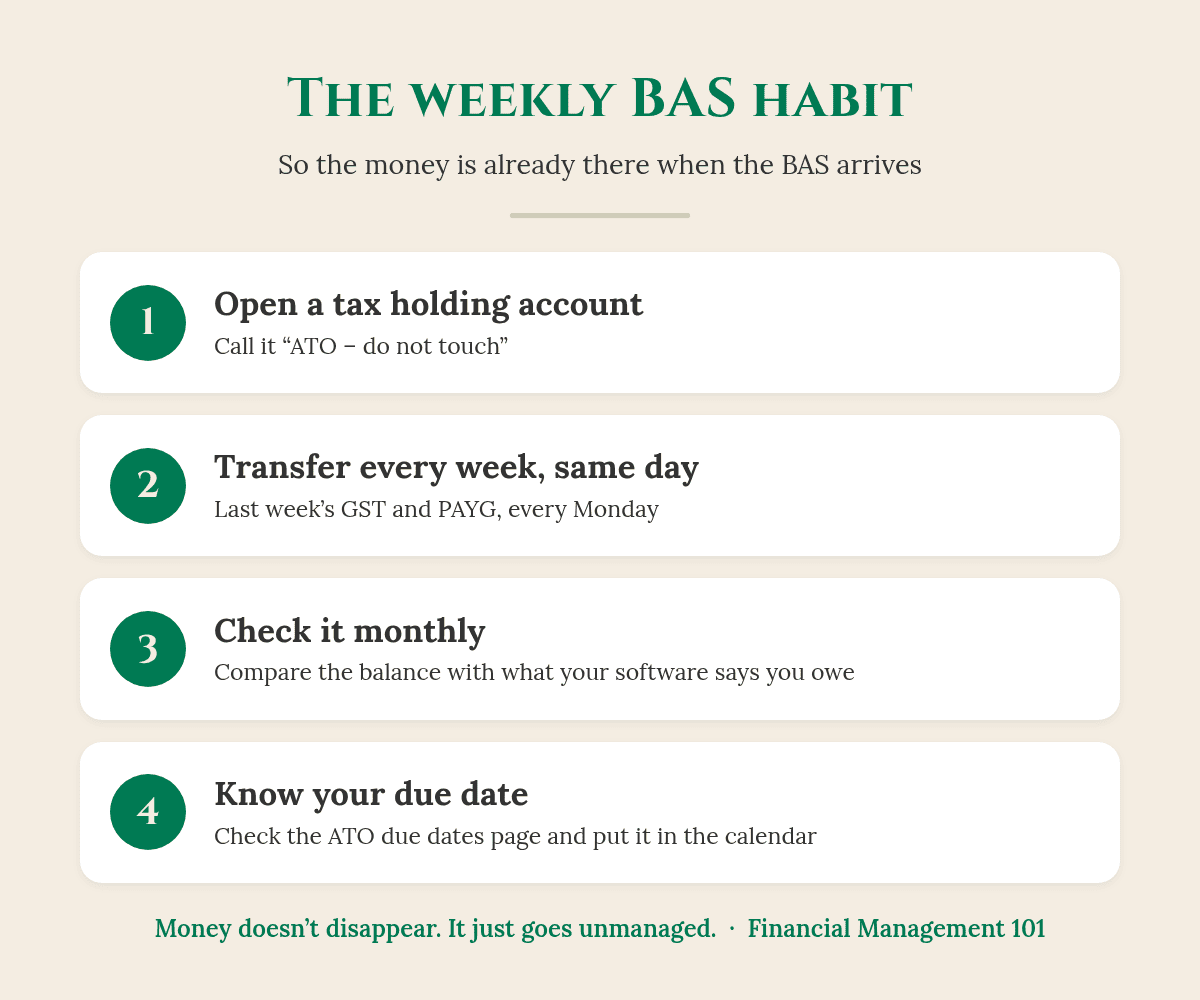
Open a separate tax holding account
Open a second account with your bank, separate from your everyday business account, and call it something obvious like “ATO – do not touch”. It’s exactly what the ATO suggests: keep the GST you collect separate from your day-to-day cash flow, ideally in a separate bank account, so you don’t spend it by accident (ATO).
Transfer every week, on the same day
Pick a day, say every Monday, and move the GST and PAYG from last week into that account. Your bookkeeper can help set up the weekly figure. Weekly beats monthly because the amounts are smaller and you can see straight away if cash is getting tight.
Check the account against what you owe
Once a month, compare the balance with what your accounting software says you owe for the quarter so far. If it’s short, you’ve found the problem early, while you still have time to fix it. My post Tax Time Without the Panic covers the other tax habits worth building.
Know your due date
Due dates depend on whether you report monthly or quarterly, whether you lodge online and whether you use a registered tax or BAS agent. Check yours on the ATO’s due dates for lodging and paying your BAS page, and put it in your calendar with a reminder two weeks before.
Next one up: If you lodge quarterly, the October to December 2026 BAS is due on 28 February 2027. The ATO says the usual extra time for lodging online or through an agent doesn’t apply to this quarter, because the date already includes a one-month extension (ATO). In the other quarters, lodging electronically through a registered BAS or tax agent can give you extra time: the January to March 2027 BAS, for example, moves from 28 April to 26 May 2027 (ATO). Check with your BAS agent which date applies to you, and check your own date if you report monthly.
What if I’m already short for this BAS?
First, take a breath. This is fixable, and it’s far better to deal with it now than to ignore it.
- Lodge on time anyway. The ATO says it’s important to lodge on time, and to contact them before the due date if you can’t pay in full (ATO).
- Talk to your BAS agent or accountant. They can help you look at your options, including a payment plan with the ATO.
- Know what late payment costs. The general interest charge (GIC) compounds daily on unpaid amounts, and from 1 July 2025 it’s no longer tax deductible (ATO).
- Start the weekly transfer now. Even a small amount means next quarter is easier than this one.
If the BAS keeps coming in short, it usually points to something deeper, like pricing, slow-paying customers or a feast-and-famine workload. Cash Flow Chaos explains how to break that cycle.
Your takeaway
- GST and PAYG withholding aren’t your money. Treat them that way from the day they land.
- Work out your BAS from four numbers: GST on sales, GST credits, PAYG withholding and any instalment.
- Move it into a separate tax account every week, and check it monthly.
- If you’re already short, lodge on time and talk to your BAS agent or accountant about your options.
Your accountant and bookkeeper are your partners here. They make sure the numbers are right. My job is to help you know what to do with them, before the BAS arrives.
Want to know where your cash is really going?
Start with The EDGE Business Health Check. It’s a $47 workbook that takes about 20 minutes. You score 30 quick statements across five areas: Profit & Pricing, Cashflow, CEO Visibility, Systems & Freedom, and Growth. Then the Profit Leak Calculator shows where money may be slipping away, and the 7-Day Reset gives you clear next steps.
Rather talk it through first? Get in touch and book a call with me.
Frequently asked questions
What percentage of income should I set aside for BAS?
For GST, one-eleventh of your GST-inclusive income (about 9.1%) less GST on your purchases. Then add all PAYG withheld from wages and any PAYG instalment. Because PAYG depends on your wages and instalment, there’s no single percentage that suits every business.
What happens if I can’t pay my BAS on time?
Lodge on time anyway and pay what you can. Then talk to your BAS agent, accountant or the ATO about a payment plan. Unpaid amounts attract the general interest charge, which compounds daily and is no longer tax deductible from 1 July 2025.
When is my BAS due?
It depends on whether you report monthly or quarterly, how you lodge, and whether you use a registered agent. The ATO lists the current dates on its due dates for lodging and paying your BAS page.
Should I have a separate bank account for GST?
Yes. A separate tax holding account keeps GST and PAYG out of your everyday spending. Transfer to it weekly, and check the balance against what you owe each month.
Why do I owe GST when I made little profit?
GST is based on your sales and purchases, not your profit. You can have a thin profit and still owe GST, especially if you account on an accrual basis and customers haven’t paid yet, or if your biggest costs, like wages, don’t include GST.
Run the business by the numbers, not the bank balance.
Karen G. Adams
Small Business Performance Strategist, Financial Management 101
This article is general education only. It isn’t financial, tax or legal advice, and it doesn’t take your personal circumstances into account. The plumbing business example is illustrative, not a real client. Check your own BAS obligations and due dates with your BAS agent, accountant or the ATO.