
You started your business because you were good at what you did. You wanted more freedom, more control, more time with family, and to make more money than you could working for someone else. So why, when you’re flat out and booked solid, do you look at the bank account and wonder where all the money has gone? If you’re busy but broke, you’re not alone, and it’s usually not because you’re bad at what you do.
In my latest video I walk through it with Dave. Dave is a fictional example, but as I say in the video, “this situation is very real with business owners that I speak with.”
This post goes through Dave’s numbers, why money coming in isn’t money you’re making, the three questions I’d want every owner to answer, and a simple check you can do with last month’s numbers.
THE SHORT ANSWER
Why am I busy but broke?
Because sales aren’t the same as what you keep. Once the business pays for the work, the running costs, the tax and the timing of cash, there can be far less left for you than the busy calendar suggests. More work isn’t necessarily the answer. Knowing your numbers, pricing for the whole business and paying yourself on purpose usually is.
Meet Dave: a good sparky with a full calendar
Dave is an electrician who’s been running his own business for about 18 months. He’s a good sparky. His customers like him, he gets plenty of referrals, and his calendar is full. Dave’s business brings in about $20,000 a month in sales, excluding GST. That’s $240,000 a year.
On the surface, that looks great. He’s busy and he’s even thinking about getting some help. But the bank account is nowhere near what he expected. He pays his suppliers, his fuel, his insurance, his vehicle costs, his software and his tools of trade, then his BAS comes in, and he’s wondering where the money went.
Where does Dave’s $20,000 a month go?
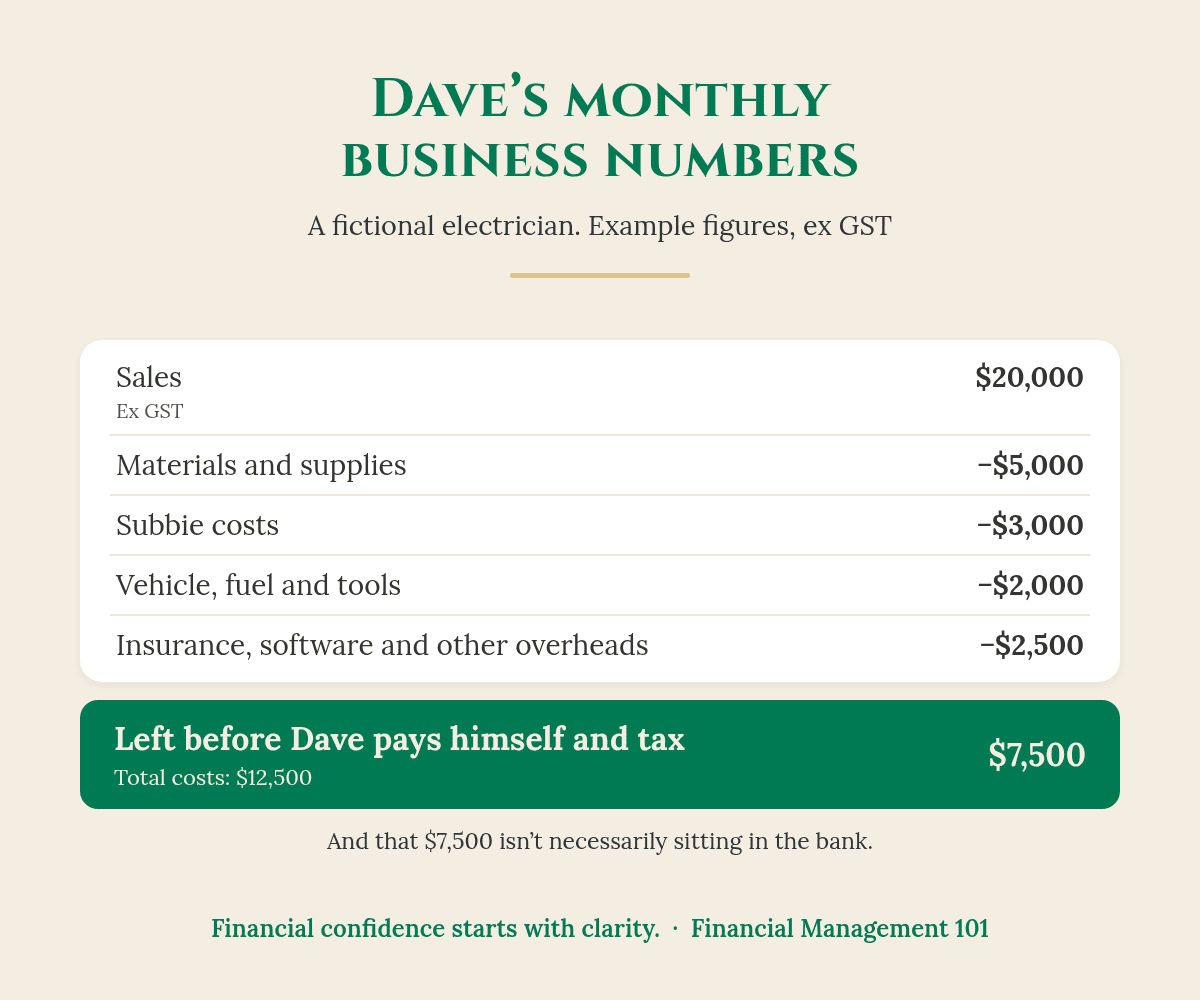
Here’s a typical month for Dave. The figures are an illustration, all excluding GST.
So what does this actually look like?
- Sales: $20,000
- Materials and supplies: $5,000
- Subbie costs: $3,000
- Vehicle, fuel and tools: $2,000
- Insurance, software and other overheads: $2,500
- Total costs: $12,500
- Left before Dave pays himself and tax: $7,500
So Dave’s $20,000 month has become $7,500, and he hasn’t paid himself yet or put anything aside for tax.
Good to know: the figures are ex GST for a reason. At $240,000 a year, Dave is well over the $75,000 GST turnover at which the ATO says you must register for GST (ATO). The GST he charges sits on top of his $20,000 and isn’t his to spend. It goes out with his BAS, so it’s a cash timing issue to plan for, not extra money.
Why isn’t the $7,500 sitting in the bank?
As I say in the video, that “doesn’t necessarily mean $7,500 sitting in the bank.” Some of it may be held up in:
- customers who haven’t paid yet
- bills from last month
- loan repayments
- GST he’s collected and has to pay
- equipment purchases
Profit and cash are related, but they’re not the same thing. If this is the part that keeps catching you out, have a read of Why Is Cashflow Always Tight?
Has Dave just bought himself a very expensive job?
Dave isn’t only the electrician. He’s the business owner, the salesperson, the accounts department, the scheduler and, as I put it in the video, “the bloke answering the phone on a Sunday.” So when he looks at what he’s earning for all those hours and all that responsibility, it’s fair to ask: has he just bought himself a very expensive job?
Money coming in isn’t money you’re making
This is one of the biggest traps I see. Just because a customer pays you $5,000, it doesn’t mean you’ve made $5,000. That’s revenue. What matters is how much you keep after the cost of doing that work and running the business.
That’s why more work isn’t necessarily the answer. If each job doesn’t leave enough behind, more jobs can simply mean more hours, more stress and more money flowing through the account without much staying there. I go deeper on this in Why Is My Business Making Revenue, But No Profit?
Good to know: it isn’t only a tradie thing. In 2024–25, external administrators’ initial reports to ASIC nominated “inadequate cash flow or high cash use” as a cause of failure in 5,446 of 9,585 reports, and “trading losses” in 4,772. More than one cause can be listed in each report (ASIC).
Are you pricing the job but forgetting the business?
A lot of owners price a job like this: the materials, plus the hours, plus a bit on top. But did you allow for:
- insurance
- vehicle costs
- time spent quoting jobs you didn’t win
- hours chasing customers who haven’t paid
- bookkeeping and software
- replacing equipment
Watch out: if a cost isn’t built into your pricing, guess who’s paying for it? As I say in the video, “You are, out of your own pocket.”
Why do so many owners pay themselves last?
Look at who gets paid in Dave’s business: suppliers, subcontractors, insurance, the accountant. And then there’s Dave, the person taking all the risk.
Depending on your structure and your advice, you might pay yourself through wages, drawings or another arrangement. For example, the ATO explains that a sole trader can employ workers but can’t employ themselves (ATO), while a company or trust can pay you a salary, wages or directors’ fees (ATO). Your BAS or tax agent/accountant can tell you what fits your situation.
However you do it, paying yourself shouldn’t be an afterthought. Your business needs to be able to support you, not just everybody else around you. My post Pay Yourself First: The Habit That Transforms Your Business (and Your Life) covers how to build that habit.
What three questions should you ask about your numbers?
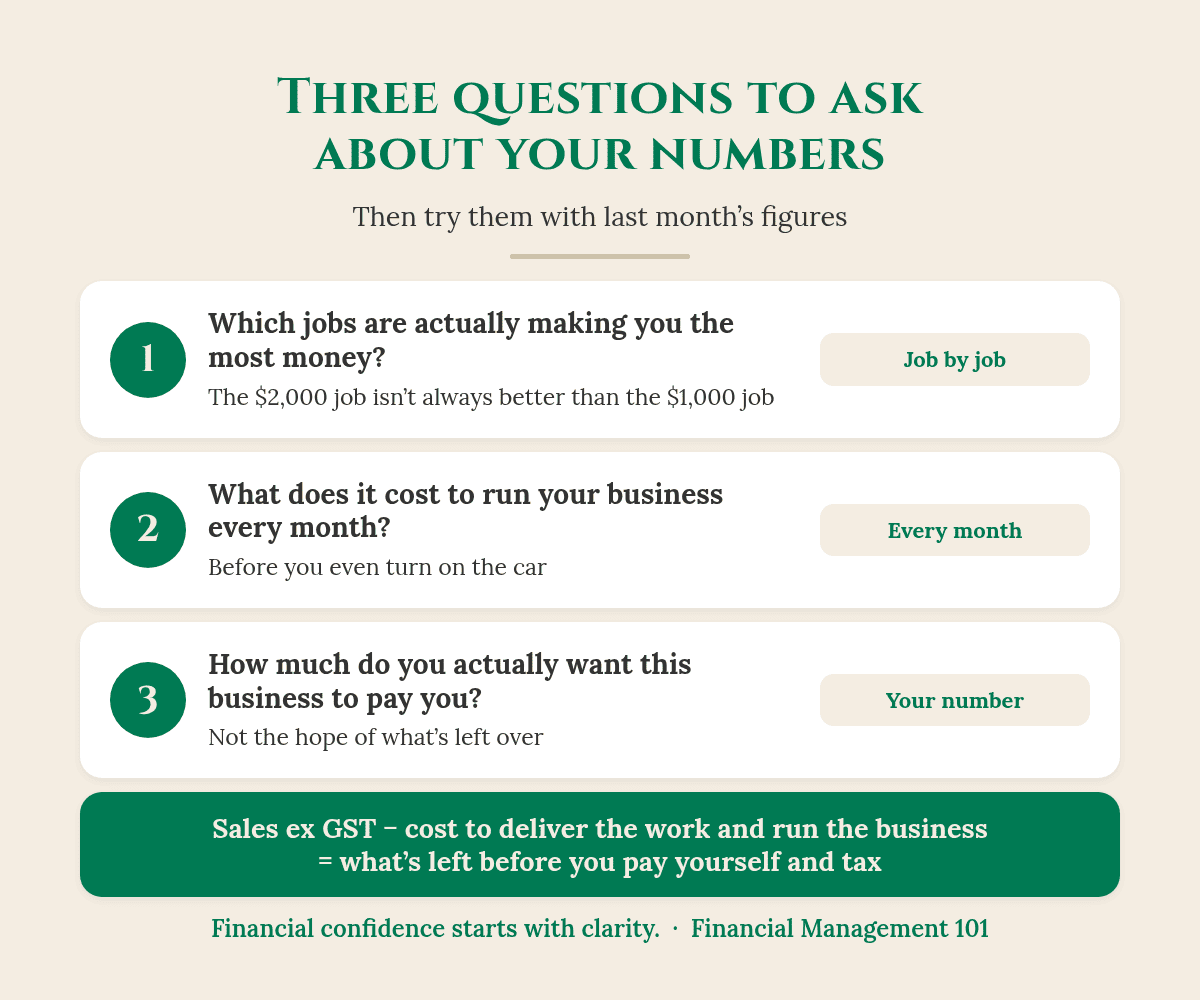
In the video, I give you three questions to sit down with.
- Which jobs are actually making you the most money? The $2,000 job isn’t necessarily a better one than the $1,000 job.
- What does it cost to run your business every month, before you even turn on the car? If you don’t know that number, how can you confidently work out what you should be charging?
- How much do you actually want this business to pay you? Not the hope of what’s left over. A real number, based on your hours, your responsibility and the risks you take.
If you’re not sure which numbers to start with, What Numbers Should A Small Business Owner Track? is a good next read.
What could Dave do differently?
Once Dave can see his numbers clearly, he can start making better decisions. He might:
- adjust his pricing, especially if he hasn’t updated it in 12 months while his material and labour costs have gone up
- stop taking jobs that don’t pay properly. As I say in the video, “You’re not a charity case. You’re a business owner.”
- tighten up his expenses
- get customers paying sooner by bringing his payment terms in
The point isn’t to be perfect. It’s to make those decisions now based on numbers, not on guesswork.
Try this with last month’s numbers
Here’s a simple exercise you can do this week.
- Take last month’s numbers.
- Write down your sales, excluding GST.
- Write down what it cost to deliver the work and keep the business running.
- Work out what was left before you paid yourself and tax.
- Then ask yourself: if I’d worked this many hours for someone else, would I be happy with what I’m earning?
Check this first: make sure you’re not counting any cost twice. For example, don’t include a supplier bill once as materials and again as an overhead.
It’s not a perfect financial analysis, but it’s a really good, comfortable place to start. It might tell you something you’ve been too busy to notice. If something doesn’t look right, take it to your bookkeeper or accountant. They’re the right people to check the detail with you.
As I say at the end of the video, “You didn’t start your business just to be busy. You started to make money, create opportunities, and hopefully enjoy a little bit more freedom.”
Being good at your trade and being good at running a business are two completely different skill sets. And nobody automatically teaches you the second one.
Your takeaway
- Money coming in isn’t money you’re making. What matters is what you keep.
- Price for the whole business, not just the materials and the hours.
- Pay yourself on purpose, not with whatever’s left over.
- Answer the three questions, then try the check with last month’s numbers.
- More work isn’t always the answer. Clear numbers and better decisions usually are.
Want to see where your money is actually going?
Take a sneak peek at The CEO Dashboard – New Look and see how it brings your numbers together in one place.
If you’re flat out and the bank account isn’t matching the effort, book a call with me. It’s a 20-minute chat.
Not ready for a call? Start with The EDGE Business Health Check. It’s a $47 workbook that takes about 20 minutes, covering Profit & Pricing, Cashflow, CEO Visibility, Systems & Freedom, and Growth, with the Profit Leak Calculator to show where money may be slipping away.

Know a business owner who’s busy but broke? Send them this post.
Frequently asked questions
Why is my business busy but I have no money?
Usually because sales aren’t the same as what you keep. Materials, subbies, vehicles, insurance, software, tax and the timing of customer payments all come out first, and many owners don’t build every cost into their pricing or pay themselves on purpose.
Is Dave a real client?
No. Dave is a fictional electrician I use in the video to explain the numbers. The figures are illustrative and exclude GST, but the situation is one I see with real business owners.
Is revenue the same as profit?
No. Revenue is the money customers pay you. Profit is what’s left after the cost of doing the work and running the business. As I say in the video, a $5,000 payment doesn’t mean you’ve made $5,000.
How should I pay myself from my business?
It depends on your structure and circumstances. You might pay yourself through wages, drawings or another arrangement. Talk to your BAS or tax agent/accountant about what fits your situation, and make your pay a planned number rather than whatever’s left over.
What’s a quick way to check if my business is paying me enough?
Take last month’s sales ex GST, take away what it cost to deliver the work and run the business (without counting anything twice), and look at what’s left before you pay yourself and tax. Then ask if you’d be happy earning that for the same hours working for someone else.
You’ve built something real. Financial confidence starts with clarity.
Karen G. Adams
Small Business Performance Strategist, Financial Management 101
This article is general education only. It isn’t financial, tax or legal advice, and it doesn’t take your personal circumstances into account. Dave is a fictional example and his figures are illustrative only, excluding GST. Check your own obligations with your BAS or tax agent/accountant or the ATO.