Why Is My Business Making Revenue, But No Profit?

Why Is My Business Making Revenue, But No Profit?

Revenue is the headline. Profit is the real story. If your sales are growing but the bank account never reflects it, here’s what the numbers are really telling you and what to do about it.

We hear this from business owners more than almost anything else. The invoices are going out. The sales are climbing. Clients are saying yes.

And yet, at the end of the month, there’s nothing left over. No breathing room. No reward for the hours going in.

If that’s you right now, we want you to hear this first: you’re not behind, and you’re not bad with money. You just haven’t had visibility on what’s actually happening between “money in” and “money left”. That’s a numbers problem, not a you problem and it’s fixable.

By the end of this, you’ll know the five most common reasons revenue and profit stop matching up, and exactly where to look first in your own business.

1. You’re pricing on gut feel, not margin

Most small business owners set their prices once, early on, based on what felt fair or what a competitor charged. Costs have moved since then supplies, wages, software, fuel, but the price hasn’t.

Every sale can look like a win on paper while quietly making you less than you think. Growing revenue with a shrinking margin doesn’t build a more profitable business. It just makes the problem bigger, faster.

Check this first: work out your gross profit margin on your top three products or services. If you don’t know that number off the top of your head, this is where to start.

2. Overheads have crept up quietly

Subscriptions renew. Rent increases. A “temporary” extra cost becomes permanent. None of these show up as one big decision, they show up as a hundred small ones, none of which felt worth questioning at the time.

Revenue can grow 20% while overheads grow 25%, and the business will still feel busier and further behind at the same time.

Check this first: list every recurring cost and ask, honestly, whether it’s still earning its place.

Your Overheads Didn’t Explode. They Quietly Crept Up.

3. You’re paying yourself last, or not consistently

Many owners take whatever’s left after everything else is paid, rather than a set wage. When there’s nothing left, that becomes the norm.

The trouble is, “whatever’s left” isn’t profit. It’s just what happened to survive the month. Without a wage built into your costs, you can’t actually see whether the business itself is profitable, because you’re the buffer absorbing the gap.

Check this first: build a wage for yourself into your cost base, even if you can’t take the full amount out yet. It changes what your numbers are really telling you.

4. Cash flow timing is hiding the truth

Cash in the bank and profit are not the same thing, even though they feel like they should be. A big invoice landing this week can make things look healthy, while a supplier payment or tax bill due next week tells a different story.

We business owners often read our bank balance as our scoreboard. It’s an important number, it’s just not the whole picture.

Check this first: look at your profit and loss statement, not just your bank balance, to see the real trend over the last three to six months.

5. You don’t have regular visibility on your numbers

This is the one underneath all the others. If you’re not reviewing your numbers on a consistent rhythm, small issues stay invisible until they’re big ones. Most owners find out something’s wrong months after it started, simply because nobody was looking.

Clarity doesn’t come from working harder. It comes from a regular, honest look at what the numbers are actually saying.

The Takeaway

Revenue growing while profit stalls is almost never one dramatic mistake. It’s usually five small, ordinary things happening at once; pricing, overheads, your own wage, cash timing, and visibility.

The good news is that each one is a decision you can revisit, not a personality flaw you have to fix. A better business creates a better life, and that starts with seeing clearly what’s really going on in yours.

If you want a clear, honest read on where your own numbers stand, that’s exactly what the Business Health Check is for.
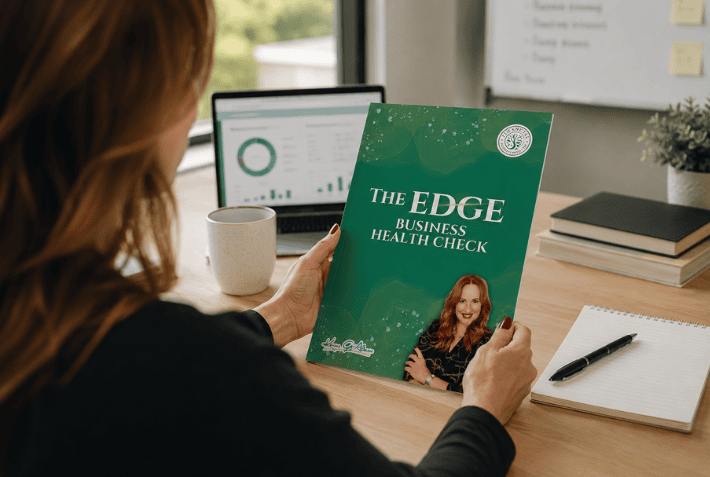
The Edge Business Health Check

#HowToResetMyMoneyMindset #NewYearFinancialMindset #HowToStartFreshWithMoney  emergency fund australia, money management, family savings #SmallBusinessOwner #BusinessGrowth #CashflowManagement #BusinessSuccess
#EntrepreneurMindset
 

Busy Doesn’t Pay the Bills

Busy Doesn’t Pay the Bills

You worked sixty hours last week. So why does the bank account look like you worked twenty?

This is the one nobody wants to say out loud at the barbecue – being busy and being profitable are two completely different things, and most small business owners have spent years chasing the wrong one without realising it, because busy is the one everyone can see and profit is the one hardly anyone talks about.

We wear “flat out” like a badge of honour around here. Full calendar, full inbox, full plate, barely time for lunch, home late again. It’s practically a competitive sport among business owners, whoever’s had the wildest week wins some invisible prize. But a full calendar doesn’t automatically mean a full bank account, and that gap is exactly where the frustration lives, working harder than you ever have and still not seeing it show up where it counts, still lying awake doing mental maths that never quite adds up the way it should.

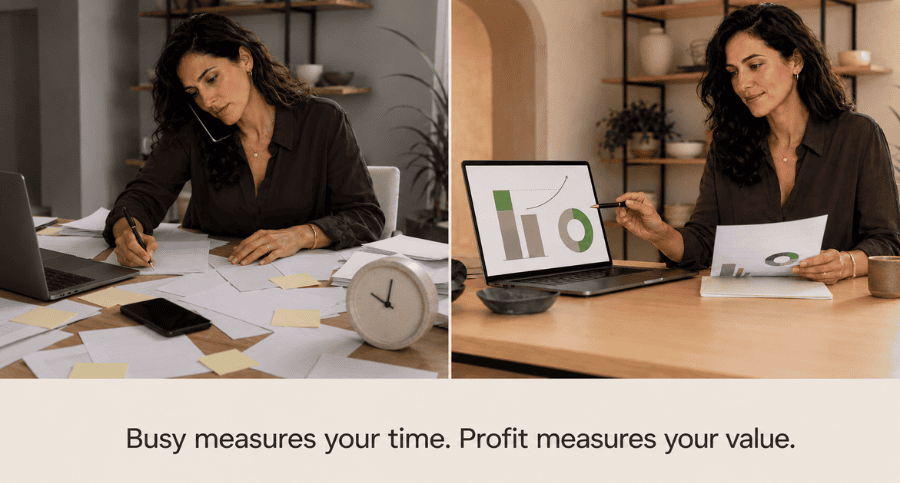
Busy measures your time. Profit measures your value.

Busy measures your time. Profit measures your value.

You can be fully booked out doing work that barely covers what it costs you to deliver it. Being busy tells you the calendar’s full. It tells you nothing about whether the business is actually working for you, or just working you into the ground while quietly running on thin margins nobody’s checked in a while.

I’ve sat across from business owners who were, by any outside measure, wildly successful booked out months in advance, a great reputation, more work than they could handle. And they were barely paying themselves properly, because nobody had ever sat down and worked out what each job actually needed to cost to make the whole thing worthwhile. Busy had completely disguised the real story, right up until it couldn’t any more.

Why busy feels so convincing

Part of the problem is that being busy comes with all the physical evidence of hard work; the tired legs, the full diary, the late nights. It feels like proof that things are going well, because it’s the same feeling we’ve always associated with success. Profit, on the other hand, is quiet. It doesn’t announce itself the same way. You don’t feel a profitable decision the moment you make it, the way you feel a long day in your bones. So busy wins the argument for attention, even when it’s not actually the one that matters most.

The trap of “just get more clients”

There’s a piece of advice that gets handed around a lot in small business circles – “just get more clients, that’ll fix it.” I’ll be straight with you, it’s tired advice, and it’s rarely true. More clients on top of an unprofitable structure just means more busy, at the same thin margin, with a lot more stress bolted on top. You’ve simply built a bigger version of the same leaky bucket. Fix the structure first. Scale it after, not before, otherwise you’re just working harder to stand still, faster, and wondering why the extra effort never seems to catch up.

What actually moves the needle

It’s rarely one big dramatic change. More often it’s a handful of smaller, unglamorous ones done properly knowing what a job genuinely costs before you quote it, building in a bit of buffer instead of pricing to the bone, saying no occasionally, following up on the money you’re owed without embarrassment. None of these make for an exciting headline. All of them, done consistently, add up to a business that reflects the effort going into it.

A small shift that changes a lot

Before you say yes to the next job, the next client, the next “quick favour” that somehow always turns into three hours of your Saturday, check what it’s actually worth once the real costs are factored in. Time, materials, the admin it drags behind it, the toll it takes on the rest of your week. Sometimes the most profitable move you can make is saying no to something that is busy without adding a cent of real profit, and saying yes instead to fewer things, done properly, priced properly.

You’re not behind, and you’re certainly not lazy. You’ve just never had proper visibility on which parts of the business are working for you and which parts are quietly working against you while you’re too busy to look. Once that becomes clear, the decisions get so much easier genuinely, not in a “just think positive” way, but in a very practical, this-is-what-the-numbers-actually-show kind of way.

The uncomfortable question worth asking

Here’s one worth sitting with for a minute; if your business stayed exactly this busy for the next twelve months, with nothing else changing, would you actually be better off this time next year? Not busier. Better off. More profit in the bank, more breathing room, more choice in what you say yes to.

For a lot of business owners, the honest answer is “not really,” and that’s an uncomfortable thing to admit after all the hours that have gone in. But it’s also the most useful question you can ask, because it points you toward the actual fix, which is almost never “do more of the same, just harder.”

The Edge Business Health Check

Redefining what a good week looks like

We’ve been taught, somewhere along the way, that a good week in business is a full one. Every hour booked, every day accounted for, home late most nights because that’s what commitment apparently looks like. It’s worth challenging that definition, because a genuinely good week isn’t the one with the most hours in it – it’s the one that moved the business forward the most, profitably, without costing you your evenings and your patience along the way.

That might mean fewer hours worked, not more. It might mean turning down the client who’s more trouble than they’re worth, even though saying yes would have made the calendar look fuller. A full calendar looks impressive from the outside. A profitable, sustainable one is the one that actually serves you.

That visibility is exactly what The Edge Business Health Check gives you, in about fifteen minutes flat.

#HowToResetMyMoneyMindset #NewYearFinancialMindset #HowToStartFreshWithMoney  emergency fund australia, money management, family savings #SmallBusinessOwner #BusinessGrowth #CashflowManagement #BusinessSuccess
#EntrepreneurMindset
 

Your First Quarter Report Card

Your First Quarter Report Card

July, August, September – done and dusted, more or less. So how’s the new financial year actually going? Not “how busy have you been.” How’s it going?

Most business owners can rattle off exactly how flat out they’ve been since July; the jobs, the clients, the late nights. Fewer can tell you how profitable they’ve been over the same stretch. And that gap between “flat out” and “actually ahead”, is exactly where a quick quarter check-in earns its keep. It’s the difference between a business that feels busy and a business you can actually prove is moving forward.

Nobody waits for the end-of-year school report to find out how a kid’s tracking. You check in along the way – a note home, a parent-teacher chat, a quiet word, and adjust before it becomes a bigger conversation. Your business deserves the same courtesy. Not a full audit, not a forensic dive into every transaction, just an honest look at the first three months of the new financial year, before you’re four quarters deep wondering where it all went and why the number at tax time doesn’t match the effort you know you put in.

Why most business owners skip this

It’s not laziness. It’s usually one of two things, either it feels like it’ll take hours you don’t have, or there’s a quiet fear of what it might show. Both of those assumptions tend to be wrong. This exercise takes less time than a coffee catch-up, and more often than not, the number is somewhere between “not as bad as I feared” and “better than I gave myself credit for.” The dread is almost always worse than the discovery.

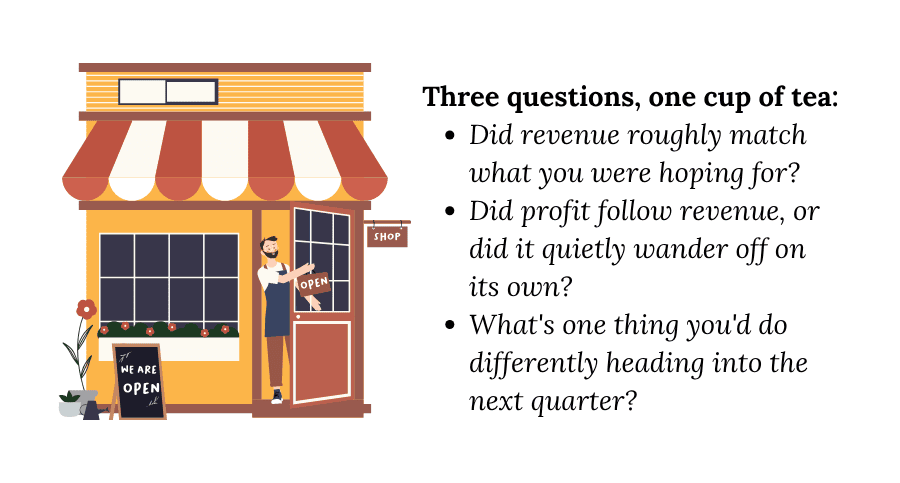
Three questions, one cup of tea

Three questions, one cup of tea

Did revenue roughly match what you were hoping for? Doesn’t need to be precise; ahead, on track, or behind is enough of an answer for now. And if you realise you never actually set a target for the quarter, that’s not a failure, it’s just a perfectly good place to start next time. You can’t be ahead or behind a target that doesn’t exist.

Did profit follow revenue, or did it quietly wander off on its own? This is the one that catches people out most often, and it’s the one I see most in this line of work. Revenue climbs, everyone’s thrilled, the calendar’s fuller than ever and then the bank balance doesn’t quite reflect it, because costs crept up right alongside the growth without anyone clocking it. Materials went up. A subcontractor’s rate went up. You took on a bit more admin help. None of it felt like a big decision at the time, but added together it’s eaten the extra revenue and then some. If you’ve felt busier than ever this quarter but the numbers don’t quite match the feeling, this is usually why.

What’s one thing you’d do differently heading into the next quarter? Not five things, just one! Trying to fix everything at once is how good intentions turn into nothing changing at all. Maybe it’s pricing, which almost every business owner I meet is quietly undercharging on. Maybe it’s chasing invoices a little sooner instead of letting them drift. Maybe it’s finally looking at where the money’s actually going instead of guessing based on vibes and a general sense of dread. Pick the lever that would move things most, and leave the rest for next quarter’s version of this exercise.

What to do with what you find

If the quarter came in ahead, resist the urge to immediately spend the difference on something exciting. Sit with it for a bit. Ask whether it’s a genuine trend or a one-off good stretch before you build plans around it. If it came in behind, resist the opposite urge, the spiral into “the whole business is failing.” One quarter is one quarter. It’s a data point, not a verdict. The value isn’t in the number itself, it’s in what the number tells you to look at next.

Why quarterly, specifically

A quarter is a genuinely good length of time to check in on; long enough to see a real pattern rather than a one-off blip, short enough to actually change course while it still matters. Check monthly and you risk reacting to noise, a slow week that means nothing, a good week that means nothing either. Check yearly and you find out too late to do much about it. Quarterly sits right in the sweet spot, giving you enough information to trust it, and enough time left in the year to actually act on it.

The business owners I see making calmer, more confident decisions are almost always the ones checking in quarterly, not just at tax time when the accountant delivers the number and there’s nothing left to do but accept it. Checking quarterly puts you back in the driver’s seat of your own financial year, rather than a passenger finding out where you ended up after the fact.

If you’d like a proper look under the bonnet, the CEO Dashboard gives you full visibility on exactly how the quarter really went not the guessed version, the real one.

Turning it into a rhythm

The businesses that get the most out of this aren’t doing anything clever, they’ve just made it a rhythm rather than a rescue mission. Same week each quarter. Same three questions. Same short list of actions afterwards. It stops being a big, dreaded event and becomes something closer to a habit, the business equivalent of a regular check-up rather than an emergency room visit.

If this is the first time you’ve done a proper quarter check-in, don’t worry about making it perfect. The value isn’t in precision, it’s in the act of actually stopping to look, on a schedule, instead of only looking when something’s gone wrong enough to force your hand.

Setting yourself up for next quarter

Before you close the laptop on this exercise, write down one number you’ll check again in three months. Just one. Revenue, profit margin, average invoice value, whatever feels most relevant to where you are right now. Having that one number in mind gives the next quarter’s check-in a head start, because you’ll already know what you’re comparing against instead of starting from scratch each time.

Small, consistent check-ins beat big, occasional audits every time. That’s true of your car, your health, and it’s absolutely true of your business.

The CEO Dashboard

#HowToResetMyMoneyMindset #NewYearFinancialMindset #HowToStartFreshWithMoney  emergency fund australia, money management, family savings #SmallBusinessOwner #BusinessGrowth #CashflowManagement #BusinessSuccess
#EntrepreneurMindset
 

Father’s Day and the Business Owner Who Can’t Switch Off

Father’s Day and the Business Owner Who Can’t Switch Off

Happy Father’s Day to every business owner who “just needs to check one email” during the barbecue.

You know the scene. Phone face-down on the table, out of principle. Two minutes later, face-up again. “Just checking something quick.” Forty-five minutes later, still checking, while someone’s asking if you want another sausage and you’re not entirely sure you heard them the first time.

Here’s the bit nobody says out loud; if you genuinely can’t switch off for one Sunday, it’s not because you’re dedicated, it’s because something in the business is relying entirely on you being switched on, all the time. That’s not commitment. That’s a business that hasn’t had its systems built yet, quietly telling on itself every time your phone lights up at a family lunch.

I say this with love, because I’ve been that person too. There’s a particular kind of guilt that creeps in when you’re not checking, like something’s about to fall over the second you look away. Sometimes it will. That’s actually useful information, not a personality flaw. It tells you precisely where the weak point is, rather than leaving you to vaguely feel like you should “be better at switching off,” which is advice with nothing practical underneath it.

Happy Father's Day to every business owner who "just needs to check one email" during the barbecue.

It’s not a discipline problem

Most business owners think the fix is “just try harder to unplug.” Buy a nicer phone case, set a screen time limit, promise yourself Sunday is sacred. And then Sunday arrives and none of it holds, because the willpower was never the actual problem.

You can’t discipline your way out of a business with no systems, no visibility, and nobody else who knows where anything lives. If you’re the only one who knows the client’s login, the only one who knows how the invoicing actually works, the only one who can answer “did that order go out,” then of course you can’t switch off – you’re not being undisciplined, you’re being the entire operations department in one exhausted human body.

The phone-checking isn’t the actual problem. It’s just the symptom you can see. Fixing the symptom without fixing the cause is like taking the batteries out of a smoke alarm because the beeping is annoying.

What it costs, quietly

There’s a cost to this that doesn’t show up on the profit and loss but shows up everywhere else. It shows up in the conversation you half-listened to. The moment with the kids you were technically present for but not really in. The mate who stopped inviting you to things because you always seemed distracted, or cancelled at the last minute, or spent the whole time with one eye on your phone. None of that gets tracked anywhere. It just quietly accumulates until one day you notice the gap.

The real question to ask

The more useful question isn’t “how do I switch off more.” It’s “what would genuinely happen today if I didn’t check my phone at all?” If the honest answer is “everything would fall apart”, that tells you exactly where the gaps are. Not a criticism. A map.

Sit with that answer for a second. Is it really everything, or is it one or two specific things? Usually, when people actually write it down, the list is shorter than the panic suggested. There’s something almost funny about how big the fear feels compared to how short the actual list turns out to be once it’s on paper instead of in your head.

Building the buffer, one piece at a time

You don’t need to overhaul the whole business in a weekend to get some breathing room back. Start with the smallest, most repeated interruption, the thing that pulls you out of family time most often and ask what it would take to hand even part of that off. A simple checklist someone else can follow. A shared login instead of a personal one. An automated reminder instead of you personally remembering. None of these are big, dramatic fixes. They’re small, boring, unglamorous changes, and they’re exactly the ones that actually stick.

One small fix before the next family day

Before your next family day, try this. Write down the three things that would actually need you if they went sideways. Then ask yourself, honestly, whether one of those three could be handled by a simple checklist, a bit of automation, or someone else entirely, instead of by you personally, every single time. Fix one. That’s next Father’s Day a little more sorted than this one and the one after that, a little more sorted again. This isn’t a one-weekend fix. It’s a habit of slowly handing things off until your presence isn’t the only thing holding the whole operation together.

A better business creates a better life and a better life includes actually being at the barbecue, present for the conversation, not just physically there while mentally reconciling last month’s invoices.

The version of success worth aiming for

There’s a version of business success that gets celebrated a lot, the one measured in revenue, growth, how many staff you’ve got, how big the operation’s gotten. It’s a fine measure, as far as it goes. But it misses something important, which is whether the person who built all of that can actually enjoy a Sunday without their phone glued to their hand.

I’d argue the better measure of success is this – can you take a full day off, properly off, and come back to a business that’s still standing, without having spent the whole day half-present because part of you never left? That’s a much harder thing to build than revenue, and it’s a much better thing to have.

Building the systems that let you switch off isn't a luxury add-on. It's kind of the whole point of doing this in the first place.

Kids notice more than we think

There’s a particular moment a lot of business-owner parents have at some point; a kid saying something like “you’re always on your phone,” delivered completely matter-of-factly, no drama attached, which somehow makes it land harder than if they’d shouted it. Kids don’t measure your love by how hard you’re working for their future. They measure it by whether you were actually there when they wanted to tell you something, show you something, or just have you sitting next to them doing nothing in particular.

That’s not a guilt trip, plenty of us are working exactly because we want a better life for them. It’s just worth remembering that the “better life” bit doesn’t only mean money down the track. It means you, actually present, more often than not.

Building the systems that let you switch off isn’t a luxury add-on. It’s kind of the whole point of doing this in the first place.

If you want help working out exactly where your business is leaning on you too hard, The CEO Dashboard is built for precisely that, a clear look at what’s actually relying on you, and what could run perfectly well without you for a Sunday afternoon.

The CEO Dashboard

#HowToResetMyMoneyMindset #NewYearFinancialMindset #HowToStartFreshWithMoney  emergency fund australia, money management, family savings #SmallBusinessOwner #BusinessGrowth #CashflowManagement #BusinessSuccess
#EntrepreneurMindset
 

R U OK? (The Question You Never Ask Yourself)

R U OK? (The Question You Never Ask Yourself)

On September 10, most of Australia will be asking each other “R U OK?” Workplaces will run morning teas. There’ll be yellow everywhere. It’s a genuinely good day, and I’m glad it exists – it’s done a lot for getting these conversations out into the open where they belong, after years of them staying firmly behind closed doors.

But here’s the question I actually want to ask you, business owner to business owner… when’s the last time you asked yourself that?

We’re brilliant at checking in on everyone else. Staff, clients, family, that one supplier who always sounds a bit frazzled on the phone. But most business owners I talk to haven’t had an honest conversation with themselves in months. We’re too busy holding everything together to notice we might not be, ourselves. We’re the ones people come to when something’s gone wrong, which means we’ve quietly trained everyone around us, including ourselves to believe we don’t need checking on.

Running a business is one of the loneliest jobs going, if I’m honest. You’re the one everyone brings their problems to. There’s rarely anyone bringing you theirs, asking how you’re actually tracking underneath it all. Even the people who love you tend to ask “how’s the business going?” rather than “how are you going?” and those are very different questions with very different answers.

The performance of “fine”

There’s a particular skill business owners develop without meaning to, the ability to say “yeah, good, flat out” in a completely convincing tone while privately feeling anything but. It becomes automatic. Someone asks how you’re going at the school pickup, at the football, at a client meeting, and out it comes before you’ve even thought about it. Over time, that automatic answer starts to replace the honest one, even in your own head. You stop checking because you’ve gotten so good at performing that you don’t seem to need it.

So today, let’s flip it. Three questions, and actual permission to answer them properly, without the reflexive “yeah, good, flat out” that we all give without thinking.

Am I okay, or am I just coping?

There’s a real difference. Coping looks like getting through the week in one piece, ticking things off, keeping the wheels on. Okay looks like genuinely enjoying the thing you built, feeling proud of it, curious about where it’s going, energised rather than depleted by it. If you’ve been in coping mode for a while now, that’s worth noticing, not brushing off with “it’s just a busy season,” because busy seasons have a habit of becoming permanent if nobody names them.

There’s no shame in “coping” as an honest answer. It’s often the truest thing a business owner has said about themselves in months, once they finally stop and let themselves say it. The shame only comes from pretending otherwise for too long.

What am I carrying that I haven't said out loud?
For a lot of business owners, it's the money. The gap between what the business brings in and what it feels like it should be bringing in by now, given how hard you're working.

What am I carrying that I haven’t said out loud?

For a lot of business owners, it’s the money. The gap between what the business brings in and what it feels like it should be bringing in by now, given how hard you’re working. That gap is heavy to carry on your own, and you really don’t have to. I’ve had conversations with business owners who’ve been sitting on that particular worry for years, silently, because it felt embarrassing to say out loud, like admitting it meant admitting they’d failed at something. It’s not embarrassing. It’s incredibly common, and it’s fixable once it’s actually spoken about, usually far more fixable than the years of silent worry suggested.

Sometimes what people are carrying isn’t even the money itself, it’s the fear of what the money says about them. That’s a heavier load than the actual numbers ever are.

Who’s actually in my corner?

Not staff. Not clients. I mean the people who ask how you’re going, not just how the business is going. If that list is short, that’s your sign; a mentor, a community, or even just a standing coffee with someone who genuinely gets what this life is like. Business ownership can be surprisingly isolating even when you’re surrounded by people all day, because being surrounded by people isn’t the same as being known by them.

The physical signs worth noticing

Sometimes the “am I okay” question is easier to answer by looking at the body rather than the mind. Are you sleeping properly, or lying awake running through tomorrow’s problems? Are you short-tempered with people who don’t deserve it? Have you stopped doing the small things that used to recharge you – the walk, the round of golf, the Sunday paper, because there’s “no time”? These aren’t small details. They’re often the clearest signal available that the tank’s getting low, well before the mind is ready to admit it in so many words.

It’s okay to not have the answer yet

If you sat with those three questions and didn’t love your answers, that’s not a failure, that’s information. The whole point of asking is so you can actually do something with what you find, rather than carrying it around unexamined for another six months. Awareness on its own doesn’t fix anything, but it’s the step that has to come first, and it’s the step most business owners skip entirely because it’s uncomfortable.

You can’t run a healthy business from an empty tank. Checking in on yourself isn’t soft, whatever the old-school hustle crowd would have you believe, it’s strategy, plain and simple. A business owner who’s running on empty makes worse decisions, snaps more easily, and enjoys less of what they’ve built. None of that helps the business either – it’s not a trade-off between looking after yourself and looking after the business. They’re the same job.

And if part of what’s weighing on you is the money side of things, that’s exactly what The Edge exists for. A place where you’re not carrying it solo, surrounded by other business owners asking each other the real questions instead of the polite ones.

Join The Edge: https://financialmanagement101.com.au/work-with-karen/the-edge/

And if today’s the day you actually need to talk to someone, Lifeline is on 13 11 14, any hour, no appointment needed.

What to do once you’ve asked yourself

Asking the question is the easy part, once you’ve actually made yourself do it. The harder part is what comes next, because most business owners are excellent at identifying a problem and then filing it away under “deal with that eventually.” So if any of the three questions above landed a bit close to home, don’t let it end there.

Pick one small thing. Not a complete overhaul of your life, not a dramatic announcement to everyone that you’re “making changes.” One small thing; a call to a friend you’ve been meaning to make, an actual look at the money situation you’ve been avoiding, a boundary around one evening a week that’s just yours. Small, specific, doable this week, not “someday.”

Business owners checking in on business owners

Business owners checking in on business owners

There’s a particular kind of relief that comes from talking to someone else who genuinely understands what this life involves – the highs that nobody else quite gets excited about the way you do, and the lows that nobody else quite understands the weight of either. Friends and family love you, but unless they’ve run a business themselves, there’s a layer of it they simply can’t relate to, however much they try.

That’s part of why community matters so much here. Not a support group in the clinical sense, just other people in the same boat, who ask “how are you really going” and actually mean it, who’ve had the sleepless nights over cash flow and the quiet pride over a client win, and who get it without you having to explain the whole backstory first.

THE EDGE Membership

#HowToResetMyMoneyMindset #NewYearFinancialMindset #HowToStartFreshWithMoney  emergency fund australia, money management, family savings #SmallBusinessOwner #BusinessGrowth #CashflowManagement #BusinessSuccess
#EntrepreneurMindset
 

How Do I Build a Business That Runs Without Me?

How Do I Build a Business That Runs Without Me?

The biggest obstacle to growing your business might not be your team, your systems, or your customers. It might be you.

When I ask business owners why they started their business, the answers are usually very similar.

“I wanted more freedom.”

“I wanted to spend more time with my family.”

“I wanted to be my own boss.”

“I wanted to build something for myself.”

“I wanted more flexibility.”

It’s a dream shared by almost every entrepreneur.

The irony is that somewhere along the journey, many business owners created exactly the opposite.

Instead of building freedom, they build dependence.

Not dependence on customers.

Not dependence on suppliers.

Dependence on themselves.

Without even realising it, they become the person every decision revolves around.

  • Every quote has to be approved by them.
  • Every customer problem lands on their desk.
  • Every invoice needs their attention.
  • Every staff member waits for direction.
  • Every decision, big or small, pauses until the owner says yes.

Then one day they say something I’ve heard hundreds of times.

“I can’t even take a week off.”

If you’ve ever felt like that, I want you to know something.

It doesn’t mean you’ve built a bad business.

It means you’ve built a business that’s become too dependent on one person.

And that person is you.

The Business You Built Has Started Owning You

There’s a moment in almost every business owner’s journey when the excitement of starting a business begins to fade.

The adrenaline has gone.

The novelty has worn off.

Instead of feeling like the owner, you feel like the busiest employee.

Your day becomes a constant stream of interruptions.

Emails.

Phone calls.

Staff questions.

Customer issues.

Approvals.

Problems.

By the time you sit down to work on something important, another interruption arrives.  

At the end of the day, you’re exhausted, but you struggle to explain what you actually achieved.

Sound familiar?

Here’s the truth. You’re probably not disorganised.You’re overloaded.

More importantly, you’ve become the centre of every decision in your business.

That’s not leadership.

That’s dependency.

And dependency is expensive.

The Business You Built Has Started Owning You

Every Time Your Business Stops When You Stop… You’ve Found a Bottleneck

Imagine walking through a factory.

Every machine is operating beautifully until suddenly everything comes to a halt.

You look around and discover one conveyor belt has stopped.

Every machine behind it is waiting.

Nothing can move until that one bottleneck starts again.

Businesses work exactly the same way.

Sometimes the bottleneck isn’t a machine.

It’s the owner.

If every quote waits for you…

You’re the bottleneck.

If every customer issue comes back to you…

You’re the bottleneck.

If every team member needs your approval…

You’re the bottleneck.

If nobody can make a decision unless you’re in the office…

You’re the bottleneck.

The difficult part is that most owners become the bottleneck because they care.

They want things done properly.

They’ve worked hard to build their reputation.

They believe no one will care as much as they do.

And they’re probably right.

Nobody will.

But that doesn’t mean nobody else can do an excellent job.

Why Smart Business Owners Accidentally Limit Their Own Growth

This is one of the biggest mindset shifts I teach.

Your value to the business changes as the business grows.

When you first start, your value comes from doing the work:

  • You’re wearing every hat.
  • You’re selling.
  • Delivering.
  • Quoting.
  • Marketing.
  • Bookkeeping.
  • Cleaning the office.
  • Making the coffee.

That’s perfectly normal.

But if you’re still doing all of those things five or ten years later, the business hasn’t evolved.

You’ve simply become busier.

Growth requires a different version of you.

Instead of doing everything… You start designing everything.

Instead of solving every problem… You build systems that prevent problems.

Instead of answering every question… You teach your team how to find the answer.

Instead of making every decision…You create clear guidelines that empower others to decide confidently.

That’s the transition from technician to CEO.

It’s one of the hardest transitions in business.

It’s also one of the most rewarding.

Control Feels Safe… Until It Doesn’t

Many owners tell me they struggle to let go because they’re afraid standards will drop.

I understand that.

You’ve spent years building your reputation.

But here’s the question I often ask.

What’s costing your business more?

The occasional mistake someone else might make, or the hundreds of decisions waiting for you every single week?

Perfection often becomes the enemy of growth. Healthy businesses don’t expect perfection. They build consistency. Consistency comes from systems.

Not superheroes.

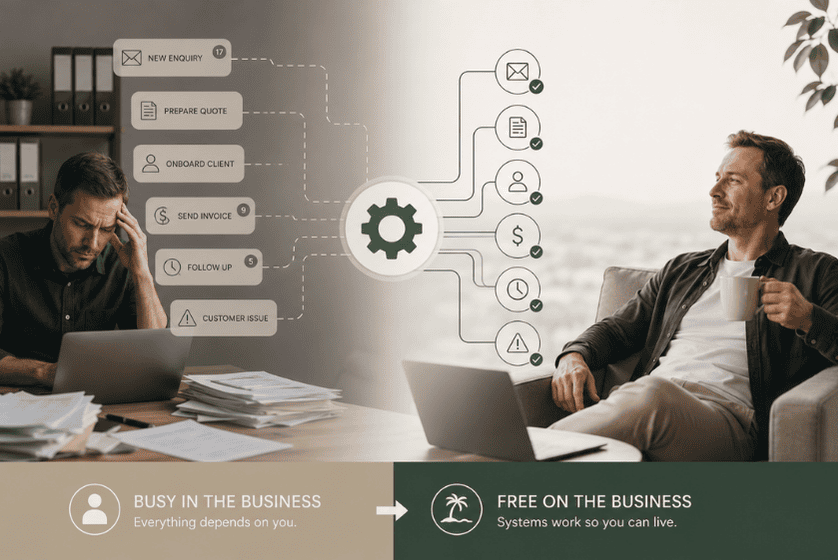
Systems Create Freedom

People often hear the word “systems” and imagine thick manuals gathering dust on a shelf.

That’s not what I mean.

A system is simply the best way of doing something.

  • How do you answer enquiries?
  • How do you prepare quotes?
  • How do you onboard new clients?
  • How do you invoice?
  • How do you follow up overdue accounts?
  • How do you manage customer complaints?

Every time you repeat something, you have an opportunity to build a system.

Every system removes another decision from your day.

Over time those small improvements compound.

Eventually your business begins solving problems without needing you in the middle of every conversation.

That’s where freedom begins.

The True Test of a Healthy Business

One of my favourite questions to ask business owners is this:

“What would happen if you disappeared for four weeks?”

Most laugh.

Then they answer honestly.

“It would fall apart.”

Imagine if the opposite were true. Imagine taking a holiday knowing your team understood their roles. Customers were looked after. Invoices still went out. Cashflow continued. Problems were solved. Business continued.

Not because you weren’t important. But because you’d built something bigger than yourself.

That’s the difference between owning a job and owning an asset.

Building a Business That Someone Would Actually Buy

Many owners tell me they’ll sell their business one day.

Then I ask another question.

“What exactly would someone be buying?”

Silence.

Because if the owner is doing everything…

The buyer isn’t purchasing a business.

They’re purchasing a job.

Businesses become valuable when they can operate consistently without relying on one individual.

That’s why scalability and saleability go hand in hand.

The less dependent your business is on you, the more valuable it becomes.

Not only to a future buyer.

But to you.

Because suddenly you have choices.

  • You can step back.
  • You can grow.
  • You can take a holiday.
  • You can spend more time with family.
  • You can focus on strategy instead of survival.

That’s what business ownership was supposed to feel like.

The EDGE Philosophy

Everything I teach comes back to one simple belief.

Businesses shouldn’t just survive. They should create freedom.

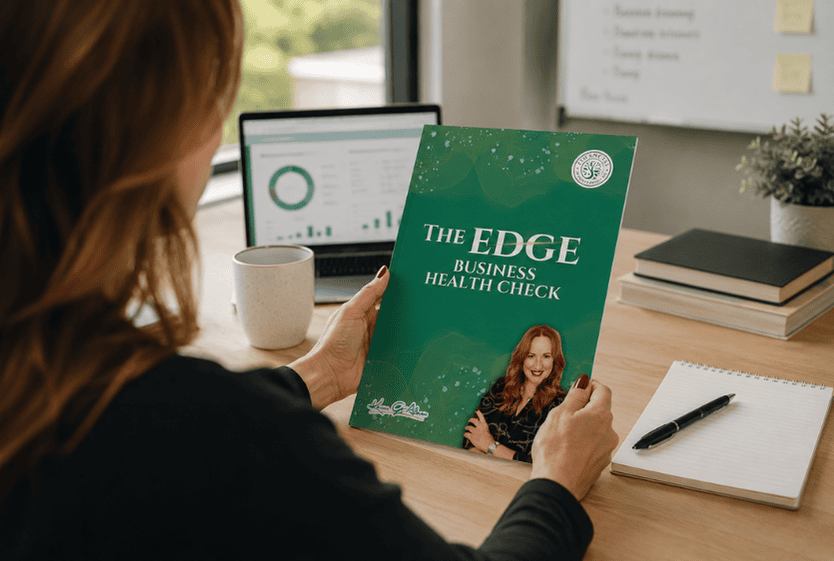
That’s why The EDGE Business Health Check exists.

It’s not simply measuring financial performance. It’s measuring the health of the business.

Healthy businesses don’t rely on luck. They don’t rely on heroic owners working eighty-hour weeks.

They rely on visibility.

Strong systems.

Clear leadership.

Healthy cash flow.

Profitable decisions.

And owners who understand that their role is no longer to be involved in everything.

Their role is to build a business that can thrive because of the foundations they’ve created.

Your Greatest Opportunity

If you’ve recognised yourself somewhere in this article, I hope you don’t feel discouraged.

I hope you feel encouraged.

Because the fact that you’ve become the bottleneck doesn’t mean you’ve failed. It means your business has reached a point where it needs a different version of you.

The next stage of growth isn’t about working harder. It’s about leading differently. It’s about trusting your team. Building systems. Understanding your numbers. Making decisions based on evidence, and gradually removing yourself from the centre of every process.

That’s not stepping away from your business.

That’s stepping into your true role as its leader.

One day, I hope you look back and realise that the greatest investment you ever made wasn’t another marketing campaign or another piece of equipment.

It was learning how to build a business that didn’t need you every minute of every day.

Because that’s when something remarkable happens.

You stop owning a job.

You start owning an asset.

And that’s the moment your business begins giving you what you wanted all along.

Freedom.

Ready to discover whether you’re the biggest bottleneck in your business?

The EDGE Business Health Check helps you identify the areas that are limiting growth – from leadership and systems to cashflow, profitability and visibility. In less than 20 minutes, you’ll receive your Business Health Score and discover practical opportunities to build a business that’s more profitable, more scalable, more sustainable. and ultimately, more saleable.

Because healthy businesses don’t just happen.

They are built – one better decision at a time.

Systems Create Freedom
The EDGE Business Health Check helps you identify the areas that are limiting growth - from leadership and systems to cashflow, profitability and visibility.

#HowToResetMyMoneyMindset #NewYearFinancialMindset #HowToStartFreshWithMoney  emergency fund australia, money management, family savings #SmallBusinessOwner #BusinessGrowth #CashflowManagement #BusinessSuccess
#EntrepreneurMindset