The van keys are going on the hook for two weeks, the phones are going to voicemail, and the team is already talking about the beach. Then the question lands: do I have to pay my staff over the Christmas shutdown? The short version is usually yes, through annual leave and public holidays. How it works depends on your award, and the notice clock starts ticking in late November.
This post covers what Fair Work says about a shutdown, how much notice to give, what happens when someone doesn’t have enough leave, how public holidays and casuals work, and how to plan the cash so January doesn’t bite.
THE SHORT ANSWER
Do I have to pay staff over the Christmas shutdown?
Usually, yes. Many awards let you direct staff to take paid annual leave during a shutdown, with at least 28 days’ written notice. Public holidays that fall on days they normally work are paid. Staff without enough leave can agree to other options, like leave in advance or unpaid leave (Fair Work Ombudsman).
28
days’ written notice under many awards. (Fair Work)
26 Nov
Latest notice date for a shutdown starting Thursday 24 December 2026.
3
weekday public holidays over the break: 25 Dec, 28 Dec and 1 Jan. (Fair Work)
What does Fair Work say about a Christmas shutdown?
Here are the rules the Fair Work Ombudsman sets out. A shutdown is when a business temporarily closes, such as over Christmas and New Year (Fair Work Ombudsman).
1. Your award or agreement decides
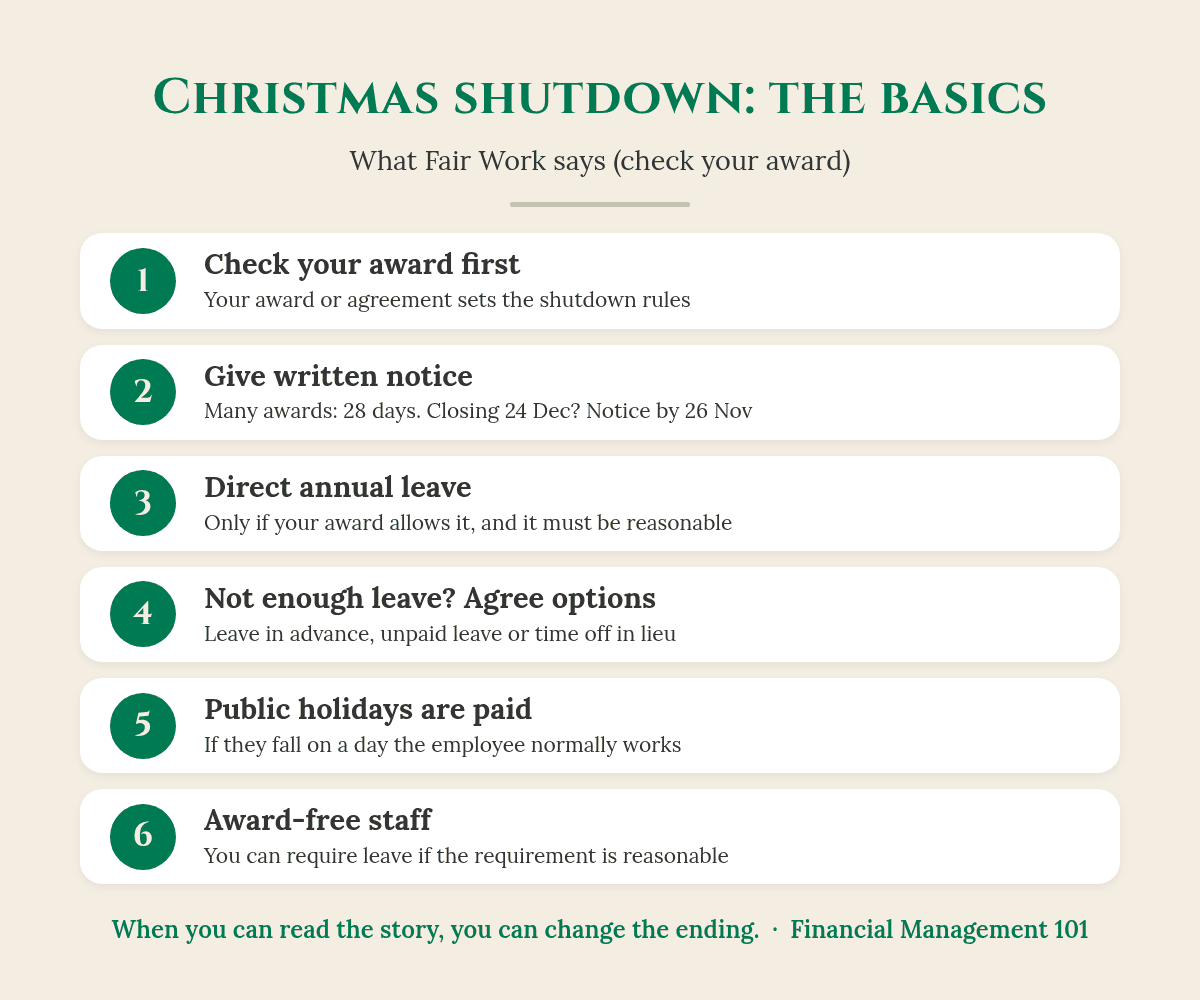
An employer can only direct an employee to take annual leave in some situations, such as when the business is closed over Christmas and New Year, and the rules are set out in awards and registered agreements (Fair Work Ombudsman). If you have an enterprise agreement, check its shutdown terms. Not sure which award applies? Fair Work’s Find my award tool takes a few minutes.
2. Many awards need 28 days’ written notice
Since 1 May 2023, many awards have updated shutdown rules. Under those rules, you may require employees to take paid annual leave during a temporary shutdown, you must give at least 28 days’ written notice to every affected employee, and the requirement must be reasonable. The notice period can be shortened if you and the majority of affected employees agree (Fair Work Ombudsman).
The list of awards with these rules includes the Electrical, Electronic and Communications Contracting Award, the Plumbing and Fire Sprinklers Award, the Building and Construction General On-site Award, the Gardening and Landscaping Services Award, the Vehicle Repair, Services and Retail Award, the Hair and Beauty Industry Award and the Clerks—Private Sector Award (Fair Work Ombudsman). That covers a lot of trades and service businesses.
Watch out: If you close on Thursday 24 December 2026, 28 days before is Thursday 26 November. Closing from Monday 21 December? Your notice needs to be with staff by Monday 23 November. Put it in writing, with the dates you close and reopen.
3. Award-free staff
For employees who aren’t covered by an award or enterprise agreement, you can require them to take paid annual leave if the requirement is reasonable, including when the business shuts down temporarily between Christmas and New Year (Fair Work Ombudsman).
What if someone doesn’t have enough annual leave?
This is the one that catches newer staff and apprentices. Under the updated award rules, an employee who doesn’t have enough paid annual leave to cover the whole shutdown can agree with you on options for the days not covered (Fair Work Ombudsman):
- Using accrued time off, such as time off in lieu.
- Annual leave in advance, so their balance goes negative for a while.
- Leave without pay for the days not covered.
The key word is agree. These options are worked out with the employee, so have the conversation early and put what you agree in writing. If someone doesn’t agree, or you’re unsure what your award allows, call the Fair Work Infoline on 13 13 94 before the shutdown starts, not after.
Good to know: A shutdown isn’t the same as a stand down. A stand down is when staff can’t be usefully employed for reasons outside your control, like equipment breakdown you aren’t responsible for, or a natural disaster (Fair Work Ombudsman). Closing for the holidays is your choice, so the shutdown rules apply.
How do public holidays work during a shutdown?
Christmas Day is Friday 25 December 2026. Boxing Day falls on a Saturday, so every state and territory has a public holiday on Monday 28 December (an additional day in most places; in Tasmania, Boxing Day itself is observed that Monday). New Year’s Day is Friday 1 January 2027. Check Fair Work’s 2026 public holidays list for your state, including part-day holidays on Christmas Eve and New Year’s Eve in some places.
Under the National Employment Standards, employees (other than casuals) who would normally work on the day a public holiday falls are paid their base pay rate for the ordinary hours they would have worked (Fair Work Ombudsman). If a public holiday falls during paid annual leave, it’s paid as a public holiday and isn’t taken out of their leave balance (Fair Work Ombudsman).
If an employee has agreed to unpaid leave during the shutdown, whether they’re paid for the public holidays depends on whether they have ordinary hours on those days, your award or agreement, the circumstances and any agreement you make (Fair Work Ombudsman). Check before you assume either way.
What about casuals?
Casual employees don’t get annual leave (Fair Work Ombudsman), and the public holiday pay rule above applies to employees other than casuals (Fair Work Ombudsman). If casuals aren’t rostered while you’re closed, they generally aren’t paid for that time. Let them know the dates early so they can plan.
What does a shutdown cost in cash?
Here’s an illustrative example (made-up numbers to show the method, not a real client). Jarrah runs an electrical business in Perth with five full-time employees, each working Monday to Friday. The business closes on Thursday 24 December 2026 and reopens on Monday 11 January 2027.
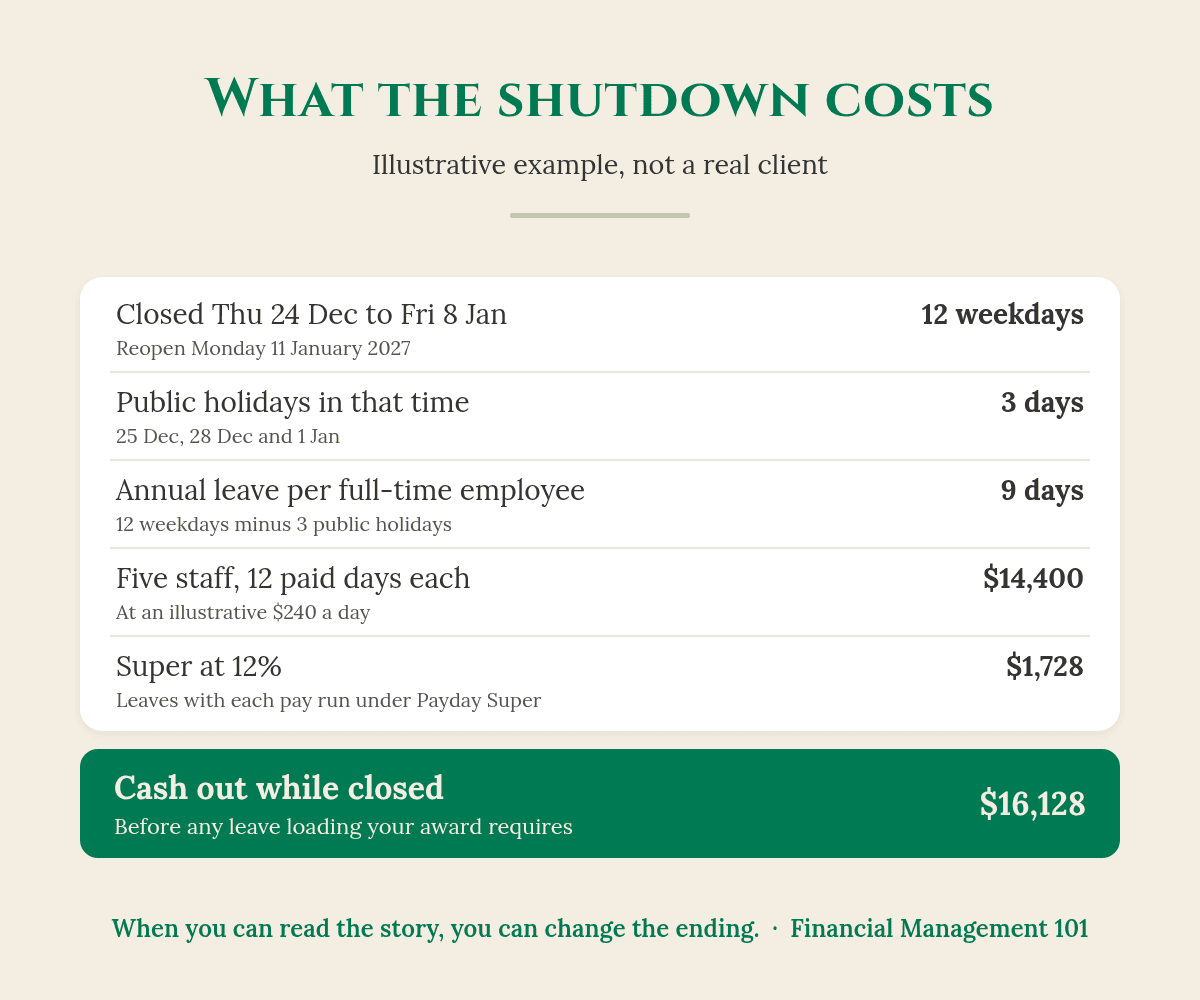
- Weekdays closed: 12 (24 December to 8 January).
- Public holidays in that time: 3 (25 December, 28 December and 1 January).
- Annual leave for each employee: 12 − 3 = 9 days.
- Wages while closed: 5 staff × 12 paid days × an illustrative $240 a day = $14,400.
- Super at 12%: $1,728, because qualifying earnings include certain paid leave (ATO).
That’s about $16,128 leaving the business while almost nothing is being invoiced, before any leave loading your award requires. Under Payday Super, the super goes out with each pay run, not in late January.
Why it works: The leave isn’t a new cost. It has been building up all year. The shutdown just decides when it leaves your bank account, so you can plan for it rather than be surprised.
So what does this actually look like?
Jarrah’s newest apprentice, Mia (also illustrative), has only 4 days of annual leave saved. That leaves 5 days not covered. In early November, Jarrah talks it through with her. Mia agrees in writing to take 2 days in advance and 3 days unpaid, and Jarrah notes what they agreed with the notice. No surprises at Christmas, and no awkward conversation on her first pay day back.
Check this first: Run a leave report in your payroll software this week. Who has less leave than the shutdown needs? Those are your early conversations.
Your shutdown checklist for late November
- Confirm your award or agreement, and read its shutdown clause, or use Fair Work’s Find my award tool.
- Set the dates you close and reopen, and count the weekdays and public holidays in between.
- Send written notice at least 28 days before you close, unless you’ve agreed a shorter period with most of your team.
- Check leave balances and agree options with anyone who’s short, in writing.
- Tell casuals when you’re closed and when shifts start again.
- Map the cash. Put leave, public holidays and super into your forecast for every pay week. My post on how to do a cash flow forecast shows a simple 13-week method.
Where your bookkeeper, payroll and Fair Work fit in
Your bookkeeper or payroll person can run leave balances, set up the leave correctly and make sure super goes out on time. Fair Work is the place for questions about your award, and the Infoline is free on 13 13 94. Your agent/accountant can help you plan the cash and tax side. My job is to help you see the whole picture, so the shutdown is planned rather than a scramble.
The leave isn’t a new cost. The shutdown just decides when it leaves your bank.
Your takeaway
- Your award or agreement decides whether you can direct staff to take annual leave over the shutdown.
- Many awards need at least 28 days’ written notice. Closing on 24 December? Notice by 26 November.
- Staff without enough leave can agree to leave in advance, unpaid leave or time off in lieu. Agree it in writing.
- Public holidays that fall on normal working days are paid, and don’t come out of annual leave.
- Casuals don’t get annual leave or paid public holidays they don’t work.
- Plan the cash: wages, leave and super still go out while you’re closed.
Want to see how ready your cash flow is for January?
Start with The EDGE Business Health Check. It’s a $47 workbook that takes about 20 minutes. You score 30 quick statements across five areas: Profit & Pricing, Cashflow, CEO Visibility, Systems & Freedom, and Growth. Then the Profit Leak Calculator shows where money may be slipping away, and the 7-Day Reset gives you clear next steps.
Rather talk it through first? Get in touch and book a call with me.
Frequently asked questions
Can I make my staff take annual leave over Christmas?
Often, yes, if your award or agreement allows it. Many awards let you direct staff to take paid annual leave during a shutdown, as long as you give at least 28 days’ written notice and the requirement is reasonable. For award-free staff, you can require it if it’s reasonable.
How much notice do I need to give for a Christmas shutdown?
Many awards require at least 28 days’ written notice to every affected employee. You can agree a shorter period with the majority of affected employees. Check your own award or agreement, because the rules aren’t the same in every one.
What if an employee doesn’t have enough annual leave?
They can agree with you to use accrued time off, take annual leave in advance, or take leave without pay for the days not covered. These options need their agreement, so talk early and put it in writing. If you can’t agree, call the Fair Work Infoline on 13 13 94.
Do I pay staff for Christmas Day and Boxing Day if we’re closed?
Employees other than casuals are paid their base rate for public holidays that fall on days they would normally work. In 2026, that’s Friday 25 December and Monday 28 December in every state and territory. New Year’s Day is Friday 1 January 2027.
Do casual employees get paid over the shutdown?
Casuals don’t get annual leave, and the public holiday pay rule applies to employees other than casuals. If they aren’t rostered while you’re closed, they generally aren’t paid for that time. Check your award for anything specific to your industry.
Is super payable on annual leave?
The ATO says qualifying earnings include pay for ordinary hours, including certain paid leave. Ask your bookkeeper to confirm how your pay items are set up, so the right super goes out with each pay run.
You’ve built something real. Financial confidence starts with clarity.
Karen G. Adams
Small Business Performance Strategist, Financial Management 101
Too Big To Wing It. Too Small To Need A CFO.
This article is general education only. It isn’t legal, workplace relations, tax or financial advice, and it doesn’t take your circumstances into account. Shutdown, leave and public holiday rules are from Fair Work Ombudsman pages as at 9 November 2026, and award rules differ, so check your own award or agreement and contact the Fair Work Ombudsman (13 13 94) for your situation. Jarrah’s business, Mia and their figures are illustrative, not real clients.