
The jobs are booked out. The team’s been paid. The suppliers have been paid. The BAS is lodged. And you? You’ll take something “when things settle down”. If “how much should I pay myself from my business?” is the question you keep putting off, this one’s for you.
If that sounds familiar, you’ve got company. In Xero’s 2026 research, almost a third (32%) of Australian small business owners surveyed said they aren’t regularly paying themselves a wage (Xero).
32%
of Australian small business owners surveyed aren’t regularly paying themselves a wage. (Xero, 2026)
12%
is the super guarantee rate from 1 July 2025, if your company pays you wages or director’s fees. (ATO)
THE SHORT ANSWER
How much should I pay myself from my business?
Pay yourself a regular base pay that’s the lower of two numbers: what it would cost to replace you in the business, and what the business can afford after tax, super and a cash buffer. Then add a profit share each quarter when the numbers allow. Your structure decides how that money is paid.
Why do so many business owners pay themselves last?
I totally get this. When you’ve got staff relying on you, it feels selfish to take your share first. So you pay everyone else, then take what’s left. And some months, there isn’t much left.
Here’s the thing… paying yourself last doesn’t protect the business. It hides what’s really going on. If the business can only run because you’re working for free, it isn’t as profitable as it looks. That’s information, not failure. It usually points to pricing, costs or cash flow, and every one of those can be fixed. (If revenue is strong but profit isn’t, start with Why Is My Business Making Revenue but No Profit?)
In my 40 years in financial services, I’ve watched owners carry this for years. The ones who change it don’t suddenly earn more. They put a simple system in place and stick to it.
Wage, drawings or dividends: how does your structure change how you’re paid?
Before we talk numbers, it helps to know how money can leave the business. Your accountant should confirm what suits you, but here’s the plain-English version.
If you’re a sole trader or in a partnership
You can’t pay yourself a wage. Money you take out is called drawings, and it isn’t a business expense. You pay tax on the business profit through your own tax return, whether you take the money out or not (ATO). You also don’t have to pay super guarantee for yourself, though you can make your own contributions (ATO).
If you run a company
The company is a separate legal entity. You can be paid a wage or director’s fees through payroll (with PAYG withholding and super), receive dividends from profit, or both (Tax, Super + You). From 1 July 2025 the super guarantee rate is 12% of ordinary time earnings (ATO).
Check this first: If you take money from a company without it being set up as wages, director’s fees or a dividend, it can be treated as a loan or a deemed dividend under Division 7A (ATO). That’s a costly surprise, so talk to your accountant before you move money.
If you have a trust
Trust distributions are decided by the trustee, usually at the end of the financial year. Many owners still take a regular amount during the year, then their accountant works out the distribution later.
Whatever your structure, the method below works the same way. It tells you how much. Your accountant tells you how.
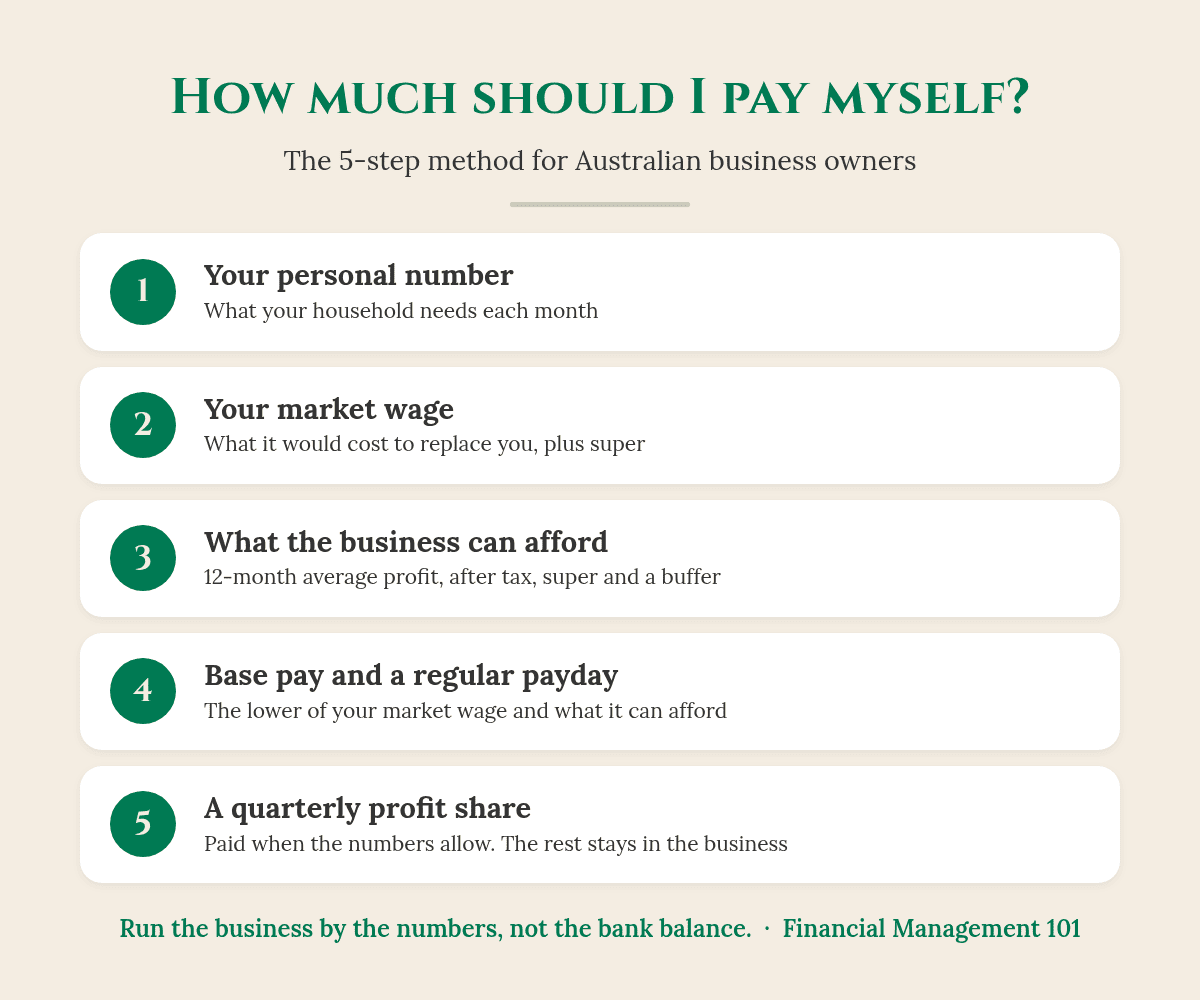
How do you work out how much to pay yourself? My 5-step method
Let me show you exactly how I walk business owners through this. Grab your last 12 months of numbers and a cuppa, and by Step 5 you’ll have your own answer to “how much should I pay myself from my business?”
Step 1: What’s your personal number?
Start with your life, not your business. Add up what it costs to run your household each month: mortgage or rent, groceries, utilities, insurance, car costs, school fees and loan repayments. Then add a realistic amount for living, because life is more than bills.
Check this first: Most owners have never written this down. They just know it feels “not enough”. Seeing the real figure takes the fog away, and it’s often less scary than you think.
Step 2: What is your role worth?
Put on your owner’s hat. If you had to hire someone to do your job tomorrow, what would you pay them? If you’re on the tools three days a week and running the office the other two, price a qualified tradesperson plus an operations manager for part of the week. Add super on top, because that’s what an employer pays.
What to look for: This is your market wage. It’s what the business should be able to pay for the work you do.
Step 3: What can the business actually afford?
Look at your average monthly profit over the last 12 months before paying yourself anything. Twelve months smooths out the busy and quiet periods. From that average, take away:
- money you need to set aside for tax (GST, PAYG and income tax), plus super if you’re paid through a company
- loan repayments that aren’t already in your expenses
- a small amount to build a cash buffer
What’s left is what the business can realistically pay you right now. For the tax piece, my post What Numbers Should a Small Business Owner Track? shows which figures to watch.
Step 4: Set your base pay and a regular payday
Compare your three numbers: your personal number, your market wage, and what the business can afford.
- If the business can afford more than your market wage: pay yourself your market wage. Anything above it is true profit (Step 5).
- If it sits between your personal number and your market wage: set your base at what the business can afford. Your home life is covered and you’ve got a clear target to grow towards.
- If it’s below your personal number: set your base at what the business can afford, even if it’s small, and read the section below.
Then pick a regular payday, weekly, fortnightly or monthly, and pay yourself on that day, every time, the same as you’d pay your team.
Step 5: Add a profit share each quarter
Your base pay is for doing the work. But you also own the business, and owners deserve a reward when it performs. Once a quarter, look at the profit left after your base pay, tax set-asides and buffer. Then decide on a share to pay yourself, and leave the rest in the business for growth or a rainy day.
Why it works: Your base pay gives your household stability. The quarterly profit share means you benefit when things go well, without putting cash flow at risk. For more on building this habit, read Pay Yourself Like a Boss: The Owner Pay System That Builds Profit, Not Burnout.
So what does this actually look like?
Here’s an illustrative example (the numbers are made up to show the method, not a real client). An electrical contracting company has been trading for 9 years, turns over about $1.4 million and has 8 staff. The owner runs jobs, quotes and manages the team.
- Personal number: $9,000 a month for the household.
- Market wage: a project manager-electrician to replace the owner would cost about $11,500 a month, plus 12% super.
- What the business can afford: averaged over 12 months, profit before paying the owner is $19,000 a month. After setting aside for tax, the owner’s super and a buffer, about $10,500 a month is comfortably available.
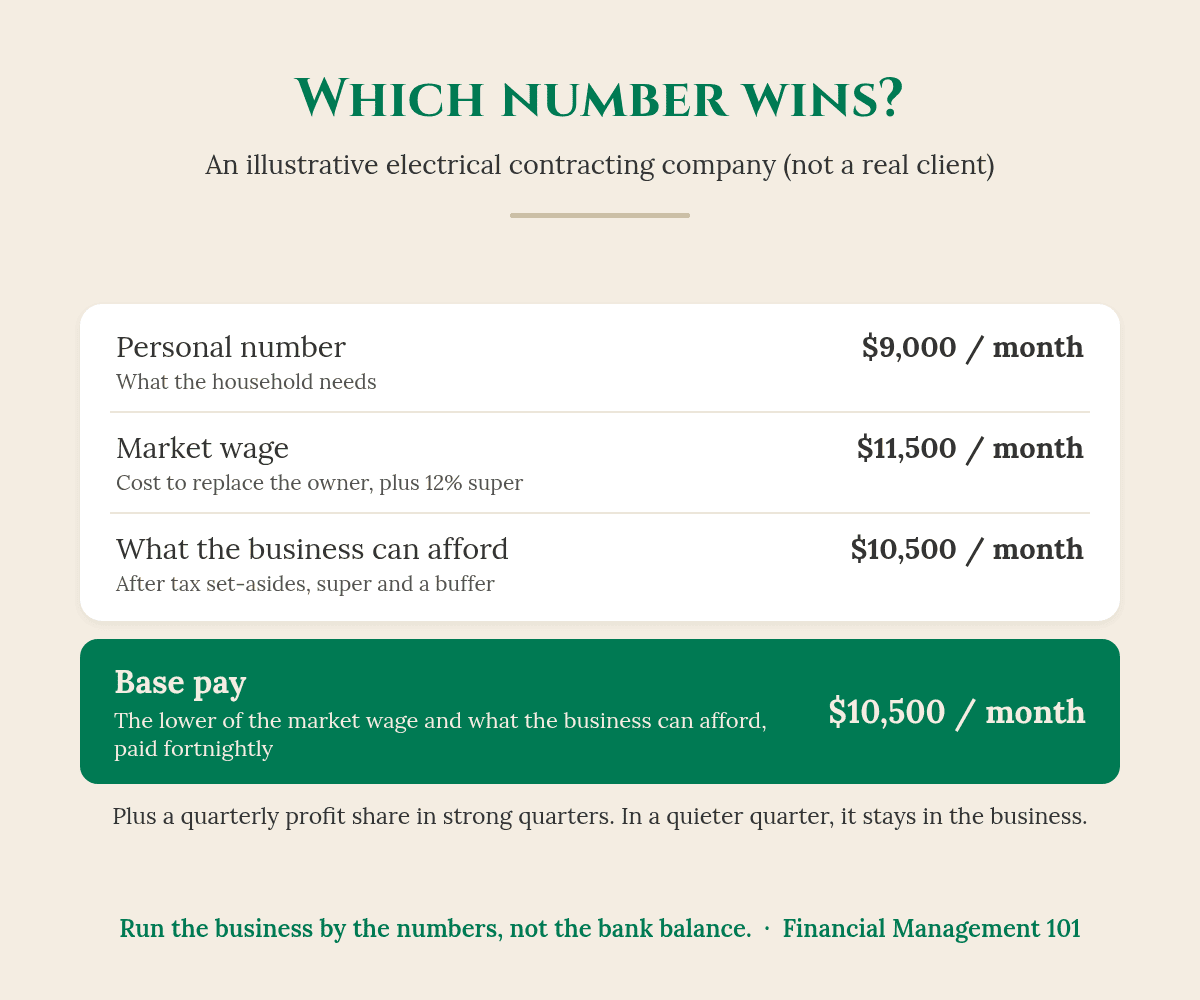
So the owner sets a base pay of $10,500 a month through payroll, paid fortnightly. It covers the household with breathing room, and there’s a clear target: lift the business so it can pay the full market wage. Each quarter, the owner and their accountant look at what’s left. In a strong quarter, there’s a profit share. In a quieter one, it stays in the business.
The biggest change isn’t the dollar amount. It’s that the question at home moves from “Can I take money out this week?” to “What’s our plan for the profit?”
What if the business can’t afford to pay me much yet?
You’re not alone in this, and it doesn’t mean you’ve failed. It means the numbers are telling you something, and now you can listen. A big gap between what you need and what the business can afford usually points to one of these:
- Pricing: you may be undercharging for your time, skill or materials.
- Costs: some expenses may have crept up without anyone noticing.
- Cash flow: money may be tied up in unpaid invoices, retentions or stock.
- Capacity: you may be doing too much low-value work yourself.
In the meantime, start paying yourself something regular, even if it’s small, and increase it as the business improves. A small regular amount builds the habit, and habits are what change businesses.
Your takeaway
- Your business isn’t truly profitable until you’re paid for the work you do.
- Set a base pay that’s the lower of your market wage and what the business can afford, and pay it on a regular payday.
- Add a quarterly profit share when the numbers allow.
- Your structure decides how you’re paid. Your accountant and bookkeeper are your partners in setting it up properly.
Run the business by the numbers, not the bank balance.
Your accountant makes sure the numbers are right. Your bookkeeper makes sure the records are right. My job is to help you know what to do with them.
Not sure what your business can afford to pay you?
Start with The EDGE Business Health Check. It’s a $47 workbook that takes about 20 minutes. You score 30 quick statements across five areas: Profit & Pricing, Cashflow, CEO Visibility, Systems & Freedom, and Growth. Then the Profit Leak Calculator shows where money may be slipping away, and the 7-Day Reset gives you clear next steps.

Rather talk it through first? Get in touch and book a call with me.
Frequently asked questions
How much should a business owner pay themselves in Australia?
There’s no single figure. A sound starting point is the lower of what it would cost to replace you and what the business can afford after tax, super and a cash buffer. Pay that as a regular base, then add a quarterly profit share when profit allows.
Should I pay myself a salary or dividends?
If you run a company, you can be paid wages or director’s fees, dividends, or a mix. Wages come with PAYG withholding and super. Dividends are paid from company profit. The right mix depends on your situation, so ask your accountant.
Do I have to pay myself super?
If you’re paid wages or director’s fees by your company, the company generally has to pay super guarantee for you, at 12% from 1 July 2025. Sole traders and partners don’t have to pay super guarantee for themselves, but can make personal contributions.
What percentage of profit should I pay myself?
Rather than a fixed percentage, set a base pay from your market wage and what the business can afford, then decide a quarterly profit share. Many owners take part of the profit and leave the rest in the business for growth and a buffer.
Are drawings taxed?
For sole traders and partners, drawings themselves aren’t taxed or deductible. You pay tax on the business profit through your own return, whether you take the money out or not. Money taken from a company works differently, so check with your accountant.
You’ve built something real. Financial confidence starts with clarity.
Karen G. Adams
Small Business Performance Strategist, Financial Management 101
This article is general education only. It isn’t financial, tax or legal advice, and it doesn’t take your personal circumstances into account. The electrical business example is illustrative, not a real client. Tax and super rules change, so check the details with your accountant, BAS agent or the ATO before you change how you pay yourself.