The BAS is due, the cash isn’t there, and the letter from the ATO is sitting unopened on the desk. If that’s where you are right now, take a breath. An ATO payment plan lets you pay what you owe in instalments, and if your business owes $200,000 or less, you may be able to set one up yourself online.
You’re far from the only one. At 30 June 2025, small businesses owed $35.9 billion of the ATO’s $54.2 billion collectable debt (ATO Annual Report 2024–25). The ATO has said $24.7 billion of that small business debt is activity statement debt (ATO).
$54.2B
collectable debt owed to the ATO at 30 June 2025. (ATO Annual Report 2024–25)
$35.9B
of that was owed by small businesses. (ATO Annual Report 2024–25)
$24.7B
of small business debt is activity statement debt, the BAS. (ATO)
THE SHORT ANSWER
What is an ATO payment plan?
An ATO payment plan lets your business pay an overdue tax debt in regular weekly, fortnightly or monthly instalments instead of one lump sum. If you owe $200,000 or less, you may be able to set it up online. Interest (the general interest charge) keeps building on the balance, and new tax bills must still be paid on time.
Can my business get an ATO payment plan?
If you’re having financial difficulty, you may be eligible. The ATO spreads the instalments over the shortest possible fixed period, and you must also pay any future tax debts in full and on time (ATO). How you set it up depends on how much you owe and what you need (ATO):
- You owe $200,000 or less: you may be able to set it up yourself through Online services for business (Accounts and payments, then Payment plans) or the ATO’s automated phone service for business enquiries.
- You have a registered tax or BAS agent/accountant: they may be able to set it up for you through Online services for agents.
- You owe more, need longer than 2 years, or the online option didn’t work: you’ll need to phone the ATO’s lodge and pay enquiry line, and they’ll ask more about your circumstances.
Do I need separate ATO payment plans for income tax and BAS?
Yes. If both your income tax account and your activity statement account are overdue, the ATO needs a separate payment plan for each (ATO). You can only set up one plan at a time through online services (ATO).
How do I set up an ATO payment plan, step by step?
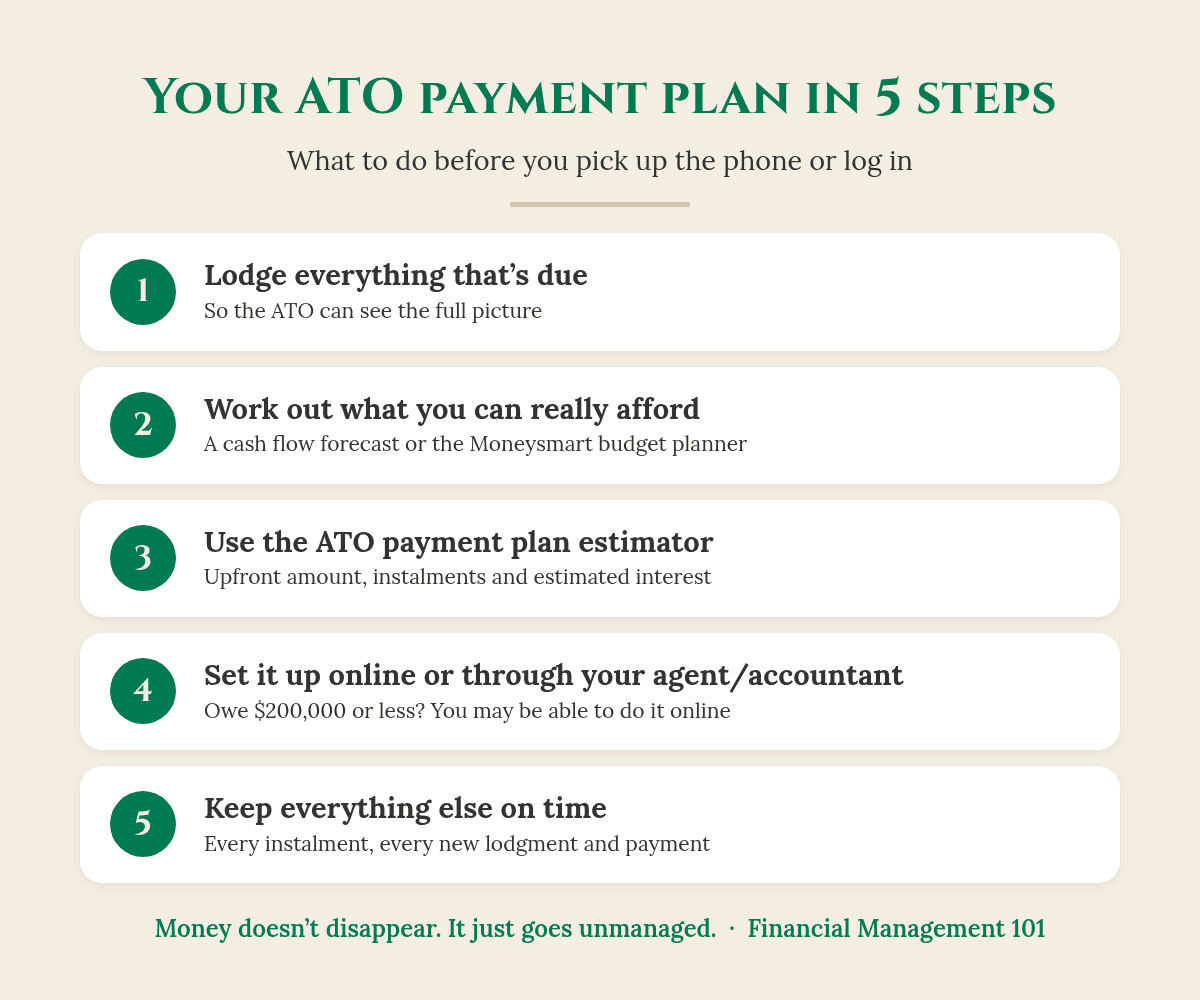
Step 1: Lodge everything that’s due
Even if you can’t pay, get your BAS and returns lodged. The ATO says that to keep a payment plan on track you need to lodge all your obligations on time (ATO). It also means you’re working from the real number, not a guess.
Step 2: Work out what you can really afford
This is where most plans succeed or fail. Look at the next few months of cash coming in and going out, including wages, super, rent and the next BAS, and work out a figure you can pay every time. For businesses that need to phone, the ATO suggests the Moneysmart budget planner to help prepare a realistic proposal (ATO). A simple cash flow forecast does the same job for your business.
Watch out: The ATO says to take into account any payments you’ll owe for future tax and super (ATO). An instalment that leaves nothing for next quarter’s BAS just moves the problem along.
Step 3: Use the ATO payment plan estimator
The ATO’s online payment plan estimator shows how much you may need to pay upfront, your minimum repayment, how quickly you could clear the debt and an estimate of the interest. It can’t be used for super guarantee charge debts (ATO).
Step 4: Set it up online or through your agent/accountant
When you set it up, the ATO gives you an upfront amount and suggested instalments, and you can adjust both up or down within limits (ATO). Set up a direct debit at the same time. The ATO calls it the easiest way to stay on top of your instalments.
Good to know: After 30 June 2027, you won’t be able to pay the ATO by credit card. If your plan is linked to a credit card, you’ll need to change to another payment method (ATO).
Step 5: Keep every instalment, and everything else, on time
If you don’t keep up with your ongoing tax obligations, your plan may default, making the full overdue balance immediately payable. Any refunds or credits will be used to reduce the debt, but they don’t replace your instalments (ATO). You can pay extra whenever you have it, and every extra dollar cuts the interest.
How much does an ATO payment plan cost in interest?
Tax debts on a payment plan keep building general interest charge (GIC), which compounds daily (ATO). For October to December 2026, the GIC rate is 11.51% a year, or 0.03153425% a day (ATO). GIC incurred on or after 1 July 2025 can’t be claimed as a tax deduction (ATO).
So what does this actually look like?
Here’s an illustrative example (the numbers are made up to show the method, not a real client). A landscaping business owes $38,000 on its activity statement and can’t pay it in full.
- At the October to December 2026 daily rate, a single 30-day month of GIC on $38,000 comes to about $361 (my working, compounding daily; the ATO works out the actual amount).
- Over a longer plan, the balance falls with each instalment, but the interest keeps building on whatever’s left. That’s why the ATO guides you towards the shortest period you can manage.
- If the business qualifies for the interest-free plan below, that GIC is automatically remitted as long as it keeps to the plan.
So before you pick the smallest instalment on offer, check your cash flow and pay as much as you can sustain. Then check whether you qualify for an interest-free plan.
Can I get an interest-free ATO payment plan?
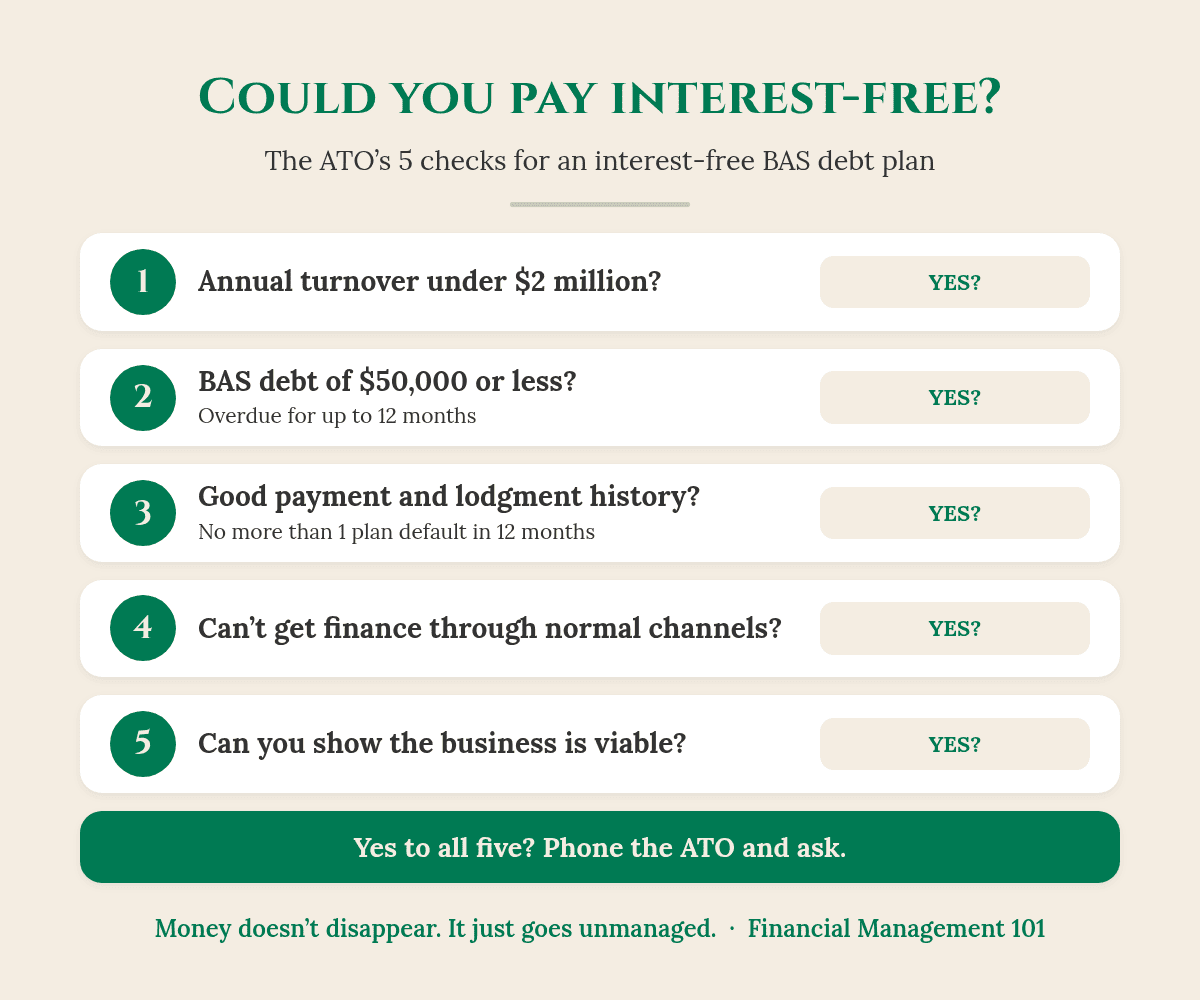
Small businesses that owe activity statement amounts may be able to pay interest-free over 12 months. The ATO says you may be eligible if your business (ATO):
- has an annual turnover of less than $2 million
- has recent activity statement debt of $50,000 or less that’s been overdue for up to 12 months
- has a good payment and lodgment history, with no more than one payment plan default in the last 12 months and no outstanding activity statement lodgments
- can’t get finance (such as a loan) through normal business channels
- can demonstrate ongoing viability.
You agree to pay by direct debit within 12 months. GIC still appears on your account, but as long as you keep to the plan, it’s automatically remitted (ATO). If you think you qualify, phone the ATO and ask. Your BAS or tax agent/accountant can help you check first.
Money doesn’t disappear. It just goes unmanaged.
What if I can’t keep up with my ATO payment plan?
Don’t go quiet. If you need to re-negotiate an existing plan, the ATO says to phone its lodge and pay enquiry line (ATO). Talk to your BAS or tax agent/accountant first, so you go in with a realistic number.
Then look at why the debt happened. In my experience, it’s rarely one bad quarter. It’s usually GST and PAYG being spent as if they were the business’s money, or customers paying slower than the bills arrive. Why Is Cashflow Always Tight? and Tax Time Without the Panic cover the habits that stop it happening again, and What Numbers Should a Small Business Owner Track? shows what to watch each week.
Your takeaway
- An ATO payment plan lets you pay an overdue debt in weekly, fortnightly or monthly instalments. If you owe $200,000 or less, you may be able to set it up online.
- Lodge first, work out what you can really afford, then use the ATO’s estimator.
- GIC compounds daily (11.51% a year for October to December 2026) and isn’t tax deductible, so pay it off as fast as you sustainably can.
- Small businesses with BAS debt of $50,000 or less may qualify for an interest-free plan over 12 months.
Your accountant makes sure the numbers are right. Your bookkeeper makes sure the records are right. My job is to help you know what to do with them, so the next tax bill doesn’t catch you short.
Want to stop the next tax bill catching you short?
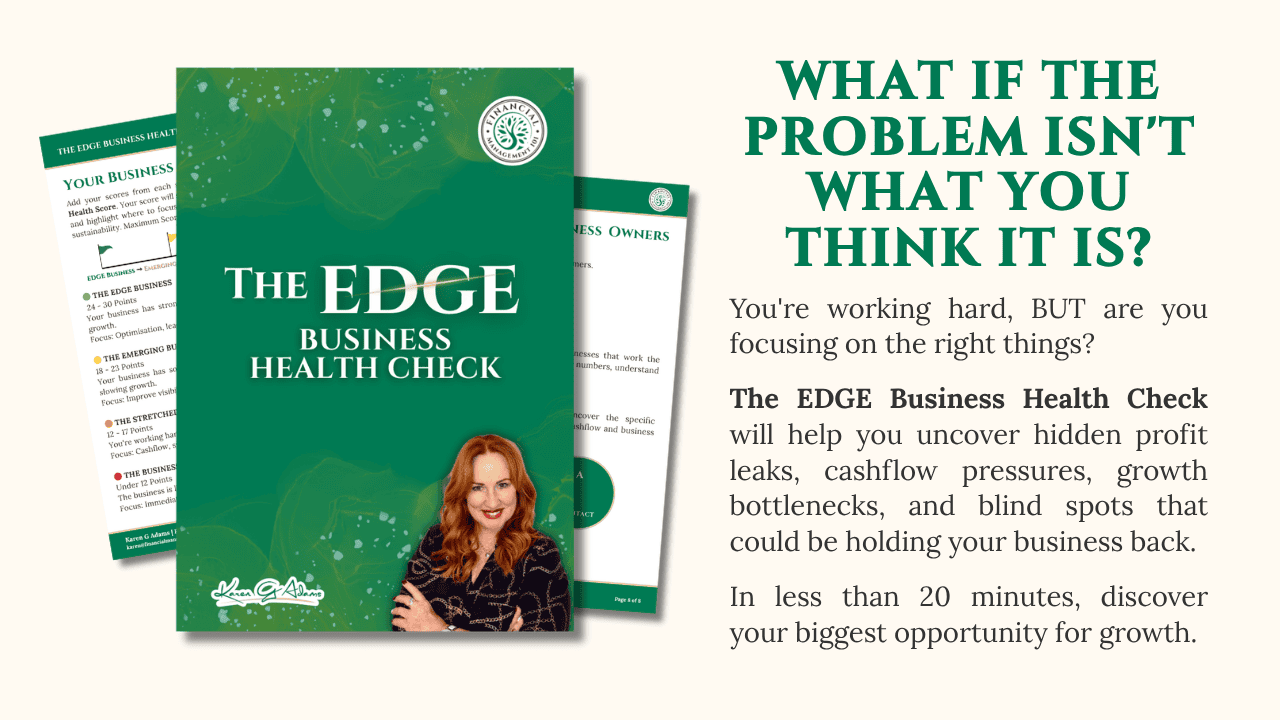
Start with The EDGE Business Health Check. It’s a $47 workbook that takes about 20 minutes. You score 30 quick statements across five areas: Profit & Pricing, Cashflow, CEO Visibility, Systems & Freedom, and Growth. Then the Profit Leak Calculator shows where money may be slipping away, and the 7-Day Reset gives you clear next steps.
Rather talk it through first? Get in touch and book a call with me.
Frequently asked questions
How long can an ATO payment plan last?
The ATO spreads instalments over the shortest possible fixed period you can manage. If you need longer than 2 years to pay, you’ll need to phone the ATO’s lodge and pay enquiry line rather than setting it up online.
Is there interest on an ATO payment plan?
Yes. The general interest charge keeps building on the unpaid balance and compounds daily. It’s 11.51% a year for October to December 2026, and GIC incurred from 1 July 2025 isn’t tax deductible. The exception is the interest-free plan for eligible small business activity statement debts.
Can I pay off my ATO payment plan early?
Yes. Extra payments reduce the debt and the interest. If you pay the plan off early, the ATO says you’ll need to cancel it in online services or contact them, so the remaining direct debits stop.
What happens if I miss an ATO payment plan instalment?
If you don’t keep up with the plan and your other tax obligations, it may default, making the full overdue balance immediately payable. If you can see you’ll miss one, contact the ATO, or ask your BAS or tax agent/accountant to, before it happens.
Will my tax refund go towards my payment plan?
Yes. The ATO uses any refunds or credits you’re entitled to to reduce your tax debt. That doesn’t replace your regular instalment, so keep paying as agreed.
You’ve built something real. Financial confidence starts with clarity.
Karen G. Adams
Small Business Performance Strategist, Financial Management 101
This article is general education only. It isn’t financial, tax or legal advice, and it doesn’t take your personal circumstances into account. The landscaping business example and interest figure are illustrative, not a real client or an ATO calculation. Check your own position with your BAS or tax agent/accountant or the ATO.