You’ve booked the financial wellbeing session. The room was half full, the feedback forms said “really useful”, and three months later nobody could tell you what changed. If that sounds familiar, let’s look at what a financial wellbeing program for employees needs to include, so the next one actually makes a difference.
That’s not a sign financial wellbeing doesn’t work. It’s usually a sign the program wasn’t built the way people need it.
THE SHORT ANSWER
What should a financial wellbeing program for employees include?
Four things: practical tools people can use this week, content that fits every financial situation in your workforce, sessions matched to different life stages, and a presenter who makes money safe to talk about. Keep it education, not personal financial advice, and measure confidence and behaviour, not just attendance.
Why does financial wellbeing matter to Australian employers?
Because money stress doesn’t stay at home. It comes to work with people, and it shows up in focus, energy and how long they stay.
88%
of moderately and severely financially stressed Australians say their finances affect their work productivity. (AMP Financial Wellness Report 2024)
11 hrs
a month is the average time an employee spends dealing with personal financial matters at work. (AMP, 2024)
6%
of Australian employees say they receive financial education through their employer. (Aon, 2025)
So the need is there, and very few workplaces are meeting it with a financial wellbeing program for employees. If you’d like more on the hidden cost for your team, read Your Team Might Look Fine, But Financial Stress Could Be Costing More Than You Think.
Why do so many workplace financial wellbeing programs fall flat?
I totally get this. You’re juggling a wellbeing calendar, a budget, leaders who want to see results, and a team who are already stretched. A one-off webinar feels like a sensible place to start.
Here’s the thing… money is one of the most private things a person carries. If a session feels like a lecture, a sales pitch or a maths class, people switch off. Or worse, they quietly feel judged for where they’re starting from.
In my 40 years in financial services, I’ve seen the same pattern again and again. The programs that change behaviour aren’t the flashiest. They’re the ones built around how real people actually live.
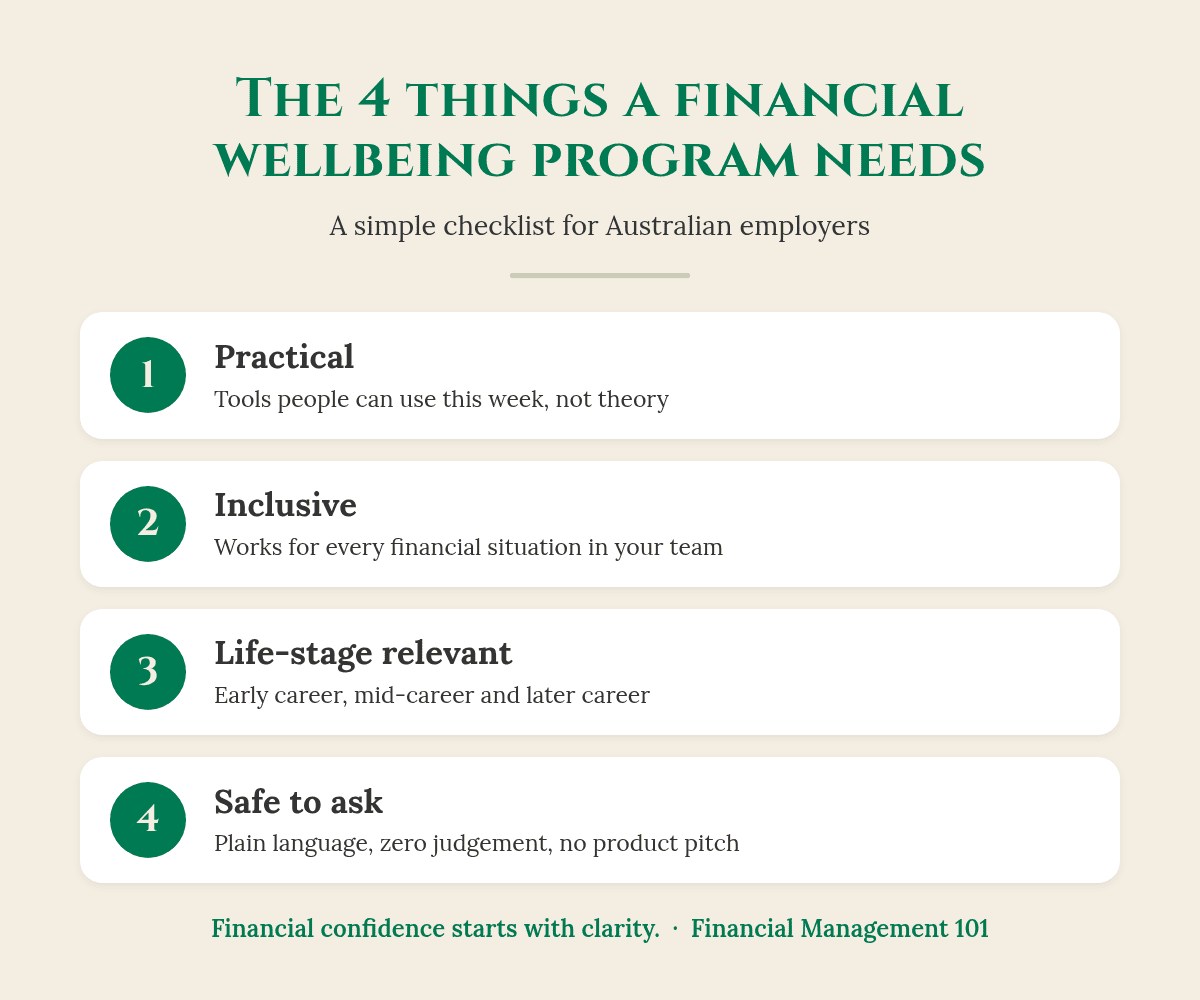
1. Is it practical, or just theory?
Compound interest charts and “principles of budgeting” rarely change anyone’s behaviour. People don’t need more theory. They need to walk out able to do something differently.
A program that works gives people simple, usable tools. How to build a spending plan that fits their real pay. How to read their own numbers without the fog. How to talk about money with a partner without it turning into an argument.
What to look for: Does each session leave people with one thing they can do this week, or just something they nodded along to?
2. Does it work for every financial situation in your team?
Content built for one income bracket misses most of the room. A program that assumes everyone owns a home, has a second income to lean on, or has spare cash to invest will lose a large part of your workforce before it starts.
Real inclusion means it works whether someone is renting, supporting a family on one income, new to Australia and building money skills from scratch, or carrying debt they’ve never mentioned at work.
What to look for: Does the program speak to a range of financial realities, or only the most comfortable one?
3. Is it relevant across life stages?
A 24-year-old paying off a HECS debt and a 58-year-old planning their last few years of full-time work have very different money questions. Yet many programs give them exactly the same session.
The strongest programs meet people where they are: early career and building foundations, mid-career and juggling family costs, or later career and planning the move out of full-time work.
What to look for: Can the program flex by life stage, or is it one size fits all?
4. Who delivers it, and do people feel safe asking questions?
This is the piece that’s easiest to underestimate. How a session is delivered matters as much as what’s in it.
People open up when the presenter uses plain language, brings warmth and zero judgement, and clearly isn’t there to sell them a product. That last point matters. Under Australian law there’s a real difference between general information and personal financial advice (Moneysmart). A good workplace program stays on the education side of that line and points people to a licensed adviser when they need personal advice.
Check this first: Would someone in your team feel comfortable asking a genuinely basic question in the room, without embarrassment?
So what does this actually look like?
Here’s an illustrative example (not a real client). An established engineering services firm with 120 staff swaps its annual one-hour webinar for a short series:
- Session 1: a plain-English spending plan, with a simple template people can fill in that week.
- Session 2: two streams, one on building foundations and one on planning for the years before retirement.
- Drop-in Q&A: anonymous questions submitted beforehand, so nobody has to raise their hand.
- A follow-up check-in six weeks later, asking one question: what did you change?
Same budget. Very different result, because each part is practical, inclusive, matched to life stage and safe.
How do you measure whether a financial wellbeing program is working?
Attendance tells you who turned up. It doesn’t tell you what changed. Keep measurement simple and anonymous:
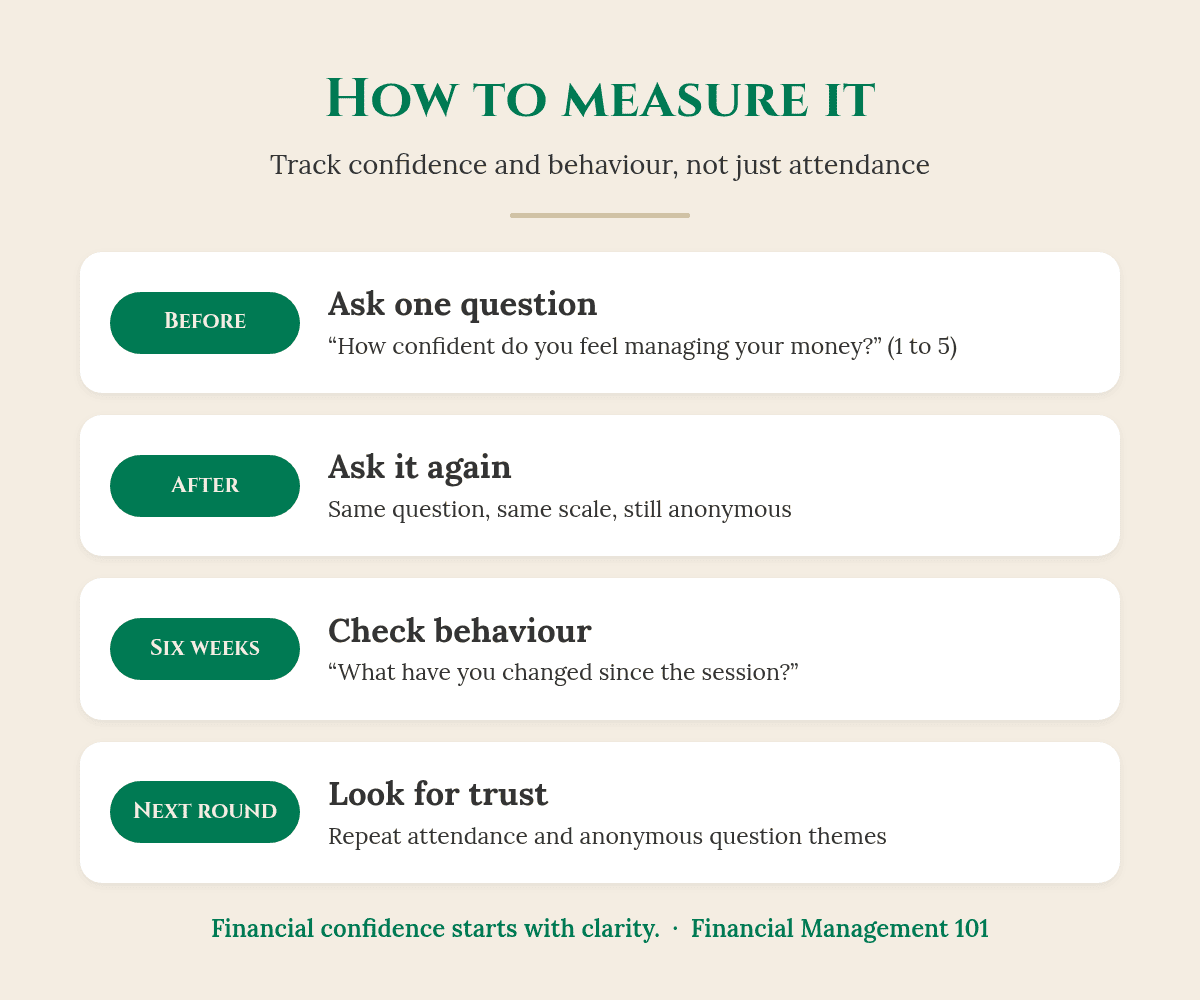
- A short before-and-after pulse question, such as “How confident do you feel about managing your money?” on a 1 to 5 scale.
- One behaviour question at the six-week mark: “What have you changed since the session?”
- Repeat attendance and questions submitted, which show trust is building.
- Themes from your EAP and HR conversations (never individual details) to shape the next round.
For more on building the case internally, see Is Money Stress the Missing Piece in Your Wellbeing Strategy?
How do you get employees to actually engage?
Make it easy and make it private. Run sessions in work time, offer more than one time slot, record a short version for shift workers, and let people ask questions anonymously. Ask leaders to attend too, so it’s clear money is a normal thing to talk about here.
Related reading: Financial Stress at Work Is Real: How Employers Can Support Staff Through Uncertain Times.
Your takeaway
- A financial wellbeing program for employees should be practical, inclusive, relevant to life stage and delivered safely.
- Keep it education, not personal financial advice.
- Measure confidence and behaviour, not just attendance.
- Make it private and easy to join, and people will come back.
Financial confidence starts with clarity.
Want to talk through what this could look like for your team?
Every workplace is different. If you’d like to explore a financial wellbeing program built around your people, your budget and your goals, book a call with me. No pressure, just a conversation.
Frequently asked questions
What is a workplace financial wellbeing program?
It’s a structured set of sessions and tools, offered by an employer, that helps staff feel more confident managing their money. Good programs cover spending plans, debt, saving and planning for each life stage, in plain language and without judgement.
What should a financial wellbeing program for employees include?
Practical tools people can use straight away, content that fits different incomes and households, sessions matched to life stage, anonymous ways to ask questions, and a simple way to measure confidence and behaviour change over time.
Is a financial wellbeing program the same as financial advice?
No. A workplace program should give general education. Personal financial advice takes someone’s individual situation into account and must come from a licensed adviser. A good program makes that difference clear and tells people where to find personal advice if they need it.
How do you measure whether it’s working?
Use a short, anonymous confidence question before and after, a behaviour check-in about six weeks later, and repeat attendance. Look for trends across the group, never individual details.
How do you get staff to engage?
Run sessions in work time, offer several time slots and a recorded option, allow anonymous questions, and have leaders attend. When money feels safe to talk about, people turn up.
You care about your people, and that’s where every good program starts. Financial confidence starts with clarity.
Karen G. Adams
Small Business Performance Strategist, Financial Management 101
This article is general education only. It isn’t financial, legal or employment advice, and it doesn’t take your organisation’s or any individual’s circumstances into account. The workplace example is illustrative, not a real client. For personal financial advice, speak with a licensed financial adviser.