Securing Your Future: The Vital Importance of Retirement Planning

Securing Your Future: The Vital Importance of Retirement Planning

One cannot stress the significance of retirement planning in a world where life events are unpredictable and economic conditions are constantly changing. Assuring a safe, comfortable, and stress-free future requires more than just making prudent financial decisions when it comes to retirement planning. This post will discuss the advantages of retirement planning and the reasons that everyone, regardless of age or income level, should make it a top priority.

1. THE POWER OF COMPOUND INTEREST

The power of compound interest is one of the strongest arguments for beginning retirement planning as soon as possible. Often called the “eighth wonder of the world,” compound interest is the process by which the interest you earn continues to accrue. This can cause your savings to grow exponentially over time, making even small contributions into a sizeable nest egg. You gain more from this compounding effect the earlier you begin.

The Power of Compound Interest

2. LIFESTYLE MAINTENANCE AND PEACE OF MIND

Making plans for retirement is crucial to preserving your way of life in your golden years. You may not be able to maintain the standard of living to which you have become accustomed if you do not have a sound plan. When you plan ahead, you can make sure you have enough money for hobbies, travel, and entertainment in addition to meeting your basic needs. Furthermore, having a plan in place can bring you a great deal of peace of mind and lessen your stress and anxiety about the future.

3. HEALTHCARE AND LONG-TERM CARE COSTS

Healthcare becomes a more pressing issue as we get older. Planning for retirement enables you to save money for unanticipated medical costs, long-term care, or assisted living facilities. Having a financial cushion can be a lifesaver, literally and figuratively, given the rising cost of healthcare.

4. INFLATION AND COST OF LIVING

When preparing for retirement, inflation is frequently overlooked. Since living expenses are likely to increase over time, if you have not made enough plans for them, your savings’ purchasing power may decline. A strong retirement plan accounts for inflation, guaranteeing that the growth of your savings exceeds the increasing cost of living.

5. FINANCIAL INDEPENDENCE AND FAMILY SECURITY 

Retirement planning is not just about you; it is also about your family’s financial stability. You can lessen the potential strain on your loved ones by taking care of your own financial future. It can also enable you to provide your kids or grandkids with a financial legacy to help with their future pursuits.

6. FLEXIBILITY AND ADAPTABILITY

A flexible retirement plan is essential. It enables you to adjust to life’s fluctuations, including unforeseen costs, pay adjustments, or changes in the state of the economy. This flexibility is essential for managing life’s uncertainties and preserving financial security.

Making plans for retirement is crucial to preserving your way of life in your golden years.

Making plans for retirement is crucial to preserving your way of life in your golden years. When you plan ahead, you can make sure you have enough money for hobbies, travel, and entertainment in addition to meeting your basic needs.

One of the most important steps toward ensuring a stress-free and financially secure future is retirement planning. It is important to invest in your future self as well as the welfare of your loved ones, not just in terms of saving money. Planning is essential, regardless of your age or financial status right now. Retirement planning is crucial to a comprehensive financial strategy because of the advantages it offers, including financial security, peace of mind, and the compound interest effect. Start your path now to create the foundation for a safer, more prosperous tomorrow.

Learning about money-saving techniques can give you the power to make smart financial decisions, prepare for your retirement, and reduce money-related stress over time. That’s where the LEARNING HUB helps you gain more financial knowledge, while providing you with the support and help you need.


Join the Learning Hub - Financial Management 101 by Karen G Adams
Investing in Your Child’s Future – Beyond the Piggy Bank

Investing in Your Child’s Future – Beyond the Piggy Bank

Investing in your child’s future is often a top priority for parents in their 35s to 50s. While the traditional piggy bank is an excellent way to teach children to save, there are more substantial ways to ensure their financial security and educational future.

1. START WITH A PLAN

Begin by outlining your goals for your child’s future. Is it a college fund, seed money for a business venture, or financial support for a creative pursuit? Having clear goals aids in selecting the best investment strategy.

2. EDUCATION SAVINGS ACCOUNT

Consider opening an education savings account; there are many options depending on where you live. These accounts, which are specifically designed for educational expenses, frequently offer tax advantages.

3. DIVERSIFY WITH MUTUAL FUNDS

Mutual funds can be a great way for parents to diversify their portfolio without having to pick individual stocks. They allow you to invest small amounts on a regular basis.

4. BONDS: A SAFER BET

Government and municipal bonds can be safer investment options. They can be a good choice if you prefer a low-risk path to grow your child’s future fund.

5. TEACH FINANCIAL LITERACY

Involving your children in age-appropriate financial discussions is invaluable. Teach them about money management, saving, and investing. This education is just as important as the financial investment you are making in their future.

Teach your children about money management, saving, and investing.

6. CONSIDER REAL ESTATE INVESTMENTS

Real estate investing can provide long-term returns for those who are financially capable. This could be through purchasing a rental property or investing in a real estate investment trust. Ensure that you first seek financial advice if you are not experienced in property investing.

7. THE POWER OF A TRUST FUND

Setting up a trust fund for your child can provide financial security and is particularly useful for larger estates or specific family circumstances. It can also assist with tax planning. Seek financial and tax advice before setting up any trust to ensure it is suitable for your financial circumstances.

8. LIFE INSURANCE AS A FINANCIAL TOOL

A life insurance policy can be used to secure your child’s financial future in addition to providing protection. Some policies accumulate cash value over time, which can be used to fund your child’s education.

9. REGULAR REVIEWS AND ADJUSTMENTS

As with any investment, it is critical to review and adjust your strategies on a regular basis. This ensures that your investments are in sync with changing market conditions and educational costs.

10. INSTILLING THE VALUE OF MONEY

Encourage your child to save for the future, whether through part-time work or saving gifts. This instills a sense of responsibility and an appreciation for money.

Encourage your child to save for the future, whether through part-time work or saving gifts.

Investing in your child’s future requires more than just financial commitment; it’s about making informed decisions, taking a diversified approach, and instilling in them the value of financial responsibility. It’s a journey that goes well beyond the piggy bank, setting the stage for a brighter, more secure future for your children.

For any of the above strategies, I would encourage you to seek out professional advice first to ensure it aligns with your values, goals, and financial position.

Remember, it starts with you. Learning about money can give you the power to make smart financial decisions and reduce money-related stress over time. That’s where the LEARNING HUB helps you gain more financial knowledge, while providing you with the support and help you need.

Join the Learning Hub - Financial Management 101 by Karen G Adams
Mastering Your Money Mindset: How the Powerful Connection Between Managing Your Money and Unshakable Confidence Go Hand in Hand

Mastering Your Money Mindset: How the Powerful Connection Between Managing Your Money and Unshakable Confidence Go Hand in Hand

How we handle money can have a big effect on how confident we feel, and the same is true in reverse.

Here are some ways that taking care of your money and having confidence are linked:

Financial success can boost confidence: Being able to manage our money and make money can make us feel good about ourselves and provide us with a sense of accomplishment. But having money problems can make us feel unsafe and lower our self-esteem.

Confidence can impact financial decisions: How confident we are can affect the choices we make about money. For example, if we are confident in our ability to make money, we may be willing to take more risks or start our own business. On the other hand, if we don’t feel confident, we might be more careful with our money and avoid taking risks.

Mastering Your Money Mindset: How the Powerful Connection Between Managing Your Money and Unshakeable Confidence Go Hand in Hand

How we think can have a huge effect on how well we do financially: With a growth mindset, we can learn and get better. This can help us solve problems with money and reach our goals. On the other hand, a fixed mindset can hold us back. This is when we think that our skills are fixed and can’t be improved.

Money can change how we feel about ourselves: How we deal with money can change how we feel about ourselves. If we judge ourselves by how much money we have, we might feel bad about ourselves if we don’t have as much as we think we should. If, on the other hand, we have a healthy relationship with money and see it as a tool to help us reach our goals, we can feel good about ourselves no matter what our financial situation is.

Managing your money, time, and confidence are all linked in the following ways:

Focus on what’s important:  When it comes to handling your money, you should pay attention to what’s most important to you. Figure out what you value and what’s most important to you, and make sure your financial choices reflect that.

Use technology to your advantage:  Technology is a strong tool that can help you keep track of your money and save time. Use apps and online tools to automate your finances, keep track of how much you spend, and make smart decisions about your money.

Money and building confidence: Taking care of your money well can help you feel better about yourself and what you can do. 

Here are some practical ways to build trust by taking care of your money:

Learn about personal finance and investing: This will give you more faith in your ability to handle your money well. You can learn more about money by reading books, taking classes, and talking to financial experts like myself.

Take action: Taking action is one of the most important ways to build confidence. Start small by making financial goals that you can reach, like paying off debt or saving money for an emergency fund. As you reach each goal, you’ll feel better about yourself.

Learn about personal finance and investing

Keep track of your progress: Keeping track of your progress can help you feel more confident in your ability to manage your money. Join programs like my “know your money” program which starts with understanding where you are financially so you can build on from there.

Celebrate your financial wins: No matter how small, celebrating your financial wins can help you build confidence and energy. Give yourself a small reward for reaching your financial goals, and use that good feeling to keep going.

By implementing these practical tips, you can improve your ability to manage your money and build confidence. Remember that building these skills takes time and effort, but the payoff can be significant in terms of your financial and personal well-being.

The LEARNING HUB helps you gain more financial knowledge, while providing you with the support and help you and others need. Join now for only $79 USD per month.

Join the Learning Hub - Financial Management 101 by Karen G Adams

Struggling with the high cost of living?

Struggling with the high cost of living?

Here are 9 ways to make your dollar go further and relieve some stress.

If you are looking for ways to tackle the rising cost of living, here are some things you can do TODAY to put money back into your pocket. Every dollar saved can make a difference!

As life changes, you need to review the major expenses in your household and see if you’re paying for things that you needed years ago but don’t now.

1. Take a look at your major costs.

When times are tight, it can make a world of difference to take a look at your subscriptions, recurring payments, gym memberships, and even your home, car, and health insurance. We recently went through the process of reviewing all our insurance policies, and we were actually surprised that we were able to save money and cut down on areas where we were over insured.  As life changes, you need to review the major expenses in your household and see if you’re paying for things that you needed years ago but don’t now. 

2. Look at how you’re paying for things.

You could save money in the short term by switching some of your subscriptions or payments from monthly to yearly, or you could temporarily reduce your spending by putting these items on hold to free up some cash in the short term.  Once you have more surplus cash, go back to yearly payments for subscriptions, as you can get a deal or save by paying for the full year.

3. Check your home loan rate.

If you want to save money, your home loan is a great place to start. Now is the time to review your home loan if you haven’t already. There are many features within your home loan that can make a BIG difference to the interest portion your bank or lending institution charges at the end of the month.  One example is that if you have an offset or redraw facility, learn how to maximise to take full advantage of how using these can save you money on your regular mortgage repayments.

4. Review your online streaming services.

I often review my online streaming services to see if we’re using them as often as we think and a month back cancelled those that I barely used.  There are so many out there, and do you really need them all?  By cutting down on one or two, you could save up to $20 – $30 per month, and that’s a big saving when money is tight. So think about canceling subscriptions to some of the streaming services you no longer regularly use.

By cutting down on one or two subscriptions, you could save up to $20 - $30 per month, and that’s a big saving when money is tight.

5. Cut down on take-away food

One of the biggest expenses for most households is buying takeout.  Take away food outlets are a time saver for busy people, but they are one of the biggest expenses in many households.  By saving $50 – $100 per month and not buying takeaway food, this can make a huge difference to your bank balance and can be used to pay down potential credit cards or other debt, which in the end will enable you to have more cash flow.

6. Plan your meals and think outside the box.

Sorry to be the bearers of bad news, but it is true: sticking to a reasonable meal plan can save you dollars at the checkout. Make a week long menu with everything from breakfast to dessert planned out, and include the family in what they’d like to eat. By getting them involved in the process, they are more likely to enjoy the food you’re cooking.  Make it a family event and teach your kids the power of saving by preparing and cooking meals the whole family will enjoy. Cook a little extra and freeze it, so on the days when you don’t feel like cooking and want to order take away, you can grab what you cooked the week earlier for dinner or lunch.

7. Shop for groceries online.

You can stick to your budget and meal plan when you shop for groceries online. Wednesday is a good day to shop at the supermarket because that is when many stores update their weekly specials.

8. Look at separate spending and savings accounts.

With your regular bills, put aside a set amount for your ongoing expenses into a separate account and have them directly debited from that account so they are paid automatically without you having to think about it.  All you need to do then is put regular money into that account at payday to ensure the amount is in there when the bills are due.

By having a separate spending account for bills, this stops you regularly dipping into your savings for non-essentials  

I have more information on how to manage your spending and savings and you can find this in the “Learning Hub” at financialmanagment101.com.au

9. Compare petrol prices

And last but not least, the costs of fuel today are so high that it’s sucking every dollar from you just to fill up your tank today!  

There are apps that you can get on your smart phone to check daily fuel prices, so I would encourage you to do this when your tank is around ¼ – ½ left to go, so you don’t fill up at the last minute and have to pay a higher price.

Want more help managing your money?  Then check out this course that helps you budget and save your hard earned money.

Use apps that you can get on your smart phone to check daily fuel prices.

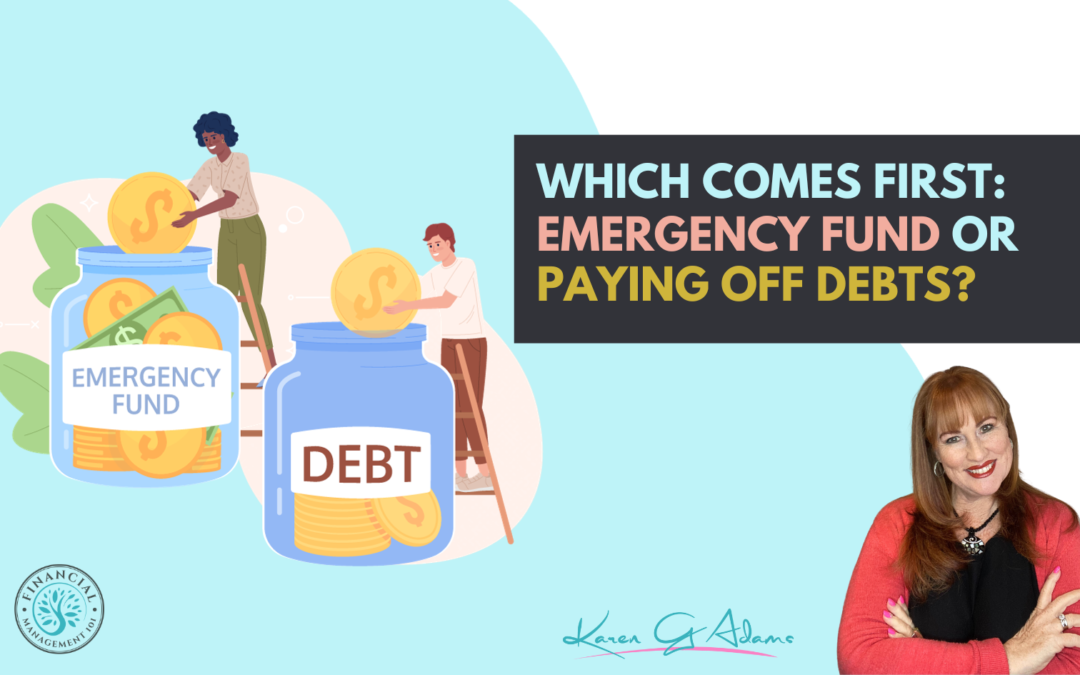
Which Comes First: Emergency Fund or Paying Off Debts?

Which Comes First: Emergency Fund or Paying Off Debts?

When money is tight, it can be hard to pay down debt and build up an emergency savings fund at the same time. But it is still possible with careful budgeting and good money management. 

Here’s a step-by-step plan on how to do this:

1. ASSESS YOUR FINANCIAL SITUATION

Start by looking carefully at your money. Write down everything you earn and everything you owe, including the balances, interest rates, and minimum monthly payments.

2. MAKE A BARE-BONES BUDGET

Make a simple budget that covers only the most important costs, such as housing, utilities, groceries, transportation, and insurance. Cut back as much as you can on spending you do not have to.

3. PAY OFF HIGH-INTEREST DEBTS

Pay off your debts with the highest interest rates first, as this will save you money in the long run. All debts should have the minimum payment made, but any extra money should be put toward the debt with the highest interest rate.

4. SET REALISTIC GOALS

Find out how much you can afford to put toward debt repayment and savings each month. Be careful and make paying off debt your first priority.

5. BUILD A SMALL EMERGENCY FUND

Even though it is important to pay down debt, having a small emergency fund can help you avoid going deeper into debt if you have to pay for something unexpected. Start with a small goal, like $500 or $1,000, and slowly raise it as time goes on.

Having a small emergency fund can help you avoid going deeper into debt if you have to pay for something unexpected.

6. USE WINDFALLS/UNEXPECTED MONEY WISELY

If you get money you did not expect, like a tax refund or a bonus, put some of it toward paying off debt and some into an emergency fund. This helps you move forward in both areas.

7. SAVE AND PAY OFF DEBTS AUTOMATICALLY

Set up automatic transfers to your emergency fund and to your debt payments whenever you can. This makes sure that you always move closer to both goals.

8. LOOK FOR WAYS TO MAKE MORE MONEY

Look for ways to make more money, like part-time work, freelance gigs, or selling things you do not use. The extra money can be used to pay off debts and save money.

Talk with your creditors about your money situation. In some cases, you may be able to negotiate lower interest rates, lower minimum payments, or a delay in payments to make it easier to handle your debt.<br />

    9. TALK WITH YOUR CREDITORS

    Talk with your creditors about your money situation. In some cases, you may be able to negotiate lower interest rates, lower minimum payments, or a delay in payments to make it easier to handle your debt.

    10. REVIEW AND ADJUST REGULARLY

    Check in on your budget and financial goals every so often. Change how you pay off debt and save money when your income and expenses change.

    11. CELEBRATE MILESTONES

    Celebrate your successes, no matter how small they are. Every dollar you save in an emergency fund or pay off of a debt is a step toward financial stability.

    Remember that building an emergency fund and paying off debt are long-term goals. It’s okay to progress slowly if your income is limited.

     The important thing is to keep working toward both goals, even if progress is slow. Your money situation will get better over time, and you will have a stronger financial base.

    At Financial Management 101 – we are committed to providing YOU with excellent financial education, training and support so that you can live the life you truly desire.  Join our LEARNING HUB today!

    Join the Learning Hub - Financial Management 101 by Karen G Adams