Why Small Business Owners Are Working Harder Than Ever — But Making Less Profit

Why Small Business Owners Are Working Harder Than Ever — But Making Less Profit

The Shift Every Business Owner Must Understand to Survive and Thrive in Today’s Economy

There was a time when hard work almost guaranteed success in business.

If you stayed committed, put in the hours, sacrificed weekends, pushed through exhaustion, and gave your business everything you had, eventually the rewards would come.

At least that’s what many small business owners were taught to believe.

But today?

Things feel very different.

Across Australia, many small business owners are working harder than ever before, yet they’re feeling more stressed, overwhelmed, and financially stretched than they did years ago.

They’re putting in longer hours.

Taking fewer breaks.

Carrying more responsibility.

Worrying more about cashflow.

And despite all the effort… many still feel like they’re not truly getting ahead.

If that sounds familiar, you’re not alone.

Right now, thousands of business owners are quietly asking themselves the same question:

“Why does it feel like I’m working harder than ever… but making less profit?”

The answer is confronting but important.

The old way of doing business no longer works in today’s economy.

And the businesses that will thrive over the next decade will not necessarily be the businesses working the hardest.

They’ll be the businesses operating the smartest.

That’s a massive shift.

Because many business owners were conditioned to believe that success comes purely from hustle.

Work harder.
Push harder.
Do more.
Sacrifice more.

But in today’s world, hard work without systems, visibility, strategy, and leadership often leads straight to burnout.

And burnout is becoming one of the biggest silent killers of small business success.

The Hidden Trap Many Business Owners Fall Into

One of the biggest issues I see with small business owners is that they unknowingly create businesses that rely entirely on them to survive.

They become:

  • the salesperson
  • the marketer
  • the customer service team
  • the accounts department
  • the operations manager
  • the problem solver
  • the social media manager
  • the decision maker

Every problem flows through them.

Every question lands on their desk.

Every fire becomes theirs to put out.

At first, this level of involvement feels normal.

In the early stages of business, most owners wear multiple hats because they have to.

But the problem is many businesses never evolve beyond this stage.

Instead of building scalable businesses, owners end up creating stressful jobs for themselves.

And over time, the pressure becomes exhausting.

The scary part?

Many business owners start believing this level of stress is simply “part of business.”

But it shouldn’t be.

Because while hustle may build a business initially, hustle alone rarely sustains long-term success.

Across Australia, many small business owners are working harder than ever before, yet they’re feeling more stressed, overwhelmed, and financially stretched than they did years ago.

Exhaustion Is Not a Business Strategy

Somewhere along the way, burnout became glorified in business culture.

Working 12-hour days became something to brag about.

Skipping holidays became normal.

Being “busy” became a badge of honour.

But exhausted people do not make powerful business decisions.

When business owners are constantly stressed and overwhelmed, they often begin operating emotionally instead of strategically.

They react instead of lead.

They focus on urgent problems instead of important ones.

They become trapped inside the daily chaos of the business instead of building a business designed for growth.

And eventually, the cracks begin to show.

Relationships suffer.
Health suffers.
Energy drops.
Decision-making weakens.
Creativity disappears.
And often… profitability suffers too.

Because here’s the truth many people don’t want to admit:

You cannot scale chaos.

Revenue Does Not Equal Profit

One of the biggest misconceptions in business is believing that high turnover automatically means success.

It doesn’t.

There are businesses turning over hundreds of thousands, even millions, of dollars that are still struggling financially behind the scenes.

Why?

Because revenue and profit are two very different things.

Turnover is not profit.

Profit is not cashflow.

And cashflow is not personal wealth.

This is where many business owners get caught.

From the outside, the business may appear successful.

The branding looks great.
Customers are coming through the door.
Sales are happening.

But internally, the owner is stressed, overwhelmed, and wondering where all the money keeps disappearing to.

And honestly?

This creates enormous emotional pressure for business owners.

Because when the numbers don’t make sense, uncertainty grows.

And uncertainty creates stress.

Why Financial Visibility Changes Everything

One of the most powerful things a business owner can have is visibility.

Not complicated spreadsheets.

Not confusing accounting jargon.

Real visibility.

Understanding:

  • where your money is going
  • what’s actually profitable
  • what products or services are underperforming
  • where cashflow leaks are happening
  • what your numbers are really telling you

Because numbers tell stories.

They reveal habits.
Patterns.
Blind spots.
Strengths.
Weaknesses.
Opportunities.

And when business owners truly understand their numbers, something powerful happens.

Confidence returns.

Decision-making improves.

Stress reduces.

Growth becomes more strategic instead of reactive.

But many owners avoid looking deeply at their numbers because they feel confronting.

So instead, they rely on gut instinct.

They check the bank account balance instead of understanding the bigger financial picture.

And while instinct matters in business, instinct without data can become dangerous.

The businesses thriving right now are the ones combining intuition with visibility.

Because when you can clearly see what’s happening in your business, you stop operating from fear.

You start operating from clarity.

The Business World Has Changed

Another reason hard work alone is no longer enough is because business itself has changed dramatically.

Consumers have changed.

Technology has changed.

Marketing has changed.

Attention spans have changed.

And artificial intelligence is now reshaping industries faster than many business owners realise.

Yet many businesses are still operating using outdated systems and outdated models.

This creates a dangerous gap between effort and results.

Some owners are working incredibly hard… but inefficiently.

They’re manually doing tasks technology could streamline.

They’re overwhelmed by admin.

They’re spending hours creating content.

They’re reacting to problems all day instead of building systems that reduce problems.

And as a result, they stay trapped in operational overwhelm.

The future belongs to business owners who learn how to combine human leadership with smart systems and modern technology.

This doesn’t mean removing the personal side of business.

In fact, human connection matters more than ever.

But it does mean removing unnecessary friction.

It means creating efficiency.

It means building businesses that don’t completely rely on the owner being “on” 24/7.

The Shift From Operator to CEO

This is one of the most important transformations a business owner can make.

The shift from operator to CEO.

Operators stay trapped in the daily chaos.

CEOs create systems.

Operators react emotionally.

CEOs make strategic decisions.

Operators focus purely on revenue.

CEOs focus on profitability and sustainability.

Operators stay busy.

CEOs stay intentional.

This shift changes everything.

Because the goal of business ownership should not be constant exhaustion.

The goal should be building a business that creates freedom, opportunity, and long-term sustainability.

But that requires leadership.

It requires visibility.

And it requires the willingness to evolve.

The Businesses That Will Thrive in the Future

The businesses that will thrive over the next decade are not necessarily the biggest businesses.

They are the businesses willing to adapt.

The businesses are willing to modernise.

The businesses willing to embrace:

  • financial clarity
  • leadership
  • systems
  • automation
  • smarter decision-making
  • visibility
  • sustainable growth

The future small business owner needs more than technical skills.

They need:

  • emotional resilience
  • financial intelligence
  • strategic thinking
  • leadership capability
  • adaptability
  • communication skills
  • modern business systems

Because business growth is no longer just about effort.

It’s about alignment.

Alignment between:

  • strategy
  • systems
  • leadership
  • financial visibility
  • personal wellbeing
  • and sustainable growth

Success is building a business that supports your life.

Your Business Should Support Your Life – Not Consume It

This is the conversation more business owners need to start having.

Because too many owners are trapped inside businesses that are draining them emotionally, mentally, physically, and financially.

And that’s not success.

Success is building a business that supports your life.

A business that creates opportunity.

A business that allows you to grow financially without destroying your health or relationships in the process.

A business that gives you freedom instead of constant anxiety.

And perhaps the biggest shift of all is this:

The goal was never just to work harder.

The goal was always to build better.

To build smarter.

To build more intentionally.

To create stronger systems.

To understand your numbers properly.

To lead with clarity instead of chaos.

And to create a business that actually works for you – instead of one that constantly burns you out.

Because the businesses that thrive in this new era will not be the businesses grinding themselves into the ground.

They’ll be the businesses willing to evolve.

The businesses willing to simplify.

The businesses willing to lead differently.

And the business owners who understand that shift will create something far more powerful than just revenue.

They’ll create sustainability.

Freedom.

Profitability.

And a business and life – they genuinely enjoy.

Ready to Stop Surviving and Start Leading?

If you’re tired of feeling overwhelmed, financially stretched, or stuck working harder without seeing the results you deserve, maybe it’s time to stop asking:

“How can I work harder?”

And start asking:

“How can I build smarter?”

Because sometimes the biggest breakthrough in business doesn’t come from doing more.

It comes from finally doing things differently.

Take the FREE Business Performance Audit™ and uncover what’s really slowing your business down.
Membership - FM101

#HowToResetMyMoneyMindset #NewYearFinancialMindset #HowToStartFreshWithMoney  emergency fund australia, money management, family savings #SmallBusinessOwner #BusinessGrowth #CashflowManagement #BusinessSuccess
#EntrepreneurMindset

 

Your Team Might Look Fine – But Financial Stress Could Be Costing More Than You Think

Your Team Might Look Fine – But Financial Stress Could Be Costing More Than You Think

“They seem fine.”

It is one of the most common assumptions leaders make.
And to be fair, it is an easy one to make.

Most employees are not walking into work announcing that they are worried about bills, debt, interest rates, or the rising cost of everyday life.

They keep going.
They keep performing.
They keep pushing through.

But financial stress has a way of showing up quietly.

It can look like a distraction.
Low energy.
Mood changes.
Reduced confidence.
Increased absenteeism.
Burnout.
Or eventually, a resignation that seems to come out of nowhere.

The employee looked fine.
But they were not fine.

The silent pressure many employees are carrying

The current financial climate is affecting people in deeply personal ways.
Even capable, high-performing employees can be under enormous pressure.

When money stress builds, people can feel:

  • mentally overloaded
  • emotionally flat
  • ashamed to ask for help
  • trapped in a cycle of stress and avoidance
  • worried about keeping up with household costs
  • fearful about debt, repayments, or unexpected expenses

And because money is still a sensitive topic, many employees suffer in silence.

That silence can be expensive.

The current financial climate is affecting people in deeply personal ways.
Even capable, high-performing employees can be under enormous pressure.

Why this is bigger than employee perks

Free lunches, social events, and workplace rewards all have their place.
But they do not solve financial anxiety.

When someone is lying awake worrying about bills, a pizza party is not going to restore their peace of mind.

This is why financial wellbeing deserves more attention inside workplaces.
It addresses a real problem that affects people’s everyday lives and their capacity to function well at work.

It is practical. It is human. And right now, it is incredibly relevant.

What financial wellbeing support actually does

A strong financial wellbeing approach helps employees move from stress and confusion to clarity and confidence.

That might involve helping them:

  • understand where their money is going
  • create simple systems that reduce overwhelm
  • identify savings opportunities they have missed
  • tackle debt with a clearer plan
  • improve money habits and mindset
  • feel more hopeful and less stuck

Notice that this is not about judgement. It is about support.

Financial pressure can affect anyone. The goal is not to shame people for needing help. The goal is to give them tools that genuinely make life feel more manageable.

What employers gain when they take this seriously

When businesses support staff with financial wellbeing, the impact can ripple through the whole workplace.

You may see:

  • better focus and engagement
  • increased productivity
  • lower staff turnover
  • stronger trust and loyalty
  • reduced burnout risk
  • a more supportive workplace culture

People remember employers who support them through hard seasons.
Not just with words, but with meaningful action.

Reassurance is part of support

Let’s pause here for something important.

If you are an employee feeling the pressure right now, please hear this:

You are not weak.
You are not bad with money just because things feel hard.
You are not the only one feeling stretched.

This season may be challenging, but it does not define you.
With the right support, practical tools, and small consistent changes, things can improve.

And if you are an employer reading this, never underestimate how powerful it is to create a workplace where people feel safe to get support before they hit breaking point.

    Reassurance is part of support

    Support before crisis is the smarter move

    Too often, workplaces respond after the damage is done.
    After the burnout.
    After the resignation.
    After the drop in performance.
    After the personal crisis spills into professional life.

    But early support changes that.

    When businesses proactively offer financial wellbeing resources, they help staff build resilience before the pressure becomes overwhelming.
    That is better for the employee and better for the organisation.

    A more compassionate and practical workplace benefit

    There is a reason financial wellbeing is becoming such an important conversation.
    It sits at the intersection of performance, retention, mental wellbeing, and culture.

    It is not about fixing everything overnight.
    It is about giving people a starting point.
    A plan.
    A sense that they are not alone.
    A pathway back to confidence.

    And in uncertain times, that kind of support matters more than ever.

    My Financial Wellbeing Program helps workplaces support staff with practical money tools, confidence-building education, and real guidance that reduces stress and strengthens wellbeing.

    Because when your people feel better about money, they often feel better at work too.

    And that is good for everyone.

    Financial Wellbeing Program

    #HowToResetMyMoneyMindset #WhyDoIFeelOutOfControlWithMoney #HowToFeelInControlOfFinances #ResetMoneyMindset2025 #NewYearFinancialMindset #HowToStartFreshWithMoney  emergency fund australia, money management, family savings 


    Busy Is Not Profitable: 7 Financial Foundations Every Business Owner Needs

    Busy Is Not Profitable: 7 Financial Foundations Every Business Owner Needs

    There’s a big myth in small business that if you just work hard enough, everything will eventually click into place.

    Spoiler alert: hard work matters, but hard work without financial foundations can leave you exhausted, underpaid, and wondering why your business still feels so heavy.

    I see this all the time with small business owners, tradies, franchisees, coaches, and self-employed professionals.

    They are flat out. Clients are coming in. Invoices are going out. The calendar is packed.

    And yet… There is still stress. Still pressure. Still that sinking feeling of, “Why does it feel like I’m doing all this work and not getting ahead?”

    Here’s why:

    Because busy is not profitable. And being great at your trade or profession is not the same as having strong money systems.

    The good news? You do not need a finance degree to fix this. You just need the right foundations.

    Here are seven of the most important ones.

    1. A cashflow system that tells the truth

    Cashflow is not something you check when you are already in trouble.
    It is something you build so you can stay out of trouble.

    A good cashflow system shows you:

    • what is coming in
    • what is going out
    • what bills are approaching
    • what is available to spend
    • what needs to be set aside for tax, super, wages, and future costs

    Cashflow gives you visibility. Visibility gives you control.

    2. Clear separation between personal and business money

    Using your personal account like a business overdraft creates confusion fast.

    It becomes harder to track spending, harder to know what the business is really earning, and harder to make clean decisions.

    Separating business and personal finances is one of the fastest ways to reduce chaos.
    It is not about being fancy. It is about being clear.

    3. Pricing that actually protects your profit

    So many business owners price from fear.

    Fear of losing the sale.
    Fear of seeming too expensive.
    Fear of being judged.

    But underpricing does not make you more professional. It makes your business more fragile.

    Your pricing needs to cover more than the job in front of you. It needs to reflect overheads, admin time, tax obligations, profit goals, and the actual value you deliver.

    Pricing with confidence is not greedy.
    It is responsible.

    4. A plan to pay yourself properly

    Using your personal account like a business overdraft creates confusion fast.

    It becomes harder to track spending, harder to know what the business is really earning, and harder to make clean decisions.

    Separating business and personal finances is one of the fastest ways to reduce chaos.
    It is not about being fancy. It is about being clear.

    5. Weekly and monthly money rhythms

    You do not need to stare at your numbers every day.
    But you do need a rhythm.

    That might include:

    • checking cashflow weekly
    • reviewing key reports monthly
    • monitoring expenses and margins
    • tracking unpaid invoices
    • spotting small issues before they turn into big ones

    Confidence with numbers is built through repetition, not perfection.

    6. Knowing your numbers without drowning in them

    You do not need to obsess over every metric.
    You do need to know the numbers that matter.

    Think:

    • revenue
    • gross profit
    • operating expenses
    • net profit
    • cash position
    • debt levels
    • wage costs
    • tax set-asides

    The goal is not more complexity.
    The goal is better decisions.

    When you know what your numbers are saying, you stop making emotional decisions and start making strategic ones.

    7. A business structure that can handle growth

    Growth is exciting, but if your systems are messy, it can magnify every weakness.

    That is why foundations matter before scaling.

    You want business systems that support:

    • clear accounts setup
    • simple automations
    • better reporting
    • cleaner budgeting
    • stronger decision-making
    • less burnout

    Strong structure makes growth feel possible instead of painful.

    Business foundations create freedom

    Why this matters right now

    The business landscape is not getting easier.
    Costs are rising. Margins can be tight. Pressure builds quickly when you do not have clarity.

    That is exactly why now is the time to stop relying on memory, hope, and hustle alone.

    The strongest business owners are not always the loudest or busiest.
    They are the ones who know their numbers, trust their systems, and make decisions early.

    Foundations Create freedom

    Let’s make this simple. When your financial foundations are solid, you get:

    • less panic
    • less avoidance
    • less confusion
    • better decisions
    • stronger profit
    • more confidence
    • more breathing room

    And honestly? More enjoyment.

    Because business should not feel like one long financial mystery.

      A business structure will help you handle growth

      Your invitation to stop winging it

      If you know your foundations need work, you are not alone.
      And you do not have to figure it all out the hard way.

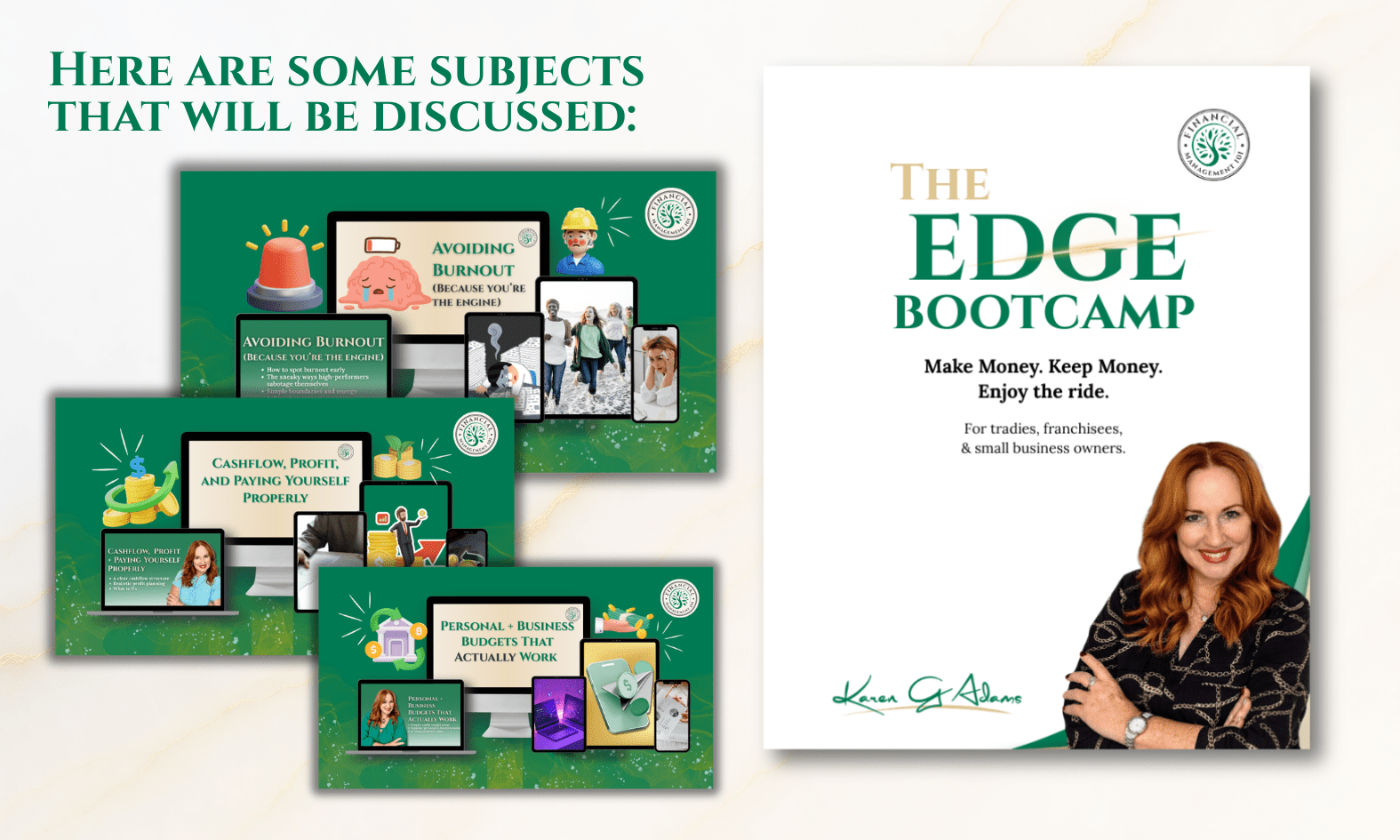
      That is exactly what The Edge Bootcamp is designed to help you do.

      Over two practical, high-impact days, we dig into the real foundations of profitable business: money systems, CEO mindset, cashflow, paying yourself, pricing, budgets, business setup, reading your numbers, leadership, growth stages, and more.

      This is for business owners who want results, not just motivation.

      Join The Edge Bootcamp in May and give your business the foundations it needs to make money, keep money, and enjoy the ride.

      Because being flat out is not the goal.
      Building a business that works for you is.

      Join The Edge Bootcamp

      #HowToResetMyMoneyMindset #WhyDoIFeelOutOfControlWithMoney #HowToFeelInControlOfFinances #ResetMoneyMindset2025 #NewYearFinancialMindset #HowToStartFreshWithMoney  emergency fund australia, money management, family savings 


      Financial Stress at Work Is Real: How Employers Can Support Staff Through Uncertain Times

      Financial Stress at Work Is Real: How Employers Can Support Staff Through Uncertain Times

      Let’s talk about the thing many workplaces feel but few talk about openly.

      Financial stress.

      Right now, many employees are carrying a heavy mental load. Rising living costs, debt pressure, interest rate worries, and the emotional weight of trying to “hold it all together” can quietly affect how people show up at work.

      The tricky part?
      A lot of struggling employees do not look like they are struggling.

      They still show up.
      They still smile in meetings.
      They still get the work done.

      But underneath the surface, they may be losing sleep, feeling distracted, or wondering how they are going to stay on top of everyday life.

      This is not just a personal issue. It is a workplace issue too.

      The hidden impact of financial pressure

      When an employee is stressed about money, it rarely stays neatly at home.
      It follows them into the workday.

      Financial stress can affect:

      • concentration
      • confidence
      • energy levels
      • productivity
      • decision-making
      • mental wellbeing
      • workplace engagement

      And when it goes unaddressed for too long, people often do not just want more money.
      They want relief.
      They want stability.
      They want support.

      Sometimes, that means they leave.

      When an employee is stressed about money, it rarely stays neatly at home.
It follows them into the workday.

      Why a pay rise is not always the answer

      This is where many employers get caught off guard.

      They assume financial stress is only about income, so they respond with a pay rise when possible. While higher income can help, it does not automatically solve poor money habits, lack of structure, debt overwhelm, or financial anxiety.

      Because financial wellbeing is not just about how much people earn.
      It is also about how confidently they manage what they have.

      That is why some employees can get a raise and still feel overwhelmed.
      And why some workplaces offer perks, rewards, and recognition but still experience turnover, burnout, or disengagement.

      People do not always leave for a bigger paycheck.
      Sometimes they leave because they are chasing less stress.

      What employees really need

      In uncertain times, employees need more than surface-level support.
      They need practical help that builds real confidence.

      That can look like:

      • education that makes money feel less overwhelming
      • simple systems to manage spending and bills
      • tools to reduce financial chaos
      • strategies to tackle debt with a plan
      • guidance that helps them feel more in control
      • a safe, shame-free space to get support

      When people feel financially stronger, they often feel emotionally stronger too.
      And that changes how they show up in every area of life, including work.

      The role employers can play

      The role employers can play

      Employers do not need to become financial advisers.
      But they can become part of the support system.

      A workplace that genuinely cares about financial wellbeing sends a powerful message:

      “We see the pressure. We care about the person, not just the performance.”

      That kind of support builds trust.
      It strengthens loyalty.
      And it helps create a workplace culture where people feel valued in a real way.

      Simple ways employers can help include:

      • offering financial wellbeing education
      • normalising money conversations without stigma
      • providing access to coaching or structured support
      • recognising the connection between financial stress and performance
      • focusing on prevention, not just crisis response

      Why this matters for business outcomes too

      Supporting employee financial wellbeing is not just kind. It is smart.

      When employees feel less stressed about money, businesses often benefit from:

      • improved focus
      • better productivity
      • lower turnover
      • stronger morale
      • healthier workplace culture
      • more trust between staff and leadership
      When employees feel less stressed about money, businesses often benefit

      In other words, supporting financial wellbeing is not a “soft” benefit.
      It is a practical one.

      And in times of uncertainty, practical support is exactly what people remember.

      Comfort matters too

      There is one more piece that deserves attention.

      People do not just need solutions. They need reassurance.

      Many employees are currently feeling shame about money. They may feel embarrassed that they are stressed. They may think they “should” have it sorted. They may stay silent because they would rather not look incapable.

      That is why comfort matters.

      It helps to remind people:

      • they are not alone
      • financial pressure is affecting many households
      • struggling does not mean failing
      • support is available
      • change is possible with the right tools and guidance

      Sometimes the most powerful first step is simply helping someone feel seen.

      Creating a more supportive workplace

      If you are an employer, leader, or HR decision-maker, this is your opportunity to think bigger about what support really means.

      Financial wellbeing is no longer a “nice to have”.
      It is one of the most practical and human ways to support your team.

      And it does not require overcomplicating things. It starts with awareness.

      Then it moves into education, tools, and support that help people take back a sense of control.

      A better path forward

      The world feels heavy for many people right now. That is real. But so is the opportunity to respond differently.

      Instead of waiting for burnout, disengagement, or unexpected resignations, employers can choose to act earlier.


      They can offer support that helps employees feel steadier, calmer, and more capable. And when that happens, everybody wins.

      If you want to support your team in a practical, meaningful way, my Financial Wellbeing Program helps employees build confidence, reduce money stress, and create healthier financial habits with real tools and support.

      Because sometimes the best staff benefit is not another perk.
      It is helping your people feel safer, stronger, and more in control of their lives.

      Financial Wellbeing Program

      #HowToResetMyMoneyMindset #WhyDoIFeelOutOfControlWithMoney #HowToFeelInControlOfFinances #ResetMoneyMindset2025 #NewYearFinancialMindset #HowToStartFreshWithMoney  emergency fund australia, money management, family savings 


      The Foundations First: Why Small Business Owners Can’t Afford to Wing It Anymore

      The Foundations First: Why Small Business Owners Can’t Afford to Wing It Anymore

      If you’re a small business owner, tradie, franchisee, coach, or self-employed professional, chances are you didn’t start your business because you love spreadsheets, cashflow forecasts, or sorting out your accounts.

      You started because you’re good at what you do.

      You solve problems. You build things. You coach people. You create results. But somewhere along the way, many business owners find themselves working harder than ever and still feeling like they’re falling behind.

      Money comes in.
      Then it disappears.
      Tax time rolls around and suddenly it feels personal.
      You’re busy every day, yet you’re not fully sure whether your business is actually performing well.

      Sound familiar?

      Here’s the truth: being busy is not the same as being profitable.

      And in today’s business world, “winging it” is no longer a strategy.

      Why foundations matter more than ever

      Strong businesses are not built on hustle alone. They are built on foundations.

      That means knowing:

      • what money is coming in
      • what money is going out
      • what your pricing needs to be
      • whether your profit is real or just temporary relief
      • how much you can actually afford to pay yourself
      • what your numbers are telling you before problems get bigger

      Without those foundations, growth gets messy fast.

      More sales can actually create more pressure.
      More clients can create more chaos.
      More team members can expose weak systems.
      And more revenue can still leave you with less cash than expected.

      This is the trap so many business owners fall into. From the outside, things can look successful. Inside, it feels like stress, uncertainty, and constant financial firefighting.

      Strong businesses are not built on hustle alone. They are built on foundations.

      The Hidden Cost of Weak Foundations

      When your financial systems are weak, everything takes more energy.

      You make decisions based on gut feel instead of facts.
      You underprice because you’re scared of losing work.
      You mix personal and business spending and hope it all works out.
      You avoid looking at reports because they feel overwhelming.
      You stay in operator mode instead of stepping into your role as CEO.

      The result?
      You work harder, worry more, and enjoy your business less.

      And let’s be honest, that is not why you started.

      A business should support your life, not swallow it whole.

      What Solid Business Foundations Actually Look Like 

      Getting your foundations right does not mean making things more complicated.

      It means making things clearer.

      It looks like:

      • a simple cashflow structure you actually understand
      • separate systems for business and personal money
      • confidence around pricing, profit, wages, and expenses
      • a weekly and monthly rhythm for checking the right numbers
      • stronger boundaries around spending and decision-making
      • knowing where your money is leaking and how to plug it

      When these basics are in place, something powerful happens.

      You stop guessing.
      You start leading.
      You stop reacting.
      You start planning.
      You stop feeling behind.
      You start building momentum.

      You do not need more motivation. You need structure.

      Many business owners think they need to feel more disciplined, more focused, or more inspired.

      But often, that’s not the real issue.

      The issue is that the business has grown beyond the systems holding it up.

      You don’t need another pep talk.
      You need a better framework.

      You need simple tools that help you:

      • understand your cashflow
      • pay yourself consistently
      • price with confidence
      • stop tax shock before it happens
      • make decisions from a place of control

      That is where real confidence comes from.
      Not from hoping, but from knowing.

      You don’t need another pep talk.
You need a better framework.

      The Difference Between Surviving and Scaling

      If your foundations are shaky, growth can break you.

      That might sound dramatic, but it’s true.

      A bigger business with poor systems often creates:

      • higher stress
      • tighter cashflow
      • more team issues
      • greater tax pressure
      • slower decision-making
      • more burnout

      On the other hand, when your business foundations are strong, growth becomes more sustainable.
      You can see what is working.
      You can fix what is not.
      You can make better decisions faster.
      You can lead with more confidence and less panic.

      That is the difference between surviving the month and building a business that genuinely funds your life.

        A Quick Self-Check for Business Owners

        Ask yourself:

        • Do I know exactly where my money is going each month?
        • Am I paying myself properly and consistently?
        • Do I understand the difference between revenue and profit in my business?
        • Do I have simple systems for cashflow, tax, and expenses?
        • Do I look at my numbers regularly, or only when I’m forced to?
        • Am I leading my business like a CEO, or just trying to keep up?


        Discomfort is not failure. It is feedback.

        If those questions feel a little uncomfortable, that’s okay.
        That discomfort is not failure.
        It is feedback.

        And it might be the exact sign that now is the time to strengthen your foundations.

        Your next step

        If you’re done with money disappearing, messy systems, and feeling like you’re working too hard for too little clarity, this is exactly why I created The Edge Bootcamp.

        This is not fluff, theory, or feel-good motivation.
        It is practical training for tradies, franchisees, coaches, small business owners, and self-employed professionals who want to stop winging it and start running their business like a CEO.

        Inside the Bootcamp, we cover the foundations that matter most – cashflow, profit, pricing, paying yourself properly, budgets that actually work, business setup, reading your numbers with confidence, and building stronger systems for sustainable growth.

        Join me at The Edge Bootcamp in May and build the financial and business foundations your growth actually needs.


        Because the goal is not to be busier.
        The goal is to be stronger, smarter, and more profitable.

        Note: This event provides education and general information, not personalised financial, accounting, legal, tax, investment, or health advice. Seek advice specific to your circumstances from qualified professionals.

        The Edge Bootcamp

        #HowToResetMyMoneyMindset #WhyDoIFeelOutOfControlWithMoney #HowToFeelInControlOfFinances #ResetMoneyMindset2025 #NewYearFinancialMindset #HowToStartFreshWithMoney  emergency fund australia, money management, family savings