Is Money Stress the Missing Piece in Your Wellbeing Strategy?

Is Money Stress the Missing Piece in Your Wellbeing Strategy?

You provide mental health support, but money is often part of the stress employees are carrying. Here’s how practical financial wellbeing education complements your EAP, without straying into personal advice.

We know how much thought goes into a wellbeing strategy. The EAP is in place. The mental health training has been rolled out. Leaders have been coached to check in on their people.

And still, something doesn’t quite add up. Engagement scores plateau. Absenteeism doesn’t shift the way you’d expect. People say they’re “fine” and clearly aren’t.

Here’s what often gets missed: a huge amount of everyday stress isn’t purely psychological in origin. It’s financial. And most wellbeing strategies aren’t built to touch it.

By the end of this, you’ll know why financial stress behaves differently to other workplace stressors, and how practical financial education sits alongside your EAP rather than competing with it.

Your employees don’t need another financial webinar.
They need personal, practical support that actually changes how they feel and what they do with their money.

Money stress doesn’t look like a “money” problem at work

Financial stress rarely walks into HR and announces itself. It shows up as distraction, short tempers, disengagement, or someone quietly declining opportunities that would help their career because the timing feels too risky.

It’s also one of the few stressors that follows people to work every single day, rather than arriving as a one-off event. A restructure or a difficult client eventually resolves. A mortgage rate rise, or not knowing where next month’s numbers land, doesn’t switch off at 9am.

Why your EAP alone doesn’t close this gap

Your EAP is doing exactly what it’s designed to do; professional, confidential support for people in genuine distress. That matters, and it isn’t in question here.

What an EAP isn’t built for is teaching everyday financial capability. Counselling can help someone process the anxiety money is causing them. It generally isn’t set up to help them understand their pay structure, build a spending plan, or feel confident having a money conversation with a partner.

That’s a different kind of support, practical, skill-based, and preventative rather than crisis-response.

Where financial wellbeing education fits

This is where financial wellbeing education does its work: building everyday money confidence and capability, in plain English, before things reach crisis point.

It’s general education, not personal advice. Nobody’s reviewing an individual’s mortgage or telling them what to do with their super. It’s giving people the foundations; how budgeting actually works, how debt behaves, how to read their own numbers, so they can make their own informed decisions.

Layered with an EAP, you get both ends covered: support for people who are already struggling, and education that helps prevent financial stress building into something bigger in the first place.

What this can look like in practice

Financial wellbeing education for workplaces can sit alongside existing programmes in a few different ways:

  • A standalone session or short series, run like any other professional development topic.
  • Content woven into an existing wellbeing calendar, alongside mental health and physical health initiatives.
  • A resource employees can return to in their own time, for privacy around a genuinely personal topic.

Done well, it’s positioned the same way physical or mental health education is a normal, non-judgemental part of supporting people, not a red flag that something’s wrong.

The Takeaway

A strong wellbeing strategy supports the whole person, and for most people, money is part of that picture whether it’s named or not. An EAP handles the crisis. Financial wellbeing education handles the everyday end, building the confidence and capability that helps prevent the crisis in the first place.

Together, they give your people a genuinely complete safety net, not just a mental health one.

If you’d like to explore what financial wellbeing education could look like for your team, we’d love to talk it through with you.
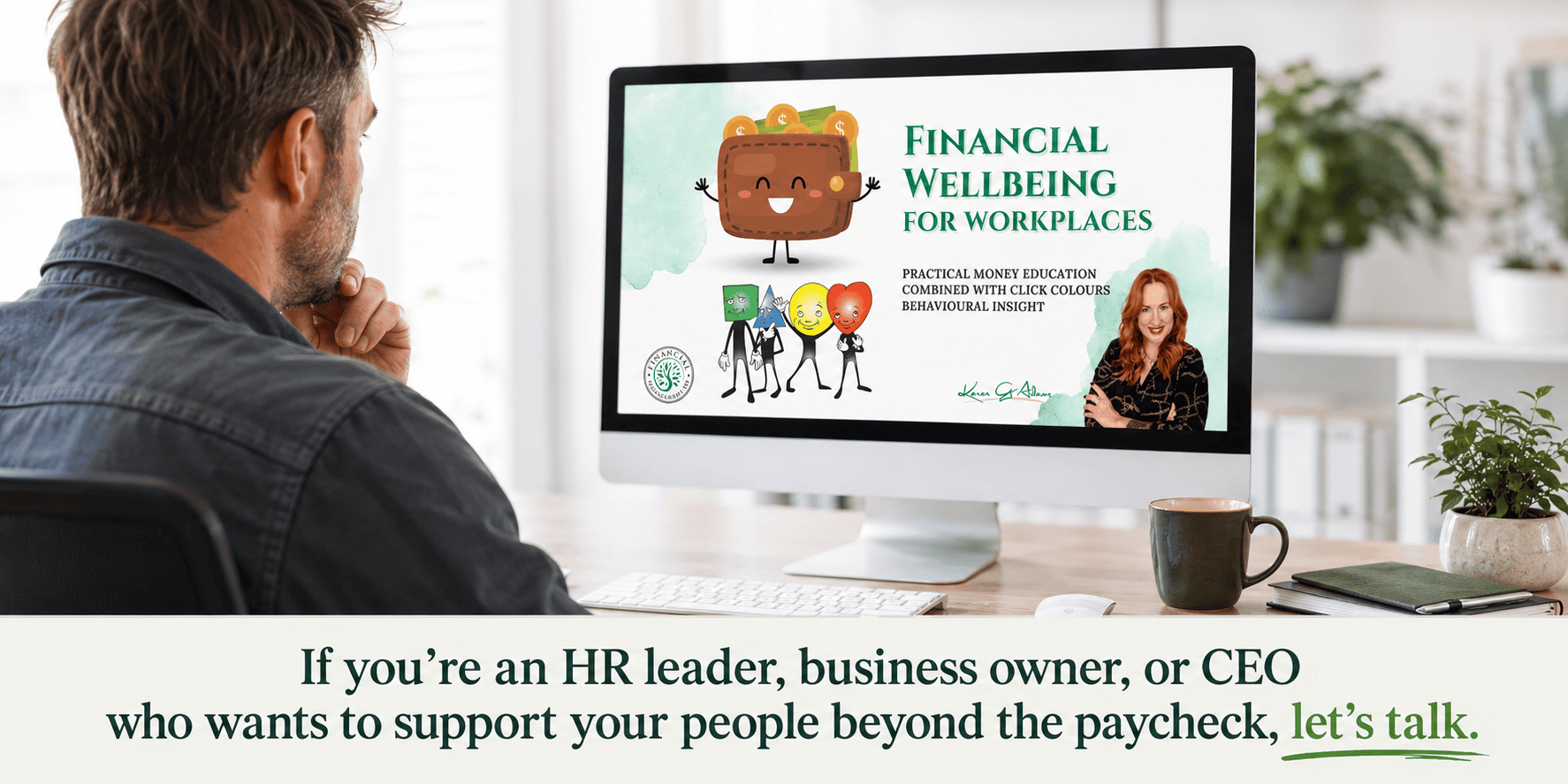
The Financial Wellbeing Solution Your People Deserve — and Your Workplace Needs

#HowToResetMyMoneyMindset #NewYearFinancialMindset #HowToStartFreshWithMoney  emergency fund australia, money management, family savings #SmallBusinessOwner #BusinessGrowth #CashflowManagement #BusinessSuccess #EAP #EmployeeAssistanceProgram
#EntrepreneurMindset

 

Father’s Day and the Business Owner Who Can’t Switch Off

Father’s Day and the Business Owner Who Can’t Switch Off

Happy Father’s Day to every business owner who “just needs to check one email” during the barbecue.

You know the scene. Phone face-down on the table, out of principle. Two minutes later, face-up again. “Just checking something quick.” Forty-five minutes later, still checking, while someone’s asking if you want another sausage and you’re not entirely sure you heard them the first time.

Here’s the bit nobody says out loud; if you genuinely can’t switch off for one Sunday, it’s not because you’re dedicated, it’s because something in the business is relying entirely on you being switched on, all the time. That’s not commitment. That’s a business that hasn’t had its systems built yet, quietly telling on itself every time your phone lights up at a family lunch.

I say this with love, because I’ve been that person too. There’s a particular kind of guilt that creeps in when you’re not checking, like something’s about to fall over the second you look away. Sometimes it will. That’s actually useful information, not a personality flaw. It tells you precisely where the weak point is, rather than leaving you to vaguely feel like you should “be better at switching off,” which is advice with nothing practical underneath it.

Happy Father's Day to every business owner who "just needs to check one email" during the barbecue.

It’s not a discipline problem

Most business owners think the fix is “just try harder to unplug.” Buy a nicer phone case, set a screen time limit, promise yourself Sunday is sacred. And then Sunday arrives and none of it holds, because the willpower was never the actual problem.

You can’t discipline your way out of a business with no systems, no visibility, and nobody else who knows where anything lives. If you’re the only one who knows the client’s login, the only one who knows how the invoicing actually works, the only one who can answer “did that order go out,” then of course you can’t switch off – you’re not being undisciplined, you’re being the entire operations department in one exhausted human body.

The phone-checking isn’t the actual problem. It’s just the symptom you can see. Fixing the symptom without fixing the cause is like taking the batteries out of a smoke alarm because the beeping is annoying.

What it costs, quietly

There’s a cost to this that doesn’t show up on the profit and loss but shows up everywhere else. It shows up in the conversation you half-listened to. The moment with the kids you were technically present for but not really in. The mate who stopped inviting you to things because you always seemed distracted, or cancelled at the last minute, or spent the whole time with one eye on your phone. None of that gets tracked anywhere. It just quietly accumulates until one day you notice the gap.

The real question to ask

The more useful question isn’t “how do I switch off more.” It’s “what would genuinely happen today if I didn’t check my phone at all?” If the honest answer is “everything would fall apart”, that tells you exactly where the gaps are. Not a criticism. A map.

Sit with that answer for a second. Is it really everything, or is it one or two specific things? Usually, when people actually write it down, the list is shorter than the panic suggested. There’s something almost funny about how big the fear feels compared to how short the actual list turns out to be once it’s on paper instead of in your head.

Building the buffer, one piece at a time

You don’t need to overhaul the whole business in a weekend to get some breathing room back. Start with the smallest, most repeated interruption, the thing that pulls you out of family time most often and ask what it would take to hand even part of that off. A simple checklist someone else can follow. A shared login instead of a personal one. An automated reminder instead of you personally remembering. None of these are big, dramatic fixes. They’re small, boring, unglamorous changes, and they’re exactly the ones that actually stick.

One small fix before the next family day

Before your next family day, try this. Write down the three things that would actually need you if they went sideways. Then ask yourself, honestly, whether one of those three could be handled by a simple checklist, a bit of automation, or someone else entirely, instead of by you personally, every single time. Fix one. That’s next Father’s Day a little more sorted than this one and the one after that, a little more sorted again. This isn’t a one-weekend fix. It’s a habit of slowly handing things off until your presence isn’t the only thing holding the whole operation together.

A better business creates a better life and a better life includes actually being at the barbecue, present for the conversation, not just physically there while mentally reconciling last month’s invoices.

The version of success worth aiming for

There’s a version of business success that gets celebrated a lot, the one measured in revenue, growth, how many staff you’ve got, how big the operation’s gotten. It’s a fine measure, as far as it goes. But it misses something important, which is whether the person who built all of that can actually enjoy a Sunday without their phone glued to their hand.

I’d argue the better measure of success is this – can you take a full day off, properly off, and come back to a business that’s still standing, without having spent the whole day half-present because part of you never left? That’s a much harder thing to build than revenue, and it’s a much better thing to have.

Building the systems that let you switch off isn't a luxury add-on. It's kind of the whole point of doing this in the first place.

Kids notice more than we think

There’s a particular moment a lot of business-owner parents have at some point; a kid saying something like “you’re always on your phone,” delivered completely matter-of-factly, no drama attached, which somehow makes it land harder than if they’d shouted it. Kids don’t measure your love by how hard you’re working for their future. They measure it by whether you were actually there when they wanted to tell you something, show you something, or just have you sitting next to them doing nothing in particular.

That’s not a guilt trip, plenty of us are working exactly because we want a better life for them. It’s just worth remembering that the “better life” bit doesn’t only mean money down the track. It means you, actually present, more often than not.

Building the systems that let you switch off isn’t a luxury add-on. It’s kind of the whole point of doing this in the first place.

If you want help working out exactly where your business is leaning on you too hard, The CEO Dashboard is built for precisely that, a clear look at what’s actually relying on you, and what could run perfectly well without you for a Sunday afternoon.

The CEO Dashboard

#HowToResetMyMoneyMindset #NewYearFinancialMindset #HowToStartFreshWithMoney  emergency fund australia, money management, family savings #SmallBusinessOwner #BusinessGrowth #CashflowManagement #BusinessSuccess
#EntrepreneurMindset


R U OK? (The Question You Never Ask Yourself)

R U OK? (The Question You Never Ask Yourself)

On September 10, most of Australia will be asking each other “R U OK?” Workplaces will run morning teas. There’ll be yellow everywhere. It’s a genuinely good day, and I’m glad it exists – it’s done a lot for getting these conversations out into the open where they belong, after years of them staying firmly behind closed doors.

But here’s the question I actually want to ask you, business owner to business owner… when’s the last time you asked yourself that?

We’re brilliant at checking in on everyone else. Staff, clients, family, that one supplier who always sounds a bit frazzled on the phone. But most business owners I talk to haven’t had an honest conversation with themselves in months. We’re too busy holding everything together to notice we might not be, ourselves. We’re the ones people come to when something’s gone wrong, which means we’ve quietly trained everyone around us, including ourselves to believe we don’t need checking on.

Running a business is one of the loneliest jobs going, if I’m honest. You’re the one everyone brings their problems to. There’s rarely anyone bringing you theirs, asking how you’re actually tracking underneath it all. Even the people who love you tend to ask “how’s the business going?” rather than “how are you going?” and those are very different questions with very different answers.

The performance of “fine”

There’s a particular skill business owners develop without meaning to, the ability to say “yeah, good, flat out” in a completely convincing tone while privately feeling anything but. It becomes automatic. Someone asks how you’re going at the school pickup, at the football, at a client meeting, and out it comes before you’ve even thought about it. Over time, that automatic answer starts to replace the honest one, even in your own head. You stop checking because you’ve gotten so good at performing that you don’t seem to need it.

So today, let’s flip it. Three questions, and actual permission to answer them properly, without the reflexive “yeah, good, flat out” that we all give without thinking.

Am I okay, or am I just coping?

There’s a real difference. Coping looks like getting through the week in one piece, ticking things off, keeping the wheels on. Okay looks like genuinely enjoying the thing you built, feeling proud of it, curious about where it’s going, energised rather than depleted by it. If you’ve been in coping mode for a while now, that’s worth noticing, not brushing off with “it’s just a busy season,” because busy seasons have a habit of becoming permanent if nobody names them.

There’s no shame in “coping” as an honest answer. It’s often the truest thing a business owner has said about themselves in months, once they finally stop and let themselves say it. The shame only comes from pretending otherwise for too long.

What am I carrying that I haven't said out loud?
For a lot of business owners, it's the money. The gap between what the business brings in and what it feels like it should be bringing in by now, given how hard you're working.

What am I carrying that I haven’t said out loud?

For a lot of business owners, it’s the money. The gap between what the business brings in and what it feels like it should be bringing in by now, given how hard you’re working. That gap is heavy to carry on your own, and you really don’t have to. I’ve had conversations with business owners who’ve been sitting on that particular worry for years, silently, because it felt embarrassing to say out loud, like admitting it meant admitting they’d failed at something. It’s not embarrassing. It’s incredibly common, and it’s fixable once it’s actually spoken about, usually far more fixable than the years of silent worry suggested.

Sometimes what people are carrying isn’t even the money itself, it’s the fear of what the money says about them. That’s a heavier load than the actual numbers ever are.

Who’s actually in my corner?

Not staff. Not clients. I mean the people who ask how you’re going, not just how the business is going. If that list is short, that’s your sign; a mentor, a community, or even just a standing coffee with someone who genuinely gets what this life is like. Business ownership can be surprisingly isolating even when you’re surrounded by people all day, because being surrounded by people isn’t the same as being known by them.

The physical signs worth noticing

Sometimes the “am I okay” question is easier to answer by looking at the body rather than the mind. Are you sleeping properly, or lying awake running through tomorrow’s problems? Are you short-tempered with people who don’t deserve it? Have you stopped doing the small things that used to recharge you – the walk, the round of golf, the Sunday paper, because there’s “no time”? These aren’t small details. They’re often the clearest signal available that the tank’s getting low, well before the mind is ready to admit it in so many words.

It’s okay to not have the answer yet

If you sat with those three questions and didn’t love your answers, that’s not a failure, that’s information. The whole point of asking is so you can actually do something with what you find, rather than carrying it around unexamined for another six months. Awareness on its own doesn’t fix anything, but it’s the step that has to come first, and it’s the step most business owners skip entirely because it’s uncomfortable.

You can’t run a healthy business from an empty tank. Checking in on yourself isn’t soft, whatever the old-school hustle crowd would have you believe, it’s strategy, plain and simple. A business owner who’s running on empty makes worse decisions, snaps more easily, and enjoys less of what they’ve built. None of that helps the business either – it’s not a trade-off between looking after yourself and looking after the business. They’re the same job.

And if part of what’s weighing on you is the money side of things, that’s exactly what The Edge exists for. A place where you’re not carrying it solo, surrounded by other business owners asking each other the real questions instead of the polite ones.

Join The Edge: https://financialmanagement101.com.au/work-with-karen/the-edge/

And if today’s the day you actually need to talk to someone, Lifeline is on 13 11 14, any hour, no appointment needed.

What to do once you’ve asked yourself

Asking the question is the easy part, once you’ve actually made yourself do it. The harder part is what comes next, because most business owners are excellent at identifying a problem and then filing it away under “deal with that eventually.” So if any of the three questions above landed a bit close to home, don’t let it end there.

Pick one small thing. Not a complete overhaul of your life, not a dramatic announcement to everyone that you’re “making changes.” One small thing; a call to a friend you’ve been meaning to make, an actual look at the money situation you’ve been avoiding, a boundary around one evening a week that’s just yours. Small, specific, doable this week, not “someday.”

Business owners checking in on business owners

Business owners checking in on business owners

There’s a particular kind of relief that comes from talking to someone else who genuinely understands what this life involves – the highs that nobody else quite gets excited about the way you do, and the lows that nobody else quite understands the weight of either. Friends and family love you, but unless they’ve run a business themselves, there’s a layer of it they simply can’t relate to, however much they try.

That’s part of why community matters so much here. Not a support group in the clinical sense, just other people in the same boat, who ask “how are you really going” and actually mean it, who’ve had the sleepless nights over cash flow and the quiet pride over a client win, and who get it without you having to explain the whole backstory first.

THE EDGE Membership

#HowToResetMyMoneyMindset #NewYearFinancialMindset #HowToStartFreshWithMoney  emergency fund australia, money management, family savings #SmallBusinessOwner #BusinessGrowth #CashflowManagement #BusinessSuccess
#EntrepreneurMindset


Why Is Cashflow Always Tight?

Why Is Cashflow Always Tight?

The biggest reason small business owners struggle with money has nothing to do with how much they’re earning.

Have you ever looked at your bank account on a Friday afternoon and thought…

“Where has all the money gone?”

It’s one of the most common questions I hear from business owners.

You’ve been flat out.

The phone hasn’t stopped ringing.

The invoices are going out.

Customers are saying yes.

Your accountant tells you revenue has increased.

Yet somehow, you’re still wondering whether there’s enough money to pay wages next week, cover your BAS, replace a piece of equipment or simply pay yourself.

If that sounds familiar, I want you to know something.

You’re not alone.

And more importantly…

You’re probably asking the wrong question.

Most business owners ask:

“Why don’t I have enough money?”

The better question is:

“Where is my cash flowing?”

That one small change in thinking can completely transform the way you run your business. Because cash flow isn’t just about money. It’s about movement. It’s about timing. It’s about decisions.

And ultimately, it’s about the health of your business.

Cash Flow Is the Lifeblood of Every Business

We’ve all heard the saying that cash flow is the lifeblood of a business.

But have you ever stopped to think about why?

Imagine the human body.

Your heart beats around 100,000 times every single day, pumping blood through your arteries and veins.

That blood carries oxygen and nutrients to every organ, every muscle and every cell.

Without healthy blood flow, your body begins to struggle. Your organs don’t receive what they need. Your muscles weaken. Your energy drops.

Eventually, if blood flow stops completely, life stops with it.

Cash Flow Is the Lifeblood of Every Business

Business works exactly the same way:

  • Money is constantly moving.
  • Customers pay invoices.
  • Suppliers need paying.
  • Employees expect wages.
  • The ATO wants its share.
  • Software subscriptions are deducted.
  • Insurance renewals arrive.
  • Equipment breaks down.
  • Vehicles need servicing.
  • Marketing costs money.
  • Rent leaves your account every month whether you’ve had a good month or not.

Your business survives because money is continually flowing through it.

That’s why I prefer to think of cashflow as the circulation system of a business.

Profit is incredibly important.

But profit alone doesn’t keep a business alive.

Cash does.

I’ve seen businesses making healthy profits on paper that still couldn’t pay their bills.

I’ve also seen businesses with modest profits thrive because they managed their cashflow brilliantly.

The difference wasn’t how much they earned. It was how well they managed the movement of money.

The Bucket That Never Fills

One of the easiest ways to understand cashflow is to imagine trying to fill a bucket with water.

Revenue is the hose filling the bucket.

Expenses are the holes in the bottom.

Most business owners focus almost entirely on getting a bigger hose.

They chase more customers.

More advertising.

More sales.

More jobs.

More turnover.

Very few stop to ask:

“How many holes are already in my bucket?”

You can double the size of the hose.

But if the holes are getting bigger too, the bucket never fills.

That’s why so many businesses become busier without becoming wealthier.

The extra revenue simply leaks back out through rising wages, higher overheads, poor pricing, discounts, inefficient systems, rework, overdue invoices and unnecessary expenses.

The answer isn’t always earning more.

Sometimes it’s plugging the leaks.

Your Bank Balance Is Lying to You

This might surprise you.

Your bank account is one of the worst places to judge the health of your business.

I know that’s how many owners make decisions.

“We’ve got money in the bank.” “We’ll be okay.”

But the bank account only tells you one thing. How much money happens to be sitting there today.

It doesn’t tell you:

  • How much GST belongs to the ATO.
  • How much PAYG you’ve collected.
  • Whether your BAS is due next month.
  • How many supplier invoices are waiting to be paid.
  • Whether a major insurance renewal is coming.
  • Whether a customer still hasn’t paid a $20,000 invoice or
  • Whether next month’s payroll has already been committed.

In other words…

Your bank balance is a snapshot.

Cashflow is the movie.

One moment in time can never tell the whole story.

Healthy business owners learn to look ahead instead of only looking at today.

The Feast and Famine Cycle

If you’ve been in business for any length of time, you’ve probably experienced it.

  • One month feels incredible.
  • Money is flowing in.
  • You’re relaxed.
  • Confident.
  • Optimistic.

Then suddenly…

Everything slows down.

  • Invoices aren’t being paid.
  • Quoting becomes quiet.
  • Expenses keep arriving.
  • Stress starts creeping back in.

Welcome to the feast and famine cycle.

The problem isn’t always inconsistent income.

It’s inconsistent planning.

Healthy businesses understand what’s coming before it arrives.

They forecast. They build buffers. They prepare for quieter months. They know seasonal trends. They don’t wait until the bank account is screaming for help. They act before the pressure arrives.

That’s one of the biggest mindset shifts I teach business owners.

Stop reacting.

Start anticipating.

Because anticipation creates confidence.

The Real Job of a CEO

Many business owners believe their primary job is generating revenue.

I disagree.

Your first responsibility as a CEO is protecting cashflow.

Because cashflow gives you options:

  • It allows you to hire.
  • To invest.
  • To upgrade equipment.
  • To market confidently.
  • To survive economic uncertainty.
  • To pay yourself consistently.
  • To sleep at night.

Your first responsibility as a CEO is protecting cashflow.

Every decision you make either strengthens or weakens the circulation system of your business.

And when you begin seeing cashflow this way, something remarkable happens.

You stop chasing money.

You start managing it with intention.

That’s when business becomes less stressful, more predictable and infinitely more enjoyable.

Because healthy cashflow isn’t luck.

It’s a habit.

And like every healthy habit, it begins with awareness.

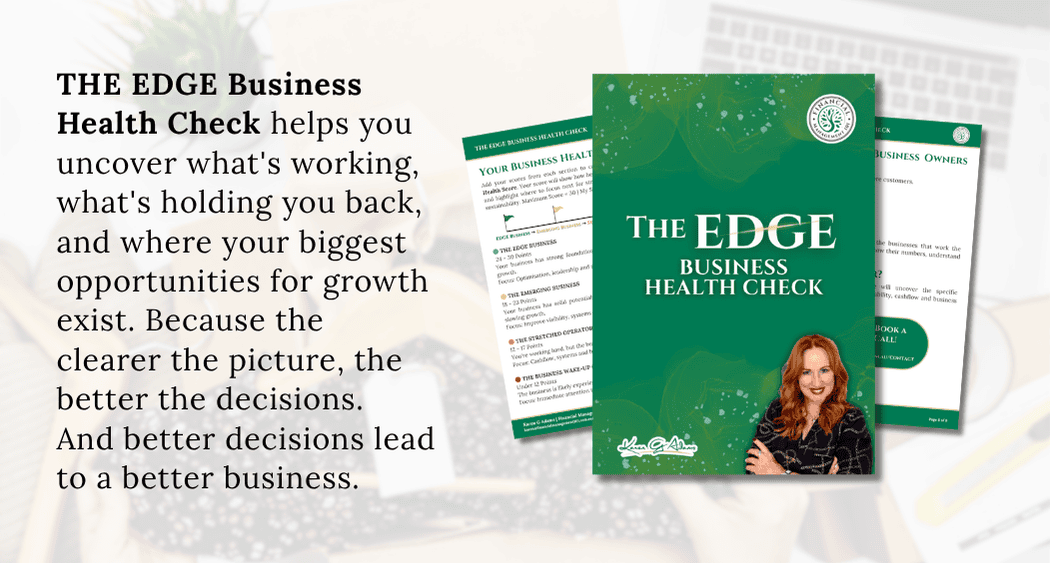
Want more awareness in your business then take a 20 minute “The EDGE Business Health Check” and see what’s happening with your cashflow.

Want more awareness in your business then take a 20 minute “The EDGE Business Health Check” and see what’s happening with your cashflow.

#HowToResetMyMoneyMindset #NewYearFinancialMindset #HowToStartFreshWithMoney  emergency fund australia, money management, family savings #SmallBusinessOwner #BusinessGrowth #CashflowManagement #BusinessSuccess
#EntrepreneurMindset


How Healthy Is My Business? The 7 Warning Signs Every Small Business Owner Should Know

How Healthy Is My Business? The 7 Warning Signs Every Small Business Owner Should Know

Most people wouldn’t drive their car for five years without having it serviced. We understand that regular maintenance prevents expensive breakdowns. Yet that’s exactly how many business owners run their businesses.

  • They work harder.
  • They sell more.
  • They hire more people.
  • They chase bigger goals.

But they rarely stop and ask one simple question…

“Is my business actually healthy?”

Because being busy isn’t a measure of health.

Neither is turnover.

Neither is having money in the bank this week.

A healthy business goes much deeper than that.

Businesses are a lot like people.

They have a heartbeat. They have warning signs. They become sick slowly. They recover slowly., and the healthiest ones don’t happen by accident. 

They happen because someone pays attention before little problems become big ones.

I’ve worked with business owners who looked incredibly successful from the outside.

  • Beautiful offices.
  • Busy workshops.
  • Phones ringing.
  • New vehicles.
  • Growing teams.
  • Yet behind closed doors…
  • The owner hadn’t paid themselves properly for months.
  • Cash flow was unpredictable.
  • Margins were shrinking.
  • Tax bills were keeping them awake at night.
  • Stress had become normal.

From the outside…

Healthy.

On the inside…

Critically unhealthy.

Does that sound familiar?

Business Health isn’t measured by one number.

It’s measured by dozens of indicators working together. Just like your own body.

You wouldn’t judge your health by stepping on a set of scales.

Your doctor looks at:

  • Blood pressure.
  • Heart rate.
  • Blood sugar.
  • Cholesterol.
  • Sleep.
  • Fitness.
  • Stress.
  • Lifestyle.

Business works exactly the same way.

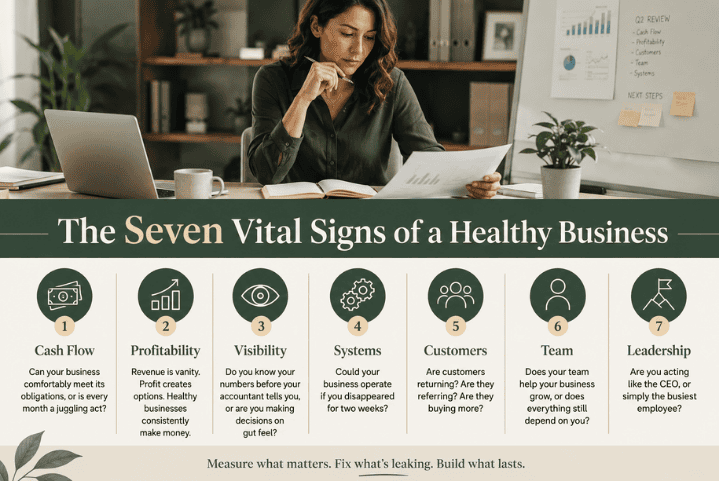
The Seven Vital Signs of a Healthy Business

The Seven Vital Signs of a Healthy Business

Not KPIs.

Not Metrics.

Vital Signs.

That language is unique.

1. Cash Flow

Can your business comfortably meet its obligations, or is every month a juggling act?

2. Profitability

Revenue is vanity. Profit creates options. Healthy businesses consistently make money.

3. Visibility

Do you know your numbers before your accountant tells you, or are you making decisions on gut feel?

4. Systems

Could your business operate if you disappeared for two weeks?

5. Customers

Are customers returning? Are they referring? Are they buying more?

6. Team

Does your team help your business grow, or does everything still depend on you?

7. Leadership

Are you acting like the CEO, or simply the busiest employee?

Healthy Businesses Don’t Just Make More Money.

  • They make better decisions.
  • They create calmer owners.
  • They employ happier teams.
  • They serve customers better.
  • They grow sustainably.
  • They survive difficult economies.
  • They become valuable assets.

Most importantly… They give owners something every entrepreneur wanted when they started…FREEDOM!

Because the healthiest businesses don’t simply generate income. They generate choices.

And that’s ultimately what every business owner is chasing.

Want to know the health of your business…then take the 20 minute “The EDGE Business Health Check” TODAY!

Take The EDGE Business Health Check today and discover where your next opportunity is hiding.

#HowToResetMyMoneyMindset #NewYearFinancialMindset #HowToStartFreshWithMoney  emergency fund australia, money management, family savings #SmallBusinessOwner #BusinessGrowth #CashflowManagement #BusinessSuccess
#EntrepreneurMindset