
What Is a Small Business in Australia? It’s Bigger Than You Think

What Is a Small Business in Australia? It’s Bigger Than You Think

When you hear “small business”, what do you picture?

For most people it’s a corner shop. A mum-and-dad operation. One van, one phone, a kitchen-table office.

So when you’re running a trades or service business with eight staff, three utes and a seven-figure turnover, “small business” can feel like the wrong label. Like it’s talking about someone else.

Here’s the thing… by every official Australian measure, it’s talking about you.

By the end of this article you’ll know what “small business” actually means in Australia, why the definitions don’t agree, and three numbers to check in your own business this week.

What is a small business in Australia? The short answer

There’s no single definition. The ABS counts a small business as one with fewer than 20 employees. The ATO uses aggregated turnover of less than $10 million. Fair Work uses fewer than 15 employees. And ASIC treats a proprietary company as small unless it meets two of three “large” tests on revenue, assets and employees.

Four official definitions, four different answers

There’s no single definition of a small business in Australia. Each government body draws the line for its own purpose.

The ABS (statistics): a small business has fewer than 20 employees. That’s the standard the Australian Bureau of Statistics uses when it counts businesses.

The ATO (tax): you’re a small business entity if you carry on a business and your aggregated turnover is less than $10 million. That turnover includes connected and affiliated businesses. (A few concessions use other thresholds, like $5 million for the small business income tax offset.)

Fair Work (employment): under the Fair Work Act, a small business employer has fewer than 15 employees. That headcount includes part-time staff, regular casuals and employees of associated entities. It matters for things like unfair dismissal rules.

ASIC (companies): a proprietary company is “large” if it meets at least two of these three tests: consolidated revenue of $50 million or more, consolidated gross assets of $25 million or more, or 100 or more employees. If it doesn’t, it’s a small proprietary company. (The Government has proposed lifting the revenue and assets tests to $100 million and $50 million, but ASIC says those changes aren’t in effect yet.)

Notice the range. “Small” can mean fewer than 15 people, fewer than 20, under $10 million in turnover, or under $50 million in revenue. Same label, very different businesses.
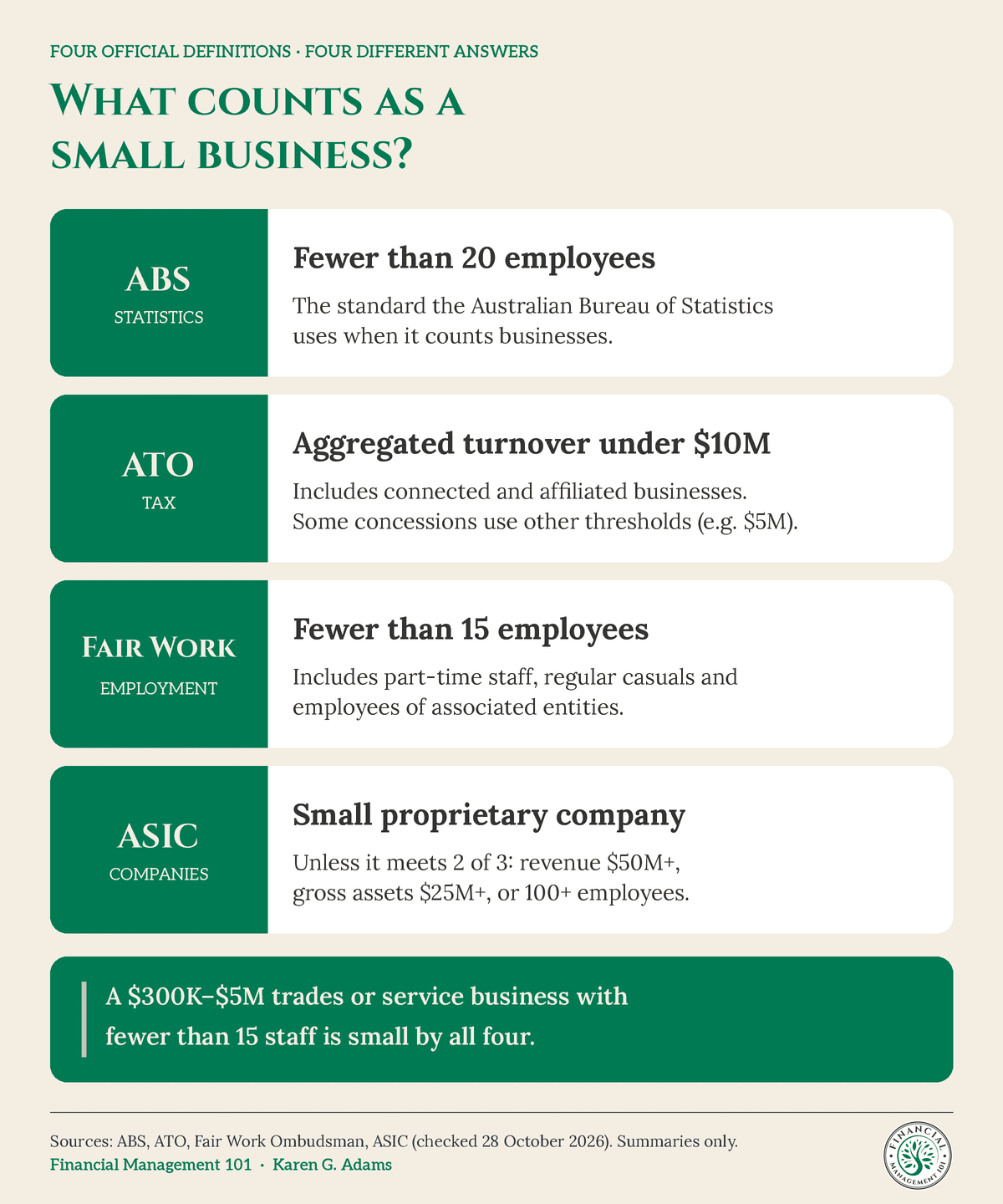
Graphic titled What counts as a small business? ABS: fewer than 20 employees. ATO: aggregated turnover under $10 million. Fair Work: fewer than 15 employees. ASIC: a small proprietary company unless it meets 2 of 3 tests, revenue $50 million or more, gross assets $25 million or more, or 100 or more employees.
Same label, four different lines. A $300K to $5M trades or service business with fewer than 15 staff is small by all four.

What the numbers say about who’s really out there

The ABS counted 2,814,778 actively trading businesses in Australia at 30 June 2026. About 97 per cent of them had fewer than 20 employees.

Yes, plenty are tiny. Around 65 per cent don’t employ anyone at all.

But look at turnover. At 30 June 2025, the latest turnover figures available, 35.4 per cent of Australian businesses turned over between $200,000 and $2 million. Another 4.8 per cent turned over between $2 million and $5 million.

That’s about 1.1 million businesses in the $200K to $5M range. Real operations, with wages, vehicles, suppliers, tax obligations and families relying on them.
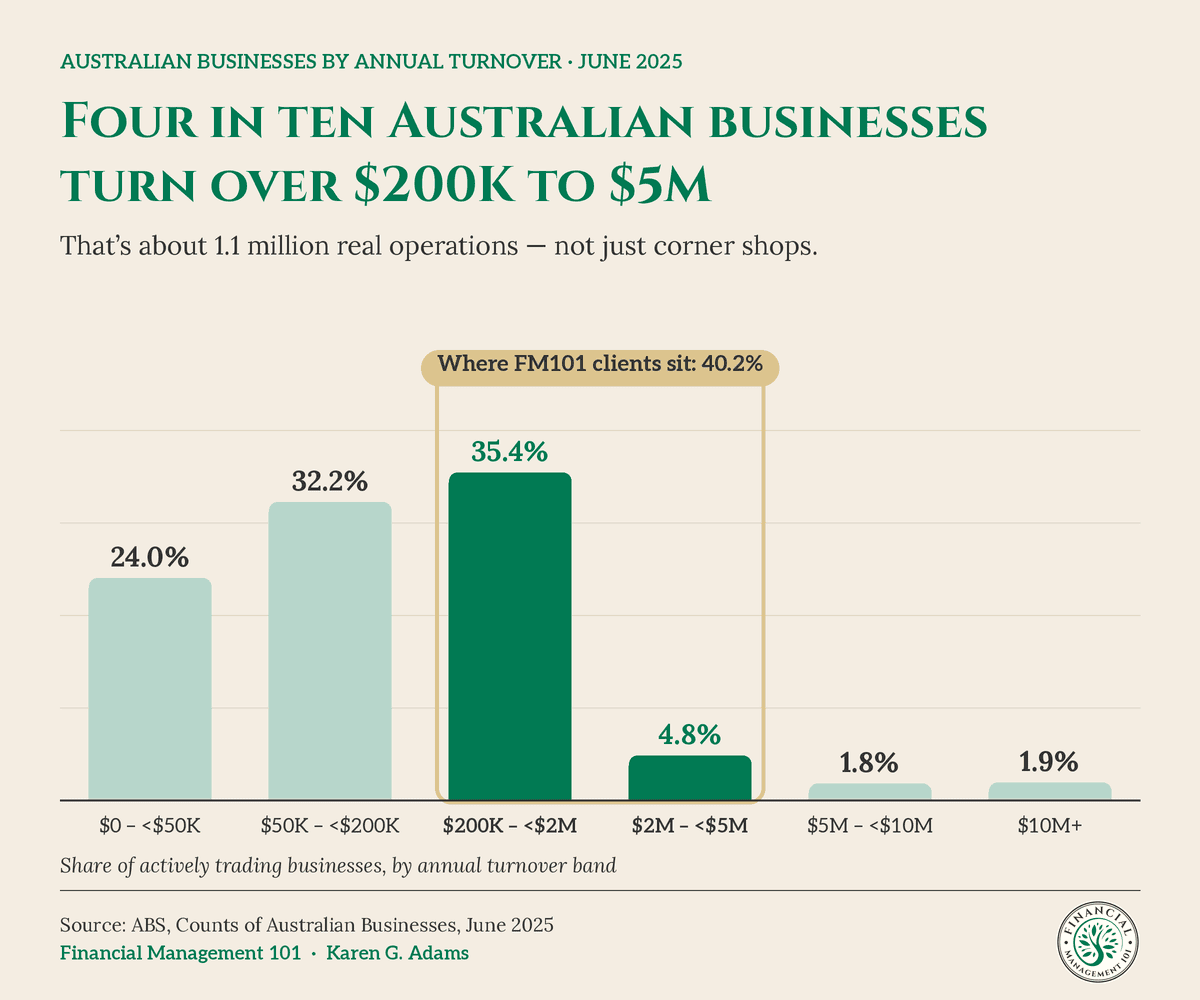
Bar chart of Australian businesses by annual turnover at June 2025: $0 to under $50K 24.0%, $50K to under $200K 32.2%, $200K to under $2M 35.4%, $2M to under $5M 4.8%, $5M to under $10M 1.8%, $10M or more 1.9%. The $200K to $5M bands are highlighted as where FM101 clients sit, 40.2% combined. Source: ABS, Counts of Australian Businesses, June 2025.
Four in ten Australian businesses turn over $200K to $5M. Source: ABS, Counts of Australian Businesses, June 2025.

So if your trades or service business turns over $300,000 to $5 million with fewer than 15 staff, you’re a small business by every official measure. With up to 19 staff, you still are for the ABS, the ATO and ASIC. And either way, you’re running something substantial.

I call it Too Big to Wing It. Too Small to Need a CFO.

Why the label matters more than you’d think

When we picture “small business” as tiny, we tend to run it like it’s tiny.

We check the bank balance and call it financial management. We look at the numbers at tax time. We assume that if the phone’s ringing and the team’s busy, the money must be fine.

At $1.5 million in turnover, that approach gets expensive. Let me show you exactly what I mean.

A worked example: a fictional electrical business with 10 staff

  • Turnover: $1,500,000
  • Direct costs (materials, subcontractors, on-the-tools wages): $900,000
  • Gross profit: $600,000, or 40 cents in every dollar
  • Overheads (rent, vehicles, insurance, software, admin): $380,000
  • A fair wage for the owner: $120,000
  • What’s actually left: $100,000

That’s under 7 cents in every dollar of turnover.

And the break-even point? Overheads plus the owner’s wage, divided by the gross profit margin: $500,000 ÷ 40% = $1,250,000. This business is only $250,000 above break-even.

A few underquoted jobs, one slow-paying builder or an uncosted variation or two, and that 7 cents disappears fast. On a $1.5 million turnover, the room for guesswork is small.

This example is fictional and for illustration only. Your figures will be different.

Your accountant and bookkeeper make sure the numbers are right. That’s essential. The next step is you knowing how to run the business with them, week to week.

Your action this week: check your three gauges

Block out 30 minutes this week with your latest monthly reports. Think of them as the three gauges on your dashboard.
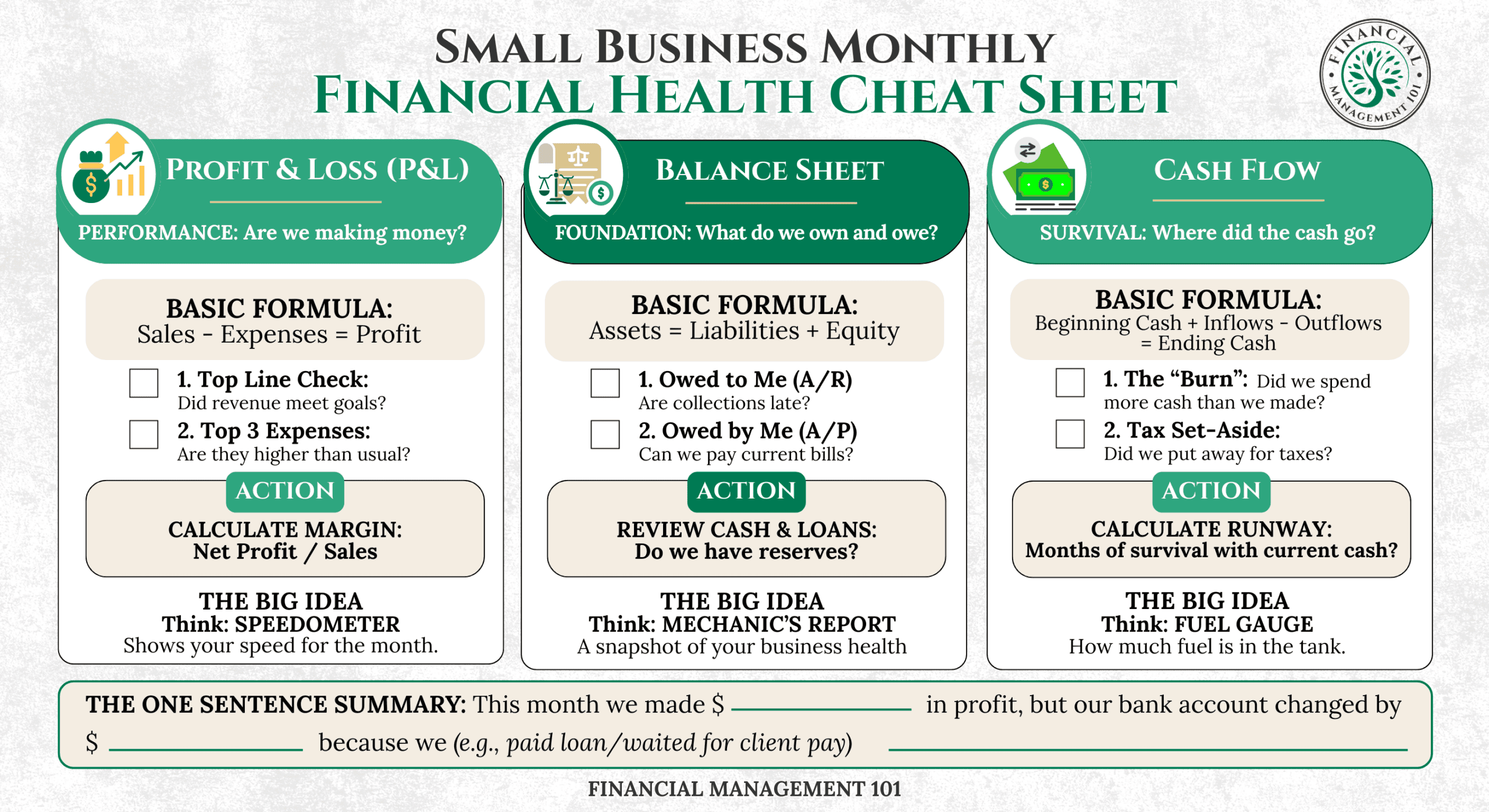
Small Business Monthly Financial Health Cheat Sheet from Financial Management 101: Profit & Loss as the speedometer, Balance Sheet as the mechanic's report and Cash Flow as the fuel gauge, each with a basic formula, two checks and one action, plus a one-sentence summary to fill in.
Your three gauges on one page: the Small Business Monthly Financial Health Cheat Sheet.

1. The speedometer: your Profit & Loss

It shows how fast you’re going this month. Are we making money?

Calculate your net profit margin: net profit ÷ sales. In our example, $100,000 ÷ $1,500,000 = 6.7%. Then ask: did revenue meet the goal, and are the top three expenses higher than usual?

2. The mechanic’s report: your Balance Sheet

It’s a snapshot of what you own and what you owe.

Check what customers owe you. Are collections running late? Then check what you owe. Can you pay current bills, and do you have reserves?

3. The fuel gauge: your cash flow

It tells you how much is in the tank.

Calculate your runway: cash on hand ÷ average monthly outgoings. In our example, monthly outgoings are about $116,700. If there’s $90,000 in the bank, that’s under three weeks of fuel. Also check: did we spend more cash than we made, and have we set aside enough for tax?

Related reading: Why Is Cashflow Always Tight?

Then write one sentence

“This month we made $_____ in profit, but our bank account changed by $_____ because we _____.”

That one sentence connects your profit to your cash. When you can read the story, you can change the ending.

Related reading: What Numbers Should A Small Business Owner Track?

Your next step: The EDGE Business Health Check

If doing those three checks raised more questions than answers, you’re not alone in this.

The EDGE Business Health Check is the next step. It takes about 20 minutes with your last 12 months’ Profit & Loss, and it gives you:

  • Your EDGE Score across 30 statements in five areas: Profit & Pricing, Cashflow, CEO Visibility, Systems & Freedom, and Growth
  • Your Profit Leak Calculator results: your break-even, your true net profit once you’re paid fairly, what a 5% price rise would add, what your unbilled time is worth, and how much cash is tied up in slow payers
  • Your lowest area, so you know the one thing to fix first
  • A 7-Day Reset you can start on Monday, around 20 minutes a day

It’s $47, and it’s designed for established business owners like you.

The EDGE Business Health Check by Karen G. Adams, Financial Management 101. What if the problem isn't what you think it is? Uncover hidden profit leaks, cashflow pressures and growth bottlenecks in less than 20 minutes.

Rather talk it through first? Get in touch and book a call with me.

Frequently asked questions

What is the ATO definition of a small business?

For tax, you’re a small business entity if you carry on a business and your aggregated turnover is less than $10 million. That turnover includes connected and affiliated businesses. A few concessions use other thresholds, like $5 million for the small business income tax offset.

How many employees can a small business have in Australia?

It depends who’s asking. The ABS counts a small business as one with fewer than 20 employees. Under the Fair Work Act, a small business employer has fewer than 15 employees, including part-time staff, regular casuals and employees of associated entities.

Is a business turning over $300,000 to $5 million still a small business?

Yes. If your trades or service business turns over $300,000 to $5 million with fewer than 15 staff, you’re a small business by every official measure. With up to 19 staff, you still are for the ABS, the ATO and ASIC.

How many small businesses are there in Australia?

The ABS counted 2,814,778 actively trading businesses in Australia at 30 June 2026. About 97 per cent of them had fewer than 20 employees, and around 65 per cent don’t employ anyone at all.

When is a company “small” under ASIC’s rules?

A proprietary company is “large” if it meets at least two of three tests: consolidated revenue of $50 million or more, consolidated gross assets of $25 million or more, or 100 or more employees. If it doesn’t, it’s a small proprietary company. The Government has proposed lifting the revenue and assets tests, but ASIC says those changes aren’t in effect yet.

You’ve built something real. Financial confidence starts with clarity.

Karen G. Adams
Small Business Performance Strategist, Financial Management 101


Business education only, not financial, tax or legal advice. The official definitions above are summaries; check with your accountant or adviser how each one applies to your business.


How Do I Build A Business That Runs Without Me?

How Do I Build A Business That Runs Without Me?

If the business relies on you for everything, you don’t own a business – you own a job!

Here’s how clearer systems and financial visibility create a business that can operate without you.

We hear a version of this from almost every business owner: “I can’t even take a week off without everything falling apart.” Or worse, “I did take a week off, and I’m still cleaning up the mess.”

If that’s familiar, please hear this: it’s not because you haven’t worked hard enough. It’s usually the opposite. You’ve worked so hard, for so long, that the business has quietly built itself around you being everywhere, all the time.

By the end of this, you’ll know the real reason most businesses stay dependent on their owner, and the two things; systems and financial visibility that actually change it.

1. In the beginning, you being everywhere was the right call

When a business starts, the owner touching everything isn’t a flaw. It’s often the only way to survive the early years; you’re the salesperson, the delivery, the bookkeeper and the decision-maker because there’s nobody else.

The problem isn’t that this happened. It’s that it kept happening long after the business could have supported something different.

The shift to make: recognise that what got the business started isn’t what will let it grow past you. Those are two different jobs.

2. Without documented systems, you’re the system

If a process only exists in your head, you are the process. Every new hire has to learn it directly from you, every exception gets escalated to you, and every “how do I…” question lands on your desk.

Systems don’t need to be complicated to work. They need to be written down, consistent, and followable by someone who isn’t you.

Check this: pick one task you do weekly. Could someone else follow written steps to do it the same way, without asking you a single question?

Without documented systems, you're the system

3. Delegating tasks isn’t the same as delegating decisions

Many owners delegate the doing but keep every decision for themselves. The team executes, but nothing moves without a final check from you, which means you’re still the bottleneck, just a busier one.

Real delegation means someone else has both the task and the authority to make the calls that go with it, within limits you’ve set.

Check this: notice how often your team’s questions could have been answered by them, if they’d had the context and the authority to decide.

4. If only you understand the numbers, the business still needs you

This is the piece most owners miss. Even with a great team and solid systems, if you’re the only one who can read the financial position of the business, every meaningful decision still funnels back through you.

Financial visibility – clear, regular, easy-to-read numbers – lets the right people make good decisions without needing you in the room. That might mean a manager, a bookkeeper, or simply you, on a rhythm that doesn’t require putting out fires to find the answer.

Check this: if you were unreachable for two weeks, could someone in your business still tell whether it was having a good month or a bad one?

5. Test it before you need it

The real test of a business that runs without you isn’t a plan, it’s a genuine trial. A few days away, phone down, seeing what actually breaks.

What breaks tells you exactly where the next system, the next handover of authority, or the next piece of financial visibility needs to go.

The Takeaway

A business that runs without you isn’t built by working harder or trusting your team more and hoping for the best. It’s built deliberately by documented systems, real decision-making authority for the people around you, and financial visibility that doesn’t depend on you being the only one who understands it.

Owning a business, not a job, comes down to whether it can function while you’re not in it. That’s not a one-off project. It’s a different way of building.

If you want a clear, structured path to building this kind of business, that’s exactly what The Edge is designed for.

My recommendation starts with doing a Business Health Check.

The EDGE Business Health Check in less than 20 minutes will help you uncover the blind spots, bottlenecks and hidden opportunities affecting your business.

The Edge Business Health Check

#HowToResetMyMoneyMindset #NewYearFinancialMindset #HowToStartFreshWithMoney  emergency fund australia, money management, family savings #SmallBusinessOwner #BusinessGrowth #CashflowManagement #BusinessSuccess
#EntrepreneurMindset


What Numbers Should A Small Business Owner Track?

What Numbers Should A Small Business Owner Track?

You don’t need a full accounting degree to run a profitable business. But you do need to know which numbers reveal the real story. These are the few that matter most.

We get it, most business owners didn’t start their business because they love spreadsheets. You started it because you’re good at what you do, and somewhere along the way, “run the numbers” got added to the job description without anyone asking if you wanted it.

The good news is you don’t need dozens of reports or a finance degree. You need a small handful of numbers, checked regularly, that tell you the truth about how the business is really going.

By the end of this, you’ll know exactly which numbers to look at first, and why each one matters more than revenue alone.

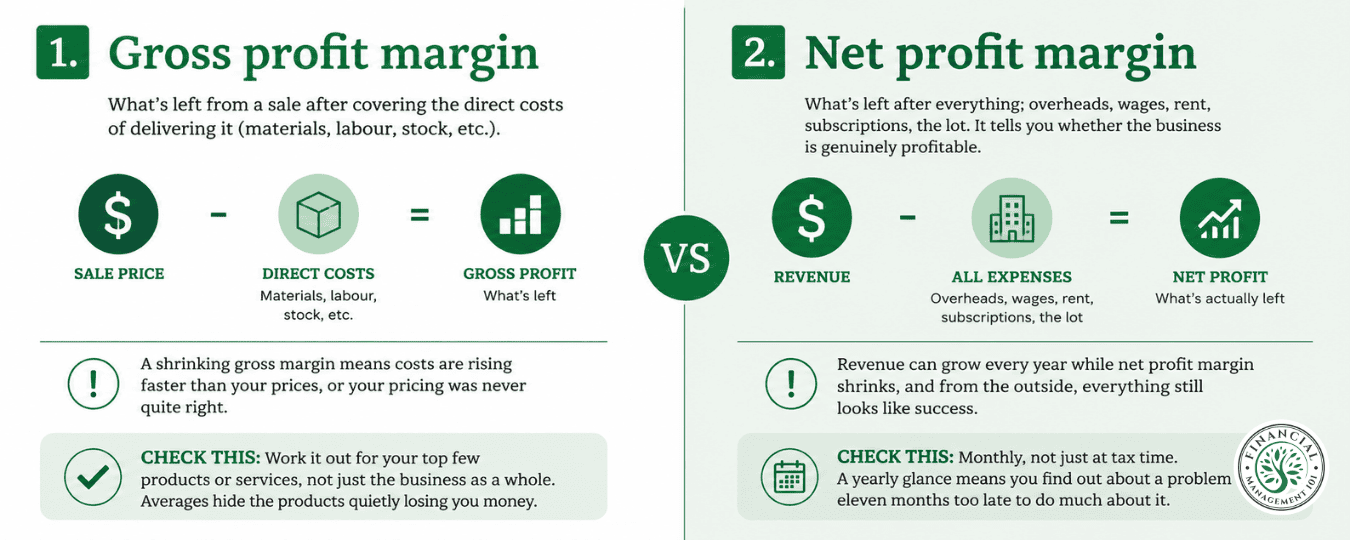
1. Gross profit margin

This is what’s left from a sale once the direct cost of delivering it is covered; materials, trade labour, stock, whatever it takes to physically deliver your product or service.

It’s the clearest early warning system in your business. A shrinking gross margin means either your costs are rising faster than your prices, or your pricing was never quite right to begin with.

Check this: work it out for your top few products or services, not just the business as a whole. Averages hide the products quietly losing you money.

2. Net profit margin

This is what’s actually left after everything; overheads, wages, rent, subscriptions, the lot. It’s the number that tells you whether the business is genuinely profitable, not just busy.

Revenue can grow every year while net profit margin shrinks, and from the outside, everything still looks like success.

Check this: monthly, not just at tax time. A yearly glance means you find out about a problem eleven months too late to do much about it.

Gross Profit Margin vs Net Profit Margin

3. Cash position versus profit

Your bank balance and your profit are two different stories, even though they feel like they should match. A healthy bank balance can be sitting on unpaid tax, a big supplier bill due next week, or a loan repayment about to land.

We business owners tend to use the bank balance as our main scoreboard, simply because it’s the number we see most often. It’s useful – it’s just not the whole picture.

Check this: look at your profit and loss statement alongside your bank balance, not instead of it.

4. Overheads as a percentage of revenue

Overheads rarely blow out all at once. They creep in like; a new subscription here, a rent increase there, a “temporary” extra cost that becomes permanent.

Tracking overheads as a percentage of revenue, rather than a raw dollar figure, shows you whether your costs are growing in proportion to the business or quietly outpacing it.

Check this: list every recurring cost and total it as a percentage of that month’s revenue. Watch the trend over a few months, not just one snapshot.

5. Debtor days – how long it takes to get paid

This is the one most owners forget to track, and it’s often the one causing the most stress. Debtor days measure the average time between sending an invoice and the money landing in your account.

The longer that gap, the more your own cash is quietly funding someone else’s business while yours waits.

Check this: if your debtor days are creeping up, it’s usually a sign your payment terms, follow-up process, or invoicing timing need a look, not that you need more sales.

The Takeaway

You don’t need to track everything. You need to track the right few things, consistently. Gross profit margin, net profit margin, cash position, overheads as a percentage of revenue, and debtor days together, these five numbers tell you far more about the health of your business than revenue ever will on its own.

Clarity here isn’t about becoming an accountant. It’s about finally being able to see your business as clearly as you run it.

If you’d like these numbers tracked and visible for you automatically, that’s exactly what the CEO Dashboard is built for.

Watch the 2 minute video on how it works HERE

The CEO Dashboard™ gives small business owners a clear, visual snapshot of what’s really happening inside their business – so you can stop operating on gut feel alone and start making confident, data-driven decisions.

#HowToResetMyMoneyMindset #NewYearFinancialMindset #HowToStartFreshWithMoney  emergency fund australia, money management, family savings #SmallBusinessOwner #BusinessGrowth #CashflowManagement #BusinessSuccess #EAP #EmployeeAssistanceProgram
#EntrepreneurMindset


Why Is My Business Making Revenue, But No Profit?

Why Is My Business Making Revenue, But No Profit?

Revenue is the headline. Profit is the real story. If your sales are growing but the bank account never reflects it, here’s what the numbers are really telling you and what to do about it.

We hear this from business owners more than almost anything else. The invoices are going out. The sales are climbing. Clients are saying yes.

And yet, at the end of the month, there’s nothing left over. No breathing room. No reward for the hours going in.

If that’s you right now, we want you to hear this first: you’re not behind, and you’re not bad with money. You just haven’t had visibility on what’s actually happening between “money in” and “money left”. That’s a numbers problem, not a you problem and it’s fixable.

By the end of this, you’ll know the five most common reasons revenue and profit stop matching up, and exactly where to look first in your own business.

1. You’re pricing on gut feel, not margin

Most small business owners set their prices once, early on, based on what felt fair or what a competitor charged. Costs have moved since then supplies, wages, software, fuel, but the price hasn’t.

Every sale can look like a win on paper while quietly making you less than you think. Growing revenue with a shrinking margin doesn’t build a more profitable business. It just makes the problem bigger, faster.

Check this first: work out your gross profit margin on your top three products or services. If you don’t know that number off the top of your head, this is where to start.

2. Overheads have crept up quietly

Subscriptions renew. Rent increases. A “temporary” extra cost becomes permanent. None of these show up as one big decision, they show up as a hundred small ones, none of which felt worth questioning at the time.

Revenue can grow 20% while overheads grow 25%, and the business will still feel busier and further behind at the same time.

Check this first: list every recurring cost and ask, honestly, whether it’s still earning its place.

Your Overheads Didn’t Explode. They Quietly Crept Up.

3. You’re paying yourself last, or not consistently

Many owners take whatever’s left after everything else is paid, rather than a set wage. When there’s nothing left, that becomes the norm.

The trouble is, “whatever’s left” isn’t profit. It’s just what happened to survive the month. Without a wage built into your costs, you can’t actually see whether the business itself is profitable, because you’re the buffer absorbing the gap.

Check this first: build a wage for yourself into your cost base, even if you can’t take the full amount out yet. It changes what your numbers are really telling you.

4. Cash flow timing is hiding the truth

Cash in the bank and profit are not the same thing, even though they feel like they should be. A big invoice landing this week can make things look healthy, while a supplier payment or tax bill due next week tells a different story.

We business owners often read our bank balance as our scoreboard. It’s an important number, it’s just not the whole picture.

Check this first: look at your profit and loss statement, not just your bank balance, to see the real trend over the last three to six months.

5. You don’t have regular visibility on your numbers

This is the one underneath all the others. If you’re not reviewing your numbers on a consistent rhythm, small issues stay invisible until they’re big ones. Most owners find out something’s wrong months after it started, simply because nobody was looking.

Clarity doesn’t come from working harder. It comes from a regular, honest look at what the numbers are actually saying.

The Takeaway

Revenue growing while profit stalls is almost never one dramatic mistake. It’s usually five small, ordinary things happening at once; pricing, overheads, your own wage, cash timing, and visibility.

The good news is that each one is a decision you can revisit, not a personality flaw you have to fix. A better business creates a better life, and that starts with seeing clearly what’s really going on in yours.

If you want a clear, honest read on where your own numbers stand, that’s exactly what the Business Health Check is for.

The Edge Business Health Check

#HowToResetMyMoneyMindset #NewYearFinancialMindset #HowToStartFreshWithMoney  emergency fund australia, money management, family savings #SmallBusinessOwner #BusinessGrowth #CashflowManagement #BusinessSuccess
#EntrepreneurMindset


Busy Doesn’t Pay the Bills

Busy Doesn’t Pay the Bills

You worked sixty hours last week. So why does the bank account look like you worked twenty?

This is the one nobody wants to say out loud at the barbecue – being busy and being profitable are two completely different things, and most small business owners have spent years chasing the wrong one without realising it, because busy is the one everyone can see and profit is the one hardly anyone talks about.

We wear “flat out” like a badge of honour around here. Full calendar, full inbox, full plate, barely time for lunch, home late again. It’s practically a competitive sport among business owners, whoever’s had the wildest week wins some invisible prize. But a full calendar doesn’t automatically mean a full bank account, and that gap is exactly where the frustration lives, working harder than you ever have and still not seeing it show up where it counts, still lying awake doing mental maths that never quite adds up the way it should.

Busy measures your time. Profit measures your value.

Busy measures your time. Profit measures your value.

You can be fully booked out doing work that barely covers what it costs you to deliver it. Being busy tells you the calendar’s full. It tells you nothing about whether the business is actually working for you, or just working you into the ground while quietly running on thin margins nobody’s checked in a while.

I’ve sat across from business owners who were, by any outside measure, wildly successful booked out months in advance, a great reputation, more work than they could handle. And they were barely paying themselves properly, because nobody had ever sat down and worked out what each job actually needed to cost to make the whole thing worthwhile. Busy had completely disguised the real story, right up until it couldn’t any more.

Why busy feels so convincing

Part of the problem is that being busy comes with all the physical evidence of hard work; the tired legs, the full diary, the late nights. It feels like proof that things are going well, because it’s the same feeling we’ve always associated with success. Profit, on the other hand, is quiet. It doesn’t announce itself the same way. You don’t feel a profitable decision the moment you make it, the way you feel a long day in your bones. So busy wins the argument for attention, even when it’s not actually the one that matters most.

The trap of “just get more clients”

There’s a piece of advice that gets handed around a lot in small business circles – “just get more clients, that’ll fix it.” I’ll be straight with you, it’s tired advice, and it’s rarely true. More clients on top of an unprofitable structure just means more busy, at the same thin margin, with a lot more stress bolted on top. You’ve simply built a bigger version of the same leaky bucket. Fix the structure first. Scale it after, not before, otherwise you’re just working harder to stand still, faster, and wondering why the extra effort never seems to catch up.

What actually moves the needle

It’s rarely one big dramatic change. More often it’s a handful of smaller, unglamorous ones done properly knowing what a job genuinely costs before you quote it, building in a bit of buffer instead of pricing to the bone, saying no occasionally, following up on the money you’re owed without embarrassment. None of these make for an exciting headline. All of them, done consistently, add up to a business that reflects the effort going into it.

A small shift that changes a lot

Before you say yes to the next job, the next client, the next “quick favour” that somehow always turns into three hours of your Saturday, check what it’s actually worth once the real costs are factored in. Time, materials, the admin it drags behind it, the toll it takes on the rest of your week. Sometimes the most profitable move you can make is saying no to something that is busy without adding a cent of real profit, and saying yes instead to fewer things, done properly, priced properly.

You’re not behind, and you’re certainly not lazy. You’ve just never had proper visibility on which parts of the business are working for you and which parts are quietly working against you while you’re too busy to look. Once that becomes clear, the decisions get so much easier genuinely, not in a “just think positive” way, but in a very practical, this-is-what-the-numbers-actually-show kind of way.

The uncomfortable question worth asking

Here’s one worth sitting with for a minute; if your business stayed exactly this busy for the next twelve months, with nothing else changing, would you actually be better off this time next year? Not busier. Better off. More profit in the bank, more breathing room, more choice in what you say yes to.

For a lot of business owners, the honest answer is “not really,” and that’s an uncomfortable thing to admit after all the hours that have gone in. But it’s also the most useful question you can ask, because it points you toward the actual fix, which is almost never “do more of the same, just harder.”

The Edge Business Health Check

Redefining what a good week looks like

We’ve been taught, somewhere along the way, that a good week in business is a full one. Every hour booked, every day accounted for, home late most nights because that’s what commitment apparently looks like. It’s worth challenging that definition, because a genuinely good week isn’t the one with the most hours in it – it’s the one that moved the business forward the most, profitably, without costing you your evenings and your patience along the way.

That might mean fewer hours worked, not more. It might mean turning down the client who’s more trouble than they’re worth, even though saying yes would have made the calendar look fuller. A full calendar looks impressive from the outside. A profitable, sustainable one is the one that actually serves you.

That visibility is exactly what The Edge Business Health Check gives you, in about fifteen minutes flat.

#HowToResetMyMoneyMindset #NewYearFinancialMindset #HowToStartFreshWithMoney  emergency fund australia, money management, family savings #SmallBusinessOwner #BusinessGrowth #CashflowManagement #BusinessSuccess
#EntrepreneurMindset


Your First Quarter Report Card

Your First Quarter Report Card

July, August, September – done and dusted, more or less. So how’s the new financial year actually going? Not “how busy have you been.” How’s it going?

Most business owners can rattle off exactly how flat out they’ve been since July; the jobs, the clients, the late nights. Fewer can tell you how profitable they’ve been over the same stretch. And that gap between “flat out” and “actually ahead”, is exactly where a quick quarter check-in earns its keep. It’s the difference between a business that feels busy and a business you can actually prove is moving forward.

Nobody waits for the end-of-year school report to find out how a kid’s tracking. You check in along the way – a note home, a parent-teacher chat, a quiet word, and adjust before it becomes a bigger conversation. Your business deserves the same courtesy. Not a full audit, not a forensic dive into every transaction, just an honest look at the first three months of the new financial year, before you’re four quarters deep wondering where it all went and why the number at tax time doesn’t match the effort you know you put in.

Why most business owners skip this

It’s not laziness. It’s usually one of two things, either it feels like it’ll take hours you don’t have, or there’s a quiet fear of what it might show. Both of those assumptions tend to be wrong. This exercise takes less time than a coffee catch-up, and more often than not, the number is somewhere between “not as bad as I feared” and “better than I gave myself credit for.” The dread is almost always worse than the discovery.

Three questions, one cup of tea

Three questions, one cup of tea

Did revenue roughly match what you were hoping for? Doesn’t need to be precise; ahead, on track, or behind is enough of an answer for now. And if you realise you never actually set a target for the quarter, that’s not a failure, it’s just a perfectly good place to start next time. You can’t be ahead or behind a target that doesn’t exist.

Did profit follow revenue, or did it quietly wander off on its own? This is the one that catches people out most often, and it’s the one I see most in this line of work. Revenue climbs, everyone’s thrilled, the calendar’s fuller than ever and then the bank balance doesn’t quite reflect it, because costs crept up right alongside the growth without anyone clocking it. Materials went up. A subcontractor’s rate went up. You took on a bit more admin help. None of it felt like a big decision at the time, but added together it’s eaten the extra revenue and then some. If you’ve felt busier than ever this quarter but the numbers don’t quite match the feeling, this is usually why.

What’s one thing you’d do differently heading into the next quarter? Not five things, just one! Trying to fix everything at once is how good intentions turn into nothing changing at all. Maybe it’s pricing, which almost every business owner I meet is quietly undercharging on. Maybe it’s chasing invoices a little sooner instead of letting them drift. Maybe it’s finally looking at where the money’s actually going instead of guessing based on vibes and a general sense of dread. Pick the lever that would move things most, and leave the rest for next quarter’s version of this exercise.

What to do with what you find

If the quarter came in ahead, resist the urge to immediately spend the difference on something exciting. Sit with it for a bit. Ask whether it’s a genuine trend or a one-off good stretch before you build plans around it. If it came in behind, resist the opposite urge, the spiral into “the whole business is failing.” One quarter is one quarter. It’s a data point, not a verdict. The value isn’t in the number itself, it’s in what the number tells you to look at next.

Why quarterly, specifically

A quarter is a genuinely good length of time to check in on; long enough to see a real pattern rather than a one-off blip, short enough to actually change course while it still matters. Check monthly and you risk reacting to noise, a slow week that means nothing, a good week that means nothing either. Check yearly and you find out too late to do much about it. Quarterly sits right in the sweet spot, giving you enough information to trust it, and enough time left in the year to actually act on it.

The business owners I see making calmer, more confident decisions are almost always the ones checking in quarterly, not just at tax time when the accountant delivers the number and there’s nothing left to do but accept it. Checking quarterly puts you back in the driver’s seat of your own financial year, rather than a passenger finding out where you ended up after the fact.

If you’d like a proper look under the bonnet, the CEO Dashboard gives you full visibility on exactly how the quarter really went not the guessed version, the real one.

Turning it into a rhythm

The businesses that get the most out of this aren’t doing anything clever, they’ve just made it a rhythm rather than a rescue mission. Same week each quarter. Same three questions. Same short list of actions afterwards. It stops being a big, dreaded event and becomes something closer to a habit, the business equivalent of a regular check-up rather than an emergency room visit.

If this is the first time you’ve done a proper quarter check-in, don’t worry about making it perfect. The value isn’t in precision, it’s in the act of actually stopping to look, on a schedule, instead of only looking when something’s gone wrong enough to force your hand.

Setting yourself up for next quarter

Before you close the laptop on this exercise, write down one number you’ll check again in three months. Just one. Revenue, profit margin, average invoice value, whatever feels most relevant to where you are right now. Having that one number in mind gives the next quarter’s check-in a head start, because you’ll already know what you’re comparing against instead of starting from scratch each time.

Small, consistent check-ins beat big, occasional audits every time. That’s true of your car, your health, and it’s absolutely true of your business.

The CEO Dashboard

#HowToResetMyMoneyMindset #NewYearFinancialMindset #HowToStartFreshWithMoney  emergency fund australia, money management, family savings #SmallBusinessOwner #BusinessGrowth #CashflowManagement #BusinessSuccess
#EntrepreneurMindset