Here are 9 ways to make your dollar go further and relieve some stress.
If you are looking for ways to tackle the rising cost of living, here are some things you can do TODAY to put money back into your pocket. Every dollar saved can make a difference!
1. Take a look at your major costs.
When times are tight, it can make a world of difference to take a look at your subscriptions, recurring payments, gym memberships, and even your home, car, and health insurance. We recently went through the process of reviewing all our insurance policies, and we were actually surprised that we were able to save money and cut down on areas where we were over insured. As life changes, you need to review the major expenses in your household and see if you’re paying for things that you needed years ago but don’t now.
2. Look at how you’re paying for things.
You could save money in the short term by switching some of your subscriptions or payments from monthly to yearly, or you could temporarily reduce your spending by putting these items on hold to free up some cash in the short term. Once you have more surplus cash, go back to yearly payments for subscriptions, as you can get a deal or save by paying for the full year.
3. Check your home loan rate.
If you want to save money, your home loan is a great place to start. Now is the time to review your home loan if you haven’t already. There are many features within your home loan that can make a BIG difference to the interest portion your bank or lending institution charges at the end of the month. One example is that if you have an offset or redraw facility, learn how to maximise to take full advantage of how using these can save you money on your regular mortgage repayments.
4. Review your online streaming services.
I often review my online streaming services to see if we’re using them as often as we think and a month back cancelled those that I barely used. There are so many out there, and do you really need them all? By cutting down on one or two, you could save up to $20 – $30 per month, and that’s a big saving when money is tight. So think about canceling subscriptions to some of the streaming services you no longer regularly use.
5. Cut down on take-away food
One of the biggest expenses for most households is buying takeout. Take away food outlets are a time saver for busy people, but they are one of the biggest expenses in many households. By saving $50 – $100 per month and not buying takeaway food, this can make a huge difference to your bank balance and can be used to pay down potential credit cards or other debt, which in the end will enable you to have more cash flow.
6. Plan your meals and think outside the box.
Sorry to be the bearers of bad news, but it is true: sticking to a reasonable meal plan can save you dollars at the checkout. Make a week long menu with everything from breakfast to dessert planned out, and include the family in what they’d like to eat. By getting them involved in the process, they are more likely to enjoy the food you’re cooking. Make it a family event and teach your kids the power of saving by preparing and cooking meals the whole family will enjoy. Cook a little extra and freeze it, so on the days when you don’t feel like cooking and want to order take away, you can grab what you cooked the week earlier for dinner or lunch.
7. Shop for groceries online.
You can stick to your budget and meal plan when you shop for groceries online. Wednesday is a good day to shop at the supermarket because that is when many stores update their weekly specials.
8. Look at separate spending and savings accounts.
With your regular bills, put aside a set amount for your ongoing expenses into a separate account and have them directly debited from that account so they are paid automatically without you having to think about it. All you need to do then is put regular money into that account at payday to ensure the amount is in there when the bills are due.
By having a separate spending account for bills, this stops you regularly dipping into your savings for non-essentials
And last but not least, the costs of fuel today are so high that it’s sucking every dollar from you just to fill up your tank today!
There are apps that you can get on your smart phone to check daily fuel prices, so I would encourage you to do this when your tank is around ¼ – ½ left to go, so you don’t fill up at the last minute and have to pay a higher price.
Want more help managing your money? Then check out this course that helps you budget and save your hard earned money.
So you want to buy your first or even second home…but not sure if you are Home Loan ready?
Here are 8 “Must HAVES” in place to ensure you are home loan ready before applying for a home loan.
STEP 1: Your Income
If you’re looking at changing your job, DON’T until you have been approved for the loan and setted on your new home.
If you are on probation, you will need to wait until you’re off probation before a lender will consider you for a home loan. There are exceptions to this and will depend on your current employment and work history.
Ensure your payslip represents the income you are earning, including the year to date figure, as lenders will look at this figure to calculate your annual income.
If you are self-employed or looking at setting up a business, lenders will require 2 x years financial history plus 2 x years tax returns to verify your income. There are exceptions to this, if you have started a busines and going doing the same work as when you were a PAYG employee, reach out and I can explore lending options.
STEP 2: Your Deposit
Have you saved up a minimum 10% deposit, or have you saved up more?
Or are you looking to use the equity in another property to fund the next purchase? ➤ This can be done if your property is worth more than the outstanding debt owing. ➤ A quick and easy way to check this is to obtain a valuation on your home. ➤ As a mortgage broker, I have access to free valuations, so I am able to assist you with this.
You will require generally a minimum 10% – 20% to be able to afford getting into your own home as there are costs associated with purchasing your home for eg; govt costs as stamp duty, property registration costs, possible lenders application fees and settlement costs. However, there are exceptions to getting into your own home with as little as a 5% deposit, reach out so I can expand and explore you own personal circumstances.
Does your bank account statement demonstrate to the lender that you have savings? As they check over a minimum 3 x months bank statements to show genuine savings? ➤ One option a lender will look at if you haven’t been able to save the full deposit is paying rent and having a lease agreement in place. Some lenders consider this, as it can show you are able to meet your regular liabilities on time, which is what they are looking at when looking to loan you money. ➤ Another option is that if you haven’t been able to save up the minimum deposit required, gifting is acceptable with the majority of lenders. Gifting is where a family member provides a cash amount to assist with obtaining a home loan and does not expect this to be paid back. Lenders will require a stat dec (statutory declaration) signed by the person giving the amount to verify this is a gift and not a loan.
STEP 3: Check Your Credit Report
You will want to look over your credit file to ensure there are no nasty surprises, and when it comes time to assesing your loan, if your score is low or there have been any missed payments on any bills or liabilities, they will pick up on this and may stop your chances of obtaining the loan.
Checking your credit report is easy and free to download from one of the credit check companies online.
Or alternatively, you can request a copy of your credit report from me and I will look over it for you to ensure your chances of getting your loan are not decreased.
At the end of the day, lenders are looking for good credit conduct and seeing before they decide to loan you the money that you are able to pay your bills and other commitments on time.
A low credit score or any missed payments on any bills or liabilities may stop your chances of obtaining the loan.
STEP 4: Bank Statements
The majority of lenders will look through your bank statements line by line to see how you manage your money.
They are looking to see your spending habits as to whether there is money left at the end of your pay period and verifying whether there is more going out than staying in your bank account.
They will require the last 3 months of statements, so make sure they look clean and have no surprises for a lender who will question why something doesn’t appear to look like a normal transaction on the statement.
STEP 5: Identification Verification (ID)
Lenders will require a minimum 2 x pieces of identification to verify who you are, and the ID will be in the form of: ➤ A current Drivers License ➤ A Current Passport and/or ➤ Birth Certificate, and i. Any visas, if not an Australian Citizen or Resident
STEP 6: Your Borrowing Potential
Your borrowing potential looks at whether you can actually afford to purchase the new property and this is where your deposit comes into the equation.;
It looks at the purchase price of what you are looking to buy, plus the costs to purchase and get into the property, less your deposit, which equals the actual percentage of how much you’re looking to borrow. ➤ Where you are borrowing less than <80% from a lender, you will not incur lender mortgage insurance, or LMI, as it’s known. i. LMI is the lender’s insurance policy in case something occurs during the term of the loan and protects the lender’s investment in loaning you the money. ii. There is an additional cost added to the loan when in LMI territory, ie; borrowing more than 80% ➤ If your borrowing potential is higher than 90% and even up to 95% then this may limit the lender’s choices available to you, as some lenders do not loan above 90% – 95% (including LMI), while others put a premium on their interest rate for loaning above 95%
➤ So if you are considering a loan, it is best to save as much as you can to access a lower interest rate and lower costs of getting your loan.
STEP 7: Your Affordability
At the end of the day, are you applying for a home loan that you can really afford?
Lenders take careful consideration when you apply for a home loan to ensure you are not going to go into mortgage stress
When a lender considers you for a home loan, they factor in higher interest rates and higher monthly ongoing living expenses, as during the loan term interest rates may rise and the ongoing costs to live increase throughout the years.
STEP 8: Consult With a Specialist Mortgage Broker
As a Mortgage Broker, it’s my job to assist you in successfully being eligible for a home loan.
I have the tools and resources to work out if you are home loan ready, and;
It’s my job to ensure it goes as smoothly as possible so that, at the end of the day, you get your home loan.
Are you home loan ready?
Buying your first home is a BIG and important step in your life. Learn 8 essential must-haves in this guide that will help you in becoming home loan-ready before applying for a home loan. Get your free copy today!
Disclaimer: The content of this article is general in nature and is presented for informative purposes. It is not intended to constitute tax or financial advice, whether general or personal nor is it intended to imply any recommendation or opinion about a financial product. It does not take into consideration your personal situation and may not be relevant to circumstances. Before taking any action, consider your own particular circumstances and seek professional advice. This content is protected by copyright laws and various other intellectual property laws. It is not to be modified, reproduced or republished without prior written consent
Supporting someone with money stress can be challenging because they may be resistant to accepting help or discussing their financial difficulties with you.
Often people don’t want you to know they are struggling because of judgement, but this is the time to be the friend or family member to support them. There is always a way out and often they can’t see that due to the stress they are experiencing.
Sadly some people feel the only way out is to leave this earth and that only leaves the loved ones behind with sadness and more stress than ever before.
Simply checking in with someone, taking them out for coffee, and listening to how they are doing can go a long way toward helping and being the supportive person they need.
Here are some ways to help them while still giving them space to maintain their dignity:
LISTEN ACTIVELY
Start by being a good listener. Let them talk about their financial concerns and stress without offering advice or judgment. Sometimes, just having someone to vent to can relieve some of the emotional burden.
YOU CAN HELP WITHOUT GIVING MONEY. YOU CAN SHOW YOUR SUPPORT IN OTHER WAYS.
Offer your time, company, or help with things that do not cost money, like doing chores around the house, running errands, or giving emotional support during hard times.
PUT AN UPBEAT SPIN ON ANY DISCUSSION OF MONEY AND ALWAYS ASSUME THE BEST.
You could say, “I have been looking into some great financial resources that I think could help anyone, and I thought you might find them interesting,” instead of “You need help with your finances.”
RESPECT THEIR PRIVACY.
Give them space and privacy when it comes to their finances. Do not ask them too many questions or force them to talk more than they want to.
MAKE MONEY PROBLEMS MORE COMMON BY TELLING STORIES OR GIVING EXAMPLES OF PEOPLE WHO HAVE HAD MONEY PROBLEMS AND GOTTEN THROUGH THEM.
This can show them that many people have trouble with money and that asking for help is not a sign of weakness.
BE PATIENT.
Know that it might take them some time to open up or accept help. Wait your turn and let them lead the conversation and decision-making.
OFFER HELP WITHOUT BEING OBVIOUS.
If you find articles or financial resources that could help, share them in a quiet way. You can send them an article or a link instead of talking directly about their money.
SUGGEST PROFESSIONAL GUIDANCE.
If you believe they would benefit from professional financial advice, make a non-confrontational suggestion. You might say, “I know someone who is really knowledgeable in this area. Would you be interested in talking to them? It might give you some new insights.”
AVOID OFFERING FINANCIAL ASSITANCE.
Do not give them money directly unless you are sure it will not hurt your relationship or encourage them to act irresponsibly. Instead, focus on helping them feel better and giving them information.
EXPRESS YOUR CONCERN.
Tell them you care about their well-being and are ready to help them in any way they feel comfortable. Make it clear that you are not judging them, but that you care about their happiness and health as a whole.
STAY SUPPORTIVE.
Keep being there for them, even if they do not accept your help or ideas right away. Let them know that you will always be there for them.
It is important to give them their independence and let them decide for themselves what to do with their money. You can give them help and resources, but in the end, they have to be ready to take steps on their own to deal with their money stress.
Your patience, understanding, and willingness to not judge them can go a long way toward helping them get through their money problems.
The LEARNING HUB helps you gain more financial knowledge, while providing you with the support and help you and others need. Join now for only $79 USD per month.
Your credit report is a big part of whether or not you can borrow money from lenders. It gives lenders an idea of how creditworthy you are and helps them figure out how much of a risk it is to lend you money.
Here are some of the most important ways that your credit report affects your ability to borrow money:
1. CREDIT SCORE
Your credit score is based on the information in your credit file. This number shows how good of a credit risk you are. It depends on things like how well you have paid your bills in the past, how much credit you use, how long you have had credit, what kinds of credit you have, and how many new credit accounts you have. If your credit score is higher, it means that you are less likely to have problems with your credit and this makes it easier for you to borrow money on good terms.
2. LOAN APPROVAL
Before deciding whether or not to give you a loan, lenders look at your credit report. They look at your credit history, which includes any missed or late payments, defaults, bankruptcies, or accounts in collections. Lenders are more likely to give you a loan if your credit file shows a history of responsible borrowing and on-time payments.
3. RATES OF INTEREST
Your credit history also affects the rates of interest that lenders may offer you on loans. Lenders look at your credit score to figure out how risky it is to give you money. Most of the time, if you have a good credit score, your interest rates will be lower because you are seen as a more reliable borrower. On the other hand, if you have a low credit score or a history of credit problems, lenders may charge you higher interest rates to make up for the risk they see in you.
4. TERMS
The terms of a loan depend on more than just the interest rate. It can also change how the loan is set up. If your credit report shows that you are a higher risk, the lender may ask for a co-signer, a bigger deposit, or a shorter amount of time to pay back the loan. On the other hand, if you have a good credit history, you might get better terms, like more time to pay back the loan or fewer requirements for security.
5. BORROWING LIMITS
Lenders may also look at your credit report when deciding how much you can borrow. If you have a good credit history and a high credit score, you may be able to borrow more money. But if your credit file shows that you are more of a risk, lenders may limit how much they will lend you or ask for more security.
It is important to keep an eye on your credit file, look over your credit reports from the three major credit bureaus, and fix any mistakes or problems you find. By making payments on time, keeping your credit usage low, and taking care of your debts, you can build and keep a good credit history. This will make it easier for you to borrow money on good terms.
At Financial Management 101 – we are committed to providing YOU with excellent financial education, training and support so that you can live the life you truly desire. Join our LEARNING HUB today!
Let’s talk about how stress maybe shortening your life.
And, how you can become better equipped to deal with stress related symptoms whenever you start to feel them come up.
Are you aware what stress is doing to your body?
You may think you do. But I’m here to share with you that some of the symptoms are not as obvious as you may think.
Here in Australia, The Australian Psychology Society produce a stress and wellbeing report.
The area that always catches my attention is how anxiety and depression levels have risen over the years.
The report also shows that financial issues continue to be the top stress over the last few years followed closely by the second top stress being family issues.
I’ve said this before that whenever there are financial issues and stress in a person’s life, their loved ones suffer immensely.
So what effect is this then having on our emotional side and physical body?
Well, stress affects a whole range of areas within our body when we feel pressured or overwhelmed.
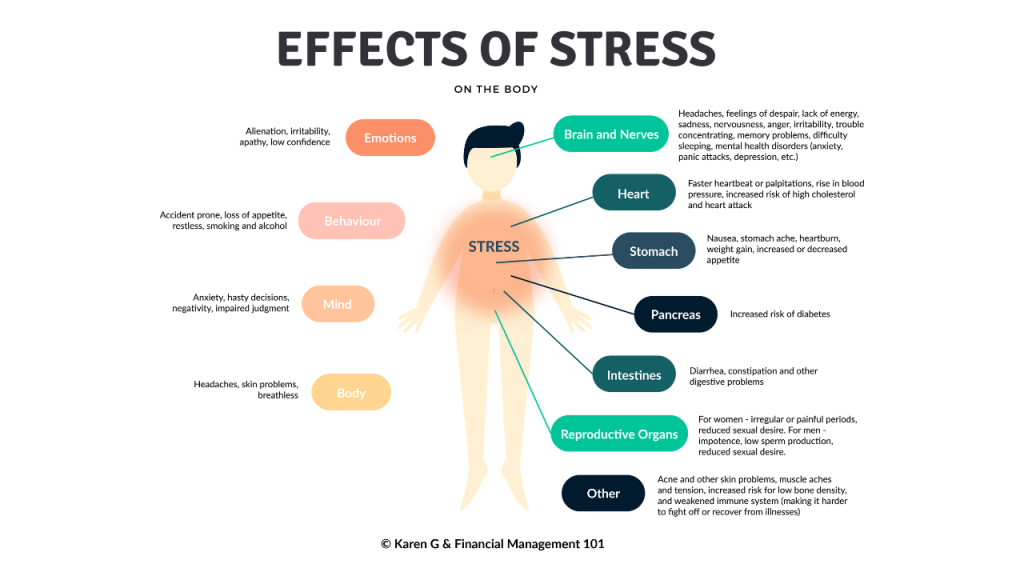
If you take a look at this illustration you’ll see that it’s affecting many areas within your body, some are obvious while others may surprise you.
I want you to look at the left hand side of this diagram to see how first hand it’s affecting your emotions.
When your emotions are overloaded by stress, you become irritable, you may alienate yourself from others and your confidence drops.
When you’re under stress, your behaviour changes and you may become accident-prone, lose appetite, take up recreational drugs or alcohol, and/or start smoking.
And no surprise here that stress greatly affects your mind and mental well-being, where you may experience more anxiety, become negative or make impaired decisions and judgments where you otherwise wouldn’t have done.
The area that I see common with stressed out people is when they experience headaches, skin problems and become breathless.
But did you know that stress can have a detrimental affect on other areas within your body like, complaints either in the form of diarrhoea or heartburn.
In more severe cases, stress can also affect your heart. You may experience heart palpitations or even worse, a heart attack.
In some cases stress has know to be the start of more serious issues like cancer and diabetes.
So you can see it’s more important than ever to take care of yourself and look at what’s stressing you out.
For a lot of people money is the biggest stress as I’ve outlined early in findings by the Australian Psychology Well Being Survey.
While I don’t have a cure for how stress affects the body – I do have a solution that anyone can adopt where financial issues are part of their stress and that’s getting more information and knowledge about how money works.
Obtaining financial education to improve your money position is critical to living a healthy stress free life.
Getting the right financial education, support and coaching will alleviate financial stress if you are serious about improving the quality of your life.
What I offer is a full coaching service that’s affordable while you get the support, knowledge and help you require to make better and healthy financial decisions.
So if money stress is causing you problems then check out how you can work with me in the resources below.