Supporting someone with money stress can be challenging because they may be resistant to accepting help or discussing their financial difficulties with you.
Often people don’t want you to know they are struggling because of judgement, but this is the time to be the friend or family member to support them. There is always a way out and often they can’t see that due to the stress they are experiencing.
Sadly some people feel the only way out is to leave this earth and that only leaves the loved ones behind with sadness and more stress than ever before.
Simply checking in with someone, taking them out for coffee, and listening to how they are doing can go a long way toward helping and being the supportive person they need.
Here are some ways to help them while still giving them space to maintain their dignity:
LISTEN ACTIVELY
Start by being a good listener. Let them talk about their financial concerns and stress without offering advice or judgment. Sometimes, just having someone to vent to can relieve some of the emotional burden.
YOU CAN HELP WITHOUT GIVING MONEY. YOU CAN SHOW YOUR SUPPORT IN OTHER WAYS.
Offer your time, company, or help with things that do not cost money, like doing chores around the house, running errands, or giving emotional support during hard times.
PUT AN UPBEAT SPIN ON ANY DISCUSSION OF MONEY AND ALWAYS ASSUME THE BEST.
You could say, “I have been looking into some great financial resources that I think could help anyone, and I thought you might find them interesting,” instead of “You need help with your finances.”
RESPECT THEIR PRIVACY.
Give them space and privacy when it comes to their finances. Do not ask them too many questions or force them to talk more than they want to.
MAKE MONEY PROBLEMS MORE COMMON BY TELLING STORIES OR GIVING EXAMPLES OF PEOPLE WHO HAVE HAD MONEY PROBLEMS AND GOTTEN THROUGH THEM.
This can show them that many people have trouble with money and that asking for help is not a sign of weakness.
BE PATIENT.
Know that it might take them some time to open up or accept help. Wait your turn and let them lead the conversation and decision-making.
OFFER HELP WITHOUT BEING OBVIOUS.
If you find articles or financial resources that could help, share them in a quiet way. You can send them an article or a link instead of talking directly about their money.
SUGGEST PROFESSIONAL GUIDANCE.
If you believe they would benefit from professional financial advice, make a non-confrontational suggestion. You might say, “I know someone who is really knowledgeable in this area. Would you be interested in talking to them? It might give you some new insights.”
AVOID OFFERING FINANCIAL ASSITANCE.
Do not give them money directly unless you are sure it will not hurt your relationship or encourage them to act irresponsibly. Instead, focus on helping them feel better and giving them information.
EXPRESS YOUR CONCERN.
Tell them you care about their well-being and are ready to help them in any way they feel comfortable. Make it clear that you are not judging them, but that you care about their happiness and health as a whole.
STAY SUPPORTIVE.
Keep being there for them, even if they do not accept your help or ideas right away. Let them know that you will always be there for them.
It is important to give them their independence and let them decide for themselves what to do with their money. You can give them help and resources, but in the end, they have to be ready to take steps on their own to deal with their money stress.
Your patience, understanding, and willingness to not judge them can go a long way toward helping them get through their money problems.
The LEARNING HUB helps you gain more financial knowledge, while providing you with the support and help you and others need. Join now for only $79 USD per month.
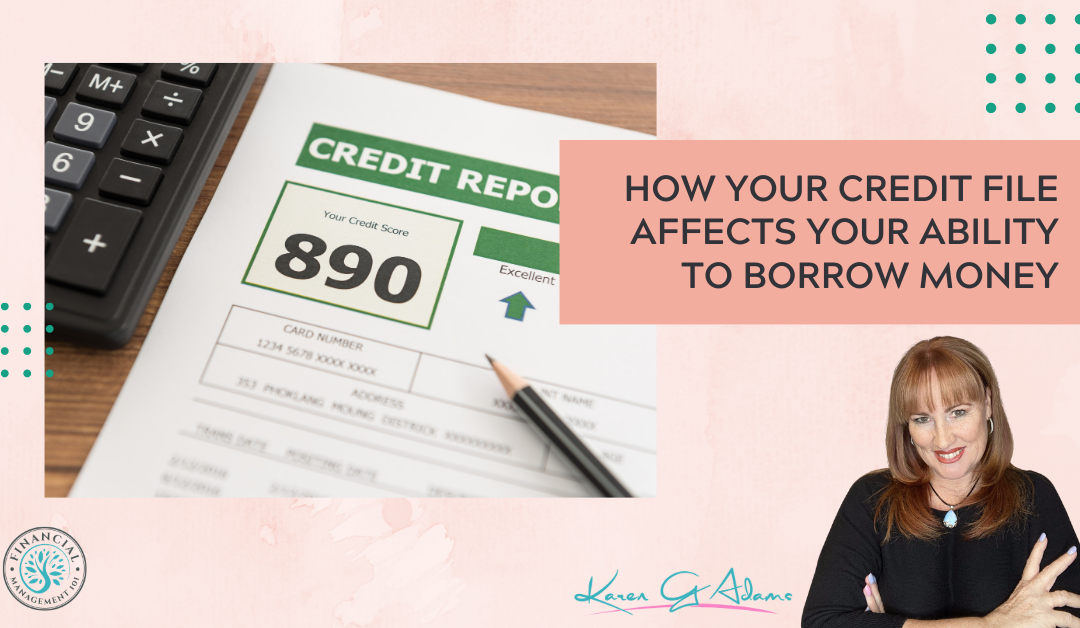
Your credit report is a big part of whether or not you can borrow money from lenders. It gives lenders an idea of how creditworthy you are and helps them figure out how much of a risk it is to lend you money.
Here are some of the most important ways that your credit report affects your ability to borrow money:
1. CREDIT SCORE
Your credit score is based on the information in your credit file. This number shows how good of a credit risk you are. It depends on things like how well you have paid your bills in the past, how much credit you use, how long you have had credit, what kinds of credit you have, and how many new credit accounts you have. If your credit score is higher, it means that you are less likely to have problems with your credit and this makes it easier for you to borrow money on good terms.
2. LOAN APPROVAL
Before deciding whether or not to give you a loan, lenders look at your credit report. They look at your credit history, which includes any missed or late payments, defaults, bankruptcies, or accounts in collections. Lenders are more likely to give you a loan if your credit file shows a history of responsible borrowing and on-time payments.
3. RATES OF INTEREST
Your credit history also affects the rates of interest that lenders may offer you on loans. Lenders look at your credit score to figure out how risky it is to give you money. Most of the time, if you have a good credit score, your interest rates will be lower because you are seen as a more reliable borrower. On the other hand, if you have a low credit score or a history of credit problems, lenders may charge you higher interest rates to make up for the risk they see in you.
4. TERMS
The terms of a loan depend on more than just the interest rate. It can also change how the loan is set up. If your credit report shows that you are a higher risk, the lender may ask for a co-signer, a bigger deposit, or a shorter amount of time to pay back the loan. On the other hand, if you have a good credit history, you might get better terms, like more time to pay back the loan or fewer requirements for security.
5. BORROWING LIMITS
Lenders may also look at your credit report when deciding how much you can borrow. If you have a good credit history and a high credit score, you may be able to borrow more money. But if your credit file shows that you are more of a risk, lenders may limit how much they will lend you or ask for more security.
It is important to keep an eye on your credit file, look over your credit reports from the three major credit bureaus, and fix any mistakes or problems you find. By making payments on time, keeping your credit usage low, and taking care of your debts, you can build and keep a good credit history. This will make it easier for you to borrow money on good terms.
At Financial Management 101 – we are committed to providing YOU with excellent financial education, training and support so that you can live the life you truly desire. Join our LEARNING HUB today!
Let’s talk about how stress maybe shortening your life.
And, how you can become better equipped to deal with stress related symptoms whenever you start to feel them come up.
Are you aware what stress is doing to your body?
You may think you do. But I’m here to share with you that some of the symptoms are not as obvious as you may think.
Here in Australia, The Australian Psychology Society produce a stress and wellbeing report.
The area that always catches my attention is how anxiety and depression levels have risen over the years.
The report also shows that financial issues continue to be the top stress over the last few years followed closely by the second top stress being family issues.
I’ve said this before that whenever there are financial issues and stress in a person’s life, their loved ones suffer immensely.
So what effect is this then having on our emotional side and physical body?
Well, stress affects a whole range of areas within our body when we feel pressured or overwhelmed.
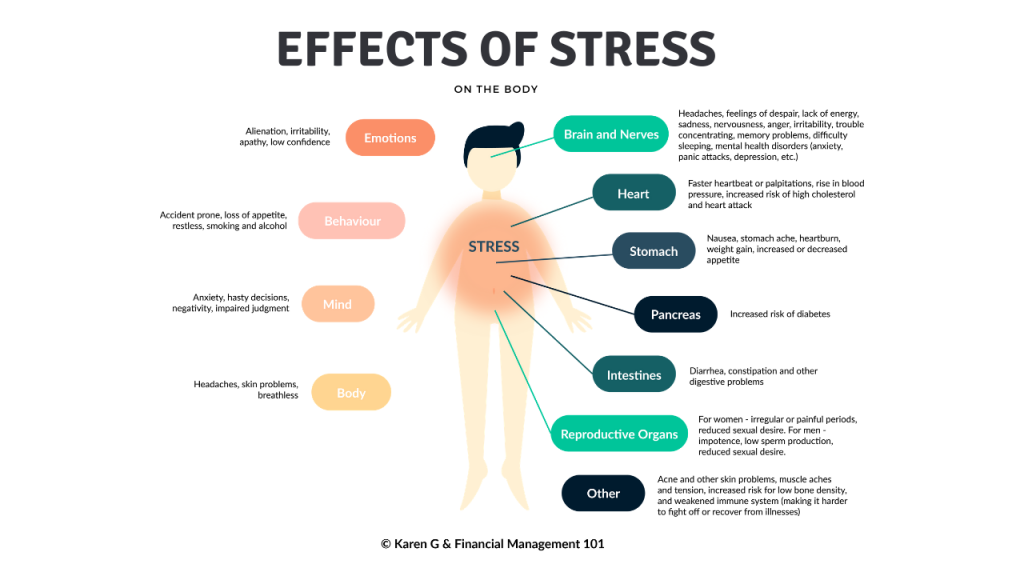
If you take a look at this illustration you’ll see that it’s affecting many areas within your body, some are obvious while others may surprise you.
I want you to look at the left hand side of this diagram to see how first hand it’s affecting your emotions.
When your emotions are overloaded by stress, you become irritable, you may alienate yourself from others and your confidence drops.
When you’re under stress, your behaviour changes and you may become accident-prone, lose appetite, take up recreational drugs or alcohol, and/or start smoking.
And no surprise here that stress greatly affects your mind and mental well-being, where you may experience more anxiety, become negative or make impaired decisions and judgments where you otherwise wouldn’t have done.
The area that I see common with stressed out people is when they experience headaches, skin problems and become breathless.
But did you know that stress can have a detrimental affect on other areas within your body like, complaints either in the form of diarrhoea or heartburn.
In more severe cases, stress can also affect your heart. You may experience heart palpitations or even worse, a heart attack.
In some cases stress has know to be the start of more serious issues like cancer and diabetes.
So you can see it’s more important than ever to take care of yourself and look at what’s stressing you out.
For a lot of people money is the biggest stress as I’ve outlined early in findings by the Australian Psychology Well Being Survey.
While I don’t have a cure for how stress affects the body – I do have a solution that anyone can adopt where financial issues are part of their stress and that’s getting more information and knowledge about how money works.
Obtaining financial education to improve your money position is critical to living a healthy stress free life.
Getting the right financial education, support and coaching will alleviate financial stress if you are serious about improving the quality of your life.
What I offer is a full coaching service that’s affordable while you get the support, knowledge and help you require to make better and healthy financial decisions.
So if money stress is causing you problems then check out how you can work with me in the resources below.
When life suddenly throws you a curveball whether the signs were there or not and you haven’t prepared yourself for what’s about to come, it can send you into a spin and see you experience massive stress and anxiety.
Financial & Relationship stress go hand in hand and it’s still the number one trigger point for most.
When a relationship breaks down and you’re left to sort out where to go and what to do – money stress is ever-present.
Not only are you dealing with the emotional stress of the relationship breakdown, but you’re now having to deal with where to live, how to survive and then there’s the issue about money which is about to get very messy.
Then if children are involved a whole other issue about custody arrangements and financial support start coming into play.
It’s like you’re in the middle of a soap opera and left emotionally drained.
When an event like this is triggered a person will feel a whole bunch of overwhelming feelings like sadness, anxiety, or even experience panic attacks.
What happens next is that our body goes into one of the “fight, flight or freeze modes” and our heart beats faster and our senses go on high alert. Also our brain stops some of its normal functions to deal with the threat we may be feeling or experiencing.
If this has happened to you or you can see life is about to dramatically change then get some help.
Firstly, find someone who is unbiased and independent and someone who doesn’t know you or the situation that you’re about to experience.
When people are feeling overwhelmed and stressed out they sometimes don’t make decisions that are in their best interests or health.
If you know of someone or you yourself, are feeling any form of stress then get some help. You don’t have to do this alone. There are people and organisations that can help.
Be on the lookout for the SYMPTOMS that stress can produce:
PHYSICALLY
Tiredness, headaches, accidents, tightness in neck and shoulders, restlessness, ulcers, hypertension, respiratory problems, diarrhoea or constipation, chest pain, back pain, upset stomach, skin problems, weight loss or gain.
If stress is experienced for long periods of time it can result in physical, mental and emotional exhaustion or ‘burnout’.
STAY CONNECTED
We need to look out for one another, stay connected and ask if we’re ok.
If your gut is telling you that you’re not ok or that someone close to you is not, then make sure you’re there for them. More often than not they’ll say they’re ok and will remain silent while living with their pain.
SUPPORT
Here in Australia, we have an organisation called Lifeline which is a national charity that has been providing assistance to Australians experiencing difficulties for over 55 years.
If you’re reading this and not in Australia then seek out your country’s support network to ensure you get help and are not dealing with this alone.
In Australia, you can call Lifeline on 13 11 14 anytime as they’re available 24 hours a day.
WHAT TO DO NEXT
I have created a tool kit to help you identify when you’re feeling overwhelmed about what to do.
Other resources I have available is my monthly coaching program which is a fraction of the cost than other coaching programs at $37 per month and with no lock-in contracts. You can exit whenever you choose.
Also, courses teaching you money management skills and how you can build financial muscle. You can check out what’s available HERE.
In the meantime, here’s to your financial health, wealth & happiness.
The words wealthy and rich are words that tend to make some of us cringe and bring up feelings that all wealthy people are “up” themselves and rotten sods, which is not always the case.
When people think about wealth it often triggers poverty thinking and brings up fears, conditioning and unhealthy thoughts.
It makes people so uncomfortable that what happens is their behaviour makes them look for ways to make themselves feel better, about being poor.
Here in Australia, we love pulling those down that do better than us. We get jealous and our personalities turn very quickly when we’re in the company of wealthy people.
The tall poppy syndrome sadly is still strong in Australia. For those that don’t know what the tall poppy syndrome is? Well, it describes aspects of a culture where people of “perceived” high status are resented, attacked, cut down or criticised because they have been classified as superior to their peers.
New research has found its keeping many Australians – especially women – from pursuing their dreams and holding people back from reaching their true potential.
Dr Fiona Wood AM asked kids (when visiting schools after she won Australian of the Year in 2004)….
“How often have you done less than your best so that others around you didn’t feel uncomfortable?”
She cringed and felt upset to hear that they all gave an example of this and some felt proud of it.
She went onto to say in an interview, that there’s absolutely no mileage in the world to be AVERAGE...no matter what job you do.
You’ve got to understand yourself, so you can match your work ethic with your full potential.
You need to make your own decisions, stand up and be proud of what you’re doing.
Negative energy is a black hole and if you want to go wasting your precious time here on earth being part of it – then go ahead and jump in the black hole.
The opinion from others of you is theirs – you don’t have to own it.
The key is to keep learning, refining and up-skilling so that each day whatever you want gets easier to achieve.
One day at a time and one foot in front of the other is all you can do somedays.
Working hard and keeping your eye on the prize or the goal and never giving up, is the way to winning and living your life full, happy and with loads of wealthy potential.
People who don’t make decisions are wasting their human potential to do, be and create something great in their life.
I believe we all have that something special in us and it’s time to knock the tall poppy syndrome on its feet, ignore it and don’t let this stop you.
We live in a world where anything we dream is possible.
Prove naysayers wrong and don’t engage in pointless negativity & criticism.
We have to start somewhere when it comes to managing our money better and that starts with building financial muscle. Once you have the foundations in place, it’s a lot easier and faster to build on your wealth.
My course “How To Keto Your Money” is the building block for building on your financial foundations. Once you’ve got the foundations set up, I will then show you how to start automatically building on your wealth, so you can retire wealthy and live a life with more freedom.
Find out more by clicking here…How To Keto Your Money and I’ll look forward to helping you achieve your full financial potential.