Busy Is Not Profitable: 7 Financial Foundations Every Business Owner Needs

Busy Is Not Profitable: 7 Financial Foundations Every Business Owner Needs

There’s a big myth in small business that if you just work hard enough, everything will eventually click into place.

Spoiler alert: hard work matters, but hard work without financial foundations can leave you exhausted, underpaid, and wondering why your business still feels so heavy.

I see this all the time with small business owners, tradies, franchisees, coaches, and self-employed professionals.

They are flat out. Clients are coming in. Invoices are going out. The calendar is packed.

And yet… There is still stress. Still pressure. Still that sinking feeling of, “Why does it feel like I’m doing all this work and not getting ahead?”

Here’s why:

Because busy is not profitable. And being great at your trade or profession is not the same as having strong money systems.

The good news? You do not need a finance degree to fix this. You just need the right foundations.

Here are seven of the most important ones.

1. A cashflow system that tells the truth

Cashflow is not something you check when you are already in trouble.
It is something you build so you can stay out of trouble.

A good cashflow system shows you:

  • what is coming in
  • what is going out
  • what bills are approaching
  • what is available to spend
  • what needs to be set aside for tax, super, wages, and future costs

Cashflow gives you visibility. Visibility gives you control.

2. Clear separation between personal and business money

Using your personal account like a business overdraft creates confusion fast.

It becomes harder to track spending, harder to know what the business is really earning, and harder to make clean decisions.

Separating business and personal finances is one of the fastest ways to reduce chaos.
It is not about being fancy. It is about being clear.

3. Pricing that actually protects your profit

So many business owners price from fear.

Fear of losing the sale.
Fear of seeming too expensive.
Fear of being judged.

But underpricing does not make you more professional. It makes your business more fragile.

Your pricing needs to cover more than the job in front of you. It needs to reflect overheads, admin time, tax obligations, profit goals, and the actual value you deliver.

Pricing with confidence is not greedy.
It is responsible.

4. A plan to pay yourself properly

Using your personal account like a business overdraft creates confusion fast.

It becomes harder to track spending, harder to know what the business is really earning, and harder to make clean decisions.

Separating business and personal finances is one of the fastest ways to reduce chaos.
It is not about being fancy. It is about being clear.

5. Weekly and monthly money rhythms

You do not need to stare at your numbers every day.
But you do need a rhythm.

That might include:

  • checking cashflow weekly
  • reviewing key reports monthly
  • monitoring expenses and margins
  • tracking unpaid invoices
  • spotting small issues before they turn into big ones

Confidence with numbers is built through repetition, not perfection.

6. Knowing your numbers without drowning in them

You do not need to obsess over every metric.
You do need to know the numbers that matter.

Think:

  • revenue
  • gross profit
  • operating expenses
  • net profit
  • cash position
  • debt levels
  • wage costs
  • tax set-asides

The goal is not more complexity.
The goal is better decisions.

When you know what your numbers are saying, you stop making emotional decisions and start making strategic ones.

7. A business structure that can handle growth

Growth is exciting, but if your systems are messy, it can magnify every weakness.

That is why foundations matter before scaling.

You want business systems that support:

  • clear accounts setup
  • simple automations
  • better reporting
  • cleaner budgeting
  • stronger decision-making
  • less burnout

Strong structure makes growth feel possible instead of painful.

Business foundations create freedom

Why this matters right now

The business landscape is not getting easier.
Costs are rising. Margins can be tight. Pressure builds quickly when you do not have clarity.

That is exactly why now is the time to stop relying on memory, hope, and hustle alone.

The strongest business owners are not always the loudest or busiest.
They are the ones who know their numbers, trust their systems, and make decisions early.

Foundations Create freedom

Let’s make this simple. When your financial foundations are solid, you get:

  • less panic
  • less avoidance
  • less confusion
  • better decisions
  • stronger profit
  • more confidence
  • more breathing room

And honestly? More enjoyment.

Because business should not feel like one long financial mystery.

    A business structure will help you handle growth

    Your invitation to stop winging it

    If you know your foundations need work, you are not alone.
    And you do not have to figure it all out the hard way.

    That is exactly what The Edge Bootcamp is designed to help you do.

    Over two practical, high-impact days, we dig into the real foundations of profitable business: money systems, CEO mindset, cashflow, paying yourself, pricing, budgets, business setup, reading your numbers, leadership, growth stages, and more.

    This is for business owners who want results, not just motivation.

    Join The Edge Bootcamp in May and give your business the foundations it needs to make money, keep money, and enjoy the ride.

    Because being flat out is not the goal.
    Building a business that works for you is.

    Join The Edge Bootcamp

    #HowToResetMyMoneyMindset #WhyDoIFeelOutOfControlWithMoney #HowToFeelInControlOfFinances #ResetMoneyMindset2025 #NewYearFinancialMindset #HowToStartFreshWithMoney  emergency fund australia, money management, family savings 
     

    Financial Stress at Work Is Real: How Employers Can Support Staff Through Uncertain Times

    Financial Stress at Work Is Real: How Employers Can Support Staff Through Uncertain Times

    Let’s talk about the thing many workplaces feel but few talk about openly.

    Financial stress.

    Right now, many employees are carrying a heavy mental load. Rising living costs, debt pressure, interest rate worries, and the emotional weight of trying to “hold it all together” can quietly affect how people show up at work.

    The tricky part?
    A lot of struggling employees do not look like they are struggling.

    They still show up.
    They still smile in meetings.
    They still get the work done.

    But underneath the surface, they may be losing sleep, feeling distracted, or wondering how they are going to stay on top of everyday life.

    This is not just a personal issue. It is a workplace issue too.

    The hidden impact of financial pressure

    When an employee is stressed about money, it rarely stays neatly at home.
    It follows them into the workday.

    Financial stress can affect:

    • concentration
    • confidence
    • energy levels
    • productivity
    • decision-making
    • mental wellbeing
    • workplace engagement

    And when it goes unaddressed for too long, people often do not just want more money.
    They want relief.
    They want stability.
    They want support.

    Sometimes, that means they leave.

    When an employee is stressed about money, it rarely stays neatly at home.
It follows them into the workday.

    Why a pay rise is not always the answer

    This is where many employers get caught off guard.

    They assume financial stress is only about income, so they respond with a pay rise when possible. While higher income can help, it does not automatically solve poor money habits, lack of structure, debt overwhelm, or financial anxiety.

    Because financial wellbeing is not just about how much people earn.
    It is also about how confidently they manage what they have.

    That is why some employees can get a raise and still feel overwhelmed.
    And why some workplaces offer perks, rewards, and recognition but still experience turnover, burnout, or disengagement.

    People do not always leave for a bigger paycheck.
    Sometimes they leave because they are chasing less stress.

    What employees really need

    In uncertain times, employees need more than surface-level support.
    They need practical help that builds real confidence.

    That can look like:

    • education that makes money feel less overwhelming
    • simple systems to manage spending and bills
    • tools to reduce financial chaos
    • strategies to tackle debt with a plan
    • guidance that helps them feel more in control
    • a safe, shame-free space to get support

    When people feel financially stronger, they often feel emotionally stronger too.
    And that changes how they show up in every area of life, including work.

    The role employers can play

    The role employers can play

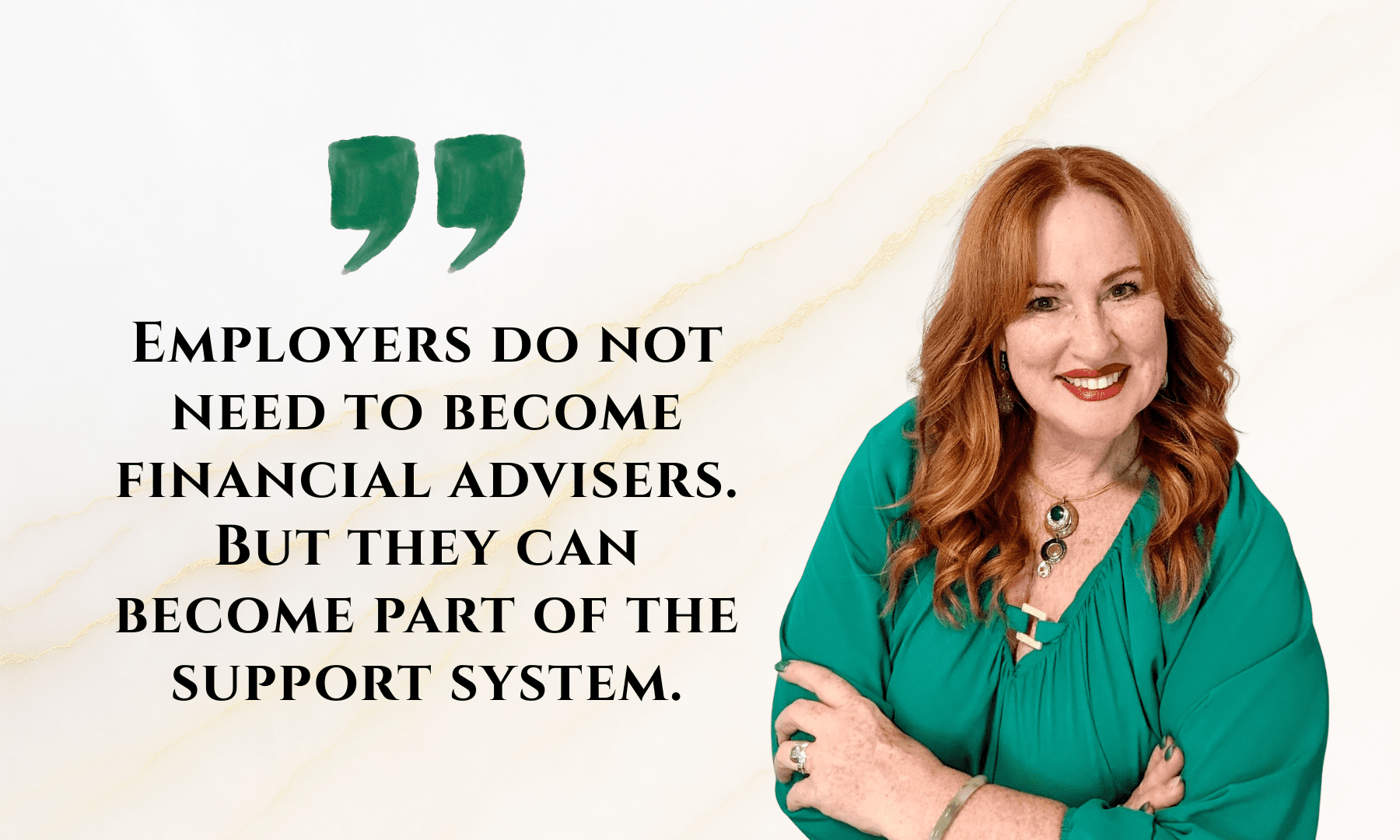
    Employers do not need to become financial advisers.
    But they can become part of the support system.

    A workplace that genuinely cares about financial wellbeing sends a powerful message:

    “We see the pressure. We care about the person, not just the performance.”

    That kind of support builds trust.
    It strengthens loyalty.
    And it helps create a workplace culture where people feel valued in a real way.

    Simple ways employers can help include:

    • offering financial wellbeing education
    • normalising money conversations without stigma
    • providing access to coaching or structured support
    • recognising the connection between financial stress and performance
    • focusing on prevention, not just crisis response

    Why this matters for business outcomes too

    Supporting employee financial wellbeing is not just kind. It is smart.

    When employees feel less stressed about money, businesses often benefit from:

    • improved focus
    • better productivity
    • lower turnover
    • stronger morale
    • healthier workplace culture
    • more trust between staff and leadership
    When employees feel less stressed about money, businesses often benefit

    In other words, supporting financial wellbeing is not a “soft” benefit.
    It is a practical one.

    And in times of uncertainty, practical support is exactly what people remember.

    Comfort matters too

    There is one more piece that deserves attention.

    People do not just need solutions. They need reassurance.

    Many employees are currently feeling shame about money. They may feel embarrassed that they are stressed. They may think they “should” have it sorted. They may stay silent because they would rather not look incapable.

    That is why comfort matters.

    It helps to remind people:

    • they are not alone
    • financial pressure is affecting many households
    • struggling does not mean failing
    • support is available
    • change is possible with the right tools and guidance

    Sometimes the most powerful first step is simply helping someone feel seen.

    Creating a more supportive workplace

    If you are an employer, leader, or HR decision-maker, this is your opportunity to think bigger about what support really means.

    Financial wellbeing is no longer a “nice to have”.
    It is one of the most practical and human ways to support your team.

    And it does not require overcomplicating things. It starts with awareness.

    Then it moves into education, tools, and support that help people take back a sense of control.

    A better path forward

    The world feels heavy for many people right now. That is real. But so is the opportunity to respond differently.

    Instead of waiting for burnout, disengagement, or unexpected resignations, employers can choose to act earlier.


    They can offer support that helps employees feel steadier, calmer, and more capable. And when that happens, everybody wins.

    If you want to support your team in a practical, meaningful way, my Financial Wellbeing Program helps employees build confidence, reduce money stress, and create healthier financial habits with real tools and support.

    Because sometimes the best staff benefit is not another perk.
    It is helping your people feel safer, stronger, and more in control of their lives.

    Financial Wellbeing Program

    #HowToResetMyMoneyMindset #WhyDoIFeelOutOfControlWithMoney #HowToFeelInControlOfFinances #ResetMoneyMindset2025 #NewYearFinancialMindset #HowToStartFreshWithMoney  emergency fund australia, money management, family savings 

     

    From Chaos to Clarity: How to Create a Money Plan That Actually Works

    From Chaos to Clarity: How to Create a Money Plan That Actually Works

    Ever feel like your money is running you instead of the other way around? Like no matter how much you earn, there’s always more month than money?

    If you nodded (or sighed), you’re not alone. The good news? You don’t need a finance degree, a six-figure income, or a strict budget to take control. You just need a money plan that works for you.

    In this blog, we’ll ditch the overwhelm and walk through exactly how to create a simple, empowering money plan that gives you clarity, confidence, and real momentum.

    Let’s go from chaos to clarity – starting today.

    1. Start With Your “Why”: Anchor Your Money to What Matters

    Before we dive into numbers, let’s get clear on your why. Because unless your money plan connects to something meaningful, it won’t stick.

    Ask yourself:

    • What would feeling in control of my money allow me to do?
    • What does financial peace look like to me?
    • What am I working toward?

    Your answers might include:

    • Paying off debt to sleep better at night
    • Saving for a dream trip or home deposit
    • Creating options so you can work less or start a business

    Write your top 2 – 3 motivations down. These are your compass when the budget feels boring or things go off track.

    2. Know Your Numbers (Without the Shame Spiral)

    You can’t improve what you don’t measure. So let’s get honest, not harsh. Gather the basics:

    • Your income (all sources)
    • Your recurring bills
    • Your debt repayments
    • Your spending patterns (groceries, eating out, transport, etc.)
    • Your current savings and investments

    Pro tip: Use the last 2–3 months of bank statements to see where your money actually went. You might be surprised (hello, Uber Eats). This isn’t about judgment. It’s about clarity.

    3. Create a Simple Money Plan (The 70/20/10 Rule)

    Forget complicated budgets with 47 categories. Here’s a simple, flexible formula you can actually stick to:

    • 70% for living: rent/mortgage, groceries, transport, lifestyle
    • 20% for financial goals: savings, debt repayments, investments
    • 10% for the future: extra super, long-term wealth building

    The percentages aren’t set in stone. Adjust based on your situation. The key is having a structure that makes sure you’re not spending 100% of your income with nothing left to show for it.

    Action step: Plug your own numbers into this formula and see where you land. If you’re off track, that’s your roadmap for change.

    Create a Simple Money Plan

    4. Automate Your Money Flow (And Take the Stress Out)

    Once you know where your money should go, make it happen on autopilot.
    Set up automatic transfers:

    • To a separate savings account (nickname it for motivation: “Italy 2026” or “Debt-Free Me”)
    • To cover bills and direct debits
    • To long-term savings or investment accounts

    When you automate, you eliminate the willpower game. You’ll save without thinking and avoid last-minute money panic.

    Bonus tip: Use a separate account for discretionary spending (like a digital “cash envelope”). When it’s empty, it’s empty.

    5. Create an Emergency Buffer (For Life’s “Oh No!” Moments)

    Life is full of surprises. Your washing machine breaks, your car needs fixing, or your job suddenly changes.

    Having even $1,000 in a buffer fund means you don’t have to reach for the credit card every time life happens.

    Aim for 1 month of essential expenses first, then build to 3. But start where you are, every $50 counts. Keep it in a separate high-interest savings account you can access in a true emergency (not Friday night online shopping).

    6. Track Progress Without Obsessing

    You don’t need to check your bank app five times a day. But regular check-ins keep you engaged and help you spot problems early.

    Ideas to stay on track:

    • Weekly money date: review transactions, check balances, update goals
    • Monthly review: celebrate wins, adjust if needed

    Use a simple app or spreadsheet to track goals

    The goal isn’t perfection. It’s progress.

    7. Keep Learning and Stay Inspired

    Your relationship with money is lifelong. The more you understand it, the more confident you’ll feel. Try:

    • Reading a finance book this quarter
    • Listening to a weekly money podcast
    • Following finance educators on socials
    • Booking a session with a financial coach to personalise your plan

    There’s no shame in not knowing something – only in staying stuck.

    Clarity = Confidence = Momentum

    When your money feels chaotic, it can affect everything: your stress levels, your sleep, your relationships, and your ability to plan ahead. But creating a money plan that actually works isn’t about spreadsheets or sacrifice. It’s about:

    • Getting clear on what matters to you
    • Creating a simple, sustainable system
    • Building habits that support your goals

    And the best part? You can start today. One step. One decision. One plan.

    If you’re ready to get out of the fog and into financial clarity, let’s talk. Book your free discovery call and let’s map out your next steps – with zero jargon, zero judgment, and 100% support.

    Because you can feel good about your money. You just need a plan that fits your life.

    No more chaos. It’s your time for clarity. Let’s make it happen.

    Mastering Budgeting and Saving
    The Vault
    The 5 Biggest Money Mistakes Small Business Owners Make (And How to Fix Them Fast)

    The 5 Biggest Money Mistakes Small Business Owners Make (And How to Fix Them Fast)

    Let’s face it – being a small business owner is no joke.

    You’re juggling clients, projects, quoting jobs, doing the work, chasing payments, paying staff or suppliers, and – somewhere in there – trying to make sure you actually get paid.

    But if it feels like you’re always hustling and still living week to week, chances are… your money systems are working against you, not for you.

    And here’s the thing: it’s not about how smart you are or how hard you work. Most business owners weren’t taught how to manage their money. You were probably just thrown into the deep end, figuring it out as you go.

    The good news? You can stop spinning your wheels, and it starts by avoiding the most common financial traps.

    In this blog, I’ll walk you through the 5 biggest money mistakes I see every week and more importantly, show you how to fix them fast so you can take back control and finally feel financially secure in your business.

    Mistake #1: Not Paying Yourself a Regular Wage

    Let’s talk about one of the most common (and painful) mistakes small business owners make: they don’t pay themselves consistently.

    You might be saying:

    “I take money out when I need it.”

    “There’s never enough to pay myself regularly.”

    “I’ll pay myself properly when things settle down.”

    Here’s the problem with that: you’re running your business like an ATM, not a real operation. And that mindset will keep you broke – even when you’re making good money.

    ? The Fix:

    Set up a dedicated Owner’s Pay account, and start paying yourself a consistent wage every week or fortnight. Even if it’s only $200 to start, build the habit. When you get paid from clients, transfer a fixed percentage into your Owner’s Pay account – just like you’d pay an employee.
    This does two things:

    • It forces you to treat your income seriously.
    • It allows you to plan and budget your personal life better.

    The Edge coaching program teaches you how to calculate your break-even wage and build a cash flow system that actually works for your business.

    Why Hard Work Alone Isn’t Paying Off

    Mistake #2: Mixing Personal and Business Finances

    It might seem harmless to buy a Bunnings tool on your personal card or pay the rego for the work ute from your grocery account – but over time, this creates a total mess.

    It’s impossible to track how your business is performing if everything is muddled together. You won’t know what you’re spending, earning, or saving – and when tax time rolls around, you’ll be in a world of pain.

    ? The Fix:

    Set up two separate bank accounts at the bare minimum:

    • One for business income and expenses
    • One for personal living

    Better yet, I recommend creating five simple business accounts:

    1. Income – all revenue lands here
    2. Owner’s Pay – your regular wage
    3. Expenses – for bills, tools, and running costs
    4. Tax & BAS – set aside 25 – 30% per payment
    5. Profit – for business growth or rainy days

    Once this is in place, your financial clarity skyrockets. You’ll know exactly where your money is going, and you’ll be less tempted to “accidentally” spend it.

    Mistake #3: Ignoring the Numbers

    This one’s a biggie, and I get it. Many small business owners avoid looking at their numbers because they’re overwhelmed, too busy, or just afraid of what they’ll find.
    But let’s be honest – if you don’t know your numbers, you don’t know your business.
    You can’t improve what you don’t measure.

    ? The Fix:

    Start by checking these numbers weekly:

    • Revenue: What came in?
    • Expenses: What went out?
    • Net Profit: What’s left over after expenses?
    • Break-even: How much do you need to earn to cover costs and pay yourself?

    Create a simple weekly “money date” even just 30 minutes every Friday, to review your finances, send invoices, follow up on payments, and track your progress.

    In The Edge, we give you simple templates to track this in under 10 minutes a week (no accountant brain required).

    Mistake #4: No System for Tax and BAS

    You know the drill: things are going well… until BAS time hits. Suddenly the ATO wants thousands you didn’t put aside, and you’re scrambling to pay.

    Sound familiar?

    Many small biz owners treat BAS like a nasty surprise – but it’s completely avoidable if you plan for it. Any case remember it’s not your money in the first place.

    ? The Fix:

    Every time you get paid, immediately transfer 25 – 30% into your Tax Account for taxes and BAS. Pretend it’s not yours. Because technically – it’s not. That’s the ATO’s cut.

    If you’re registered for GST, track your income and expenses monthly and lodge on time. Using software like Xero, QuickBooks, or even a simple spreadsheet will make this 10x easier.

    Imagine having a tax bill and already having the money sitting there ready. That’s the kind of peace The Edge helps you create.

    Mistake #5: Undercharging for Your Work

    This one hurts because you’re working hard, showing up, and doing great work… but the money just isn’t adding up.

    Often, it’s because you’re undercharging. Maybe you’re pricing based on what others charge, or you’re too scared to raise your rates in case you lose clients.

    But here’s the thing: if your pricing doesn’t cover your expenses, time off tools, admin time, and leave a profit – you’re not running a business. You’re running a charity.

    ? The Fix:

    • Add up everything it costs to run your business monthly (including paying yourself)
    • Work out how many hours you realistically work and how many jobs you can do
    • Divide your monthly costs by the number of billable hours or jobs – that’s your true minimum rate
    • Add a profit margin

    Also, factor in time spent quoting, driving, admin, and materials. You’re not just being paid for the hour on site, you’re being paid for all the time and expertise it takes to do the job well.

    In The Edge, we give you a simple pricing tool to calculate your true rate with confidence – so you never wonder, “Am I charging enough?” again.

    Bonus Tip: You Don’t Have to Figure This Out Alone

    Here’s the thing most people won’t tell you: money stress isn’t about how much you make. It’s about how you manage what you’ve got.

    And most small business owners were never taught how to do this. You’ve just been doing the best you can with what you know.

    But what if there was a better way?

    What if, in just 6 weeks, you could:

    ✅ Pay yourself regularly
    ✅ Get your tax sorted and stop panicking at BAS time
    ✅ Know your numbers and feel in control
    ✅ Charge with confidence
    ✅ Build a buffer so you’re never caught off guard
    ✅ Actually enjoy running your business again?

    Introducing: The Edge – Your 6-Week Business Financial Reset

    The Edge is a coaching program for tradies, franchisees and small business owners who are sick of just “getting by” and ready to build a business that actually pays them.

    Inside The Edge, you’ll get:

    ? Weekly coaching calls
    ? Easy-to-use templates and systems
    ? Real-life strategies that work for time-poor business owners
    ? Support and accountability from someone who gets it
    ? A full money makeover – without the financial jargon

    It’s not about being perfect – it’s about taking action, building structure, and finally feeling confident with your money.

    Final Thoughts: You Can Fix This. Fast.

    The biggest money mistakes small business owners make aren’t about numbers, they’re about habits.
    If you’re not paying yourself, mixing finances, ignoring your numbers, or winging it at tax time… it’s costing you more than you know. Not just money, but peace of mind, time with your family, and the freedom you started your business for.

    You don’t have to keep doing it the hard way.

    Let’s fix it – fast, together, and for good.

    ? Ready to stop surviving and start thriving?

    Join The Edge 6-Week Coaching Program Now and get the tools, systems, and support you need to take control of your business money – once and for all.

    THE EDGE - 6-WEEK PROGRAM