When Did Your Business Stop Being Fun?

When Did Your Business Stop Being Fun?

There was a time when your business felt exciting.

Remember that?

The early days when every new customer felt like a win.

When every sale brought a sense of achievement.

When you couldn’t wait to tell people about your idea.

When your business represented freedom, possibility and opportunity.

Back then, the long hours didn’t seem to matter.

  • The challenges felt exciting.
  • The future looked full of potential.
  • You were building something.
  • Creating something.
  • Chasing something bigger.

But somewhere along the way, for many business owners, something changes.

The excitement starts to fade.

The pressure starts to grow.

The to-do list gets longer.

The responsibilities multiply.

And without even realising it, the business that once energised you starts to drain you.

The question is:

When did your business stop being fun?

It Doesn’t Happen Overnight

Very few business owners wake up one morning and suddenly decide they no longer enjoy their business.

It’s usually much more subtle than that.

A little more stress.

A few more responsibilities.

Another team member to manage.

More customer expectations.

More bills.

More administration.

More compliance.

More decisions.

More pressure.

Little by little, the business grows.

But so does the weight of running it.

Until one day you realise you’re spending more time solving problems than pursuing opportunities.

More time reacting than creating.

More time surviving than enjoying.

And that’s often the moment business starts feeling different.

The Dream Was Never About More Emails

Let’s be honest.

  • Nobody starts a business because they dream of spending their day buried in emails.
  • Nobody starts a business because they love chasing invoices.
  • Nobody starts a business because they enjoy dealing with staffing issues.
  • Nobody starts a business because they want to spend weekends catching up on paperwork.

Yet for many business owners, that’s exactly where they end up.

The business grows.

Complexity grows.

Administration grows.

Responsibilities grow.

And suddenly the business owner spends less time doing what they love and more time doing what the business demands.

The dream wasn’t supposed to look like this.

    Growth and enjoyment don't always increase together.
Unless you're intentional about building both.

    Success Can Create New Problems

    One of the biggest surprises in business is that growth doesn’t automatically make life easier.

    In fact, growth often introduces entirely new challenges.

    A larger customer base means more demands.

    A larger team means more leadership responsibilities.

    More revenue often means more moving parts.

    More complexity.

    More decisions.

    More pressure.

    This catches many business owners off guard.

    They achieve goals they once dreamed about and then wonder why they still feel exhausted.

    Why do they still feel overwhelmed?

    Why does the business still feel harder than it should?

    The answer is simple.

    Growth and enjoyment don’t always increase together.

    Unless you’re intentional about building both.

    The Trap of Becoming the Business

    Many small business owners start out wearing every hat:

    • Sales.
    • Marketing.
    • Operations.
    • Customer service.
    • Finance, and
    • Administration.

    It’s understandable.

    In the beginning, there may be nobody else.

    The challenge comes when the business continues to rely on the owner for everything.

    Every decision.

    Every approval.

    Every customer issues.

    Every problem.

    Every opportunity.

    The business becomes dependent on one person.

    And that person becomes trapped.

    What started as freedom slowly turns into obligation.

    Instead of owning a business, the business starts owning you.

    That’s a dangerous place to be.

    Not because the business is failing.

    But because the business can no longer function without your constant involvement.

    The Warning Signs

    Many business owners don’t realise they’ve reached this point until they see some of the warning signs.

    You might recognise a few of these:

    You check emails first thing in the morning and last thing at night.

    You struggle to switch off on weekends.

    You feel guilty taking holidays.

    You answer messages while you’re with family.

    You constantly think about work.

    You feel exhausted even after a day off.

    You find yourself saying things like:

    “If I don’t do it, it won’t get done properly.”

    Or:

    “It’s just easier if I do it myself.”

    Or:

    “I’ll deal with that later.”

    These aren’t signs of commitment.

    They’re often signs that the business has become too dependent on you.

    Why Fun Actually Matters

    Some people dismiss the idea of fun in business.

    They think business should be serious.

    Professional.

    Disciplined.

    Structured.

    And while all of those things have their place, enjoyment matters too.

    A lot.

    Because when business stops being enjoyable, several things start happening.

    Creativity declines.

    Energy declines.

    Motivation declines.

    Decision making suffers.

    Opportunities get missed.

    Burnout becomes more likely.

    The reality is that business owners perform better when they enjoy what they’re building.

    Not because it’s easy.

    But because it feels meaningful.

    When enjoyment disappears, business becomes something you endure rather than something you create.

    And that’s a very different experience.

      What Would Make Business More Enjoyable Again?

      This is one of my favourite questions to ask business owners.

      Not:

      “How do you grow?”

      Not:

      “How do you make more money?”

      But:

      “What would make your business more enjoyable?”

      Most business owners already know the real challenge isn't necessarily growth.
It's creating a business that feels sustainable.
A business that supports their life instead of consuming it.

      The answers are fascinating:

      • Some want more time.
      • Some want less stress.
      • Some want better systems.
      • Some want more clarity.
      • Some want a stronger team.
      • Some want to stop worrying about cash flow.
      • Some want to take a holiday without checking their phone every five minutes.

      What’s interesting is that very few people answer:

      “I need more customers.”

      Most business owners already know the real challenge isn’t necessarily growth.

      It’s creating a business that feels sustainable.

      A business that supports their life instead of consuming it.

      The Difference Between Building a Business and Building a Life

      At some point every business owner faces a choice.

      Will the business become the centre of their life?

      Or will the business support the life they want to create?

      They’re very different goals.

      One creates dependency.

      The other creates freedom.

      One creates constant pressure.

      The other creates options.

      One requires endless sacrifice.

      The other creates balance.

      The most successful business owners I’ve met understand this distinction.

      They don’t simply focus on building a bigger business.

      They focus on building a better business.

      One that creates profit.

      One that creates opportunities.

      One that creates freedom.

      One that allows them to enjoy the journey.

      Because what’s the point of building something successful if you never get to enjoy it?

      The Three Questions Worth Asking Yourself

      If business isn’t feeling as enjoyable as it once did, start with these three questions.

      1. What Am I Spending Too Much Time Doing?

      Look honestly at your week.

      What’s draining your energy?

      What’s consuming your time?

      What’s keeping you stuck in the weeds?

      Awareness is the first step.

      2. What Am I Avoiding?

      Sometimes the biggest frustrations come from problems we’ve been avoiding.

      A pricing issue.

      A staffing issue.

      A systems issue.

      A process issue.

      What conversation needs to happen?

      What decision needs to be made?

      3. What Would Make Business Feel Lighter?

      Not bigger.

      Not faster.

      Not more complicated.

      Lighter.

      What would create more breathing room?

      More confidence?

      More enjoyment?

      More freedom?

      The answer may be closer than you think.

      Business Was Never Meant to Be a Punishment

      Running a business will always involve challenges.

      That’s part of the journey.

      There will always be problems to solve.

      Decisions to make.

      Obstacles to overcome.

      But that doesn’t mean the journey should feel like a punishment.

      You didn’t start your business to become stressed, exhausted and overwhelmed.

      You started because you wanted something better:

      • More freedom.
      • More flexibility.
      • More opportunity.
      • More impact, and
      • More life.

      And perhaps that’s the reminder many business owners need.

      Success isn’t just about making more.

      It’s about keeping more.

      Keeping more time.

      Keeping more energy.

      Keeping more freedom.

      Keeping more enjoyment.

      Because at the end of the day, business should help you create a life you love.

      Not distract you from living it.

      Final Thoughts

      If your business isn’t feeling as fun as it once did, don’t ignore it.

      It’s often a sign that something needs attention.

      Not because you’re failing.

      Not because you’re doing anything wrong.

      But because growth changes things.

      Responsibilities change things.

      Life changes things.

      The goal isn’t to go backwards.

      The goal is to build a business that evolves with you.

      One that creates opportunity without consuming your life.

      One that gives you confidence instead of constant stress.

      One that allows you to make more, keep more and enjoy the ride.

      Ready to Find Out What’s Holding Your Business Back?

      The EDGE Business Health Check helps you uncover the hidden opportunities, blind spots and challenges inside your business.

      In less than 20 minutes, you’ll gain valuable insights across profitability, cash flow, growth, systems, leadership and CEO visibility.

      Because the more clarity you have, the easier it becomes to build a business that supports your goals and your lifestyle.

      Take The EDGE Business Health Check today and discover where your next opportunity is hiding.

      Take The EDGE Business Health Check today and discover where your next opportunity is hiding.

      #HowToResetMyMoneyMindset #NewYearFinancialMindset #HowToStartFreshWithMoney  emergency fund australia, money management, family savings #SmallBusinessOwner #BusinessGrowth #CashflowManagement #BusinessSuccess
      #EntrepreneurMindset

       

      How to Price Your Products or Services Properly (Without Undervaluing Yourself)

      How to Price Your Products or Services Properly (Without Undervaluing Yourself)

      Pricing your products or services can feel like one of the most uncomfortable parts of running a business.

      You sit there staring at a number, wondering:

      Is this too high?
      Is this too low?
      Will people actually pay this?
      What if I lose customers?

      So instead of making a clear, strategic decision, you do what most small business owners do…

      You guess.

      Maybe you look at what competitors are charging and land somewhere in the middle. Maybe you choose a number that “feels reasonable”. Or maybe you go lower than you’d like, just to be safe.

      And while that might feel like the least risky option, it’s actually one of the biggest reasons businesses struggle to grow.

      Because pricing isn’t just about making a sale, it’s about building a business that actually works.

      If your pricing is off, everything feels harder. You work more, earn less, and constantly feel like you’re chasing your tail. But when your pricing is right, things start to click. You attract better clients, your workload becomes more manageable, and your business becomes far more sustainable.

      So let’s break this down properly and give you a clear, practical approach to pricing your products or services, without the guesswork.

      The first thing to understand is that pricing is not just a financial decision. It’s also a positioning decision.

      The price you set tells your customers something about your business before you even speak to them.

      A lower price often signals affordability and accessibility, but it can also suggest lower value. A higher price can position you as premium, but only if the experience and results match.

      Neither approach is right or wrong, but it has to be intentional.

      The problem is that many business owners don’t choose a position. They end up somewhere in the middle, without a clear strategy, trying to appeal to everyone, and ultimately attracting the wrong customers.

      And this is where pricing starts to create stress.

      Because when your pricing doesn’t align with your costs, your value, and your positioning, you feel it every single day in your business.

      Because when your pricing doesn’t align with your costs, your value, and your positioning, you feel it every single day in your business.<br />

      One of the most common mistakes is relying too heavily on competitor pricing.

      It seems like the logical place to start. After all, if everyone else is charging a certain amount, it must be the “right” price… right?

      Not necessarily.

      You don’t know their financial situation. You don’t know their cost structure. You don’t know their profit margins. And you definitely don’t know whether they’re actually making money.

      There are plenty of businesses out there that look successful on the surface but are barely breaking even behind the scenes.

      So when you base your pricing on competitors, you’re not creating a strategy – you’re copying someone else’s guess.

      And that’s a risky way to run a business.

      Instead, your pricing needs to start with your numbers.

      At its simplest level, pricing comes down to one core idea: Your price must cover your costs and generate a profit.

      Sounds straightforward, but this is where most business owners get it wrong. Because they don’t fully understand their costs.

      When people think about costs, they often focus on the obvious ones; materials, stock, or direct expenses tied to delivering a product or service.

      But there are so many hidden costs that get overlooked.

      Your time is a cost. Admin work is a cost. Emails, phone calls, quoting, planning, travel—it all adds up. Even things like software subscriptions, marketing tools, insurance, and professional services need to be factored in.

      If you’re not accounting for all of these, you’re underpricing – whether you realise it or not. And that’s where the frustration begins. You’re busy. You’re making sales. But at the end of the month, there’s not much left over.

      Not because your business isn’t working, but because your pricing isn’t supporting it.

      Then there’s the topic of profit.

      This is where things get a little uncomfortable for many business owners. Because profit can feel… optional. Something extra. Something you’ll get to “eventually”.

      But here’s the reality: Profit is not a bonus. It’s a requirement. Profit is what allows you to:

      • Pay yourself properly
      • Reinvest in your business
      • Handle unexpected expenses
      • Grow sustainably

      Without profit, your business becomes a job and often not a very well-paid one. So instead of hoping there’s money left at the end, you need to build profit into your pricing from the start.

      Even if it’s small to begin with, it needs to be intentional.

      Now, once you understand your costs and include a profit margin, the next step is thinking about value. Because pricing isn’t just about covering costs – it’s also about what your customer is receiving.

      This is where value-based pricing comes into play

      Let’s say you’re offering a service that helps a client increase their revenue, save time, or reduce stress. The value of that outcome is often far greater than the time it takes you to deliver it.

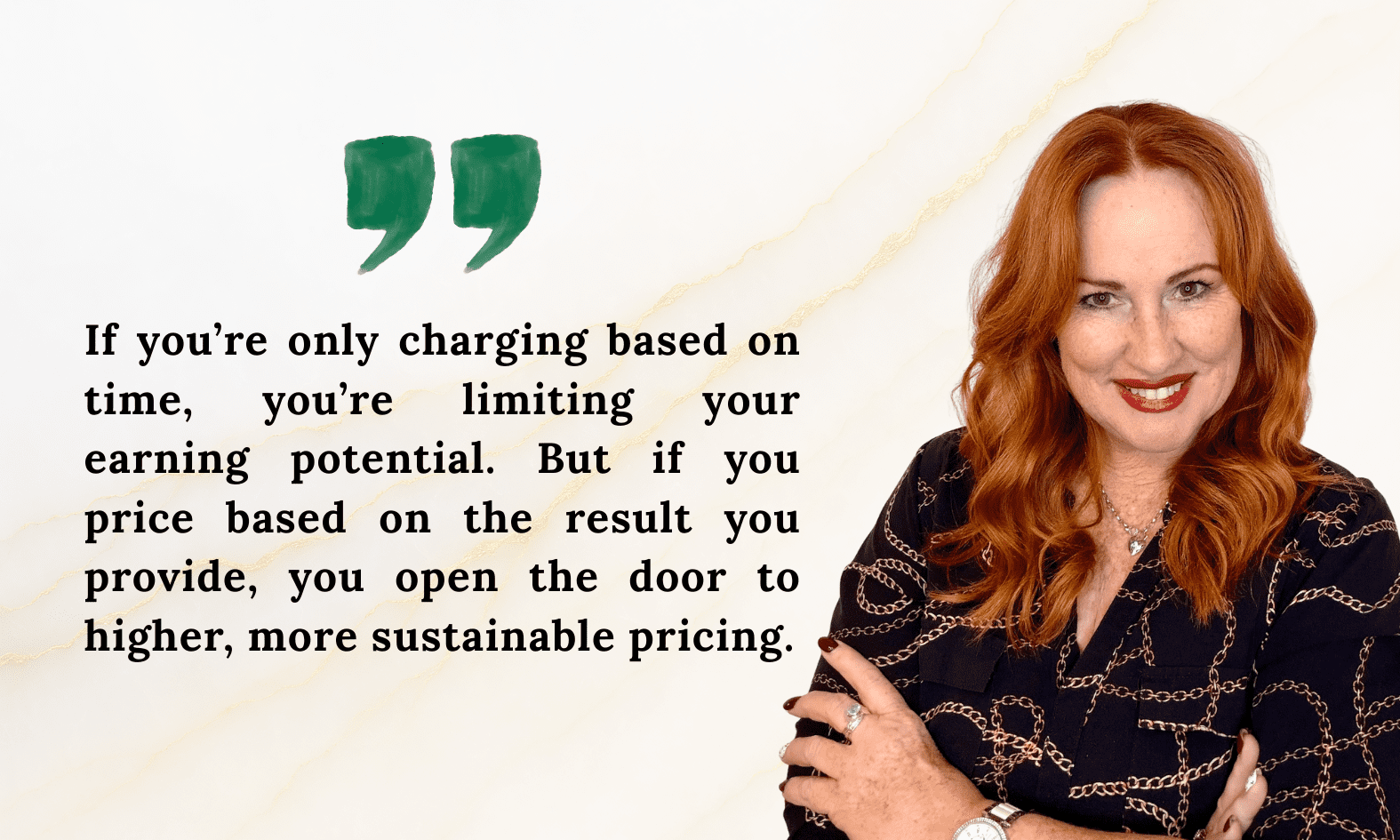
      If you’re only charging based on time, you’re limiting your earning potential. But if you price based on the result you provide, you open the door to higher, more sustainable pricing.

      This doesn’t mean ignoring your costs; it means combining both approaches.

      Know your baseline (your costs and required profit), then position your pricing based on the value you deliver.

      Of course, even when you understand all of this, there are still a few traps that can quietly pull your pricing down.

      One of the biggest is underpricing to win customers

      It feels like a smart move to make your offer more attractive, get more sales, and build momentum.

      But what often happens is that you attract price-sensitive customers who are always looking for the cheapest option. They’re harder to please, quicker to leave, and less loyal overall. And because your margins are lower, you need more of them just to stay afloat.

      That’s not a recipe for a healthy business.

      Another common trap is discounting too quickly. A customer hesitates, and before they even ask, you offer a lower price. It might help close the sale in the moment, but it also reduces your perceived value and sets a precedent.

      Over time, it trains customers to expect discounts and makes it harder to charge your full price.

      Then there’s the habit of avoiding price increases altogether.

      Costs go up. Expenses rise. But your prices stay the same.

      This slowly erodes your profitability, often without you noticing until things feel tight.

      Raising your prices doesn’t have to be dramatic. Even small, regular adjustments can make a big difference over time.

      And in most cases, customers expect it, especially if you’re continuing to deliver value.

      If the idea of increasing your prices feels uncomfortable, you’re not alone.

      But here’s a helpful way to think about it.

      When you raise your prices, you’re not just charging more – you’re creating space.

      Space to:

      • Deliver a better experience
      • Reduce stress and burnout
      • Focus on quality over quantity
      • Build a more sustainable business

      And while you might lose a small number of customers, you often gain better ones.

      Clients who value what you do, respect your time, and are willing to pay for quality.

      Confidence in pricing doesn’t come from mindset alone – it comes from clarity.

      When you understand your numbers, your costs, and your value, pricing becomes less emotional and more strategic.

      You stop second-guessing yourself. You stop apologising for your prices. And you start making decisions that support the business you actually want to build.

      So where should you start?

      Keep it simple. Choose one product or service and break it down properly.

      Work out what it truly costs you to deliver. Include your time. Add a profit margin. Then compare that to what you’re currently charging.

      If there’s a gap, adjust. Not perfectly. Not all at once. Just intentionally. Because small improvements in pricing can have a huge impact over time.

      At the end of the day, pricing properly isn’t about being the most expensive or the cheapest.

      It’s about building a business that works for you.

      A business that pays you properly.
      A business that supports your lifestyle.
      A business that gives you room to grow.

      And that starts with one decision, stopping the guesswork and taking control of your pricing.

      Ready to Get Started?

      If you’re serious about changing your money…

      Not just thinking about it…

      Join the membership and let’s build this together!

      Membership - FM101

      #HowToResetMyMoneyMindset #WhyDoIFeelOutOfControlWithMoney #HowToFeelInControlOfFinances #ResetMoneyMindset2025 #NewYearFinancialMindset #HowToStartFreshWithMoney  emergency fund australia, money management, family savings 


      Busy Is Not Profitable: 7 Financial Foundations Every Business Owner Needs

      Busy Is Not Profitable: 7 Financial Foundations Every Business Owner Needs

      There’s a big myth in small business that if you just work hard enough, everything will eventually click into place.

      Spoiler alert: hard work matters, but hard work without financial foundations can leave you exhausted, underpaid, and wondering why your business still feels so heavy.

      I see this all the time with small business owners, tradies, franchisees, coaches, and self-employed professionals.

      They are flat out. Clients are coming in. Invoices are going out. The calendar is packed.

      And yet… There is still stress. Still pressure. Still that sinking feeling of, “Why does it feel like I’m doing all this work and not getting ahead?”

      Here’s why:

      Because busy is not profitable. And being great at your trade or profession is not the same as having strong money systems.

      The good news? You do not need a finance degree to fix this. You just need the right foundations.

      Here are seven of the most important ones.

      1. A cashflow system that tells the truth

      Cashflow is not something you check when you are already in trouble.
      It is something you build so you can stay out of trouble.

      A good cashflow system shows you:

      • what is coming in
      • what is going out
      • what bills are approaching
      • what is available to spend
      • what needs to be set aside for tax, super, wages, and future costs

      Cashflow gives you visibility. Visibility gives you control.

      2. Clear separation between personal and business money

      Using your personal account like a business overdraft creates confusion fast.

      It becomes harder to track spending, harder to know what the business is really earning, and harder to make clean decisions.

      Separating business and personal finances is one of the fastest ways to reduce chaos.
      It is not about being fancy. It is about being clear.

      3. Pricing that actually protects your profit

      So many business owners price from fear.

      Fear of losing the sale.
      Fear of seeming too expensive.
      Fear of being judged.

      But underpricing does not make you more professional. It makes your business more fragile.

      Your pricing needs to cover more than the job in front of you. It needs to reflect overheads, admin time, tax obligations, profit goals, and the actual value you deliver.

      Pricing with confidence is not greedy.
      It is responsible.

      4. A plan to pay yourself properly

      Using your personal account like a business overdraft creates confusion fast.

      It becomes harder to track spending, harder to know what the business is really earning, and harder to make clean decisions.

      Separating business and personal finances is one of the fastest ways to reduce chaos.
      It is not about being fancy. It is about being clear.

      5. Weekly and monthly money rhythms

      You do not need to stare at your numbers every day.
      But you do need a rhythm.

      That might include:

      • checking cashflow weekly
      • reviewing key reports monthly
      • monitoring expenses and margins
      • tracking unpaid invoices
      • spotting small issues before they turn into big ones

      Confidence with numbers is built through repetition, not perfection.

      6. Knowing your numbers without drowning in them

      You do not need to obsess over every metric.
      You do need to know the numbers that matter.

      Think:

      • revenue
      • gross profit
      • operating expenses
      • net profit
      • cash position
      • debt levels
      • wage costs
      • tax set-asides

      The goal is not more complexity.
      The goal is better decisions.

      When you know what your numbers are saying, you stop making emotional decisions and start making strategic ones.

      7. A business structure that can handle growth

      Growth is exciting, but if your systems are messy, it can magnify every weakness.

      That is why foundations matter before scaling.

      You want business systems that support:

      • clear accounts setup
      • simple automations
      • better reporting
      • cleaner budgeting
      • stronger decision-making
      • less burnout

      Strong structure makes growth feel possible instead of painful.

      Business foundations create freedom

      Why this matters right now

      The business landscape is not getting easier.
      Costs are rising. Margins can be tight. Pressure builds quickly when you do not have clarity.

      That is exactly why now is the time to stop relying on memory, hope, and hustle alone.

      The strongest business owners are not always the loudest or busiest.
      They are the ones who know their numbers, trust their systems, and make decisions early.

      Foundations Create freedom

      Let’s make this simple. When your financial foundations are solid, you get:

      • less panic
      • less avoidance
      • less confusion
      • better decisions
      • stronger profit
      • more confidence
      • more breathing room

      And honestly? More enjoyment.

      Because business should not feel like one long financial mystery.

        A business structure will help you handle growth

        Your invitation to stop winging it

        If you know your foundations need work, you are not alone.
        And you do not have to figure it all out the hard way.

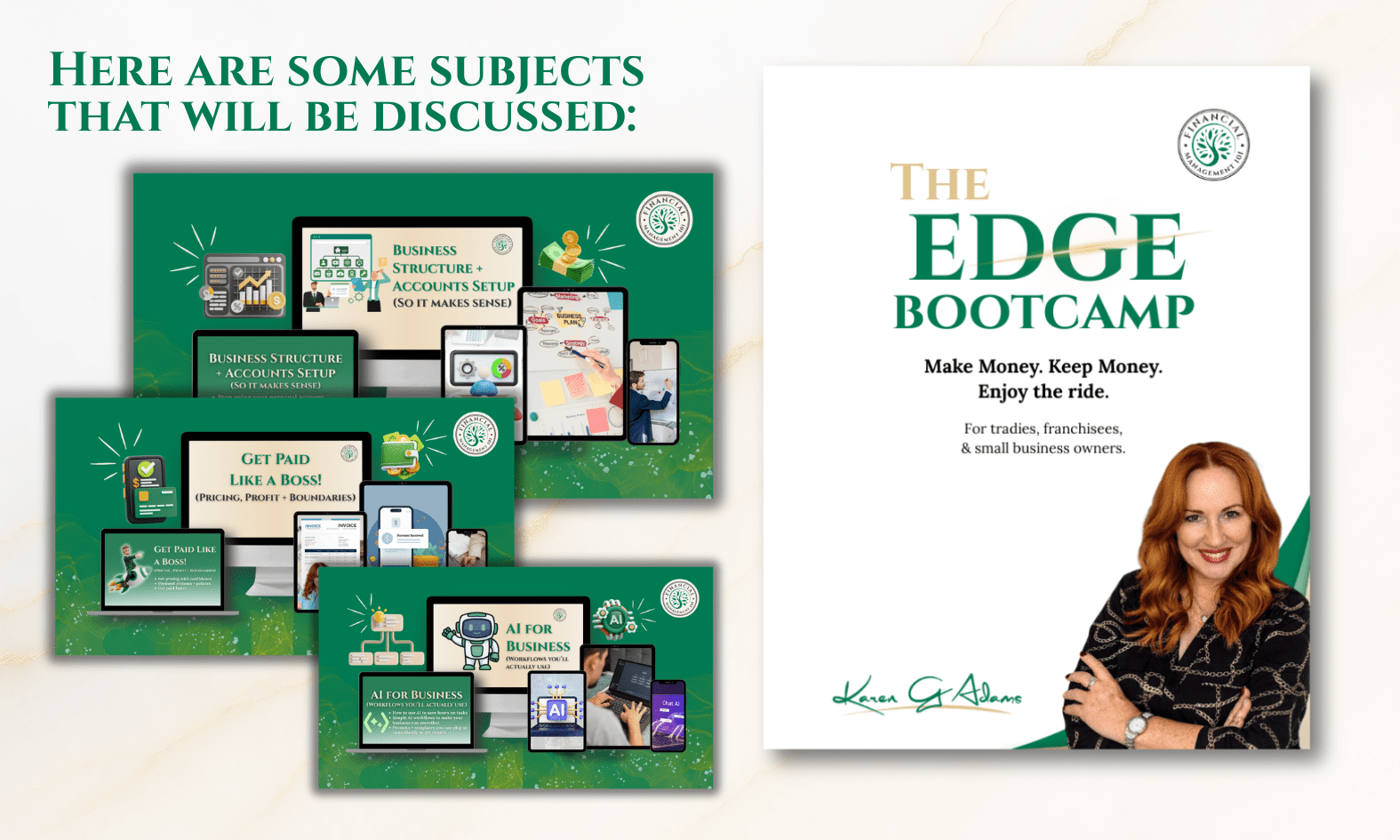
        That is exactly what The Edge Bootcamp is designed to help you do.

        Over two practical, high-impact days, we dig into the real foundations of profitable business: money systems, CEO mindset, cashflow, paying yourself, pricing, budgets, business setup, reading your numbers, leadership, growth stages, and more.

        This is for business owners who want results, not just motivation.

        Join The Edge Bootcamp in May and give your business the foundations it needs to make money, keep money, and enjoy the ride.

        Because being flat out is not the goal.
        Building a business that works for you is.

        Join The Edge Bootcamp

        #HowToResetMyMoneyMindset #WhyDoIFeelOutOfControlWithMoney #HowToFeelInControlOfFinances #ResetMoneyMindset2025 #NewYearFinancialMindset #HowToStartFreshWithMoney  emergency fund australia, money management, family savings 


        How Can I Rebuild My Confidence After Making a Financial Mistake or Falling Behind on My Budget?

        How Can I Rebuild My Confidence After Making a Financial Mistake or Falling Behind on My Budget?

        We’ve all had that moment.

        You check your bank account… and it’s lower than you thought.
        You open your credit card bill… and it’s higher than you expected.
        You look at your budget… and realse you haven’t followed it for two weeks.

        Cue the shame spiral.

        If you’ve recently made a money mistake – or you just feel behind – I want you to know this:

        You are not alone.
        You are not a failure.
        And you are absolutely capable of bouncing back stronger.

        This blog will walk you through how to move from guilt to growth, and rebuild your confidence one step at a time.

        1. Separate Your Self-Worth from Your Net Worth

        First and foremost: you are not your bank balance.

        Your financial missteps don’t make you “bad with money.” They make you human.

        Whether you overspent, ignored your budget, or slipped back into old habits, it doesn’t define who you are. It’s a moment – not a life sentence.

        Start here:

        • Remind yourself: “I am capable of change.”
        • Reflect on a past financial win, no matter how small

        Say out loud: “I forgive myself. I’m ready to move forward.”

        2. Get Honest (Without the Shame)

        Let’s name what happened – not to beat yourself up, but to take your power back.

        Ask yourself:

        • What did I spend that I hadn’t planned for?
        • Did I avoid tracking or checking in with my money?
        • Did I say “yes” to things I couldn’t afford?

        Write it all down. You’re not here to judge yourself – just to gain clarity so you can move forward with purpose.

        3. Understand What Triggered the Slip-Up

        There’s always a “why” behind every money misstep mand understanding it is key to change.

        Common triggers:

        • Emotional spending (boredom, stress, celebration)
        • People-pleasing (saying yes to things out of guilt)
        • Lack of planning (unexpected expenses you didn’t prep for)
        • Old money stories (like “I’ll never get ahead anyway”)

        Identifying the trigger gives you a new layer of awareness and that’s when real change begins.

        4. Reset with a Micro-Goal

        When your confidence is shaken, the best thing you can do is create a tiny win that rebuilds momentum.

        Here are some examples:

        • Track your spending for the next 3 days
        • Create a mini budget just for this week
        • Make one extra payment toward your credit card
        • Pause one subscription and save the money instead

        Success is a series of small, intentional steps. Start with one.

        Create a mini budget for this week

        5. Watch Your Words (They Matter More Than You Think)

        Your internal dialogue becomes your financial reality.

        Let’s flip the script:

        ❌ “I’m terrible with money.”
        ✅ “I’m learning how to manage my money better every day.”
        ❌ “I’ll never get out of debt.”
        ✅ “Every payment I make moves me closer to freedom.”
        ❌ “I can’t stick to a budget.”
        ✅ “I’m figuring out a system that works for me.”

        Language matters. Speak like someone who’s growing because you are.

        6. Track Progress, Not Perfection

        You don’t have to get everything right to be making progress. Celebrate the fact that:

        • You noticed the slip-up
        • You chose to stop and reflect
        • You’re taking action now

        That’s what winning with money actually looks like.

        Make a habit of reflecting each month:

        • What went well?
        • Where did I struggle?

        • What can I adjust?

        And remember: even showing up for your finances when it’s hard is worth celebrating.

        7. Lean Into Support – Don’t Do This Alone

        Shame thrives in isolation. Confidence grows in community.

        Find a space where:

        • You can ask questions without feeling judged
        • You can share your wins and struggles
        • You can be held accountable to your goals

        That’s exactly what Financial Muscle Coaching is a coaching and accountability space, where we normalise setbacks and celebrate bounce-backs.

        Inside the membership, you’ll find structure, strategy, and support – all in one place.

        8. Build Your Financial Muscle, One Rep at a Time

        Rebuilding financial confidence is like building physical strength – it happens one rep at a time.

        One decision to check your balance.
        One habit of tracking your spending.
        One conversation where you ask for help instead of hiding.
        One payment that moves you forward.

        You don’t need to leap – you just need to lift. And every lift makes you stronger.

        Final Thoughts

        Mistakes are part of the journey – not the end of it.

        You are not behind. You are not bad with money. And you don’t have to do this perfectly to make progress.

        Every time you choose to come back – to review, reflect, and reset – you’re rebuilding your confidence.

        You’re showing yourself what you’re made of.
        And you’re writing a new money story that’s rooted in self-trust, resilience, and growth.

        You’ve got this. And I’m right here cheering you on.

        ? Join Financial Muscle Coaching

        If you’re tired of navigating your money alone – or beating yourself up every time you slip – Financial Muscle Coaching is the place for you.

        In this weekly coaching space, you’ll get:
        ✅ Encouragement instead of criticism
        ✅ Clear, doable action plans that meet you where you are
        ✅ Real accountability to build habits and confidence that last

        No more shame. No more silence. Just strength, strategy, and steady growth.

        Join Financial Muscle Coaching Now

        #HowToChangeMoneyMindset #ResetMyMoneyBeliefs #BuildFinancialConfidence #MoneyMindsetHelp #FinancialMindsetCoaching #HowToFeelBetterAboutMoney #WhyDoIFeelStressedAboutMoney #NewYearMoneyMindset #MoneyMindsetReset2025 #PositiveMoneyBeliefs #MoneyMindset #FinancialFreedomJourney #MoneyCoach #BudgetMindset #AbundanceMindset

        Why Do Most People Fail at Their New Year’s Resolutions and How Can I Actually Stick to My Financial Goals This Year?

        Why Do Most People Fail at Their New Year’s Resolutions and How Can I Actually Stick to My Financial Goals This Year?

        New Year, Same Resolutions? Let’s Talk About It.

        Ahhh January the month of green smoothies, gym selfies, and freshly purchased planners that are definitely going to change your life this time, right?

        If you’re like most people, you’ve probably made a few New Year’s resolutions that sounded amazing on January 1st… but by February? They’re long forgotten, buried under Uber Eats receipts and good intentions.

        And when it comes to money goals? Ohhh, this is where the guilt hits hard.

        So let’s break it down: Why do New Year’s resolutions fail and what can you do instead to actually stick to your financial goals this year?

        Spoiler: It’s not about willpower. It’s about building financial muscle and that’s what I help people do every day.

        The Stats Don’t Lie – Most Resolutions Don’t Last

        According to research:

        • 43% of people expect to fail their resolutions by February
        • Only 9% actually feel successful by the end of the year
        • The most common failed resolutions? Diet, fitness… and yes — money

        Why? Because most resolutions are made in the heat of a moment – not rooted in a system, a strategy, or support.

        We say things like:

        • “I’m going to save $5,000 this year!”
        • “I’m cutting up ALL my credit cards!”
        • “I’ll never spend money on takeout again!”

        …but we don’t have a real plan behind it. Just hope, hype, and maybe a pretty notebook.

        New Year’s Resolutions

        Why Financial Resolutions Fail: The Real Talk

        Here’s what I’ve seen in my coaching practice over and over:

        1. The goal is too vague.
          “Get better with money” isn’t a goal – it’s a wish. Your brain doesn’t know what to do with that.
        2. There’s no timeline.
          Saving “someday” or “this year” doesn’t create urgency or clarity.
        3. You try to do too much, too fast.
          Going from zero to “never spending a dollar unless it’s pre-budgeted” is like deciding to run a marathon when you haven’t walked around the block in months.
        4. No accountability.
          When you’re the only one who knows your goals… it’s easy to quit. Life gets busy, bills pile up, and suddenly, your “big resolution” is a tab you closed weeks ago.
        5. Shame gets in the way.
          One slip-up, and your inner critic screams, “See?! You always mess this up!” And so you give up again.

        Sound familiar?

        So What Actually Works? (This Is Where It Gets Fun)

        Instead of setting rigid resolutions, try this instead:

        ✅ Set Clear Financial Intentions – Not Punishments

        Financial intentions focus on who you want to become and how you want to feel – not just what you want to do.

        For example:

        • “I want to feel peaceful when I check my bank account.”
        • “I want to be someone who saves consistently.”
        • “I want to feel proud of my money decisions.”

        From there, we build small, tangible goals that align with that intention. That’s the sweet spot.

        ✅ Build Micro Goals That Stack Into Momentum

        Instead of “Save $5,000 this year,” try:

        • “Transfer $100 every payday to my savings account.”
        • “Do 1 no-spend weekend per month.”
        • “Track my spending daily for 30 days.”

        These small actions feel doable and when done consistently, they change everything.

        ✅ Have a System – Not Just a Goal

        Anyone can write a goal. But what’s your system to get there?

        Here’s a basic system I teach inside my Financial Muscle Coaching:

        1. Weekly money check-ins (10 minutes)
        2. Monthly budget reviews
        3. Track 1 habit at a time (like spending or debt payments)
        4. Celebrate progress every month.

        Have a Money Budgeting System

        Systems create structure and structure creates success. Don’t wait – join the membership now and start living your best life from today.

        Join Financial Muscle Coaching Now

        #WhyDoResolutionsFail #HowToStickToFinancialGoals #WhyCantIKeepNewYearGoals #NewYearMoneyResolutionHelp #HowToMakeMoneyGoalsThatLast #MoneyGoalsNotResolutions #HowToStayMotivatedWithMoney #BreakTheCycleWithMoney #SmartFinancialGoals2025 #BuildBetterMoneyHabits #NewYearsResolutionFail #MoneyGoals2025 #FinancialGoalsThatStick #BudgetGoals #MoneyHabits #ResolutionReset #MoneyCoaching #FinancialMuscle #GoalSettingTips #SmartMoneyMoves