The Cheapest Mistake in Business Is Learning Too Late

The Cheapest Mistake in Business Is Learning Too Late

There comes a point in business where working harder stops being the answer.

You can hustle longer. Quote faster. Take on more jobs. Reply to emails at ridiculous hours. Tell yourself you’ll sort the numbers out next month.

But eventually, every business owner faces the same challenge:

You cannot scale chaos.

And you definitely cannot build a profitable, sustainable business on crossed fingers, late nights, and a banking app you check with one eye closed.

That is why the smartest investment in business is rarely another shiny object. It is about getting the right foundations and the right guidance before the cracks become expensive.

Because in business, the most affordable lesson is the one you learn early. The expensive ones? They usually show up as tax shock, cashflow pressure, pricing mistakes, profit leaks, team issues, burnout, and growth that looks good from the outside but feels awful on the inside.

Most business owners do not need more information. They need better integration.

Let’s be honest. Business owners are not short on information.

There are podcasts. Books. Webinars. Advice from Facebook groups. Random tips from successful people with very different businesses. A dozen tabs open about pricing, cashflow, GST, systems, leadership, and AI.

The problem is not a lack of content. The problem is that most people are trying to patch together big-business wisdom, internet noise, and half-finished good intentions into something that works in real life.

That is exhausting.

Real progress happens when the moving parts of your business start making sense together. When money systems connect to pricing. When pricing connects to profit. When profit connects to paying yourself properly. When structure supports growth. When leadership supports team stability. When better decisions reduce burnout.

That is where real return shows up. Not just in revenue. In clarity. In confidence. In cleaner decisions. In a business that stops eating you alive.

Most business owners do not need more information. They need better integration.

The real ROI is not just dollars. It is what dollars start doing.

When people hear “return on investment”, they often think of one thing: more money.

And yes, that matters. Of course it does.

But the ROI of getting the right business foundations goes deeper than a single sales figure.

It looks like:

  • plugging money leaks you did not realise were there
  • building a cashflow plan that works in real life, not just in theory
  • understanding your pricing well enough to stop undercharging
  • paying yourself more consistently
  • making faster decisions because your numbers are clearer
  • reducing the stress tax of uncertainty
  • avoiding costly mistakes before they become “lessons”
  • leading your team with more confidence and less frustration
  • creating systems that support growth instead of collapsing under it

That is real ROI.

Because a better business is not just one that earns more. It is one that keeps more, wastes less, and gives you more control over what happens next.

What the right room can accelerate

Sometimes one of the biggest shortcuts in business is proximity.

Being in the right room with the right people can collapse months, even years, of confusion.

Why? Because instead of trying to solve everything alone, you get access to practical guidance, real-world strategies, better questions, and perspectives that challenge the habits keeping you stuck.

That is especially powerful when the room is built for business owners who are already in it. Not dreamers. Not dabblers. People in the messy middle of building something real.

Tradies. Franchisees. Coaches. Self-employed professionals. Small business owners are wearing too many hats and carrying too much in their head.

The value of that environment is hard to measure on a spreadsheet, but you feel it quickly.

You stop normalising chaos. You start seeing what needs to change. You recognise where you are leaking money, energy, and decision-making power. And suddenly the next step becomes a whole lot clearer.

What business owners actually buy when they invest in growth

Let’s call this out.

People think they are paying for an event. But that is rarely what they are actually buying.

They are buying:

  • less stress
  • more profitable thinking
  • faster learning
  • stronger systems
  • better conversations
  • more confidence with numbers
  • clearer leadership
  • a roadmap for growth that does not break the business

They are buying time back. They are buying perspective. They are buying fewer expensive mistakes.

And that matters because one pricing correction, one cashflow fix, one better system, one improved boundary around profit, or one smarter decision around growth can pay for itself many times over.

Not hypothetically. Practically.

Why foundations create scale

Here is the trap many owners fall into: They think scale comes from doing more.

More marketing. More staff. More clients. More hours.

Sometimes scale actually begins with doing the basics better.

Knowing your numbers. Structuring your accounts properly. Setting up cleaner money systems. Understanding what to focus on in Xero and what to ignore. Creating budgets that actually work. Paying yourself properly. Pricing with boundaries. Improving credit readiness. Building leadership rhythms that reduce team friction. Avoiding burnout before your body forces the issue.

That is not boring admin. That is the engine room of a scalable business.

And once that engine room is stronger, growth stops feeling like a threat and starts feeling like a strategy.

    The smartest investment is the one that changes how you operate

    The best learning experiences do not just give you inspiration for a weekend. They change how you operate on Monday.

    That is the difference.

    A strong business event should not leave you with a notebook full of quotes and no idea what to do next. It should leave you with practical tools, sharper thinking, and actions you can apply straight away.

    You Can’t Pay Yourself Properly Without Pricing for Profit

    It should help you:

    • know exactly where your money is leaking
    • build a simple cashflow plan
    • understand pricing, profit, wages, and expenses without overwhelm
    • strengthen your business foundations so growth does not break you
    • lead with more confidence across people, teams, communication, and culture
    • stop guessing and start making decisions with control

    When that happens, the investment is no longer about the two days. It is about the next 12 months of better business.

    This is how smart business owners think about value

    Smart business owners do not only ask, “What does it cost?”

    They ask:

    • What problem does this solve?
    • What mistake could this help me avoid?
    • What capability will this build?
    • What would one better decision be worth?
    • What could happen if I keep delaying this?

    That is a much more powerful lens.

    Because staying stuck has a cost too. So does confusion. So does underpricing. So does weak cashflow. So does blurry leadership. So does waiting until the pressure becomes urgent.

    Often, the highest price in business is not the investment you make. It is the cost of delaying the fix.

    The bottom line

    A two-day event does not magically transform a business. People do the work. People implement. People make the changes.

    But the right event can compress the learning curve, sharpen the strategy, build momentum, and give business owners the tools, confidence, and direction they need to move differently.

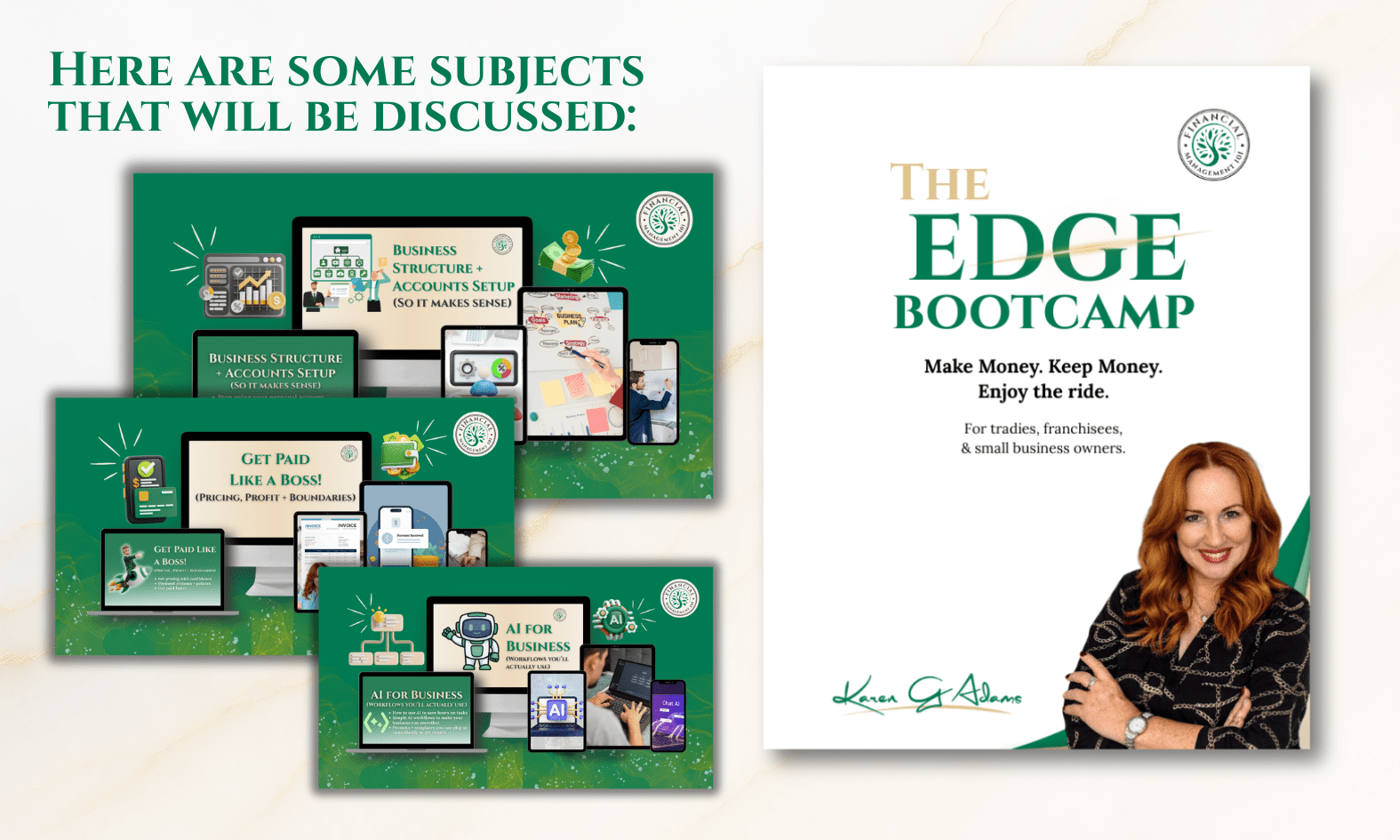
    And when that event includes practical training, multiple expert perspectives, tools and templates, live Q&A, action planning, networking, and a recording to rewatch and implement, the value extends well beyond the room.

    This is not about hype. It is about business owners finally getting access to the kind of guidance that helps them make money, keep money, and enjoy the ride.

    If you are ready to stop paying for confusion, stress, and avoidable mistakes, The Edge Bootcamp is an investment that can transform how you run your business.

    Not because it sells you a dream. Because it helps you build a stronger business reality.

    I look forward to seeing at The EDGE Bootcamp either in person or in the livestream.

    Click here and get your early bird ticket now before it runs out!
    Financial Wellbeing Program

    #HowToResetMyMoneyMindset #WhyDoIFeelOutOfControlWithMoney #HowToFeelInControlOfFinances #ResetMoneyMindset2025 #NewYearFinancialMindset #HowToStartFreshWithMoney  emergency fund australia, money management, family savings 
     

    Your Team Might Look Fine – But Financial Stress Could Be Costing More Than You Think

    Your Team Might Look Fine – But Financial Stress Could Be Costing More Than You Think

    “They seem fine.”

    It is one of the most common assumptions leaders make.
    And to be fair, it is an easy one to make.

    Most employees are not walking into work announcing that they are worried about bills, debt, interest rates, or the rising cost of everyday life.

    They keep going.
    They keep performing.
    They keep pushing through.

    But financial stress has a way of showing up quietly.

    It can look like a distraction.
    Low energy.
    Mood changes.
    Reduced confidence.
    Increased absenteeism.
    Burnout.
    Or eventually, a resignation that seems to come out of nowhere.

    The employee looked fine.
    But they were not fine.

    The silent pressure many employees are carrying

    The current financial climate is affecting people in deeply personal ways.
    Even capable, high-performing employees can be under enormous pressure.

    When money stress builds, people can feel:

    • mentally overloaded
    • emotionally flat
    • ashamed to ask for help
    • trapped in a cycle of stress and avoidance
    • worried about keeping up with household costs
    • fearful about debt, repayments, or unexpected expenses

    And because money is still a sensitive topic, many employees suffer in silence.

    That silence can be expensive.

    The current financial climate is affecting people in deeply personal ways.
Even capable, high-performing employees can be under enormous pressure.

    Why this is bigger than employee perks

    Free lunches, social events, and workplace rewards all have their place.
    But they do not solve financial anxiety.

    When someone is lying awake worrying about bills, a pizza party is not going to restore their peace of mind.

    This is why financial wellbeing deserves more attention inside workplaces.
    It addresses a real problem that affects people’s everyday lives and their capacity to function well at work.

    It is practical. It is human. And right now, it is incredibly relevant.

    What financial wellbeing support actually does

    A strong financial wellbeing approach helps employees move from stress and confusion to clarity and confidence.

    That might involve helping them:

    • understand where their money is going
    • create simple systems that reduce overwhelm
    • identify savings opportunities they have missed
    • tackle debt with a clearer plan
    • improve money habits and mindset
    • feel more hopeful and less stuck

    Notice that this is not about judgement. It is about support.

    Financial pressure can affect anyone. The goal is not to shame people for needing help. The goal is to give them tools that genuinely make life feel more manageable.

    What employers gain when they take this seriously

    When businesses support staff with financial wellbeing, the impact can ripple through the whole workplace.

    You may see:

    • better focus and engagement
    • increased productivity
    • lower staff turnover
    • stronger trust and loyalty
    • reduced burnout risk
    • a more supportive workplace culture

    People remember employers who support them through hard seasons.
    Not just with words, but with meaningful action.

    Reassurance is part of support

    Let’s pause here for something important.

    If you are an employee feeling the pressure right now, please hear this:

    You are not weak.
    You are not bad with money just because things feel hard.
    You are not the only one feeling stretched.

    This season may be challenging, but it does not define you.
    With the right support, practical tools, and small consistent changes, things can improve.

    And if you are an employer reading this, never underestimate how powerful it is to create a workplace where people feel safe to get support before they hit breaking point.

      Reassurance is part of support

      Support before crisis is the smarter move

      Too often, workplaces respond after the damage is done.
      After the burnout.
      After the resignation.
      After the drop in performance.
      After the personal crisis spills into professional life.

      But early support changes that.

      When businesses proactively offer financial wellbeing resources, they help staff build resilience before the pressure becomes overwhelming.
      That is better for the employee and better for the organisation.

      A more compassionate and practical workplace benefit

      There is a reason financial wellbeing is becoming such an important conversation.
      It sits at the intersection of performance, retention, mental wellbeing, and culture.

      It is not about fixing everything overnight.
      It is about giving people a starting point.
      A plan.
      A sense that they are not alone.
      A pathway back to confidence.

      And in uncertain times, that kind of support matters more than ever.

      My Financial Wellbeing Program helps workplaces support staff with practical money tools, confidence-building education, and real guidance that reduces stress and strengthens wellbeing.

      Because when your people feel better about money, they often feel better at work too.

      And that is good for everyone.

      Financial Wellbeing Program

      #HowToResetMyMoneyMindset #WhyDoIFeelOutOfControlWithMoney #HowToFeelInControlOfFinances #ResetMoneyMindset2025 #NewYearFinancialMindset #HowToStartFreshWithMoney  emergency fund australia, money management, family savings 

       

      The Foundations First: Why Small Business Owners Can’t Afford to Wing It Anymore

      The Foundations First: Why Small Business Owners Can’t Afford to Wing It Anymore

      If you’re a small business owner, tradie, franchisee, coach, or self-employed professional, chances are you didn’t start your business because you love spreadsheets, cashflow forecasts, or sorting out your accounts.

      You started because you’re good at what you do.

      You solve problems. You build things. You coach people. You create results. But somewhere along the way, many business owners find themselves working harder than ever and still feeling like they’re falling behind.

      Money comes in.
      Then it disappears.
      Tax time rolls around and suddenly it feels personal.
      You’re busy every day, yet you’re not fully sure whether your business is actually performing well.

      Sound familiar?

      Here’s the truth: being busy is not the same as being profitable.

      And in today’s business world, “winging it” is no longer a strategy.

      Why foundations matter more than ever

      Strong businesses are not built on hustle alone. They are built on foundations.

      That means knowing:

      • what money is coming in
      • what money is going out
      • what your pricing needs to be
      • whether your profit is real or just temporary relief
      • how much you can actually afford to pay yourself
      • what your numbers are telling you before problems get bigger

      Without those foundations, growth gets messy fast.

      More sales can actually create more pressure.
      More clients can create more chaos.
      More team members can expose weak systems.
      And more revenue can still leave you with less cash than expected.

      This is the trap so many business owners fall into. From the outside, things can look successful. Inside, it feels like stress, uncertainty, and constant financial firefighting.

      Strong businesses are not built on hustle alone. They are built on foundations.

      The Hidden Cost of Weak Foundations

      When your financial systems are weak, everything takes more energy.

      You make decisions based on gut feel instead of facts.
      You underprice because you’re scared of losing work.
      You mix personal and business spending and hope it all works out.
      You avoid looking at reports because they feel overwhelming.
      You stay in operator mode instead of stepping into your role as CEO.

      The result?
      You work harder, worry more, and enjoy your business less.

      And let’s be honest, that is not why you started.

      A business should support your life, not swallow it whole.

      What Solid Business Foundations Actually Look Like 

      Getting your foundations right does not mean making things more complicated.

      It means making things clearer.

      It looks like:

      • a simple cashflow structure you actually understand
      • separate systems for business and personal money
      • confidence around pricing, profit, wages, and expenses
      • a weekly and monthly rhythm for checking the right numbers
      • stronger boundaries around spending and decision-making
      • knowing where your money is leaking and how to plug it

      When these basics are in place, something powerful happens.

      You stop guessing.
      You start leading.
      You stop reacting.
      You start planning.
      You stop feeling behind.
      You start building momentum.

      You do not need more motivation. You need structure.

      Many business owners think they need to feel more disciplined, more focused, or more inspired.

      But often, that’s not the real issue.

      The issue is that the business has grown beyond the systems holding it up.

      You don’t need another pep talk.
      You need a better framework.

      You need simple tools that help you:

      • understand your cashflow
      • pay yourself consistently
      • price with confidence
      • stop tax shock before it happens
      • make decisions from a place of control

      That is where real confidence comes from.
      Not from hoping, but from knowing.

      You don’t need another pep talk.
You need a better framework.

      The Difference Between Surviving and Scaling

      If your foundations are shaky, growth can break you.

      That might sound dramatic, but it’s true.

      A bigger business with poor systems often creates:

      • higher stress
      • tighter cashflow
      • more team issues
      • greater tax pressure
      • slower decision-making
      • more burnout

      On the other hand, when your business foundations are strong, growth becomes more sustainable.
      You can see what is working.
      You can fix what is not.
      You can make better decisions faster.
      You can lead with more confidence and less panic.

      That is the difference between surviving the month and building a business that genuinely funds your life.

        A Quick Self-Check for Business Owners

        Ask yourself:

        • Do I know exactly where my money is going each month?
        • Am I paying myself properly and consistently?
        • Do I understand the difference between revenue and profit in my business?
        • Do I have simple systems for cashflow, tax, and expenses?
        • Do I look at my numbers regularly, or only when I’m forced to?
        • Am I leading my business like a CEO, or just trying to keep up?


        Discomfort is not failure. It is feedback.

        If those questions feel a little uncomfortable, that’s okay.
        That discomfort is not failure.
        It is feedback.

        And it might be the exact sign that now is the time to strengthen your foundations.

        Your next step

        If you’re done with money disappearing, messy systems, and feeling like you’re working too hard for too little clarity, this is exactly why I created The Edge Bootcamp.

        This is not fluff, theory, or feel-good motivation.
        It is practical training for tradies, franchisees, coaches, small business owners, and self-employed professionals who want to stop winging it and start running their business like a CEO.

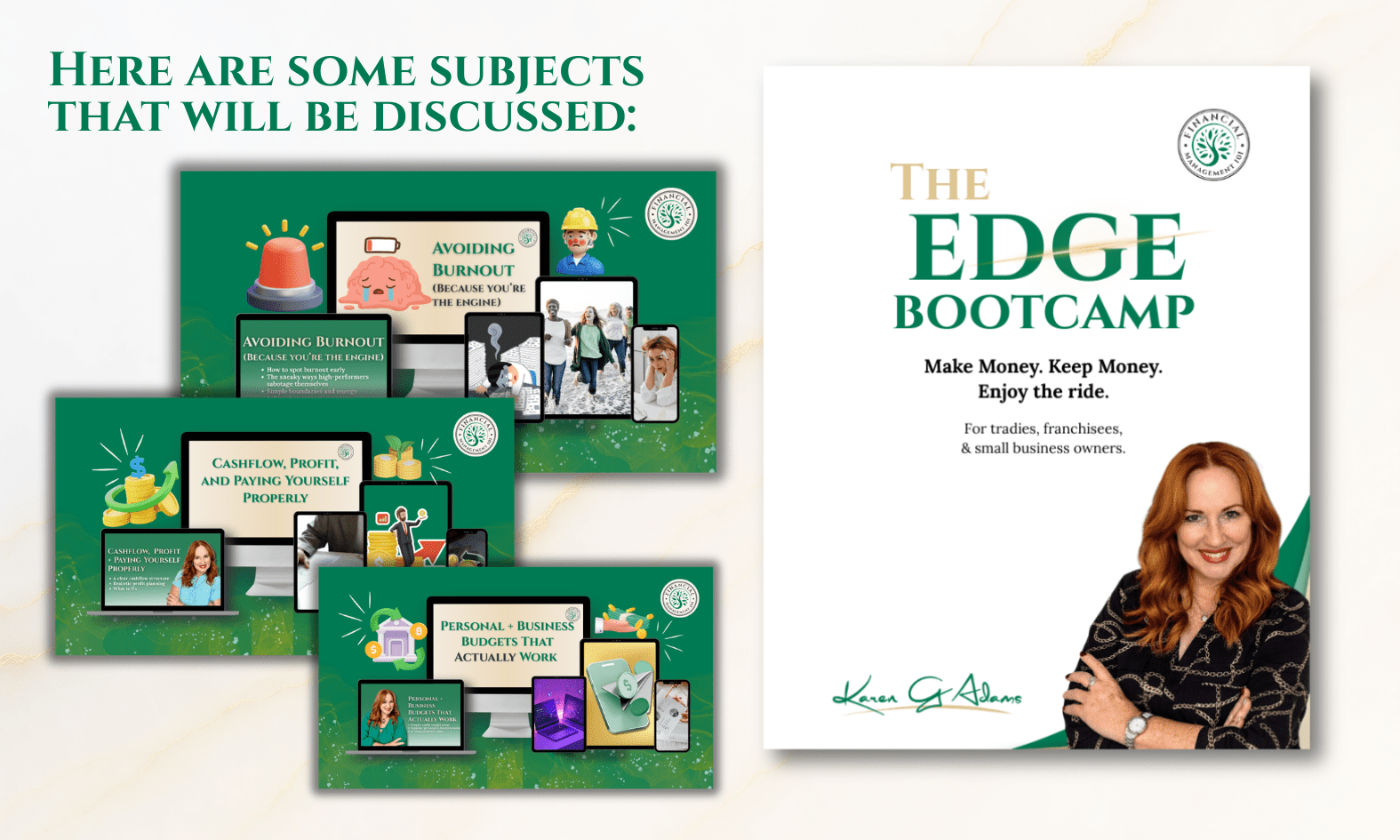
        Inside the Bootcamp, we cover the foundations that matter most – cashflow, profit, pricing, paying yourself properly, budgets that actually work, business setup, reading your numbers with confidence, and building stronger systems for sustainable growth.

        Join me at The Edge Bootcamp in May and build the financial and business foundations your growth actually needs.


        Because the goal is not to be busier.
        The goal is to be stronger, smarter, and more profitable.

        Note: This event provides education and general information, not personalised financial, accounting, legal, tax, investment, or health advice. Seek advice specific to your circumstances from qualified professionals.

        The Edge Bootcamp

        #HowToResetMyMoneyMindset #WhyDoIFeelOutOfControlWithMoney #HowToFeelInControlOfFinances #ResetMoneyMindset2025 #NewYearFinancialMindset #HowToStartFreshWithMoney  emergency fund australia, money management, family savings 

         

        Pay Yourself Like a Boss – The Owner Pay System That Builds Profit (Not Burnout)

        Pay Yourself Like a Boss – The Owner Pay System That Builds Profit (Not Burnout)

        If You’re Not Getting Paid Consistently… Your Business Is Giving You a Job (Not Freedom)

        Let’s talk about the thing almost every small business owner quietly tolerates for way too long:

        You run around all week making everyone else’s life easier…
        …then you look at your bank balance and think:

        “Cool. So when do I get paid?”

        If you’re a tradie, franchisee, coach, consultant, or self-employed professional, this can show up as:

        • you take random “owner draws” when there’s money (then nothing for weeks)
        • you avoid paying yourself because you’re “being responsible”
        • you feel guilty taking money out of the business
        • you tell yourself it’ll be better “next month”
        •  

        • you have revenue… but no reliable income


        And here’s the hard truth:
        If you can’t pay yourself consistently, the business isn’t stable yet.

        That doesn’t mean you’re failing.
        It means your business needs foundations.

        Because paying yourself isn’t a luxury. It’s a system.

        Why Owner Pay Is the Cornerstone of a Healthy Business

        Owner pay affects everything:

        • your stress levels
        • your relationships
        • your confidence
        • your decision-making
        • your ability to take time off
        •  

        • and your long-term wealth


        When you’re not paying yourself properly, you’re more likely to:

        • undercharge (because you’re desperate for cash)
        • say yes to the wrong work
        • delay tax payments
        • overwork (to make up for low profit)
        •  

        • resent the business you built


        Owner pay isn’t just a financial issue. It’s a sustainability issue.

        And it’s one of the biggest reasons business owners burn out – even when they’re doing “well” on the outside.

        Owner Pay Is the Cornerstone of a Healthy Business<br />

        The Two Biggest Mistakes That Keep Owners Underpaid

        Mistake #1: “I’ll Pay Myself What’s Left”

        This is the most common trap:
        Pay expenses first… and if anything is left, that’s owner pay.

        But if your costs aren’t tightly controlled and your pricing isn’t profit-based, there’s rarely much left.
        So owner pay becomes inconsistent, emotional, and reactive.

        Better approach: owner pay becomes part of the plan, built into your weekly rhythm.

        Mistake #2: Confusing Revenue with Profit

        Revenue is vanity. Profit is sanity.

        You can have a $25k month and still feel broke if:

        • your margin is thin
        • your overheads are high
        • tax isn’t set aside
        • you’re carrying too much unbillable time
        • your pricing doesn’t match reality

        Profit is what creates stable owner pay.
        Stable owner pay is what creates calm leadership.

        The “Pay Yourself Like a Boss” Framework (Simple + Realistic) 

        Here’s a practical approach that works across industries.

        Step 1: Decide what “consistent” looks like (start smaller than you want)

        Most owners try to jump straight to “I want $2,500/week.”

        Love that energy. But consistency beats big numbers that don’t stick.

        Start with a baseline that feels achievable and repeatable:

        • $600/week
        • $800/week
        • $1,000/week
        • Whatever makes sense based on current reality.

        Your first win is not “highest possible.” Your first win is reliable.

        Step 2: Pay yourself on a schedule (not on a feeling)

        Choose a pay day. Weekly is often simplest. Fortnightly can work too.

        The point is: You get paid like an employee of your business.
        Because you are.

        This alone changes your mindset from:
        “I take money when I can…”
        to:
        “My business is responsible for paying me.”

        Step 3: Create a money allocation structure

        This can be with separate accounts or “buckets” you allocate within one account (separate accounts usually create stronger boundaries).

        At minimum, you’re allocating income into:

        • Operating expenses (wages, tools, rent, subscriptions, fuel, etc.)
        • Tax/GST
        • Owner pay 
        • Buffer

        When owner pay is allocated intentionally, it stops competing with every expense in your business.

        Step 4: Use a weekly “money check-in” to stay in control

        A weekly check-in prevents that “oops we spent it” moment.

        Your weekly money check-in might include:

        • what came in this week
        • what bills are due soon 
        • what needs to be allocated to tax
        • confirm owner pay 
        • quick look at one key metric (margin, break-even, runway)

        This process doesn’t need to be long. It needs to be consistent.

        The Missing Link: You Can’t Pay Yourself Properly Without Pricing for Profit

        Let’s say your owner pay target is $1,200/week.

        If your pricing doesn’t include enough margin to fund that, you’ll keep “robbing Peter to pay Paul”:

        • borrowing from tax money
        • delaying supplier payments
        • stressing about the next invoice
        • doing more work to make up the shortfall

        If you want reliable pay, you need reliable profit.,

        You Can’t Pay Yourself Properly Without Pricing for Profit<br />

        Pricing problems often look like this:

        Tradies:

        • quotes don’t include enough for time + overheads + margin
        • variations aren’t priced clearly
        • you underestimate labour hours
        • you price to win jobs, not to make profit

        Franchisees:

        • margins are tight and you need tighter systems
        • wages creep and overheads creep
        • stock management impacts cash 
        • owner pay gets squeezed when costs rise


        Coaches/consultants:

        • pricing based on what feels “fair,” not what’s sustainable
        • not charging for delivery time (prep, comms, admin)
        • too much customised work for too little revenue
        • discounts and freebies that quietly eat margin

        Profit-focused pricing means you understand these 3 basics:

        1. Your direct costs (materials, labour, subcontractors, platform fees, etc.)
        2. Your overheads (insurance, fuel, rent, tools, admin, software, marketing)
        3. Your required margin (profit + owner pay + buffer + tax readiness)


          You don’t need to be perfect. But you do need to stop guessing.

          The 5 Numbers That Make Owner Pay and Pricing Easier (and Less Emotional)

          You don’t need “all the numbers.” You need these:

          1) Gross Margin

          What’s left after direct costs.
          If this is too low, you’re working for nothing.

          2) Net Profit

          What you keep after overheads.
          This is what funds growth, buffer, and wealth.

          3) Break-Even Point

          The minimum revenue you must earn to cover costs.
          This is your “must hit” number.

          4) Owner Pay Baseline

          The amount you pay yourself consistently.

          5) Cash Runway

          How long you can operate with current cash.

          When you track these, owner pay stops being a debate.
          It becomes a decision based on reality.

          “But I Feel Guilty Taking Money Out of the Business”

          Let me say this plainly:

          If your business can’t pay you, it’s not a business. It’s a hobby with invoices.

          Owner pay isn’t selfish. It’s responsible. Because when you’re financially stable:

          • you make better decisions
          • you lead better
          • you stop panicking 
          • you build a business that supports your life


          And yes, sometimes the answer is:
          “We need to tighten costs.”
          Sometimes the answer is:
          “We need to raise pricing.”
          Sometimes the answer is:
          “We need better systems so we’re not bleeding time and money.”

          But it starts with telling the truth:
          I deserve to get paid for running this thing called “MY BUSINESS”.

          A Quick “Pay Yourself Properly” Audit

          If you answered “yes” to two or more of these, your foundations need attention:

          • Do you take owner drawings randomly instead of consistently?
          • Do you avoid looking at your numbers because it feels overwhelming?
          • Do you feel nervous when a big bill is due (even in a busy month)?
          • Do you “borrow” from GST/tax set-aside to cover expenses?
          • Do you underquote or discount because you’re worried you won’t win the job?
          • Do you feel like you’re working harder than ever but not getting ahead?

          No judgement. This is common. But it is changeable.

          This Is Exactly Why I’m Running The Edge Bootcamp

          You’ll leave with:

          • a simple money system
          • clearer separation between business and personal finances
          • confidence understanding Xero and key reports
          • and a clear 90-day implementation plan so you know what to do first, next, and next

          Also – important for busy business owners:

          • All tickets include digital resources, templates, and 90-day action plan tools
          • And yes, recordings are provided after the event (for personal use)

          So you can attend live, learn the system, then rewatch sections while you implement.

          By the way – you don’t need Xero – you’ll get extra value if you use it, but the principles apply across tools (MYOB, QuickBooks, spreadsheets, or still figuring it out).

          The Bootcamp is:

          • In person at East Fremantle Yacht Club
          • or you can attend live online

          It’s designed for real-world business owners, practical, step-by-step, and judgement-free, even if you feel behind.

          Want to Pay Yourself Consistently and Increase Profit?

          If you’re ready to stop guessing and start paying yourself like a CEO (with pricing and profit to back it up), then The Edge Bootcamp is your next step.

          It’s built for small business owners, tradies, franchisees, coaches and self-employed professionals who want more profit, better systems, cleaner numbers, and less overwhelm.

          ✅ 2-day live bootcamp
          ✅ In person (East Fremantle Yacht Club) or live online
          ✅ Templates + digital resources + 90-day action plan tools included
          ✅ Recordings provided after the event

          Join The Edge Bootcamp and walk away with a simple money system + a clear plan to pay yourself properly, price for profit, and build a business that supports your life.

          Note: This event provides education and general information, not personalised financial, accounting, legal, tax, investment, or health advice. Seek advice specific to your circumstances from qualified professionals.

          Join The Membership at Financial Management 101

          #HowToResetMyMoneyMindset #WhyDoIFeelOutOfControlWithMoney #HowToFeelInControlOfFinances #ResetMoneyMindset2025 #NewYearFinancialMindset #HowToStartFreshWithMoney  emergency fund australia, money management, family savings 
           

          Budgeting Without the Boring: The Money Map Method That Actually Works

          Budgeting Without the Boring: The Money Map Method That Actually Works

          Let’s be honest for a second. The word “budget” has the same vibe as:

          • “We need to talk…”
          • “Your call is being transferred…”
          • “Please see the attached invoice…”

          It makes people tense. Defensive. Slightly sweaty. 😅

          And here’s the irony: most people don’t hate having a plan. They hate the way budgeting has been sold to them – like it’s punishment for daring to enjoy life.

          So today, I’m giving you a different approach.

          Not a strict budget.
          Not a spreadsheet that needs a PhD to operate.
          Not a system that makes you feel like you have to track every piece of gum you’ve ever purchased.

          This is Money Mapping – the method I use with clients who want to feel in control, not controlled.

          Because your money doesn’t need a prison.

          It needs a plan. A plan that fits your actual life. Not the version of you who meal preps on Sundays and never impulse buys at Kmart.

          (If that version of you exists, I’d like to meet her. She sounds organised and slightly intimidating.)

          Why Traditional Budgets Fail (and why it’s not your fault)

          Most budgets fail for three reasons:

          1) They’re too restrictive

          People try to cut everything at once: coffees, fun, birthdays, little treats, takeaway, holidays… and then wonder why they rebound like a rubber band.

          If a budget feels like suffering, you won’t stick to it.
          Your brain will treat it like a threat.
          And humans don’t do “threat” long-term.

          2) They’re too complicated

          Forty-seven categories. Daily tracking. Constant adjustments.
          You miss one thing and suddenly you feel like you’ve “failed.”

          A budget that requires constant maintenance becomes another job.
          And nobody needs a second job that doesn’t pay.

          3) They’re built on guilt, not goals

          Many budgets are basically: “Stop spending money on things that make you happy.”

          No thanks.

          Money mapping works because it’s:

          • simple
          • flexible
          • based on priorities
          • designed for consistency, not perfection

          What is a Money Map?

          A Money Map is a simple plan that tells your money where to go before life grabs it.

          It answers these questions:

          1. What must be paid? (essentials + bills)
          2. What matters to you? (your priorities)
          3. What are we building? (savings, emergency fund, investing, debt reduction)
          4. How do we keep your life enjoyable while still making progress? (yes, fun stays)

          A money map is not about tracking every dollar.
          It’s about creating a flow.

          And when your money flows with intention, financial stress drops fast

          A Money Map is a simple plan that tells your money where to go before life grabs it.

          The Big Mindset Shift: A Budget Isn’t Restriction – It’s Permission

          I want you to reframe this:

          A budget isn’t a list of things you can’t do.
          It’s a permission slip that says:

          ✅ “Yes, you can spend money on what you love.”
          ✅ “Yes, you can have fun.”
          ✅ “Yes, you can enjoy your life.”
          and also
          ✅ “Yes, you can build wealth and feel safe.”

          That’s the goal: enjoying today while protecting tomorrow.

          The Money Map Framework (Simple, Powerful, Real-Life Friendly)

          Here’s the structure I recommend. It’s clean and easy:

          Category 1: Essentials (Must Pays)

          These are the costs of keeping your life running:

          • mortgage/rent
          • utilities
          • groceries
          • fuel/transport
          • insurance
          • minimum debt repayments
          • childcare/school essentials
          • basic medical

          These are your “keep the lights on” expenses.

          Category 2: Future You (Your Financial Muscle)

          This is where you build safety and wealth:

          • emergency fund
          • sinking funds (car rego, Christmas, school costs, rates, holidays)
          • extra debt repayments
          • investing/super top-ups (where appropriate)

          Future You deserves funding. Not “whatever’s left.”

          Rainy Day Fund or Emergency Fund

          Category 3: Fun & Freedom (Guilt-Free Spending)

          This is the category that keeps you sane:

          • coffees
          • dinners out
          • entertainment
          • hobbies
          • shopping (within reason, Karen… within reason 😄)
          • little treats

          The reason most budgets fail is because this category is either missing or unrealistically small.

          We’re not doing that here.

          Step-by-Step: How to Build Your Money Map in Under an Hour

          Grab a pen, notes app, or whatever you use when you’re feeling productive for five minutes.

          Step 1: Find your baseline numbers

          Look at the last 4–8 weeks of spending (not because we love pain, but because data helps).

          Write down:

          • total income (after tax)
          • total essentials
          • average weekly spending (groceries, fuel, eating out, shopping)
          • debt minimums
          • any annual bills that sneak up (rego, insurance, school, rates)

          You’re not judging. You’re observing.

          Step 2: Choose your “Money Map style”

          There are two main styles:

          1. A) Weekly Flow Map (best for people paid weekly/fortnightly)
          • Allocate money each pay into Essentials / Future You / Fun
          1. B) Monthly Map (best for salaried monthly pay)
          • Set amounts for each category and automate them

          If you’ve tried budgeting before and it didn’t stick, weekly is usually easier because it gives faster feedback.

          Step 3: Set up separate accounts (this is where the magic happens)

          I’m going to say this lovingly:

          If all your money sits in one account, your brain will treat it like it’s all available.
          That’s not a discipline problem. That’s a human brain problem.

          A simple setup is:

          1. Bills account (Essentials)
          2. Spending account (groceries/fuel/fun)
          3. Future You account (emergency + sinking funds)

          Automation is your best friend. Because you’re busy.
          And your money system should run even when you’re tired.

          Step 4: Decide your “non-negotiables”

          These are your priorities — the things you want your money to reflect.

          Examples:

          • “I want to stop feeling anxious about bills.”
          • “I want an emergency fund.”
          • “I want to pay off this debt.”
          • “I want to travel without putting it on a credit card.”
          • “I want to stop fighting with my partner about money.”

          Your money map should support your real goals — not someone else’s idea of financial success.

          Step 5: Allocate your numbers (start simple)

          Here’s a starting point many people can relate to:

          • Essentials: 60–75%
          • Future You: 10–20% (even 5% is a start if money is tight)
          • Fun & Freedom: 10–20%

          If your essentials are currently higher than 75% — you’re not alone. Cost of living has been doing the most.

          This is where strategy matters: we might need to reduce leaks, renegotiate bills, or adjust the debt plan to create breathing room.

          Step 6: Create one weekly “Money Date” (10 minutes)

          Once a week:

          • check what’s coming out
          • check what’s coming in
          • make sure bills are covered
          • adjust your spending category if needed

          No drama. No self-lectures. Just a quick check-in.

          Think of it like brushing your teeth. You don’t do it once and call it done forever.

          The “I Hate Tracking” Version: The 3-Number Method

          If you’re someone who rebels against tracking (I see you), do this instead:

          Pick three numbers each week:

          1. Your weekly spending limit (food + fuel + fun)
          2. Your weekly Future You transfer
          3. Your “buffer amount” you want to keep in your spending account

          Then the rule is simple:
          When spending hits the limit… you stop spending until next week.
          No guilt. Just boundaries.

          This is the system many of my clients love because it’s:

          • quick
          • clear
          • low-maintenance
          • effective

          Money Map in Real Life: What This Looks Like (Example)

          Let’s say your household brings in $2,500 a week after tax.

          You might map it like this:

          • $1,700 Essentials (bills, groceries, fuel, minimum debt)
          • $400 Future You (emergency fund + sinking funds + extra debt)
          • $400 Fun & Freedom (eating out, treats, spending money)

          Then you automate:

          • $1,700 goes straight into Bills account
          • $400 into Future You account
          • $400 stays in Spending account

          Now you’re not trying to “budget” daily.
          You’re simply spending from the right place.

          And when your Spending account runs low, it gives you a clear signal:
          “That’s it for this week.”

          No spreadsheet required.

          What If There’s Not Enough Money to Map?

          This is the part where I get very real with you:

          If you feel like there’s never enough, it doesn’t mean you’re failing.
          It means your map needs to include leak-plugging and breathing space first.

          Here’s what I do with clients when money is tight:

          1. tighten obvious leaks (subscriptions, lazy renewals, bank fees)
          2. build a tiny emergency buffer (even $500 can change your stress levels)
          3. stabilise bills and reduce panic spending
          4. create sinking funds for predictable expenses
          5. then build momentum

          You don’t jump from stressed to thriving in one week.
          But you can absolutely move from chaos to calm with the right steps.

          The Most Important Part: Your Money Map Must Match Your Personality

          Some people need structure.
          Some need flexibility.
          Some need boundaries.
          Some need permission.

          So here are a few personality-based tweaks:

          If you’re an overspender:

          • reduce “available money” in your spending account
          • use separate “fun” cash or a dedicated card
          • increase automation

          If you’re an underspender/anxious saver:

          • allocate guilt-free fun money and actually spend it
          • focus on safety targets (emergency fund)
          • build confidence with small consistent steps

          If you’re a “set and forget” person:

          • automate everything
          • schedule the weekly money check-in
          • keep categories very simple

          If you’re a couple/family:

          • do a shared Money Map + personal spending allowances
          • agree on the weekly “household number”
          • remove judgement from the conversation

          Money mapping isn’t one-size-fits-all.
          It’s “your life, your values, your plan.”

          If You Want This to Stick, Join the Membership

          Now, if you’re reading this thinking:

          “Okay… this makes sense. But I need help setting it up properly.” or “I’ve tried before and I fall off the wagon.” or “I want a system that actually fits my life.”

          That’s exactly what my Membership is for.

          Because here’s the truth:

          Most people don’t need more information. They need support, structure, and someone to keep them consistent.

          Inside the Membership, we don’t just talk about budgeting. We:
          ✅ build your personal Money Map (based on your real numbers)
          ✅ set up accounts and automation so it runs without willpower
          ✅ create sinking funds so life stops surprising you
          ✅ learn how to manage spending without guilt
          ✅ build financial muscle with ongoing guidance and community

          You’re not meant to do this alone.

          If you’re ready to stop winging it and start feeling calm and in control, join the Membership.
          Let’s build your Money Map together — and get your financial house in order the smart way.

          budgeting without spreadsheets, simple budget method, cash flow planning, how to budget in Australia, reduce financial stress, personal finance tips, money management system, budgeting for beginners, weekly money check-in, sinking funds, financial management 101, Karen G Adams, financial coaching