Why Small Business Owners Are Working Harder Than Ever — But Making Less Profit

Why Small Business Owners Are Working Harder Than Ever — But Making Less Profit

The Shift Every Business Owner Must Understand to Survive and Thrive in Today’s Economy

There was a time when hard work almost guaranteed success in business.

If you stayed committed, put in the hours, sacrificed weekends, pushed through exhaustion, and gave your business everything you had, eventually the rewards would come.

At least that’s what many small business owners were taught to believe.

But today?

Things feel very different.

Across Australia, many small business owners are working harder than ever before, yet they’re feeling more stressed, overwhelmed, and financially stretched than they did years ago.

They’re putting in longer hours.

Taking fewer breaks.

Carrying more responsibility.

Worrying more about cashflow.

And despite all the effort… many still feel like they’re not truly getting ahead.

If that sounds familiar, you’re not alone.

Right now, thousands of business owners are quietly asking themselves the same question:

“Why does it feel like I’m working harder than ever… but making less profit?”

The answer is confronting but important.

The old way of doing business no longer works in today’s economy.

And the businesses that will thrive over the next decade will not necessarily be the businesses working the hardest.

They’ll be the businesses operating the smartest.

That’s a massive shift.

Because many business owners were conditioned to believe that success comes purely from hustle.

Work harder.
Push harder.
Do more.
Sacrifice more.

But in today’s world, hard work without systems, visibility, strategy, and leadership often leads straight to burnout.

And burnout is becoming one of the biggest silent killers of small business success.

The Hidden Trap Many Business Owners Fall Into

One of the biggest issues I see with small business owners is that they unknowingly create businesses that rely entirely on them to survive.

They become:

  • the salesperson
  • the marketer
  • the customer service team
  • the accounts department
  • the operations manager
  • the problem solver
  • the social media manager
  • the decision maker

Every problem flows through them.

Every question lands on their desk.

Every fire becomes theirs to put out.

At first, this level of involvement feels normal.

In the early stages of business, most owners wear multiple hats because they have to.

But the problem is many businesses never evolve beyond this stage.

Instead of building scalable businesses, owners end up creating stressful jobs for themselves.

And over time, the pressure becomes exhausting.

The scary part?

Many business owners start believing this level of stress is simply “part of business.”

But it shouldn’t be.

Because while hustle may build a business initially, hustle alone rarely sustains long-term success.

Across Australia, many small business owners are working harder than ever before, yet they’re feeling more stressed, overwhelmed, and financially stretched than they did years ago.

Exhaustion Is Not a Business Strategy

Somewhere along the way, burnout became glorified in business culture.

Working 12-hour days became something to brag about.

Skipping holidays became normal.

Being “busy” became a badge of honour.

But exhausted people do not make powerful business decisions.

When business owners are constantly stressed and overwhelmed, they often begin operating emotionally instead of strategically.

They react instead of lead.

They focus on urgent problems instead of important ones.

They become trapped inside the daily chaos of the business instead of building a business designed for growth.

And eventually, the cracks begin to show.

Relationships suffer.
Health suffers.
Energy drops.
Decision-making weakens.
Creativity disappears.
And often… profitability suffers too.

Because here’s the truth many people don’t want to admit:

You cannot scale chaos.

Revenue Does Not Equal Profit

One of the biggest misconceptions in business is believing that high turnover automatically means success.

It doesn’t.

There are businesses turning over hundreds of thousands, even millions, of dollars that are still struggling financially behind the scenes.

Why?

Because revenue and profit are two very different things.

Turnover is not profit.

Profit is not cashflow.

And cashflow is not personal wealth.

This is where many business owners get caught.

From the outside, the business may appear successful.

The branding looks great.
Customers are coming through the door.
Sales are happening.

But internally, the owner is stressed, overwhelmed, and wondering where all the money keeps disappearing to.

And honestly?

This creates enormous emotional pressure for business owners.

Because when the numbers don’t make sense, uncertainty grows.

And uncertainty creates stress.

Why Financial Visibility Changes Everything

One of the most powerful things a business owner can have is visibility.

Not complicated spreadsheets.

Not confusing accounting jargon.

Real visibility.

Understanding:

  • where your money is going
  • what’s actually profitable
  • what products or services are underperforming
  • where cashflow leaks are happening
  • what your numbers are really telling you

Because numbers tell stories.

They reveal habits.
Patterns.
Blind spots.
Strengths.
Weaknesses.
Opportunities.

And when business owners truly understand their numbers, something powerful happens.

Confidence returns.

Decision-making improves.

Stress reduces.

Growth becomes more strategic instead of reactive.

But many owners avoid looking deeply at their numbers because they feel confronting.

So instead, they rely on gut instinct.

They check the bank account balance instead of understanding the bigger financial picture.

And while instinct matters in business, instinct without data can become dangerous.

The businesses thriving right now are the ones combining intuition with visibility.

Because when you can clearly see what’s happening in your business, you stop operating from fear.

You start operating from clarity.

The Business World Has Changed

Another reason hard work alone is no longer enough is because business itself has changed dramatically.

Consumers have changed.

Technology has changed.

Marketing has changed.

Attention spans have changed.

And artificial intelligence is now reshaping industries faster than many business owners realise.

Yet many businesses are still operating using outdated systems and outdated models.

This creates a dangerous gap between effort and results.

Some owners are working incredibly hard… but inefficiently.

They’re manually doing tasks technology could streamline.

They’re overwhelmed by admin.

They’re spending hours creating content.

They’re reacting to problems all day instead of building systems that reduce problems.

And as a result, they stay trapped in operational overwhelm.

The future belongs to business owners who learn how to combine human leadership with smart systems and modern technology.

This doesn’t mean removing the personal side of business.

In fact, human connection matters more than ever.

But it does mean removing unnecessary friction.

It means creating efficiency.

It means building businesses that don’t completely rely on the owner being “on” 24/7.

The Shift From Operator to CEO

This is one of the most important transformations a business owner can make.

The shift from operator to CEO.

Operators stay trapped in the daily chaos.

CEOs create systems.

Operators react emotionally.

CEOs make strategic decisions.

Operators focus purely on revenue.

CEOs focus on profitability and sustainability.

Operators stay busy.

CEOs stay intentional.

This shift changes everything.

Because the goal of business ownership should not be constant exhaustion.

The goal should be building a business that creates freedom, opportunity, and long-term sustainability.

But that requires leadership.

It requires visibility.

And it requires the willingness to evolve.

The Businesses That Will Thrive in the Future

The businesses that will thrive over the next decade are not necessarily the biggest businesses.

They are the businesses willing to adapt.

The businesses are willing to modernise.

The businesses willing to embrace:

  • financial clarity
  • leadership
  • systems
  • automation
  • smarter decision-making
  • visibility
  • sustainable growth

The future small business owner needs more than technical skills.

They need:

  • emotional resilience
  • financial intelligence
  • strategic thinking
  • leadership capability
  • adaptability
  • communication skills
  • modern business systems

Because business growth is no longer just about effort.

It’s about alignment.

Alignment between:

  • strategy
  • systems
  • leadership
  • financial visibility
  • personal wellbeing
  • and sustainable growth

Success is building a business that supports your life.

Your Business Should Support Your Life – Not Consume It

This is the conversation more business owners need to start having.

Because too many owners are trapped inside businesses that are draining them emotionally, mentally, physically, and financially.

And that’s not success.

Success is building a business that supports your life.

A business that creates opportunity.

A business that allows you to grow financially without destroying your health or relationships in the process.

A business that gives you freedom instead of constant anxiety.

And perhaps the biggest shift of all is this:

The goal was never just to work harder.

The goal was always to build better.

To build smarter.

To build more intentionally.

To create stronger systems.

To understand your numbers properly.

To lead with clarity instead of chaos.

And to create a business that actually works for you – instead of one that constantly burns you out.

Because the businesses that thrive in this new era will not be the businesses grinding themselves into the ground.

They’ll be the businesses willing to evolve.

The businesses willing to simplify.

The businesses willing to lead differently.

And the business owners who understand that shift will create something far more powerful than just revenue.

They’ll create sustainability.

Freedom.

Profitability.

And a business and life – they genuinely enjoy.

Ready to Stop Surviving and Start Leading?

If you’re tired of feeling overwhelmed, financially stretched, or stuck working harder without seeing the results you deserve, maybe it’s time to stop asking:

“How can I work harder?”

And start asking:

“How can I build smarter?”

Because sometimes the biggest breakthrough in business doesn’t come from doing more.

It comes from finally doing things differently.

Take the FREE Business Performance Audit™ and uncover what’s really slowing your business down.

Membership - FM101

#HowToResetMyMoneyMindset #NewYearFinancialMindset #HowToStartFreshWithMoney  emergency fund australia, money management, family savings #SmallBusinessOwner #BusinessGrowth #CashflowManagement #BusinessSuccess
#EntrepreneurMindset


 

How to Price Your Products or Services Properly (Without Undervaluing Yourself)

How to Price Your Products or Services Properly (Without Undervaluing Yourself)

Pricing your products or services can feel like one of the most uncomfortable parts of running a business.

You sit there staring at a number, wondering:

Is this too high?
Is this too low?
Will people actually pay this?
What if I lose customers?

So instead of making a clear, strategic decision, you do what most small business owners do…

You guess.

Maybe you look at what competitors are charging and land somewhere in the middle. Maybe you choose a number that “feels reasonable”. Or maybe you go lower than you’d like, just to be safe.

And while that might feel like the least risky option, it’s actually one of the biggest reasons businesses struggle to grow.

Because pricing isn’t just about making a sale, it’s about building a business that actually works.

If your pricing is off, everything feels harder. You work more, earn less, and constantly feel like you’re chasing your tail. But when your pricing is right, things start to click. You attract better clients, your workload becomes more manageable, and your business becomes far more sustainable.

So let’s break this down properly and give you a clear, practical approach to pricing your products or services, without the guesswork.

The first thing to understand is that pricing is not just a financial decision. It’s also a positioning decision.

The price you set tells your customers something about your business before you even speak to them.

A lower price often signals affordability and accessibility, but it can also suggest lower value. A higher price can position you as premium, but only if the experience and results match.

Neither approach is right or wrong, but it has to be intentional.

The problem is that many business owners don’t choose a position. They end up somewhere in the middle, without a clear strategy, trying to appeal to everyone, and ultimately attracting the wrong customers.

And this is where pricing starts to create stress.

Because when your pricing doesn’t align with your costs, your value, and your positioning, you feel it every single day in your business.

Because when your pricing doesn’t align with your costs, your value, and your positioning, you feel it every single day in your business.<br />

One of the most common mistakes is relying too heavily on competitor pricing.

It seems like the logical place to start. After all, if everyone else is charging a certain amount, it must be the “right” price… right?

Not necessarily.

You don’t know their financial situation. You don’t know their cost structure. You don’t know their profit margins. And you definitely don’t know whether they’re actually making money.

There are plenty of businesses out there that look successful on the surface but are barely breaking even behind the scenes.

So when you base your pricing on competitors, you’re not creating a strategy – you’re copying someone else’s guess.

And that’s a risky way to run a business.

Instead, your pricing needs to start with your numbers.

At its simplest level, pricing comes down to one core idea: Your price must cover your costs and generate a profit.

Sounds straightforward, but this is where most business owners get it wrong. Because they don’t fully understand their costs.

When people think about costs, they often focus on the obvious ones; materials, stock, or direct expenses tied to delivering a product or service.

But there are so many hidden costs that get overlooked.

Your time is a cost. Admin work is a cost. Emails, phone calls, quoting, planning, travel—it all adds up. Even things like software subscriptions, marketing tools, insurance, and professional services need to be factored in.

If you’re not accounting for all of these, you’re underpricing – whether you realise it or not. And that’s where the frustration begins. You’re busy. You’re making sales. But at the end of the month, there’s not much left over.

Not because your business isn’t working, but because your pricing isn’t supporting it.

Then there’s the topic of profit.

This is where things get a little uncomfortable for many business owners. Because profit can feel… optional. Something extra. Something you’ll get to “eventually”.

But here’s the reality: Profit is not a bonus. It’s a requirement. Profit is what allows you to:

  • Pay yourself properly
  • Reinvest in your business
  • Handle unexpected expenses
  • Grow sustainably

Without profit, your business becomes a job and often not a very well-paid one. So instead of hoping there’s money left at the end, you need to build profit into your pricing from the start.

Even if it’s small to begin with, it needs to be intentional.

Now, once you understand your costs and include a profit margin, the next step is thinking about value. Because pricing isn’t just about covering costs – it’s also about what your customer is receiving.

This is where value-based pricing comes into play

Let’s say you’re offering a service that helps a client increase their revenue, save time, or reduce stress. The value of that outcome is often far greater than the time it takes you to deliver it.

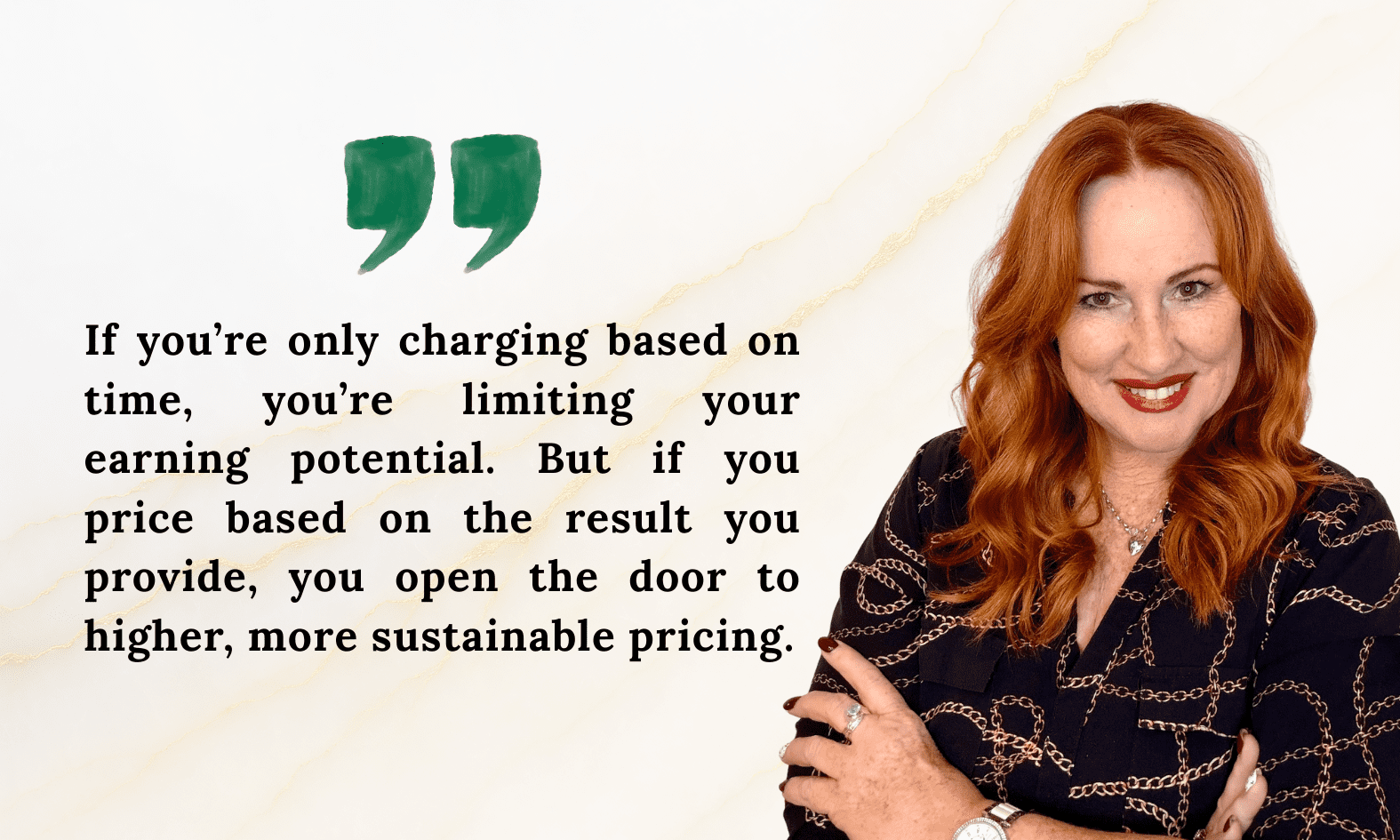
If you’re only charging based on time, you’re limiting your earning potential. But if you price based on the result you provide, you open the door to higher, more sustainable pricing.

This doesn’t mean ignoring your costs; it means combining both approaches.

Know your baseline (your costs and required profit), then position your pricing based on the value you deliver.

Of course, even when you understand all of this, there are still a few traps that can quietly pull your pricing down.

One of the biggest is underpricing to win customers

It feels like a smart move to make your offer more attractive, get more sales, and build momentum.

But what often happens is that you attract price-sensitive customers who are always looking for the cheapest option. They’re harder to please, quicker to leave, and less loyal overall. And because your margins are lower, you need more of them just to stay afloat.

That’s not a recipe for a healthy business.

Another common trap is discounting too quickly. A customer hesitates, and before they even ask, you offer a lower price. It might help close the sale in the moment, but it also reduces your perceived value and sets a precedent.

Over time, it trains customers to expect discounts and makes it harder to charge your full price.

Then there’s the habit of avoiding price increases altogether.

Costs go up. Expenses rise. But your prices stay the same.

This slowly erodes your profitability, often without you noticing until things feel tight.

Raising your prices doesn’t have to be dramatic. Even small, regular adjustments can make a big difference over time.

And in most cases, customers expect it, especially if you’re continuing to deliver value.

If the idea of increasing your prices feels uncomfortable, you’re not alone.

But here’s a helpful way to think about it.

When you raise your prices, you’re not just charging more – you’re creating space.

Space to:

  • Deliver a better experience
  • Reduce stress and burnout
  • Focus on quality over quantity
  • Build a more sustainable business

And while you might lose a small number of customers, you often gain better ones.

Clients who value what you do, respect your time, and are willing to pay for quality.

Confidence in pricing doesn’t come from mindset alone – it comes from clarity.

When you understand your numbers, your costs, and your value, pricing becomes less emotional and more strategic.

You stop second-guessing yourself. You stop apologising for your prices. And you start making decisions that support the business you actually want to build.

So where should you start?

Keep it simple. Choose one product or service and break it down properly.

Work out what it truly costs you to deliver. Include your time. Add a profit margin. Then compare that to what you’re currently charging.

If there’s a gap, adjust. Not perfectly. Not all at once. Just intentionally. Because small improvements in pricing can have a huge impact over time.

At the end of the day, pricing properly isn’t about being the most expensive or the cheapest.

It’s about building a business that works for you.

A business that pays you properly.
A business that supports your lifestyle.
A business that gives you room to grow.

And that starts with one decision, stopping the guesswork and taking control of your pricing.

Ready to Get Started?

If you’re serious about changing your money…

Not just thinking about it…

Join the membership and let’s build this together!

Membership - FM101

#HowToResetMyMoneyMindset #WhyDoIFeelOutOfControlWithMoney #HowToFeelInControlOfFinances #ResetMoneyMindset2025 #NewYearFinancialMindset #HowToStartFreshWithMoney  emergency fund australia, money management, family savings 


The Emergency Fund Isn’t Optional – How to Build One Without Feeling Broke (and why it changes everything)

The Emergency Fund Isn’t Optional – How to Build One Without Feeling Broke (and why it changes everything)

Let’s talk about the one money habit that turns chaos into calm faster than almost anything else:

An emergency fund.

Now before you roll your eyes and think, “Karen, I knowww… but I can barely afford groceries,” stay with me.

Because I’m not about to tell you to magically save three months of expenses overnight, live on rice and sadness, and stop enjoying life.

That’s not financial education – that’s financial punishment. 😅

What I am going to do is show you how to build an emergency fund in a way that feels doable, realistic, and actually sticks… even if money is tight.

And here’s why this matters:

An emergency fund isn’t just “money in an account.”
It’s peace, options, and less stress when life does what life does best… surprise you at the worst possible time.

So let’s get your financial house in order by building the foundation that stops everything from wobbling.

Why the Emergency Fund Is Non-Negotiable (Even If You Have Debt)

I want you to imagine your finances like a house.

If your foundation is cracked, everything else feels unstable:

  • you can’t plan properly
  • you can’t relax
  • you’re constantly bracing for impact
  • and one unexpected bill can knock you sideways

An emergency fund is the foundation.

It stops you from:

  • using credit cards “just this once”
  • grabbing BNPL for essentials
  • borrowing from family
  • draining your savings every time something happens
  • feeling like you’re always behind

Even if you’re paying down debt, you still need a buffer.
Because without one, every emergency becomes more debt… and that cycle is exhausting.

An Emergency Fund Is Non-Negotiable Even If You Have Debt

The Biggest Myth: “I’ll Start When I Have More Money”

This is the #1 reason people delay emergency savings.

They think:

  • “I’ll start when I get a pay rise.”

  • “I’ll start when the kids are older.”

  • “I’ll start when the cost of living calms down.” (lol… remember calm?)

  • “I’ll start when things settle.”

But here’s the truth:

Things don’t settle.
You just get stronger and more organised.

And you don’t get stronger by waiting.
You get stronger by starting small and building consistency.

You don’t need a massive emergency fund to change your life.
You need the habit of saving, the system that supports it, and the confidence that you can handle surprises.

What Counts as an “Emergency”? (Let’s Be Clear)

If we don’t define “emergency,” your emergency fund gets eaten by:

  • sales

  • convenience spending

  • spontaneous “self-care” shopping

  • and that “it’s been a week” moment at Target 😄

An emergency is:
✅ urgent
✅ necessary
✅ unexpected
✅ not in the budget

Examples:

  • car repairs

  • urgent medical/dental

  • last-minute travel for family reasons

  • job loss or reduced income

  • essential home repairs

  • unexpected vet bills (pets are adorable little financial liabilities)

Not emergencies:
❌ a holiday
❌ Christmas (it’s predictable, we plan for it)
❌ a new phone because your current one is “annoying”
❌ a birthday gift (also predictable)
❌ a sale (I don’t care how good the sale is)

For those predictable costs, we use sinking funds (we’ll talk about that shortly).

Emergency Fund vs Sinking Funds (The Difference That Changes Everything)

This is a game-changer for getting your financial house in order.

Emergency fund:

For true, unexpected emergencies.

Sinking funds:

For expected expenses that don’t happen weekly or monthly but absolutely happen:

  • car rego and insurance
  • school expenses
  • rates
  • Christmas
  • birthdays
  • holidays
  • annual subscriptions
  • car servicing

When people don’t have sinking funds, they call predictable bills an “emergency”… and then their emergency fund never grows.

So yes, we want both. But we start with a buffer first.

Step One: Build a “Stress Buffer” (The First Goal)

Forget “3 months of expenses” for a second.

Your first goal is what I call a Stress Buffer:

  • $500 if you’re starting from scratch
  • $1,000 if you have a bit more breathing room

This amount won’t solve everything, but it will stop the small stuff from turning into drama.

And you know what? When you see that balance grow, something shifts.

You start trusting yourself. You feel less panicked. You stop living on the edge of your bank balance.

That’s financial muscle building in real time.

“But I Can’t Save” – Yes You Can (Here’s How)

I’m going to say this kindly:

Most people can save something.
They just haven’t had a system that makes it automatic and non-negotiable.

Here are practical ways to start, even if you’re on a tight budget.

1) The Micro-Save Method

Start with:

  • $10 a week

  • or $25 a fortnight

  • or $2 a day

Yes, it feels small. But small done consistently becomes powerful.

The goal is not the amount at the start.
The goal is building the identity of: “I’m someone who saves.”

2) The “Pay Yourself First” Transfer

This is the most important strategy of all:

Set up an automatic transfer on payday into a separate account called:

  • “Emergency Fund”

  • “Stress Buffer”

  • “Do Not Touch” 😄

  • “Future Me’s Peace”

When it’s automatic, you don’t have to think about it.

And thinking less about money is the dream, isn’t it?

3) The Round-Up Hack

Many banks let you round up purchases and move the difference into savings.

It’s not life-changing on its own, but combined with automation?
It’s a lovely little boost.

4) The “Found Money” Rule

Any unexpected money goes to the emergency fund until you hit your first goal:

  • tax returns

  • bonuses

  • cashback

  • refunds

  • gifts

  • overtime

You can still enjoy some of it – I’m not a monster – but Future You gets first dibs until your foundation is built.

Where to Put Your Emergency Fund (So You Don’t Accidentally Spend It)

This part matters because if your emergency fund is sitting next to your spending money… it will be treated like spending money.

Human brains do not like temptation.

Here’s the rule:
✅ separate account
✅ not linked to your everyday card
✅ easy enough to access in an emergency, but not instant-grab easy

A high-interest savings account is often a good option for many people, but the key isn’t the interest rate – it’s the separation.

If you have to take one extra step to access it, you’ll be less likely to raid it for non-emergencies.

How Much Should Your Emergency Fund Be?

Once you’ve built the Stress Buffer, you can level up.

Here are the common tiers:

Tier 1: $500–$1,000 Stress Buffer

Stops small emergencies becoming debt.

Tier 2: 1 month of essential expenses

Covers short-term hiccups.

Tier 3: 3 months of essential expenses

A solid safety net for most households.

Tier 4: 6 months of essential expenses

Great if you’re self-employed, commission-based, or in an industry with variable work.

Important: You don’t have to build this in a week. You build it steadily and that’s what makes it sustainable.

The “Life Is Lifey” List: Why Emergencies Keep Happening

Here are just a few things I see all the time:

  • the car decides it’s done with life
  • unexpected house repair
  • the hot water system taps out
  • the dog eats something it shouldn’t (again)
  • a dentist visit becomes a “how is this $800?” moment
  • your kid needs something for school tomorrow
  • your income changes unexpectedly


These aren’t rare events. They’re predictable unpredictables.

And when you have an emergency fund, you stop being shocked and start being prepared. That is the point.

Life Emergencies Keep Happening

What If You’re Paying Off Debt?

Here’s my professional but real-life approach: If you have debt, you still build a Stress Buffer first.

Why? Because without it, you’ll keep going back into debt every time something happens.

A simple strategy is:

  1. Build $500 – $1,000 buffer
  2. Focus on debt payoff
  3. Build 1 month expenses
  4. Continue debt payoff + build sinking funds
  5. Build to 3 months expenses

This is balanced. Realistic. And it reduces stress.

How to Make Saving Feel Less Painful (Because Yes, It Can)

Saving can feel like deprivation when your brain believes money is scarce.

So we make it feel lighter by doing two things:

1) Make it automatic

If you’re relying on motivation, you’ll save only when you feel inspired.

And motivation is… inconsistent. Automation builds wealth quietly.

2) Give your savings a purpose

Calling it “Savings” is boring. Calling it “Freedom Fund” or “Peace Buffer” hits differently.

Name it like it matters, because it does.

The Secret to Getting Your Financial House in Order: One System That Runs Without You

Here’s the truth:

Most people don’t fail at money because they don’t care.
They fail because they don’t have a system, they’re doing everything manually, with willpower, while stressed.

And that’s like trying to carry groceries without bags. Possible… but messy and exhausting.

A system looks like:

  • separate accounts
  • automatic transfers
  • sinking funds for predictable costs
  • a weekly 10-minute money check-in
  • clear rules for what is/isn’t an emergency

This is what creates calm.

Want Help Building This (So It Actually Sticks)? Join the Membership.

If you’ve read this and thought:

“I want this, but I need help setting it up.” or “I’ve tried to save before and it disappears.” or “I need a plan that’s realistic for my life.”

That’s exactly why I created my Membership.

Inside the Membership we don’t just talk about emergency funds – we build the whole system:
✅  Your Stress Buffer plan (based on your income and expenses)
✅  Automated transfers so saving happens without willpower
✅  Sinking funds so predictable expenses stop feeling like emergencies
✅  Amoney map so your cash flow has structure
✅  Support and guidance so you don’t fall off track

You don’t need to “try harder.” You need the right strategy and ongoing support.

If you’re ready to stop living one unexpected bill away from stress, join the Membership.
Let’s build your emergency fund, get your financial house in order, and help you feel calm with money again for good.

Join The Membership at Financial Management 101

#HowToResetMyMoneyMindset #WhyDoIFeelOutOfControlWithMoney #HowToFeelInControlOfFinances #ResetMoneyMindset2025 #NewYearFinancialMindset #HowToStartFreshWithMoney  emergency fund australia, money management, family savings 


Think Rich, Stay Rich: Building Wealth + Protecting It with Wills, Insurance & Estate Planning

Think Rich, Stay Rich: Building Wealth + Protecting It with Wills, Insurance & Estate Planning

Wealth isn’t just about having money.

It’s about building it strategically and protecting it wisely.

And let’s be honest:

Most people focus so hard on making money that they forget to plan for what happens once they have it.

In this blog, we’re unpacking:

  • The mindset shift from making money to keeping money
  • What wealth-building really looks like (even if you’re starting small)
  • Why insurance and estate planning matter at every stage
  • How to future-proof your finances for yourself and your family

Let’s get into it.

? First: Shift from Earning to Building

When you’re in survival mode, your focus is on earning and paying bills. But true financial freedom comes when you start thinking long-term.

Here’s what wealthy people understand:

It’s not just what you make that matters. It’s what you keep, grow, and protect.

That shift in thinking is powerful. It means you’re no longer reacting to money problems – you’re planning for prosperity.

? What Does Wealth-Building Look Like?

Wealth-building isn’t about flashy cars or seven-figure salaries. It’s about consistent, values-aligned habits over time.

Here are some key wealth-building actions:

1. Investing Early & Often

You don’t need thousands to start. With micro-investing apps and superannuation (or retirement accounts), you can begin small and grow big.

2. Multiple Income Streams

Wealth builders don’t rely on just one source. Think side hustles, passive income, rental properties, or dividend stocks.

3. Automated Saving

Treat savings like a non-negotiable bill. Automation makes it effortless and consistent.

4. Asset Growth

Buy appreciating assets (like property or shares), not just liabilities (cars, gadgets, etc.).

5. Financial Literacy

Wealthy people are constantly learning. They read books, hire coaches, and surround themselves with financial wisdom.

? Why Protecting Your Wealth Matters

Building wealth is only one part of the equation.

Protecting it is just as important.

This is where too many people drop the ball. Without protection, all your hard work could be undone by:

  • Illness or injury
  • Legal disputes
  • Death without a plan

Let’s talk about the tools that safeguard your legacy.

? Wills, Insurance & Estate Planning: The Wealth Protectors

1. Life Insurance

If anyone depends on your income, you need life insurance. It’s about protecting your loved ones from financial stress in the worst-case scenario.

2. Income Protection Insurance

What happens if you’re too sick or injured to work for months? Income protection can cover up to 75% of your income to keep you afloat.

3. Wills & Power of Attorney

Wills ensure your assets go where you want them to. Power of Attorney gives someone legal authority to act on your behalf if you become incapacitated.

No one wants to think about worst-case scenarios. But planning now means your family won’t be left scrambling later.

4. Advance Care Directives

These outline your medical wishes if you can’t speak for yourself. It brings peace of mind for you and your family.

5. Trusts (for those further ahead)

If you have significant assets or dependents, trusts can help manage, protect, and distribute wealth according to your wishes.

Working on your money mindset while paying off debt is so important.

? Estate Planning Is an Act of Love

Let’s be real. Avoiding your numbers can lead to:

  • Overspending without realising it
  • Paying late fees or higher interest
  • Never knowing where your money is going
  • Constant financial anxiety

This creates the cycle of financial fog:

Avoid → Panic → Overspend → Avoid again

You deserve better.

? How This Fits Into the Financial Freedom Diagram

At the top of the Financial Management 101 Diagram are people who are:

  • Confident
  • Happy
  • Focused
  • Designing a life of freedom and purpose

That includes growing their wealth and protecting their assets.

This is the final layer of your financial muscle. It’s where you move from “doing okay” to building a legacy.

⚡ Ready to Build and Protect Your Future?

Here are 3 steps to take today:

  1. Schedule a review of your current insurances and will (or start one if you haven’t yet!)
  2. Join our Financial Freedom Breakthrough Program to get tools, templates, and expert support
  3. Have a money conversation with your family – start talking about future plans

? Final Thoughts

You work hard for your money. Now it’s time to make sure your money works hard for you.

Wealth is not just about what you earn. It’s about what you grow. What you protect. And what you pass on.

Think rich. Stay rich. And build a life and legacy – you’re proud of.

Your Financial Freedom Breakthrough™
Mind Over Money: How to Rewrite Your Financial Story & Build a Breakthrough Mindset

Mind Over Money: How to Rewrite Your Financial Story & Build a Breakthrough Mindset

Let’s start with the truth:

You can have the perfect budget, a great-paying job, even a savings plan, and still feel stuck financially.

Why? Because if your mindset doesn’t change, your money won’t either.

In this blog, we’re going to unpack:

  • The power of mindset in creating real financial change
  • How money stories are formed (and how to rewrite them)
  • Common mindset blocks that keep people stuck
  • Simple tools to build a breakthrough mindset
  • How this fits into your journey toward financial freedom

Let’s dive in!

? What Is a Money Mindset (and Why Should You Care)?

Your money mindset is your core belief system around money. It shapes how you:

  • Spend
  • Save
  • Earn
  • Invest
  • React in financial stress

It’s the voice in your head that says:

  • “I’m just not good with money.”
  • “Money always slips through my fingers.”
  • “I have to work hard to survive.”

Or, on the flip side:

  • “I’m in control of my finances.”
  • “I know how to make money work for me.”
  • “Wealth is available to me.”

The difference? Mindset.

This isn’t wishful thinking, this is neuroscience and behavioural psychology. What you believe impacts how you behave. And how you behave impacts your bank account.

? Where Do These Beliefs Come From?

Most of our money beliefs are formed before age 7.

You may have grown up hearing:

  • “Money doesn’t grow on trees.”
  • “We can’t afford that.”
  • “Rich people are greedy.”

Without realising it, those phrases became part of your internal money script – even if they don’t serve you now.

Other money stories come from:

  • Your parents’ relationship with money
  • Cultural or community influences
  • Early financial trauma (like debt, bankruptcy, poverty)

Good news? You can rewrite the script.

? Common Money Mindset Blocks (And How They Show Up)

If you’ve ever thought:

  • “As soon as I get ahead, something always knocks me back.”
  • “I don’t deserve to be wealthy.”
  • “I feel anxious just opening my banking app,”

…you’re not alone.

Here are 5 of the most common mindset blocks we see:

1. Scarcity Thinking

The belief that there’s never enough (time, money, opportunities). This leads to fear-based decisions and self-sabotage.

2. Imposter Syndrome

Feeling like you’re not smart or “good enough” to manage money well. You might under-earn or avoid taking risks.

3. Fear of Success

It sounds weird, but many fear what will change if they actually become successful.

4. Guilt Around Wealth

Especially common if you grew up in struggle or were taught that money = greed.

5. Money Avoidance

This shows up as procrastination, not checking accounts, or avoiding financial conversations.

Getting Out of Debt Starts in Your Mind

The Power of Rewriting Your Financial Story

Here’s the deal: your current money story isn’t your final chapter.

You can shift from:

  • “I’ll always be in debt” → “I’m learning how to manage and reduce my debt.”
  • “I’m terrible with money” → “I’m becoming more financially confident every day.”

Just like you wouldn’t expect physical results without working out, you can’t expect financial change without working on your mindset.

? Simple Tools to Strengthen Your Money Mindset

1. Awareness is Power

Start by journaling or reflecting on your early money memories. What did you hear, see, or feel growing up?

2. Affirmations That Stick

Affirmations are powerful when they’re practiced consistently. Try these:

  • “I am safe and in control of my finances.”
  • “Every dollar I spend and save has purpose.”
  • “I deserve financial abundance.”

3. Surround Yourself With Growth

Follow financial educators, podcasts, and communities that reinforce positive beliefs about money.

4. Set Micro-Goals

Progress builds confidence. Start with tiny, achievable wins – like tracking your expenses or saving $10/week.

5. Visualise the Outcome

Spend 2 minutes a day visualising what your financially free life looks like. Your brain responds powerfully to visualisation.

6. Join a Supportive Program

A structured environment with accountability and coaching helps speed up your mindset shift.

That’s exactly what we provide in the Financial Freedom Breakthrough Program, launching this September.

? The Role of Mindset in the Financial Freedom Diagram

Let’s circle back to the diagram from Financial Management 101.

If you’re stuck at the bottom (overwhelmed, struggling, surviving), it’s not just a numbers issue.

It’s a belief issue.

Mindset is the foundation that supports every other level:

  • Budgeting
  • Saving
  • Debt reduction
  • Credit health
  • Wealth building
  • Estate planning

With the right mindset, these tools feel doable. Without it, even the best strategy will collapse.

? Real Talk: You Are NOT Broken

Maybe you’ve made mistakes. Maybe you’ve felt stuck for years. Maybe you’re scared to even start.

That doesn’t make you broken – it makes you human.

Your past doesn’t define you. Your future is still yours to shape.

And the first step? Believing you can.

Working on your money mindset while paying off debt is so important.

? Ready to Rewrite Your Story?

Here’s how to begin:

  1. Download our Free Money Mindset Workbook (coming soon)
  2. Join the waitlist for the Financial Freedom Breakthrough Program
  3. Share this post with someone who needs to hear it today

    ? Final Thoughts

    Money mindset isn’t fluff, it’s the fuel behind every breakthrough.

    If you want a different result, you need a different belief.

    You’re not meant to just survive. You’re meant to thrive.

    Let’s start believing in that version of you, and take action to bring it to life.

    Your Financial Freedom Breakthrough™