Financial Stress at Work Is Real: How Employers Can Support Staff Through Uncertain Times

Financial Stress at Work Is Real: How Employers Can Support Staff Through Uncertain Times

Let’s talk about the thing many workplaces feel but few talk about openly.

Financial stress.

Right now, many employees are carrying a heavy mental load. Rising living costs, debt pressure, interest rate worries, and the emotional weight of trying to “hold it all together” can quietly affect how people show up at work.

The tricky part?
A lot of struggling employees do not look like they are struggling.

They still show up.
They still smile in meetings.
They still get the work done.

But underneath the surface, they may be losing sleep, feeling distracted, or wondering how they are going to stay on top of everyday life.

This is not just a personal issue. It is a workplace issue too.

The hidden impact of financial pressure

When an employee is stressed about money, it rarely stays neatly at home.
It follows them into the workday.

Financial stress can affect:

  • concentration
  • confidence
  • energy levels
  • productivity
  • decision-making
  • mental wellbeing
  • workplace engagement

And when it goes unaddressed for too long, people often do not just want more money.
They want relief.
They want stability.
They want support.

Sometimes, that means they leave.

When an employee is stressed about money, it rarely stays neatly at home.
It follows them into the workday.

Why a pay rise is not always the answer

This is where many employers get caught off guard.

They assume financial stress is only about income, so they respond with a pay rise when possible. While higher income can help, it does not automatically solve poor money habits, lack of structure, debt overwhelm, or financial anxiety.

Because financial wellbeing is not just about how much people earn.
It is also about how confidently they manage what they have.

That is why some employees can get a raise and still feel overwhelmed.
And why some workplaces offer perks, rewards, and recognition but still experience turnover, burnout, or disengagement.

People do not always leave for a bigger paycheck.
Sometimes they leave because they are chasing less stress.

What employees really need

In uncertain times, employees need more than surface-level support.
They need practical help that builds real confidence.

That can look like:

  • education that makes money feel less overwhelming
  • simple systems to manage spending and bills
  • tools to reduce financial chaos
  • strategies to tackle debt with a plan
  • guidance that helps them feel more in control
  • a safe, shame-free space to get support

When people feel financially stronger, they often feel emotionally stronger too.
And that changes how they show up in every area of life, including work.
The role employers can play

The role employers can play

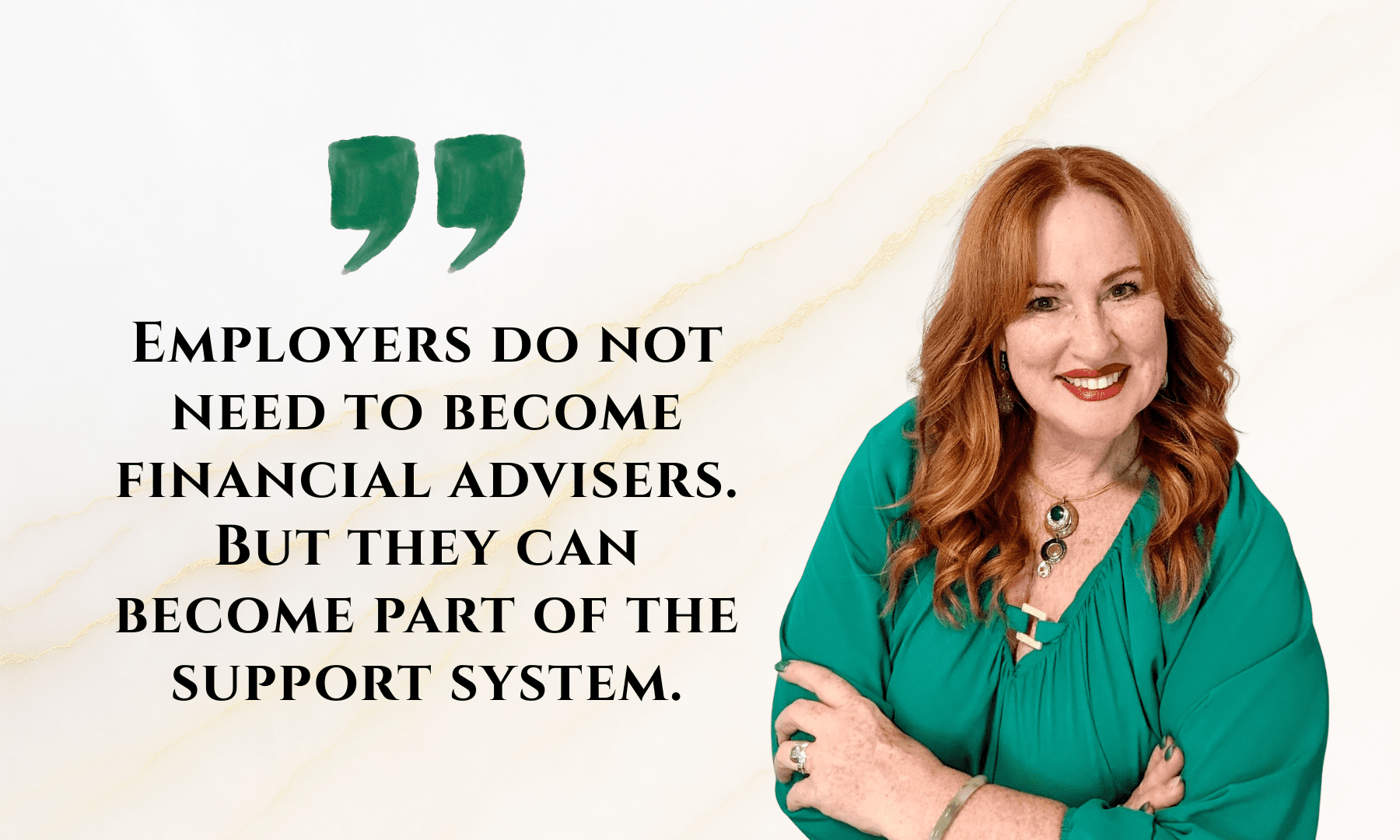
Employers do not need to become financial advisers.
But they can become part of the support system.

A workplace that genuinely cares about financial wellbeing sends a powerful message:

“We see the pressure. We care about the person, not just the performance.”

That kind of support builds trust.
It strengthens loyalty.
And it helps create a workplace culture where people feel valued in a real way.

Simple ways employers can help include:

  • offering financial wellbeing education
  • normalising money conversations without stigma
  • providing access to coaching or structured support
  • recognising the connection between financial stress and performance
  • focusing on prevention, not just crisis response

Why this matters for business outcomes too

Supporting employee financial wellbeing is not just kind. It is smart.

When employees feel less stressed about money, businesses often benefit from:

  • improved focus
  • better productivity
  • lower turnover
  • stronger morale
  • healthier workplace culture
  • more trust between staff and leadership

When employees feel less stressed about money, businesses often benefit

In other words, supporting financial wellbeing is not a “soft” benefit.
It is a practical one.

And in times of uncertainty, practical support is exactly what people remember.

Comfort matters too

There is one more piece that deserves attention.

People do not just need solutions. They need reassurance.

Many employees are currently feeling shame about money. They may feel embarrassed that they are stressed. They may think they “should” have it sorted. They may stay silent because they would rather not look incapable.

That is why comfort matters.

It helps to remind people:

  • they are not alone
  • financial pressure is affecting many households
  • struggling does not mean failing
  • support is available
  • change is possible with the right tools and guidance

Sometimes the most powerful first step is simply helping someone feel seen.

Creating a more supportive workplace

If you are an employer, leader, or HR decision-maker, this is your opportunity to think bigger about what support really means.

Financial wellbeing is no longer a “nice to have”.
It is one of the most practical and human ways to support your team.

And it does not require overcomplicating things. It starts with awareness.

Then it moves into education, tools, and support that help people take back a sense of control.

A better path forward

The world feels heavy for many people right now. That is real. But so is the opportunity to respond differently.

Instead of waiting for burnout, disengagement, or unexpected resignations, employers can choose to act earlier.


They can offer support that helps employees feel steadier, calmer, and more capable. And when that happens, everybody wins.

If you want to support your team in a practical, meaningful way, my Financial Wellbeing Program helps employees build confidence, reduce money stress, and create healthier financial habits with real tools and support.

Because sometimes the best staff benefit is not another perk.
It is helping your people feel safer, stronger, and more in control of their lives.
Financial Wellbeing Program

#HowToResetMyMoneyMindset #WhyDoIFeelOutOfControlWithMoney #HowToFeelInControlOfFinances #ResetMoneyMindset2025 #NewYearFinancialMindset #HowToStartFreshWithMoney  emergency fund australia, money management, family savings 
 

Budgeting Without the Boring: The Money Map Method That Actually Works

Budgeting Without the Boring: The Money Map Method That Actually Works

Let’s be honest for a second. The word “budget” has the same vibe as:

  • “We need to talk…”
  • “Your call is being transferred…”
  • “Please see the attached invoice…”

It makes people tense. Defensive. Slightly sweaty. 😅

And here’s the irony: most people don’t hate having a plan. They hate the way budgeting has been sold to them – like it’s punishment for daring to enjoy life.

So today, I’m giving you a different approach.

Not a strict budget.
Not a spreadsheet that needs a PhD to operate.
Not a system that makes you feel like you have to track every piece of gum you’ve ever purchased.

This is Money Mapping – the method I use with clients who want to feel in control, not controlled.

Because your money doesn’t need a prison.

It needs a plan. A plan that fits your actual life. Not the version of you who meal preps on Sundays and never impulse buys at Kmart.

(If that version of you exists, I’d like to meet her. She sounds organised and slightly intimidating.)

Why Traditional Budgets Fail (and why it’s not your fault)

Most budgets fail for three reasons:

1) They’re too restrictive

People try to cut everything at once: coffees, fun, birthdays, little treats, takeaway, holidays… and then wonder why they rebound like a rubber band.

If a budget feels like suffering, you won’t stick to it.
Your brain will treat it like a threat.
And humans don’t do “threat” long-term.

2) They’re too complicated

Forty-seven categories. Daily tracking. Constant adjustments.
You miss one thing and suddenly you feel like you’ve “failed.”

A budget that requires constant maintenance becomes another job.
And nobody needs a second job that doesn’t pay.

3) They’re built on guilt, not goals

Many budgets are basically: “Stop spending money on things that make you happy.”

No thanks.

Money mapping works because it’s:

  • simple
  • flexible
  • based on priorities
  • designed for consistency, not perfection

What is a Money Map?

A Money Map is a simple plan that tells your money where to go before life grabs it.

It answers these questions:

  1. What must be paid? (essentials + bills)
  2. What matters to you? (your priorities)
  3. What are we building? (savings, emergency fund, investing, debt reduction)
  4. How do we keep your life enjoyable while still making progress? (yes, fun stays)

A money map is not about tracking every dollar.
It’s about creating a flow.

And when your money flows with intention, financial stress drops fast

A Money Map is a simple plan that tells your money where to go before life grabs it.

The Big Mindset Shift: A Budget Isn’t Restriction – It’s Permission

I want you to reframe this:

A budget isn’t a list of things you can’t do.
It’s a permission slip that says:

✅ “Yes, you can spend money on what you love.”
✅ “Yes, you can have fun.”
✅ “Yes, you can enjoy your life.”
and also
✅ “Yes, you can build wealth and feel safe.”

That’s the goal: enjoying today while protecting tomorrow.

The Money Map Framework (Simple, Powerful, Real-Life Friendly)

Here’s the structure I recommend. It’s clean and easy:

Category 1: Essentials (Must Pays)

These are the costs of keeping your life running:

  • mortgage/rent
  • utilities
  • groceries
  • fuel/transport
  • insurance
  • minimum debt repayments
  • childcare/school essentials
  • basic medical

These are your “keep the lights on” expenses.

Category 2: Future You (Your Financial Muscle)

This is where you build safety and wealth:

  • emergency fund
  • sinking funds (car rego, Christmas, school costs, rates, holidays)
  • extra debt repayments
  • investing/super top-ups (where appropriate)

Future You deserves funding. Not “whatever’s left.”

Rainy Day Fund or Emergency Fund

Category 3: Fun & Freedom (Guilt-Free Spending)

This is the category that keeps you sane:

  • coffees
  • dinners out
  • entertainment
  • hobbies
  • shopping (within reason, Karen… within reason 😄)
  • little treats

The reason most budgets fail is because this category is either missing or unrealistically small.

We’re not doing that here.

Step-by-Step: How to Build Your Money Map in Under an Hour

Grab a pen, notes app, or whatever you use when you’re feeling productive for five minutes.

Step 1: Find your baseline numbers

Look at the last 4–8 weeks of spending (not because we love pain, but because data helps).

Write down:

  • total income (after tax)
  • total essentials
  • average weekly spending (groceries, fuel, eating out, shopping)
  • debt minimums
  • any annual bills that sneak up (rego, insurance, school, rates)

You’re not judging. You’re observing.

Step 2: Choose your “Money Map style”

There are two main styles:

  1. A) Weekly Flow Map (best for people paid weekly/fortnightly)
  • Allocate money each pay into Essentials / Future You / Fun
  1. B) Monthly Map (best for salaried monthly pay)
  • Set amounts for each category and automate them

If you’ve tried budgeting before and it didn’t stick, weekly is usually easier because it gives faster feedback.

Step 3: Set up separate accounts (this is where the magic happens)

I’m going to say this lovingly:

If all your money sits in one account, your brain will treat it like it’s all available.
That’s not a discipline problem. That’s a human brain problem.

A simple setup is:

  1. Bills account (Essentials)
  2. Spending account (groceries/fuel/fun)
  3. Future You account (emergency + sinking funds)

Automation is your best friend. Because you’re busy.
And your money system should run even when you’re tired.

Step 4: Decide your “non-negotiables”

These are your priorities — the things you want your money to reflect.

Examples:

  • “I want to stop feeling anxious about bills.”
  • “I want an emergency fund.”
  • “I want to pay off this debt.”
  • “I want to travel without putting it on a credit card.”
  • “I want to stop fighting with my partner about money.”

Your money map should support your real goals — not someone else’s idea of financial success.

Step 5: Allocate your numbers (start simple)

Here’s a starting point many people can relate to:

  • Essentials: 60–75%
  • Future You: 10–20% (even 5% is a start if money is tight)
  • Fun & Freedom: 10–20%

If your essentials are currently higher than 75% — you’re not alone. Cost of living has been doing the most.

This is where strategy matters: we might need to reduce leaks, renegotiate bills, or adjust the debt plan to create breathing room.

Step 6: Create one weekly “Money Date” (10 minutes)

Once a week:

  • check what’s coming out
  • check what’s coming in
  • make sure bills are covered
  • adjust your spending category if needed

No drama. No self-lectures. Just a quick check-in.

Think of it like brushing your teeth. You don’t do it once and call it done forever.

The “I Hate Tracking” Version: The 3-Number Method

If you’re someone who rebels against tracking (I see you), do this instead:

Pick three numbers each week:

  1. Your weekly spending limit (food + fuel + fun)
  2. Your weekly Future You transfer
  3. Your “buffer amount” you want to keep in your spending account

Then the rule is simple:
When spending hits the limit… you stop spending until next week.
No guilt. Just boundaries.

This is the system many of my clients love because it’s:

  • quick
  • clear
  • low-maintenance
  • effective

Money Map in Real Life: What This Looks Like (Example)

Let’s say your household brings in $2,500 a week after tax.

You might map it like this:

  • $1,700 Essentials (bills, groceries, fuel, minimum debt)
  • $400 Future You (emergency fund + sinking funds + extra debt)
  • $400 Fun & Freedom (eating out, treats, spending money)

Then you automate:

  • $1,700 goes straight into Bills account
  • $400 into Future You account
  • $400 stays in Spending account

Now you’re not trying to “budget” daily.
You’re simply spending from the right place.

And when your Spending account runs low, it gives you a clear signal:
“That’s it for this week.”

No spreadsheet required.

What If There’s Not Enough Money to Map?

This is the part where I get very real with you:

If you feel like there’s never enough, it doesn’t mean you’re failing.
It means your map needs to include leak-plugging and breathing space first.

Here’s what I do with clients when money is tight:

  1. tighten obvious leaks (subscriptions, lazy renewals, bank fees)
  2. build a tiny emergency buffer (even $500 can change your stress levels)
  3. stabilise bills and reduce panic spending
  4. create sinking funds for predictable expenses
  5. then build momentum

You don’t jump from stressed to thriving in one week.
But you can absolutely move from chaos to calm with the right steps.

The Most Important Part: Your Money Map Must Match Your Personality

Some people need structure.
Some need flexibility.
Some need boundaries.
Some need permission.

So here are a few personality-based tweaks:

If you’re an overspender:

  • reduce “available money” in your spending account
  • use separate “fun” cash or a dedicated card
  • increase automation

If you’re an underspender/anxious saver:

  • allocate guilt-free fun money and actually spend it
  • focus on safety targets (emergency fund)
  • build confidence with small consistent steps

If you’re a “set and forget” person:

  • automate everything
  • schedule the weekly money check-in
  • keep categories very simple

If you’re a couple/family:

  • do a shared Money Map + personal spending allowances
  • agree on the weekly “household number”
  • remove judgement from the conversation

Money mapping isn’t one-size-fits-all.
It’s “your life, your values, your plan.”

If You Want This to Stick, Join the Membership

Now, if you’re reading this thinking:

“Okay… this makes sense. But I need help setting it up properly.” or “I’ve tried before and I fall off the wagon.” or “I want a system that actually fits my life.”

That’s exactly what my Membership is for.

Because here’s the truth:

Most people don’t need more information. They need support, structure, and someone to keep them consistent.

Inside the Membership, we don’t just talk about budgeting. We:
✅ build your personal Money Map (based on your real numbers)
✅ set up accounts and automation so it runs without willpower
✅ create sinking funds so life stops surprising you
✅ learn how to manage spending without guilt
✅ build financial muscle with ongoing guidance and community

You’re not meant to do this alone.

If you’re ready to stop winging it and start feeling calm and in control, join the Membership.
Let’s build your Money Map together — and get your financial house in order the smart way.

budgeting without spreadsheets, simple budget method, cash flow planning, how to budget in Australia, reduce financial stress, personal finance tips, money management system, budgeting for beginners, weekly money check-in, sinking funds, financial management 101, Karen G Adams, financial coaching


The Financial House Inspection: 10 Sneaky Money Leaks (And How to Plug Them Fast)

The Financial House Inspection: 10 Sneaky Money Leaks (And How to Plug Them Fast)

Let me ask you something… if your financial house was a real house, would you invite guests over right now?

Or would you do that frantic pre-visit panic clean where you shove everything into the laundry or the spare room and pray nobody opens that door?

Because that’s what most people are doing financially.
Not because they’re “bad with money” (you’re not), but because life is busy, expensive, and full of sneaky little costs that quietly set up camp in your bank account like they pay rent.

And the truth is… you don’t always need a bigger income to feel more in control.
Sometimes you just need to find the leaks.

Today, we’re doing a Financial House Inspection – warm cuppa in hand, no shame, no judgement, and definitely no stiff “financial coach voice.”  You’ll walk away with practical fixes, a clearer head, and probably a few “WAIT… WHAT?!” moments.

Let’s inspect your money house.

Why “Money Leaks” Matter (Even If You Earn Good Money)

A money leak is not a big, dramatic purchase you remember forever (like buying a car or going on a holiday).

A money leak is the “small stuff” you don’t notice… until you look at your bank statement and think:

“Excuse me, where did my money go?”

Leaks are dangerous because they:

  • feel harmless in the moment
  • happen repeatedly
  • add up faster than you think
  • make you feel like you’re always behind even when you’re trying

And here’s the kicker: leaks are often emotionally driven, not logically driven. They’re convenience, comfort, habit, exhaustion, reward, stress, or just not having a system in place.

So let’s find them and plug them like the financially strong legend you are.

The Financial House Inspection Checklist: 10 Common Money Leaks

1) The Subscription Graveyard

This one is so common it deserves its own memorial plaque.

Streaming services, apps, software, gym memberships, delivery memberships, random “productivity tools,” audiobooks, meditation apps, cloud storage…

And you know what makes subscriptions sneaky?
They don’t hurt enough to notice. It’s just $9.99 here… $14.99 there… $24.99 for something you “might use.”

Until suddenly you’re donating $300 a month to the Subscription Graveyard.

Quick Fix:

  • Go through your bank statements and highlight every recurring payment.
  • Ask: “Would I buy this again today?”
  • Cancel anything that isn’t a HELL YES.

Pro tip:
If cancelling makes you panic (“but what if I need it one day?”), that’s not logic, that’s fear. And fear is expensive.

2) Lazy Renewals (Insurance, Utilities, Phone Plans)

Lazy renewals are like leaving a tap dripping for years and being shocked your water bill is high.

Insurance companies love loyal customers… because loyal customers often don’t check the price.

Phone plans creep up. Internet deals expire. Electricity rates change. Suddenly you’re paying premium pricing for basic service.

Quick Fix:

  1. Put a recurring reminder in your calendar every 6–12 months:
    • car/home insurance
    • health insurance
    • electricity/gas
    • phone/internet
  2. Compare and renegotiate.

Money mindset note:
Being financially responsible is not being “cheap.” It’s being strategic.

3) Bank Fees and “Oops” Charges

Account keeping fees. International transaction fees. ATM fees. Late payment fees. Overdraft fees.

These aren’t “just the cost of banking.” They’re often the cost of not having the right account setup or system.

Quick Fix:

  • Review your bank accounts and credit cards.
  • Ask your bank: “Is there a fee-free option?”
  • Set up alerts for low balances and bill due dates.
  • Automate minimum payments to avoid late fees.

You don’t need to pay $10 – $30 a month in fees just to have a bank account. Your money deserves better.

4) Convenience Spending (AKA “I’m Too Tired” Tax)

This is the one people don’t want to admit because it’s so relatable.

Convenience spending is:

  • takeaway because you’re exhausted
  • Uber because parking feels like emotional warfare
  • delivery apps because “I’ll just get one thing”
  • pre-made meals because you can’t face thinking

And honestly? Sometimes it’s worth it. Life is busy. You’re human. But if it’s happening on autopilot, it becomes a leak.

Quick Fix:

  • Create a weekly “convenience budget”  –  guilt-free, planned.
  • Have one or two “emergency meals” at home (freezer meals, eggs, wraps, anything easy).
  • Decide your rules before you’re tired.

This isn’t about perfection. It’s about awareness + boundaries.

Convenience Spending includes food delivery services.

5) Supermarket Drift (The “Just One More Thing” Trap)

You go in for milk and bread. You come out with:

  • fancy dips
  • a plant you didn’t need
  • snacks for “school lunches” (even though you don’t have kids)
  • and a candle because self-care.

The supermarket is designed to separate you from your money with maximum efficiency.

Quick Fix:

  • Shop with a list (yes, like a grown-up, annoying but effective).
  • Eat before you shop.
  • Do click-and-collect if you’re an impulse buyer.
  • Track your weekly grocery spend for 4 weeks and be honest about what’s happening.

Groceries are one of the easiest leaks to tighten without feeling deprived.

6) The Servo Snack & Coffee Leak

The little daily habits: coffee, snacks, “just grabbing something,” the quick drink on the way home, the “treat” because the day was hard.

And let me be clear: you’re allowed joy. But when joy is unplanned and daily, it becomes a leak.

Quick Fix:

  • Choose what’s worth it.
  • If café coffee is your thing, keep it, but make it intentional.
  • Set a weekly allowance for treats and stick to it.

The goal isn’t to become a finance robot. The goal is to stop accidentally overspending.

7) Lifestyle Inflation (The “I Deserve It” Spiral)

This one is sneaky because it feels like progress. You earn more… so you spend more. New car. Nicer clothes. More dinners out. Better holidays. Upgraded everything.

And you might still feel broke. Lifestyle inflation isn’t about being irresponsible. It’s about missing the moment where you lock in your future before upgrading your present.

Quick Fix:

  1. When income increases, decide in advance:
    • what percentage goes to lifestyle
    • what percentage goes to savings/investing
    • what percentage goes to debt reduction
  2. Automate “Future You” first.

Future You is not asking for everything.
Future You is asking for something.

8) “Buy Now Pay Later” (BNPL) and Payment Splitting

BNPL is basically like inviting little debts into your house and then being shocked they’re eating all your groceries.

It doesn’t feel like debt because it’s broken up into payments.
But it still reduces your future cash flow and adds mental load.

Quick Fix:

  • List every BNPL account and total outstanding.
  • Pause new purchases until the balances are cleared.
  • Rebuild a sinking fund for things you commonly use BNPL for (clothes, gifts, school costs, etc.

BNPL is not evil. But it is dangerous if it becomes your normal.

9) Unused Memberships and “Aspirational Spending”

This is spending money on the version of you who:

  • goes to the gym 5 days a week
  • does yoga at sunrise
  • reads 2 business books a week
  • meal preps like a wellness influencer
  • uses that online course “soon”

We’re funding our aspirational selves while our current selves are just trying to get through Tuesday.

Quick Fix:

  • Keep one “growth” commitment at a time.
  • If you’re not using it, pause it.
  • Choose what actually fits your life right now.

The goal is to build financial muscle, not financial guilt.

10) The “No System” Leak (The Biggest One)

This is the mother of all leaks. Because even if you fix everything above, if you don’t have a system, the leaks come back.

A system is what creates calm. It tells your money where to go before life grabs it first.

Quick Fix:
Start with these basics:

  • a separate bills account
  • automatic transfers on pay day
  • a weekly money check-in (10 minutes)
  • clear spending categories (not 47 categories… just the ones that matter)

Most people don’t have a money problem. They have a money flow problem.

And that is fixable.

Your Mini Action Plan: Plug Leaks in 30 Minutes This Week

If you want to feel immediate relief, do this:

  1. Print your last 30 days of transactions (or pull them up on your banking app).
  2. Highlight anything that surprised you.
  3. Circle:
    • subscriptions
    • takeaway/coffee
    • shopping
    • fees
  4. Choose 3 leaks to plug this week.
  5. Move the money you save into a separate “Future Me” account.

That last step matters. If you don’t redirect the savings, it disappears into new spending. Money is like that. It loves momentum.

Print your last 30 days of transactions (or pull them up on your banking app). Then, highlight anything that surprised you.

The Real Truth: You Don’t Need More Willpower – You Need Support + Structure

I want to say something kindly but clearly:

If you’ve tried to “get on top of money” before and it didn’t stick, it’s not because you’re hopeless. It’s because you’ve been trying to do it alone, in between work, kids, stress, bills, and exhaustion… with zero structure and a lot of pressure.

And that’s not a character flaw. That’s a strategy gap.

Come Into the Membership (Because This Is What We Do Together)

If reading this has you thinking, “Okay… I can see the leaks, but I need help making this a real system,” then babe – this is exactly why I created my Membership.

Inside the Membership, we don’t just talk about money. We build financial muscle.

✅ We identify your personal leaks (not generic ones).
✅ We set up a simple money system that actually fits your life.
✅ We make progress without shame, overwhelm, or perfection.
✅ You get guidance, structure, education, and support – so you’re not constantly starting over.

Because getting your financial house in order isn’t about a one-time clean-up.
It’s about building habits and systems that keep it running smoothly long-term.

If you’re ready to stop guessing and start feeling in control, join the Membership.
Let’s plug the leaks, create a plan, and turn your financial house into a place you feel proud to live in.

#HowToResetMyMoneyMindset #WhyDoIFeelOutOfControlWithMoney #HowToFeelInControlOfFinances #ResetMoneyMindset2025 #NewYearFinancialMindset #HowToStartFreshWithMoney Discover 10 sneaky money leaks draining your bank account and simple fixes to plug them fast. Get your financial house in order without the guilt. financial house in order, stop overspending, budgeting without stress, cash flow tips reduce financial stress, personal finance Australia spending habits save money fast, subscriptions costing me money, how to manage money better


How Can I Reset My Money Mindset This Year and Finally Feel in Control of My Finances?

How Can I Reset My Money Mindset This Year and Finally Feel in Control of My Finances?

It’s Not Just About the Numbers – It’s About Your Mindset

Look, you can have the best spreadsheet in the world…

You can download all the budget apps, cut back on coffee, and cancel every subscription.

But if your money mindset hasn’t shifted? You’ll still feel stuck, overwhelmed, or like “you’re just not good with money.”

Let’s fix that because 2026 is the year we stop dragging last year’s money baggage into our future.

This blog is your ultimate guide to resetting your mindset, clearing out old financial beliefs, and building a powerful, positive relationship with money.

And yes – it’s fun, it’s doable, and it’s way more effective than another boring budget.

Let’s go.

What Even Is a Money Mindset?

Your money mindset is the collection of beliefs, emotions, and thoughts you have about money. It’s your personal “money story” – the internal script you repeat (often subconsciously) about earning, saving, spending, and wealth.

Some of it comes from your childhood, your past experiences, or society’s weird money rules. And here’s the wild part: It influences every single money decision you make.

Your mindset determines whether you:

  • Save confidently or hoard out of fear
  • Ask for more money or shrink your value
  • Budget with ease or avoid your bank balance like it’s haunted

Signs You Might Need a Money Mindset Reset

?‍♀️ You feel anxious or guilty every time you spend money
? You avoid looking at your bank account or credit card
?‍♂️ You say things like “I’m just bad with money” or “I’ll never get ahead”
?‍♀️ You feel stuck in a paycheck-to-paycheck cycle, even when your income grows

If that sounds like you, it doesn’t mean you’re broken – it means it’s time to reprogram your financial brain.

Step 1: Identify the Old Money Stories Holding You Back

Before you can shift your mindset, you need to see what you’re working with.

Ask yourself:

  • What did I learn about money growing up?
  • What do I believe about wealthy people?
  • When I think about money, do I feel free or fearful?

Some common limiting beliefs:

  • “There’s never enough money.”
  • “Money is hard to manage.”
  • “I’m not good with numbers.”
  • “More money means more stress.”

? None of these are facts. They’re just beliefs. And beliefs can change.

Step 2: Choose Empowering New Money Beliefs

You get to write a new story this year. Start by replacing the old thoughts with intentional, positive ones:

Instead of: “I’m bad with money” → Say: “I’m learning how to manage my money powerfully.”
Instead of: “I’ll never get ahead” → Say: “Every dollar I manage well moves me forward.”
Instead of: “Money is stressful” → Say: “Money is a tool I’m learning to use with confidence.”

✨ Tip: Write your new beliefs down. Post them on your mirror. Make them your phone wallpaper. Say them out loud. Train your brain to believe better.

Step 3: Connect Your Money to What You Actually Value

Ask yourself:

  • What do I want money to do for me this year?
  • What do I value most – freedom? stability? generosity? joy?
  • How can I align my spending and saving with those values?

Example: 

If you value peace of mind, create a savings plan.
If you value freedom, reduce debt.
If you value fun, build in guilt-free spending money.

Money doesn’t just serve numbers – it should serve your life.

Money doesn’t just serve numbers - it should serve your life.

Step 4: Make Mindset Work Part of Your Routine

You don’t go to the gym once and expect abs, right?
Same with your mindset. It takes repetition.

Here’s a weekly reset routine you can follow:

? Money Mindset Reset (10 Minutes):

  • Review your thoughts from the week – what came up around money?
  • Journal one thing you’re proud of financially
  • Write or say one new belief out loud
  • Visualise yourself succeeding with money

? Do this every Sunday before your weekly budget check-in and you’ll be unstoppable.

Step 5: Surround Yourself With New Financial Energy

If you want to upgrade your mindset, you need to upgrade your environment.

That might look like:

  • Listening to empowering money podcasts
  • Following financial educators who speak your language (hello ? yes me ?)
  • Talking about money with friends who are also growing
  • Hiring a coach who helps you reframe, reset, and rise (hello ? yes me again ?)

You can’t change your money mindset in isolation. That’s why I created my Financial Muscle Coaching Membership.  It’s where financial growth meets real community and support.

Listen to empowering money podcasts like Managing Money Made Easy

Step 6: Replace Shame With Curiosity

When things go “wrong”  you overspend, forget a bill, or avoid a budget – don’t spiral into shame. Instead, ask:

  • What triggered this?
  • What do I need right now – support, structure, or space?
  • What can I do differently next time?

Every financial hiccup is just data. Don’t let one moment of messiness define your entire money story.

You’re allowed to be a work in progress and a success story at the same time.

Step 7: Set Mindset-Based Goals for the Year

Let’s skip the boring “save more, spend less” vibe.

Try these instead:

  • “This year, I’m building my financial self-trust.”
  • “This year, I’m proving I can stick to one habit consistently.”
  • “This year, I’m learning to enjoy managing my money.”

Then break that into monthly goals:
✅ January: Track every dollar
✅ February: Create a spending plan aligned to my values
✅ March: Build an emergency fund of $300

Momentum creates confidence and mindset fuels momentum.

Final Thoughts: You Can’t Budget Your Way Out of a Scarcity Mindset

If you’re stuck in fear, guilt, or shame around money, no spreadsheet will save you. You have to go deeper. And you have to believe that a new relationship with money is possible for you.

Because it is.

You are not bad with money.
You are not too far behind.
You are not stuck – you’re just getting started.

And when you build a strong, positive money mindset? Everything else gets easier.

Let’s build that mindset muscle together.

? Join Financial Muscle Coaching

If you’re ready to change your money mindset, build real financial confidence, and create a life that feels good – not just looks good on paper – I’ve got you.

Join Financial Muscle Coaching – my coaching community where we:
✅ Rewrite limiting money stories
✅ Build strong, sustainable habits
✅ Create aligned goals you actually want to follow

This isn’t just budgeting. This is mindset, motivation, and muscle – built week by week, with me in your corner.

Your money mindset reset starts here. Let’s go. ?

Join Financial Muscle Coaching Now

#HowToResetMyMoneyMindset #WhyDoIFeelOutOfControlWithMoney #HowToFeelInControlOfFinances #ResetMoneyMindset2025 #NewYearFinancialMindset #HowToStartFreshWithMoney #MindsetShiftForMoney #RebuildMoneyConfidence #WhatIsMoneyMindset #MoneyMindsetTransformation #MoneyMindset #MoneyConfidence #FinancialReset #MoneyHealing #FinancialEmpowerment #AbundanceMindset #WealthMindset #MoneyCoach #MoneyGoals2025 #FinancialMuscle

Money Isn’t the Problem – Your Brain Might Be!

Money Isn’t the Problem – Your Brain Might Be!

Feeling Stuck with Money? You’re Not Alone

Ever feel like no matter how hard you work, money keeps slipping through your fingers?

You track your spending, download another budgeting app, maybe even try a no-spend challenge (ugh)…
But nothing sticks. You’re still stressed, still overspending, and still wondering why money feels so hard.

Here’s a radical idea that might blow your mind:

Your financial struggle isn’t just about money. It’s about your mindset.

If you’ve ever told yourself:

  • “I’m just not good with money.”


  • “I’ll never get ahead.”


  • “I’m terrible with numbers.”


  • “There’s never enough to go around.”

…then guess what? You’re not bad with money.
You’re just running an outdated mental program and it’s time to upgrade your system.

? Your Mindset Is the Missing Link in Money Management

Let’s get one thing straight: You weren’t born with your current money habits.

They were learned, shaped, and reinforced over years often by:

  • What you saw growing up
  • What society tells you about money
  • Your past financial “mistakes”
  • Deep, often unconscious beliefs about what’s possible for you

Most of us were never taught how to actually think about money in a healthy, empowering way.

Instead, we internalise things like:

  • “Money doesn’t grow on trees.”
  • “Rich people are greedy.”
  • “You have to work hard to make money.”

These beliefs shape our thoughts.
Our thoughts drive our behaviours.
Our behaviours determine our results.

“Change your thoughts, and you change your world.” – Norman Vincent Peale

? Meet the RAS: The Tiny Brain Filter That Shapes Your Reality

One of the most powerful (yet overlooked) players in your financial journey is your Reticular Activating System (RAS).

It’s a tiny bundle of nerves in your brainstem that acts like a filter, allowing in information that matches your beliefs and blocking out everything else.

In short:

  • If you believe money is hard to come by, your RAS will filter out opportunities and highlight obstacles.
  • If you believe you’ll never get ahead, your RAS will literally make it harder to see paths to progress.

It’s not woo-woo. It’s neuroscience. ?⚡

But here’s the good news: You can train your RAS to focus on abundance, opportunity, and growth. That’s the work we do in my Master Your Money program – and it works.

Create a monthly payment plan that includes money for fun and savings.

? 5 Limiting Beliefs That Keep You Financially Stuck

Let’s get real for a moment. Most people are walking around with a money mindset full of invisible roadblocks.

Here are 5 common ones that might be running in the background of your brain:

  1. “I’m just not good with money.”
    → Translation: I’ve made mistakes, and now I believe they define me.


  2. “There’s never enough.”
    → Leads to hoarding, fear-based spending, or total avoidance.


  3. “I always mess it up.”
    → Creates shame, procrastination, and financial self-sabotage.


  4. “If I make more, I’ll lose it anyway.”
    → Keeps you stuck at your current income level (or worse).


  5. “Wanting wealth is greedy or selfish.”
    → Prevents you from receiving more, even when you’ve earned it.

Sound familiar?

The first step to changing your results is changing these beliefs. But how? Let’s walk through a simple reframe technique that works fast.

? Flip the Script: How to Rewire a Limiting Money Belief

Step 1: Identify the belief

Example: “I’ll never be debt-free.”

Step 2: Ask yourself, “Where did I learn this?”

Maybe from watching your parents struggle, or after repeated financial setbacks.

Step 3: Write the empowering opposite

✅ “I am taking steps every day toward financial freedom.”
✅ “My past doesn’t define my financial future.”
✅ “I am capable, committed, and in control.”

Now, speak that new belief out loud every morning.
Yes – out loud. You’re rewiring your brain. It needs to hear the new code.

?‍♀️ Practice Mindful Money: A Daily 5-Minute Ritual

You don’t need hours of meditation or 12-tab spreadsheets to take control of your finances.
You just need five intentional minutes a day.

Here’s a powerful money mindfulness ritual to try:

? Each morning or evening:

  1. Check in with your emotions around money.
    • Am I feeling anxious? Grateful? Avoidant?
  2. Review your spending from the past 24 hours.
    • One win + one lesson.
  3. Name your money goal for the week.
    • Keep it small and actionable: “Track all spending” or “Bring lunch from home 3x.”
  4. Say your top 3 affirmations out loud.
    • Examples: “I am aligned with abundance.” “Money flows to me with ease.” “I am in control of my financial future.”

      Repeat for 30 days and watch how much more confident, clear, and calm you feel around money.

Create a monthly payment plan that includes money for fun and savings.

? Why This Work Matters More Than Spreadsheets

I’ve been in the financial industry since 1986.
I’ve seen people transform their finances not because they suddenly won the lotto or got a huge raise…
…but because they shifted how they think about money.

They rewired their brains for:

  • Financial confidence
  • Resilience
  • Peace of mind
  • And yes – wealtH

And that’s why I created the Master Your Money program.

It’s not just another budgeting course. It’s a 30-day, mindset-first reset that helps you finally stop the cycle of stress, sabotage, and shame around money and start creating real momentum towards financial freedom.

? What Happens When You Rewire Your Money Mindset?

✨ You stop panic-spending and start making calm, intentional choices.
✨ You forgive your past mistakes and take empowered action today.
✨ You feel in control – even if your income hasn’t changed yet.
✨ You start attracting new opportunities, support, and even more money.

This is the magic of mindset.
It works. It’s real. And it’s within your reach.

? Try This: Your 7-Day Money Mindset Challenge

Want to get a taste of what mindset work can do for you?

Here’s a simple challenge to try this week:

Day 1: Write your 3 biggest money fears

Day 2: Flip each into an empowering belief

Day 3: Create a 5-minute money ritual

Day 4: Track one spending habit with curiosity (not judgment)

Day 5: Visualise your ideal financial future

Day 6: Celebrate one money win

Day 7: Journal what’s shifted emotionally, mentally, or financially

You’ll be amazed what starts to change in just one week.

? Ready to Go Deeper? Join Master Your Money!

If you’re tired of feeling:

  • Confused about where your money goes
  • Anxious every time a bill lands
  • Guilty when you spend (or don’t)
  • Stuck in a financial Groundhog Day…

Then you’re ready for a reset.
Not just in your bank account – but in your brain.

My Master Your Money 30-day program walks you step-by-step through:
✅ Rewiring limiting beliefs
✅ Creating daily habits that stick
✅ Building emotional clarity around money
✅ Using mindset tools like visualisation, affirmations, and gratitude
✅ Becoming the CEO of your financial life (finally)

No judgment. No jargon. Just powerful, practical transformation.

? Final Thought: It Was Never About the Money

It was always about:

  • The story you believed.
  • The patterns you repeated.
  • The mindset you inherited.

But here’s the best part:

You have the power to rewrite the story.

Let today be the day you stop blaming money and start mastering your mindset.

Because once your brain gets on board? Your bank account will follow.

Your Financial Freedom Breakthrough™