The Big Picture: Why Net Position Matters More Than Budgeting

The Big Picture: Why Net Position Matters More Than Budgeting

When people think about managing their finances, budgeting is often the first thing that comes to mind. While budgeting is an essential tool, it’s only one piece of the puzzle. To truly take control of your financial life, you need to understand your net position. This bigger-picture view is the cornerstone of long-term financial success. In this blog, we’ll dive into what net position is, why it matters, and how it can transform your approach to money management.

What is Net Position?

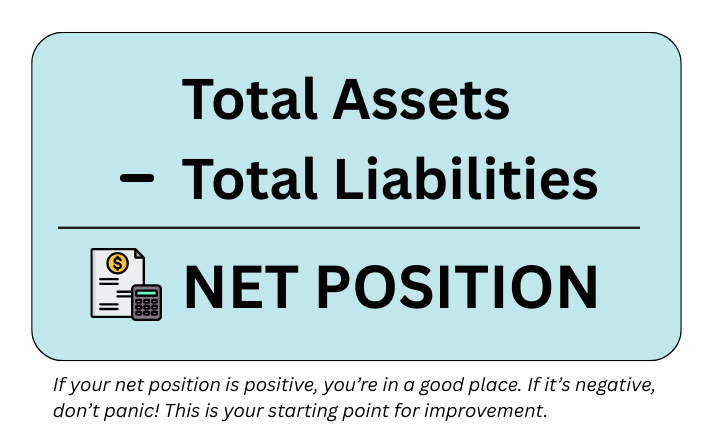
Your net position is the difference between what you own (your assets) and what you owe (your liabilities). It’s essentially your financial scorecard, giving you a snapshot of your overall financial health. Here’s a simple formula:

Net Position

Assets include things like your home, car, savings, and investments. Liabilities include mortgages, credit card debt, personal loans, and other financial obligations. Knowing your net position helps you understand whether you’re building wealth or accumulating debt.

Why Net Position Matters More Than Budgeting

Budgeting is about managing your monthly cash flow, how much money comes in and goes out. While this is important, it doesn’t give you a complete picture of your financial health. Here’s why focusing on your net position is a game-changer:

1. PROVIDES A HOLISTIC VIEW

      • Budgeting focuses on short-term goals, like paying bills or saving for a vacation. Net position shows your long-term financial standing, including the value of your assets and the weight of your debts.

2. HELPS SET REALISTIC GOALS

      • Understanding your net position allows you to set achievable financial goals, whether it’s buying a home, retiring early, or becoming debt-free.

3. REVEALS FINANCIAL TRENDS

      • Tracking your net position over time helps you see whether your financial health is improving or deteriorating.

4. GUIDES BETTER DECISION-MAKING

      • Knowing your net position helps you make informed decisions about spending, saving, and investing.

Common Misconceptions About Net Position

Budgeting is about managing your monthly cash flow, how much money comes in and goes out. While this is important, it doesn’t give you a complete picture of your financial health. Here’s why focusing on your net position is a game-changer:

1. “Only Wealthy People Need to Track Their Net Position”

      • False! Everyone, regardless of income level, can benefit from understanding their net position. It’s about knowing where you stand and where you’re headed.

2. “Budgeting Alone is Enough”

      • While budgeting is crucial for managing day-to-day expenses, it doesn’t address your overall financial health.

3. “It’s Too Complicated”

      • Tracking your net position can be as simple as listing your assets and liabilities in a spreadsheet or using a financial app.

Steps to Improve Your Net Position

1. ELIMINATE HIGH-INTEREST DEBT

      • Focus on paying off credit cards and personal loans first. These often carry the highest interest rates and can significantly impact your financial health.

2. INCREASE YOUR SAVINGS

      • Build an emergency fund with at least three to six months’ worth of living expenses. This provides a financial safety net and reduces the need for high-interest debt during emergencies.

3. INVEST WISELY

      • Grow your assets by investing in a diversified portfolio. Consider long-term investments like retirement accounts or real estate.

4. REDUCE LIABILITIES

      • Pay down loans and avoid taking on new debt unless it’s for a strategic purpose, like buying a home.

5. TRACK YOUR PROGRESS

      • Revisit your net position quarterly or annually to measure your progress and adjust your financial plan as needed.

How Our “Know Your Numbers” Course Can Help

Our “Know Your Numbers” course is designed to take the guesswork out of understanding your net position. Here’s what you’ll learn:

1. HOW TO CALCULATE YOUR NET POSITION 

      • Step-by-step guidance on listing your assets and liabilities.

2. TOOLS AND TEMPLATES

      • Access user-friendly calculators and spreadsheets to track your progress.

3. STRATEGIES FOR IMPROVEMENT

      • Learn actionable steps to grow your assets, reduce your liabilities, and increase your net worth.

4. REAL-LIFE EXAMPLES 

      • See how others have transformed their financial health by focusing on their net position.

Success Stories

1. JOAN’S TRANSFORMATION

Joan discovered her net position was negative due to high credit card debt. Using strategies from the course, she paid off her debt in two years and now has a positive net worth of $20,000.

2. PETER’S JOURNEY

Peter thought he was doing well because he had a high income. After calculating his net position, he realised his debt outweighed his assets. He’s since restructured his finances and is on track to achieve financial independence.

Know Your Numbers

Conclusion

Understanding your net position is the key to unlocking financial freedom. It’s not just about how much you earn or spend; it’s about the bigger picture of what you own versus what you owe. By focusing on your net position, you can make smarter financial decisions, set realistic goals, and build a secure future. Ready to take control? Join our “Know Your Numbers” course today and start your journey toward financial clarity and success.

The Vault
The Financial Confidence Formula: How to Trust Yourself with Money Again

The Financial Confidence Formula: How to Trust Yourself with Money Again

We’ve all had those moments standing at the checkout, second-guessing a purchase, or staring at a bank statement, feeling a wave of regret. Maybe you’ve told yourself, “I’m just bad with money,” or, “I can’t trust myself to make good financial decisions.” If this sounds familiar, you’re not alone. But here’s the truth: you are not inherently bad with money. You just need to rebuild your financial confidence.

Financial confidence isn’t about knowing every investment strategy or becoming a budgeting master overnight. It’s about trusting yourself to make empowered, intentional choices with your money without fear, guilt, or self-doubt.

So how do you start trusting yourself with money again? Let’s dive into the formula that can help you regain control and move forward with confidence.

STEP 1: Reframe Your Money Story

The beliefs you have about money shape how you handle it. If you’ve experienced financial struggles in the past, it’s easy to assume that you’ll always struggle. But that’s not true you are constantly evolving, and your financial reality can evolve with you.

Take a moment to reflect: What are the money stories you’ve been telling yourself? Do you believe money is hard to earn? Do you think you’re destined to be in debt? Once you identify these limiting beliefs, challenge them. Instead of saying, “I’m terrible with money,” try, “I am learning to manage my money with confidence.” Words matter, and so does your mindset.

What are the money stories you’ve been telling yourself? Do you believe money is hard to earn?

STEP 2: Small Wins Lead to Big Confidence

Trust isn’t built overnight it’s created through consistent actions. If you’ve been avoiding your finances out of fear, start small. Set up a weekly “money date” with yourself to review your finances, even if it’s just for 15 minutes. Celebrate the small victories, like paying a bill on time or choosing to cook at home instead of eating out. These small wins add up, reinforcing the belief that you are capable of managing your money wisely.

STEP 3: Shift from Fear to Curiosity

Many people feel anxious when they look at their bank account, but what if you approached your finances with curiosity instead of fear? Instead of saying, “I don’t even want to look at my balance,” try asking yourself, “I wonder what I can learn from my spending habits this month?” By shifting your mindset, you turn financial management into a tool for empowerment rather than a source of stress.

Align Your Spending with Your Values<br />

STEP 4: Align Your Spending with Your Values

One of the fastest ways to feel good about your money is to ensure your spending reflects what truly matters to you. If financial guilt is a recurring theme, it may be because you’re spending in ways that don’t align with your priorities.

Ask yourself: What do I value most in life? If it’s family, are you investing in quality time with loved ones? If it’s health, are you prioritising your well-being over impulse purchases? When your spending aligns with your values, financial confidence follows naturally.

STEP 5: Give Yourself Permission to Learn

No one is born knowing how to manage money perfectly. Mistakes will happen, but they don’t define you. What matters is how you respond. Instead of beating yourself up over a financial misstep, treat it as a learning experience.

Ask: “What can I do differently next time?” This shift in perspective turns every challenge into an opportunity for growth, reinforcing your ability to trust yourself.

STEP 5: Give Yourself Permission to Learn

Confidence grows in the right environment. If you’ve been struggling alone, it may be time to seek out support whether that’s a financial coach, a community of like-minded individuals, or access to the right financial education.

That’s why I created my Monthly Coaching program, giving you access to The Vault a treasure trove of financial resources, courses, and guidance to help you build the skills and mindset necessary for long-term success. And if you’re ready to take full control of your finances, my Master Your Money program will guide you through everything you need to know to transform your financial future.

Master Your Money Program

Final Thoughts

Rebuilding financial confidence isn’t about perfection it’s about progress. Every positive step you take strengthens your trust in yourself. You are fully capable of making empowered financial choices, and your journey starts today.

Take the first step, celebrate your wins, and remember: you are not alone in this. With the right mindset, tools, and support, you can rewrite your financial story and step into a future filled with confidence and abundance.

Are you ready to take control? Let’s do this together!

The 90 Day Money Makeover

What is the Best Way to Pay Off Debt?

What is the Best Way to Pay Off Debt?

If you’re feeling overwhelmed and just not sure how to make a start, I’ve got you covered in this blog. To pay off debt efficiently, you must employ a variety of strategies that are tailored to your specific financial situation. 

Here are some general steps to consider:

ASSESS YOUR DEBT

Start by listing all your debts, including credit cards, loans, and mortgages. Note the balance, interest rate, and minimum payment for each.

CREATE A BUDGET

Understand your monthly income and expenses. This helps in identifying how much extra you can allocate towards debt repayment.

EMERGENCY FUND

Before aggressively paying off debt, it’s wise to have a small emergency fund (like $1,000) to cover unexpected expenses without adding more debt.

Understand Your Monthly Income and Expenses

CHOOSE A DEBT REPAYMENT STRATEGY:

  1. Debt Snowball Method: Pay off debts from smallest to largest balance, regardless of interest rate. This method can offer quick wins and motivation.


  2. Debt Avalanche Method: Focus on paying off debts with the highest interest rates first while maintaining minimum payments on others. This method saves money on interest over time.

MAKE EXTRA PAYMENTS

Whenever possible, make extra payments. Even small additional amounts can significantly reduce your total interest and repayment duration.

CUT EXPENSES

Review your budget for areas to reduce spending. Redirecting these savings toward your debt can accelerate repayment.

CONSIDER CONSOLIDATION OR REFINANCING 

If you have high-interest debt, consolidating into a lower-interest loan or refinancing can reduce the total interest paid.

AVOID NEW DEBT

While paying off existing debt, try to avoid taking on new debt, as this can derail your repayment plan.

INCREASE INCOME

Consider ways to boost your income, such as a side job or selling unused items, and use this extra income to pay down debt.

SEEK PROFESSIONAL ADVICE

If you’re overwhelmed, consider consulting a financial advisor or a credit counselor for personalised advice and possible debt management plans.


Consider ways to boost your income, such as a side job or selling unused items, and use this extra income to pay down debt.

Remember, the best method depends on your personal financial situation, your discipline, and your motivation. It’s important to choose a strategy that you can stick with until all your debts are paid off.

Grab a FREE COPY of my Budget Spending Plan to track your income and expenses. CLICK HERE!

Need help and accountability? The LEARNING HUB helps you gain more financial knowledge, while providing you with the support and help you and others need. Join now for only $79 USD per month.

Join the Learning Hub - Financial Management 101 by Karen G Adams
Fixed vs. Variable: Navigating Mortgage Interest Types for Homebuyers

Fixed vs. Variable: Navigating Mortgage Interest Types for Homebuyers

Hello, aspiring homeowners and financial adventurers! As your trusty financial coach and savvy mortgage broker, I’m here to guide you through the thrilling yet often perplexing world of mortgage interest types. 

Picture this: you’re embarking on a quest to find the perfect home, but there’s a fork in the road. Do you take the path of fixed interest rates or venture down the trail of variable rates? Let’s unpack these options together, with a sprinkle of fun and a dash of wisdom, to ensure you make the best decision for your financial future.

The Tale of Two Rates: Setting the Scene

Imagine two characters in our story: Fiona Fixed and Victor Variable. Fiona enjoys predictability in her life. She loves knowing exactly how much her payments will be each month, providing her with a sense of security and peace of mind. Victor, on the other hand, is a bit more daring. He’s willing to ride the waves of the market, betting that interest rates will go in his favour, potentially saving him money in the long run. 

Steady Ship vs. Sailboat

The Fixed Rate: A Steady Ship in Stormy Seas

Fixed-rate mortgages are like a sturdy ship that can weather any storm. They offer the same interest rate for the entire term of the loan, whether it’s 15, 20, or 30 years. This means your monthly mortgage payments remain unchanged, making budgeting as easy as pie. It’s perfect for those who, like Fiona, prefer stability over surprises.

Pros:

    • Predictability: You’ll sleep soundly knowing your payments won’t change.
    • Simplicity: Easy to understand, especially for first-time homebuyers.
    • Protection: You’re shielded from sudden spikes in interest rates.

Cons:

    • Higher Initial Rates: Fixed rates are usually higher than the initial variable rates.
    • Less Flexibility: If interest rates fall, you’re stuck with your rate unless you refinance.

The Variable Rate: Sailing the Winds of Chance

On the flip side, variable-rate mortgages are like a nimble sailboat that adjusts its sails with the winds of the market. The interest rate can fluctuate based on market conditions, meaning your monthly payments could increase or decrease. This is where Victor finds his thrill, in the potential for lower overall costs when rates favour the borrower.

Pros:

    • Lower Initial Rates: Start with a lower rate compared to fixed-rate mortgages.
    • Potential Savings: Benefit from paying less interest when rates decrease.
    • Flexibility: Often includes options to lock in a fixed rate if the winds change.

Cons:

    • Uncertainty: Your monthly payment could change, making budgeting a challenge.
    • Risk: If interest rates soar, so do your payments.

Navigating Through the Fog: How to Choose

Now, how do you choose between these two? Consider your financial situation, lifestyle, and risk tolerance. Here are a few lanterns to help illuminate your path:

Financial Stability: If you’re in a stable financial position and can handle potential increases in your payments, Victor’s variable rate might be your calling. However, if you prefer the safety of a predictable budget, follow Fiona’s lead with a fixed rate.

Market Trends: Keep an ear to the ground on market trends. If rates are historically low, locking in a fixed rate might be wise. But if you’re feeling optimistic about where rates are headed, the variable rate could be your treasure.

Term Length: Consider how long you plan to stay in your home. If it’s a short-term stay, a variable rate might offer lower initial payments. For a long haul, a fixed rate could offer long-term stability.

Ask the Experts: Consult with me, your financial coach and mortgage broker. I love helping heroes of homeownership chart their course to the perfect mortgage.

The Adventure Awaits

Remember, choosing between fixed and variable interest rates isn’t just about crunching numbers; it’s about aligning your mortgage with your life’s voyage. Whether you’re a Fiona Fixed, preferring the calm seas of predictability, or a Victor Variable, ready to sail the fluctuating financial tides, the right choice is out there.

As your financial navigator, I’m here to help you explore the possibilities and make an informed decision. So, gather your maps and set your sights on the horizon; your dream home awaits, and the perfect mortgage is your key to unlocking the door. Happy house hunting, brave explorers.

Whether you’re dipping your toes into the home-buying waters for the first time, eyeing a smarter refinancing strategy, coming off a fixed interest rate, or expanding your portfolio with another investment property, Karen’s 20-minute discovery call, is your first step towards mortgage mastery! Let’s dive into your financing needs, explore your options, and perform a FREE mortgage health check to ensure your plans aren’t just dreams but achievable realities.  

Karen Adams of Financial Management 101