Your First Quarter Report Card

Your First Quarter Report Card

July, August, September – done and dusted, more or less. So how’s the new financial year actually going? Not “how busy have you been.” How’s it going?

Most business owners can rattle off exactly how flat out they’ve been since July; the jobs, the clients, the late nights. Fewer can tell you how profitable they’ve been over the same stretch. And that gap between “flat out” and “actually ahead”, is exactly where a quick quarter check-in earns its keep. It’s the difference between a business that feels busy and a business you can actually prove is moving forward.

Nobody waits for the end-of-year school report to find out how a kid’s tracking. You check in along the way – a note home, a parent-teacher chat, a quiet word, and adjust before it becomes a bigger conversation. Your business deserves the same courtesy. Not a full audit, not a forensic dive into every transaction, just an honest look at the first three months of the new financial year, before you’re four quarters deep wondering where it all went and why the number at tax time doesn’t match the effort you know you put in.

Why most business owners skip this

It’s not laziness. It’s usually one of two things, either it feels like it’ll take hours you don’t have, or there’s a quiet fear of what it might show. Both of those assumptions tend to be wrong. This exercise takes less time than a coffee catch-up, and more often than not, the number is somewhere between “not as bad as I feared” and “better than I gave myself credit for.” The dread is almost always worse than the discovery.
Three questions, one cup of tea

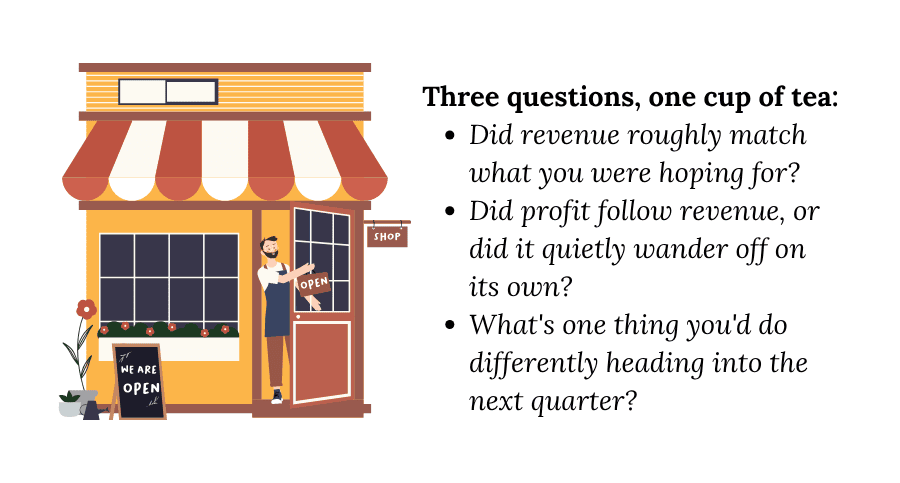
Three questions, one cup of tea

Did revenue roughly match what you were hoping for? Doesn’t need to be precise; ahead, on track, or behind is enough of an answer for now. And if you realise you never actually set a target for the quarter, that’s not a failure, it’s just a perfectly good place to start next time. You can’t be ahead or behind a target that doesn’t exist.

Did profit follow revenue, or did it quietly wander off on its own? This is the one that catches people out most often, and it’s the one I see most in this line of work. Revenue climbs, everyone’s thrilled, the calendar’s fuller than ever and then the bank balance doesn’t quite reflect it, because costs crept up right alongside the growth without anyone clocking it. Materials went up. A subcontractor’s rate went up. You took on a bit more admin help. None of it felt like a big decision at the time, but added together it’s eaten the extra revenue and then some. If you’ve felt busier than ever this quarter but the numbers don’t quite match the feeling, this is usually why.

What’s one thing you’d do differently heading into the next quarter? Not five things, just one! Trying to fix everything at once is how good intentions turn into nothing changing at all. Maybe it’s pricing, which almost every business owner I meet is quietly undercharging on. Maybe it’s chasing invoices a little sooner instead of letting them drift. Maybe it’s finally looking at where the money’s actually going instead of guessing based on vibes and a general sense of dread. Pick the lever that would move things most, and leave the rest for next quarter’s version of this exercise.

What to do with what you find

If the quarter came in ahead, resist the urge to immediately spend the difference on something exciting. Sit with it for a bit. Ask whether it’s a genuine trend or a one-off good stretch before you build plans around it. If it came in behind, resist the opposite urge, the spiral into “the whole business is failing.” One quarter is one quarter. It’s a data point, not a verdict. The value isn’t in the number itself, it’s in what the number tells you to look at next.

Why quarterly, specifically

A quarter is a genuinely good length of time to check in on; long enough to see a real pattern rather than a one-off blip, short enough to actually change course while it still matters. Check monthly and you risk reacting to noise, a slow week that means nothing, a good week that means nothing either. Check yearly and you find out too late to do much about it. Quarterly sits right in the sweet spot, giving you enough information to trust it, and enough time left in the year to actually act on it.

The business owners I see making calmer, more confident decisions are almost always the ones checking in quarterly, not just at tax time when the accountant delivers the number and there’s nothing left to do but accept it. Checking quarterly puts you back in the driver’s seat of your own financial year, rather than a passenger finding out where you ended up after the fact.

If you’d like a proper look under the bonnet, the CEO Dashboard gives you full visibility on exactly how the quarter really went not the guessed version, the real one.

Turning it into a rhythm

The businesses that get the most out of this aren’t doing anything clever, they’ve just made it a rhythm rather than a rescue mission. Same week each quarter. Same three questions. Same short list of actions afterwards. It stops being a big, dreaded event and becomes something closer to a habit, the business equivalent of a regular check-up rather than an emergency room visit.

If this is the first time you’ve done a proper quarter check-in, don’t worry about making it perfect. The value isn’t in precision, it’s in the act of actually stopping to look, on a schedule, instead of only looking when something’s gone wrong enough to force your hand.

Setting yourself up for next quarter

Before you close the laptop on this exercise, write down one number you’ll check again in three months. Just one. Revenue, profit margin, average invoice value, whatever feels most relevant to where you are right now. Having that one number in mind gives the next quarter’s check-in a head start, because you’ll already know what you’re comparing against instead of starting from scratch each time.

Small, consistent check-ins beat big, occasional audits every time. That’s true of your car, your health, and it’s absolutely true of your business.
The CEO Dashboard

#HowToResetMyMoneyMindset #NewYearFinancialMindset #HowToStartFreshWithMoney  emergency fund australia, money management, family savings #SmallBusinessOwner #BusinessGrowth #CashflowManagement #BusinessSuccess
#EntrepreneurMindset

 

Father’s Day and the Business Owner Who Can’t Switch Off

Father’s Day and the Business Owner Who Can’t Switch Off

Happy Father’s Day to every business owner who “just needs to check one email” during the barbecue.

You know the scene. Phone face-down on the table, out of principle. Two minutes later, face-up again. “Just checking something quick.” Forty-five minutes later, still checking, while someone’s asking if you want another sausage and you’re not entirely sure you heard them the first time.

Here’s the bit nobody says out loud; if you genuinely can’t switch off for one Sunday, it’s not because you’re dedicated, it’s because something in the business is relying entirely on you being switched on, all the time. That’s not commitment. That’s a business that hasn’t had its systems built yet, quietly telling on itself every time your phone lights up at a family lunch.

I say this with love, because I’ve been that person too. There’s a particular kind of guilt that creeps in when you’re not checking, like something’s about to fall over the second you look away. Sometimes it will. That’s actually useful information, not a personality flaw. It tells you precisely where the weak point is, rather than leaving you to vaguely feel like you should “be better at switching off,” which is advice with nothing practical underneath it.

Happy Father's Day to every business owner who "just needs to check one email" during the barbecue.

It’s not a discipline problem

Most business owners think the fix is “just try harder to unplug.” Buy a nicer phone case, set a screen time limit, promise yourself Sunday is sacred. And then Sunday arrives and none of it holds, because the willpower was never the actual problem.

You can’t discipline your way out of a business with no systems, no visibility, and nobody else who knows where anything lives. If you’re the only one who knows the client’s login, the only one who knows how the invoicing actually works, the only one who can answer “did that order go out,” then of course you can’t switch off – you’re not being undisciplined, you’re being the entire operations department in one exhausted human body.

The phone-checking isn’t the actual problem. It’s just the symptom you can see. Fixing the symptom without fixing the cause is like taking the batteries out of a smoke alarm because the beeping is annoying.

What it costs, quietly

There’s a cost to this that doesn’t show up on the profit and loss but shows up everywhere else. It shows up in the conversation you half-listened to. The moment with the kids you were technically present for but not really in. The mate who stopped inviting you to things because you always seemed distracted, or cancelled at the last minute, or spent the whole time with one eye on your phone. None of that gets tracked anywhere. It just quietly accumulates until one day you notice the gap.

The real question to ask

The more useful question isn’t “how do I switch off more.” It’s “what would genuinely happen today if I didn’t check my phone at all?” If the honest answer is “everything would fall apart”, that tells you exactly where the gaps are. Not a criticism. A map.

Sit with that answer for a second. Is it really everything, or is it one or two specific things? Usually, when people actually write it down, the list is shorter than the panic suggested. There’s something almost funny about how big the fear feels compared to how short the actual list turns out to be once it’s on paper instead of in your head.

Building the buffer, one piece at a time

You don’t need to overhaul the whole business in a weekend to get some breathing room back. Start with the smallest, most repeated interruption, the thing that pulls you out of family time most often and ask what it would take to hand even part of that off. A simple checklist someone else can follow. A shared login instead of a personal one. An automated reminder instead of you personally remembering. None of these are big, dramatic fixes. They’re small, boring, unglamorous changes, and they’re exactly the ones that actually stick.

One small fix before the next family day

Before your next family day, try this. Write down the three things that would actually need you if they went sideways. Then ask yourself, honestly, whether one of those three could be handled by a simple checklist, a bit of automation, or someone else entirely, instead of by you personally, every single time. Fix one. That’s next Father’s Day a little more sorted than this one and the one after that, a little more sorted again. This isn’t a one-weekend fix. It’s a habit of slowly handing things off until your presence isn’t the only thing holding the whole operation together.

A better business creates a better life and a better life includes actually being at the barbecue, present for the conversation, not just physically there while mentally reconciling last month’s invoices.

The version of success worth aiming for

There’s a version of business success that gets celebrated a lot, the one measured in revenue, growth, how many staff you’ve got, how big the operation’s gotten. It’s a fine measure, as far as it goes. But it misses something important, which is whether the person who built all of that can actually enjoy a Sunday without their phone glued to their hand.

I’d argue the better measure of success is this – can you take a full day off, properly off, and come back to a business that’s still standing, without having spent the whole day half-present because part of you never left? That’s a much harder thing to build than revenue, and it’s a much better thing to have.

Building the systems that let you switch off isn't a luxury add-on. It's kind of the whole point of doing this in the first place.

Kids notice more than we think

There’s a particular moment a lot of business-owner parents have at some point; a kid saying something like “you’re always on your phone,” delivered completely matter-of-factly, no drama attached, which somehow makes it land harder than if they’d shouted it. Kids don’t measure your love by how hard you’re working for their future. They measure it by whether you were actually there when they wanted to tell you something, show you something, or just have you sitting next to them doing nothing in particular.

That’s not a guilt trip, plenty of us are working exactly because we want a better life for them. It’s just worth remembering that the “better life” bit doesn’t only mean money down the track. It means you, actually present, more often than not.

Building the systems that let you switch off isn’t a luxury add-on. It’s kind of the whole point of doing this in the first place.

If you want help working out exactly where your business is leaning on you too hard, The CEO Dashboard is built for precisely that, a clear look at what’s actually relying on you, and what could run perfectly well without you for a Sunday afternoon.

The CEO Dashboard

#HowToResetMyMoneyMindset #NewYearFinancialMindset #HowToStartFreshWithMoney  emergency fund australia, money management, family savings #SmallBusinessOwner #BusinessGrowth #CashflowManagement #BusinessSuccess
#EntrepreneurMindset

 

How Do I Build a Business That Runs Without Me?

How Do I Build a Business That Runs Without Me?

The biggest obstacle to growing your business might not be your team, your systems, or your customers. It might be you.

When I ask business owners why they started their business, the answers are usually very similar.

“I wanted more freedom.”

“I wanted to spend more time with my family.”

“I wanted to be my own boss.”

“I wanted to build something for myself.”

“I wanted more flexibility.”

It’s a dream shared by almost every entrepreneur.

The irony is that somewhere along the journey, many business owners created exactly the opposite.

Instead of building freedom, they build dependence.

Not dependence on customers.

Not dependence on suppliers.

Dependence on themselves.

Without even realising it, they become the person every decision revolves around.

  • Every quote has to be approved by them.
  • Every customer problem lands on their desk.
  • Every invoice needs their attention.
  • Every staff member waits for direction.
  • Every decision, big or small, pauses until the owner says yes.

Then one day they say something I’ve heard hundreds of times.

“I can’t even take a week off.”

If you’ve ever felt like that, I want you to know something.

It doesn’t mean you’ve built a bad business.

It means you’ve built a business that’s become too dependent on one person.

And that person is you.

The Business You Built Has Started Owning You

There’s a moment in almost every business owner’s journey when the excitement of starting a business begins to fade.

The adrenaline has gone.

The novelty has worn off.

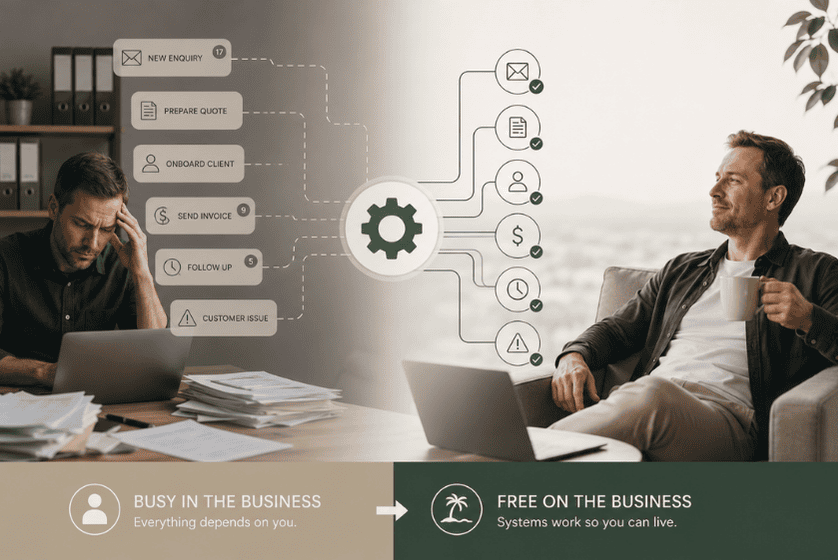
Instead of feeling like the owner, you feel like the busiest employee.

Your day becomes a constant stream of interruptions.

Emails.

Phone calls.

Staff questions.

Customer issues.

Approvals.

Problems.

By the time you sit down to work on something important, another interruption arrives.  

At the end of the day, you’re exhausted, but you struggle to explain what you actually achieved.

Sound familiar?

Here’s the truth. You’re probably not disorganised.You’re overloaded.

More importantly, you’ve become the centre of every decision in your business.

That’s not leadership.

That’s dependency.

And dependency is expensive.

The Business You Built Has Started Owning You

Every Time Your Business Stops When You Stop… You’ve Found a Bottleneck

Imagine walking through a factory.

Every machine is operating beautifully until suddenly everything comes to a halt.

You look around and discover one conveyor belt has stopped.

Every machine behind it is waiting.

Nothing can move until that one bottleneck starts again.

Businesses work exactly the same way.

Sometimes the bottleneck isn’t a machine.

It’s the owner.

If every quote waits for you…

You’re the bottleneck.

If every customer issue comes back to you…

You’re the bottleneck.

If every team member needs your approval…

You’re the bottleneck.

If nobody can make a decision unless you’re in the office…

You’re the bottleneck.

The difficult part is that most owners become the bottleneck because they care.

They want things done properly.

They’ve worked hard to build their reputation.

They believe no one will care as much as they do.

And they’re probably right.

Nobody will.

But that doesn’t mean nobody else can do an excellent job.

Why Smart Business Owners Accidentally Limit Their Own Growth

This is one of the biggest mindset shifts I teach.

Your value to the business changes as the business grows.

When you first start, your value comes from doing the work:

  • You’re wearing every hat.
  • You’re selling.
  • Delivering.
  • Quoting.
  • Marketing.
  • Bookkeeping.
  • Cleaning the office.
  • Making the coffee.

That’s perfectly normal.

But if you’re still doing all of those things five or ten years later, the business hasn’t evolved.

You’ve simply become busier.

Growth requires a different version of you.

Instead of doing everything… You start designing everything.

Instead of solving every problem… You build systems that prevent problems.

Instead of answering every question… You teach your team how to find the answer.

Instead of making every decision…You create clear guidelines that empower others to decide confidently.

That’s the transition from technician to CEO.

It’s one of the hardest transitions in business.

It’s also one of the most rewarding.

Control Feels Safe… Until It Doesn’t

Many owners tell me they struggle to let go because they’re afraid standards will drop.

I understand that.

You’ve spent years building your reputation.

But here’s the question I often ask.

What’s costing your business more?

The occasional mistake someone else might make, or the hundreds of decisions waiting for you every single week?

Perfection often becomes the enemy of growth. Healthy businesses don’t expect perfection. They build consistency. Consistency comes from systems.

Not superheroes.

Systems Create Freedom

People often hear the word “systems” and imagine thick manuals gathering dust on a shelf.

That’s not what I mean.

A system is simply the best way of doing something.

  • How do you answer enquiries?
  • How do you prepare quotes?
  • How do you onboard new clients?
  • How do you invoice?
  • How do you follow up overdue accounts?
  • How do you manage customer complaints?

Every time you repeat something, you have an opportunity to build a system.

Every system removes another decision from your day.

Over time those small improvements compound.

Eventually your business begins solving problems without needing you in the middle of every conversation.

That’s where freedom begins.

The True Test of a Healthy Business

One of my favourite questions to ask business owners is this:

“What would happen if you disappeared for four weeks?”

Most laugh.

Then they answer honestly.

“It would fall apart.”

Imagine if the opposite were true. Imagine taking a holiday knowing your team understood their roles. Customers were looked after. Invoices still went out. Cashflow continued. Problems were solved. Business continued.

Not because you weren’t important. But because you’d built something bigger than yourself.

That’s the difference between owning a job and owning an asset.

Building a Business That Someone Would Actually Buy

Many owners tell me they’ll sell their business one day.

Then I ask another question.

“What exactly would someone be buying?”

Silence.

Because if the owner is doing everything…

The buyer isn’t purchasing a business.

They’re purchasing a job.

Businesses become valuable when they can operate consistently without relying on one individual.

That’s why scalability and saleability go hand in hand.

The less dependent your business is on you, the more valuable it becomes.

Not only to a future buyer.

But to you.

Because suddenly you have choices.

  • You can step back.
  • You can grow.
  • You can take a holiday.
  • You can spend more time with family.
  • You can focus on strategy instead of survival.

That’s what business ownership was supposed to feel like.

The EDGE Philosophy

Everything I teach comes back to one simple belief.

Businesses shouldn’t just survive. They should create freedom.

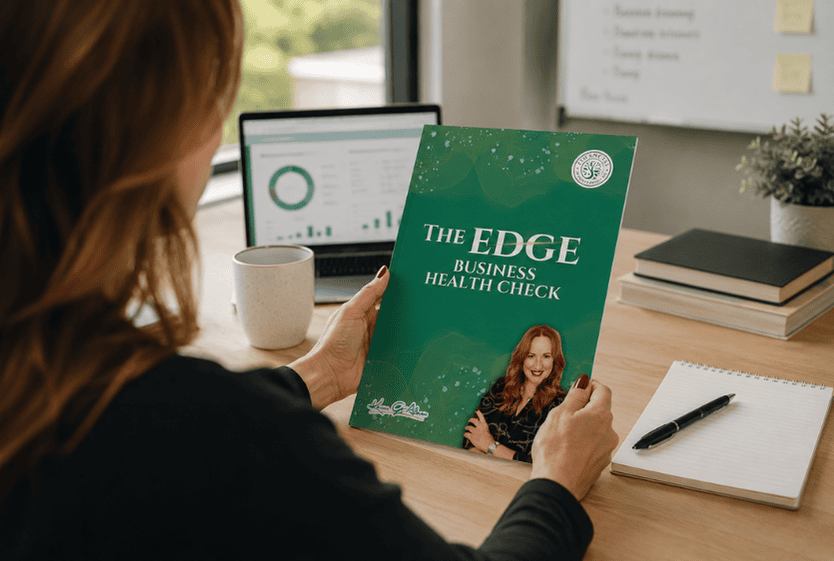
That’s why The EDGE Business Health Check exists.

It’s not simply measuring financial performance. It’s measuring the health of the business.

Healthy businesses don’t rely on luck. They don’t rely on heroic owners working eighty-hour weeks.

They rely on visibility.

Strong systems.

Clear leadership.

Healthy cash flow.

Profitable decisions.

And owners who understand that their role is no longer to be involved in everything.

Their role is to build a business that can thrive because of the foundations they’ve created.

Your Greatest Opportunity

If you’ve recognised yourself somewhere in this article, I hope you don’t feel discouraged.

I hope you feel encouraged.

Because the fact that you’ve become the bottleneck doesn’t mean you’ve failed. It means your business has reached a point where it needs a different version of you.

The next stage of growth isn’t about working harder. It’s about leading differently. It’s about trusting your team. Building systems. Understanding your numbers. Making decisions based on evidence, and gradually removing yourself from the centre of every process.

That’s not stepping away from your business.

That’s stepping into your true role as its leader.

One day, I hope you look back and realise that the greatest investment you ever made wasn’t another marketing campaign or another piece of equipment.

It was learning how to build a business that didn’t need you every minute of every day.

Because that’s when something remarkable happens.

You stop owning a job.

You start owning an asset.

And that’s the moment your business begins giving you what you wanted all along.

Freedom.

Ready to discover whether you’re the biggest bottleneck in your business?

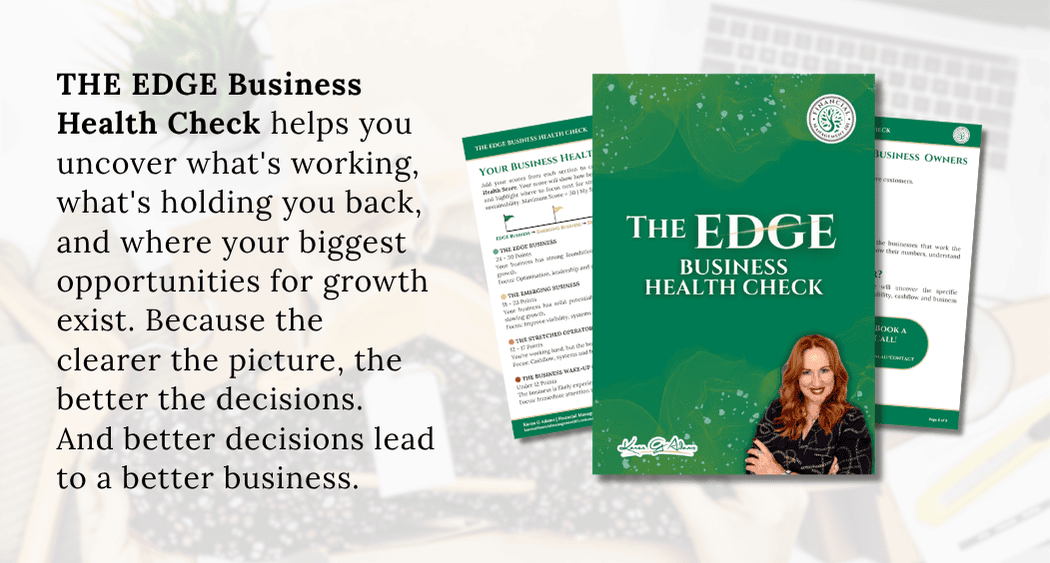
The EDGE Business Health Check helps you identify the areas that are limiting growth – from leadership and systems to cashflow, profitability and visibility. In less than 20 minutes, you’ll receive your Business Health Score and discover practical opportunities to build a business that’s more profitable, more scalable, more sustainable. and ultimately, more saleable.

Because healthy businesses don’t just happen.

They are built – one better decision at a time.

Systems Create Freedom
The EDGE Business Health Check helps you identify the areas that are limiting growth - from leadership and systems to cashflow, profitability and visibility.

#HowToResetMyMoneyMindset #NewYearFinancialMindset #HowToStartFreshWithMoney  emergency fund australia, money management, family savings #SmallBusinessOwner #BusinessGrowth #CashflowManagement #BusinessSuccess
#EntrepreneurMindset
 

Why Is Cashflow Always Tight?

Why Is Cashflow Always Tight?

The biggest reason small business owners struggle with money has nothing to do with how much they’re earning.

Have you ever looked at your bank account on a Friday afternoon and thought…

“Where has all the money gone?”

It’s one of the most common questions I hear from business owners.

You’ve been flat out.

The phone hasn’t stopped ringing.

The invoices are going out.

Customers are saying yes.

Your accountant tells you revenue has increased.

Yet somehow, you’re still wondering whether there’s enough money to pay wages next week, cover your BAS, replace a piece of equipment or simply pay yourself.

If that sounds familiar, I want you to know something.

You’re not alone.

And more importantly…

You’re probably asking the wrong question.

Most business owners ask:

“Why don’t I have enough money?”

The better question is:

“Where is my cash flowing?”

That one small change in thinking can completely transform the way you run your business. Because cash flow isn’t just about money. It’s about movement. It’s about timing. It’s about decisions.

And ultimately, it’s about the health of your business.

Cash Flow Is the Lifeblood of Every Business

We’ve all heard the saying that cash flow is the lifeblood of a business.

But have you ever stopped to think about why?

Imagine the human body.

Your heart beats around 100,000 times every single day, pumping blood through your arteries and veins.

That blood carries oxygen and nutrients to every organ, every muscle and every cell.

Without healthy blood flow, your body begins to struggle. Your organs don’t receive what they need. Your muscles weaken. Your energy drops.

Eventually, if blood flow stops completely, life stops with it.

Cash Flow Is the Lifeblood of Every Business

Business works exactly the same way:

  • Money is constantly moving.
  • Customers pay invoices.
  • Suppliers need paying.
  • Employees expect wages.
  • The ATO wants its share.
  • Software subscriptions are deducted.
  • Insurance renewals arrive.
  • Equipment breaks down.
  • Vehicles need servicing.
  • Marketing costs money.
  • Rent leaves your account every month whether you’ve had a good month or not.

Your business survives because money is continually flowing through it.

That’s why I prefer to think of cashflow as the circulation system of a business.

Profit is incredibly important.

But profit alone doesn’t keep a business alive.

Cash does.

I’ve seen businesses making healthy profits on paper that still couldn’t pay their bills.

I’ve also seen businesses with modest profits thrive because they managed their cashflow brilliantly.

The difference wasn’t how much they earned. It was how well they managed the movement of money.

The Bucket That Never Fills

One of the easiest ways to understand cashflow is to imagine trying to fill a bucket with water.

Revenue is the hose filling the bucket.

Expenses are the holes in the bottom.

Most business owners focus almost entirely on getting a bigger hose.

They chase more customers.

More advertising.

More sales.

More jobs.

More turnover.

Very few stop to ask:

“How many holes are already in my bucket?”

You can double the size of the hose.

But if the holes are getting bigger too, the bucket never fills.

That’s why so many businesses become busier without becoming wealthier.

The extra revenue simply leaks back out through rising wages, higher overheads, poor pricing, discounts, inefficient systems, rework, overdue invoices and unnecessary expenses.

The answer isn’t always earning more.

Sometimes it’s plugging the leaks.

Your Bank Balance Is Lying to You

This might surprise you.

Your bank account is one of the worst places to judge the health of your business.

I know that’s how many owners make decisions.

“We’ve got money in the bank.” “We’ll be okay.”

But the bank account only tells you one thing. How much money happens to be sitting there today.

It doesn’t tell you:

  • How much GST belongs to the ATO.
  • How much PAYG you’ve collected.
  • Whether your BAS is due next month.
  • How many supplier invoices are waiting to be paid.
  • Whether a major insurance renewal is coming.
  • Whether a customer still hasn’t paid a $20,000 invoice or
  • Whether next month’s payroll has already been committed.

In other words…

Your bank balance is a snapshot.

Cashflow is the movie.

One moment in time can never tell the whole story.

Healthy business owners learn to look ahead instead of only looking at today.

The Feast and Famine Cycle

If you’ve been in business for any length of time, you’ve probably experienced it.

  • One month feels incredible.
  • Money is flowing in.
  • You’re relaxed.
  • Confident.
  • Optimistic.

Then suddenly…

Everything slows down.

  • Invoices aren’t being paid.
  • Quoting becomes quiet.
  • Expenses keep arriving.
  • Stress starts creeping back in.

Welcome to the feast and famine cycle.

The problem isn’t always inconsistent income.

It’s inconsistent planning.

Healthy businesses understand what’s coming before it arrives.

They forecast. They build buffers. They prepare for quieter months. They know seasonal trends. They don’t wait until the bank account is screaming for help. They act before the pressure arrives.

That’s one of the biggest mindset shifts I teach business owners.

Stop reacting.

Start anticipating.

Because anticipation creates confidence.

The Real Job of a CEO

Many business owners believe their primary job is generating revenue.

I disagree.

Your first responsibility as a CEO is protecting cashflow.

Because cashflow gives you options:

  • It allows you to hire.
  • To invest.
  • To upgrade equipment.
  • To market confidently.
  • To survive economic uncertainty.
  • To pay yourself consistently.
  • To sleep at night.

Your first responsibility as a CEO is protecting cashflow.

Every decision you make either strengthens or weakens the circulation system of your business.

And when you begin seeing cashflow this way, something remarkable happens.

You stop chasing money.

You start managing it with intention.

That’s when business becomes less stressful, more predictable and infinitely more enjoyable.

Because healthy cashflow isn’t luck.

It’s a habit.

And like every healthy habit, it begins with awareness.

Want more awareness in your business then take a 20 minute “The EDGE Business Health Check” and see what’s happening with your cashflow.

Want more awareness in your business then take a 20 minute “The EDGE Business Health Check” and see what’s happening with your cashflow.

#HowToResetMyMoneyMindset #NewYearFinancialMindset #HowToStartFreshWithMoney  emergency fund australia, money management, family savings #SmallBusinessOwner #BusinessGrowth #CashflowManagement #BusinessSuccess
#EntrepreneurMindset

 

How Healthy Is My Business? The 7 Warning Signs Every Small Business Owner Should Know

How Healthy Is My Business? The 7 Warning Signs Every Small Business Owner Should Know

Most people wouldn’t drive their car for five years without having it serviced. We understand that regular maintenance prevents expensive breakdowns. Yet that’s exactly how many business owners run their businesses.

  • They work harder.
  • They sell more.
  • They hire more people.
  • They chase bigger goals.

But they rarely stop and ask one simple question…

“Is my business actually healthy?”

Because being busy isn’t a measure of health.

Neither is turnover.

Neither is having money in the bank this week.

A healthy business goes much deeper than that.

Businesses are a lot like people.

They have a heartbeat. They have warning signs. They become sick slowly. They recover slowly., and the healthiest ones don’t happen by accident. 

They happen because someone pays attention before little problems become big ones.

I’ve worked with business owners who looked incredibly successful from the outside.

  • Beautiful offices.
  • Busy workshops.
  • Phones ringing.
  • New vehicles.
  • Growing teams.
  • Yet behind closed doors…
  • The owner hadn’t paid themselves properly for months.
  • Cash flow was unpredictable.
  • Margins were shrinking.
  • Tax bills were keeping them awake at night.
  • Stress had become normal.

From the outside…

Healthy.

On the inside…

Critically unhealthy.

Does that sound familiar?

Business Health isn’t measured by one number.

It’s measured by dozens of indicators working together. Just like your own body.

You wouldn’t judge your health by stepping on a set of scales.

Your doctor looks at:

  • Blood pressure.
  • Heart rate.
  • Blood sugar.
  • Cholesterol.
  • Sleep.
  • Fitness.
  • Stress.
  • Lifestyle.

Business works exactly the same way.

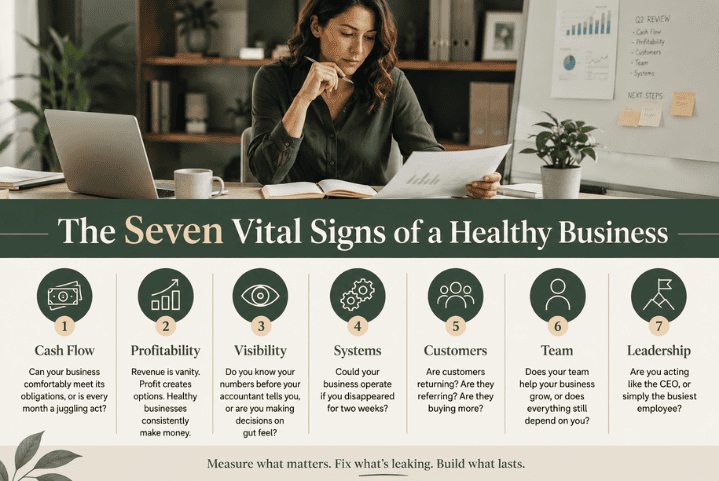
The Seven Vital Signs of a Healthy Business

The Seven Vital Signs of a Healthy Business

Not KPIs.

Not Metrics.

Vital Signs.

That language is unique.

1. Cash Flow

Can your business comfortably meet its obligations, or is every month a juggling act?

2. Profitability

Revenue is vanity. Profit creates options. Healthy businesses consistently make money.

3. Visibility

Do you know your numbers before your accountant tells you, or are you making decisions on gut feel?

4. Systems

Could your business operate if you disappeared for two weeks?

5. Customers

Are customers returning? Are they referring? Are they buying more?

6. Team

Does your team help your business grow, or does everything still depend on you?

7. Leadership

Are you acting like the CEO, or simply the busiest employee?

Healthy Businesses Don’t Just Make More Money.

  • They make better decisions.
  • They create calmer owners.
  • They employ happier teams.
  • They serve customers better.
  • They grow sustainably.
  • They survive difficult economies.
  • They become valuable assets.

Most importantly… They give owners something every entrepreneur wanted when they started…FREEDOM!

Because the healthiest businesses don’t simply generate income. They generate choices.

And that’s ultimately what every business owner is chasing.

Want to know the health of your business…then take the 20 minute “The EDGE Business Health Check” TODAY!

Take The EDGE Business Health Check today and discover where your next opportunity is hiding.

#HowToResetMyMoneyMindset #NewYearFinancialMindset #HowToStartFreshWithMoney  emergency fund australia, money management, family savings #SmallBusinessOwner #BusinessGrowth #CashflowManagement #BusinessSuccess
#EntrepreneurMindset