How Do I Build A Business That Runs Without Me?

How Do I Build A Business That Runs Without Me?

If the business relies on you for everything, you don’t own a business – you own a job!

Here’s how clearer systems and financial visibility create a business that can operate without you.

We hear a version of this from almost every business owner: “I can’t even take a week off without everything falling apart.” Or worse, “I did take a week off, and I’m still cleaning up the mess.”

If that’s familiar, please hear this: it’s not because you haven’t worked hard enough. It’s usually the opposite. You’ve worked so hard, for so long, that the business has quietly built itself around you being everywhere, all the time.

By the end of this, you’ll know the real reason most businesses stay dependent on their owner, and the two things; systems and financial visibility that actually change it.

1. In the beginning, you being everywhere was the right call

When a business starts, the owner touching everything isn’t a flaw. It’s often the only way to survive the early years; you’re the salesperson, the delivery, the bookkeeper and the decision-maker because there’s nobody else.

The problem isn’t that this happened. It’s that it kept happening long after the business could have supported something different.

The shift to make: recognise that what got the business started isn’t what will let it grow past you. Those are two different jobs.

2. Without documented systems, you’re the system

If a process only exists in your head, you are the process. Every new hire has to learn it directly from you, every exception gets escalated to you, and every “how do I…” question lands on your desk.

Systems don’t need to be complicated to work. They need to be written down, consistent, and followable by someone who isn’t you.

Check this: pick one task you do weekly. Could someone else follow written steps to do it the same way, without asking you a single question?

Without documented systems, you're the system

3. Delegating tasks isn’t the same as delegating decisions

Many owners delegate the doing but keep every decision for themselves. The team executes, but nothing moves without a final check from you, which means you’re still the bottleneck, just a busier one.

Real delegation means someone else has both the task and the authority to make the calls that go with it, within limits you’ve set.

Check this: notice how often your team’s questions could have been answered by them, if they’d had the context and the authority to decide.

4. If only you understand the numbers, the business still needs you

This is the piece most owners miss. Even with a great team and solid systems, if you’re the only one who can read the financial position of the business, every meaningful decision still funnels back through you.

Financial visibility – clear, regular, easy-to-read numbers – lets the right people make good decisions without needing you in the room. That might mean a manager, a bookkeeper, or simply you, on a rhythm that doesn’t require putting out fires to find the answer.

Check this: if you were unreachable for two weeks, could someone in your business still tell whether it was having a good month or a bad one?

5. Test it before you need it

The real test of a business that runs without you isn’t a plan, it’s a genuine trial. A few days away, phone down, seeing what actually breaks.

What breaks tells you exactly where the next system, the next handover of authority, or the next piece of financial visibility needs to go.

The Takeaway

A business that runs without you isn’t built by working harder or trusting your team more and hoping for the best. It’s built deliberately by documented systems, real decision-making authority for the people around you, and financial visibility that doesn’t depend on you being the only one who understands it.

Owning a business, not a job, comes down to whether it can function while you’re not in it. That’s not a one-off project. It’s a different way of building.

If you want a clear, structured path to building this kind of business, that’s exactly what The Edge is designed for.

My recommendation starts with doing a Business Health Check.

The EDGE Business Health Check in less than 20 minutes will help you uncover the blind spots, bottlenecks and hidden opportunities affecting your business.
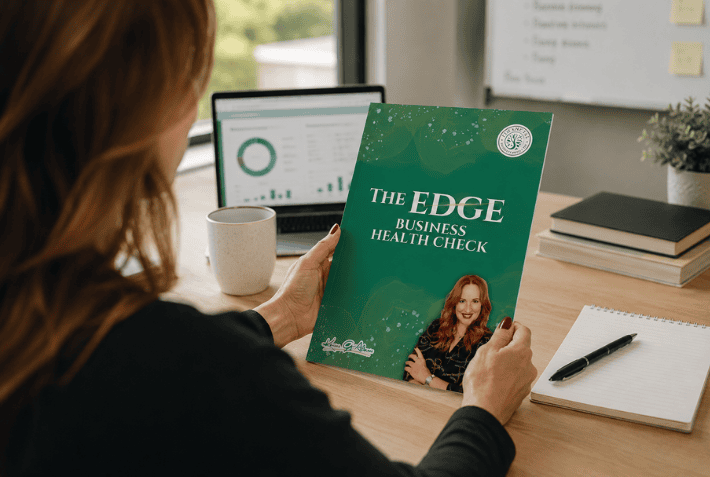
The Edge Business Health Check

#HowToResetMyMoneyMindset #NewYearFinancialMindset #HowToStartFreshWithMoney  emergency fund australia, money management, family savings #SmallBusinessOwner #BusinessGrowth #CashflowManagement #BusinessSuccess
#EntrepreneurMindset

 

R U OK? (The Question You Never Ask Yourself)

R U OK? (The Question You Never Ask Yourself)

On September 10, most of Australia will be asking each other “R U OK?” Workplaces will run morning teas. There’ll be yellow everywhere. It’s a genuinely good day, and I’m glad it exists – it’s done a lot for getting these conversations out into the open where they belong, after years of them staying firmly behind closed doors.

But here’s the question I actually want to ask you, business owner to business owner… when’s the last time you asked yourself that?

We’re brilliant at checking in on everyone else. Staff, clients, family, that one supplier who always sounds a bit frazzled on the phone. But most business owners I talk to haven’t had an honest conversation with themselves in months. We’re too busy holding everything together to notice we might not be, ourselves. We’re the ones people come to when something’s gone wrong, which means we’ve quietly trained everyone around us, including ourselves to believe we don’t need checking on.

Running a business is one of the loneliest jobs going, if I’m honest. You’re the one everyone brings their problems to. There’s rarely anyone bringing you theirs, asking how you’re actually tracking underneath it all. Even the people who love you tend to ask “how’s the business going?” rather than “how are you going?” and those are very different questions with very different answers.

The performance of “fine”

There’s a particular skill business owners develop without meaning to, the ability to say “yeah, good, flat out” in a completely convincing tone while privately feeling anything but. It becomes automatic. Someone asks how you’re going at the school pickup, at the football, at a client meeting, and out it comes before you’ve even thought about it. Over time, that automatic answer starts to replace the honest one, even in your own head. You stop checking because you’ve gotten so good at performing that you don’t seem to need it.

So today, let’s flip it. Three questions, and actual permission to answer them properly, without the reflexive “yeah, good, flat out” that we all give without thinking.

Am I okay, or am I just coping?

There’s a real difference. Coping looks like getting through the week in one piece, ticking things off, keeping the wheels on. Okay looks like genuinely enjoying the thing you built, feeling proud of it, curious about where it’s going, energised rather than depleted by it. If you’ve been in coping mode for a while now, that’s worth noticing, not brushing off with “it’s just a busy season,” because busy seasons have a habit of becoming permanent if nobody names them.

There’s no shame in “coping” as an honest answer. It’s often the truest thing a business owner has said about themselves in months, once they finally stop and let themselves say it. The shame only comes from pretending otherwise for too long.

What am I carrying that I haven't said out loud?
For a lot of business owners, it's the money. The gap between what the business brings in and what it feels like it should be bringing in by now, given how hard you're working.

What am I carrying that I haven’t said out loud?

For a lot of business owners, it’s the money. The gap between what the business brings in and what it feels like it should be bringing in by now, given how hard you’re working. That gap is heavy to carry on your own, and you really don’t have to. I’ve had conversations with business owners who’ve been sitting on that particular worry for years, silently, because it felt embarrassing to say out loud, like admitting it meant admitting they’d failed at something. It’s not embarrassing. It’s incredibly common, and it’s fixable once it’s actually spoken about, usually far more fixable than the years of silent worry suggested.

Sometimes what people are carrying isn’t even the money itself, it’s the fear of what the money says about them. That’s a heavier load than the actual numbers ever are.

Who’s actually in my corner?

Not staff. Not clients. I mean the people who ask how you’re going, not just how the business is going. If that list is short, that’s your sign; a mentor, a community, or even just a standing coffee with someone who genuinely gets what this life is like. Business ownership can be surprisingly isolating even when you’re surrounded by people all day, because being surrounded by people isn’t the same as being known by them.

The physical signs worth noticing

Sometimes the “am I okay” question is easier to answer by looking at the body rather than the mind. Are you sleeping properly, or lying awake running through tomorrow’s problems? Are you short-tempered with people who don’t deserve it? Have you stopped doing the small things that used to recharge you – the walk, the round of golf, the Sunday paper, because there’s “no time”? These aren’t small details. They’re often the clearest signal available that the tank’s getting low, well before the mind is ready to admit it in so many words.

It’s okay to not have the answer yet

If you sat with those three questions and didn’t love your answers, that’s not a failure, that’s information. The whole point of asking is so you can actually do something with what you find, rather than carrying it around unexamined for another six months. Awareness on its own doesn’t fix anything, but it’s the step that has to come first, and it’s the step most business owners skip entirely because it’s uncomfortable.

You can’t run a healthy business from an empty tank. Checking in on yourself isn’t soft, whatever the old-school hustle crowd would have you believe, it’s strategy, plain and simple. A business owner who’s running on empty makes worse decisions, snaps more easily, and enjoys less of what they’ve built. None of that helps the business either – it’s not a trade-off between looking after yourself and looking after the business. They’re the same job.

And if part of what’s weighing on you is the money side of things, that’s exactly what The Edge exists for. A place where you’re not carrying it solo, surrounded by other business owners asking each other the real questions instead of the polite ones.

Join The Edge: https://financialmanagement101.com.au/work-with-karen/the-edge/

And if today’s the day you actually need to talk to someone, Lifeline is on 13 11 14, any hour, no appointment needed.

What to do once you’ve asked yourself

Asking the question is the easy part, once you’ve actually made yourself do it. The harder part is what comes next, because most business owners are excellent at identifying a problem and then filing it away under “deal with that eventually.” So if any of the three questions above landed a bit close to home, don’t let it end there.

Pick one small thing. Not a complete overhaul of your life, not a dramatic announcement to everyone that you’re “making changes.” One small thing; a call to a friend you’ve been meaning to make, an actual look at the money situation you’ve been avoiding, a boundary around one evening a week that’s just yours. Small, specific, doable this week, not “someday.”

Business owners checking in on business owners

Business owners checking in on business owners

There’s a particular kind of relief that comes from talking to someone else who genuinely understands what this life involves – the highs that nobody else quite gets excited about the way you do, and the lows that nobody else quite understands the weight of either. Friends and family love you, but unless they’ve run a business themselves, there’s a layer of it they simply can’t relate to, however much they try.

That’s part of why community matters so much here. Not a support group in the clinical sense, just other people in the same boat, who ask “how are you really going” and actually mean it, who’ve had the sleepless nights over cash flow and the quiet pride over a client win, and who get it without you having to explain the whole backstory first.

THE EDGE Membership

#HowToResetMyMoneyMindset #NewYearFinancialMindset #HowToStartFreshWithMoney  emergency fund australia, money management, family savings #SmallBusinessOwner #BusinessGrowth #CashflowManagement #BusinessSuccess
#EntrepreneurMindset

 

Your Team Might Look Fine – But Financial Stress Could Be Costing More Than You Think

Your Team Might Look Fine – But Financial Stress Could Be Costing More Than You Think

“They seem fine.”

It is one of the most common assumptions leaders make.
And to be fair, it is an easy one to make.

Most employees are not walking into work announcing that they are worried about bills, debt, interest rates, or the rising cost of everyday life.

They keep going.
They keep performing.
They keep pushing through.

But financial stress has a way of showing up quietly.

It can look like a distraction.
Low energy.
Mood changes.
Reduced confidence.
Increased absenteeism.
Burnout.
Or eventually, a resignation that seems to come out of nowhere.

The employee looked fine.
But they were not fine.

The silent pressure many employees are carrying

The current financial climate is affecting people in deeply personal ways.
Even capable, high-performing employees can be under enormous pressure.

When money stress builds, people can feel:

  • mentally overloaded
  • emotionally flat
  • ashamed to ask for help
  • trapped in a cycle of stress and avoidance
  • worried about keeping up with household costs
  • fearful about debt, repayments, or unexpected expenses

And because money is still a sensitive topic, many employees suffer in silence.

That silence can be expensive.

The current financial climate is affecting people in deeply personal ways.
Even capable, high-performing employees can be under enormous pressure.

Why this is bigger than employee perks

Free lunches, social events, and workplace rewards all have their place.
But they do not solve financial anxiety.

When someone is lying awake worrying about bills, a pizza party is not going to restore their peace of mind.

This is why financial wellbeing deserves more attention inside workplaces.
It addresses a real problem that affects people’s everyday lives and their capacity to function well at work.

It is practical. It is human. And right now, it is incredibly relevant.

What financial wellbeing support actually does

A strong financial wellbeing approach helps employees move from stress and confusion to clarity and confidence.

That might involve helping them:

  • understand where their money is going
  • create simple systems that reduce overwhelm
  • identify savings opportunities they have missed
  • tackle debt with a clearer plan
  • improve money habits and mindset
  • feel more hopeful and less stuck

Notice that this is not about judgement. It is about support.

Financial pressure can affect anyone. The goal is not to shame people for needing help. The goal is to give them tools that genuinely make life feel more manageable.

What employers gain when they take this seriously

When businesses support staff with financial wellbeing, the impact can ripple through the whole workplace.

You may see:

  • better focus and engagement
  • increased productivity
  • lower staff turnover
  • stronger trust and loyalty
  • reduced burnout risk
  • a more supportive workplace culture

People remember employers who support them through hard seasons.
Not just with words, but with meaningful action.

Reassurance is part of support

Let’s pause here for something important.

If you are an employee feeling the pressure right now, please hear this:

You are not weak.
You are not bad with money just because things feel hard.
You are not the only one feeling stretched.

This season may be challenging, but it does not define you.
With the right support, practical tools, and small consistent changes, things can improve.

And if you are an employer reading this, never underestimate how powerful it is to create a workplace where people feel safe to get support before they hit breaking point.

    Reassurance is part of support

    Support before crisis is the smarter move

    Too often, workplaces respond after the damage is done.
    After the burnout.
    After the resignation.
    After the drop in performance.
    After the personal crisis spills into professional life.

    But early support changes that.

    When businesses proactively offer financial wellbeing resources, they help staff build resilience before the pressure becomes overwhelming.
    That is better for the employee and better for the organisation.

    A more compassionate and practical workplace benefit

    There is a reason financial wellbeing is becoming such an important conversation.
    It sits at the intersection of performance, retention, mental wellbeing, and culture.

    It is not about fixing everything overnight.
    It is about giving people a starting point.
    A plan.
    A sense that they are not alone.
    A pathway back to confidence.

    And in uncertain times, that kind of support matters more than ever.

    My Financial Wellbeing Program helps workplaces support staff with practical money tools, confidence-building education, and real guidance that reduces stress and strengthens wellbeing.

    Because when your people feel better about money, they often feel better at work too.

    And that is good for everyone.

    Financial Wellbeing Program

    #HowToResetMyMoneyMindset #WhyDoIFeelOutOfControlWithMoney #HowToFeelInControlOfFinances #ResetMoneyMindset2025 #NewYearFinancialMindset #HowToStartFreshWithMoney  emergency fund australia, money management, family savings 


    Busy Is Not Profitable: 7 Financial Foundations Every Business Owner Needs

    Busy Is Not Profitable: 7 Financial Foundations Every Business Owner Needs

    There’s a big myth in small business that if you just work hard enough, everything will eventually click into place.

    Spoiler alert: hard work matters, but hard work without financial foundations can leave you exhausted, underpaid, and wondering why your business still feels so heavy.

    I see this all the time with small business owners, tradies, franchisees, coaches, and self-employed professionals.

    They are flat out. Clients are coming in. Invoices are going out. The calendar is packed.

    And yet… There is still stress. Still pressure. Still that sinking feeling of, “Why does it feel like I’m doing all this work and not getting ahead?”

    Here’s why:

    Because busy is not profitable. And being great at your trade or profession is not the same as having strong money systems.

    The good news? You do not need a finance degree to fix this. You just need the right foundations.

    Here are seven of the most important ones.

    1. A cashflow system that tells the truth

    Cashflow is not something you check when you are already in trouble.
    It is something you build so you can stay out of trouble.

    A good cashflow system shows you:

    • what is coming in
    • what is going out
    • what bills are approaching
    • what is available to spend
    • what needs to be set aside for tax, super, wages, and future costs

    Cashflow gives you visibility. Visibility gives you control.

    2. Clear separation between personal and business money

    Using your personal account like a business overdraft creates confusion fast.

    It becomes harder to track spending, harder to know what the business is really earning, and harder to make clean decisions.

    Separating business and personal finances is one of the fastest ways to reduce chaos.
    It is not about being fancy. It is about being clear.

    3. Pricing that actually protects your profit

    So many business owners price from fear.

    Fear of losing the sale.
    Fear of seeming too expensive.
    Fear of being judged.

    But underpricing does not make you more professional. It makes your business more fragile.

    Your pricing needs to cover more than the job in front of you. It needs to reflect overheads, admin time, tax obligations, profit goals, and the actual value you deliver.

    Pricing with confidence is not greedy.
    It is responsible.

    4. A plan to pay yourself properly

    Using your personal account like a business overdraft creates confusion fast.

    It becomes harder to track spending, harder to know what the business is really earning, and harder to make clean decisions.

    Separating business and personal finances is one of the fastest ways to reduce chaos.
    It is not about being fancy. It is about being clear.

    5. Weekly and monthly money rhythms

    You do not need to stare at your numbers every day.
    But you do need a rhythm.

    That might include:

    • checking cashflow weekly
    • reviewing key reports monthly
    • monitoring expenses and margins
    • tracking unpaid invoices
    • spotting small issues before they turn into big ones

    Confidence with numbers is built through repetition, not perfection.

    6. Knowing your numbers without drowning in them

    You do not need to obsess over every metric.
    You do need to know the numbers that matter.

    Think:

    • revenue
    • gross profit
    • operating expenses
    • net profit
    • cash position
    • debt levels
    • wage costs
    • tax set-asides

    The goal is not more complexity.
    The goal is better decisions.

    When you know what your numbers are saying, you stop making emotional decisions and start making strategic ones.

    7. A business structure that can handle growth

    Growth is exciting, but if your systems are messy, it can magnify every weakness.

    That is why foundations matter before scaling.

    You want business systems that support:

    • clear accounts setup
    • simple automations
    • better reporting
    • cleaner budgeting
    • stronger decision-making
    • less burnout

    Strong structure makes growth feel possible instead of painful.

    Business foundations create freedom

    Why this matters right now

    The business landscape is not getting easier.
    Costs are rising. Margins can be tight. Pressure builds quickly when you do not have clarity.

    That is exactly why now is the time to stop relying on memory, hope, and hustle alone.

    The strongest business owners are not always the loudest or busiest.
    They are the ones who know their numbers, trust their systems, and make decisions early.

    Foundations Create freedom

    Let’s make this simple. When your financial foundations are solid, you get:

    • less panic
    • less avoidance
    • less confusion
    • better decisions
    • stronger profit
    • more confidence
    • more breathing room

    And honestly? More enjoyment.

    Because business should not feel like one long financial mystery.

      A business structure will help you handle growth

      Your invitation to stop winging it

      If you know your foundations need work, you are not alone.
      And you do not have to figure it all out the hard way.

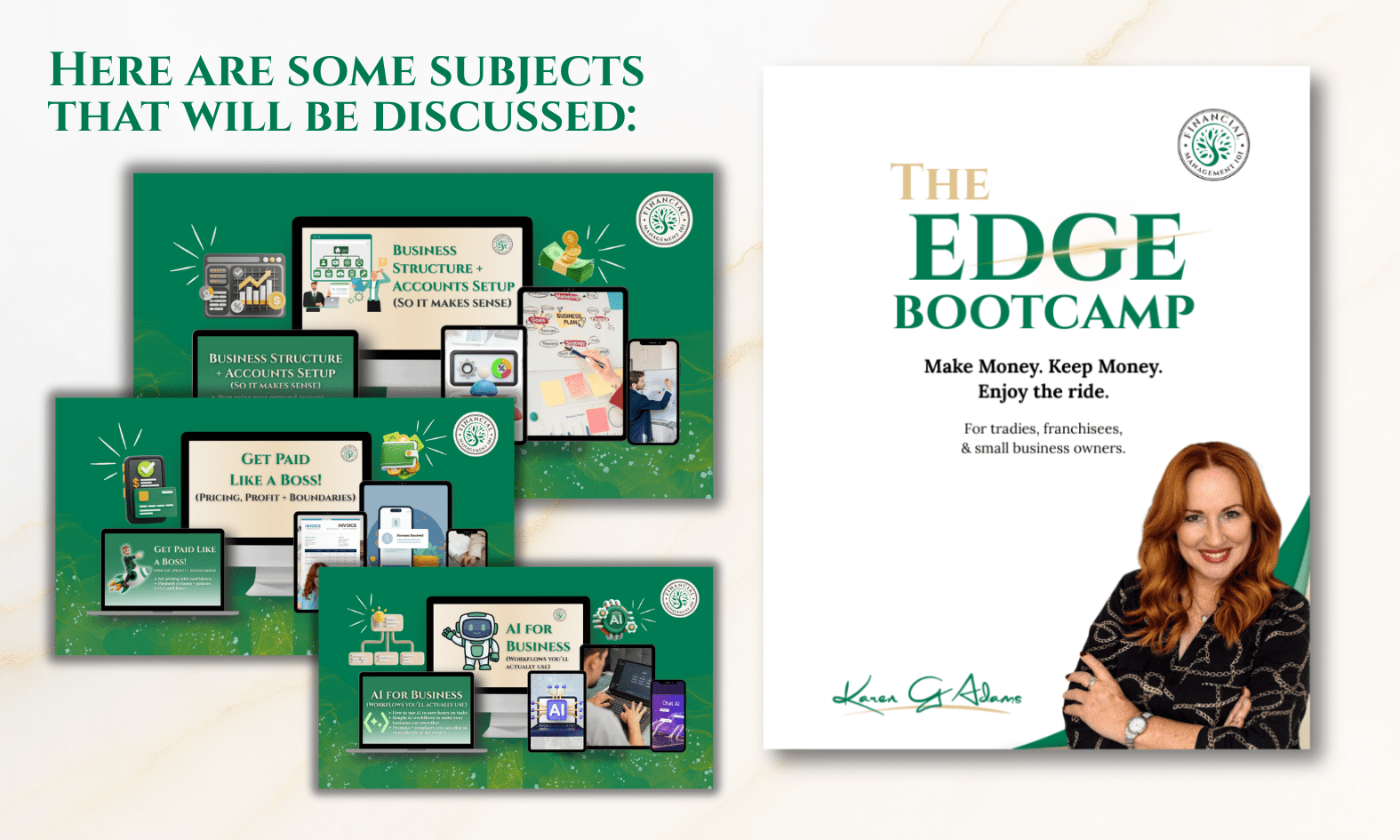
      That is exactly what The Edge Bootcamp is designed to help you do.

      Over two practical, high-impact days, we dig into the real foundations of profitable business: money systems, CEO mindset, cashflow, paying yourself, pricing, budgets, business setup, reading your numbers, leadership, growth stages, and more.

      This is for business owners who want results, not just motivation.

      Join The Edge Bootcamp in May and give your business the foundations it needs to make money, keep money, and enjoy the ride.

      Because being flat out is not the goal.
      Building a business that works for you is.

      Join The Edge Bootcamp

      #HowToResetMyMoneyMindset #WhyDoIFeelOutOfControlWithMoney #HowToFeelInControlOfFinances #ResetMoneyMindset2025 #NewYearFinancialMindset #HowToStartFreshWithMoney  emergency fund australia, money management, family savings 


      Tax Time Without the Panic – The Simple Systems That Keep More of Your Hard-Earned Money

      Tax Time Without the Panic – The Simple Systems That Keep More of Your Hard-Earned Money

      Tax Time Shouldn’t Feel Like a Horror Movie

      If “BAS” makes your eye twitch or tax time feels like a jump scare, you’re not alone.

      For many business owners, tax time looks like:

      • digging through email for receipts
      • trying to remember what that transaction was
      • realising GST money has been accidentally spent
      • asking your accountant, “Is this bad?” 😅
      • promising yourself (again) that you’ll get organised next year

      Whether you’re a tradie, franchisee, coach, consultant, or self-employed professional, it’s easy for tax to become the thing you avoid… until you can’t.

      But here’s the thing:
      Tax panic isn’t a personality trait. It’s a system issue.

      And the solution isn’t “try harder.”
      It’s: build foundations that make tax time boring.

      Boring is the goal.
      Boring means organised.
      Boring means you’re in control.

      The Real Reason Tax Time Feels So Stressful

      Most tax stress comes from one (or more) of these:

      1) You’re spending money that isn’t actually yours

      If GST/tax isn’t separated, the bank balance lies.

      It looks like there’s cash available… but a chunk of that cash belongs to the ATO (or will soon). So when BAS hits, it feels like a crisis.

      2) Your numbers aren’t clean

      Mixed transactions, personal spending from business accounts, inconsistent invoicing, missing receipts – these all make reporting harder.

      And when reporting is hard, you avoid it.

      3) You don’t have a simple routine

      If you only look at your money when something is due, you’ll always be reacting.

      4) You’re not clear on what’s “normal”

      Many owners don’t know what to expect from their obligations (GST, PAYG, super, income tax, etc.). That uncertainty turns into anxiety.

      The fix is not complicated, but it does require a shift from reactive to proactive.

      Owner Pay Is the Cornerstone of a Healthy Business

      The “Tax Calm” Blueprint (Simple, Practical, Repeatable)

      Let’s build tax calm from the ground up.

      Step 1: Separate business and personal (because clarity = calm)

      This is the first domino.

      When business and personal are mixed:

      • profit looks different than it really is
      • expenses get miscategorised
      •  your accountant has to untangle it (costly + time-consuming)

      •  BAS reporting becomes messy

      • tax estimates become unreliable

      When you separate them, your numbers get clearer fast. Even if you’re not ready to overhaul everything, start with this:

      • separate bank accounts (or at least strict allocation “buckets”)
      • a clear rule: business expenses only from business, personal only from personal
      • owner pay transferred as owner pay (not random withdrawals)

      This one change reduces stress massively.

      Step 2: Quarantine GST/tax weekly (so it never surprises you again)

      If you do nothing else after reading this blog, do this one thing.

      When GST and tax are quarantined weekly:

      • you stop “accidentally spending” future obligations
      • BAS becomes a planned payment
      • your cash flow becomes more reliable
      • you feel calm because you know the money is there

      A simple habit: Each week (or each time income lands), transfer a percentage into a tax/GST bucket

      The right percentage depends on your structure and circumstances (and this is where your accountant or qualified adviser can guide you). But the foundation is non-negotiable:

      Set aside first. Spend second.

      Step 3: Create a weekly money routine (30 minutes that changes everything)

      You don’t need a full day of admin.

      You need a repeatable routine.

      Pick one day per week – your “money check-in.”

      On that day, you:

      1. review what came in
      2. allocate GST/tax set-aside
      3. check bills due in the next 7 – 14 days
      4. confirm owner pay
      5. quickly check that transactions are being categorised correctly
      6. look at ONE key number (margin, break-even, or cash runway)

      That’s it.

      This is how tax time becomes boring, because you’ve been managing it in small pieces all year.

      Step 4: Keep records simple (no one’s trying to win an admin award)

      Receipts and records are one of the biggest stress points, so let’s make it easy.

      Your goal is not “perfect bookkeeping.”
      Your goal is “good enough that nothing becomes a disaster.”

      Simple record habits that help:

      • snap receipts immediately (or forward them to a dedicated email)
      • keep a consistent filing approach (even if it’s just “by month”)
      • reconcile regularly (weekly or fortnightly)
      • don’t leave it until BAS is due

      Future you will thank you.

      Step 5: Understand the 3 reports that remove the fear

      You don’t need to become an accountant, but you do need to feel confident in the basics.

      These three reports reduce stress instantly:

      1. Profit & Loss (P&L): tells you if the business is making money
      2. Balance Sheet (basic understanding): tells you what the business owns/owes
      3. Cash Flow position: tells you what’s actually available and what’s coming

      You’ll build confidence understanding key reports, including Xero if you use it (and the principles still apply if you use other systems).

      Confidence with these reports is what stops tax time feeling like a mystery.

      The Hidden Cost of Tax Panic (It’s Not Just the Bill)

      Tax panic doesn’t only cost you money. It costs you:

      • time (scrambling, chasing receipts, fixing mistakes)
      • stress (constant background anxiety)
      •  decision fatigue (avoiding choices because you don’t trust your numbers)

      • opportunity (hesitating to invest, hire, grow, or take time off)


      When your numbers are clean and your system is simple:

      • you price more confidently
      • you choose better clients 
      • you stop discounting out of fear
      • you plan ahead instead of catching up 
      • you keep more of what you earn (because you stop leaking money through chaos)

      Common “Tax Time Traps” (and how to avoid them)

      Here are the patterns I see all the time:

      Trap #1: “I’ll sort it out when it’s quieter”

      If you’re a tradie or franchisee, it might never get quieter.
      If you’re a coach/consultant, the quiet seasons are often when you’re building the next offer.

      Solution: a weekly rhythm. It’s small enough to do even when busy.

      Trap #2: “My accountant will handle it”

      Your accountant is essential, but they shouldn’t be your emergency clean-up crew.

      Solution: you handle the foundation; they handle the strategy and compliance.

      Trap #3: “I’m scared to look”

      Avoidance creates bigger problems.

      Solution: start with one number, one routine, one week at a time.

      Trap #4: “I don’t use Xero so I can’t get organised”

      Tools help, but tools aren’t the solution.

      Solution: the system works regardless of platform. (Xero is just a tool; your habits are the strategy.

      What “Tax Calm” Looks Like in Real Life

      When you’ve built foundations, tax time becomes:

      • “Yep, that’s due – money’s already set aside.”
      • “My reports make sense.”
      • “My accountant has what they need.”
      • “I’m not guessing.”
      • “I’m not panicking.” 

      And here’s the best part: When tax becomes calm, you stop running your business from stress. You start running it from strategy.


      When tax becomes calm, you stop running your business from stress.
You start running it from strategy.

      How The Edge Bootcamp Supports This (and why it’s perfect before EOFY planning)

      The Edge Bootcamp is designed for business owners who want more profit, better systems, cleaner numbers, and less overwhelm.

      You’ll walk away with:

      • a simple money system
      • clearer separation between business and personal finances
      • confidence understanding Xero and key reports
      • and a clear 90-day implementation plan so you know what to do first, next, and next

      Tickets include:

      • the 2-day live bootcamp
      • digital resources
      • templates
      • 90-day action plan tools

      And yes, recordings are provided after the event for ticket holders.

      If you’re thinking, “I’m behind and embarrassed,” this is a practical and judgement-free event – designed to help you build confidence step-by-step.

      You can attend:

      So whether you’re based in Perth, Fremantle, East Fremantle, regional WA, interstate, or juggling a packed schedule, you can still get the foundations in place.

      Want Tax Time to Be Boring (In the Best Way)?

      If you’re ready to stop the stress spiral and build a simple system that makes tax time calm, cash flow predictable, and owner pay consistent…

      ✅ Join The Edge Bootcamp (2-day live event)
      ✅ Attend in person at East Fremantle Yacht Club or live online
      ✅ Get templates + digital resources + your 90-day action plan tools included
      ✅ Receive recordings after the event so you can rewatch while you implement

      CTA: Book your spot for The Edge Bootcamp and walk away with the foundations to manage your business and finances with clarity, confidence, and a plan.

      Note: This is general education only, not personalised financial, tax, accounting, legal, health, or investment advice. Please seek advice from qualified professionals for your specific circumstances.

      Join The Membership at Financial Management 101

      #HowToResetMyMoneyMindset #WhyDoIFeelOutOfControlWithMoney #HowToFeelInControlOfFinances #ResetMoneyMindset2025 #NewYearFinancialMindset #HowToStartFreshWithMoney  emergency fund australia, money management, family savings