Yesterday we worked out how much cash your business should keep on hand. Today’s question sits right underneath it: how much do you need to sell each month just to cover your costs? That number is your break-even point, and once you know it, a lot of decisions get easier.
By the end of this post you’ll know the simple formula, the two numbers you need, how to use it for pricing and hiring, and how the Christmas shutdown weeks change your monthly target. There’s an illustrative worked example the whole way through.
THE SHORT ANSWER
What is a break-even point?
It’s the level of sales where your total revenue equals your total costs, so you make no profit and no loss. Business Queensland’s simple formula is: break-even point = fixed costs ÷ gross profit margin (Business Queensland). Every dollar of sales above that point starts contributing to profit.
$0
profit or loss at break-even: revenue equals total costs. (Business Queensland)
17 days
working days in December 2026 if you close from 24 December. Illustrative.
3
weekday public holidays over the break: 25 Dec, 28 Dec, 1 Jan. (Fair Work Ombudsman)
Why does my break-even point matter?
Because turnover can look great while the business quietly runs at a loss. Business Queensland says knowing your break-even point helps you make decisions about your selling prices, set a sales budget and prepare your business plan (Business Queensland).
It also tells you how far sales can drop before you make a loss, and how much more you’d need to sell to cover an increase in fixed costs (Business Queensland). That’s exactly the question to ask before you hire, sign a new lease or buy a vehicle.
What numbers do I need?
1. Your fixed costs
These are the costs that stay the same no matter how much you sell. Business Queensland lists things like rent, insurance and accounting, licence fees, utilities and depreciation (Business Queensland).
Two more belong in there. First, your own pay: Business Queensland says your operating expenses should include the wages or drawings you pay yourself (Business Queensland). Second, in many trades and service businesses, permanent staff are paid whether the work is there or not, so their wages and super behave like fixed costs. Super guarantee is 12% of qualifying earnings (ATO). Ask your accountant how to split your wages between fixed and variable.
Good to know: Your profit and loss statement is where these numbers live. Business.gov.au says it lists your sales and expenses and can help you develop sales targets and the right price for your goods or services (business.gov.au).
2. Your gross profit margin
Gross profit is your revenue less the cost of goods sold, such as materials and subcontractors. Gross profit margin = gross profit ÷ total revenue × 100, shown as a percentage (Business Queensland). My post on what a good gross profit margin is walks you through checking yours.
How do I work out my break-even point?
Here are the steps. You’ll need your last 12 months of profit and loss, or your budget for the year ahead.
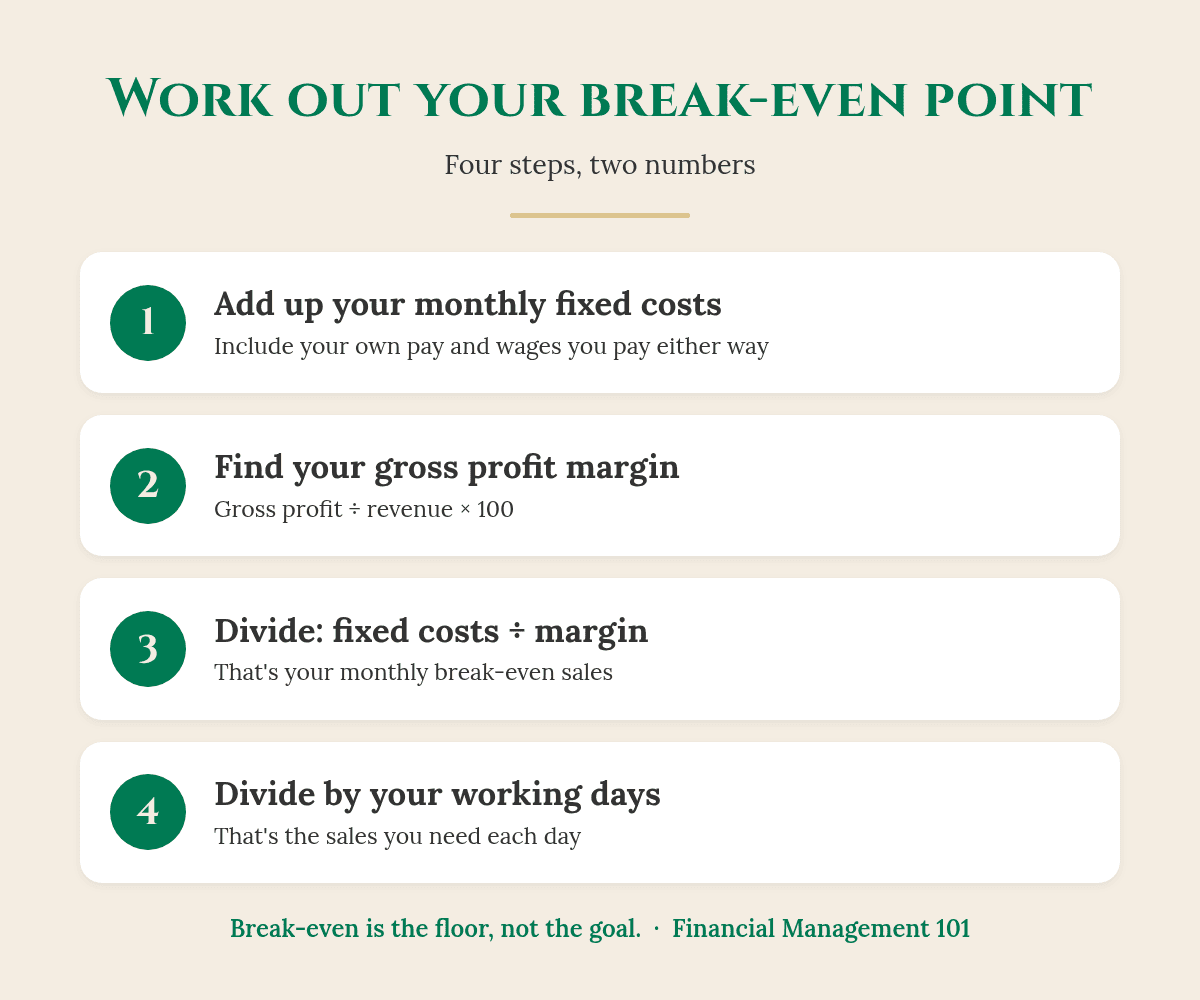
- Add up your monthly fixed costs, including your own pay and the wages and super you pay either way.
- Find your gross profit margin as a percentage.
- Divide your fixed costs by your margin (as a decimal, so 60% is 0.60). The answer is your monthly break-even sales.
- Divide by your working days in the month to get a daily sales target.
What does this look like in dollars?
Here’s an illustrative example (made-up numbers to show the method, not a real client). It’s Mia’s electrical business from yesterday’s post. Her essential costs are $10,020 a week: wages for 4 staff, super, overheads and her own pay. That’s $43,420 a month ($10,020 × 52 ÷ 12).
- Monthly fixed costs: $43,420.
- Gross profit margin after materials and subcontractors: 60%.
- Monthly break-even sales: $43,420 ÷ 0.60 = $72,367.
- In a normal month with 22 working days: $72,367 ÷ 22 = $3,289 of sales a working day.
So Mia needs about $72,000 of sales a month before she makes a dollar of profit. Anything above that contributes to profit.
How does the Christmas shutdown change my target?
Here’s where it gets interesting. Your fixed costs don’t take a holiday. Rent, insurance and loan repayments still come out. If your team takes paid annual leave, wages and super are still paid. But you have fewer days to earn the sales that cover them.
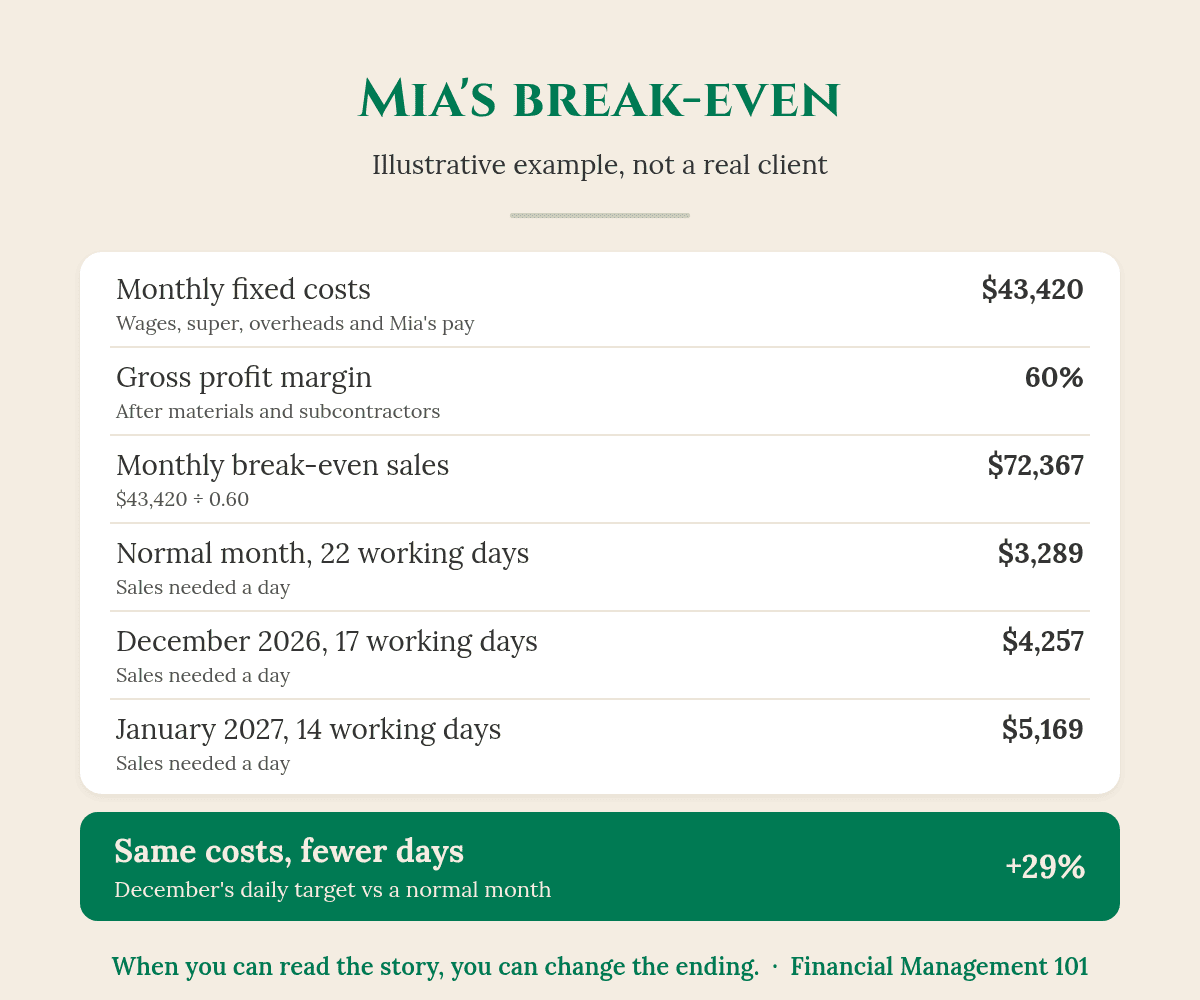
Mia closes from Thursday 24 December and reopens on Monday 11 January. Friday 25 December, Monday 28 December and Friday 1 January are public holidays (Fair Work Ombudsman, 2026 and 2027), and they fall inside her shutdown anyway.
- December 2026: 17 working days (1 to 23 December). $72,367 ÷ 17 = $4,257 a day.
- January 2027: 14 working days (11 to 29 January, minus Australia Day on Tuesday 26 January). $72,367 ÷ 14 = $5,169 a day.
- Compared with a normal month: December’s daily target is about 29% higher, and January’s about 57% higher.
Watch out: This is why December can feel busy and still come up short. The work you do in the first three weeks has to carry the whole month.
So what does this actually look like?
Mia has three choices, and she’ll probably use all of them. She can sell more in the weeks she’s open, by booking in the jobs that are ready and invoicing as soon as they’re done. She can plan the gap with the cash buffer from yesterday’s post, so the shortfall is covered by cash she set aside on purpose. And she can look at the whole year, not just one month: if the other ten months run comfortably above break-even, two short months are a plan, not a problem.
She also gives her team the right notice for the shutdown. My post on paying staff over the Christmas shutdown covers how that works.
Check this first: Count your working days in December and January before you set your targets. Then divide your monthly break-even by those days, not by a normal month.
How can I use my break-even point?
Before you hire
A new cost needs new sales to cover it. To find out how much, divide the extra monthly cost by your gross profit margin. Using Mia’s illustrative numbers, a new cost of $4,000 a month needs about $6,667 more sales a month at a 60% margin ($4,000 ÷ 0.60).
Before you drop a price
A discount lowers your gross profit margin, which pushes your break-even point up. Business Queensland lists checking whether reducing price or volume will affect your profit as one of the things break-even helps you work out (Business Queensland). My post on raising your prices without losing customers covers the other direction.
When you set a profit goal
Break-even is the floor, not the goal. Business Queensland’s minimum sales formula adds your profit goal: minimum sales = (fixed costs + profit goal) ÷ gross profit margin (Business Queensland). If Mia wants a $10,000 monthly profit on top of her pay, she needs ($43,420 + $10,000) ÷ 0.60 = $89,033 of sales a month (illustrative).
Is break-even the same as cash flow?
No. Business Queensland points out that profit is not the same as the cash in the bank (Business Queensland). You can sell above break-even in December and still be short of cash in January if customers pay late, the BAS is due or you’ve bought materials up front. That’s why you need both numbers: break-even for profit, and a cash buffer for timing.
Where your accountant and bookkeeper fit in
Your bookkeeper makes sure costs are coded correctly, so your gross profit margin is real. Your accountant can help you decide which costs are fixed and which are variable for your business, and check your figures. Business Queensland also suggests talking to your accountant or bookkeeper when you plan (Business Queensland). My job is to help you use the number every month to make better decisions.
Break-even is the floor, not the goal.
Your takeaway
- Your break-even point is the sales level where revenue equals costs: no profit, no loss.
- Break-even point = fixed costs ÷ gross profit margin.
- Put your own pay, and wages you pay either way, in your fixed costs.
- The Christmas shutdown doesn’t change your monthly costs. It cuts the days you have to cover them.
- Divide your break-even by the working days in December and January, not a normal month.
- Break-even isn’t cash. Pair it with a cash buffer for the timing gaps.
Want to see where your profit is going?
Start with The EDGE Business Health Check. It’s a $47 workbook that takes about 20 minutes. You score 30 quick statements across five areas: Profit & Pricing, Cashflow, CEO Visibility, Systems & Freedom, and Growth. Then the Profit Leak Calculator shows where money may be slipping away, and the 7-Day Reset gives you clear next steps.
Rather talk it through first? Get in touch and book a call with me.
Frequently asked questions
What is the break-even formula?
Business Queensland’s simple formula is break-even point = fixed costs ÷ gross profit margin. Use your margin as a decimal, so 60% is 0.60. It’s a simplified formula, so check your figures with your accountant.
Should I include my own wage in my break-even point?
Yes. Business Queensland says your operating expenses should include the wages or drawings you pay yourself. Otherwise your break-even shows the point where the business covers everything except you.
Are staff wages a fixed cost or a variable cost?
It depends on your business. Business Queensland lists labour as a variable cost, but in many trades and service businesses, permanent staff are paid whether the work is there or not. Ask your accountant how to split your wages.
How does a Christmas shutdown affect my break-even point?
Your monthly break-even stays about the same, because your fixed costs keep going. What changes is the number of working days you have to reach it, so the sales you need each working day go up.
What’s the difference between break-even and a profit goal?
Break-even covers your costs with nothing left over. A profit goal adds the profit you want: minimum sales = (fixed costs + profit goal) ÷ gross profit margin.
How often should I check my break-even point?
Whenever your costs or prices change, and at least when you set your budget. It’s worth checking before you hire, sign a lease, change your prices or plan a shutdown.
You’ve built something real. Know the number that keeps it standing.
Karen G. Adams
Small Business Performance Strategist, Financial Management 101
Too Big To Wing It. Too Small To Need A CFO.
This article is general education only. It isn’t tax or financial advice, and it doesn’t take your circumstances into account. The break-even and minimum sales formulas are Business Queensland’s simplified formulas; public holiday dates are from the Fair Work Ombudsman; the super rate is from the ATO, as at 10 November 2026. Mia’s business and its figures are illustrative, not a real client. Check your own figures with your accountant.