The restaurant’s booked, the playlist is sorted, and someone in the office asks: is the Christmas party tax deductible? It’s one of the most searched questions this time of year, and the honest answer surprises people. Often, no. But that usually comes with no fringe benefits tax (FBT) either, which is a good trade.
This post covers what the ATO says about parties on and off your premises, the $300 minor benefit rule, gifts, GST credits and clients at your party, with an illustrative worked example so you can see the dollars.
THE SHORT ANSWER
Is the staff Christmas party tax deductible?
Only if it’s subject to FBT. The ATO says that if your Christmas party isn’t subject to FBT, you can’t claim an income tax deduction for its cost. A party on your premises on a working day for staff only, or one under $300 a head, usually has no FBT, so no deduction or GST credits either (ATO).
$300
per person: under this, a party or gift can be an FBT-free minor benefit. (ATO)
$0
FBT on food and drink for staff on your premises on a working day. (ATO)
No FBT
usually means no deduction or GST credits for the party. (ATO)
What does the ATO say about Christmas parties?
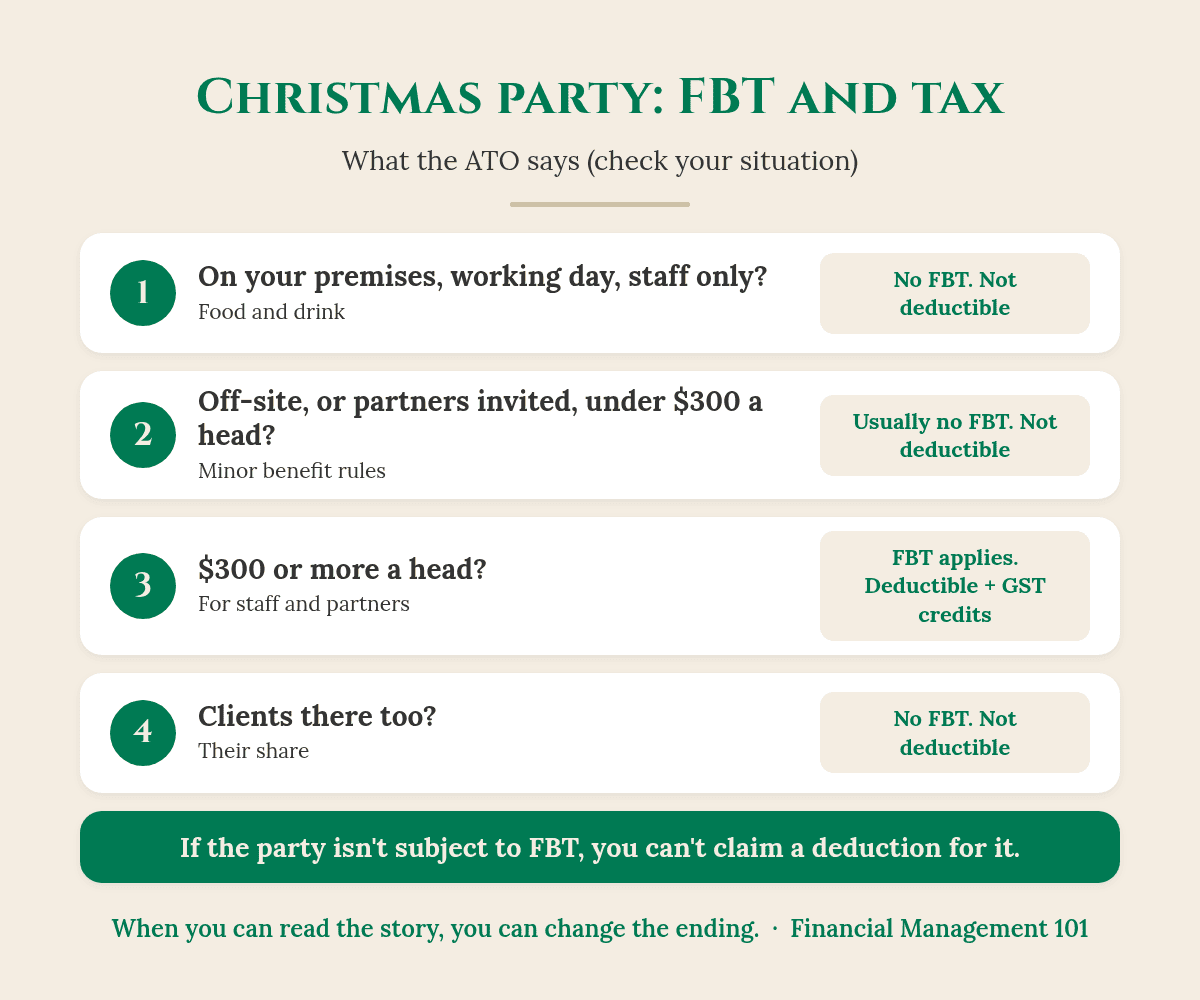
Here are the four situations the ATO sets out for commercial businesses. FBT depends on how much you spend on each person, when and where the event is held, who attends, and the value and type of any gifts (ATO).
1. On your premises, on a working day, staff only
If your party is held on a working day, on your business premises, and only for your current employees, you don’t pay FBT for the food and drink (ATO). Think of a Friday afternoon barbecue at the workshop. No FBT, and no income tax deduction or GST credits for the food and drink.
Good to know: The ATO’s FBT guide says the cost of associates (such as partners) at an on-premises party isn’t covered by that exemption (ATO). Their share can still be FBT-free under the minor benefit rule below.
2. Off-site, or partners invited: the $300 minor benefit rule
If the party is off your premises, or includes associates of employees such as partners, you don’t pay FBT if it’s a minor benefit. That means the cost for each person is less than $300 and it would be unreasonable to treat it as a fringe benefit (ATO).
A few details matter here (ATO):
- It’s per person, not per party. Benefits to associates aren’t added to the employee’s when you work out whether each is under $300.
- Connected benefits are looked at separately for the $300 test, such as a meal and taxi travel, but their total still counts when deciding whether it’s reasonable to treat them as fringe benefits.
- Frequency matters. The more often and regularly a benefit is given, the less likely it is to be exempt. A once-a-year party is very different from a weekly team lunch.
3. $300 or more per head
Once the cost per person reaches $300, the minor benefit exemption doesn’t apply. FBT is payable on the benefits to employees and their associates. In the ATO’s golf day example, where FBT applies, the employer can claim an income tax deduction and GST credits for the cost, plus a deduction for the FBT paid (ATO).
4. Clients at your party
There’s no FBT on the costs for clients. But the costs of entertaining clients aren’t income tax deductible either (ATO), and in the ATO’s on-premises example the employer can’t claim GST credits for the clients’ food and drink (ATO).
Watch out: Some businesses have elected a different method for valuing meal entertainment, such as the 50:50 split method. The ATO says the on-premises exemption works differently in that case (ATO). If you’re not sure which method your business uses, ask your agent/accountant before the party.
Why isn’t the party deductible if there’s no FBT?
Because the two are linked. The ATO’s guide puts it plainly: the cost of a Christmas party is income tax deductible only to the extent that it’s subject to FBT. Costs that are exempt from FBT, as exempt minor benefits or exempt property benefits, can’t be claimed as an income tax deduction (ATO).
So the question isn’t really is it deductible? It’s which costs less overall? For most small businesses, a modest party with no FBT and no deduction costs less than a lavish one where you pay FBT to get the deduction.
What about Christmas gifts for staff?
If you give employees a Christmas gift, you don’t pay FBT if it’s worth less than $300 per person and it would be unreasonable to treat it as a fringe benefit (ATO). The ATO’s newsroom adds that this applies to infrequent gifts (ATO).
Gifts given at the party, like a bottle of wine or a hamper, are looked at separately from the party when you check the minor benefit rule (ATO). The type of gift matters too. The ATO’s determination TD 94/55 says items like bottled spirits and groceries generally aren’t entertainment, while things like hot meals and theatre tickets generally are (ATO). That difference can affect whether a gift is deductible and whether you can claim GST credits, so check your gift list with your agent/accountant.
What does this look like in dollars?
Here’s an illustrative example (made-up numbers to show the method, not a real client). Tanya runs a landscaping business with 8 employees. Six of them would bring a partner. She’s weighing up three options, plus a hamper for each employee.
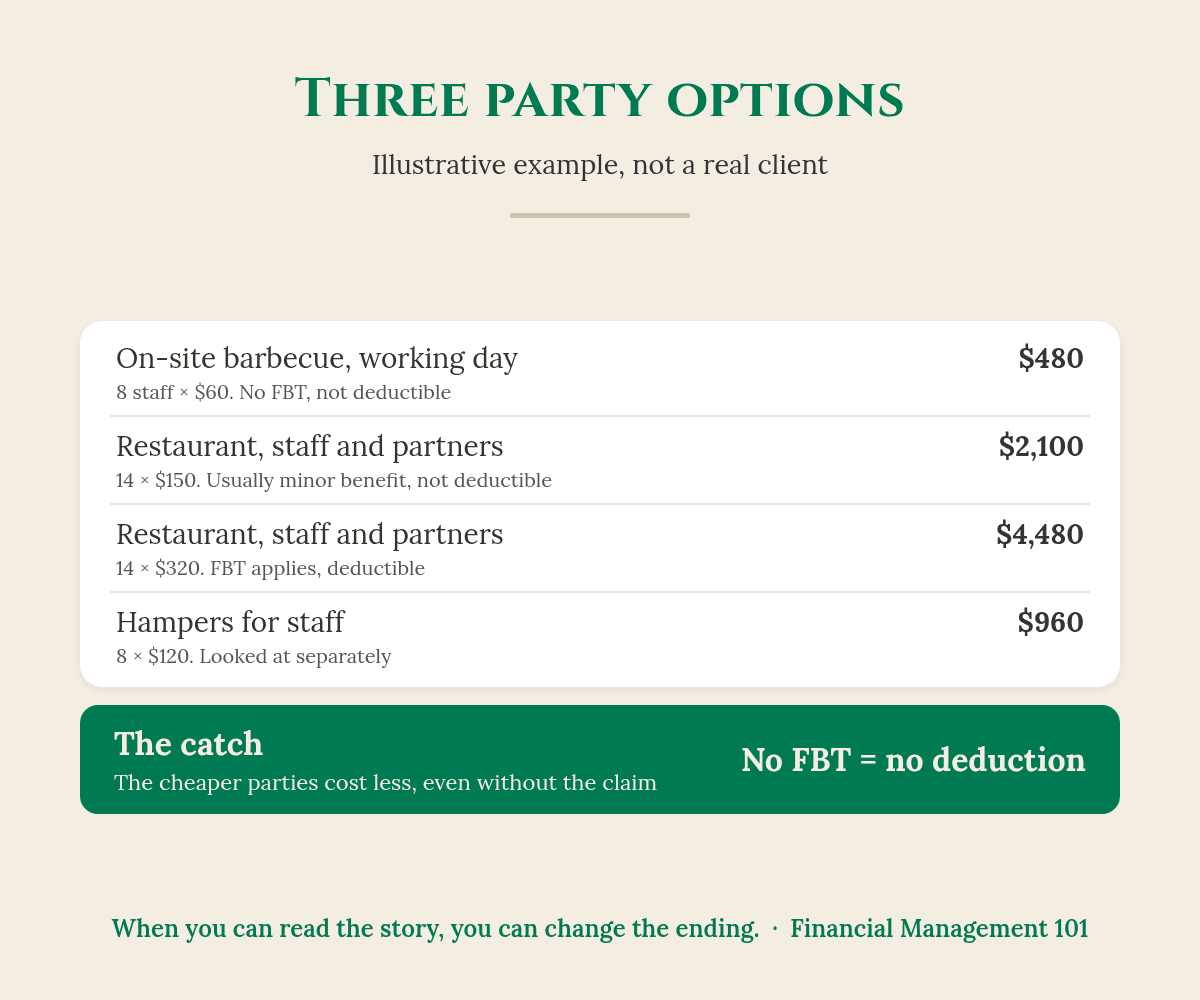
- Option 1, on-site barbecue on a working day, staff only: 8 × $60 = $480. No FBT on the food and drink. Not deductible.
- Option 2, restaurant with partners at $150 a head: 14 × $150 = $2,100. Under $300 a head, so usually a minor benefit. No FBT. Not deductible.
- Option 3, restaurant with partners at $320 a head: 14 × $320 = $4,480. FBT applies. Deductible, with GST credits, plus a deduction for the FBT.
- Hampers: 8 × $120 = $960, looked at separately from whichever party she chooses.
Option 3 is the only party Tanya can claim. It’s also the most expensive, before she’s even paid the FBT. Options 1 and 2 cost less in real dollars, with no FBT paperwork for the party.
Why it works: Decide the experience you want for your team and the budget per head first. Then let the tax treatment follow. Chasing a deduction rarely makes a party cheaper.
So what does this actually look like?
Tanya picks Option 2 and sets a firm per-head budget with the restaurant, including drinks, so nobody tips over $300. She keeps the invoice showing the number of guests, and a note of who attended (staff, partners, any clients). The hampers go out on the last working day. Her bookkeeper codes the party as non-deductible entertainment, and the FBT question is answered before anyone raises a glass.
Check this first: Ask the venue for a per-head quote that includes drinks. That one number tells you which side of $300 you’re on.
Your Christmas party checklist
- Set a per-head budget, including drinks, transport and extras.
- Decide where: on your premises on a working day, or off-site.
- Decide who: staff only, partners, clients.
- Keep records: invoices, guest numbers and who attended. The ATO says to keep the right records to stay compliant (ATO).
- Check gifts separately against the $300 rule, and ask about deductions and GST credits.
- Plan the cash. The party, gifts, shutdown leave and super all land in the same few weeks. My post on paying staff over the Christmas shutdown covers the leave side.
Where your agent/accountant and bookkeeper fit in
FBT is detailed, and your agent/accountant is the right person to confirm how it applies to your party, your gifts and your business structure, including any method elections you’ve made. Your bookkeeper makes sure the costs are coded correctly and GST credits are only claimed where they should be. My job is to help you see the whole Christmas cash picture, so the celebration is planned, not a surprise in January.
No FBT usually means no deduction. Decide the party you want, then let the tax follow.
Your takeaway
- A Christmas party is income tax deductible only to the extent it’s subject to FBT.
- On your premises, on a working day, staff only: no FBT on food and drink, and no deduction or GST credits.
- Off-site or with partners: no FBT if it’s a minor benefit, under $300 a head and unreasonable to treat as a fringe benefit.
- $300 or more a head: FBT applies, and the cost becomes deductible with GST credits.
- Clients: no FBT, and not deductible.
- Gifts under $300 per person can be FBT-free, and are looked at separately from the party.
Want to see where your money goes this Christmas?
Start with The EDGE Business Health Check. It’s a $47 workbook that takes about 20 minutes. You score 30 quick statements across five areas: Profit & Pricing, Cashflow, CEO Visibility, Systems & Freedom, and Growth. Then the Profit Leak Calculator shows where money may be slipping away, and the 7-Day Reset gives you clear next steps.
Rather talk it through first? Get in touch and book a call with me.
Frequently asked questions
Is a staff Christmas party tax deductible in Australia?
Only to the extent it’s subject to FBT. The ATO says that if the party isn’t subject to FBT, you can’t claim an income tax deduction for it. Most modest parties are FBT-free, so they aren’t deductible.
What is the $300 minor benefit rule?
A benefit worth less than $300 per person is exempt from FBT if it would also be unreasonable to treat it as a fringe benefit. Frequency matters: a once-a-year party or gift is more likely to qualify than something given regularly.
Is there FBT on a Christmas party held at work?
For food and drink provided to current employees on your business premises on a working day, the ATO says you don’t pay FBT. Partners’ costs aren’t covered by that exemption, but can be FBT-free as a minor benefit.
Can I claim GST credits on the Christmas party?
In the ATO’s examples, you can’t claim GST credits for party food and drink that isn’t subject to FBT, including for clients. Where FBT applies, as in its golf day example, GST credits can be claimed. Check your situation with your agent/accountant.
Are Christmas gifts for staff tax deductible?
Gifts under $300 per person can be FBT-free as a minor benefit. Whether a gift is deductible and GST-creditable depends on whether it’s entertainment, like tickets, or not, like a hamper or bottle of wine to take home. Confirm your gift list with your agent/accountant.
Do I pay FBT if clients come to the party?
No. There’s no FBT on the costs for clients. But client entertainment isn’t income tax deductible, and you can’t claim GST credits for it.
You’ve built something real. Celebrate it, and plan it.
Karen G. Adams
Small Business Performance Strategist, Financial Management 101
Too Big To Wing It. Too Small To Need A CFO.
This article is general education only. It isn’t tax or financial advice, and it doesn’t take your circumstances into account. FBT rules are from ATO pages, the ATO’s FBT guide for employers and TD 94/55, as at 9 November 2026. Tanya’s business and its figures are illustrative, not a real client. FBT depends on your business structure, any meal entertainment election and the facts of your event, so check with your registered tax agent/accountant.