
When a trades or service owner asks me about hiring, the conversation usually starts with the hourly rate. That figure matters, but it is not the full picture. The real cost of hiring an employee in Australia includes super, paid leave, workers’ compensation, possible payroll tax, equipment and the time it takes to get someone productive. Get that clear first, and the hire decision gets calmer.
This post walks through those on-costs with current figures, an illustrative worked example, and a simple forecast check so you can see whether the business can carry the role.
THE SHORT ANSWER
What does it really cost to hire an employee?
Budget for the wage, plus the 12% super guarantee, paid leave that reduces productive hours, workers’ compensation insurance, and any payroll tax once your Australian wages pass your state’s threshold. Add equipment and training time. Then test the whole package against a cash flow forecast before you make the offer.
Start with the right pay rate
Most employees are covered by an award. The Fair Work Ombudsman says the minimum wage for most people is set by the award for their industry or occupation, and you should use their Pay and Conditions Tool for the right rate, penalties and allowances (Fair Work Ombudsman).
As of 1 July 2026, the National Minimum Wage for employees not covered by an award or registered agreement is $26.44 per hour, or $1,004.90 per week (Fair Work Ombudsman). Award rates are often higher. Paying under the correct rate is not optional, so confirm the classification before you advertise.
Good to know: business.gov.au’s guide to hiring employees walks through employment type, awards, tax, super and workplace impacts in one place (business.gov.au). Use it as your checklist alongside your bookkeeper or agent/accountant.
What is the cost of hiring an employee beyond the hourly rate?
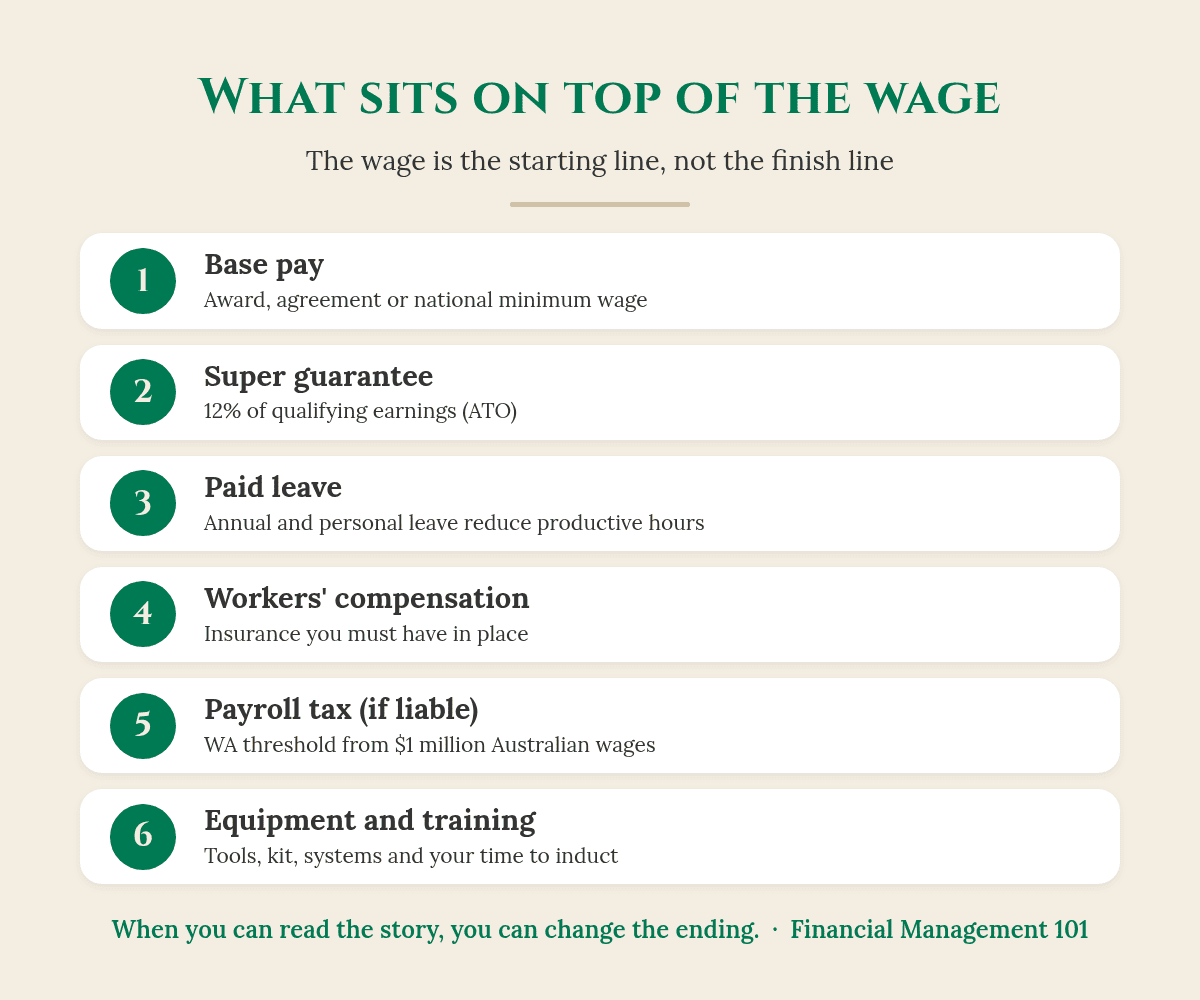
Here is what sits on top of base pay for most small businesses.
1. Super guarantee (12%)
The ATO’s super guarantee rate is 12.00% for the period 1 July 2025 to 30 June 2026, and it stays at 12.00% from 1 July 2026 onwards (ATO). business.gov.au confirms you pay an amount equal to 12% of your employee’s qualifying earnings into their super fund each payday, on top of wages — you cannot deduct it from their pay (business.gov.au).
From 1 July 2026, Payday Super applies. The ATO says your contribution is on time if the fund receives it (with the information needed to allocate it) within 7 business days after payday. For the first contribution for a new employee, you have 20 business days (ATO). That timing matters for cash flow: super leaves the business with each pay cycle, not once a quarter.
2. Paid leave (fewer productive hours)
Full-time and part-time employees get 4 weeks of annual leave based on their ordinary hours under the National Employment Standards (Fair Work Ombudsman). Paid sick and carer’s leave (personal leave) is 10 days per year for full-time employees, and pro-rata for part-time employees (Fair Work Ombudsman).
You still pay for those days. When you work out the true cost per hour worked, you divide the year’s labour cost by the hours the person is actually available to do the work — after leave. Public holidays in your state sit on top of that. Casual employees are different: they usually receive a casual loading instead of paid leave, so check the award.
3. Workers’ compensation
business.gov.au is clear: you must have workers’ compensation insurance, and you should also consider public liability (business.gov.au). Premiums vary by industry and claims history, so get a quote for your trade or service before you lock in the hire. Do not guess this line.
4. Payroll tax (WA thresholds)
Payroll tax is a state tax on wages once you pass the threshold. In Western Australia, the Department of Finance employer guide says the rate is 5.5%, with an annual Australian taxable wages threshold of $1 million (about $83,333 in any month from 1 July 2023). Between $1 million and $7.5 million a diminishing tax-free amount applies; at $7.5 million or more there is no deductable amount (WA Department of Finance).
Many owners with one or two staff are under the threshold. The hire that tips your total Australian wages over $1 million is the one that needs a payroll tax line in the budget. Thresholds and rates differ in other states, so check the revenue office where your employees work (WA Department of Finance).
5. Equipment, kit and training time
Uniforms, tools, a laptop, software seats, licences and safety gear are real dollars. So is your time to recruit, induct and train. business.gov.au notes you (or someone in the business) will need to manage the new employee and their performance, and that you should make sure you have the time to do that properly (business.gov.au). Put a dollar value on the first month of your supervision, even if it is rough.
So what does the true cost look like per hour worked?
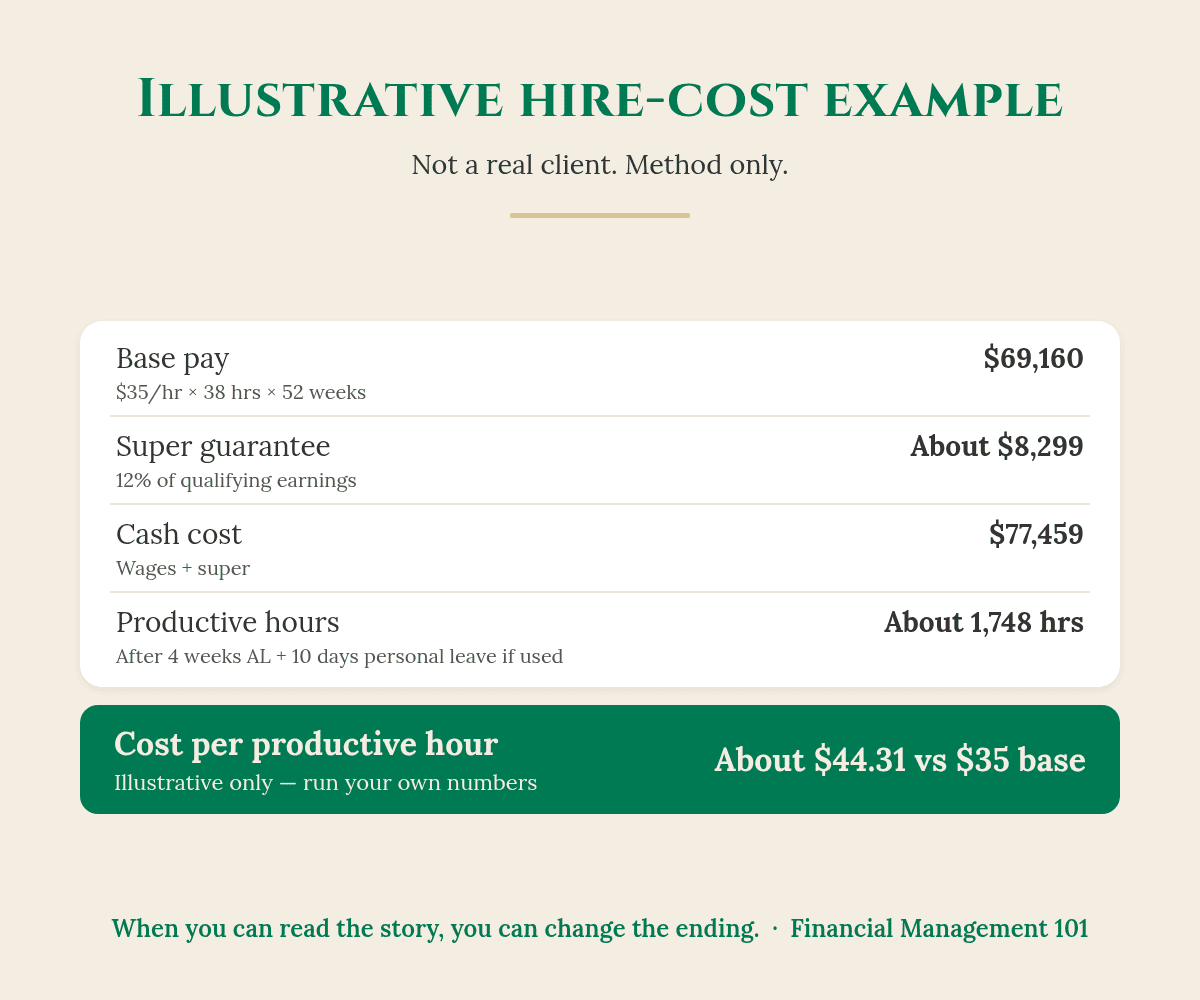
Here’s an illustrative example (made-up numbers to show the method, not a real client). Jordan runs a service business in Perth and plans to hire a full-time coordinator at $35 an hour for 38 ordinary hours a week.
- Base pay for the year: $35 × 38 hours × 52 weeks = $69,160.
- Super at 12%: $69,160 × 0.12 = $8,299.20 (about $8,299).
- Cash cost of wages + super: $69,160 + $8,299 = $77,459.
- Productive hours (illustrative): start with 52 weeks, subtract 4 weeks of annual leave and 10 days (2 weeks) of personal leave if fully used → 46 weeks × 38 hours = 1,748 productive hours. (Also allow for public holidays in your state; they reduce productive hours further.)
- Cost per productive hour: $77,459 ÷ 1,748 ≈ $44.31, against a $35 base rate.
That is roughly $9.30 an hour more than the sticker rate, before workers’ compensation, equipment, training time or any payroll tax. If Jordan also allows for about 10 paid public holidays (another 2 weeks in this illustration), productive hours fall to about 1,672 and the cost rises to about $46.33 per hour worked.
Why it works: You are not inflating the wage. You are matching the year’s labour cash to the hours that actually earn revenue. That is the number to put against charge-out rates and gross profit margin.
Watch out: Your award, allowances, overtime, leave loading (if it applies), and workers’ compensation rate will change the result. Run the same steps with your bookkeeper or agent/accountant and your real figures.
Can the business afford it? Check the forecast first
Before you advertise, put the full monthly cost into a cash flow forecast: wages, super each payday, workers’ compensation instalments, extra kit, and a buffer for the first months while the person ramps up. My post on how to do a cash flow forecast walks through a simple 13-week method.
- Does the forecast stay comfortably positive for at least three months after the start date?
- Is there enough work (or a clear plan to win it) to cover the productive-hour cost at your current margins?
- Have you set aside GST and super so payday does not raid the operating account?
- If this hire pushes Australian wages near $1 million, have you modelled WA payroll tax with your agent/accountant?
business.gov.au puts it simply when it talks about pay rates and conditions: make sure your business can afford it (business.gov.au). The forecast is how you answer that with numbers, not hope.
Where your bookkeeper and accountant fit in
Your bookkeeper keeps payroll, STP and leave balances tidy so the numbers you review are real. Your agent/accountant helps with PAYG withholding, super timing under Payday Super, payroll tax registration if you need it, and the tax settings around the hire. My job is to help you see whether the role fits the profit and cash story before you commit.
Hire against a forecast, not a feeling.
Your takeaway
- Confirm the correct award or National Minimum Wage rate before you advertise.
- Add 12% super on qualifying earnings, and plan for Payday Super timing from 1 July 2026.
- Convert annual leave and personal leave into fewer productive hours, then calculate cost per hour worked.
- Get a workers’ compensation quote; do not skip it.
- Check the WA $1 million payroll tax threshold (5.5% rate) against your total Australian wages.
- Test the full monthly cost in a cash flow forecast before you make the offer.
Want to see whether a new hire fits your numbers?
Start with The EDGE Business Health Check. It’s a $47 workbook that takes about 20 minutes. You score 30 quick statements across five areas: Profit & Pricing, Cashflow, CEO Visibility, Systems & Freedom, and Growth. Then the Profit Leak Calculator shows where money may be slipping away, and the 7-Day Reset gives you clear next steps.

Rather talk it through first? Get in touch and book a call with me.
Frequently asked questions
What is the current super guarantee rate in Australia?
The ATO lists the super guarantee at 12.00% from 1 July 2025 onwards, including 1 July 2026 to 30 June 2027. From 1 July 2026, contributions generally need to reach the fund within 7 business days of payday (20 business days for the first contribution for a new employee).
What is the National Minimum Wage from 1 July 2026?
As of 1 July 2026, the Fair Work Ombudsman lists the National Minimum Wage at $26.44 per hour or $1,004.90 per week for employees not covered by an award or registered agreement. Most employees are covered by an award with its own minimum rates.
What is the WA payroll tax threshold?
Western Australia’s Department of Finance employer guide lists a 5.5% rate and an annual Australian taxable wages threshold of $1 million (monthly figure $83,333 from 1 July 2023). A diminishing threshold applies between $1 million and $7.5 million.
How do I work out the true cost per hour of an employee?
Add wages and super for the year, then divide by productive hours after allowing for annual leave, personal leave and public holidays. Add workers’ compensation, kit and training as separate lines. Use illustrative maths only as a method — always run your own figures.
Should I hire before I have a cash flow forecast?
I would not. A simple forecast shows whether wages, super and on-costs still leave you with a safe cash buffer while the new person ramps up.
You’ve built something real. Financial confidence starts with clarity.
Karen G. Adams
Small Business Performance Strategist, Financial Management 101
Too Big To Wing It. Too Small To Need A CFO.
This article is general education only. It isn’t financial, tax, employment or accounting advice, and it doesn’t take your personal circumstances into account. Jordan’s service business and all its figures are illustrative, not a real client. Super guarantee rates and Payday Super deadlines are from the ATO as at 6 November 2026; the National Minimum Wage is from the Fair Work Ombudsman as at 6 November 2026; WA payroll tax rates and thresholds are from the WA Department of Finance employer guide as at 6 November 2026 (page last updated 2 June 2026). Awards, leave loading, workers’ compensation premiums and payroll tax can differ for your business — check the live sources and your bookkeeper or agent/accountant.