If cash was already tight before Melbourne Cup Day, this week’s rate rise probably landed hard. You might be juggling supplier bills, a BAS and a quiet patch, and now the Reserve Bank has lifted rates again. Take a breath. You’re not alone in this, and there’s a plan for it.
In my latest video I talk through what this rate rise means for your profit. This post answers the questions business owners are asking me right now, puts the rise into dollars a month, and gives you a simple four-week plan for the rest of November.
This is general information, not financial advice. Your accountant, broker or lender can help with your own situation, and I’d encourage you to talk to them.
THE SHORT ANSWER
What does the RBA rate rise mean for my small business?
More of your cash goes to interest each month, through your business loans and overdraft, your home loan, and what your customers and suppliers pass on to you. Every extra dollar of interest comes straight off profit, so it takes more than a dollar of sales to win back. The fix starts with cash flow: see every debt, forecast the next 13 weeks, check your margin and pricing, and talk to your team early.
What exactly did the RBA decide on 3 November 2026?
4.85%
The new cash rate target, up 0.25 percentage points (RBA media release)
4 Nov
The day it took effect, Wednesday 4 November 2026 (RBA cash rate table)
6–3
The Board’s vote. Three members voted to hold at 4.60%
5th
Rise this year, up from 3.60% in January. The highest cash rate since 2008
Two lines in the Board’s statement matter for business owners. First: “The economy is slowing, housing prices have fallen significantly and the unemployment rate has risen.” That’s your customers. Second: “Liaison indicates that many firms are experiencing cost pressures and are either increasing the prices of their goods and services in response or looking to do so.” That’s your suppliers, and quite possibly you.
Will my business loan repayments go up?
If your loan or overdraft is on a variable rate, your repayments usually go up when your lender passes the rise on. Lenders set their own rates and timing, so log in this week and check the actual rate on each facility rather than guessing. Fixed-rate loans don’t change until the fixed term ends.
In my 40 years in financial services, I’ve seen plenty of rate rises come and go, and they rarely land in just one place. As I say in the video, it shows up in about six:
- Business loans on a variable rate.
- Equipment and vehicle finance. Often fixed for the term, but the replacement ute or machine will likely be financed at today’s higher rates.
- Your overdraft. Usually variable, and often the facility you lean on hardest when cash is tight.
- Your home loan. When the mortgage goes up, the household needs more out of the business, and that puts pressure on your drawings.
- Your customers. They have mortgages too, so jobs get pushed back or put on hold.
- Your suppliers. They’re paying more for their own debt, fuel and energy, and some of it comes back to you.
How much more will I actually pay each month?
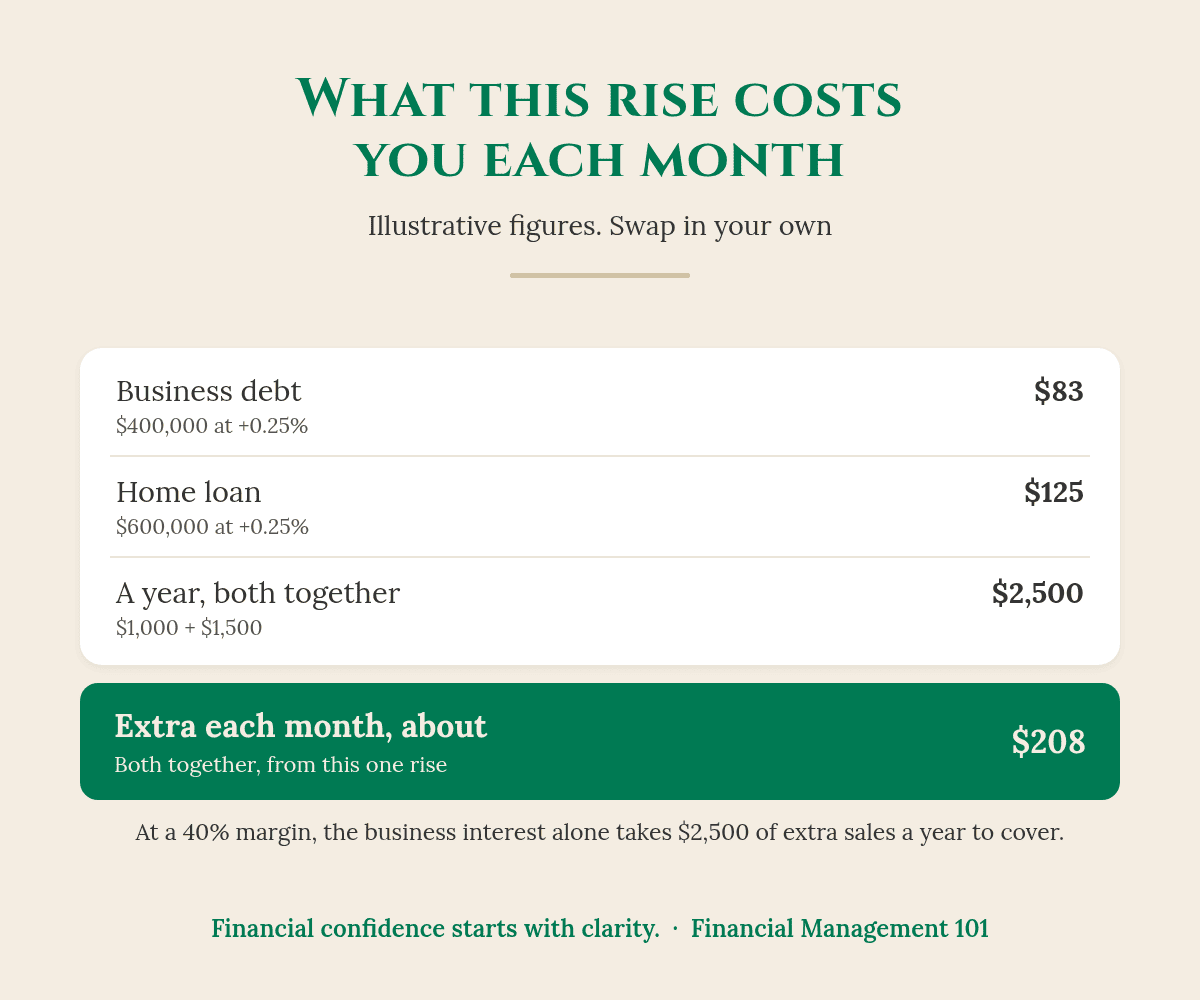
Here’s an illustrative example, so swap in your own figures. Say your business has $400,000 of variable-rate debt across a loan, an overdraft and some other finance, and you have a $600,000 mortgage on the family home.
So what does this actually look like in dollars?
- Business debt: 0.25% of $400,000 is $1,000 a year, about $83 a month.
- Home loan: 0.25% of $600,000 is $1,500 a year, or $125 a month.
- Together: about $208 a month, or $2,500 a year, from this one rise.
- Sales to cover the business interest: at a 40% gross margin, every $1,000 of sales leaves $400, so you need $2,500 of extra sales to cover that $1,000.
Good to know: if your lender has passed on all 1.25 percentage points since January, that same $400,000 is costing around $5,000 a year more than it was, about $417 a month. Check your own statements, because lenders don’t all move the same way.
As I say in the video, money doesn’t just disappear. It goes unmanaged. So here’s how to manage it, one week at a time.
My cash is already tight. What should I do first?
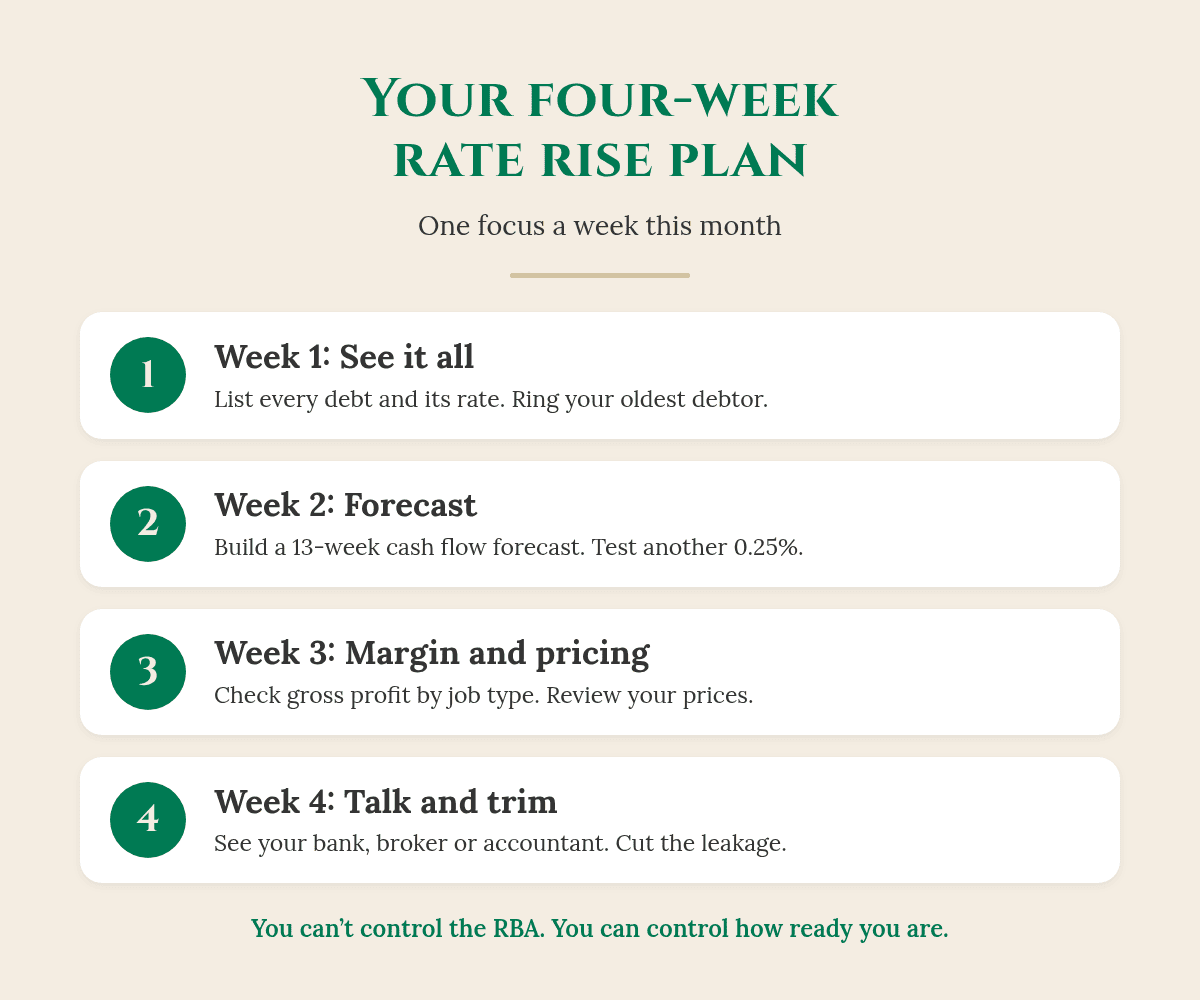
If you’re already stretched, a list of ten things to fix is the last thing you need. So give each week of November one focus. Small, steady steps beat one big panic.
Week 1: See it all, and bring in some cash
Write down every loan, finance contract, the overdraft, the credit cards and the home loan if it’s secured against the business. Next to each, note the balance, the rate, fixed or variable, and when it ends. Most owners I meet have never seen all their debt on one page. It can feel confronting, but you can’t manage what you can’t see.
Then ring your oldest debtor. Not an email, a phone call. Here’s an illustrative example: $60,000 of overdue invoices sitting on an overdraft at around 10% is about $6,000 a year, roughly $500 a month, in interest you’re paying to fund your customers.
Week 2: Build your 13-week cash flow forecast
One spreadsheet, 13 weeks, money in and money out, week by week. Include your BAS, super, loan repayments and the extra the household now needs. It shows you the tight weeks before you get to them, so you’re deciding, not reacting. My post How Do I Do a Cash Flow Forecast for My Small Business? walks you through it step by step.
Check this first: add another 0.25% to your variable debt in the forecast. On $400,000 that’s about $83 a month. If the forecast still works, you’ve got breathing room. If it doesn’t, you’ve found out now, not in February.
Week 3: Check your margin, then your pricing
Pull up your profit and loss and look at gross profit by job type or service line. Revenue is the headline, but profit is the real story. One type of job might be quietly carrying the business while another barely covers its costs. If that rings a bell, read Why Is My Business Making Revenue, But No Profit?
Then review your prices. If your costs have gone up and your prices haven’t, your margin has gone down. In the video’s illustrative example, a business turning over $1.2 million that lifts its prices by just 1% and keeps its customers adds $12,000 to gross profit. That’s more than double the $5,000 a year of extra interest if every rise this year has flowed through on $400,000.
Week 4: Talk to your team and trim the leakage
Book time with your bank, broker or accountant, and take your debt list and your forecast with you. Early is the key word, so go before a repayment becomes a problem. They’re your team, so use them. If the ATO is part of the pressure, How Do I Set Up an ATO Payment Plan for My Business? explains how payment plans work and what they cost.
Then look for the leakage: unbilled variations, subscriptions nobody uses, materials not charged back to the job. Small amounts add up. Once you’ve freed up some cash, ask your accountant whether paying down your highest-cost debt first makes sense for you.
Should I cut my marketing to save cash?
Please don’t panic and cut it. When customers get careful, the businesses that stay visible and keep their pipeline full are the ones still standing when things pick up. For more on why cash can feel tight even in a good month, see Why Is Cashflow Always Tight?
Trim the waste, absolutely, but keep the phone ringing.
What if I can’t keep up with my repayments?
Talk to your lender before you miss a payment, and ask what options they have for customers in financial difficulty. Bring your accountant or broker into the conversation. If you’d like independent help, the Small Business Debt Helpline (1800 413 828) has financial counsellors for small business owners, at no cost to you.
Your takeaway
- The cash rate is now 4.85%, effective 4 November 2026, after a 6–3 vote.
- On $400,000 of business debt and a $600,000 home loan, this one rise is about $208 a month.
- Every extra dollar of interest takes more than a dollar of sales to win back. At a 40% margin, it’s $2.50.
- Give November one focus a week: see your debt, forecast 13 weeks, check margin and pricing, then talk to your team.
- You can’t control the Reserve Bank. You can control how ready your business is.
Where is the pressure in your business?
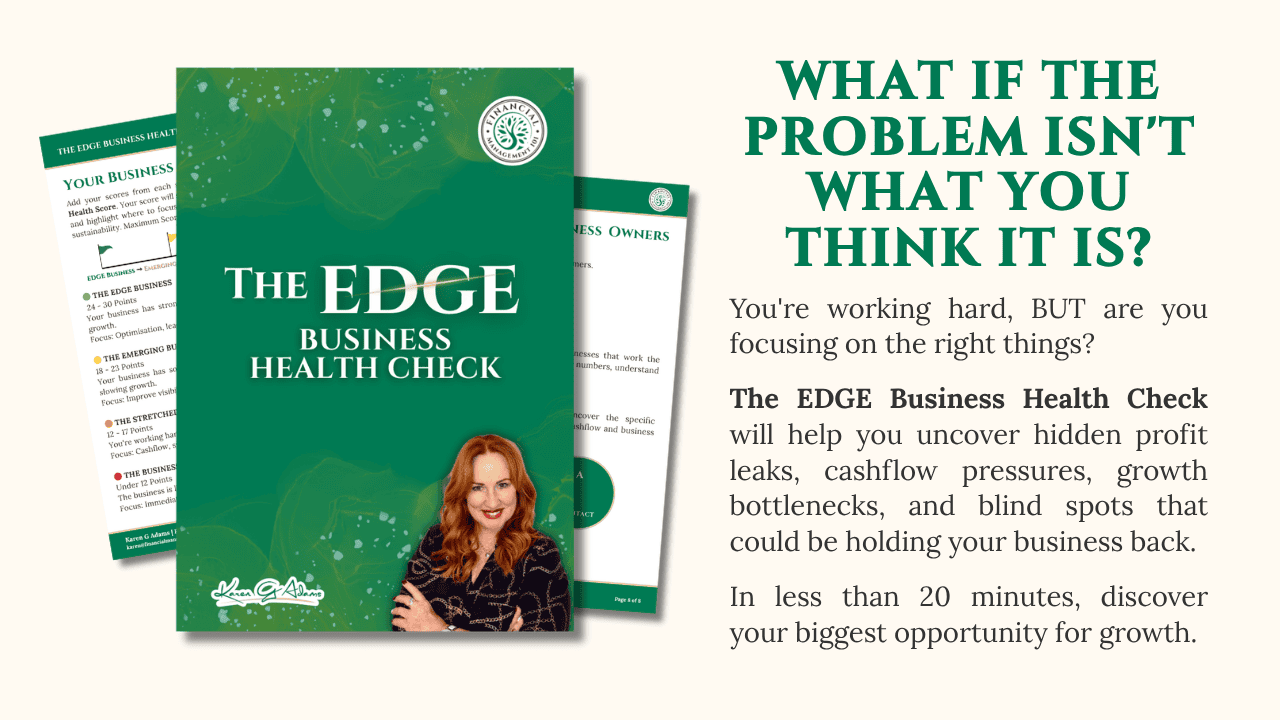
Before the next rate decision, find out where your business is strong and where it’s stretched. Start with The EDGE Business Health Check. It’s a $47 workbook that takes about 20 minutes and looks at your Profit & Pricing, Cashflow, CEO Visibility, Systems & Freedom, and Growth. It includes the Profit Leak Calculator, so you can see where money may be slipping away and where to focus first.
Know an owner who’s feeling the squeeze this month? Send them this post.
Frequently asked questions
When does the new 4.85% cash rate start?
It took effect on Wednesday 4 November 2026, the day after the Reserve Bank Board’s decision on 3 November. Your lender sets its own timing for passing it on, so check your own loans.
Was the RBA decision unanimous?
No. It was a 6–3 vote. Six Board members voted to lift the cash rate to 4.85%, and three voted to hold it at 4.60%.
Will interest rates go up again?
No one can say for sure. The Board said it “will be attentive to the data and the evolving assessment of the outlook and risks to guide its decisions”. The practical step is to test another 0.25% in your 13-week cash flow forecast, so you know where you stand either way.
How do I work out what the rate rise costs my business each month?
Take your variable-rate debt, multiply it by 0.25%, then divide by 12. On $400,000 that’s $1,000 a year, about $83 a month. Add your home loan if the household relies on the business: on $600,000 it’s $125 a month. These are illustrative figures, so use your own.
Should I use my overdraft to get through the tight weeks?
It can bridge a short gap, but it’s usually variable, so it costs more after each rise. Chase your oldest debts first, use your 13-week forecast to see how long the gap really is, and talk to your accountant or broker about the best option for you.
How do I tell customers I’m putting my prices up?
Tell them early, keep it simple and give them a date. Explain that your costs have gone up, apply the new prices to new quotes from that date, and start with the work that’s underpriced. A price rise only adds to profit if you keep the work, so look after your best customers.
If you’re doing it tough right now, you’re not alone. Rate rises are stressful, but a business that knows its numbers can steer through almost anything. I’ve got your back. You’re too big to wing it and too small to need a CFO.
Karen G. Adams
Small Business Performance Strategist, Financial Management 101
This article is general information only. It isn’t financial, credit, tax or legal advice, and it doesn’t take your personal circumstances into account. All dollar figures are illustrative examples. Speak with your accountant, broker or lender about your own situation.