
How Do I Build A Business That Runs Without Me?

How Do I Build A Business That Runs Without Me?

If the business relies on you for everything, you don’t own a business – you own a job!

Here’s how clearer systems and financial visibility create a business that can operate without you.

We hear a version of this from almost every business owner: “I can’t even take a week off without everything falling apart.” Or worse, “I did take a week off, and I’m still cleaning up the mess.”

If that’s familiar, please hear this: it’s not because you haven’t worked hard enough. It’s usually the opposite. You’ve worked so hard, for so long, that the business has quietly built itself around you being everywhere, all the time.

By the end of this, you’ll know the real reason most businesses stay dependent on their owner, and the two things; systems and financial visibility that actually change it.

1. In the beginning, you being everywhere was the right call

When a business starts, the owner touching everything isn’t a flaw. It’s often the only way to survive the early years; you’re the salesperson, the delivery, the bookkeeper and the decision-maker because there’s nobody else.

The problem isn’t that this happened. It’s that it kept happening long after the business could have supported something different.

The shift to make: recognise that what got the business started isn’t what will let it grow past you. Those are two different jobs.

2. Without documented systems, you’re the system

If a process only exists in your head, you are the process. Every new hire has to learn it directly from you, every exception gets escalated to you, and every “how do I…” question lands on your desk.

Systems don’t need to be complicated to work. They need to be written down, consistent, and followable by someone who isn’t you.

Check this: pick one task you do weekly. Could someone else follow written steps to do it the same way, without asking you a single question?

Without documented systems, you're the system

3. Delegating tasks isn’t the same as delegating decisions

Many owners delegate the doing but keep every decision for themselves. The team executes, but nothing moves without a final check from you, which means you’re still the bottleneck, just a busier one.

Real delegation means someone else has both the task and the authority to make the calls that go with it, within limits you’ve set.

Check this: notice how often your team’s questions could have been answered by them, if they’d had the context and the authority to decide.

4. If only you understand the numbers, the business still needs you

This is the piece most owners miss. Even with a great team and solid systems, if you’re the only one who can read the financial position of the business, every meaningful decision still funnels back through you.

Financial visibility – clear, regular, easy-to-read numbers – lets the right people make good decisions without needing you in the room. That might mean a manager, a bookkeeper, or simply you, on a rhythm that doesn’t require putting out fires to find the answer.

Check this: if you were unreachable for two weeks, could someone in your business still tell whether it was having a good month or a bad one?

5. Test it before you need it

The real test of a business that runs without you isn’t a plan, it’s a genuine trial. A few days away, phone down, seeing what actually breaks.

What breaks tells you exactly where the next system, the next handover of authority, or the next piece of financial visibility needs to go.

The Takeaway

A business that runs without you isn’t built by working harder or trusting your team more and hoping for the best. It’s built deliberately by documented systems, real decision-making authority for the people around you, and financial visibility that doesn’t depend on you being the only one who understands it.

Owning a business, not a job, comes down to whether it can function while you’re not in it. That’s not a one-off project. It’s a different way of building.

If you want a clear, structured path to building this kind of business, that’s exactly what The Edge is designed for.

My recommendation starts with doing a Business Health Check.

The EDGE Business Health Check in less than 20 minutes will help you uncover the blind spots, bottlenecks and hidden opportunities affecting your business.

The Edge Business Health Check

#HowToResetMyMoneyMindset #NewYearFinancialMindset #HowToStartFreshWithMoney  emergency fund australia, money management, family savings #SmallBusinessOwner #BusinessGrowth #CashflowManagement #BusinessSuccess
#EntrepreneurMindset

 

What Numbers Should A Small Business Owner Track?

What Numbers Should A Small Business Owner Track?

You don’t need a full accounting degree to run a profitable business. But you do need to know which numbers reveal the real story. These are the few that matter most.

We get it, most business owners didn’t start their business because they love spreadsheets. You started it because you’re good at what you do, and somewhere along the way, “run the numbers” got added to the job description without anyone asking if you wanted it.

The good news is you don’t need dozens of reports or a finance degree. You need a small handful of numbers, checked regularly, that tell you the truth about how the business is really going.

By the end of this, you’ll know exactly which numbers to look at first, and why each one matters more than revenue alone.

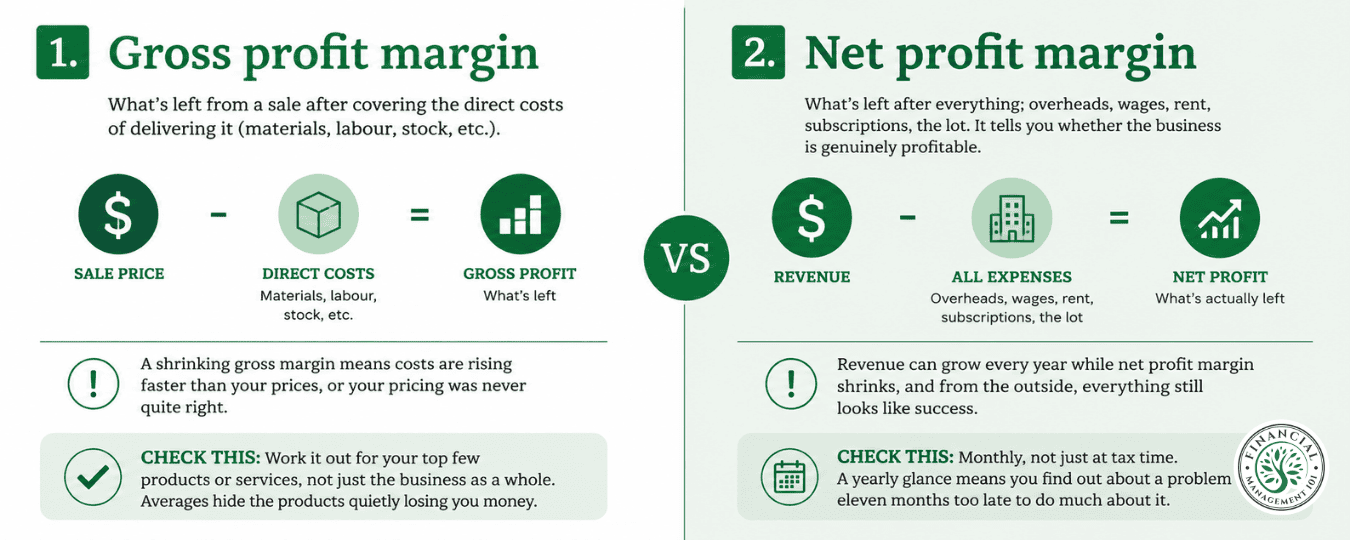
1. Gross profit margin

This is what’s left from a sale once the direct cost of delivering it is covered; materials, trade labour, stock, whatever it takes to physically deliver your product or service.

It’s the clearest early warning system in your business. A shrinking gross margin means either your costs are rising faster than your prices, or your pricing was never quite right to begin with.

Check this: work it out for your top few products or services, not just the business as a whole. Averages hide the products quietly losing you money.

2. Net profit margin

This is what’s actually left after everything; overheads, wages, rent, subscriptions, the lot. It’s the number that tells you whether the business is genuinely profitable, not just busy.

Revenue can grow every year while net profit margin shrinks, and from the outside, everything still looks like success.

Check this: monthly, not just at tax time. A yearly glance means you find out about a problem eleven months too late to do much about it.

Gross Profit Margin vs Net Profit Margin

3. Cash position versus profit

Your bank balance and your profit are two different stories, even though they feel like they should match. A healthy bank balance can be sitting on unpaid tax, a big supplier bill due next week, or a loan repayment about to land.

We business owners tend to use the bank balance as our main scoreboard, simply because it’s the number we see most often. It’s useful – it’s just not the whole picture.

Check this: look at your profit and loss statement alongside your bank balance, not instead of it.

4. Overheads as a percentage of revenue

Overheads rarely blow out all at once. They creep in like; a new subscription here, a rent increase there, a “temporary” extra cost that becomes permanent.

Tracking overheads as a percentage of revenue, rather than a raw dollar figure, shows you whether your costs are growing in proportion to the business or quietly outpacing it.

Check this: list every recurring cost and total it as a percentage of that month’s revenue. Watch the trend over a few months, not just one snapshot.

5. Debtor days – how long it takes to get paid

This is the one most owners forget to track, and it’s often the one causing the most stress. Debtor days measure the average time between sending an invoice and the money landing in your account.

The longer that gap, the more your own cash is quietly funding someone else’s business while yours waits.

Check this: if your debtor days are creeping up, it’s usually a sign your payment terms, follow-up process, or invoicing timing need a look, not that you need more sales.

The Takeaway

You don’t need to track everything. You need to track the right few things, consistently. Gross profit margin, net profit margin, cash position, overheads as a percentage of revenue, and debtor days together, these five numbers tell you far more about the health of your business than revenue ever will on its own.

Clarity here isn’t about becoming an accountant. It’s about finally being able to see your business as clearly as you run it.

If you’d like these numbers tracked and visible for you automatically, that’s exactly what the CEO Dashboard is built for.

Watch the 2 minute video on how it works HERE

The CEO Dashboard™ gives small business owners a clear, visual snapshot of what’s really happening inside their business – so you can stop operating on gut feel alone and start making confident, data-driven decisions.

#HowToResetMyMoneyMindset #NewYearFinancialMindset #HowToStartFreshWithMoney  emergency fund australia, money management, family savings #SmallBusinessOwner #BusinessGrowth #CashflowManagement #BusinessSuccess #EAP #EmployeeAssistanceProgram
#EntrepreneurMindset


Is Money Stress the Missing Piece in Your Wellbeing Strategy?

Is Money Stress the Missing Piece in Your Wellbeing Strategy?

You provide mental health support, but money is often part of the stress employees are carrying. Here’s how practical financial wellbeing education complements your EAP, without straying into personal advice.

We know how much thought goes into a wellbeing strategy. The EAP is in place. The mental health training has been rolled out. Leaders have been coached to check in on their people.

And still, something doesn’t quite add up. Engagement scores plateau. Absenteeism doesn’t shift the way you’d expect. People say they’re “fine” and clearly aren’t.

Here’s what often gets missed: a huge amount of everyday stress isn’t purely psychological in origin. It’s financial. And most wellbeing strategies aren’t built to touch it.

By the end of this, you’ll know why financial stress behaves differently to other workplace stressors, and how practical financial education sits alongside your EAP rather than competing with it.

Your employees don’t need another financial webinar.
They need personal, practical support that actually changes how they feel and what they do with their money.

Money stress doesn’t look like a “money” problem at work

Financial stress rarely walks into HR and announces itself. It shows up as distraction, short tempers, disengagement, or someone quietly declining opportunities that would help their career because the timing feels too risky.

It’s also one of the few stressors that follows people to work every single day, rather than arriving as a one-off event. A restructure or a difficult client eventually resolves. A mortgage rate rise, or not knowing where next month’s numbers land, doesn’t switch off at 9am.

Why your EAP alone doesn’t close this gap

Your EAP is doing exactly what it’s designed to do; professional, confidential support for people in genuine distress. That matters, and it isn’t in question here.

What an EAP isn’t built for is teaching everyday financial capability. Counselling can help someone process the anxiety money is causing them. It generally isn’t set up to help them understand their pay structure, build a spending plan, or feel confident having a money conversation with a partner.

That’s a different kind of support, practical, skill-based, and preventative rather than crisis-response.

Where financial wellbeing education fits

This is where financial wellbeing education does its work: building everyday money confidence and capability, in plain English, before things reach crisis point.

It’s general education, not personal advice. Nobody’s reviewing an individual’s mortgage or telling them what to do with their super. It’s giving people the foundations; how budgeting actually works, how debt behaves, how to read their own numbers, so they can make their own informed decisions.

Layered with an EAP, you get both ends covered: support for people who are already struggling, and education that helps prevent financial stress building into something bigger in the first place.

What this can look like in practice

Financial wellbeing education for workplaces can sit alongside existing programmes in a few different ways:

  • A standalone session or short series, run like any other professional development topic.
  • Content woven into an existing wellbeing calendar, alongside mental health and physical health initiatives.
  • A resource employees can return to in their own time, for privacy around a genuinely personal topic.

Done well, it’s positioned the same way physical or mental health education is a normal, non-judgemental part of supporting people, not a red flag that something’s wrong.

The Takeaway

A strong wellbeing strategy supports the whole person, and for most people, money is part of that picture whether it’s named or not. An EAP handles the crisis. Financial wellbeing education handles the everyday end, building the confidence and capability that helps prevent the crisis in the first place.

Together, they give your people a genuinely complete safety net, not just a mental health one.

If you’d like to explore what financial wellbeing education could look like for your team, we’d love to talk it through with you.

The Financial Wellbeing Solution Your People Deserve — and Your Workplace Needs

#HowToResetMyMoneyMindset #NewYearFinancialMindset #HowToStartFreshWithMoney  emergency fund australia, money management, family savings #SmallBusinessOwner #BusinessGrowth #CashflowManagement #BusinessSuccess #EAP #EmployeeAssistanceProgram
#EntrepreneurMindset


Why Is My Business Making Revenue, But No Profit?

Why Is My Business Making Revenue, But No Profit?

Revenue is the headline. Profit is the real story. If your sales are growing but the bank account never reflects it, here’s what the numbers are really telling you and what to do about it.

We hear this from business owners more than almost anything else. The invoices are going out. The sales are climbing. Clients are saying yes.

And yet, at the end of the month, there’s nothing left over. No breathing room. No reward for the hours going in.

If that’s you right now, we want you to hear this first: you’re not behind, and you’re not bad with money. You just haven’t had visibility on what’s actually happening between “money in” and “money left”. That’s a numbers problem, not a you problem and it’s fixable.

By the end of this, you’ll know the five most common reasons revenue and profit stop matching up, and exactly where to look first in your own business.

1. You’re pricing on gut feel, not margin

Most small business owners set their prices once, early on, based on what felt fair or what a competitor charged. Costs have moved since then supplies, wages, software, fuel, but the price hasn’t.

Every sale can look like a win on paper while quietly making you less than you think. Growing revenue with a shrinking margin doesn’t build a more profitable business. It just makes the problem bigger, faster.

Check this first: work out your gross profit margin on your top three products or services. If you don’t know that number off the top of your head, this is where to start.

2. Overheads have crept up quietly

Subscriptions renew. Rent increases. A “temporary” extra cost becomes permanent. None of these show up as one big decision, they show up as a hundred small ones, none of which felt worth questioning at the time.

Revenue can grow 20% while overheads grow 25%, and the business will still feel busier and further behind at the same time.

Check this first: list every recurring cost and ask, honestly, whether it’s still earning its place.

Your Overheads Didn’t Explode. They Quietly Crept Up.

3. You’re paying yourself last, or not consistently

Many owners take whatever’s left after everything else is paid, rather than a set wage. When there’s nothing left, that becomes the norm.

The trouble is, “whatever’s left” isn’t profit. It’s just what happened to survive the month. Without a wage built into your costs, you can’t actually see whether the business itself is profitable, because you’re the buffer absorbing the gap.

Check this first: build a wage for yourself into your cost base, even if you can’t take the full amount out yet. It changes what your numbers are really telling you.

4. Cash flow timing is hiding the truth

Cash in the bank and profit are not the same thing, even though they feel like they should be. A big invoice landing this week can make things look healthy, while a supplier payment or tax bill due next week tells a different story.

We business owners often read our bank balance as our scoreboard. It’s an important number, it’s just not the whole picture.

Check this first: look at your profit and loss statement, not just your bank balance, to see the real trend over the last three to six months.

5. You don’t have regular visibility on your numbers

This is the one underneath all the others. If you’re not reviewing your numbers on a consistent rhythm, small issues stay invisible until they’re big ones. Most owners find out something’s wrong months after it started, simply because nobody was looking.

Clarity doesn’t come from working harder. It comes from a regular, honest look at what the numbers are actually saying.

The Takeaway

Revenue growing while profit stalls is almost never one dramatic mistake. It’s usually five small, ordinary things happening at once; pricing, overheads, your own wage, cash timing, and visibility.

The good news is that each one is a decision you can revisit, not a personality flaw you have to fix. A better business creates a better life, and that starts with seeing clearly what’s really going on in yours.

If you want a clear, honest read on where your own numbers stand, that’s exactly what the Business Health Check is for.

The Edge Business Health Check

#HowToResetMyMoneyMindset #NewYearFinancialMindset #HowToStartFreshWithMoney  emergency fund australia, money management, family savings #SmallBusinessOwner #BusinessGrowth #CashflowManagement #BusinessSuccess
#EntrepreneurMindset

 

Don’t Burn Out – Level Up: Why Tradies, Franchisees and Small Biz Owners Need More Than Just a Good Work Ethic

Don’t Burn Out – Level Up: Why Tradies, Franchisees and Small Biz Owners Need More Than Just a Good Work Ethic

Let’s be real. If working hard were the only thing needed to succeed, most small business owners would be millionaires by now.

You show up early, stay late, grind through weekends, answer client calls after hours, and keep the business running even when you’re running on empty. But here’s the truth that most people won’t say out loud:

Hard work alone isn’t enough.

In fact, relying only on a strong work ethic without smart systems, boundaries, or support is the quickest way to burn out. And when you burn out, your business suffers, your health takes a hit, and the dream you started chasing starts feeling like a full-time trap.

This blog is for every hardworking tradie, sole trader, franchisee and small business owner who’s asking: “I’m doing everything – why am I still so exhausted, stressed, and broke?”

Let’s talk about why hustle culture is failing you, and what you can do instead to level up your business without running yourself into the ground.

The Burnout Warning Signs


Let’s start with a little self-check. If you tick two or more of these boxes, burnout is either already happening, or it’s not far off:

? You wake up dreading another day of work
?‍? You’re constantly overwhelmed and behind
? You’re earning money, but it never feels like enough
? You’re getting snappy with your partner, kids, or team
? You’ve had recurring health issues – headaches, poor sleep, exhaustion
? You’ve started fantasising about quitting or getting a “normal” job

The Burnout Warning Signs

Sound familiar? That’s your body, mind, and bank account waving the red flag.

The Problem with Hustle Culture

Somewhere along the way, we got sold a lie: “If you just work hard enough, everything will work out.”

But here’s what that advice doesn’t take into account:

  • Poor pricing
  • No cash flow plan
  • Tax stress
  • Overdue invoices
  • Zero systems
  • No boundaries with clients
  • Mental and physical fatigue

Working longer hours without addressing these problems just leads to one thing: resentment and burnout.

Because when you’re stuck in the cycle of feast and famine, chasing money, and reacting to chaos, it doesn’t matter how committed you are. Your business starts to feel like a prison instead of the freedom you dreamed of.

Why Good Work Ethic Isn’t Enough Anymore

Don’t get me wrong, your work ethic is your superpower. But in today’s small business world, it’s not enough by itself. You also need:

? Smart systems
? A clear money plan
? Mindset support
?‍♂️ Time to rest and reset
? Clarity over numbers
? A game plan for growth

Hard work without structure is like running a job site with no tools, no blueprint, and no team – you might get something done, but it’ll be chaos, and you’ll be wrecked in the process.

The Reality of Being the Boss

You didn’t start your business to be stressed all the time. You started it for:

  • Freedom
  • Flexibility
  • To create something of your own
  • To make a good income doing what you love

But somewhere along the way, the business started running you.

You’re the operator, the bookkeeper, the admin, the marketer, the debt collector, the payroll officer, the complaint handler… and you’re trying to be a good partner/parent/friend on top of it all.

No wonder you’re fried.

So if you’ve ever said, “There’s got to be a better way…”

You’re right. There is.

Here’s How to Level Up (Instead of Burning Out)

Burnout happens when the pressure is constant but the systems are weak. Let’s flip the script. Here are 6 key shifts you can make to stop the burnout spiral and finally feel like the CEO of your business again.

1. PUT YOURSELF ON THE PAYROLL 

This is a big one. If you’re still paying yourself “when there’s money left” or pulling cash out as needed, you’ll never feel in control.

Start paying yourself a consistent wage – weekly or fortnightly, and build it into your pricing. Even if it’s small to begin with, the habit changes everything.

2. BUILD A BUSINESS THAT PAYS YOU BACK

You can’t keep pouring into your business if it doesn’t pour back into you.

That means:

  • Charging properly (not just guessing)
  • Creating boundaries around your time
  • Saying no to jobs that don’t serve you
  • Building in breaks, even short ones

Rest is productive. And you’re allowed to take a day off without feeling guilty.

Build a Business That Pays You Back

3. DITCH THE MONEY STRESS WITH A CASH FLOW PLAN

Most tradies, franchisees and small biz owners aren’t short on income – they’re short on structure. That’s why a simple money system can change your life. Inside THE EDGE, we teach you how to set up five simple buckets:

  • Income
  • Expenses
  • Owner’s Pay
  • Tax
  • Profit

This stops the “Where did my money go?” panic, and gives you breathing room, even during quiet periods.

4. AUTOMATE THE ADMIN

If quoting, invoicing, and chasing payments takes up your evenings or weekends, you’re burning time you can never get back.

Use simple software (like Xero, MYOB, or Quickbooks) to automate as much admin as you can.

And if it’s still too much? Outsource it. You didn’t become a small biz owner to become a full-time administrator.

5. PROTECT YOUR MENTAL HEALTH LIKE YOU PROTECT YOUR TOOLS

Your mindset is everything. When you’re constantly overwhelmed, you start making decisions from a place of fear and fatigue.

That’s when undercharging happens. That’s when you say yes to jobs you shouldn’t take. That’s when you give up and go back to the tools full time because “it’s just easier.”

Your brain is your best business asset. Look after it.

✅ Take breaks
✅ Talk to someone
✅ Do something you enjoy that isn’t work
✅ Get support (not just financial, but emotional)

6. GET SUPPORT – STOP DOING IT ALL ALONE

This is the one that makes all the difference. Most small business owners feel isolated. No one sees the pressure you’re under. Everyone thinks you’re doing great because “you’re your own boss.”

But the truth is, the pressure is real. And you don’t have to carry it all on your own.

That’s exactly why I created THE EDGE – to give you tools, support, and a solid plan.

? Introducing The Edge: Your 6-Week Reset

The Edge is a coaching program for tradies, franchisees and small business owners who are ready to stop burning out and start building a business that works with them, not against them. Over 6 weeks, I’ll walk you through how to:

  • Pay yourself a proper wage
  • Set up a simple cash flow system
  • Price with confidence
  • Stop the tax panic
  • Build structure and breathing room into your business
  • Shift your mindset and get back in control

It’s everything you wish someone taught you when you first started your business – delivered in simple, actionable steps with my support the whole way.

You’ll go from overwhelmed and overworked…

To confident, structured, and finally in charge.

Final Thoughts: You Deserve to Thrive, Not Just Survive

You didn’t go into business to be exhausted.
You’re already working hard. Now it’s time to work smart.

Burnout isn’t a sign that you’re weak. It’s a sign that your systems need support. And with the right tools, you can reset – without starting from scratch.

So if you’re ready to level up, get your spark back, and build a business that supports your life – not swallows it whole…

? Join The Edge 6-Week Coaching Program Today

Let’s get your time, money, and sanity back TOGETHER.

THE EDGE - 6-WEEK PROGRAM