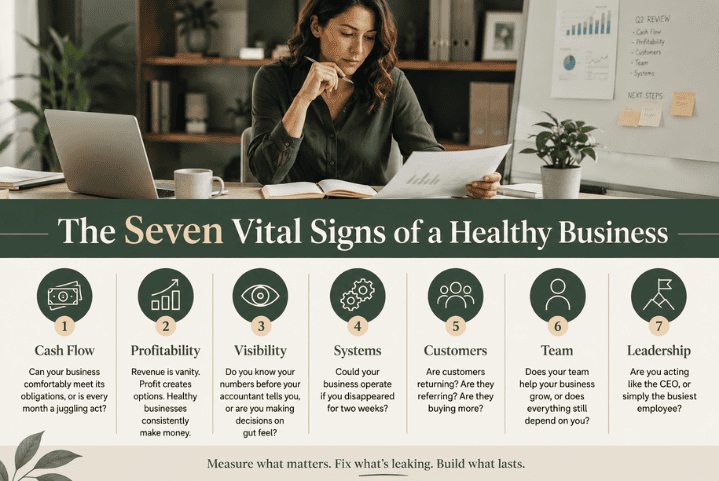
Why Isn’t My Business Making Money?

Why Isn’t My Business Making Money?

If you’ve ever sat in your office after another long week and thought…

“We’re busy… so why does it still feel like there’s never enough money?”

You’re not alone.

In fact, it’s one of the most common conversations I have with small business owners.

Tradies.
Hair salon owners.
Electricians.
Builders.
Consultants.
Professional service businesses.
Family businesses.

Different industries.

Different personalities.

Different businesses.

Yet almost every one of them eventually asks me the same question.

“Karen… where is all the money going?”

It’s a frustrating place to be.

You’ve worked hard. You’re winning work. Your staff are busy. The phone keeps ringing. Your turnover has grown. Yet somehow the bank account never seems to reflect all the effort you’re putting in.

You start questioning yourself.

“Maybe we need more customers.”

“Maybe we need better marketing.”

“Maybe everyone else is just better at business than I am.”

But here’s what I’ve discovered after working with many business owners. Most businesses don’t actually have a revenue problem. They have a decision problem. And there’s a very big difference.

Turnover Is Not the Same as Profit

One of the biggest myths in business is that more sales automatically mean more money.  If only it were that simple.

I’ve met business owners proudly telling me they’ve just had their biggest revenue month ever. Then, five minutes later….

  • They’re telling me they can’t pay themselves or
  • They’re worried about BAS, or
  • They’re putting supplier invoices on payment plans, or
  • They’re lying awake wondering how they’ll make payroll next week.

How is that possible?

Because revenue is only one number.

Business health is made up of hundreds of decisions happening behind the scenes every single day.

You can increase sales by 30% and still make less profit than last year.  You can double your revenue and double your stress at exactly the same time.

I’ve seen businesses grow themselves broke. That’s one of the cruelest realities of running a business.

Growth doesn’t fix poor visibility. Sometimes it simply magnifies it.

Busy Doesn’t Always Mean Successful

One of my favourite questions to ask business owners is this:

“On a scale of one to ten… how busy are you?”

Almost everyone answers…

“Ten.”

Then I ask another question.

“Great… and on the same scale, how profitable are you?”

Silence.

Because being busy has become a badge of honour.

We’re proud of working weekends. We celebrate twelve-hour days. We convince ourselves exhaustion is proof we’re succeeding.

  • But being busy isn’t the goal.
  • Profit is.
  • Freedom is.
  • Choice is.

A business should improve your life. Not consume it.

Somewhere along the journey many owners stop building businesses and start building jobs. Very expensive jobs.

  • They’re the salesperson.
  • The operations manager.
  • The bookkeeper.
  • The HR department.
  • The marketing team.
  • The problem solver.
  • The firefighter.
  • The person who answers every phone call.
  • Approves every invoice.
  • Signs every cheque and
  • Makes every decision.

Without even realising it, they’ve become the employee their business depends on most.

That’s exhausting.

And eventually it’s expensive too.

Busy Doesn't Always Mean Successful

The Business Health Problem Nobody Talks About

Imagine waking up tomorrow feeling unwell. You visit your doctor.

Instead of checking your blood pressure…

Instead of ordering blood tests…

Instead of listening to your heart…

They simply look at you and say,

“You seem okay.”

You’d probably find another doctor. Because real health isn’t measured by guesswork. It’s measured by evidence.

Business should be exactly the same. Yet most owners judge the health of their business by three things. How much money is in the bank. Whether the phone is ringing, and how stressed they feel.

None of those are reliable indicators. They’re symptoms.

Not diagnoses.

Your bank account tells you where you’ve been. Not where you’re heading. Your accountant tells you what happened months ago. Not what’s happening today.

And your stress levels? They’re usually the last indicator to appear.

By the time you’re feeling overwhelmed, the problems have often been building quietly for months.

That’s why I believe every business deserves a proper health check.

Not because something has gone wrong. But because prevention is always cheaper than recovery.

Flying Blind

Have you ever flown on a plane?

Imagine if halfway through the flight the pilot turned around and announced…

“Good news everyone… I’ve switched off all the instruments. We’re just going to trust our instincts from here.” Nobody would stay on that plane.

Yet that’s exactly how thousands of businesses are being run every day. No visibility. No dashboard. No early warning signs. No meaningful data. Just gut feel. Hope, and crossed fingers.

The problem with relying on instinct is that instinct becomes less reliable as businesses become more complex.

Five customers become fifty. One employee becomes ten. One service becomes six.

More invoices.

More suppliers.

More wages.

More tax obligations.

More moving parts.

Eventually your brain simply can’t keep up.

And that’s when little problems quietly become expensive ones.

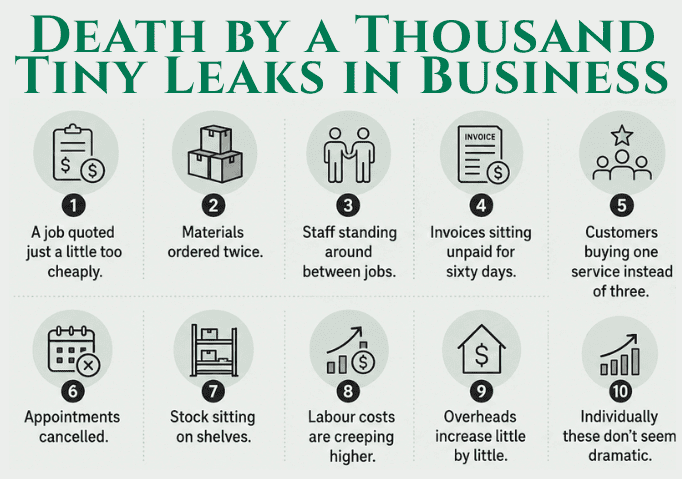
Death by a Thousand Tiny Leaks

People often imagine businesses fail because of one catastrophic event. That’s rarely what happens. It’s usually death by a thousand tiny leaks.

  • A job quoted just a little too cheaply. 
  • Materials ordered twice.
  • Staff standing around between jobs.
  • Invoices sitting unpaid for sixty days.
  • Customers buying one service instead of three.
  • Appointments cancelled.
  • Stock sitting on shelves.
  • Labour costs are creeping higher.
  • Overheads increase little by little.
  • Individually these don’t seem dramatic.

Collectively they can cost tens, or even hundreds of-thousands of dollars each year.

The frustrating part?  Most owners never see them.

Not because they aren’t intelligent. Because they’re too busy running the business to step back and actually see the business.

That’s a very different skill, and it’s one most people were never taught.

Death by a Thousand Tiny Leaks

Working In the Business Instead of On It

Most people start businesses because they’re good at something.

They’re great electricians.

Fantastic hairdressers.

Excellent plumbers.

Talented builders.

Experienced consultants.

Amazing photographers.

But nobody teaches them how to become CEOs. Nobody teaches them how to read the heartbeat of a business. Nobody teaches them which numbers actually matter, or which numbers don’t.

That’s where the shift begins.

The day you stop seeing yourself as someone who simply does the work….and start thinking like the owner of an asset. 

Because your job isn’t just to generate income. It’s to build something valuable. Something predictable. Something profitable. Something that doesn’t rely entirely on you.

That shift changes everything.

From Guesswork to Confidence

Over the years, I’ve noticed something fascinating.

When business owners first come to me, they usually think they have one big problem.

They’ll say things like:

“Cash flow is terrible.”

“I need more customers.”

“I need to make more sales.”

“My profit has disappeared.”

They’re convinced they’ve identified the problem.

But after we spend time looking at the business properly, we often discover that those things weren’t the problem at all.

They were simply the symptoms.

It’s a little like taking painkillers every day for a headache without ever discovering you actually need glasses.

You can keep treating the symptom forever, but until you understand the real cause, nothing truly changes.

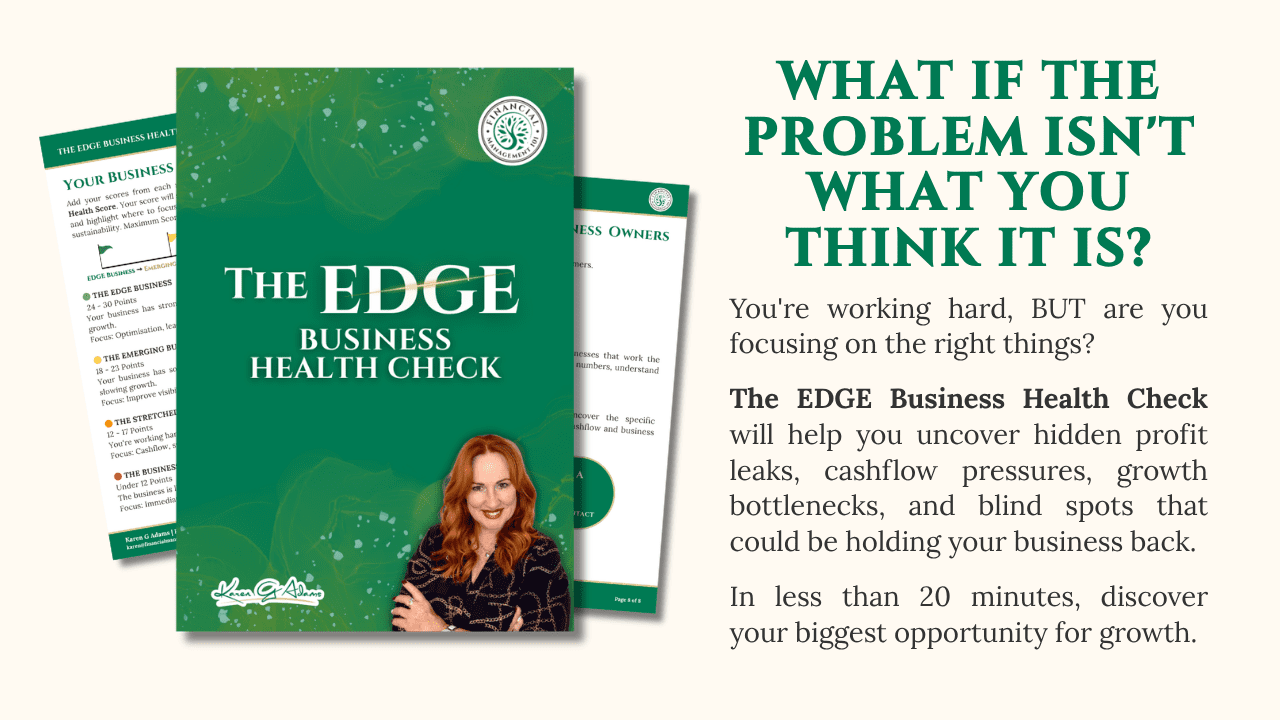
That’s why I created The EDGE Business Health Check™.

Not because business owners need another spreadsheet. Not because they need another report sitting in a drawer. They need clarity. They need visibility to make the decisions easier.

They need someone to help them see what they can’t see because they’re standing in the middle of it every single day.

One of my favourite sayings is:

You can’t fix what you can’t see.

It sounds simple. But it might just be the most important lesson in business.

Give your business a business health check – take a 20 minute “The EDGE Business Health Check”…..your business will love it and so will you.

THE EDGE BUSINESS HEALTH CHECK

#HowToResetMyMoneyMindset #NewYearFinancialMindset #HowToStartFreshWithMoney  emergency fund australia, money management, family savings #SmallBusinessOwner #BusinessGrowth #CashflowManagement #BusinessSuccess
#EntrepreneurMindset

 

Nobody Warns You About This Part of Business Ownership (And It’s Not Cash Flow)

Nobody Warns You About This Part of Business Ownership (And It’s Not Cash Flow)

When people talk about running a business, they usually talk about the exciting stuff:

  • The freedom.
  • The flexibility.
  • The ability to be your own boss, and
  • The opportunity to build wealth and create a life on your terms.

Scroll through social media and you’ll see plenty of business owners talking about growth, success, scaling, marketing, and revenue.

You’ll see photos of awards, new clients, packed events, business milestones and smiling faces.

What you don’t often see is what happens behind the scenes;

  • The pressure.
  • The responsibility.
  • The sleepless nights.
  • The moments of doubt, and
  • The weight that comes with being the person everyone depends on.

Because nobody really warns you about this part of business ownership.

And yet, for many small business owners, it’s the hardest part.

The Weight Nobody Sees

When you start a business, you’re usually driven by a dream…..

  • Maybe you wanted more freedom.
  • Maybe you wanted to escape the corporate world.
  • Maybe you wanted to create something meaningful, or
  • Maybe you simply wanted to provide a better future for your family.

What many people don’t realise is that owning a business isn’t just a job.

It’s a responsibility.

A responsibility that often follows you home.

You don’t simply clock off at 5pm.

You don’t leave your worries at the office.

You don’t hand difficult decisions to someone else.

You carry them. Every single day.

  • You carry the responsibility of paying wages.
  • You carry the responsibility of keeping customers happy.
  • You carry the responsibility of generating income.
  • You carry the responsibility of solving problems, and 
  • You carry the responsibility of making decisions that impact your team, your family and your future.

And while many people see the business owner as the person with freedom, the reality is that many business owners quietly carry a burden that few people truly understand.

The Lonely Side of Leadership

One of the things I hear most often from business owners is this:

“I feel like I’m carrying everything.”

Not because they aren’t capable.

Not because they’re failing.

But because leadership can be lonely.

  • Your staff come to you with problems. 
  • Your customers come to you with questions.
  • Your suppliers come to you with issues.
  • Your accountant wants information.
  • The tax office wants payments.
  • Your family wants your time, and
  • Somewhere in the middle of all that, you’re expected to keep moving the business forward.

Many business owners become the problem solver for everyone else while having very few people they can lean on themselves.

That’s not a weakness. That’s reality.

The challenge is that over time, carrying everything can become exhausting.

Not physically.

Mentally.

Emotionally.

And that’s where many business owners begin to lose the spark they once had.

The Pressure to Have All the Answers

There seems to be an unspoken belief that business owners should always know what they’re doing.

Always have a plan.

Always have the answer.

Always appear confident.

The truth?

Most business owners are figuring things out as they go.

They are making decisions based on the information they have at the time.

  • They are adapting.
  • Learning.
  • Adjusting, and
  • Growing.

Just like everyone else.

The difference is that they often feel they can’t admit uncertainty because everyone is looking to them for direction.

This creates enormous pressure.

  • Pressure to appear confident.
  • Pressure to stay positive.
  • Pressure to keep going even when they’re tired, and
  • Pressure to make the right decision every single time.

But here’s something important to remember:

  • You do not need to have all the answers.
  • You simply need to keep asking better questions.

Many business owners become the problem solver for everyone else while having very few people they can lean on themselves.

Success Doesn’t Eliminate Pressure

Many people assume that once a business reaches a certain level, things become easier.

That once revenue grows, the pressure disappears.

That once the business is successful, the worries vanish.

Unfortunately, that’s rarely how it works.

Growth often creates new challenges.

  • More customers.
  • More staff.
  • More systems.
  • More decisions.
  • More complexity, and
  • More responsibility.

The business may become larger, but the need for leadership grows right alongside it.

This is why some business owners reach revenue goals they once dreamed about and still feel stressed.

Still feel overwhelmed.

Still wonder if they’re doing enough.

Success does not automatically create peace of mind.

Clarity does.

The Hidden Cost of Constant Decision Making

Business owners make hundreds of decisions every week.

  • Some small.
  • Some significant.
  • What should we charge?
  • Should we hire?
  • Can we afford another team member?
  • Should we invest in marketing?
  • Is this client worth keeping?
  • Should we expand?
  • Should we change direction?
  • Should we say yes?
  • Should we say no?

Every decision consumes energy.

Every decision requires attention.

Every decision carries consequences.

Over time, decision fatigue becomes very real.

This is often why business owners feel mentally exhausted even when they haven’t done physically demanding work.

Their brain has been making decisions all day.

Every day.

Week after week.

Month after month.

Year after year.

Without realising it, many business owners become mentally overloaded.

And when that happens, even simple decisions start to feel difficult.

The Business Starts Running You

Most people start a business seeking freedom.

Yet many eventually find themselves trapped by the very thing they created.

The business becomes dependent on them.

Every question comes to them.

Every approval comes to them.

Every problem comes to them.

Every decision comes to them.

The result?

The business cannot move without them.

Vacations become difficult.

Time off feels impossible.

Weekends become catch-up days.

And the business owner slowly becomes an employee in their own business.

Not because they’re doing anything wrong.

But because systems, visibility and structure haven’t kept pace with growth.

This happens more often than people realise.

And it doesn’t happen overnight.

It happens one small decision at a time.

Why Business Owners Need More Than Motivation

The business world loves motivation.

  • Inspirational quotes.
  • Motivational videos.
  • Success stories.

And while motivation has its place, it isn’t enough.

Because motivation doesn’t solve uncertainty.

Motivation doesn’t provide clarity.

Motivation doesn’t help you make better business decisions.

Business owners don’t need more hype.

They need better information.

They need visibility.

They need confidence in the decisions they’re making.

They need to understand what’s really happening inside their business.

Not what they think is happening.

Not what they hope is happening.

What’s actually happening.

Because when you can see clearly, decision making becomes easier.

  • Confidence increases.
  • Stress decreases.
  • Momentum improves.

The Businesses That Thrive Aren’t Necessarily the Smartest

This might surprise you. The businesses that thrive are not always run by the smartest people.

They’re often run by the people who have the clearest view of what’s going on.

They know what matters.

They know where to focus.

They know what’s working.

They know what isn’t.

They know where their biggest opportunities exist.

And they know where they’re leaking time, money and energy.

That level of visibility changes everything.

Because when you know where to look, you stop guessing.

And when you stop guessing, you start making better decisions.

The businesses that thrive are not always run by the smartest people.
They're often run by the people who have the clearest view of what's going on.

You Were Never Meant to Carry It Alone

One of the biggest myths in business is that successful people do everything themselves.

They don’t.

Successful business owners build support around them.

  • They seek advice.
  • They use systems.
  • They use data.
  • They use frameworks, and
  • They surround themselves with people who help them see what they cannot see themselves.

Business ownership should not feel like a solo sport.

You shouldn’t have to carry every challenge on your own.

You shouldn’t have to guess your way through important decisions.

You shouldn’t have to wonder whether you’re focusing on the right things.

The right support doesn’t remove responsibility.

But it can make the journey significantly easier.

Final Thoughts

If you’ve ever felt overwhelmed by the responsibility of running a business, you’re not alone.

If you’ve ever questioned whether you’re doing enough, you’re not alone.

If you’ve ever felt like you’re carrying the weight of the business on your shoulders, you’re definitely not alone.

The truth is that many business owners experience these feelings.

They just don’t often talk about them.

The good news?

You don’t need to work harder.

You don’t need to carry more.

You don’t need to have all the answers.

You simply need greater clarity about what’s happening inside your business so you can make better decisions with confidence.

Because business ownership shouldn’t just be about surviving.

It should be about building a business that supports your life, not consumes it.

Ready to See What’s Really Going On Inside Your Business?

The first step is understanding where your business is today.

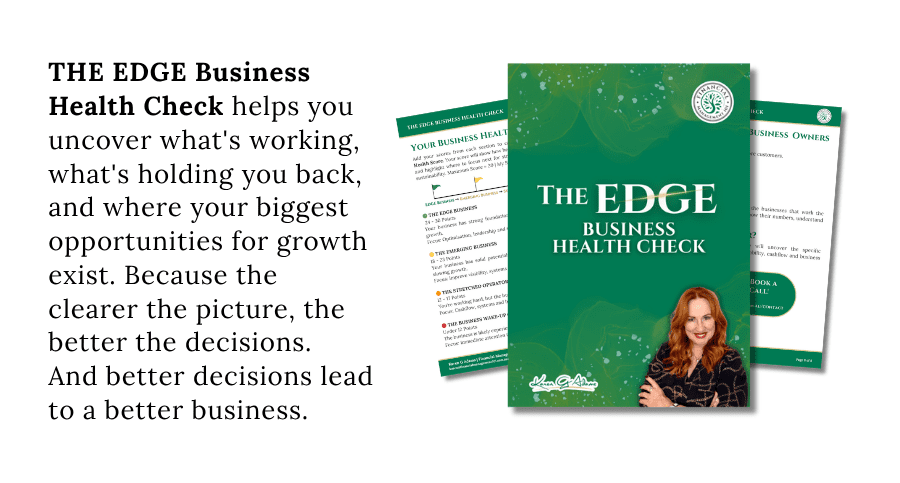
THE EDGE Business Health Check helps you uncover what’s working, what’s holding you back, and where your biggest opportunities for growth exist.

In less than 20 minutes, you’ll gain valuable insights into the health of your business across profitability, cash flow, growth, systems, leadership and CEO visibility.

Because the clearer the picture, the better the decisions.

And better decisions lead to a better business.

Take THE EDGE Business Health Check today and discover where your next opportunity is hiding.

THE EDGE BUSINESS HEALTH CHECK

#HowToResetMyMoneyMindset #NewYearFinancialMindset #HowToStartFreshWithMoney  emergency fund australia, money management, family savings #SmallBusinessOwner #BusinessGrowth #CashflowManagement #BusinessSuccess
#EntrepreneurMindset
 

Your Team Might Look Fine – But Financial Stress Could Be Costing More Than You Think

Your Team Might Look Fine – But Financial Stress Could Be Costing More Than You Think

“They seem fine.”

It is one of the most common assumptions leaders make.
And to be fair, it is an easy one to make.

Most employees are not walking into work announcing that they are worried about bills, debt, interest rates, or the rising cost of everyday life.

They keep going.
They keep performing.
They keep pushing through.

But financial stress has a way of showing up quietly.

It can look like a distraction.
Low energy.
Mood changes.
Reduced confidence.
Increased absenteeism.
Burnout.
Or eventually, a resignation that seems to come out of nowhere.

The employee looked fine.
But they were not fine.

The silent pressure many employees are carrying

The current financial climate is affecting people in deeply personal ways.
Even capable, high-performing employees can be under enormous pressure.

When money stress builds, people can feel:

  • mentally overloaded
  • emotionally flat
  • ashamed to ask for help
  • trapped in a cycle of stress and avoidance
  • worried about keeping up with household costs
  • fearful about debt, repayments, or unexpected expenses

And because money is still a sensitive topic, many employees suffer in silence.

That silence can be expensive.

The current financial climate is affecting people in deeply personal ways.
Even capable, high-performing employees can be under enormous pressure.

Why this is bigger than employee perks

Free lunches, social events, and workplace rewards all have their place.
But they do not solve financial anxiety.

When someone is lying awake worrying about bills, a pizza party is not going to restore their peace of mind.

This is why financial wellbeing deserves more attention inside workplaces.
It addresses a real problem that affects people’s everyday lives and their capacity to function well at work.

It is practical. It is human. And right now, it is incredibly relevant.

What financial wellbeing support actually does

A strong financial wellbeing approach helps employees move from stress and confusion to clarity and confidence.

That might involve helping them:

  • understand where their money is going
  • create simple systems that reduce overwhelm
  • identify savings opportunities they have missed
  • tackle debt with a clearer plan
  • improve money habits and mindset
  • feel more hopeful and less stuck

Notice that this is not about judgement. It is about support.

Financial pressure can affect anyone. The goal is not to shame people for needing help. The goal is to give them tools that genuinely make life feel more manageable.

What employers gain when they take this seriously

When businesses support staff with financial wellbeing, the impact can ripple through the whole workplace.

You may see:

  • better focus and engagement
  • increased productivity
  • lower staff turnover
  • stronger trust and loyalty
  • reduced burnout risk
  • a more supportive workplace culture

People remember employers who support them through hard seasons.
Not just with words, but with meaningful action.

Reassurance is part of support

Let’s pause here for something important.

If you are an employee feeling the pressure right now, please hear this:

You are not weak.
You are not bad with money just because things feel hard.
You are not the only one feeling stretched.

This season may be challenging, but it does not define you.
With the right support, practical tools, and small consistent changes, things can improve.

And if you are an employer reading this, never underestimate how powerful it is to create a workplace where people feel safe to get support before they hit breaking point.

    Reassurance is part of support

    Support before crisis is the smarter move

    Too often, workplaces respond after the damage is done.
    After the burnout.
    After the resignation.
    After the drop in performance.
    After the personal crisis spills into professional life.

    But early support changes that.

    When businesses proactively offer financial wellbeing resources, they help staff build resilience before the pressure becomes overwhelming.
    That is better for the employee and better for the organisation.

    A more compassionate and practical workplace benefit

    There is a reason financial wellbeing is becoming such an important conversation.
    It sits at the intersection of performance, retention, mental wellbeing, and culture.

    It is not about fixing everything overnight.
    It is about giving people a starting point.
    A plan.
    A sense that they are not alone.
    A pathway back to confidence.

    And in uncertain times, that kind of support matters more than ever.

    My Financial Wellbeing Program helps workplaces support staff with practical money tools, confidence-building education, and real guidance that reduces stress and strengthens wellbeing.

    Because when your people feel better about money, they often feel better at work too.

    And that is good for everyone.

    Financial Wellbeing Program

    #HowToResetMyMoneyMindset #WhyDoIFeelOutOfControlWithMoney #HowToFeelInControlOfFinances #ResetMoneyMindset2025 #NewYearFinancialMindset #HowToStartFreshWithMoney  emergency fund australia, money management, family savings 


    Busy Is Not Profitable: 7 Financial Foundations Every Business Owner Needs

    Busy Is Not Profitable: 7 Financial Foundations Every Business Owner Needs

    There’s a big myth in small business that if you just work hard enough, everything will eventually click into place.

    Spoiler alert: hard work matters, but hard work without financial foundations can leave you exhausted, underpaid, and wondering why your business still feels so heavy.

    I see this all the time with small business owners, tradies, franchisees, coaches, and self-employed professionals.

    They are flat out. Clients are coming in. Invoices are going out. The calendar is packed.

    And yet… There is still stress. Still pressure. Still that sinking feeling of, “Why does it feel like I’m doing all this work and not getting ahead?”

    Here’s why:

    Because busy is not profitable. And being great at your trade or profession is not the same as having strong money systems.

    The good news? You do not need a finance degree to fix this. You just need the right foundations.

    Here are seven of the most important ones.

    1. A cashflow system that tells the truth

    Cashflow is not something you check when you are already in trouble.
    It is something you build so you can stay out of trouble.

    A good cashflow system shows you:

    • what is coming in
    • what is going out
    • what bills are approaching
    • what is available to spend
    • what needs to be set aside for tax, super, wages, and future costs

    Cashflow gives you visibility. Visibility gives you control.

    2. Clear separation between personal and business money

    Using your personal account like a business overdraft creates confusion fast.

    It becomes harder to track spending, harder to know what the business is really earning, and harder to make clean decisions.

    Separating business and personal finances is one of the fastest ways to reduce chaos.
    It is not about being fancy. It is about being clear.

    3. Pricing that actually protects your profit

    So many business owners price from fear.

    Fear of losing the sale.
    Fear of seeming too expensive.
    Fear of being judged.

    But underpricing does not make you more professional. It makes your business more fragile.

    Your pricing needs to cover more than the job in front of you. It needs to reflect overheads, admin time, tax obligations, profit goals, and the actual value you deliver.

    Pricing with confidence is not greedy.
    It is responsible.

    4. A plan to pay yourself properly

    Using your personal account like a business overdraft creates confusion fast.

    It becomes harder to track spending, harder to know what the business is really earning, and harder to make clean decisions.

    Separating business and personal finances is one of the fastest ways to reduce chaos.
    It is not about being fancy. It is about being clear.

    5. Weekly and monthly money rhythms

    You do not need to stare at your numbers every day.
    But you do need a rhythm.

    That might include:

    • checking cashflow weekly
    • reviewing key reports monthly
    • monitoring expenses and margins
    • tracking unpaid invoices
    • spotting small issues before they turn into big ones

    Confidence with numbers is built through repetition, not perfection.

    6. Knowing your numbers without drowning in them

    You do not need to obsess over every metric.
    You do need to know the numbers that matter.

    Think:

    • revenue
    • gross profit
    • operating expenses
    • net profit
    • cash position
    • debt levels
    • wage costs
    • tax set-asides

    The goal is not more complexity.
    The goal is better decisions.

    When you know what your numbers are saying, you stop making emotional decisions and start making strategic ones.

    7. A business structure that can handle growth

    Growth is exciting, but if your systems are messy, it can magnify every weakness.

    That is why foundations matter before scaling.

    You want business systems that support:

    • clear accounts setup
    • simple automations
    • better reporting
    • cleaner budgeting
    • stronger decision-making
    • less burnout

    Strong structure makes growth feel possible instead of painful.

    Business foundations create freedom

    Why this matters right now

    The business landscape is not getting easier.
    Costs are rising. Margins can be tight. Pressure builds quickly when you do not have clarity.

    That is exactly why now is the time to stop relying on memory, hope, and hustle alone.

    The strongest business owners are not always the loudest or busiest.
    They are the ones who know their numbers, trust their systems, and make decisions early.

    Foundations Create freedom

    Let’s make this simple. When your financial foundations are solid, you get:

    • less panic
    • less avoidance
    • less confusion
    • better decisions
    • stronger profit
    • more confidence
    • more breathing room

    And honestly? More enjoyment.

    Because business should not feel like one long financial mystery.

      A business structure will help you handle growth

      Your invitation to stop winging it

      If you know your foundations need work, you are not alone.
      And you do not have to figure it all out the hard way.

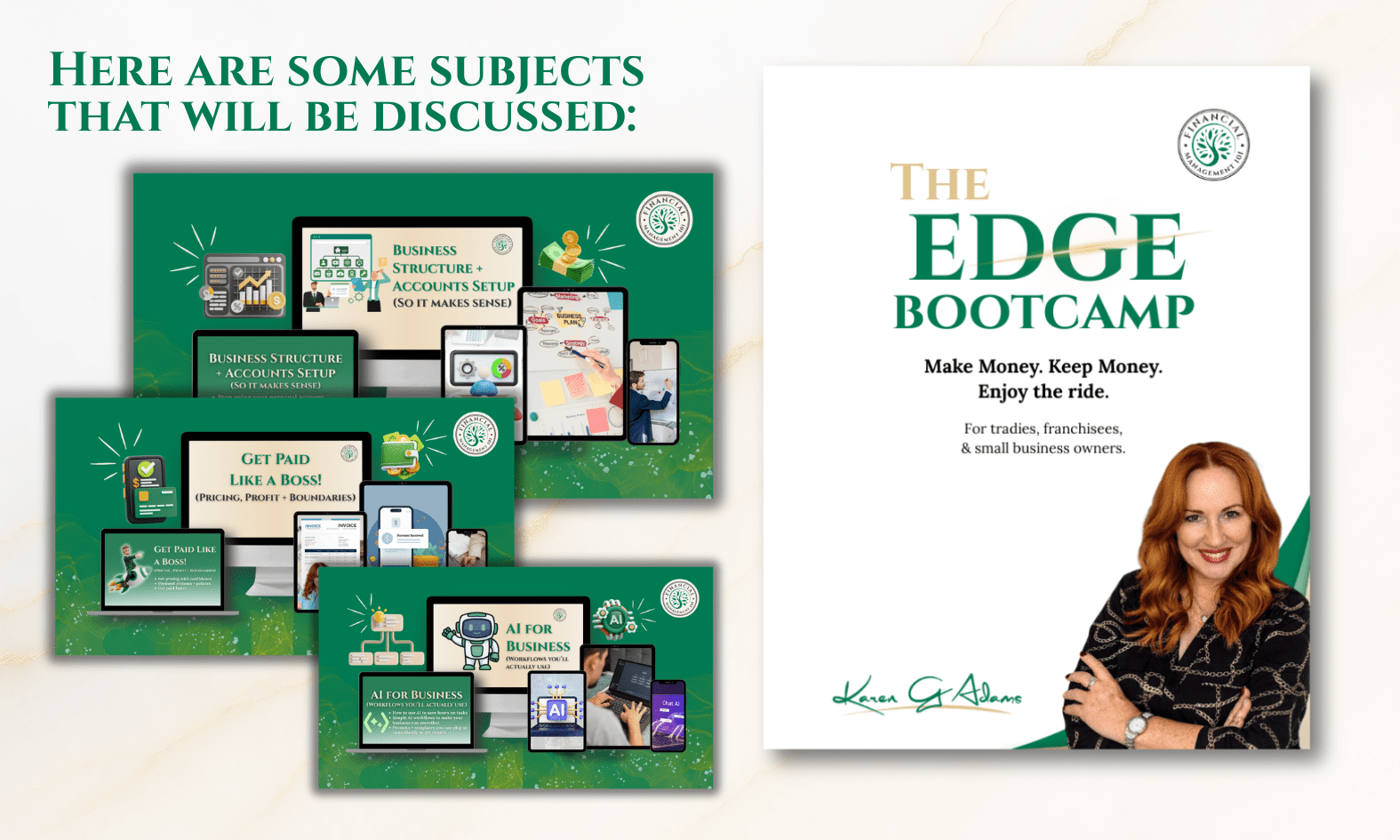
      That is exactly what The Edge Bootcamp is designed to help you do.

      Over two practical, high-impact days, we dig into the real foundations of profitable business: money systems, CEO mindset, cashflow, paying yourself, pricing, budgets, business setup, reading your numbers, leadership, growth stages, and more.

      This is for business owners who want results, not just motivation.

      Join The Edge Bootcamp in May and give your business the foundations it needs to make money, keep money, and enjoy the ride.

      Because being flat out is not the goal.
      Building a business that works for you is.

      Join The Edge Bootcamp

      #HowToResetMyMoneyMindset #WhyDoIFeelOutOfControlWithMoney #HowToFeelInControlOfFinances #ResetMoneyMindset2025 #NewYearFinancialMindset #HowToStartFreshWithMoney  emergency fund australia, money management, family savings 


      The Foundations First: Why Small Business Owners Can’t Afford to Wing It Anymore

      The Foundations First: Why Small Business Owners Can’t Afford to Wing It Anymore

      If you’re a small business owner, tradie, franchisee, coach, or self-employed professional, chances are you didn’t start your business because you love spreadsheets, cashflow forecasts, or sorting out your accounts.

      You started because you’re good at what you do.

      You solve problems. You build things. You coach people. You create results. But somewhere along the way, many business owners find themselves working harder than ever and still feeling like they’re falling behind.

      Money comes in.
      Then it disappears.
      Tax time rolls around and suddenly it feels personal.
      You’re busy every day, yet you’re not fully sure whether your business is actually performing well.

      Sound familiar?

      Here’s the truth: being busy is not the same as being profitable.

      And in today’s business world, “winging it” is no longer a strategy.

      Why foundations matter more than ever

      Strong businesses are not built on hustle alone. They are built on foundations.

      That means knowing:

      • what money is coming in
      • what money is going out
      • what your pricing needs to be
      • whether your profit is real or just temporary relief
      • how much you can actually afford to pay yourself
      • what your numbers are telling you before problems get bigger

      Without those foundations, growth gets messy fast.

      More sales can actually create more pressure.
      More clients can create more chaos.
      More team members can expose weak systems.
      And more revenue can still leave you with less cash than expected.

      This is the trap so many business owners fall into. From the outside, things can look successful. Inside, it feels like stress, uncertainty, and constant financial firefighting.

      Strong businesses are not built on hustle alone. They are built on foundations.

      The Hidden Cost of Weak Foundations

      When your financial systems are weak, everything takes more energy.

      You make decisions based on gut feel instead of facts.
      You underprice because you’re scared of losing work.
      You mix personal and business spending and hope it all works out.
      You avoid looking at reports because they feel overwhelming.
      You stay in operator mode instead of stepping into your role as CEO.

      The result?
      You work harder, worry more, and enjoy your business less.

      And let’s be honest, that is not why you started.

      A business should support your life, not swallow it whole.

      What Solid Business Foundations Actually Look Like 

      Getting your foundations right does not mean making things more complicated.

      It means making things clearer.

      It looks like:

      • a simple cashflow structure you actually understand
      • separate systems for business and personal money
      • confidence around pricing, profit, wages, and expenses
      • a weekly and monthly rhythm for checking the right numbers
      • stronger boundaries around spending and decision-making
      • knowing where your money is leaking and how to plug it

      When these basics are in place, something powerful happens.

      You stop guessing.
      You start leading.
      You stop reacting.
      You start planning.
      You stop feeling behind.
      You start building momentum.

      You do not need more motivation. You need structure.

      Many business owners think they need to feel more disciplined, more focused, or more inspired.

      But often, that’s not the real issue.

      The issue is that the business has grown beyond the systems holding it up.

      You don’t need another pep talk.
      You need a better framework.

      You need simple tools that help you:

      • understand your cashflow
      • pay yourself consistently
      • price with confidence
      • stop tax shock before it happens
      • make decisions from a place of control

      That is where real confidence comes from.
      Not from hoping, but from knowing.

      You don’t need another pep talk.
You need a better framework.

      The Difference Between Surviving and Scaling

      If your foundations are shaky, growth can break you.

      That might sound dramatic, but it’s true.

      A bigger business with poor systems often creates:

      • higher stress
      • tighter cashflow
      • more team issues
      • greater tax pressure
      • slower decision-making
      • more burnout

      On the other hand, when your business foundations are strong, growth becomes more sustainable.
      You can see what is working.
      You can fix what is not.
      You can make better decisions faster.
      You can lead with more confidence and less panic.

      That is the difference between surviving the month and building a business that genuinely funds your life.

        A Quick Self-Check for Business Owners

        Ask yourself:

        • Do I know exactly where my money is going each month?
        • Am I paying myself properly and consistently?
        • Do I understand the difference between revenue and profit in my business?
        • Do I have simple systems for cashflow, tax, and expenses?
        • Do I look at my numbers regularly, or only when I’m forced to?
        • Am I leading my business like a CEO, or just trying to keep up?


        Discomfort is not failure. It is feedback.

        If those questions feel a little uncomfortable, that’s okay.
        That discomfort is not failure.
        It is feedback.

        And it might be the exact sign that now is the time to strengthen your foundations.

        Your next step

        If you’re done with money disappearing, messy systems, and feeling like you’re working too hard for too little clarity, this is exactly why I created The Edge Bootcamp.

        This is not fluff, theory, or feel-good motivation.
        It is practical training for tradies, franchisees, coaches, small business owners, and self-employed professionals who want to stop winging it and start running their business like a CEO.

        Inside the Bootcamp, we cover the foundations that matter most – cashflow, profit, pricing, paying yourself properly, budgets that actually work, business setup, reading your numbers with confidence, and building stronger systems for sustainable growth.

        Join me at The Edge Bootcamp in May and build the financial and business foundations your growth actually needs.


        Because the goal is not to be busier.
        The goal is to be stronger, smarter, and more profitable.

        Note: This event provides education and general information, not personalised financial, accounting, legal, tax, investment, or health advice. Seek advice specific to your circumstances from qualified professionals.

        The Edge Bootcamp

        #HowToResetMyMoneyMindset #WhyDoIFeelOutOfControlWithMoney #HowToFeelInControlOfFinances #ResetMoneyMindset2025 #NewYearFinancialMindset #HowToStartFreshWithMoney  emergency fund australia, money management, family savings