How we handle money can have a big effect on how confident we feel, and the same is true in reverse.
Here are some ways that taking care of your money and having confidence are linked:
Financial success can boost confidence: Being able to manage our money and make money can make us feel good about ourselves and provide us with a sense of accomplishment. But having money problems can make us feel unsafe and lower our self-esteem.
Confidence can impact financial decisions: How confident we are can affect the choices we make about money. For example, if we are confident in our ability to make money, we may be willing to take more risks or start our own business. On the other hand, if we don’t feel confident, we might be more careful with our money and avoid taking risks.
How we think can have a huge effect on how well we do financially:With a growth mindset, we can learn and get better. This can help us solve problems with money and reach our goals. On the other hand, a fixed mindset can hold us back. This is when we think that our skills are fixed and can’t be improved.
Money can change how we feel about ourselves: How we deal with money can change how we feel about ourselves. If we judge ourselves by how much money we have, we might feel bad about ourselves if we don’t have as much as we think we should. If, on the other hand, we have a healthy relationship with money and see it as a tool to help us reach our goals, we can feel good about ourselves no matter what our financial situation is.
Managing your money, time, and confidence are all linked in the following ways:
Focus on what’s important: When it comes to handling your money, you should pay attention to what’s most important to you. Figure out what you value and what’s most important to you, and make sure your financial choices reflect that.
Use technology to your advantage: Technology is a strong tool that can help you keep track of your money and save time. Use apps and online tools to automate your finances, keep track of how much you spend, and make smart decisions about your money.
Money and building confidence: Taking care of your money well can help you feel better about yourself and what you can do.
Here are some practical ways to build trust by taking care of your money:
Learn about personal finance and investing: This will give you more faith in your ability to handle your money well. You can learn more about money by reading books, taking classes, and talking to financial experts like myself.
Take action: Taking action is one of the most important ways to build confidence. Start small by making financial goals that you can reach, like paying off debt or saving money for an emergency fund. As you reach each goal, you’ll feel better about yourself.
Keep track of your progress: Keeping track of your progress can help you feel more confident in your ability to manage your money. Join programs like my “know your money” program which starts with understanding where you are financially so you can build on from there.
Celebrate your financial wins:No matter how small, celebrating your financial wins can help you build confidence and energy. Give yourself a small reward for reaching your financial goals, and use that good feeling to keep going.
By implementing these practical tips, you can improve your ability to manage your money and build confidence. Remember that building these skills takes time and effort, but the payoff can be significant in terms of your financial and personal well-being.
The LEARNING HUB helps you gain more financial knowledge, while providing you with the support and help you and others need. Join now for only $79 USD per month.
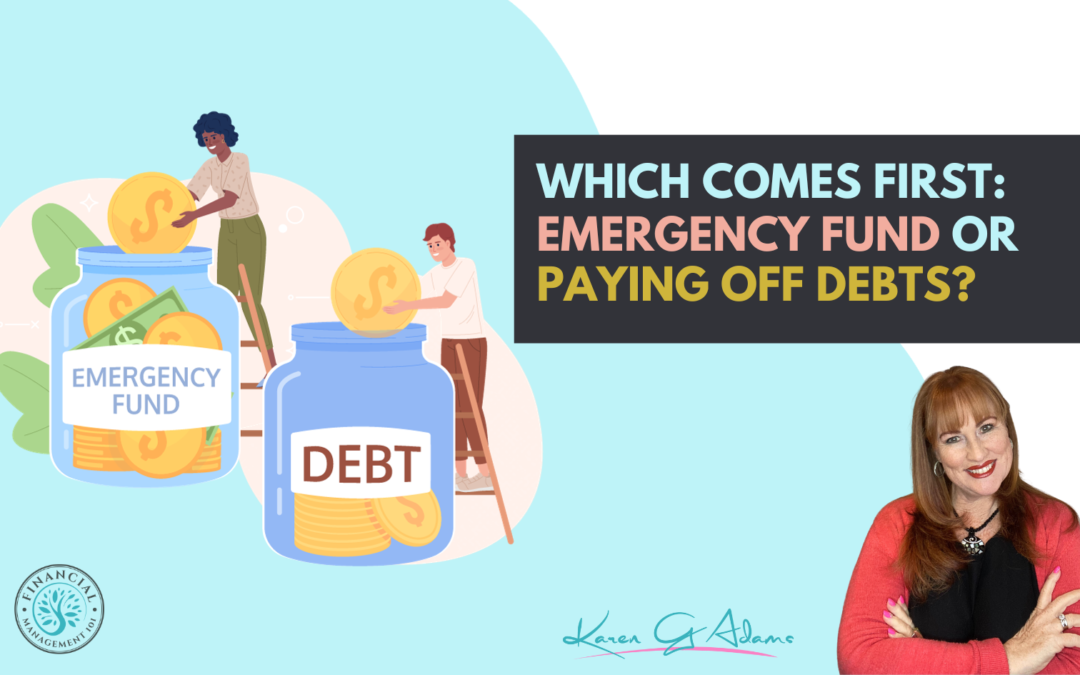
When money is tight, it can be hard to pay down debt and build up an emergency savings fund at the same time. But it is still possible with careful budgeting and good money management.
Here’s a step-by-step plan on how to do this:
1. ASSESS YOUR FINANCIAL SITUATION
Start by looking carefully at your money. Write down everything you earn and everything you owe, including the balances, interest rates, and minimum monthly payments.
2. MAKE A BARE-BONES BUDGET
Make a simple budget that covers only the most important costs, such as housing, utilities, groceries, transportation, and insurance. Cut back as much as you can on spending you do not have to.
3. PAY OFF HIGH-INTEREST DEBTS
Pay off your debts with the highest interest rates first, as this will save you money in the long run. All debts should have the minimum payment made, but any extra money should be put toward the debt with the highest interest rate.
4. SET REALISTIC GOALS
Find out how much you can afford to put toward debt repayment and savings each month. Be careful and make paying off debt your first priority.
5. BUILD A SMALL EMERGENCY FUND
Even though it is important to pay down debt, having a small emergency fund can help you avoid going deeper into debt if you have to pay for something unexpected. Start with a small goal, like $500 or $1,000, and slowly raise it as time goes on.
6. USE WINDFALLS/UNEXPECTED MONEY WISELY
If you get money you did not expect, like a tax refund or a bonus, put some of it toward paying off debt and some into an emergency fund. This helps you move forward in both areas.
7. SAVE AND PAY OFF DEBTS AUTOMATICALLY
Set up automatic transfers to your emergency fund and to your debt payments whenever you can. This makes sure that you always move closer to both goals.
8. LOOK FOR WAYS TO MAKE MORE MONEY
Look for ways to make more money, like part-time work, freelance gigs, or selling things you do not use. The extra money can be used to pay off debts and save money.
9. TALK WITH YOUR CREDITORS
Talk with your creditors about your money situation. In some cases, you may be able to negotiate lower interest rates, lower minimum payments, or a delay in payments to make it easier to handle your debt.
10. REVIEW AND ADJUST REGULARLY
Check in on your budget and financial goals every so often. Change how you pay off debt and save money when your income and expenses change.
11. CELEBRATE MILESTONES
Celebrate your successes, no matter how small they are. Every dollar you save in an emergency fund or pay off of a debt is a step toward financial stability.
Remember that building an emergency fund and paying off debt are long-term goals. It’s okay to progress slowly if your income is limited.
The important thing is to keep working toward both goals, even if progress is slow. Your money situation will get better over time, and you will have a stronger financial base.
At Financial Management 101 – we are committed to providing YOU with excellent financial education, training and support so that you can live the life you truly desire. Join ourLEARNING HUBtoday!
Building an emergency savings fund is a crucial step in achieving financial security and peace of mind.
Here are some strategies to assist with building an emergency savings fund:
1. SET CLEAR GOALS
Determine how much you want to save in your emergency fund. It is often recommended to have at least three to six months’ worth of living expenses, but you can start with a smaller goal and work your way up.
2. CREATE A BUDGET
Develop a detailed monthly budget to track your income and expenses. This will help you identify areas where you can cut back and allocate more money to savings.
3. PAY YOURSELF FIRST
Think of the money you save for an emergency fund as a must-have expense. Set up transfers from your regular account, where your pay goes, to your savings account when you get paid. This makes sure that you always save.
4. REDUCE UNNECESSARY COSTS
Review how you spend your money and see if there are any expenses you can temporarily cut back on or stop. Put the money you save into your emergency fund.
5. INCREASE YOUR INCOME
Look for opportunities to boost your income, such as taking on a part-time job, freelancing, or selling items you no longer need around your home. All and any extra income can then be put into your emergency fund.
6. USE BONUSES AND UNEXPECTED MONEY/WINDFALLS
Any unexpected windfalls, such as tax refunds, work bonuses, or cash gifts, can be a great way to jumpstart your emergency fund. Instead of spending this money, save it.
7. OPEN A SEPARATE SAVINGS ACCOUNT
Consider opening a separate savings account specifically for your emergency fund. Look for a savings account that offers a better interest rate than a regular savings account, allowing your money to grow faster.
8. BUILD GRADUALLY
Do not feel like you have to hit your savings goal right away. It takes time to build up an emergency fund. Celebrate small steps along the way to stay motivated.
9. AVOID USING THE FUND FOR NON-EMERGENCIES
Define what you think of as an emergency and promise to only use your emergency fund for real emergencies, like medical bills, car repairs you did not plan for, or losing your job.
10. REVIEW AND ADJUST
Check in on your budget and savings progress. Change your savings goals and how much you put in as your finances change.
11. CONSIDER THE WINDFALL STRATEGY
If you get a big bonus, like an inheritance or money from a legal settlement, you might want to put some of it in your emergency fund to save money faster.
12. SEEK PROFESSIONAL ADVICE AND HELP
If you’re struggling to save or need some help, consider consulting a financial advisor or financial educator who can help you create a savings plan tailored to your specific situation.
Remember that building an emergency savings fund takes time, and it is fine to start small. The key is to develop a consistent savings habit and stick to your plan over time.
Having an emergency fund can give you peace of mind and financial security when unplanned expenses come up.
As I start the year off preparing for what I plan to achieve and share with you this coming year, I came across an article I wrote 2 years ago but never published.
I thought back and wondered why I wrote these inspirational thoughts?
On reflection, it was because at that time my Dad lost 3 of his brothers (my uncles) and his best mate all in the same year and who were all in their 70’s.
I also realised that last year I wrote a ton of stuff whether it be educational or inspirational but sadly never shared it with you my reader.
So today is the day that I promise to share more financial and mindset content that in the hope helps and benefits people in my community.
Here’s what I’ve learned these past 12 months:
1. Random acts of kindness are rare today. When you do something nice for someone without expecting anything in return, you may have just brightened up their day without knowing it.
2. If someone is unkind to you unless you’ve done something terribly horrible to them – it’s not about you – it’s about them and the challenges they may be facing behind the scenes.
3. Don’t judge anybody or any situation – you never know what someone is going through. Just because they put on a brave and smiling face, it doesn’t mean they are having a good time at life!
4. True friends are the ones that after months of not seeing them – don’t get upset or offended but greet you as if they just saw you the other day.
5. If people don’t acknowledge you – it’s ok. They may not have seen you like you think they have or if they have – possibly have a lot on their mind.
6. Money may not grow on trees – however if you work not only hard but smart – you will be growing your own tree that will look after you for many years to come.
7. Treasure the loved ones in your life – as you never know how long they will be here for.
8. When you look at exercise in a different way, other than to lose weight – amazing transformations happen – not only physically but your mind becomes super fit and sharp. Now that’s a bonus worth exercising for!
9. Love where you live – no matter on the size of your house or location. When you really love where you live – happiness appears from the corners of each room.
And, stop and smell the roses – I mean REALLY stop and smell the roses and get out in nature. It’s God and the Universe’s way of showing you all the beauty that surrounds you daily!
So while I wrote this 2 years ago, it still rings true for me today and has become even more important for me to follow the steps to achieve more happiness and fun in my life.
What have you learned over the past 12 months that you’ve decided you don’t want anymore and long to bring more of this year?
Leave me a comment below as I’d love to hear.
So until next time, wishing you more health, wealth and happiness this year.