Could a smaller dwelling be a solution for you, with apartments, units and townhouses widening their appeal in the property market? If you’re considering your options, reach out to discuss your situation today, there could be a rewarding solution for you!
Apartments stand out as an affordable choice when it comes to cracking the property market, not to mention downsizing. But a looming shortage may soon push unit values higher.
For many of us, buying a house on its own block of land is the ‘great Australian dream’. While plenty of people achieve this goal, our property journey is often book-ended by apartment living.
For first home buyers, units can be an affordable choice, costing around 30% less than houses according to CoreLogic.
Then, as we head into our senior years, an apartment offers secure, low-maintenance living, often with a wealth of amenities right on the doorstep.
Apartment demand is outstripping supply
Apartments may be affordable today, but a lack of new apartment construction, coupled with rising immigration levels, points to a looming apartment shortage according to CoreLogic. And that could push values higher.
Over the next few years, new apartment construction is forecast to be 40% lower in the 2010s, leading to a shortfall of over 100,000 homes by 2027. Close to 60% of the new home shortfall is expected to be in the apartment market.
On the demand side, CoreLogic says a stronger-than-expected level of migration into Australia has seen overall housing demand “skyrocket”. Historically, new migrants head to the high-density areas of our big cities, putting extra pressure on the unit market.
As CoreLogic explains, with interest rates potentially easing in 2024, greater demand and tight supply could fuel a “price boom” in the unit market.
Why more of us are choosing apartment living
Modern apartments are packed with the latest design and sustainability features, meaning they are no longer the poor relation of freestanding houses.
Across our major cities, apartments now account for 30% of all homes, up from 23% in 2010. And the appeal doesn’t just lie in affordability.
Today’s apartments usually come with a wealth of benefits, including:
Government Schemes: because apartments are generally cheaper than houses, they’re more often under the price caps for a range of government schemes, including the Home Guarantee Scheme, stamp duty concessions, and first home owner grants (usually for new builds). These schemes can be combined to potentially save you tens of thousands of dollars and get you into the property market years sooner.
Sought-after Locations: apartment living can be the difference between living close to work, or facing a long daily commute from the outer suburbs.
Lifestyle Advantages: the days of apartments being cramped and lacklustre are over. A variety of on-site amenities, from barbecue areas to pools, gyms and car-wash bays, make unit living convenient and relaxing.
Low maintenance Living: not interested in spending precious spare time mowing the lawns or cleaning the gutters? It turns out plenty of others aren’t either. Unlike houses, units require minimal upkeep, letting residents enjoy more quality time.
Improved Security: if you’re after a lock-and-leave lifestyle, modern apartments fit the bill. Advanced security features add up to a safe and secure living environment.
Is now the time to take the leap?
Right now, apartments still present an affordable option for first-home buyers, downsizers and investors.
The median apartment price across our state capitals is currently $637,593 – but if CoreLogic is correct, that figure could soon increase as demand outstrips supply.
So if you’d like help exploring your options to purchase your first property – for example, with just a 5% deposit via the Home Guarantee Scheme – then get in touch today to discover your borrowing power.
Disclaimer: The content of this article is general in nature and is presented for informative purposes. It is not intended to constitute tax or financial advice, whether general or personal nor is it intended to imply any recommendation or opinion about a financial product. It does not take into consideration your personal situation and may not be relevant to circumstances. Before taking any action, consider your own particular circumstances and seek professional advice. This content is protected by copyright laws and various other intellectual property laws. It is not to be modified, reproduced or republished without prior written consent.
Supporting someone with money stress can be challenging because they may be resistant to accepting help or discussing their financial difficulties with you.
Often people don’t want you to know they are struggling because of judgement, but this is the time to be the friend or family member to support them. There is always a way out and often they can’t see that due to the stress they are experiencing.
Sadly some people feel the only way out is to leave this earth and that only leaves the loved ones behind with sadness and more stress than ever before.
Simply checking in with someone, taking them out for coffee, and listening to how they are doing can go a long way toward helping and being the supportive person they need.
Here are some ways to help them while still giving them space to maintain their dignity:
LISTEN ACTIVELY
Start by being a good listener. Let them talk about their financial concerns and stress without offering advice or judgment. Sometimes, just having someone to vent to can relieve some of the emotional burden.
YOU CAN HELP WITHOUT GIVING MONEY. YOU CAN SHOW YOUR SUPPORT IN OTHER WAYS.
Offer your time, company, or help with things that do not cost money, like doing chores around the house, running errands, or giving emotional support during hard times.
PUT AN UPBEAT SPIN ON ANY DISCUSSION OF MONEY AND ALWAYS ASSUME THE BEST.
You could say, “I have been looking into some great financial resources that I think could help anyone, and I thought you might find them interesting,” instead of “You need help with your finances.”
RESPECT THEIR PRIVACY.
Give them space and privacy when it comes to their finances. Do not ask them too many questions or force them to talk more than they want to.
MAKE MONEY PROBLEMS MORE COMMON BY TELLING STORIES OR GIVING EXAMPLES OF PEOPLE WHO HAVE HAD MONEY PROBLEMS AND GOTTEN THROUGH THEM.
This can show them that many people have trouble with money and that asking for help is not a sign of weakness.
BE PATIENT.
Know that it might take them some time to open up or accept help. Wait your turn and let them lead the conversation and decision-making.
OFFER HELP WITHOUT BEING OBVIOUS.
If you find articles or financial resources that could help, share them in a quiet way. You can send them an article or a link instead of talking directly about their money.
SUGGEST PROFESSIONAL GUIDANCE.
If you believe they would benefit from professional financial advice, make a non-confrontational suggestion. You might say, “I know someone who is really knowledgeable in this area. Would you be interested in talking to them? It might give you some new insights.”
AVOID OFFERING FINANCIAL ASSITANCE.
Do not give them money directly unless you are sure it will not hurt your relationship or encourage them to act irresponsibly. Instead, focus on helping them feel better and giving them information.
EXPRESS YOUR CONCERN.
Tell them you care about their well-being and are ready to help them in any way they feel comfortable. Make it clear that you are not judging them, but that you care about their happiness and health as a whole.
STAY SUPPORTIVE.
Keep being there for them, even if they do not accept your help or ideas right away. Let them know that you will always be there for them.
It is important to give them their independence and let them decide for themselves what to do with their money. You can give them help and resources, but in the end, they have to be ready to take steps on their own to deal with their money stress.
Your patience, understanding, and willingness to not judge them can go a long way toward helping them get through their money problems.
The LEARNING HUB helps you gain more financial knowledge, while providing you with the support and help you and others need. Join now for only $79 USD per month.
To deal with the top five money worries, you need to learn about money, plan ahead, and use practical solutions.
Here are five ways to help yourself or someone you know who is under a lot of financial stress:
1. DEBT MANAGEMENT
◼️ Debt Consolidation: Look into your options for turning high-interest debts into loans or credit cards with lower rates.
◼️ Budgeting: If you know how to budget well, you can put money toward paying off debt in a planned way. If you do not know how to budget well, you can get help from experts who can teach you how to do it.
◼️ Financial Counseling: Talk to a financial counselor or advisor who can help you come up with a plan to deal with your debts.
2. EMERGENCY FUND BUILDING
◼️ Automated Savings: Set up automatic transfers to a separate savings account where you can build up an emergency fund.
◼️ Changes to your Budget: Look for places in your budget where you can cut back on spending you do not have in order to save money.
◼️ Side Income: Look into part-time jobs, freelancing, and the “gig economy” as ways to earn extra money to add to your emergency fund.
3. SAVING FOR FUTURE GOALS
◼️ Goal Setting: Set specific financial goals, like saving for retirement, buying a home, or paying for your child’s education.
◼️ Financial Literacy: Learning about the various investment vehicles available and the advantages of investing over the long term to build wealth.
◼️ Automated Savings: Consider setting up recurring payments to your retirement account or other investment fund to ensure regular savings.
4. JOB SECURITY AND INCOME STABILITY
◼️ Skills Development: Look for ways to improve your skills and keep learning to make yourself more employable.
◼️ Networking: Build and keep up a professional network, which can be helpful for getting job referrals and opportunities.
◼️ Backup Plan: Have a backup way to make additional income, like freelance work or a side business, as a way to supplement your current income, or, just in case you lose your job.
5. MANAGING LIVING EXPENSES
◼️ Expense Tracking: There are budgeting apps and tools that can assist with tracking your daily expenses and help identify areas where you may need to look at cutting costs.
◼️ Shop Around: Look around for the best deals on things you need, like groceries, insurance, and utilities.
◼️ Housing Options: Consider downsizing, renting a room, or getting a lower interest rate on your home loan, are all viable options for lowering monthly housing costs.
Remember that financial stress relief often requires time and persistence.
Seek professional financial advice as needed, and look for ongoing support and accountability to assist you in effectively implementing these strategies.
Also, learning about money can give you the power to make smart financial decisions and reduce money-related stress over time, that’s where the LEARNING HUB helps you gain more financial knowledge, while providing you with the support and help you need.
If you have multiple high-interest debts, such as credit card balances or payday loans, you may choose to get a personal loan to consolidate them. By doing so, you can simplify your finances and potentially secure a lower interest rate, reducing your overall debt burden.
2. FINANCING A LARGE PURCHASE
A personal loan can provide the funds you need to make a large purchase, such as buying a car, renovating your home, or paying for a wedding. Rather than depleting your savings or relying on high-interest credit cards, a personal loan provides a structured repayment plan and a potentially lower interest rate.
3. COVERING UNEXPECTED EXPENSES
Life is unpredictable, and unexpected expenses can arise, such as medical bills, home repairs, or emergency travel. In such situations, a personal loan can provide immediate funds to cover these unexpected costs without disrupting your financial stability.
4. FUNDING EDUCATIONAL EXPENSES
If you’re considering furthering your education or pursuing a degree, a personal loan can be a viable option for covering tuition fees, purchasing textbooks, or paying for other education-related expenses. Personal loans can offer more favourable terms compared to student loans, especially for non-traditional students or those attending part-time.
5. IMPROVING CREDIT SCORE
If you have a limited credit history or a low credit score, managing a personal loan responsibly can help you improve your credit profile. Making consistent, on-time payments demonstrates creditworthiness, which may improve your credit score over time. A higher credit score can help you get better interest rates on future loans.
Remember that the decision to take out a personal loan should be based on careful consideration of your financial situation, repayment ability, and the terms offered by lenders. It’s important to compare loan options, understand the associated costs and fees, and ensure that borrowing fits within your overall financial plan.
At Financial Management 101 – we are committed to providing YOU with excellent financial education, training and support so that you can live the life you truly desire. Join our LEARNING HUB today!
I talk a lot about building financial muscle and for good reason.
Why? Because some people today still don’t have their money working for them and they’re making dumb decisions when it comes to managing it effectively.
My concern is that when these people decide around 65 – 70 years of age that they would like to retire – they’re going to struggle!
Why, because they’re going to have nothing to enjoy their retirement years with, as they’ve spent everything they’ve earned along the way.
Financial muscle as I bang on about constantly, is making sure firstly that you’re hard earned money is working for you and not your bank’s.
And secondly, it’s about having something put away for “just in case” which “just in case” comes up a fair bit during our lifetime.
So how nice would it be to know that you’ve got money and it’s working to your advantage when you need it.
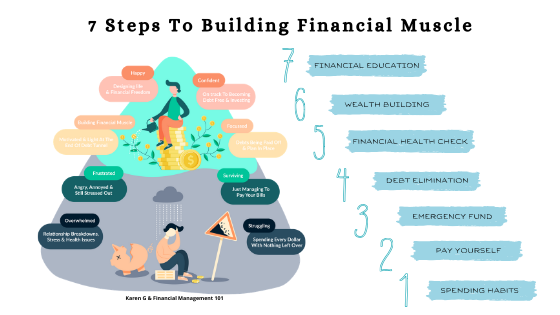
Here are 7 steps you need to know when it comes to building financial muscle and they are:
1 Looking at your spending habits. What are you spending your money on each and every payday? Are you spending it on things that are worthless and while short term makes you feel good initially but then when it comes to paying your bills you haven’t anything left to pay for them?
My guess is, this is when you start to feel stressed out and your life becomes very overwhelming.
The quickest and easiest way to get a handle on what you’re spending is to look at doing a budget. For the first month, you write down everything you spend and then deduct what you earn by what you’ve spent for the month.
More often than not, you’ve used credit to help get you out of a bind, but it’s not working and you’re getting further and further into debt.
2 Next, once you’ve worked out if there’s any surplus, you’ll want to make some adjustments in your spending to put away a small percentage around 10% of what you earn into a savings account.
Now 10% is not a lot of money, but you’ll need to do this first at payday before you pay any bills or use some of your income on other expenditure.
Once you’ve put away 10% or even $20 or $30 into a savings account then put on autopilot, where every payday money goes from your pay into this account. I guarantee you’ll start to think about your money a little differently.
Something magical happens when you know you have some money saved and you start to feel a little more confident and less stressed and it gives you a greater sense of security.
3 Ok the third area where you’ve got to be strict with yourself is to open another savings account, one that is too hard to get access to and start building on your emergency fund.
You’ll need to get your emergency fund up to at least $2000 as quickly as possible.
There are many ways to get this account up to $2000 and the first is to look around your home. What could you sell online that’s sitting around in your garage or shed that’s gathering dust?
The emergency fund is the 3rd most critical aspect to building financial muscle because it takes the pressure off you and your money when those unexpected things arise like your hot water goes on the blink or your fridge packs up.
The emergency fund is for exactly that emergencies that make life very difficult if they’re not fixed or replaced.
Ideally, the emergency fund needs to be at a balance where if you lost your job or you couldn’t work for 6 months, you would have enough money to be able to pay your bills until you get back to working again.
4 The major stress for most people is their ever-increasing debt, whether it be from overspending on credit or the mortgage on your home.
I can’t stress enough that when you finally become debt-free life is going to be a whole lot more fun. Things that used to stress you out are suddenly gone and all the pressure of working at a job that you probably don’t like now gives you the power and choice to look at whether you continue working there.
If you’re not working to pay down all your debts as fast as you can – you’re just throwing away good money to the banking institutions that are funding your poor money habits and making them richer while you become poorer.
Map out who you owe, how much you owe and then start with one debt at a time and pay that down until it’s gone. Once the first debt has been eliminated, then use the money that you paid the debt down with to double up on the next debt.
5 Ok, so the next step in building financial muscle is to stop and do a quick financial health check.
A financial health check will look at quite simply if there are any areas within your money that you need to work on, or get more information on, to get you back on track and retiring comfortably.
I have a 5 min financial health check that you can download HERE to get you started.
6 Now you’ve got money being saved, your debts are being paid off, it’s now time to look at your wealth-building strategies.
Your wealth-building will consist of two parts:
Investing and
Protecting
Let’s talk about investing first.
Investing is about growing your money through facilities like superannuation and other investment options.
Superannuation is a way of saving for retirement.
Essentially your employer in Australia is putting away a percentage of your salary into a fund of your choice that invests the money until you retire.
It’s a forced type of saving but brilliant to help those in particular that are not good at saving and will see you have some money at the end of your working life.
This is a big topic that’s too big to cover off in this post, so I will write a post on this and explain in more detail shortly, so keep an eye out for it.
Other investment options for wealth building during your working years could consist of investing in shares, managed funds or property to name a few.
I would encourage anyone looking into wealth building to seek a financial adviser who is qualified to provide advice on what assets or which investment vehicle is best for you and your personal circumstances.
There are many out there so be careful and take the time to ensure they have your best interest at the forefront of their advice giving.
Next, I want to talk about protecting your money. This is a very important topic. Today, I’ll give you a brief summary but like the topic on superannuation, I’ll be writing more about this in another post.
But for now, let me explain why it’s important to have a Will or good Estate Plan.
A Will and Estate Plan are there to make sure your wishes at the end of your life are carried out and distributed properly.
A Will is a legal document that states what you would like to happen with your assets when you die and forms part of your Estate Plan.
An Estate Plan, on the other hand, records exactly what you would like to happen with your assets upon death and includes documents such as your Will, a testamentary trust, superannuation assets and may contain powers of attorney or other such documents that in the event of you being unable to make decisions, someone appointed by you will act on your behalf.
So as you can see from the brief descriptions above it is extremely important to make sure you are protecting what you’ve worked long and hard to build.
If you die without making a Will it means you die intestate and this causes a lot of heartache and headache for your loved ones left behind.
What actually happens here is that your estate is left to deal with either from the Supreme or Highest Court, depending on which state you live in Australia, who will appoint an administrator.
The administrator’s job is to arrange the funeral and distribute any leftover assets after paying any debts and taxes. Sometimes there are fees associated with an administrator taking care of your details which means your loved ones may not receive the full inheritance you had planned on leaving them.
So make sure you have a current Will your priority today because nobody knows when our time is up.
7 And lastly, the 7th step to building financial muscle is to get yourself ongoing financial education and support.
Just like a sporting team, they all use coaches to help them and guide them to their sporting greatness.
Financial coaching is much the same, an experienced coach who knows sound financial education can make the difference between living with financial stress or living your life the way you’ve always desired – happy and stress-free.
If you’ve read to the bottom of this and you’ve followed the steps outlined above then congratulations as you are one who is committed to living a financially comfortable life.
Why not continue with your financial education by working with me on a monthly basis.
I offer several options, but the first is the most preferred as it’s inexpensive and extremely supportive towards you achieving awesome financial health.