Your First Quarter Report Card

Your First Quarter Report Card

July, August, September – done and dusted, more or less. So how’s the new financial year actually going? Not “how busy have you been.” How’s it going?

Most business owners can rattle off exactly how flat out they’ve been since July; the jobs, the clients, the late nights. Fewer can tell you how profitable they’ve been over the same stretch. And that gap between “flat out” and “actually ahead”, is exactly where a quick quarter check-in earns its keep. It’s the difference between a business that feels busy and a business you can actually prove is moving forward.

Nobody waits for the end-of-year school report to find out how a kid’s tracking. You check in along the way – a note home, a parent-teacher chat, a quiet word, and adjust before it becomes a bigger conversation. Your business deserves the same courtesy. Not a full audit, not a forensic dive into every transaction, just an honest look at the first three months of the new financial year, before you’re four quarters deep wondering where it all went and why the number at tax time doesn’t match the effort you know you put in.

Why most business owners skip this

It’s not laziness. It’s usually one of two things, either it feels like it’ll take hours you don’t have, or there’s a quiet fear of what it might show. Both of those assumptions tend to be wrong. This exercise takes less time than a coffee catch-up, and more often than not, the number is somewhere between “not as bad as I feared” and “better than I gave myself credit for.” The dread is almost always worse than the discovery.
Three questions, one cup of tea

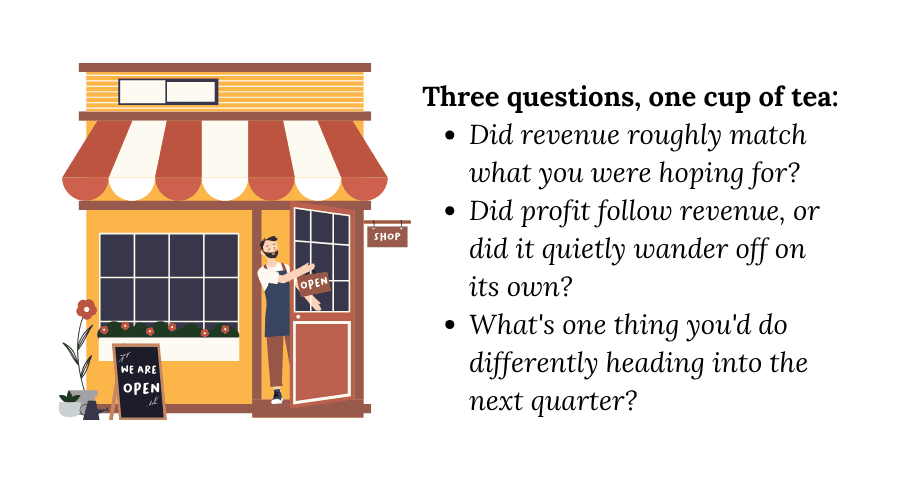
Three questions, one cup of tea

Did revenue roughly match what you were hoping for? Doesn’t need to be precise; ahead, on track, or behind is enough of an answer for now. And if you realise you never actually set a target for the quarter, that’s not a failure, it’s just a perfectly good place to start next time. You can’t be ahead or behind a target that doesn’t exist.

Did profit follow revenue, or did it quietly wander off on its own? This is the one that catches people out most often, and it’s the one I see most in this line of work. Revenue climbs, everyone’s thrilled, the calendar’s fuller than ever and then the bank balance doesn’t quite reflect it, because costs crept up right alongside the growth without anyone clocking it. Materials went up. A subcontractor’s rate went up. You took on a bit more admin help. None of it felt like a big decision at the time, but added together it’s eaten the extra revenue and then some. If you’ve felt busier than ever this quarter but the numbers don’t quite match the feeling, this is usually why.

What’s one thing you’d do differently heading into the next quarter? Not five things, just one! Trying to fix everything at once is how good intentions turn into nothing changing at all. Maybe it’s pricing, which almost every business owner I meet is quietly undercharging on. Maybe it’s chasing invoices a little sooner instead of letting them drift. Maybe it’s finally looking at where the money’s actually going instead of guessing based on vibes and a general sense of dread. Pick the lever that would move things most, and leave the rest for next quarter’s version of this exercise.

What to do with what you find

If the quarter came in ahead, resist the urge to immediately spend the difference on something exciting. Sit with it for a bit. Ask whether it’s a genuine trend or a one-off good stretch before you build plans around it. If it came in behind, resist the opposite urge, the spiral into “the whole business is failing.” One quarter is one quarter. It’s a data point, not a verdict. The value isn’t in the number itself, it’s in what the number tells you to look at next.

Why quarterly, specifically

A quarter is a genuinely good length of time to check in on; long enough to see a real pattern rather than a one-off blip, short enough to actually change course while it still matters. Check monthly and you risk reacting to noise, a slow week that means nothing, a good week that means nothing either. Check yearly and you find out too late to do much about it. Quarterly sits right in the sweet spot, giving you enough information to trust it, and enough time left in the year to actually act on it.

The business owners I see making calmer, more confident decisions are almost always the ones checking in quarterly, not just at tax time when the accountant delivers the number and there’s nothing left to do but accept it. Checking quarterly puts you back in the driver’s seat of your own financial year, rather than a passenger finding out where you ended up after the fact.

If you’d like a proper look under the bonnet, the CEO Dashboard gives you full visibility on exactly how the quarter really went not the guessed version, the real one.

Turning it into a rhythm

The businesses that get the most out of this aren’t doing anything clever, they’ve just made it a rhythm rather than a rescue mission. Same week each quarter. Same three questions. Same short list of actions afterwards. It stops being a big, dreaded event and becomes something closer to a habit, the business equivalent of a regular check-up rather than an emergency room visit.

If this is the first time you’ve done a proper quarter check-in, don’t worry about making it perfect. The value isn’t in precision, it’s in the act of actually stopping to look, on a schedule, instead of only looking when something’s gone wrong enough to force your hand.

Setting yourself up for next quarter

Before you close the laptop on this exercise, write down one number you’ll check again in three months. Just one. Revenue, profit margin, average invoice value, whatever feels most relevant to where you are right now. Having that one number in mind gives the next quarter’s check-in a head start, because you’ll already know what you’re comparing against instead of starting from scratch each time.

Small, consistent check-ins beat big, occasional audits every time. That’s true of your car, your health, and it’s absolutely true of your business.

The CEO Dashboard

#HowToResetMyMoneyMindset #NewYearFinancialMindset #HowToStartFreshWithMoney  emergency fund australia, money management, family savings #SmallBusinessOwner #BusinessGrowth #CashflowManagement #BusinessSuccess
#EntrepreneurMindset

 

R U OK? (The Question You Never Ask Yourself)

R U OK? (The Question You Never Ask Yourself)

On September 10, most of Australia will be asking each other “R U OK?” Workplaces will run morning teas. There’ll be yellow everywhere. It’s a genuinely good day, and I’m glad it exists – it’s done a lot for getting these conversations out into the open where they belong, after years of them staying firmly behind closed doors.

But here’s the question I actually want to ask you, business owner to business owner… when’s the last time you asked yourself that?

We’re brilliant at checking in on everyone else. Staff, clients, family, that one supplier who always sounds a bit frazzled on the phone. But most business owners I talk to haven’t had an honest conversation with themselves in months. We’re too busy holding everything together to notice we might not be, ourselves. We’re the ones people come to when something’s gone wrong, which means we’ve quietly trained everyone around us, including ourselves to believe we don’t need checking on.

Running a business is one of the loneliest jobs going, if I’m honest. You’re the one everyone brings their problems to. There’s rarely anyone bringing you theirs, asking how you’re actually tracking underneath it all. Even the people who love you tend to ask “how’s the business going?” rather than “how are you going?” and those are very different questions with very different answers.

The performance of “fine”

There’s a particular skill business owners develop without meaning to, the ability to say “yeah, good, flat out” in a completely convincing tone while privately feeling anything but. It becomes automatic. Someone asks how you’re going at the school pickup, at the football, at a client meeting, and out it comes before you’ve even thought about it. Over time, that automatic answer starts to replace the honest one, even in your own head. You stop checking because you’ve gotten so good at performing that you don’t seem to need it.

So today, let’s flip it. Three questions, and actual permission to answer them properly, without the reflexive “yeah, good, flat out” that we all give without thinking.

Am I okay, or am I just coping?

There’s a real difference. Coping looks like getting through the week in one piece, ticking things off, keeping the wheels on. Okay looks like genuinely enjoying the thing you built, feeling proud of it, curious about where it’s going, energised rather than depleted by it. If you’ve been in coping mode for a while now, that’s worth noticing, not brushing off with “it’s just a busy season,” because busy seasons have a habit of becoming permanent if nobody names them.

There’s no shame in “coping” as an honest answer. It’s often the truest thing a business owner has said about themselves in months, once they finally stop and let themselves say it. The shame only comes from pretending otherwise for too long.

What am I carrying that I haven't said out loud?
For a lot of business owners, it's the money. The gap between what the business brings in and what it feels like it should be bringing in by now, given how hard you're working.

What am I carrying that I haven’t said out loud?

For a lot of business owners, it’s the money. The gap between what the business brings in and what it feels like it should be bringing in by now, given how hard you’re working. That gap is heavy to carry on your own, and you really don’t have to. I’ve had conversations with business owners who’ve been sitting on that particular worry for years, silently, because it felt embarrassing to say out loud, like admitting it meant admitting they’d failed at something. It’s not embarrassing. It’s incredibly common, and it’s fixable once it’s actually spoken about, usually far more fixable than the years of silent worry suggested.

Sometimes what people are carrying isn’t even the money itself, it’s the fear of what the money says about them. That’s a heavier load than the actual numbers ever are.

Who’s actually in my corner?

Not staff. Not clients. I mean the people who ask how you’re going, not just how the business is going. If that list is short, that’s your sign; a mentor, a community, or even just a standing coffee with someone who genuinely gets what this life is like. Business ownership can be surprisingly isolating even when you’re surrounded by people all day, because being surrounded by people isn’t the same as being known by them.

The physical signs worth noticing

Sometimes the “am I okay” question is easier to answer by looking at the body rather than the mind. Are you sleeping properly, or lying awake running through tomorrow’s problems? Are you short-tempered with people who don’t deserve it? Have you stopped doing the small things that used to recharge you – the walk, the round of golf, the Sunday paper, because there’s “no time”? These aren’t small details. They’re often the clearest signal available that the tank’s getting low, well before the mind is ready to admit it in so many words.

It’s okay to not have the answer yet

If you sat with those three questions and didn’t love your answers, that’s not a failure, that’s information. The whole point of asking is so you can actually do something with what you find, rather than carrying it around unexamined for another six months. Awareness on its own doesn’t fix anything, but it’s the step that has to come first, and it’s the step most business owners skip entirely because it’s uncomfortable.

You can’t run a healthy business from an empty tank. Checking in on yourself isn’t soft, whatever the old-school hustle crowd would have you believe, it’s strategy, plain and simple. A business owner who’s running on empty makes worse decisions, snaps more easily, and enjoys less of what they’ve built. None of that helps the business either – it’s not a trade-off between looking after yourself and looking after the business. They’re the same job.

And if part of what’s weighing on you is the money side of things, that’s exactly what The Edge exists for. A place where you’re not carrying it solo, surrounded by other business owners asking each other the real questions instead of the polite ones.

Join The Edge: https://financialmanagement101.com.au/work-with-karen/the-edge/

And if today’s the day you actually need to talk to someone, Lifeline is on 13 11 14, any hour, no appointment needed.

What to do once you’ve asked yourself

Asking the question is the easy part, once you’ve actually made yourself do it. The harder part is what comes next, because most business owners are excellent at identifying a problem and then filing it away under “deal with that eventually.” So if any of the three questions above landed a bit close to home, don’t let it end there.

Pick one small thing. Not a complete overhaul of your life, not a dramatic announcement to everyone that you’re “making changes.” One small thing; a call to a friend you’ve been meaning to make, an actual look at the money situation you’ve been avoiding, a boundary around one evening a week that’s just yours. Small, specific, doable this week, not “someday.”

Business owners checking in on business owners

Business owners checking in on business owners

There’s a particular kind of relief that comes from talking to someone else who genuinely understands what this life involves – the highs that nobody else quite gets excited about the way you do, and the lows that nobody else quite understands the weight of either. Friends and family love you, but unless they’ve run a business themselves, there’s a layer of it they simply can’t relate to, however much they try.

That’s part of why community matters so much here. Not a support group in the clinical sense, just other people in the same boat, who ask “how are you really going” and actually mean it, who’ve had the sleepless nights over cash flow and the quiet pride over a client win, and who get it without you having to explain the whole backstory first.

THE EDGE Membership

#HowToResetMyMoneyMindset #NewYearFinancialMindset #HowToStartFreshWithMoney  emergency fund australia, money management, family savings #SmallBusinessOwner #BusinessGrowth #CashflowManagement #BusinessSuccess
#EntrepreneurMindset

 

How Do I Recover From Holiday Overspending and Start Fresh With My Money in the New Year?

How Do I Recover From Holiday Overspending and Start Fresh With My Money in the New Year?

The holiday lights have dimmed, the decorations are packed away, and the credit card bill has landed in your inbox. January can feel like a financial hangover – but it doesn’t have to stay that way. The new year is the perfect time for a fresh start with your money. Let’s turn those post-holiday regrets into real financial progress.

Step 1: Acknowledge the Overspend – Without Shame

Let’s be real. You probably didn’t mean to go overboard, but the season has a way of loosening our wallets. Flash sales, peer pressure, holiday cheer – it’s a perfect storm of spending. Here’s the deal: You’re not bad with money. You’re human.

The first thing I tell my clients: “You can’t change what you won’t face.” So open those credit card statements, take a breath, and look at the total. It’s just data and now you’re in the driver’s seat.

Step 2: Have a “Money Review Day”

Set aside one focused hour this week for your personal “Money Review Day – grab a coffee, and get into CEO mode:

 ? Print or pull up your December statements
? List your total credit card balances
? Note the interest rates and minimum payments
✂️ Highlight 3 spending categories to cut back this month

This is about clarity, not judgment. Think of it as gathering puzzle pieces before you start putting them together.

 Have a “Money Review Day”

Step 3: Set a Short-Term Payoff Goal

Massive goals feel good in theory, but small wins are what keep you going. Look at your balances and pick ONE target:

  • Your smallest balance to clear quickly (Snowball method)
  • Your highest-interest card to save money (Avalanche method)

Example: If you owe $3,000 across 3 cards, focus on paying off the $500 one first. That win builds confidence and momentum.

Step 4: Build a Realistic January Budget

Post-holiday budgeting is all about breathing room. Not punishment. Build a one-month “recovery budget” that helps you regain control:

✅ Cover essentials first: Rent/mortgage, food, utilities, transport
❌ Cut or pause: Subscriptions, takeout, impulse buys
? Redirect: Any leftover funds go straight to your debt goal

Even an extra $50 a week toward debt adds up. And if money is tight? See if you can generate a little extra (selling unused items, picking up a side hustle, cashback apps, etc.).

Step 5: Create a “Holiday Payback Plan”

If you overspent by $1,200 in December, divide that into 6 monthly chunks: $200/month. Add it to your budget now and automate it.

This isn’t about guilt – it’s about taking control on your terms. When you have a plan, the weight of the debt gets lighter.

Step 6: Replace Shame with Strategy

Negative self-talk like “I’m terrible with money” only reinforces stuck patterns. Flip the script:

❌ “I can’t believe I did this again.”
✅ “I’m learning new habits that support my goals.”

Money is emotional and mindset matters. Be your own biggest ally, not your harshest critic.

Step 7: Future-Proof Next Year with a Holiday Fund

Want to avoid this January stress next time? Start now with a holiday sinking fund:

  • Name it: “Holiday Joy Fund”
  • Set a goal: $1,000 by November
  • Break it down: $42/month or $21/paycheck

Automate it. When next December hits, you’ll be ready, and proud of yourself.

 Future-Proof Next Year with a Holiday Fund

Step 8: Find a Support System

This journey is easier (and more fun) when you don’t do it alone. Whether it’s a money buddy, group, or coach – accountability is the secret sauce. That’s where my “Financial Muscle Coaching Membership” helps keep you accountable and gives you to the tools and knowledge to update your financial future.

Most people don’t need more information. They need support, structure, and a system.

Final Thoughts

You don’t have to fix everything overnight. But you do have to start. And now is the perfect time. Your financial reset starts with one decision, one action, and one new mindset: You’re in control now.

Ready to stop feeling stuck and finally build real financial momentum? Join Financial Muscle Coaching – this is a membership designed to help you rebuild, reset, and grow stronger with your money. It’s time to train your financial muscles and feel powerful about your money choices.

Let’s make this your best money year yet. ??

Join Financial Muscle Coaching Now

#HowToRecoverFromOverspending #HolidayDebtHelp2025 #PostHolidayMoneyStress #GetBackOnTrackFinancially #HowToResetMoneyAfterTheHolidays #OverspentAtChristmasNowWhat #NewYearFinancialReset #HowToFixMyFinancesAfterHolidays #MoneyRecoveryPlan #CreditCardHangoverHelp

The #1 Money Habit That Changes Everything (And It’s Not What You Think!)

The #1 Money Habit That Changes Everything (And It’s Not What You Think!)

Let’s play a little game.

Quick – what’s the first thing that pops into your mind when you hear the words “financial makeover”? Is it…

Cutting up credit cards?

Pinching coins until your wallet cries?

Living on a “beans and rice” budget?

If you said yes to any of the above, take a deep breath.

Because I’ve got some really good news for you.

The real secret to transforming your finances isn’t about spreadsheets, budgeting apps, or even how much you make.

The secret is something you carry with you every single day.

It’s your money mindset.

And yep – that’s what this post is all about.

By the end of this article, you’ll see why the most important financial habit you’ll ever master has nothing to do with crunching numbers and everything to do with the way you think about money. Trust me, this one shift can change your life forever (and yes, your bank account too).

? Why Your Mindset Matters More Than Math

I know, I know… mindset talk can sound a little fluffy.

After all, what does thinking differently about money have to do with paying off your credit card or saving for that vacation you’ve been dreaming about?

Here’s the truth:

Your mindset drives every single financial decision you make.

It shapes:

  • How you spend
  • How you save
  • How you handle debt
  • How you invest

Even how much money you believe you’re capable of earning. Most people don’t have a money problem – they have a money mindset problem. Here’s what that looks like in the real world:

  • You set a budget… but keep overspending.
  • You say you want to save… but somehow the money disappears.
  • You try to pay down debt… but the balance never seems to go down.

Sound familiar?

That’s not a lack of discipline or intelligence. It’s a deep-seated pattern playing out from within.

? What Is Money Mindset, Really?

Let’s break this down simply.

Your money mindset is the collection of beliefs, thoughts, and emotions you have about money, most of which were shaped long before you started earning your first paycheck.

Here are some common money mindsets (see if any of these feel familiar):

1. Scarcity Mindset:
“There’s never enough money.”
“Money comes in, but it always goes right back out.”

2. Avoidance Mindset:

“I hate thinking about money – it stresses me out.”
“I’m just not good with numbers.”

3. Security Mindset:
“As long as I have enough to cover the basics, I’m fine.”
“Money isn’t that important.”

4. Abundance Mindset (Healthy & Empowered):
“Money is a tool that helps me live my best life.”
“I can learn how to grow and manage my money wisely.”

Here’s the kicker: Most people are operating on autopilot with their money beliefs, without even realising it.

? How Your Money Beliefs Keep You Stuck (Without You Noticing)

Let’s get real for a moment.

If you grew up in a household where money was tight, you may have absorbed the belief that:

  • Money is stressful.
  • Rich people are greedy.
  • It’s dangerous to want more.

On the flip side, maybe you heard phrases like:

  • “We can’t afford that.”
  • “Money doesn’t grow on trees.”
  • “You have to work hard for every penny.”

Even if those sayings were innocent, they may have planted deep-rooted beliefs that:

  • Money is hard to get.
  • You shouldn’t ask for more.
  • You don’t deserve financial ease.

And those beliefs? They’re running the show in your adult life.

? The #1 Money Habit You Need to Master: Awareness

Here it is. The one habit that changes everything: Awareness of your money mindset. That’s it.

When you begin noticing what you believe about money – without judgment – you unlock the ability to change your financial reality. Here’s how it works:

Step 1: Catch Your Thoughts

Next time you face a money decision, pause and notice your immediate reaction.

Example:

  • You see something you want to buy.
  • You automatically think, “I can’t afford it.”
  • Or maybe you think, “I deserve this, even if I can’t really pay for it.”

That’s your money mindset speaking.

Catch Your Thoughts<br />

Step 2: Question the Belief

Ask yourself:

  • “Is this really true?”
  • “Where did I learn this?”
  • “Is this belief helping or harming me?”

Step 3: Choose a New Thought

You don’t have to go from “I’m broke” to “I’m a millionaire” overnight. But you can shift gently, like:

  • “I’m learning to manage my money better every day.”
  • “I’m making choices that align with my goals.”

This habit of noticing and questioning your money thoughts is like turning on a light switch. Once it’s on, you can’t unsee the patterns anymore.

? How Money Mindset Shows Up in Real Life (3 Sneaky Examples)

Here are some common ways your money mindset might be running the show right now:

1. Budgeting Resistance

If you’ve ever thought, “Budgets feel too restrictive,” you might have a scarcity or rebellion-based money mindset.

Shifting your thought to:
“My budget is a permission slip to spend on what truly matters.”

…can make budgeting feel empowering instead of limiting.

Budgeting

2. Debt Denial

Avoiding your debt? That’s often rooted in avoidance or fear-based money beliefs.

Try this thought:

“Facing my debt is the first step toward my financial freedom.”

3. Under-Saving

If saving feels impossible or boring, your belief might be:

“I’ll never have enough to make a difference.”

Shift it to:

“Every dollar saved builds my future security and freedom.”

? Why Money Mindset Isn’t About Toxic Positivity

Let’s be clear—this isn’t about pretending everything is fine when it isn’t. If you’re dealing with debt, low income, or financial instability, you’re not expected to just “think happy thoughts.”

But here’s what does work:

  • Facing your financial reality with honesty.
  • Believing in your ability to improve it.
  • Taking small, consistent actions to build new habits.

Mindset work isn’t about ignoring reality. It’s about empowering yourself to change it.

? How This Mindset Work Connects to Your Money Goals

This is exactly why in my 90 Day Money Makeover program, we don’t just dive into budgeting and debt. We start with mindset, because if you don’t shift how you think, no amount of budgeting tools or savings hacks will stick.

Inside the program, we go deep into:

  • Uncovering your personal money story.
  • Rewriting limiting beliefs about money.
  • Learning to set goals that are emotionally connected to your values.

And yes, we also tackle budgeting, saving, debt, and even your will and estate planning—but all of that becomes easier once you’ve adjusted your financial lens.

✨ Ready to Start Shifting Your Mindset Right Now? (Mini Challenge!)

Let’s get you started with a quick, powerful exercise:

Money Mindset Reset Challenge:

  1. Write down 3 common thoughts you have about money.
  2. Circle any that feel negative or limiting.
  3. Rewrite each one into a more supportive, empowering statement.
  4. Say your new money affirmations out loud every morning this week.

Example:

  • Old Thought: “I’ll never get ahead financially.”
  • New Thought: “I’m learning to grow my finances one step at a time.”

This tiny habit can plant the seed for massive change.

? Final Thoughts: Your Money Mindset Is the Foundation for Everything

Here’s what I want you to remember:

Your money situation isn’t set in stone.

Your past does not define your future.

Your financial life can transform faster than you think—but it starts inside.

And if you’re ready to go deeper with this work (and finally create the lasting financial change you’ve been craving), get ready, because my Your Financial Freedom Breakthrough™ – 90 Day Money Makeover opens for enrollment on September 10th.

This isn’t just another budget bootcamp.

It’s a complete personal money transformation – from the inside out. Stay tuned… and get ready to make your next 90 days your most financially empowering yet.

Your Financial Freedom Breakthrough™ - 90 Day Money Makeover