R U OK? (The Question You Never Ask Yourself)

R U OK? (The Question You Never Ask Yourself)

On September 10, most of Australia will be asking each other “R U OK?” Workplaces will run morning teas. There’ll be yellow everywhere. It’s a genuinely good day, and I’m glad it exists – it’s done a lot for getting these conversations out into the open where they belong, after years of them staying firmly behind closed doors.

But here’s the question I actually want to ask you, business owner to business owner… when’s the last time you asked yourself that?

We’re brilliant at checking in on everyone else. Staff, clients, family, that one supplier who always sounds a bit frazzled on the phone. But most business owners I talk to haven’t had an honest conversation with themselves in months. We’re too busy holding everything together to notice we might not be, ourselves. We’re the ones people come to when something’s gone wrong, which means we’ve quietly trained everyone around us, including ourselves to believe we don’t need checking on.

Running a business is one of the loneliest jobs going, if I’m honest. You’re the one everyone brings their problems to. There’s rarely anyone bringing you theirs, asking how you’re actually tracking underneath it all. Even the people who love you tend to ask “how’s the business going?” rather than “how are you going?” and those are very different questions with very different answers.

The performance of “fine”

There’s a particular skill business owners develop without meaning to, the ability to say “yeah, good, flat out” in a completely convincing tone while privately feeling anything but. It becomes automatic. Someone asks how you’re going at the school pickup, at the football, at a client meeting, and out it comes before you’ve even thought about it. Over time, that automatic answer starts to replace the honest one, even in your own head. You stop checking because you’ve gotten so good at performing that you don’t seem to need it.

So today, let’s flip it. Three questions, and actual permission to answer them properly, without the reflexive “yeah, good, flat out” that we all give without thinking.

Am I okay, or am I just coping?

There’s a real difference. Coping looks like getting through the week in one piece, ticking things off, keeping the wheels on. Okay looks like genuinely enjoying the thing you built, feeling proud of it, curious about where it’s going, energised rather than depleted by it. If you’ve been in coping mode for a while now, that’s worth noticing, not brushing off with “it’s just a busy season,” because busy seasons have a habit of becoming permanent if nobody names them.

There’s no shame in “coping” as an honest answer. It’s often the truest thing a business owner has said about themselves in months, once they finally stop and let themselves say it. The shame only comes from pretending otherwise for too long.

What am I carrying that I haven't said out loud?
For a lot of business owners, it's the money. The gap between what the business brings in and what it feels like it should be bringing in by now, given how hard you're working.

What am I carrying that I haven’t said out loud?

For a lot of business owners, it’s the money. The gap between what the business brings in and what it feels like it should be bringing in by now, given how hard you’re working. That gap is heavy to carry on your own, and you really don’t have to. I’ve had conversations with business owners who’ve been sitting on that particular worry for years, silently, because it felt embarrassing to say out loud, like admitting it meant admitting they’d failed at something. It’s not embarrassing. It’s incredibly common, and it’s fixable once it’s actually spoken about, usually far more fixable than the years of silent worry suggested.

Sometimes what people are carrying isn’t even the money itself, it’s the fear of what the money says about them. That’s a heavier load than the actual numbers ever are.

Who’s actually in my corner?

Not staff. Not clients. I mean the people who ask how you’re going, not just how the business is going. If that list is short, that’s your sign; a mentor, a community, or even just a standing coffee with someone who genuinely gets what this life is like. Business ownership can be surprisingly isolating even when you’re surrounded by people all day, because being surrounded by people isn’t the same as being known by them.

The physical signs worth noticing

Sometimes the “am I okay” question is easier to answer by looking at the body rather than the mind. Are you sleeping properly, or lying awake running through tomorrow’s problems? Are you short-tempered with people who don’t deserve it? Have you stopped doing the small things that used to recharge you – the walk, the round of golf, the Sunday paper, because there’s “no time”? These aren’t small details. They’re often the clearest signal available that the tank’s getting low, well before the mind is ready to admit it in so many words.

It’s okay to not have the answer yet

If you sat with those three questions and didn’t love your answers, that’s not a failure, that’s information. The whole point of asking is so you can actually do something with what you find, rather than carrying it around unexamined for another six months. Awareness on its own doesn’t fix anything, but it’s the step that has to come first, and it’s the step most business owners skip entirely because it’s uncomfortable.

You can’t run a healthy business from an empty tank. Checking in on yourself isn’t soft, whatever the old-school hustle crowd would have you believe, it’s strategy, plain and simple. A business owner who’s running on empty makes worse decisions, snaps more easily, and enjoys less of what they’ve built. None of that helps the business either – it’s not a trade-off between looking after yourself and looking after the business. They’re the same job.

And if part of what’s weighing on you is the money side of things, that’s exactly what The Edge exists for. A place where you’re not carrying it solo, surrounded by other business owners asking each other the real questions instead of the polite ones.

Join The Edge: https://financialmanagement101.com.au/work-with-karen/the-edge/

And if today’s the day you actually need to talk to someone, Lifeline is on 13 11 14, any hour, no appointment needed.

What to do once you’ve asked yourself

Asking the question is the easy part, once you’ve actually made yourself do it. The harder part is what comes next, because most business owners are excellent at identifying a problem and then filing it away under “deal with that eventually.” So if any of the three questions above landed a bit close to home, don’t let it end there.

Pick one small thing. Not a complete overhaul of your life, not a dramatic announcement to everyone that you’re “making changes.” One small thing; a call to a friend you’ve been meaning to make, an actual look at the money situation you’ve been avoiding, a boundary around one evening a week that’s just yours. Small, specific, doable this week, not “someday.”

Business owners checking in on business owners

Business owners checking in on business owners

There’s a particular kind of relief that comes from talking to someone else who genuinely understands what this life involves – the highs that nobody else quite gets excited about the way you do, and the lows that nobody else quite understands the weight of either. Friends and family love you, but unless they’ve run a business themselves, there’s a layer of it they simply can’t relate to, however much they try.

That’s part of why community matters so much here. Not a support group in the clinical sense, just other people in the same boat, who ask “how are you really going” and actually mean it, who’ve had the sleepless nights over cash flow and the quiet pride over a client win, and who get it without you having to explain the whole backstory first.
THE EDGE Membership

#HowToResetMyMoneyMindset #NewYearFinancialMindset #HowToStartFreshWithMoney  emergency fund australia, money management, family savings #SmallBusinessOwner #BusinessGrowth #CashflowManagement #BusinessSuccess
#EntrepreneurMindset
 

How Healthy Is My Business? The 7 Warning Signs Every Small Business Owner Should Know

How Healthy Is My Business? The 7 Warning Signs Every Small Business Owner Should Know

Most people wouldn’t drive their car for five years without having it serviced. We understand that regular maintenance prevents expensive breakdowns. Yet that’s exactly how many business owners run their businesses.

  • They work harder.
  • They sell more.
  • They hire more people.
  • They chase bigger goals.

But they rarely stop and ask one simple question…

“Is my business actually healthy?”

Because being busy isn’t a measure of health.

Neither is turnover.

Neither is having money in the bank this week.

A healthy business goes much deeper than that.

Businesses are a lot like people.

They have a heartbeat. They have warning signs. They become sick slowly. They recover slowly., and the healthiest ones don’t happen by accident. 

They happen because someone pays attention before little problems become big ones.

I’ve worked with business owners who looked incredibly successful from the outside.

  • Beautiful offices.
  • Busy workshops.
  • Phones ringing.
  • New vehicles.
  • Growing teams.
  • Yet behind closed doors…
  • The owner hadn’t paid themselves properly for months.
  • Cash flow was unpredictable.
  • Margins were shrinking.
  • Tax bills were keeping them awake at night.
  • Stress had become normal.

From the outside…

Healthy.

On the inside…

Critically unhealthy.

Does that sound familiar?

Business Health isn’t measured by one number.

It’s measured by dozens of indicators working together. Just like your own body.

You wouldn’t judge your health by stepping on a set of scales.

Your doctor looks at:

  • Blood pressure.
  • Heart rate.
  • Blood sugar.
  • Cholesterol.
  • Sleep.
  • Fitness.
  • Stress.
  • Lifestyle.

Business works exactly the same way.

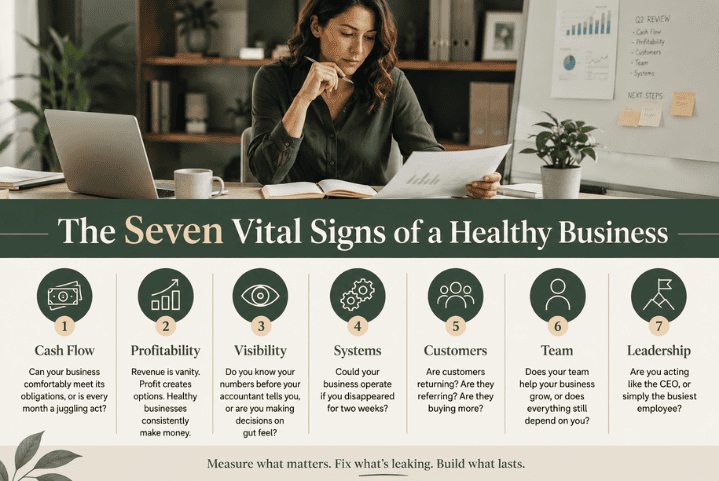
The Seven Vital Signs of a Healthy Business

The Seven Vital Signs of a Healthy Business

Not KPIs.

Not Metrics.

Vital Signs.

That language is unique.

1. Cash Flow

Can your business comfortably meet its obligations, or is every month a juggling act?

2. Profitability

Revenue is vanity. Profit creates options. Healthy businesses consistently make money.

3. Visibility

Do you know your numbers before your accountant tells you, or are you making decisions on gut feel?

4. Systems

Could your business operate if you disappeared for two weeks?

5. Customers

Are customers returning? Are they referring? Are they buying more?

6. Team

Does your team help your business grow, or does everything still depend on you?

7. Leadership

Are you acting like the CEO, or simply the busiest employee?

Healthy Businesses Don’t Just Make More Money.

  • They make better decisions.
  • They create calmer owners.
  • They employ happier teams.
  • They serve customers better.
  • They grow sustainably.
  • They survive difficult economies.
  • They become valuable assets.

Most importantly… They give owners something every entrepreneur wanted when they started…FREEDOM!

Because the healthiest businesses don’t simply generate income. They generate choices.

And that’s ultimately what every business owner is chasing.

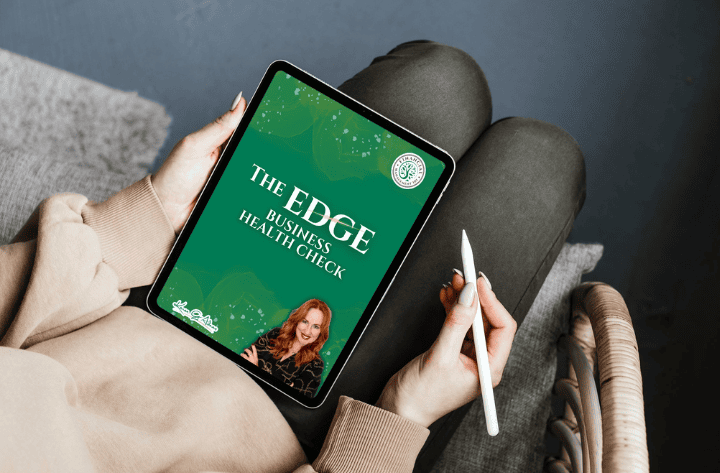
Want to know the health of your business…then take the 20 minute “The EDGE Business Health Check” TODAY!

Take The EDGE Business Health Check today and discover where your next opportunity is hiding.

#HowToResetMyMoneyMindset #NewYearFinancialMindset #HowToStartFreshWithMoney  emergency fund australia, money management, family savings #SmallBusinessOwner #BusinessGrowth #CashflowManagement #BusinessSuccess
#EntrepreneurMindset
 

Why Isn’t My Business Making Money?

Why Isn’t My Business Making Money?

If you’ve ever sat in your office after another long week and thought…

“We’re busy… so why does it still feel like there’s never enough money?”

You’re not alone.

In fact, it’s one of the most common conversations I have with small business owners.

Tradies.
Hair salon owners.
Electricians.
Builders.
Consultants.
Professional service businesses.
Family businesses.

Different industries.

Different personalities.

Different businesses.

Yet almost every one of them eventually asks me the same question.

“Karen… where is all the money going?”

It’s a frustrating place to be.

You’ve worked hard. You’re winning work. Your staff are busy. The phone keeps ringing. Your turnover has grown. Yet somehow the bank account never seems to reflect all the effort you’re putting in.

You start questioning yourself.

“Maybe we need more customers.”

“Maybe we need better marketing.”

“Maybe everyone else is just better at business than I am.”

But here’s what I’ve discovered after working with many business owners. Most businesses don’t actually have a revenue problem. They have a decision problem. And there’s a very big difference.

Turnover Is Not the Same as Profit

One of the biggest myths in business is that more sales automatically mean more money.  If only it were that simple.

I’ve met business owners proudly telling me they’ve just had their biggest revenue month ever. Then, five minutes later….

  • They’re telling me they can’t pay themselves or
  • They’re worried about BAS, or
  • They’re putting supplier invoices on payment plans, or
  • They’re lying awake wondering how they’ll make payroll next week.

How is that possible?

Because revenue is only one number.

Business health is made up of hundreds of decisions happening behind the scenes every single day.

You can increase sales by 30% and still make less profit than last year.  You can double your revenue and double your stress at exactly the same time.

I’ve seen businesses grow themselves broke. That’s one of the cruelest realities of running a business.

Growth doesn’t fix poor visibility. Sometimes it simply magnifies it.

Busy Doesn’t Always Mean Successful

One of my favourite questions to ask business owners is this:

“On a scale of one to ten… how busy are you?”

Almost everyone answers…

“Ten.”

Then I ask another question.

“Great… and on the same scale, how profitable are you?”

Silence.

Because being busy has become a badge of honour.

We’re proud of working weekends. We celebrate twelve-hour days. We convince ourselves exhaustion is proof we’re succeeding.

  • But being busy isn’t the goal.
  • Profit is.
  • Freedom is.
  • Choice is.

A business should improve your life. Not consume it.

Somewhere along the journey many owners stop building businesses and start building jobs. Very expensive jobs.

  • They’re the salesperson.
  • The operations manager.
  • The bookkeeper.
  • The HR department.
  • The marketing team.
  • The problem solver.
  • The firefighter.
  • The person who answers every phone call.
  • Approves every invoice.
  • Signs every cheque and
  • Makes every decision.

Without even realising it, they’ve become the employee their business depends on most.

That’s exhausting.

And eventually it’s expensive too.

Busy Doesn't Always Mean Successful

The Business Health Problem Nobody Talks About

Imagine waking up tomorrow feeling unwell. You visit your doctor.

Instead of checking your blood pressure…

Instead of ordering blood tests…

Instead of listening to your heart…

They simply look at you and say,

“You seem okay.”

You’d probably find another doctor. Because real health isn’t measured by guesswork. It’s measured by evidence.

Business should be exactly the same. Yet most owners judge the health of their business by three things. How much money is in the bank. Whether the phone is ringing, and how stressed they feel.

None of those are reliable indicators. They’re symptoms.

Not diagnoses.

Your bank account tells you where you’ve been. Not where you’re heading. Your accountant tells you what happened months ago. Not what’s happening today.

And your stress levels? They’re usually the last indicator to appear.

By the time you’re feeling overwhelmed, the problems have often been building quietly for months.

That’s why I believe every business deserves a proper health check.

Not because something has gone wrong. But because prevention is always cheaper than recovery.

Flying Blind

Have you ever flown on a plane?

Imagine if halfway through the flight the pilot turned around and announced…

“Good news everyone… I’ve switched off all the instruments. We’re just going to trust our instincts from here.” Nobody would stay on that plane.

Yet that’s exactly how thousands of businesses are being run every day. No visibility. No dashboard. No early warning signs. No meaningful data. Just gut feel. Hope, and crossed fingers.

The problem with relying on instinct is that instinct becomes less reliable as businesses become more complex.

Five customers become fifty. One employee becomes ten. One service becomes six.

More invoices.

More suppliers.

More wages.

More tax obligations.

More moving parts.

Eventually your brain simply can’t keep up.

And that’s when little problems quietly become expensive ones.

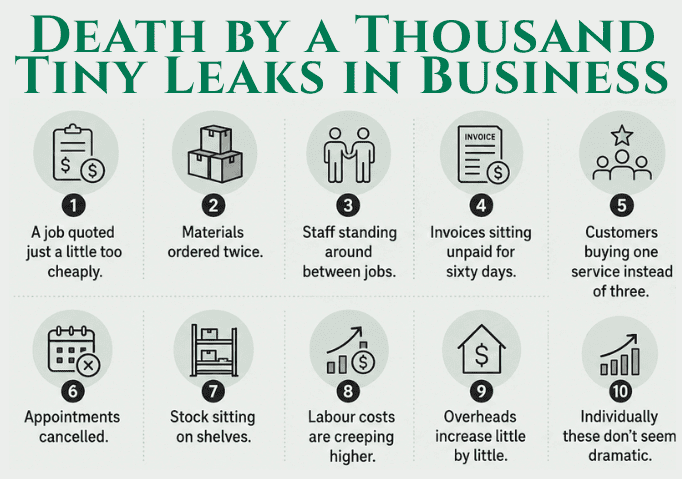
Death by a Thousand Tiny Leaks

People often imagine businesses fail because of one catastrophic event. That’s rarely what happens. It’s usually death by a thousand tiny leaks.

  • A job quoted just a little too cheaply. 
  • Materials ordered twice.
  • Staff standing around between jobs.
  • Invoices sitting unpaid for sixty days.
  • Customers buying one service instead of three.
  • Appointments cancelled.
  • Stock sitting on shelves.
  • Labour costs are creeping higher.
  • Overheads increase little by little.
  • Individually these don’t seem dramatic.

Collectively they can cost tens, or even hundreds of-thousands of dollars each year.

The frustrating part?  Most owners never see them.

Not because they aren’t intelligent. Because they’re too busy running the business to step back and actually see the business.

That’s a very different skill, and it’s one most people were never taught.

Death by a Thousand Tiny Leaks

Working In the Business Instead of On It

Most people start businesses because they’re good at something.

They’re great electricians.

Fantastic hairdressers.

Excellent plumbers.

Talented builders.

Experienced consultants.

Amazing photographers.

But nobody teaches them how to become CEOs. Nobody teaches them how to read the heartbeat of a business. Nobody teaches them which numbers actually matter, or which numbers don’t.

That’s where the shift begins.

The day you stop seeing yourself as someone who simply does the work….and start thinking like the owner of an asset. 

Because your job isn’t just to generate income. It’s to build something valuable. Something predictable. Something profitable. Something that doesn’t rely entirely on you.

That shift changes everything.

From Guesswork to Confidence

Over the years, I’ve noticed something fascinating.

When business owners first come to me, they usually think they have one big problem.

They’ll say things like:

“Cash flow is terrible.”

“I need more customers.”

“I need to make more sales.”

“My profit has disappeared.”

They’re convinced they’ve identified the problem.

But after we spend time looking at the business properly, we often discover that those things weren’t the problem at all.

They were simply the symptoms.

It’s a little like taking painkillers every day for a headache without ever discovering you actually need glasses.

You can keep treating the symptom forever, but until you understand the real cause, nothing truly changes.

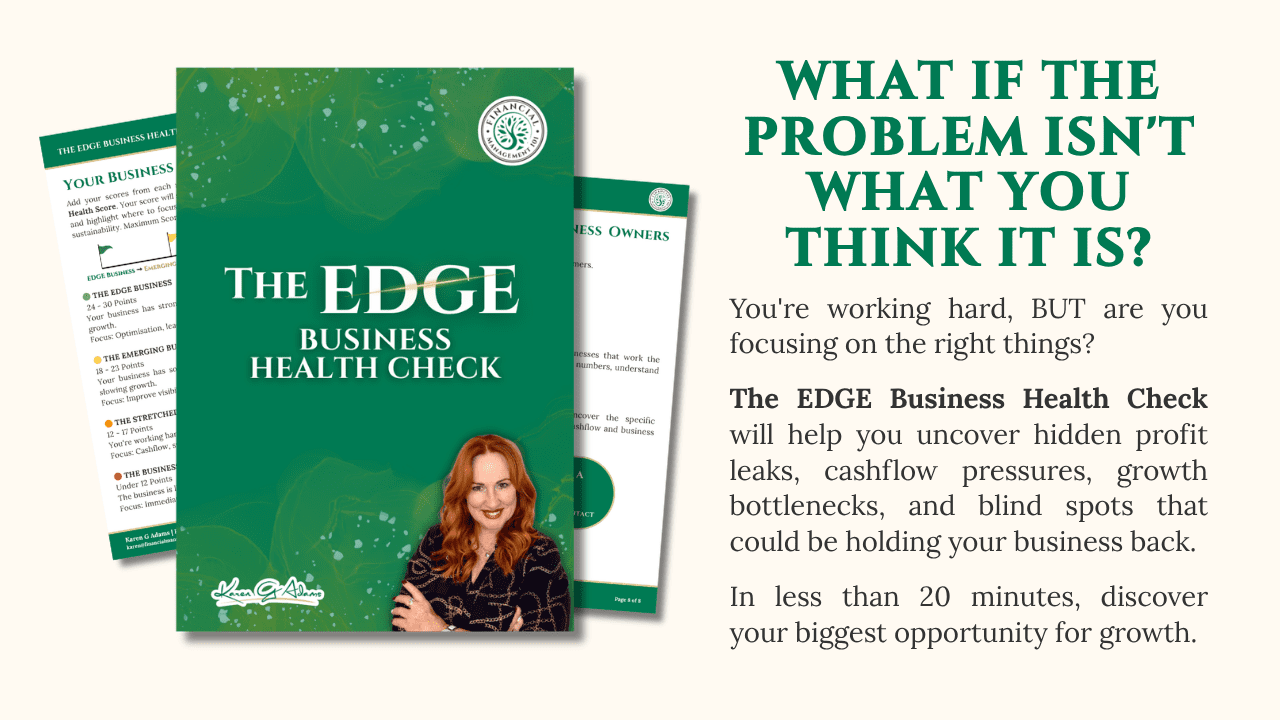
That’s why I created The EDGE Business Health Check™.

Not because business owners need another spreadsheet. Not because they need another report sitting in a drawer. They need clarity. They need visibility to make the decisions easier.

They need someone to help them see what they can’t see because they’re standing in the middle of it every single day.

One of my favourite sayings is:

You can’t fix what you can’t see.

It sounds simple. But it might just be the most important lesson in business.

Give your business a business health check – take a 20 minute “The EDGE Business Health Check”…..your business will love it and so will you.

THE EDGE BUSINESS HEALTH CHECK

#HowToResetMyMoneyMindset #NewYearFinancialMindset #HowToStartFreshWithMoney  emergency fund australia, money management, family savings #SmallBusinessOwner #BusinessGrowth #CashflowManagement #BusinessSuccess
#EntrepreneurMindset
 

When Did Your Business Stop Being Fun?

When Did Your Business Stop Being Fun?

There was a time when your business felt exciting.

Remember that?

The early days when every new customer felt like a win.

When every sale brought a sense of achievement.

When you couldn’t wait to tell people about your idea.

When your business represented freedom, possibility and opportunity.

Back then, the long hours didn’t seem to matter.

  • The challenges felt exciting.
  • The future looked full of potential.
  • You were building something.
  • Creating something.
  • Chasing something bigger.

But somewhere along the way, for many business owners, something changes.

The excitement starts to fade.

The pressure starts to grow.

The to-do list gets longer.

The responsibilities multiply.

And without even realising it, the business that once energised you starts to drain you.

The question is:

When did your business stop being fun?

It Doesn’t Happen Overnight

Very few business owners wake up one morning and suddenly decide they no longer enjoy their business.

It’s usually much more subtle than that.

A little more stress.

A few more responsibilities.

Another team member to manage.

More customer expectations.

More bills.

More administration.

More compliance.

More decisions.

More pressure.

Little by little, the business grows.

But so does the weight of running it.

Until one day you realise you’re spending more time solving problems than pursuing opportunities.

More time reacting than creating.

More time surviving than enjoying.

And that’s often the moment business starts feeling different.

The Dream Was Never About More Emails

Let’s be honest.

  • Nobody starts a business because they dream of spending their day buried in emails.
  • Nobody starts a business because they love chasing invoices.
  • Nobody starts a business because they enjoy dealing with staffing issues.
  • Nobody starts a business because they want to spend weekends catching up on paperwork.

Yet for many business owners, that’s exactly where they end up.

The business grows.

Complexity grows.

Administration grows.

Responsibilities grow.

And suddenly the business owner spends less time doing what they love and more time doing what the business demands.

The dream wasn’t supposed to look like this.

    Growth and enjoyment don't always increase together.
Unless you're intentional about building both.

    Success Can Create New Problems

    One of the biggest surprises in business is that growth doesn’t automatically make life easier.

    In fact, growth often introduces entirely new challenges.

    A larger customer base means more demands.

    A larger team means more leadership responsibilities.

    More revenue often means more moving parts.

    More complexity.

    More decisions.

    More pressure.

    This catches many business owners off guard.

    They achieve goals they once dreamed about and then wonder why they still feel exhausted.

    Why do they still feel overwhelmed?

    Why does the business still feel harder than it should?

    The answer is simple.

    Growth and enjoyment don’t always increase together.

    Unless you’re intentional about building both.

    The Trap of Becoming the Business

    Many small business owners start out wearing every hat:

    • Sales.
    • Marketing.
    • Operations.
    • Customer service.
    • Finance, and
    • Administration.

    It’s understandable.

    In the beginning, there may be nobody else.

    The challenge comes when the business continues to rely on the owner for everything.

    Every decision.

    Every approval.

    Every customer issues.

    Every problem.

    Every opportunity.

    The business becomes dependent on one person.

    And that person becomes trapped.

    What started as freedom slowly turns into obligation.

    Instead of owning a business, the business starts owning you.

    That’s a dangerous place to be.

    Not because the business is failing.

    But because the business can no longer function without your constant involvement.

    The Warning Signs

    Many business owners don’t realise they’ve reached this point until they see some of the warning signs.

    You might recognise a few of these:

    You check emails first thing in the morning and last thing at night.

    You struggle to switch off on weekends.

    You feel guilty taking holidays.

    You answer messages while you’re with family.

    You constantly think about work.

    You feel exhausted even after a day off.

    You find yourself saying things like:

    “If I don’t do it, it won’t get done properly.”

    Or:

    “It’s just easier if I do it myself.”

    Or:

    “I’ll deal with that later.”

    These aren’t signs of commitment.

    They’re often signs that the business has become too dependent on you.

    Why Fun Actually Matters

    Some people dismiss the idea of fun in business.

    They think business should be serious.

    Professional.

    Disciplined.

    Structured.

    And while all of those things have their place, enjoyment matters too.

    A lot.

    Because when business stops being enjoyable, several things start happening.

    Creativity declines.

    Energy declines.

    Motivation declines.

    Decision making suffers.

    Opportunities get missed.

    Burnout becomes more likely.

    The reality is that business owners perform better when they enjoy what they’re building.

    Not because it’s easy.

    But because it feels meaningful.

    When enjoyment disappears, business becomes something you endure rather than something you create.

    And that’s a very different experience.

      What Would Make Business More Enjoyable Again?

      This is one of my favourite questions to ask business owners.

      Not:

      “How do you grow?”

      Not:

      “How do you make more money?”

      But:

      “What would make your business more enjoyable?”

      Most business owners already know the real challenge isn't necessarily growth.
It's creating a business that feels sustainable.
A business that supports their life instead of consuming it.

      The answers are fascinating:

      • Some want more time.
      • Some want less stress.
      • Some want better systems.
      • Some want more clarity.
      • Some want a stronger team.
      • Some want to stop worrying about cash flow.
      • Some want to take a holiday without checking their phone every five minutes.

      What’s interesting is that very few people answer:

      “I need more customers.”

      Most business owners already know the real challenge isn’t necessarily growth.

      It’s creating a business that feels sustainable.

      A business that supports their life instead of consuming it.

      The Difference Between Building a Business and Building a Life

      At some point every business owner faces a choice.

      Will the business become the centre of their life?

      Or will the business support the life they want to create?

      They’re very different goals.

      One creates dependency.

      The other creates freedom.

      One creates constant pressure.

      The other creates options.

      One requires endless sacrifice.

      The other creates balance.

      The most successful business owners I’ve met understand this distinction.

      They don’t simply focus on building a bigger business.

      They focus on building a better business.

      One that creates profit.

      One that creates opportunities.

      One that creates freedom.

      One that allows them to enjoy the journey.

      Because what’s the point of building something successful if you never get to enjoy it?

      The Three Questions Worth Asking Yourself

      If business isn’t feeling as enjoyable as it once did, start with these three questions.

      1. What Am I Spending Too Much Time Doing?

      Look honestly at your week.

      What’s draining your energy?

      What’s consuming your time?

      What’s keeping you stuck in the weeds?

      Awareness is the first step.

      2. What Am I Avoiding?

      Sometimes the biggest frustrations come from problems we’ve been avoiding.

      A pricing issue.

      A staffing issue.

      A systems issue.

      A process issue.

      What conversation needs to happen?

      What decision needs to be made?

      3. What Would Make Business Feel Lighter?

      Not bigger.

      Not faster.

      Not more complicated.

      Lighter.

      What would create more breathing room?

      More confidence?

      More enjoyment?

      More freedom?

      The answer may be closer than you think.

      Business Was Never Meant to Be a Punishment

      Running a business will always involve challenges.

      That’s part of the journey.

      There will always be problems to solve.

      Decisions to make.

      Obstacles to overcome.

      But that doesn’t mean the journey should feel like a punishment.

      You didn’t start your business to become stressed, exhausted and overwhelmed.

      You started because you wanted something better:

      • More freedom.
      • More flexibility.
      • More opportunity.
      • More impact, and
      • More life.

      And perhaps that’s the reminder many business owners need.

      Success isn’t just about making more.

      It’s about keeping more.

      Keeping more time.

      Keeping more energy.

      Keeping more freedom.

      Keeping more enjoyment.

      Because at the end of the day, business should help you create a life you love.

      Not distract you from living it.

      Final Thoughts

      If your business isn’t feeling as fun as it once did, don’t ignore it.

      It’s often a sign that something needs attention.

      Not because you’re failing.

      Not because you’re doing anything wrong.

      But because growth changes things.

      Responsibilities change things.

      Life changes things.

      The goal isn’t to go backwards.

      The goal is to build a business that evolves with you.

      One that creates opportunity without consuming your life.

      One that gives you confidence instead of constant stress.

      One that allows you to make more, keep more and enjoy the ride.

      Ready to Find Out What’s Holding Your Business Back?

      The EDGE Business Health Check helps you uncover the hidden opportunities, blind spots and challenges inside your business.

      In less than 20 minutes, you’ll gain valuable insights across profitability, cash flow, growth, systems, leadership and CEO visibility.

      Because the more clarity you have, the easier it becomes to build a business that supports your goals and your lifestyle.

      Take The EDGE Business Health Check today and discover where your next opportunity is hiding.

      Take The EDGE Business Health Check today and discover where your next opportunity is hiding.

      #HowToResetMyMoneyMindset #NewYearFinancialMindset #HowToStartFreshWithMoney  emergency fund australia, money management, family savings #SmallBusinessOwner #BusinessGrowth #CashflowManagement #BusinessSuccess
      #EntrepreneurMindset

       

      AI for Small Business: Why Business Owners Who Embrace AI Will Dominate the Next Decade

      AI for Small Business: Why Business Owners Who Embrace AI Will Dominate the Next Decade

      How Smart Small Business Owners Are Using AI to Save Time, Increase Profit, Improve Productivity and Stay Ahead of the Competition

      Right now, many small business owners are feeling overwhelmed.

      The economy feels uncertain. Costs keep rising. Customers are changing. Marketing is changing. Technology is changing. And business owners are trying to keep up with it all while still running their business every single day.

      For many people, it feels exhausting.

      And then along comes AI. Suddenly everywhere you look, people are talking about artificial intelligence. Some business owners are excited by it. Others are terrified by it. And many are simply confused.

      They’re wondering:

      • Is AI going to replace jobs?
      • Is it too complicated?
      • Is it only for big companies?
      • Will it actually help my business?
      • Am I already falling behind?

      These are valid questions.

      But here’s the truth most people are starting to realise:

      AI is not going away. In fact, artificial intelligence is rapidly becoming one of the biggest shifts in business since the internet itself. And the businesses that learn how to use it wisely will create a major advantage over those who ignore it.

      Because AI is not about replacing good business owners. It’s about helping business owners operate smarter. And in today’s business world, ‘smarter’ matters more than ever.

      Small Business Owners Are Drowning in Overwhelm

      One of the biggest challenges small business owners face today is time. There never seems to be enough of it.

      Most owners are juggling:

      • customers
      • staff
      • marketing
      • emails
      • bookkeeping
      • social media
      • admin
      • sales
      • cashflow
      • Operations, and
      • Problem-solving

      All at once. And many are completely exhausted trying to hold everything together.

      The reality is that many business owners are spending huge amounts of time on repetitive tasks that technology can now help simplify.

      That’s where AI becomes powerful. Not because it replaces the human side of business. But because it removes unnecessary friction.

      It creates efficiency. It saves time. And time is one of the most valuable currencies in business.

      AI Is Not Replacing Human Leadership

      AI Is Not Replacing Human Leadership

      One of the biggest misconceptions about AI is the fear that it will replace humans entirely. But the businesses thriving with AI are not removing leadership. They are enhancing leadership.

      Because no matter how advanced technology becomes, people still buy from people. Customers still want:

      • trust
      • connection
      • communication
      • empathy
      • authenticity
      • leadership

      AI cannot replace genuine human relationships. But it can support business owners by helping them operate more effectively behind the scenes.

      Think of AI as an assistant. A tool. A support system. Not a replacement for human leadership.

      The future belongs to business owners who combine human connection with smart technology. That combination is incredibly powerful.

      Why Small Business Owners Can No Longer Ignore AI

      Many small business owners still think AI is only for large corporations with massive budgets. That’s no longer true.

      AI tools are now accessible to everyday business owners. And businesses that learn how to use these tools early will have a significant advantage moving forward. Why? Because AI allows business owners to:

      • save time
      • improve productivity
      • automate repetitive tasks
      • create content faster
      • improve customer communication
      • streamline systems
      • simplify operations
      • and make smarter decisions

      In a world where many owners already feel overwhelmed, this is a game changer. Because right now, too many business owners are drowning in operational chaos.

      They’re working harder instead of smarter. And that’s becoming unsustainable.

      AI Can Help Small Business Owners Save Time

      One of the biggest benefits of AI is time efficiency. Many business owners spend hours every week doing repetitive tasks manually.

      Tasks like:

      • writing social media posts
      • responding to emails
      • creating marketing content
      • brainstorming ideas
      • writing blogs
      • planning campaigns
      • creating customer follow-ups
      • summarising meetings
      • organising information

      AI can dramatically reduce the time spent on these tasks. And when business owners save time, they create space. Space to:

      • think strategically
      • focus on growth
      • improve leadership
      • work on the business instead of constantly in it
      • and reduce overwhelm

      This is one of the biggest shifts happening right now. Business owners are starting to realise they no longer need to do everything the hard way.

      AI Helps Small Businesses Compete Smarter

      For years, large companies had advantages small businesses didn’t.

      Bigger marketing teams. Bigger budgets. More staff. More resources. But AI is helping level the playing field.

      Small business owners can now:

      • create professional content faster
      • improve branding
      • generate marketing ideas
      • automate customer interactions
      • improve efficiency
      • and increase visibility online

      …without needing massive teams or enormous budgets.

      This creates incredible opportunity for small businesses willing to adapt. Because the future isn’t necessarily about having the biggest business. It’s about having the smartest systems.

      The Businesses That Thrive Will Be the Ones That Adapt

      This is another important point.

      AI is powerful. But AI without strategy is still ineffective.

      Technology alone does not build successful businesses. Leadership does. Vision does. Decision-making does. Strategy does.

      AI simply enhances those things when used correctly. That’s why business owners still need:

      • financial clarity
      • leadership skills
      • systems
      • communication
      • strategic thinking
      • emotional intelligence
      • visibility

      AI is a tool. Not the entire solution.

      The businesses succeeding with AI are the businesses combining smart technology with strong business foundations.

      AI Can Improve Marketing for Small Business Owners

      Marketing is one area where many small business owners feel completely overwhelmed. They know they need visibility online. They know consistency matters. But many struggle with:

      • time
      • ideas
      • content creation
      • confidence
      • strategy

      This is where AI can become incredibly useful. AI can help business owners:

      • generate blog ideas
      • write social media captions
      • brainstorm marketing campaigns
      • create video scripts
      • improve website copy
      • organise content plans
      • repurpose content, and
      • speed up content creation dramatically

      This allows owners to remain visible without spending endless hours trying to create everything manually.

      And in today’s world, visibility matters. Because great businesses still need great communication.

        AI and Financial Visibility

        Another powerful area where AI is transforming business is financial visibility. Many business owners struggle to understand their numbers clearly. They feel overwhelmed by reports and disconnected from what the financial data actually means.

        AI-driven dashboards and smarter reporting tools are helping simplify this process. Business owners can now gain faster insights into:

        • cashflow
        • profitability
        • expenses
        • trends
        • forecasting
        • and operational performance

        This allows owners to make decisions more proactively instead of reactively. And in uncertain economic times, visibility becomes one of the greatest competitive advantages a business can have.

        The Real Risk Is Staying Stuck

        Many business owners fear AI because it feels unfamiliar. But the real risk is not learning it at all. Because while some business owners avoid change, others are already using AI to:

        • improve efficiency
        • save time
        • increase visibility
        • strengthen marketing
        • streamline systems
        • and grow faster

        The gap between adaptable businesses and resistant businesses is likely to widen over the next few years.

        And honestly? This isn’t about replacing humans. It’s about removing unnecessary struggle. Because many business owners are burnt out from trying to do everything manually.

        AI gives business owners an opportunity to work smarter instead of simply working harder.

        The Future Belongs to Business Owners Who Evolve

        One of the biggest truths in business is this: The businesses that survive and thrive are the businesses willing to evolve.

        And right now, business is evolving rapidly. The future business owner needs:

        • adaptability
        • financial intelligence
        • leadership
        • systems
        • visibility
        • modern marketing understanding
        • and technological awareness

        This is no longer optional. It’s becoming essential.

        Because customers are evolving. Technology is evolving. And the businesses that evolve alongside them will create extraordinary opportunities moving forward.

        AI Should Support Your Life – Not Complicate It

        At the end of the day, the purpose of AI is not to make business owners feel more overwhelmed.

        It’s supposed to reduce overwhelm. It’s supposed to simplify processes. It’s supposed to create more freedom, more efficiency, and more opportunity. And perhaps that’s the biggest shift of all.

        For years, many business owners believed success required doing everything manually and working themselves into exhaustion.

        But the future belongs to business owners who learn how to create leverage. Who learn how to simplify. Who learn how to combine human leadership with smart systems and technology.

        Because AI won’t replace great business owners.

        But business owners who embrace AI wisely may absolutely outperform those who refuse to evolve.

        And in today’s economy, adaptability is becoming one of the most valuable business skills of all.

        Take the FREE Business Performance Audit™ and uncover how you can outperform those who refuse to evolve.

        Membership - FM101

        #HowToResetMyMoneyMindset #NewYearFinancialMindset #HowToStartFreshWithMoney  emergency fund australia, money management, family savings #SmallBusinessOwner #BusinessGrowth #CashflowManagement #BusinessSuccess
        #EntrepreneurMindset