What Numbers Should A Small Business Owner Track?

What Numbers Should A Small Business Owner Track?

You don’t need a full accounting degree to run a profitable business. But you do need to know which numbers reveal the real story. These are the few that matter most.

We get it, most business owners didn’t start their business because they love spreadsheets. You started it because you’re good at what you do, and somewhere along the way, “run the numbers” got added to the job description without anyone asking if you wanted it.

The good news is you don’t need dozens of reports or a finance degree. You need a small handful of numbers, checked regularly, that tell you the truth about how the business is really going.

By the end of this, you’ll know exactly which numbers to look at first, and why each one matters more than revenue alone.

1. Gross profit margin

This is what’s left from a sale once the direct cost of delivering it is covered; materials, trade labour, stock, whatever it takes to physically deliver your product or service.

It’s the clearest early warning system in your business. A shrinking gross margin means either your costs are rising faster than your prices, or your pricing was never quite right to begin with.

Check this: work it out for your top few products or services, not just the business as a whole. Averages hide the products quietly losing you money.

2. Net profit margin

This is what’s actually left after everything; overheads, wages, rent, subscriptions, the lot. It’s the number that tells you whether the business is genuinely profitable, not just busy.

Revenue can grow every year while net profit margin shrinks, and from the outside, everything still looks like success.

Check this: monthly, not just at tax time. A yearly glance means you find out about a problem eleven months too late to do much about it.
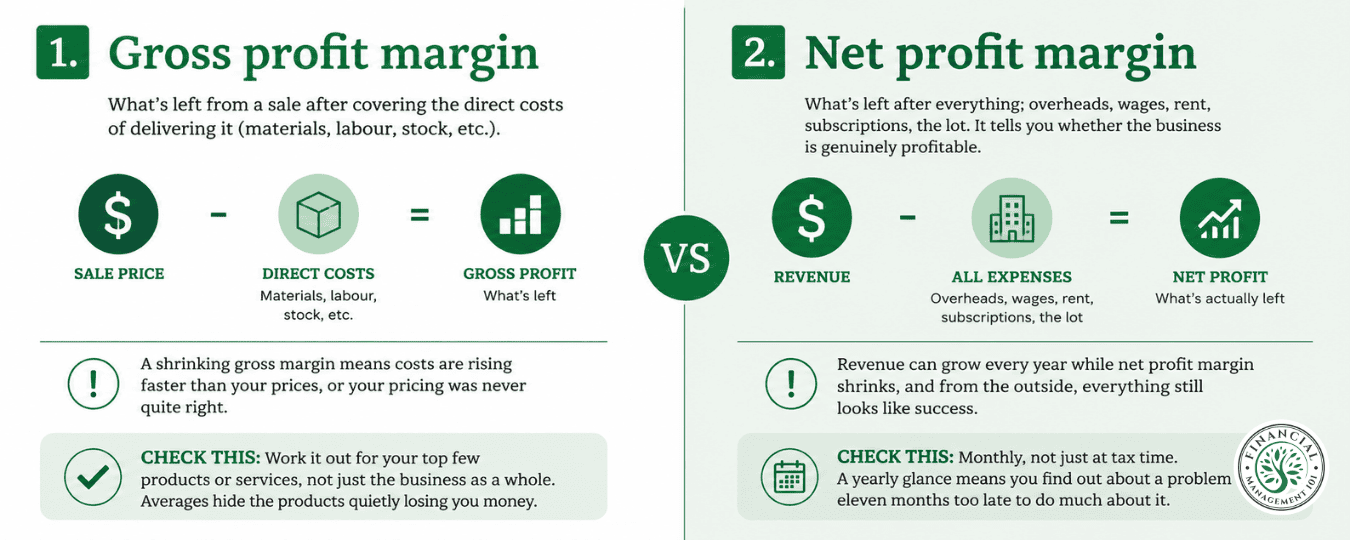
Gross Profit Margin vs Net Profit Margin

3. Cash position versus profit

Your bank balance and your profit are two different stories, even though they feel like they should match. A healthy bank balance can be sitting on unpaid tax, a big supplier bill due next week, or a loan repayment about to land.

We business owners tend to use the bank balance as our main scoreboard, simply because it’s the number we see most often. It’s useful – it’s just not the whole picture.

Check this: look at your profit and loss statement alongside your bank balance, not instead of it.

4. Overheads as a percentage of revenue

Overheads rarely blow out all at once. They creep in like; a new subscription here, a rent increase there, a “temporary” extra cost that becomes permanent.

Tracking overheads as a percentage of revenue, rather than a raw dollar figure, shows you whether your costs are growing in proportion to the business or quietly outpacing it.

Check this: list every recurring cost and total it as a percentage of that month’s revenue. Watch the trend over a few months, not just one snapshot.

5. Debtor days – how long it takes to get paid

This is the one most owners forget to track, and it’s often the one causing the most stress. Debtor days measure the average time between sending an invoice and the money landing in your account.

The longer that gap, the more your own cash is quietly funding someone else’s business while yours waits.

Check this: if your debtor days are creeping up, it’s usually a sign your payment terms, follow-up process, or invoicing timing need a look, not that you need more sales.

The Takeaway

You don’t need to track everything. You need to track the right few things, consistently. Gross profit margin, net profit margin, cash position, overheads as a percentage of revenue, and debtor days together, these five numbers tell you far more about the health of your business than revenue ever will on its own.

Clarity here isn’t about becoming an accountant. It’s about finally being able to see your business as clearly as you run it.

If you’d like these numbers tracked and visible for you automatically, that’s exactly what the CEO Dashboard is built for.

Watch the 2 minute video on how it works HERE

The CEO Dashboard™ gives small business owners a clear, visual snapshot of what’s really happening inside their business – so you can stop operating on gut feel alone and start making confident, data-driven decisions.

#HowToResetMyMoneyMindset #NewYearFinancialMindset #HowToStartFreshWithMoney  emergency fund australia, money management, family savings #SmallBusinessOwner #BusinessGrowth #CashflowManagement #BusinessSuccess #EAP #EmployeeAssistanceProgram
#EntrepreneurMindset

 

Busy Doesn’t Pay the Bills

Busy Doesn’t Pay the Bills

You worked sixty hours last week. So why does the bank account look like you worked twenty?

This is the one nobody wants to say out loud at the barbecue – being busy and being profitable are two completely different things, and most small business owners have spent years chasing the wrong one without realising it, because busy is the one everyone can see and profit is the one hardly anyone talks about.

We wear “flat out” like a badge of honour around here. Full calendar, full inbox, full plate, barely time for lunch, home late again. It’s practically a competitive sport among business owners, whoever’s had the wildest week wins some invisible prize. But a full calendar doesn’t automatically mean a full bank account, and that gap is exactly where the frustration lives, working harder than you ever have and still not seeing it show up where it counts, still lying awake doing mental maths that never quite adds up the way it should.

Busy measures your time. Profit measures your value.

Busy measures your time. Profit measures your value.

You can be fully booked out doing work that barely covers what it costs you to deliver it. Being busy tells you the calendar’s full. It tells you nothing about whether the business is actually working for you, or just working you into the ground while quietly running on thin margins nobody’s checked in a while.

I’ve sat across from business owners who were, by any outside measure, wildly successful booked out months in advance, a great reputation, more work than they could handle. And they were barely paying themselves properly, because nobody had ever sat down and worked out what each job actually needed to cost to make the whole thing worthwhile. Busy had completely disguised the real story, right up until it couldn’t any more.

Why busy feels so convincing

Part of the problem is that being busy comes with all the physical evidence of hard work; the tired legs, the full diary, the late nights. It feels like proof that things are going well, because it’s the same feeling we’ve always associated with success. Profit, on the other hand, is quiet. It doesn’t announce itself the same way. You don’t feel a profitable decision the moment you make it, the way you feel a long day in your bones. So busy wins the argument for attention, even when it’s not actually the one that matters most.

The trap of “just get more clients”

There’s a piece of advice that gets handed around a lot in small business circles – “just get more clients, that’ll fix it.” I’ll be straight with you, it’s tired advice, and it’s rarely true. More clients on top of an unprofitable structure just means more busy, at the same thin margin, with a lot more stress bolted on top. You’ve simply built a bigger version of the same leaky bucket. Fix the structure first. Scale it after, not before, otherwise you’re just working harder to stand still, faster, and wondering why the extra effort never seems to catch up.

What actually moves the needle

It’s rarely one big dramatic change. More often it’s a handful of smaller, unglamorous ones done properly knowing what a job genuinely costs before you quote it, building in a bit of buffer instead of pricing to the bone, saying no occasionally, following up on the money you’re owed without embarrassment. None of these make for an exciting headline. All of them, done consistently, add up to a business that reflects the effort going into it.

A small shift that changes a lot

Before you say yes to the next job, the next client, the next “quick favour” that somehow always turns into three hours of your Saturday, check what it’s actually worth once the real costs are factored in. Time, materials, the admin it drags behind it, the toll it takes on the rest of your week. Sometimes the most profitable move you can make is saying no to something that is busy without adding a cent of real profit, and saying yes instead to fewer things, done properly, priced properly.

You’re not behind, and you’re certainly not lazy. You’ve just never had proper visibility on which parts of the business are working for you and which parts are quietly working against you while you’re too busy to look. Once that becomes clear, the decisions get so much easier genuinely, not in a “just think positive” way, but in a very practical, this-is-what-the-numbers-actually-show kind of way.

The uncomfortable question worth asking

Here’s one worth sitting with for a minute; if your business stayed exactly this busy for the next twelve months, with nothing else changing, would you actually be better off this time next year? Not busier. Better off. More profit in the bank, more breathing room, more choice in what you say yes to.

For a lot of business owners, the honest answer is “not really,” and that’s an uncomfortable thing to admit after all the hours that have gone in. But it’s also the most useful question you can ask, because it points you toward the actual fix, which is almost never “do more of the same, just harder.”

The Edge Business Health Check

Redefining what a good week looks like

We’ve been taught, somewhere along the way, that a good week in business is a full one. Every hour booked, every day accounted for, home late most nights because that’s what commitment apparently looks like. It’s worth challenging that definition, because a genuinely good week isn’t the one with the most hours in it – it’s the one that moved the business forward the most, profitably, without costing you your evenings and your patience along the way.

That might mean fewer hours worked, not more. It might mean turning down the client who’s more trouble than they’re worth, even though saying yes would have made the calendar look fuller. A full calendar looks impressive from the outside. A profitable, sustainable one is the one that actually serves you.

That visibility is exactly what The Edge Business Health Check gives you, in about fifteen minutes flat.

#HowToResetMyMoneyMindset #NewYearFinancialMindset #HowToStartFreshWithMoney  emergency fund australia, money management, family savings #SmallBusinessOwner #BusinessGrowth #CashflowManagement #BusinessSuccess
#EntrepreneurMindset


Your First Quarter Report Card

Your First Quarter Report Card

July, August, September – done and dusted, more or less. So how’s the new financial year actually going? Not “how busy have you been.” How’s it going?

Most business owners can rattle off exactly how flat out they’ve been since July; the jobs, the clients, the late nights. Fewer can tell you how profitable they’ve been over the same stretch. And that gap between “flat out” and “actually ahead”, is exactly where a quick quarter check-in earns its keep. It’s the difference between a business that feels busy and a business you can actually prove is moving forward.

Nobody waits for the end-of-year school report to find out how a kid’s tracking. You check in along the way – a note home, a parent-teacher chat, a quiet word, and adjust before it becomes a bigger conversation. Your business deserves the same courtesy. Not a full audit, not a forensic dive into every transaction, just an honest look at the first three months of the new financial year, before you’re four quarters deep wondering where it all went and why the number at tax time doesn’t match the effort you know you put in.

Why most business owners skip this

It’s not laziness. It’s usually one of two things, either it feels like it’ll take hours you don’t have, or there’s a quiet fear of what it might show. Both of those assumptions tend to be wrong. This exercise takes less time than a coffee catch-up, and more often than not, the number is somewhere between “not as bad as I feared” and “better than I gave myself credit for.” The dread is almost always worse than the discovery.

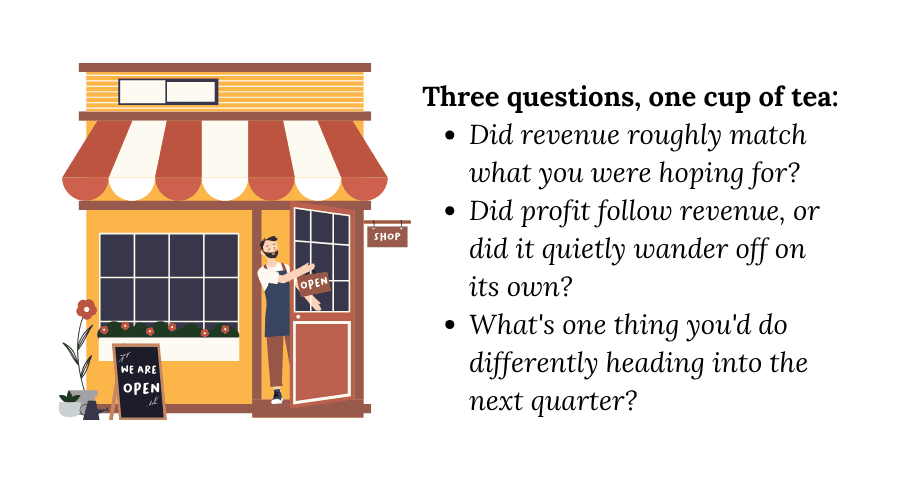
Three questions, one cup of tea

Three questions, one cup of tea

Did revenue roughly match what you were hoping for? Doesn’t need to be precise; ahead, on track, or behind is enough of an answer for now. And if you realise you never actually set a target for the quarter, that’s not a failure, it’s just a perfectly good place to start next time. You can’t be ahead or behind a target that doesn’t exist.

Did profit follow revenue, or did it quietly wander off on its own? This is the one that catches people out most often, and it’s the one I see most in this line of work. Revenue climbs, everyone’s thrilled, the calendar’s fuller than ever and then the bank balance doesn’t quite reflect it, because costs crept up right alongside the growth without anyone clocking it. Materials went up. A subcontractor’s rate went up. You took on a bit more admin help. None of it felt like a big decision at the time, but added together it’s eaten the extra revenue and then some. If you’ve felt busier than ever this quarter but the numbers don’t quite match the feeling, this is usually why.

What’s one thing you’d do differently heading into the next quarter? Not five things, just one! Trying to fix everything at once is how good intentions turn into nothing changing at all. Maybe it’s pricing, which almost every business owner I meet is quietly undercharging on. Maybe it’s chasing invoices a little sooner instead of letting them drift. Maybe it’s finally looking at where the money’s actually going instead of guessing based on vibes and a general sense of dread. Pick the lever that would move things most, and leave the rest for next quarter’s version of this exercise.

What to do with what you find

If the quarter came in ahead, resist the urge to immediately spend the difference on something exciting. Sit with it for a bit. Ask whether it’s a genuine trend or a one-off good stretch before you build plans around it. If it came in behind, resist the opposite urge, the spiral into “the whole business is failing.” One quarter is one quarter. It’s a data point, not a verdict. The value isn’t in the number itself, it’s in what the number tells you to look at next.

Why quarterly, specifically

A quarter is a genuinely good length of time to check in on; long enough to see a real pattern rather than a one-off blip, short enough to actually change course while it still matters. Check monthly and you risk reacting to noise, a slow week that means nothing, a good week that means nothing either. Check yearly and you find out too late to do much about it. Quarterly sits right in the sweet spot, giving you enough information to trust it, and enough time left in the year to actually act on it.

The business owners I see making calmer, more confident decisions are almost always the ones checking in quarterly, not just at tax time when the accountant delivers the number and there’s nothing left to do but accept it. Checking quarterly puts you back in the driver’s seat of your own financial year, rather than a passenger finding out where you ended up after the fact.

If you’d like a proper look under the bonnet, the CEO Dashboard gives you full visibility on exactly how the quarter really went not the guessed version, the real one.

Turning it into a rhythm

The businesses that get the most out of this aren’t doing anything clever, they’ve just made it a rhythm rather than a rescue mission. Same week each quarter. Same three questions. Same short list of actions afterwards. It stops being a big, dreaded event and becomes something closer to a habit, the business equivalent of a regular check-up rather than an emergency room visit.

If this is the first time you’ve done a proper quarter check-in, don’t worry about making it perfect. The value isn’t in precision, it’s in the act of actually stopping to look, on a schedule, instead of only looking when something’s gone wrong enough to force your hand.

Setting yourself up for next quarter

Before you close the laptop on this exercise, write down one number you’ll check again in three months. Just one. Revenue, profit margin, average invoice value, whatever feels most relevant to where you are right now. Having that one number in mind gives the next quarter’s check-in a head start, because you’ll already know what you’re comparing against instead of starting from scratch each time.

Small, consistent check-ins beat big, occasional audits every time. That’s true of your car, your health, and it’s absolutely true of your business.

The CEO Dashboard

#HowToResetMyMoneyMindset #NewYearFinancialMindset #HowToStartFreshWithMoney  emergency fund australia, money management, family savings #SmallBusinessOwner #BusinessGrowth #CashflowManagement #BusinessSuccess
#EntrepreneurMindset


Your Team Might Look Fine – But Financial Stress Could Be Costing More Than You Think

Your Team Might Look Fine – But Financial Stress Could Be Costing More Than You Think

“They seem fine.”

It is one of the most common assumptions leaders make.
And to be fair, it is an easy one to make.

Most employees are not walking into work announcing that they are worried about bills, debt, interest rates, or the rising cost of everyday life.

They keep going.
They keep performing.
They keep pushing through.

But financial stress has a way of showing up quietly.

It can look like a distraction.
Low energy.
Mood changes.
Reduced confidence.
Increased absenteeism.
Burnout.
Or eventually, a resignation that seems to come out of nowhere.

The employee looked fine.
But they were not fine.

The silent pressure many employees are carrying

The current financial climate is affecting people in deeply personal ways.
Even capable, high-performing employees can be under enormous pressure.

When money stress builds, people can feel:

  • mentally overloaded
  • emotionally flat
  • ashamed to ask for help
  • trapped in a cycle of stress and avoidance
  • worried about keeping up with household costs
  • fearful about debt, repayments, or unexpected expenses

And because money is still a sensitive topic, many employees suffer in silence.

That silence can be expensive.

The current financial climate is affecting people in deeply personal ways.
Even capable, high-performing employees can be under enormous pressure.

Why this is bigger than employee perks

Free lunches, social events, and workplace rewards all have their place.
But they do not solve financial anxiety.

When someone is lying awake worrying about bills, a pizza party is not going to restore their peace of mind.

This is why financial wellbeing deserves more attention inside workplaces.
It addresses a real problem that affects people’s everyday lives and their capacity to function well at work.

It is practical. It is human. And right now, it is incredibly relevant.

What financial wellbeing support actually does

A strong financial wellbeing approach helps employees move from stress and confusion to clarity and confidence.

That might involve helping them:

  • understand where their money is going
  • create simple systems that reduce overwhelm
  • identify savings opportunities they have missed
  • tackle debt with a clearer plan
  • improve money habits and mindset
  • feel more hopeful and less stuck

Notice that this is not about judgement. It is about support.

Financial pressure can affect anyone. The goal is not to shame people for needing help. The goal is to give them tools that genuinely make life feel more manageable.

What employers gain when they take this seriously

When businesses support staff with financial wellbeing, the impact can ripple through the whole workplace.

You may see:

  • better focus and engagement
  • increased productivity
  • lower staff turnover
  • stronger trust and loyalty
  • reduced burnout risk
  • a more supportive workplace culture

People remember employers who support them through hard seasons.
Not just with words, but with meaningful action.

Reassurance is part of support

Let’s pause here for something important.

If you are an employee feeling the pressure right now, please hear this:

You are not weak.
You are not bad with money just because things feel hard.
You are not the only one feeling stretched.

This season may be challenging, but it does not define you.
With the right support, practical tools, and small consistent changes, things can improve.

And if you are an employer reading this, never underestimate how powerful it is to create a workplace where people feel safe to get support before they hit breaking point.

    Reassurance is part of support

    Support before crisis is the smarter move

    Too often, workplaces respond after the damage is done.
    After the burnout.
    After the resignation.
    After the drop in performance.
    After the personal crisis spills into professional life.

    But early support changes that.

    When businesses proactively offer financial wellbeing resources, they help staff build resilience before the pressure becomes overwhelming.
    That is better for the employee and better for the organisation.

    A more compassionate and practical workplace benefit

    There is a reason financial wellbeing is becoming such an important conversation.
    It sits at the intersection of performance, retention, mental wellbeing, and culture.

    It is not about fixing everything overnight.
    It is about giving people a starting point.
    A plan.
    A sense that they are not alone.
    A pathway back to confidence.

    And in uncertain times, that kind of support matters more than ever.

    My Financial Wellbeing Program helps workplaces support staff with practical money tools, confidence-building education, and real guidance that reduces stress and strengthens wellbeing.

    Because when your people feel better about money, they often feel better at work too.

    And that is good for everyone.

    Financial Wellbeing Program

    #HowToResetMyMoneyMindset #WhyDoIFeelOutOfControlWithMoney #HowToFeelInControlOfFinances #ResetMoneyMindset2025 #NewYearFinancialMindset #HowToStartFreshWithMoney  emergency fund australia, money management, family savings 


    The Emergency Fund Isn’t Optional – How to Build One Without Feeling Broke (and why it changes everything)

    The Emergency Fund Isn’t Optional – How to Build One Without Feeling Broke (and why it changes everything)

    Let’s talk about the one money habit that turns chaos into calm faster than almost anything else:

    An emergency fund.

    Now before you roll your eyes and think, “Karen, I knowww… but I can barely afford groceries,” stay with me.

    Because I’m not about to tell you to magically save three months of expenses overnight, live on rice and sadness, and stop enjoying life.

    That’s not financial education – that’s financial punishment. 😅

    What I am going to do is show you how to build an emergency fund in a way that feels doable, realistic, and actually sticks… even if money is tight.

    And here’s why this matters:

    An emergency fund isn’t just “money in an account.”
    It’s peace, options, and less stress when life does what life does best… surprise you at the worst possible time.

    So let’s get your financial house in order by building the foundation that stops everything from wobbling.

    Why the Emergency Fund Is Non-Negotiable (Even If You Have Debt)

    I want you to imagine your finances like a house.

    If your foundation is cracked, everything else feels unstable:

    • you can’t plan properly
    • you can’t relax
    • you’re constantly bracing for impact
    • and one unexpected bill can knock you sideways

    An emergency fund is the foundation.

    It stops you from:

    • using credit cards “just this once”
    • grabbing BNPL for essentials
    • borrowing from family
    • draining your savings every time something happens
    • feeling like you’re always behind

    Even if you’re paying down debt, you still need a buffer.
    Because without one, every emergency becomes more debt… and that cycle is exhausting.

    An Emergency Fund Is Non-Negotiable Even If You Have Debt

    The Biggest Myth: “I’ll Start When I Have More Money”

    This is the #1 reason people delay emergency savings.

    They think:

    • “I’ll start when I get a pay rise.”

    • “I’ll start when the kids are older.”

    • “I’ll start when the cost of living calms down.” (lol… remember calm?)

    • “I’ll start when things settle.”

    But here’s the truth:

    Things don’t settle.
    You just get stronger and more organised.

    And you don’t get stronger by waiting.
    You get stronger by starting small and building consistency.

    You don’t need a massive emergency fund to change your life.
    You need the habit of saving, the system that supports it, and the confidence that you can handle surprises.

    What Counts as an “Emergency”? (Let’s Be Clear)

    If we don’t define “emergency,” your emergency fund gets eaten by:

    • sales

    • convenience spending

    • spontaneous “self-care” shopping

    • and that “it’s been a week” moment at Target 😄

    An emergency is:
    ✅ urgent
    ✅ necessary
    ✅ unexpected
    ✅ not in the budget

    Examples:

    • car repairs

    • urgent medical/dental

    • last-minute travel for family reasons

    • job loss or reduced income

    • essential home repairs

    • unexpected vet bills (pets are adorable little financial liabilities)

    Not emergencies:
    ❌ a holiday
    ❌ Christmas (it’s predictable, we plan for it)
    ❌ a new phone because your current one is “annoying”
    ❌ a birthday gift (also predictable)
    ❌ a sale (I don’t care how good the sale is)

    For those predictable costs, we use sinking funds (we’ll talk about that shortly).

    Emergency Fund vs Sinking Funds (The Difference That Changes Everything)

    This is a game-changer for getting your financial house in order.

    Emergency fund:

    For true, unexpected emergencies.

    Sinking funds:

    For expected expenses that don’t happen weekly or monthly but absolutely happen:

    • car rego and insurance
    • school expenses
    • rates
    • Christmas
    • birthdays
    • holidays
    • annual subscriptions
    • car servicing

    When people don’t have sinking funds, they call predictable bills an “emergency”… and then their emergency fund never grows.

    So yes, we want both. But we start with a buffer first.

    Step One: Build a “Stress Buffer” (The First Goal)

    Forget “3 months of expenses” for a second.

    Your first goal is what I call a Stress Buffer:

    • $500 if you’re starting from scratch
    • $1,000 if you have a bit more breathing room

    This amount won’t solve everything, but it will stop the small stuff from turning into drama.

    And you know what? When you see that balance grow, something shifts.

    You start trusting yourself. You feel less panicked. You stop living on the edge of your bank balance.

    That’s financial muscle building in real time.

    “But I Can’t Save” – Yes You Can (Here’s How)

    I’m going to say this kindly:

    Most people can save something.
    They just haven’t had a system that makes it automatic and non-negotiable.

    Here are practical ways to start, even if you’re on a tight budget.

    1) The Micro-Save Method

    Start with:

    • $10 a week

    • or $25 a fortnight

    • or $2 a day

    Yes, it feels small. But small done consistently becomes powerful.

    The goal is not the amount at the start.
    The goal is building the identity of: “I’m someone who saves.”

    2) The “Pay Yourself First” Transfer

    This is the most important strategy of all:

    Set up an automatic transfer on payday into a separate account called:

    • “Emergency Fund”

    • “Stress Buffer”

    • “Do Not Touch” 😄

    • “Future Me’s Peace”

    When it’s automatic, you don’t have to think about it.

    And thinking less about money is the dream, isn’t it?

    3) The Round-Up Hack

    Many banks let you round up purchases and move the difference into savings.

    It’s not life-changing on its own, but combined with automation?
    It’s a lovely little boost.

    4) The “Found Money” Rule

    Any unexpected money goes to the emergency fund until you hit your first goal:

    • tax returns

    • bonuses

    • cashback

    • refunds

    • gifts

    • overtime

    You can still enjoy some of it – I’m not a monster – but Future You gets first dibs until your foundation is built.

    Where to Put Your Emergency Fund (So You Don’t Accidentally Spend It)

    This part matters because if your emergency fund is sitting next to your spending money… it will be treated like spending money.

    Human brains do not like temptation.

    Here’s the rule:
    ✅ separate account
    ✅ not linked to your everyday card
    ✅ easy enough to access in an emergency, but not instant-grab easy

    A high-interest savings account is often a good option for many people, but the key isn’t the interest rate – it’s the separation.

    If you have to take one extra step to access it, you’ll be less likely to raid it for non-emergencies.

    How Much Should Your Emergency Fund Be?

    Once you’ve built the Stress Buffer, you can level up.

    Here are the common tiers:

    Tier 1: $500–$1,000 Stress Buffer

    Stops small emergencies becoming debt.

    Tier 2: 1 month of essential expenses

    Covers short-term hiccups.

    Tier 3: 3 months of essential expenses

    A solid safety net for most households.

    Tier 4: 6 months of essential expenses

    Great if you’re self-employed, commission-based, or in an industry with variable work.

    Important: You don’t have to build this in a week. You build it steadily and that’s what makes it sustainable.

    The “Life Is Lifey” List: Why Emergencies Keep Happening

    Here are just a few things I see all the time:

    • the car decides it’s done with life
    • unexpected house repair
    • the hot water system taps out
    • the dog eats something it shouldn’t (again)
    • a dentist visit becomes a “how is this $800?” moment
    • your kid needs something for school tomorrow
    • your income changes unexpectedly


    These aren’t rare events. They’re predictable unpredictables.

    And when you have an emergency fund, you stop being shocked and start being prepared. That is the point.

    Life Emergencies Keep Happening

    What If You’re Paying Off Debt?

    Here’s my professional but real-life approach: If you have debt, you still build a Stress Buffer first.

    Why? Because without it, you’ll keep going back into debt every time something happens.

    A simple strategy is:

    1. Build $500 – $1,000 buffer
    2. Focus on debt payoff
    3. Build 1 month expenses
    4. Continue debt payoff + build sinking funds
    5. Build to 3 months expenses

    This is balanced. Realistic. And it reduces stress.

    How to Make Saving Feel Less Painful (Because Yes, It Can)

    Saving can feel like deprivation when your brain believes money is scarce.

    So we make it feel lighter by doing two things:

    1) Make it automatic

    If you’re relying on motivation, you’ll save only when you feel inspired.

    And motivation is… inconsistent. Automation builds wealth quietly.

    2) Give your savings a purpose

    Calling it “Savings” is boring. Calling it “Freedom Fund” or “Peace Buffer” hits differently.

    Name it like it matters, because it does.

    The Secret to Getting Your Financial House in Order: One System That Runs Without You

    Here’s the truth:

    Most people don’t fail at money because they don’t care.
    They fail because they don’t have a system, they’re doing everything manually, with willpower, while stressed.

    And that’s like trying to carry groceries without bags. Possible… but messy and exhausting.

    A system looks like:

    • separate accounts
    • automatic transfers
    • sinking funds for predictable costs
    • a weekly 10-minute money check-in
    • clear rules for what is/isn’t an emergency

    This is what creates calm.

    Want Help Building This (So It Actually Sticks)? Join the Membership.

    If you’ve read this and thought:

    “I want this, but I need help setting it up.” or “I’ve tried to save before and it disappears.” or “I need a plan that’s realistic for my life.”

    That’s exactly why I created my Membership.

    Inside the Membership we don’t just talk about emergency funds – we build the whole system:
    ✅  Your Stress Buffer plan (based on your income and expenses)
    ✅  Automated transfers so saving happens without willpower
    ✅  Sinking funds so predictable expenses stop feeling like emergencies
    ✅  Amoney map so your cash flow has structure
    ✅  Support and guidance so you don’t fall off track

    You don’t need to “try harder.” You need the right strategy and ongoing support.

    If you’re ready to stop living one unexpected bill away from stress, join the Membership.
    Let’s build your emergency fund, get your financial house in order, and help you feel calm with money again for good.

    Join The Membership at Financial Management 101

    #HowToResetMyMoneyMindset #WhyDoIFeelOutOfControlWithMoney #HowToFeelInControlOfFinances #ResetMoneyMindset2025 #NewYearFinancialMindset #HowToStartFreshWithMoney  emergency fund australia, money management, family savings