
Fixed vs. Variable: Navigating Mortgage Interest Types for Homebuyers

Fixed vs. Variable: Navigating Mortgage Interest Types for Homebuyers

Hello, aspiring homeowners and financial adventurers! As your trusty financial coach and savvy mortgage broker, I’m here to guide you through the thrilling yet often perplexing world of mortgage interest types. 

Picture this: you’re embarking on a quest to find the perfect home, but there’s a fork in the road. Do you take the path of fixed interest rates or venture down the trail of variable rates? Let’s unpack these options together, with a sprinkle of fun and a dash of wisdom, to ensure you make the best decision for your financial future.

The Tale of Two Rates: Setting the Scene

Imagine two characters in our story: Fiona Fixed and Victor Variable. Fiona enjoys predictability in her life. She loves knowing exactly how much her payments will be each month, providing her with a sense of security and peace of mind. Victor, on the other hand, is a bit more daring. He’s willing to ride the waves of the market, betting that interest rates will go in his favour, potentially saving him money in the long run. 

Steady Ship vs. Sailboat

The Fixed Rate: A Steady Ship in Stormy Seas

Fixed-rate mortgages are like a sturdy ship that can weather any storm. They offer the same interest rate for the entire term of the loan, whether it’s 15, 20, or 30 years. This means your monthly mortgage payments remain unchanged, making budgeting as easy as pie. It’s perfect for those who, like Fiona, prefer stability over surprises.

Pros:

    • Predictability: You’ll sleep soundly knowing your payments won’t change.
    • Simplicity: Easy to understand, especially for first-time homebuyers.
    • Protection: You’re shielded from sudden spikes in interest rates.

Cons:

    • Higher Initial Rates: Fixed rates are usually higher than the initial variable rates.
    • Less Flexibility: If interest rates fall, you’re stuck with your rate unless you refinance.

The Variable Rate: Sailing the Winds of Chance

On the flip side, variable-rate mortgages are like a nimble sailboat that adjusts its sails with the winds of the market. The interest rate can fluctuate based on market conditions, meaning your monthly payments could increase or decrease. This is where Victor finds his thrill, in the potential for lower overall costs when rates favour the borrower.

Pros:

    • Lower Initial Rates: Start with a lower rate compared to fixed-rate mortgages.
    • Potential Savings: Benefit from paying less interest when rates decrease.
    • Flexibility: Often includes options to lock in a fixed rate if the winds change.

Cons:

    • Uncertainty: Your monthly payment could change, making budgeting a challenge.
    • Risk: If interest rates soar, so do your payments.

Navigating Through the Fog: How to Choose

Now, how do you choose between these two? Consider your financial situation, lifestyle, and risk tolerance. Here are a few lanterns to help illuminate your path:

Financial Stability: If you’re in a stable financial position and can handle potential increases in your payments, Victor’s variable rate might be your calling. However, if you prefer the safety of a predictable budget, follow Fiona’s lead with a fixed rate.

Market Trends: Keep an ear to the ground on market trends. If rates are historically low, locking in a fixed rate might be wise. But if you’re feeling optimistic about where rates are headed, the variable rate could be your treasure.

Term Length: Consider how long you plan to stay in your home. If it’s a short-term stay, a variable rate might offer lower initial payments. For a long haul, a fixed rate could offer long-term stability.

Ask the Experts: Consult with me, your financial coach and mortgage broker. I love helping heroes of homeownership chart their course to the perfect mortgage.

The Adventure Awaits

Remember, choosing between fixed and variable interest rates isn’t just about crunching numbers; it’s about aligning your mortgage with your life’s voyage. Whether you’re a Fiona Fixed, preferring the calm seas of predictability, or a Victor Variable, ready to sail the fluctuating financial tides, the right choice is out there.

As your financial navigator, I’m here to help you explore the possibilities and make an informed decision. So, gather your maps and set your sights on the horizon; your dream home awaits, and the perfect mortgage is your key to unlocking the door. Happy house hunting, brave explorers.

Whether you’re dipping your toes into the home-buying waters for the first time, eyeing a smarter refinancing strategy, coming off a fixed interest rate, or expanding your portfolio with another investment property, Karen’s 20-minute discovery call, is your first step towards mortgage mastery! Let’s dive into your financing needs, explore your options, and perform a FREE mortgage health check to ensure your plans aren’t just dreams but achievable realities.  
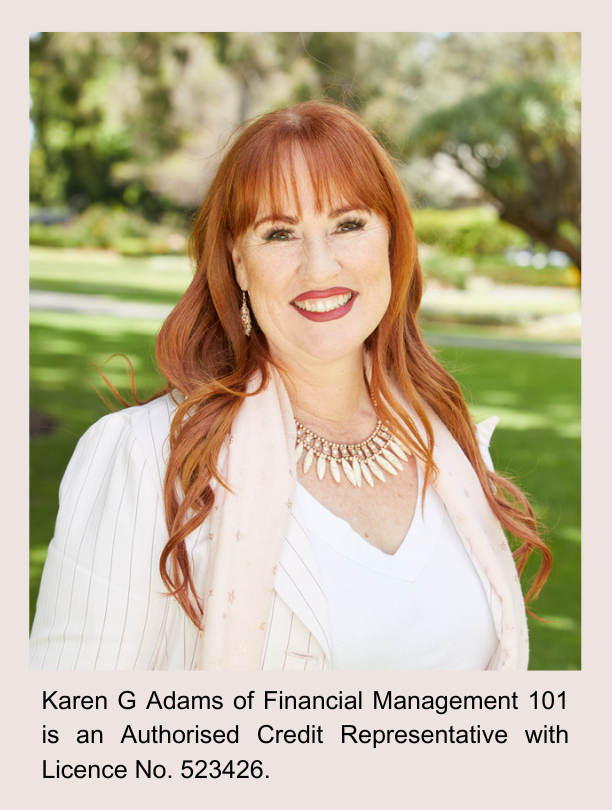
Karen Adams of Financial Management 101
Mortgage Basics – Helping You Understand Your Home Loan Better

Mortgage Basics – Helping You Understand Your Home Loan Better

Hey, fellow financial mavericks, I want to share a quick bite-size piece of information about your home loan, or, if you’re looking to dive into the property market as a first home buyer, then here are some of the mortgage terminology to help you understand what you’re getting into.

Buying a home and financing your new home is one of the biggest purchases of your life and is both exciting and nerve-racking.  Firstly, it takes enormous amounts of your income to pay and smash down the home loan, however, it’s also one of the most rewarding things to see you owning your own home, whether it’s your first home or building an investment portfolio.

UNDERSTANDING MORTGAGES: THE BASICS

A mortgage is essentially a loan that helps you buy a property. When you take out a mortgage, you’re borrowing money from a lender (usually a bank or mortgage company) to purchase a home. The twist? The home itself serves as collateral for the loan. This means if you fail to make your payments, the lender has the right to take ownership of the property through a process known as foreclosure.

THE PLAYERS: LENDER AND BORROWER

In the mortgage world, the lender is the financial institution lending you the money. You, the homebuyer, are the borrower. Lenders evaluate your creditworthiness based on factors like your credit score, income, debts, and employment history. This evaluation helps determine how much they’re willing to lend you and at what interest rate.

YOUR MORTGAGE: THE KEY COMPONENTS

Let’s break down the basics of what a mortgage is, including terms like interest rates, principal, what amortisation means, and what it means when you look to refinancing. 

So let’s start with:

Principal: This is the amount of money you borrow to buy a home. For example, if you buy a house for $500,000 and make a down payment or deposit of $80,000, your principal would be $420,000.

Interest Rate: The lender charges you interest as a cost of borrowing money. Interest rates can be fixed (remaining the same throughout the term) or variable (changing with market conditions). The rate impacts your monthly payment and the total cost over the life of the loan.

Amortisation: This refers to the process of spreading out the loan payments over a set period, typically 20 to 30 years for mortgages. Each payment includes a portion that goes toward the principal and a portion that goes toward interest. In the early years, a larger part of each payment goes toward interest; later, more goes toward reducing the principal.

Lenders Mortgage Insurance (LMI): Insurance added onto a home loan where your deposit or down payment is less than 20%, which is there to protect the lender if you default on the loan.

Government & Property Taxes: Whenever you purchase a property in Australia, the government charges you stamp duty and other costs, which you can either pay the amount owing at time of settlement, or, you can add the govt costs into your home loan.

Refinancing: This is the process of replacing your existing mortgage with a new one, usually to take advantage of lower interest rates. Refinancing can reduce your monthly payments or shorten your loan term, but it may involve additional costs like settlement fees.

Monthly Payments: Your monthly mortgage payment typically includes:

        • Principal repayment: Reduces your outstanding loan amount.
        • Interest payment: The cost of borrowing the principal.

Long-term Costs: Over the life of the mortgage, you’ll pay back the principal plus the total interest accrued. A higher interest rate or a longer term means more money paid in interest. 

For instance, a $420,000 mortgage at 6% interest over 30 years will cost less in monthly mortgage repayments, however you will be paying more in total interest than the same mortgage at 6% interest over a 25 year period.  With a lower loan term, you will be paying higher monthly payments, but in total lower interest costs.

Generally a more extended loan term, helps make the repayment more manageable.

Successful Mortgage Management

THE MORTGAGE PROCESS: STEP-BY-STEP

    • Pre-Approval: Before house hunting, you may want to get pre-approved for a mortgage. This gives you a better idea of how much you can afford and shows sellers you’re serious.
    • Find a Home: Once pre-approved, you can shop for a home within your budget.
    • Apply for a Mortgage: After finding a home, apply for a mortgage. You’ll need to provide detailed information about your finances.
    • Underwriting/Assessment: The lender reviews your application, verifies your financial information, and assesses the property’s value.
    • Approval & Settlement: If the loan is approved, you’ll sign the loan documents, your solicitor or settlement agent will assist you in finalising the loan contract and then once settles, the home is yours!

TIPS FOR SUCCESSFUL MORTGAGE MANAGEMENT

    • Understand Your Budget: Know what you can afford monthly,, to avoid financial stress.
    • Improve Your Credit Score: A higher credit score can secure a better interest rate, saving you money in the long run.
    • Save for the Deposit/ Down Payment: The bigger your deposit payment, the less you have to borrow, and the less you pay in interest and possibly mortgage insurance.
    • Use a Mortgage Broker: Work with a mortgage broker research for you on who is going to offer you the best deal, based on your own personal financing position. Your mortgage broker will offer you a product comparison, highlighting a few lenders rates, terms and features and benefits.

Understanding these quick basics, helps in making informed decisions about buying a home and choosing the right mortgage. It’s essential to consider both the monthly affordability and the long-term financial implications when selecting a mortgage type and term.

CONCLUSION

Navigating the world of mortgages can feel overwhelming, but armed with the right information, you can make decisions with confidence. Remember, a mortgage is one of the biggest financial commitments you’ll make, so it pays to understand the basics and consider your options carefully. 

As your financial and mortgage coach, I’m here to guide you through this journey, ensuring you feel empowered and informed every step of the way.

Understanding your home loan is about more than just signing papers; it’s about taking control of your financial future and making the dream of homeownership a reality. 

If you want to know whether your home loan is working effectively for you and your personal finances contact me at karen@harkenfinance.com for a chat.

Securing Your Future: The Vital Importance of Retirement Planning

Securing Your Future: The Vital Importance of Retirement Planning

One cannot stress the significance of retirement planning in a world where life events are unpredictable and economic conditions are constantly changing. Assuring a safe, comfortable, and stress-free future requires more than just making prudent financial decisions when it comes to retirement planning. This post will discuss the advantages of retirement planning and the reasons that everyone, regardless of age or income level, should make it a top priority.

1. THE POWER OF COMPOUND INTEREST

The power of compound interest is one of the strongest arguments for beginning retirement planning as soon as possible. Often called the “eighth wonder of the world,” compound interest is the process by which the interest you earn continues to accrue. This can cause your savings to grow exponentially over time, making even small contributions into a sizeable nest egg. You gain more from this compounding effect the earlier you begin.

The Power of Compound Interest

2. LIFESTYLE MAINTENANCE AND PEACE OF MIND

Making plans for retirement is crucial to preserving your way of life in your golden years. You may not be able to maintain the standard of living to which you have become accustomed if you do not have a sound plan. When you plan ahead, you can make sure you have enough money for hobbies, travel, and entertainment in addition to meeting your basic needs. Furthermore, having a plan in place can bring you a great deal of peace of mind and lessen your stress and anxiety about the future.

3. HEALTHCARE AND LONG-TERM CARE COSTS

Healthcare becomes a more pressing issue as we get older. Planning for retirement enables you to save money for unanticipated medical costs, long-term care, or assisted living facilities. Having a financial cushion can be a lifesaver, literally and figuratively, given the rising cost of healthcare.

4. INFLATION AND COST OF LIVING

When preparing for retirement, inflation is frequently overlooked. Since living expenses are likely to increase over time, if you have not made enough plans for them, your savings’ purchasing power may decline. A strong retirement plan accounts for inflation, guaranteeing that the growth of your savings exceeds the increasing cost of living.

5. FINANCIAL INDEPENDENCE AND FAMILY SECURITY 

Retirement planning is not just about you; it is also about your family’s financial stability. You can lessen the potential strain on your loved ones by taking care of your own financial future. It can also enable you to provide your kids or grandkids with a financial legacy to help with their future pursuits.

6. FLEXIBILITY AND ADAPTABILITY

A flexible retirement plan is essential. It enables you to adjust to life’s fluctuations, including unforeseen costs, pay adjustments, or changes in the state of the economy. This flexibility is essential for managing life’s uncertainties and preserving financial security.

Making plans for retirement is crucial to preserving your way of life in your golden years.

Making plans for retirement is crucial to preserving your way of life in your golden years. When you plan ahead, you can make sure you have enough money for hobbies, travel, and entertainment in addition to meeting your basic needs.

One of the most important steps toward ensuring a stress-free and financially secure future is retirement planning. It is important to invest in your future self as well as the welfare of your loved ones, not just in terms of saving money. Planning is essential, regardless of your age or financial status right now. Retirement planning is crucial to a comprehensive financial strategy because of the advantages it offers, including financial security, peace of mind, and the compound interest effect. Start your path now to create the foundation for a safer, more prosperous tomorrow.

Learning about money-saving techniques can give you the power to make smart financial decisions, prepare for your retirement, and reduce money-related stress over time. That’s where the LEARNING HUB helps you gain more financial knowledge, while providing you with the support and help you need.

Join the Learning Hub - Financial Management 101 by Karen G Adams
Creating Multiple Income Streams After 35

Creating Multiple Income Streams After 35

In today’s economic climate, relying solely on one source of income can be risky, particularly for people in their mid-30s to 50s. Diversifying income sources not only provides financial security, but also creates opportunities for personal and professional development. Let us look at how you can generate multiple income streams in your prime years.

1. TURN HOBBIES INTO INCOME

Many of us have interests or skills that can be monetized. Consider turning your passions, such as crafting, photography, or writing, into a side business. Online platforms make it easier than ever to sell products or services.

2. INVEST IN REAL ESTATE

Real estate investing can be a profitable way to generate passive income. This could include buying a rental property, investing in a real estate investment trust, or looking into Airbnb hosting if you have extra space.

Turn Hobbies into Income

3. DIVE INTO THE GIG COMMUNITY

The gig economy provides flexible ways to earn extra money. Freelancing, consulting, or part-time work in your area of expertise can supplement your primary income while giving you control over your schedule.

4. CREATE DIGITAL PRODUCTS

If you are an expert in a specific field, consider creating digital products such as eBooks, online courses, or webinars. Once created, these products can generate ongoing passive income with minimal effort.

5. DIVIDEND STOCKS OR MUTUAL FUNDS

Investing in dividend-paying stocks or mutual funds can generate a consistent income stream. While there are risks involved, dividends can be a relatively passive way to earn income.

6. PEER-TO-PEER LENDING

Platforms that allow peer-to-peer lending may be an alternative source of income. You can earn interest on money you lend to individuals or small businesses.

7. RENT OUT ASSETS

Consider renting out assets that you do not use on a regular basis, such as a vehicle, tools, or even a parking space. This can be an easy way to make money without a significant time investment.

8. START A BLOG OR A YOUTUBE CHANNEL

If you’re passionate about a particular subject, starting a blog or YouTube channel can be a way to earn income through advertising, sponsorships, and affiliate marketing.

Keep track of your earnings and expenses, and consider consulting with a financial advisor to make the most of your additional income sources.

9. PLAN AND BE PATIENT

Creating multiple income streams requires time and planning. Be patient, and do not expect immediate results. Concentrate on one or two areas first, then expand as you become more comfortable and successful.

10. KEEP YOUR FINANCES IN CHECK

More income streams require more financial management. Keep track of your earnings and expenses, and consider consulting with a financial advisor to make the most of your additional income sources.

Having multiple income streams after 35 is about more than just financial security; it is about discovering new opportunities and leveraging your skills and passions. With creativity and dedication, you can create a more secure and diverse financial future.

The LEARNING HUB at Financial Management 101 aims to help you gain more financial knowledge, while providing you with the support and help you need. Join the Learning Hub today for only $79 per month.

Join the Learning Hub - Financial Management 101 by Karen G Adams
Investing in Your Child’s Future – Beyond the Piggy Bank

Investing in Your Child’s Future – Beyond the Piggy Bank

Investing in your child’s future is often a top priority for parents in their 35s to 50s. While the traditional piggy bank is an excellent way to teach children to save, there are more substantial ways to ensure their financial security and educational future.

1. START WITH A PLAN

Begin by outlining your goals for your child’s future. Is it a college fund, seed money for a business venture, or financial support for a creative pursuit? Having clear goals aids in selecting the best investment strategy.

2. EDUCATION SAVINGS ACCOUNT

Consider opening an education savings account; there are many options depending on where you live. These accounts, which are specifically designed for educational expenses, frequently offer tax advantages.

3. DIVERSIFY WITH MUTUAL FUNDS

Mutual funds can be a great way for parents to diversify their portfolio without having to pick individual stocks. They allow you to invest small amounts on a regular basis.

4. BONDS: A SAFER BET

Government and municipal bonds can be safer investment options. They can be a good choice if you prefer a low-risk path to grow your child’s future fund.

5. TEACH FINANCIAL LITERACY

Involving your children in age-appropriate financial discussions is invaluable. Teach them about money management, saving, and investing. This education is just as important as the financial investment you are making in their future.

Teach your children about money management, saving, and investing.

6. CONSIDER REAL ESTATE INVESTMENTS

Real estate investing can provide long-term returns for those who are financially capable. This could be through purchasing a rental property or investing in a real estate investment trust. Ensure that you first seek financial advice if you are not experienced in property investing.

7. THE POWER OF A TRUST FUND

Setting up a trust fund for your child can provide financial security and is particularly useful for larger estates or specific family circumstances. It can also assist with tax planning. Seek financial and tax advice before setting up any trust to ensure it is suitable for your financial circumstances.

8. LIFE INSURANCE AS A FINANCIAL TOOL

A life insurance policy can be used to secure your child’s financial future in addition to providing protection. Some policies accumulate cash value over time, which can be used to fund your child’s education.

9. REGULAR REVIEWS AND ADJUSTMENTS

As with any investment, it is critical to review and adjust your strategies on a regular basis. This ensures that your investments are in sync with changing market conditions and educational costs.

10. INSTILLING THE VALUE OF MONEY

Encourage your child to save for the future, whether through part-time work or saving gifts. This instills a sense of responsibility and an appreciation for money.

Encourage your child to save for the future, whether through part-time work or saving gifts.

Investing in your child’s future requires more than just financial commitment; it’s about making informed decisions, taking a diversified approach, and instilling in them the value of financial responsibility. It’s a journey that goes well beyond the piggy bank, setting the stage for a brighter, more secure future for your children.

For any of the above strategies, I would encourage you to seek out professional advice first to ensure it aligns with your values, goals, and financial position.

Remember, it starts with you. Learning about money can give you the power to make smart financial decisions and reduce money-related stress over time. That’s where the LEARNING HUB helps you gain more financial knowledge, while providing you with the support and help you need.

Join the Learning Hub - Financial Management 101 by Karen G Adams