How Do I Build a Business That Runs Without Me?

How Do I Build a Business That Runs Without Me?

The biggest obstacle to growing your business might not be your team, your systems, or your customers. It might be you.

When I ask business owners why they started their business, the answers are usually very similar.

“I wanted more freedom.”

“I wanted to spend more time with my family.”

“I wanted to be my own boss.”

“I wanted to build something for myself.”

“I wanted more flexibility.”

It’s a dream shared by almost every entrepreneur.

The irony is that somewhere along the journey, many business owners created exactly the opposite.

Instead of building freedom, they build dependence.

Not dependence on customers.

Not dependence on suppliers.

Dependence on themselves.

Without even realising it, they become the person every decision revolves around.

  • Every quote has to be approved by them.
  • Every customer problem lands on their desk.
  • Every invoice needs their attention.
  • Every staff member waits for direction.
  • Every decision, big or small, pauses until the owner says yes.

Then one day they say something I’ve heard hundreds of times.

“I can’t even take a week off.”

If you’ve ever felt like that, I want you to know something.

It doesn’t mean you’ve built a bad business.

It means you’ve built a business that’s become too dependent on one person.

And that person is you.

The Business You Built Has Started Owning You

There’s a moment in almost every business owner’s journey when the excitement of starting a business begins to fade.

The adrenaline has gone.

The novelty has worn off.

Instead of feeling like the owner, you feel like the busiest employee.

Your day becomes a constant stream of interruptions.

Emails.

Phone calls.

Staff questions.

Customer issues.

Approvals.

Problems.

By the time you sit down to work on something important, another interruption arrives.  

At the end of the day, you’re exhausted, but you struggle to explain what you actually achieved.

Sound familiar?

Here’s the truth. You’re probably not disorganised.You’re overloaded.

More importantly, you’ve become the centre of every decision in your business.

That’s not leadership.

That’s dependency.

And dependency is expensive.

The Business You Built Has Started Owning You

Every Time Your Business Stops When You Stop… You’ve Found a Bottleneck

Imagine walking through a factory.

Every machine is operating beautifully until suddenly everything comes to a halt.

You look around and discover one conveyor belt has stopped.

Every machine behind it is waiting.

Nothing can move until that one bottleneck starts again.

Businesses work exactly the same way.

Sometimes the bottleneck isn’t a machine.

It’s the owner.

If every quote waits for you…

You’re the bottleneck.

If every customer issue comes back to you…

You’re the bottleneck.

If every team member needs your approval…

You’re the bottleneck.

If nobody can make a decision unless you’re in the office…

You’re the bottleneck.

The difficult part is that most owners become the bottleneck because they care.

They want things done properly.

They’ve worked hard to build their reputation.

They believe no one will care as much as they do.

And they’re probably right.

Nobody will.

But that doesn’t mean nobody else can do an excellent job.

Why Smart Business Owners Accidentally Limit Their Own Growth

This is one of the biggest mindset shifts I teach.

Your value to the business changes as the business grows.

When you first start, your value comes from doing the work:

  • You’re wearing every hat.
  • You’re selling.
  • Delivering.
  • Quoting.
  • Marketing.
  • Bookkeeping.
  • Cleaning the office.
  • Making the coffee.

That’s perfectly normal.

But if you’re still doing all of those things five or ten years later, the business hasn’t evolved.

You’ve simply become busier.

Growth requires a different version of you.

Instead of doing everything… You start designing everything.

Instead of solving every problem… You build systems that prevent problems.

Instead of answering every question… You teach your team how to find the answer.

Instead of making every decision…You create clear guidelines that empower others to decide confidently.

That’s the transition from technician to CEO.

It’s one of the hardest transitions in business.

It’s also one of the most rewarding.

Control Feels Safe… Until It Doesn’t

Many owners tell me they struggle to let go because they’re afraid standards will drop.

I understand that.

You’ve spent years building your reputation.

But here’s the question I often ask.

What’s costing your business more?

The occasional mistake someone else might make, or the hundreds of decisions waiting for you every single week?

Perfection often becomes the enemy of growth. Healthy businesses don’t expect perfection. They build consistency. Consistency comes from systems.

Not superheroes.

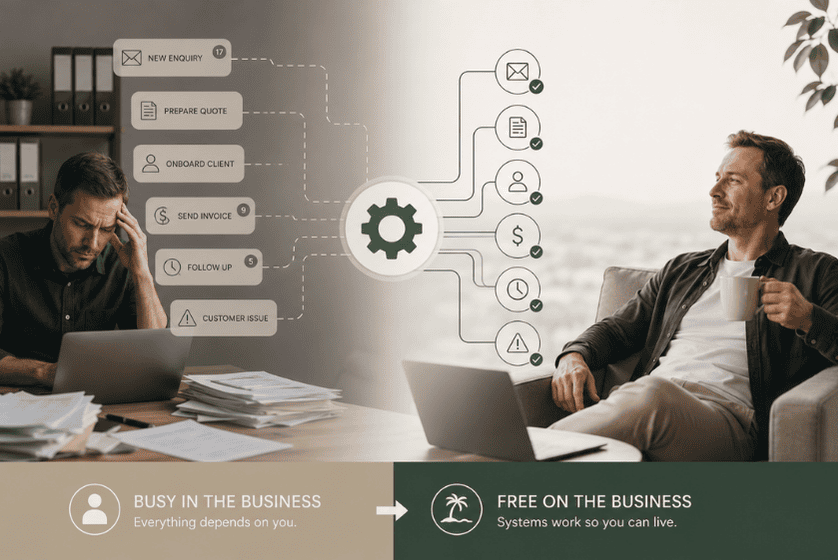
Systems Create Freedom

People often hear the word “systems” and imagine thick manuals gathering dust on a shelf.

That’s not what I mean.

A system is simply the best way of doing something.

  • How do you answer enquiries?
  • How do you prepare quotes?
  • How do you onboard new clients?
  • How do you invoice?
  • How do you follow up overdue accounts?
  • How do you manage customer complaints?

Every time you repeat something, you have an opportunity to build a system.

Every system removes another decision from your day.

Over time those small improvements compound.

Eventually your business begins solving problems without needing you in the middle of every conversation.

That’s where freedom begins.

The True Test of a Healthy Business

One of my favourite questions to ask business owners is this:

“What would happen if you disappeared for four weeks?”

Most laugh.

Then they answer honestly.

“It would fall apart.”

Imagine if the opposite were true. Imagine taking a holiday knowing your team understood their roles. Customers were looked after. Invoices still went out. Cashflow continued. Problems were solved. Business continued.

Not because you weren’t important. But because you’d built something bigger than yourself.

That’s the difference between owning a job and owning an asset.

Building a Business That Someone Would Actually Buy

Many owners tell me they’ll sell their business one day.

Then I ask another question.

“What exactly would someone be buying?”

Silence.

Because if the owner is doing everything…

The buyer isn’t purchasing a business.

They’re purchasing a job.

Businesses become valuable when they can operate consistently without relying on one individual.

That’s why scalability and saleability go hand in hand.

The less dependent your business is on you, the more valuable it becomes.

Not only to a future buyer.

But to you.

Because suddenly you have choices.

  • You can step back.
  • You can grow.
  • You can take a holiday.
  • You can spend more time with family.
  • You can focus on strategy instead of survival.

That’s what business ownership was supposed to feel like.

The EDGE Philosophy

Everything I teach comes back to one simple belief.

Businesses shouldn’t just survive. They should create freedom.

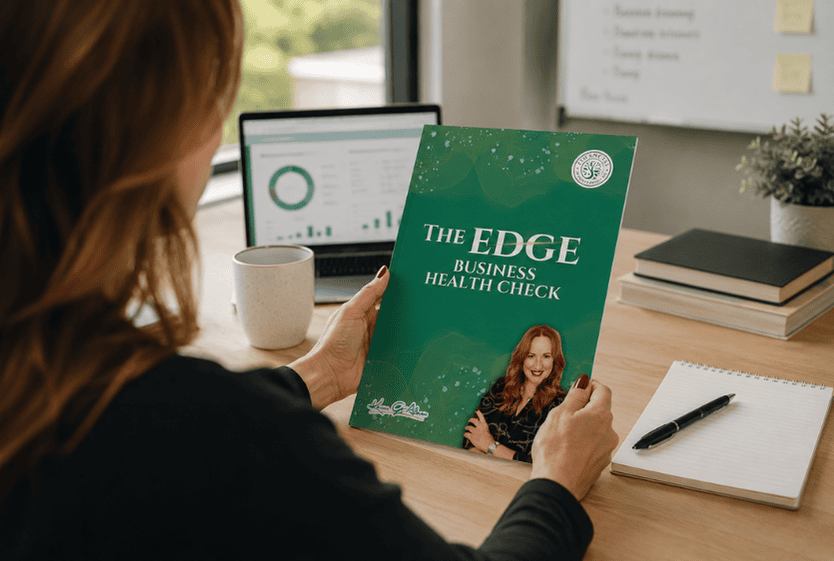
That’s why The EDGE Business Health Check exists.

It’s not simply measuring financial performance. It’s measuring the health of the business.

Healthy businesses don’t rely on luck. They don’t rely on heroic owners working eighty-hour weeks.

They rely on visibility.

Strong systems.

Clear leadership.

Healthy cash flow.

Profitable decisions.

And owners who understand that their role is no longer to be involved in everything.

Their role is to build a business that can thrive because of the foundations they’ve created.

Your Greatest Opportunity

If you’ve recognised yourself somewhere in this article, I hope you don’t feel discouraged.

I hope you feel encouraged.

Because the fact that you’ve become the bottleneck doesn’t mean you’ve failed. It means your business has reached a point where it needs a different version of you.

The next stage of growth isn’t about working harder. It’s about leading differently. It’s about trusting your team. Building systems. Understanding your numbers. Making decisions based on evidence, and gradually removing yourself from the centre of every process.

That’s not stepping away from your business.

That’s stepping into your true role as its leader.

One day, I hope you look back and realise that the greatest investment you ever made wasn’t another marketing campaign or another piece of equipment.

It was learning how to build a business that didn’t need you every minute of every day.

Because that’s when something remarkable happens.

You stop owning a job.

You start owning an asset.

And that’s the moment your business begins giving you what you wanted all along.

Freedom.

Ready to discover whether you’re the biggest bottleneck in your business?

The EDGE Business Health Check helps you identify the areas that are limiting growth – from leadership and systems to cashflow, profitability and visibility. In less than 20 minutes, you’ll receive your Business Health Score and discover practical opportunities to build a business that’s more profitable, more scalable, more sustainable. and ultimately, more saleable.

Because healthy businesses don’t just happen.

They are built – one better decision at a time.
Systems Create Freedom
The EDGE Business Health Check helps you identify the areas that are limiting growth - from leadership and systems to cashflow, profitability and visibility.

#HowToResetMyMoneyMindset #NewYearFinancialMindset #HowToStartFreshWithMoney  emergency fund australia, money management, family savings #SmallBusinessOwner #BusinessGrowth #CashflowManagement #BusinessSuccess
#EntrepreneurMindset

 

Tax Time Without the Panic – The Simple Systems That Keep More of Your Hard-Earned Money

Tax Time Without the Panic – The Simple Systems That Keep More of Your Hard-Earned Money

Tax Time Shouldn’t Feel Like a Horror Movie

If “BAS” makes your eye twitch or tax time feels like a jump scare, you’re not alone.

For many business owners, tax time looks like:

  • digging through email for receipts
  • trying to remember what that transaction was
  • realising GST money has been accidentally spent
  • asking your accountant, “Is this bad?” 😅
  • promising yourself (again) that you’ll get organised next year

Whether you’re a tradie, franchisee, coach, consultant, or self-employed professional, it’s easy for tax to become the thing you avoid… until you can’t.

But here’s the thing:
Tax panic isn’t a personality trait. It’s a system issue.

And the solution isn’t “try harder.”
It’s: build foundations that make tax time boring.

Boring is the goal.
Boring means organised.
Boring means you’re in control.

The Real Reason Tax Time Feels So Stressful

Most tax stress comes from one (or more) of these:

1) You’re spending money that isn’t actually yours

If GST/tax isn’t separated, the bank balance lies.

It looks like there’s cash available… but a chunk of that cash belongs to the ATO (or will soon). So when BAS hits, it feels like a crisis.

2) Your numbers aren’t clean

Mixed transactions, personal spending from business accounts, inconsistent invoicing, missing receipts – these all make reporting harder.

And when reporting is hard, you avoid it.

3) You don’t have a simple routine

If you only look at your money when something is due, you’ll always be reacting.

4) You’re not clear on what’s “normal”

Many owners don’t know what to expect from their obligations (GST, PAYG, super, income tax, etc.). That uncertainty turns into anxiety.

The fix is not complicated, but it does require a shift from reactive to proactive.

Owner Pay Is the Cornerstone of a Healthy Business

The “Tax Calm” Blueprint (Simple, Practical, Repeatable)

Let’s build tax calm from the ground up.

Step 1: Separate business and personal (because clarity = calm)

This is the first domino.

When business and personal are mixed:

  • profit looks different than it really is
  • expenses get miscategorised
  •  your accountant has to untangle it (costly + time-consuming)

  •  BAS reporting becomes messy

  • tax estimates become unreliable

When you separate them, your numbers get clearer fast. Even if you’re not ready to overhaul everything, start with this:

  • separate bank accounts (or at least strict allocation “buckets”)
  • a clear rule: business expenses only from business, personal only from personal
  • owner pay transferred as owner pay (not random withdrawals)

This one change reduces stress massively.

Step 2: Quarantine GST/tax weekly (so it never surprises you again)

If you do nothing else after reading this blog, do this one thing.

When GST and tax are quarantined weekly:

  • you stop “accidentally spending” future obligations
  • BAS becomes a planned payment
  • your cash flow becomes more reliable
  • you feel calm because you know the money is there

A simple habit: Each week (or each time income lands), transfer a percentage into a tax/GST bucket

The right percentage depends on your structure and circumstances (and this is where your accountant or qualified adviser can guide you). But the foundation is non-negotiable:

Set aside first. Spend second.

Step 3: Create a weekly money routine (30 minutes that changes everything)

You don’t need a full day of admin.

You need a repeatable routine.

Pick one day per week – your “money check-in.”

On that day, you:

  1. review what came in
  2. allocate GST/tax set-aside
  3. check bills due in the next 7 – 14 days
  4. confirm owner pay
  5. quickly check that transactions are being categorised correctly
  6. look at ONE key number (margin, break-even, or cash runway)

That’s it.

This is how tax time becomes boring, because you’ve been managing it in small pieces all year.

Step 4: Keep records simple (no one’s trying to win an admin award)

Receipts and records are one of the biggest stress points, so let’s make it easy.

Your goal is not “perfect bookkeeping.”
Your goal is “good enough that nothing becomes a disaster.”

Simple record habits that help:

  • snap receipts immediately (or forward them to a dedicated email)
  • keep a consistent filing approach (even if it’s just “by month”)
  • reconcile regularly (weekly or fortnightly)
  • don’t leave it until BAS is due

Future you will thank you.

Step 5: Understand the 3 reports that remove the fear

You don’t need to become an accountant, but you do need to feel confident in the basics.

These three reports reduce stress instantly:

  1. Profit & Loss (P&L): tells you if the business is making money
  2. Balance Sheet (basic understanding): tells you what the business owns/owes
  3. Cash Flow position: tells you what’s actually available and what’s coming

You’ll build confidence understanding key reports, including Xero if you use it (and the principles still apply if you use other systems).

Confidence with these reports is what stops tax time feeling like a mystery.

The Hidden Cost of Tax Panic (It’s Not Just the Bill)

Tax panic doesn’t only cost you money. It costs you:

  • time (scrambling, chasing receipts, fixing mistakes)
  • stress (constant background anxiety)
  •  decision fatigue (avoiding choices because you don’t trust your numbers)

  • opportunity (hesitating to invest, hire, grow, or take time off)


When your numbers are clean and your system is simple:

  • you price more confidently
  • you choose better clients 
  • you stop discounting out of fear
  • you plan ahead instead of catching up 
  • you keep more of what you earn (because you stop leaking money through chaos)

Common “Tax Time Traps” (and how to avoid them)

Here are the patterns I see all the time:

Trap #1: “I’ll sort it out when it’s quieter”

If you’re a tradie or franchisee, it might never get quieter.
If you’re a coach/consultant, the quiet seasons are often when you’re building the next offer.

Solution: a weekly rhythm. It’s small enough to do even when busy.

Trap #2: “My accountant will handle it”

Your accountant is essential, but they shouldn’t be your emergency clean-up crew.

Solution: you handle the foundation; they handle the strategy and compliance.

Trap #3: “I’m scared to look”

Avoidance creates bigger problems.

Solution: start with one number, one routine, one week at a time.

Trap #4: “I don’t use Xero so I can’t get organised”

Tools help, but tools aren’t the solution.

Solution: the system works regardless of platform. (Xero is just a tool; your habits are the strategy.

What “Tax Calm” Looks Like in Real Life

When you’ve built foundations, tax time becomes:

  • “Yep, that’s due – money’s already set aside.”
  • “My reports make sense.”
  • “My accountant has what they need.”
  • “I’m not guessing.”
  • “I’m not panicking.” 

And here’s the best part: When tax becomes calm, you stop running your business from stress. You start running it from strategy.


When tax becomes calm, you stop running your business from stress.
You start running it from strategy.

How The Edge Bootcamp Supports This (and why it’s perfect before EOFY planning)

The Edge Bootcamp is designed for business owners who want more profit, better systems, cleaner numbers, and less overwhelm.

You’ll walk away with:

  • a simple money system
  • clearer separation between business and personal finances
  • confidence understanding Xero and key reports
  • and a clear 90-day implementation plan so you know what to do first, next, and next

Tickets include:

  • the 2-day live bootcamp
  • digital resources
  • templates
  • 90-day action plan tools

And yes, recordings are provided after the event for ticket holders.

If you’re thinking, “I’m behind and embarrassed,” this is a practical and judgement-free event – designed to help you build confidence step-by-step.

You can attend:

So whether you’re based in Perth, Fremantle, East Fremantle, regional WA, interstate, or juggling a packed schedule, you can still get the foundations in place.

Want Tax Time to Be Boring (In the Best Way)?

If you’re ready to stop the stress spiral and build a simple system that makes tax time calm, cash flow predictable, and owner pay consistent…

✅ Join The Edge Bootcamp (2-day live event)
✅ Attend in person at East Fremantle Yacht Club or live online
✅ Get templates + digital resources + your 90-day action plan tools included
✅ Receive recordings after the event so you can rewatch while you implement

CTA: Book your spot for The Edge Bootcamp and walk away with the foundations to manage your business and finances with clarity, confidence, and a plan.

Note: This is general education only, not personalised financial, tax, accounting, legal, health, or investment advice. Please seek advice from qualified professionals for your specific circumstances.

Join The Membership at Financial Management 101

#HowToResetMyMoneyMindset #WhyDoIFeelOutOfControlWithMoney #HowToFeelInControlOfFinances #ResetMoneyMindset2025 #NewYearFinancialMindset #HowToStartFreshWithMoney  emergency fund australia, money management, family savings 


Budgeting Without the Boring: The Money Map Method That Actually Works

Budgeting Without the Boring: The Money Map Method That Actually Works

Let’s be honest for a second. The word “budget” has the same vibe as:

  • “We need to talk…”
  • “Your call is being transferred…”
  • “Please see the attached invoice…”

It makes people tense. Defensive. Slightly sweaty. 😅

And here’s the irony: most people don’t hate having a plan. They hate the way budgeting has been sold to them – like it’s punishment for daring to enjoy life.

So today, I’m giving you a different approach.

Not a strict budget.
Not a spreadsheet that needs a PhD to operate.
Not a system that makes you feel like you have to track every piece of gum you’ve ever purchased.

This is Money Mapping – the method I use with clients who want to feel in control, not controlled.

Because your money doesn’t need a prison.

It needs a plan. A plan that fits your actual life. Not the version of you who meal preps on Sundays and never impulse buys at Kmart.

(If that version of you exists, I’d like to meet her. She sounds organised and slightly intimidating.)

Why Traditional Budgets Fail (and why it’s not your fault)

Most budgets fail for three reasons:

1) They’re too restrictive

People try to cut everything at once: coffees, fun, birthdays, little treats, takeaway, holidays… and then wonder why they rebound like a rubber band.

If a budget feels like suffering, you won’t stick to it.
Your brain will treat it like a threat.
And humans don’t do “threat” long-term.

2) They’re too complicated

Forty-seven categories. Daily tracking. Constant adjustments.
You miss one thing and suddenly you feel like you’ve “failed.”

A budget that requires constant maintenance becomes another job.
And nobody needs a second job that doesn’t pay.

3) They’re built on guilt, not goals

Many budgets are basically: “Stop spending money on things that make you happy.”

No thanks.

Money mapping works because it’s:

  • simple
  • flexible
  • based on priorities
  • designed for consistency, not perfection

What is a Money Map?

A Money Map is a simple plan that tells your money where to go before life grabs it.

It answers these questions:

  1. What must be paid? (essentials + bills)
  2. What matters to you? (your priorities)
  3. What are we building? (savings, emergency fund, investing, debt reduction)
  4. How do we keep your life enjoyable while still making progress? (yes, fun stays)

A money map is not about tracking every dollar.
It’s about creating a flow.

And when your money flows with intention, financial stress drops fast

A Money Map is a simple plan that tells your money where to go before life grabs it.

The Big Mindset Shift: A Budget Isn’t Restriction – It’s Permission

I want you to reframe this:

A budget isn’t a list of things you can’t do.
It’s a permission slip that says:

✅ “Yes, you can spend money on what you love.”
✅ “Yes, you can have fun.”
✅ “Yes, you can enjoy your life.”
and also
✅ “Yes, you can build wealth and feel safe.”

That’s the goal: enjoying today while protecting tomorrow.

The Money Map Framework (Simple, Powerful, Real-Life Friendly)

Here’s the structure I recommend. It’s clean and easy:

Category 1: Essentials (Must Pays)

These are the costs of keeping your life running:

  • mortgage/rent
  • utilities
  • groceries
  • fuel/transport
  • insurance
  • minimum debt repayments
  • childcare/school essentials
  • basic medical

These are your “keep the lights on” expenses.

Category 2: Future You (Your Financial Muscle)

This is where you build safety and wealth:

  • emergency fund
  • sinking funds (car rego, Christmas, school costs, rates, holidays)
  • extra debt repayments
  • investing/super top-ups (where appropriate)

Future You deserves funding. Not “whatever’s left.”

Rainy Day Fund or Emergency Fund

Category 3: Fun & Freedom (Guilt-Free Spending)

This is the category that keeps you sane:

  • coffees
  • dinners out
  • entertainment
  • hobbies
  • shopping (within reason, Karen… within reason 😄)
  • little treats

The reason most budgets fail is because this category is either missing or unrealistically small.

We’re not doing that here.

Step-by-Step: How to Build Your Money Map in Under an Hour

Grab a pen, notes app, or whatever you use when you’re feeling productive for five minutes.

Step 1: Find your baseline numbers

Look at the last 4–8 weeks of spending (not because we love pain, but because data helps).

Write down:

  • total income (after tax)
  • total essentials
  • average weekly spending (groceries, fuel, eating out, shopping)
  • debt minimums
  • any annual bills that sneak up (rego, insurance, school, rates)

You’re not judging. You’re observing.

Step 2: Choose your “Money Map style”

There are two main styles:

  1. A) Weekly Flow Map (best for people paid weekly/fortnightly)
  • Allocate money each pay into Essentials / Future You / Fun
  1. B) Monthly Map (best for salaried monthly pay)
  • Set amounts for each category and automate them

If you’ve tried budgeting before and it didn’t stick, weekly is usually easier because it gives faster feedback.

Step 3: Set up separate accounts (this is where the magic happens)

I’m going to say this lovingly:

If all your money sits in one account, your brain will treat it like it’s all available.
That’s not a discipline problem. That’s a human brain problem.

A simple setup is:

  1. Bills account (Essentials)
  2. Spending account (groceries/fuel/fun)
  3. Future You account (emergency + sinking funds)

Automation is your best friend. Because you’re busy.
And your money system should run even when you’re tired.

Step 4: Decide your “non-negotiables”

These are your priorities — the things you want your money to reflect.

Examples:

  • “I want to stop feeling anxious about bills.”
  • “I want an emergency fund.”
  • “I want to pay off this debt.”
  • “I want to travel without putting it on a credit card.”
  • “I want to stop fighting with my partner about money.”

Your money map should support your real goals — not someone else’s idea of financial success.

Step 5: Allocate your numbers (start simple)

Here’s a starting point many people can relate to:

  • Essentials: 60–75%
  • Future You: 10–20% (even 5% is a start if money is tight)
  • Fun & Freedom: 10–20%

If your essentials are currently higher than 75% — you’re not alone. Cost of living has been doing the most.

This is where strategy matters: we might need to reduce leaks, renegotiate bills, or adjust the debt plan to create breathing room.

Step 6: Create one weekly “Money Date” (10 minutes)

Once a week:

  • check what’s coming out
  • check what’s coming in
  • make sure bills are covered
  • adjust your spending category if needed

No drama. No self-lectures. Just a quick check-in.

Think of it like brushing your teeth. You don’t do it once and call it done forever.

The “I Hate Tracking” Version: The 3-Number Method

If you’re someone who rebels against tracking (I see you), do this instead:

Pick three numbers each week:

  1. Your weekly spending limit (food + fuel + fun)
  2. Your weekly Future You transfer
  3. Your “buffer amount” you want to keep in your spending account

Then the rule is simple:
When spending hits the limit… you stop spending until next week.
No guilt. Just boundaries.

This is the system many of my clients love because it’s:

  • quick
  • clear
  • low-maintenance
  • effective

Money Map in Real Life: What This Looks Like (Example)

Let’s say your household brings in $2,500 a week after tax.

You might map it like this:

  • $1,700 Essentials (bills, groceries, fuel, minimum debt)
  • $400 Future You (emergency fund + sinking funds + extra debt)
  • $400 Fun & Freedom (eating out, treats, spending money)

Then you automate:

  • $1,700 goes straight into Bills account
  • $400 into Future You account
  • $400 stays in Spending account

Now you’re not trying to “budget” daily.
You’re simply spending from the right place.

And when your Spending account runs low, it gives you a clear signal:
“That’s it for this week.”

No spreadsheet required.

What If There’s Not Enough Money to Map?

This is the part where I get very real with you:

If you feel like there’s never enough, it doesn’t mean you’re failing.
It means your map needs to include leak-plugging and breathing space first.

Here’s what I do with clients when money is tight:

  1. tighten obvious leaks (subscriptions, lazy renewals, bank fees)
  2. build a tiny emergency buffer (even $500 can change your stress levels)
  3. stabilise bills and reduce panic spending
  4. create sinking funds for predictable expenses
  5. then build momentum

You don’t jump from stressed to thriving in one week.
But you can absolutely move from chaos to calm with the right steps.

The Most Important Part: Your Money Map Must Match Your Personality

Some people need structure.
Some need flexibility.
Some need boundaries.
Some need permission.

So here are a few personality-based tweaks:

If you’re an overspender:

  • reduce “available money” in your spending account
  • use separate “fun” cash or a dedicated card
  • increase automation

If you’re an underspender/anxious saver:

  • allocate guilt-free fun money and actually spend it
  • focus on safety targets (emergency fund)
  • build confidence with small consistent steps

If you’re a “set and forget” person:

  • automate everything
  • schedule the weekly money check-in
  • keep categories very simple

If you’re a couple/family:

  • do a shared Money Map + personal spending allowances
  • agree on the weekly “household number”
  • remove judgement from the conversation

Money mapping isn’t one-size-fits-all.
It’s “your life, your values, your plan.”

If You Want This to Stick, Join the Membership

Now, if you’re reading this thinking:

“Okay… this makes sense. But I need help setting it up properly.” or “I’ve tried before and I fall off the wagon.” or “I want a system that actually fits my life.”

That’s exactly what my Membership is for.

Because here’s the truth:

Most people don’t need more information. They need support, structure, and someone to keep them consistent.

Inside the Membership, we don’t just talk about budgeting. We:
✅ build your personal Money Map (based on your real numbers)
✅ set up accounts and automation so it runs without willpower
✅ create sinking funds so life stops surprising you
✅ learn how to manage spending without guilt
✅ build financial muscle with ongoing guidance and community

You’re not meant to do this alone.

If you’re ready to stop winging it and start feeling calm and in control, join the Membership.
Let’s build your Money Map together — and get your financial house in order the smart way.

budgeting without spreadsheets, simple budget method, cash flow planning, how to budget in Australia, reduce financial stress, personal finance tips, money management system, budgeting for beginners, weekly money check-in, sinking funds, financial management 101, Karen G Adams, financial coaching


Money Mindset Makeover: Rewiring Your Brain for Financial Success

Money Mindset Makeover: Rewiring Your Brain for Financial Success

Have you ever felt like no matter what you do, financial success always seems just out of reach? Maybe you’ve tried budgeting, saving, and cutting expenses, but something still holds you back from true financial freedom. What if the key to transforming your financial reality isn’t just in spreadsheets and numbers but in your mindset?

The Power of Money Mindset

Your thoughts and beliefs about money shape your financial reality more than you think. If you grew up hearing phrases like “money doesn’t grow on trees” or “rich people are greedy,” you may unconsciously hold limiting beliefs that prevent you from achieving financial success.

Your money mindset determines how you earn, spend, save, and invest. A scarcity mindset can keep you stuck in fear and lack, while an abundance mindset opens doors to financial opportunities. If you’re ready to shift from financial stress to success, let’s start rewiring your brain for wealth!

Step 1: Identify Your Money Beliefs

Before you can change your mindset, you must first uncover the deep-rooted beliefs you hold about money. Ask yourself:

  • What did I hear about money growing up?
  • Do I believe that making money is hard?
  • How do I feel when I spend money – guilt, fear, excitement?
  • Do I see money as a tool or an obstacle?

Write down your answers and notice any patterns. Awareness is the first step to transformation.

Build a Buffer Fund

Step 2: Reframe Your Money Story

Now that you’ve identified limiting beliefs, it’s time to replace them with empowering ones. If you’ve been telling yourself, “I’ll never get ahead financially,” flip the script to “I am capable of creating financial abundance.” Instead of “I’m bad with money,” tell yourself, “I am learning to master my finances.”

Affirmations like these rewire your subconscious mind to support your financial goals. Say them daily, write them down, and believe them.

Step 3: Visualise Your Financial Success

Elite athletes use visualisation to win competitions, and you can use the same technique to achieve financial success. Close your eyes and imagine:

  • Seeing a healthy bank balance
  • Living in your dream home
  • Traveling without financial worry
  • Feeling empowered and in control of your money

The more vividly you picture your financial success, the more your brain works to turn it into reality.

Step 4: Upgrade Your Financial Cycle

You are the average of the five people you spend the most time with. If those around you constantly complain about money, struggle financially, or discourage your financial growth, it might be time to upgrade your financial circle.

Surround yourself with people who inspire and uplift you financially. Join money-focused communities, listen to financial podcasts, and invest in programs that teach financial mastery.

Step 5: Take Action With Confidence

Mindset without action won’t lead to results. Set clear financial goals and take intentional steps toward them. Whether it’s increasing your income, paying off debt, or investing, make decisions with confidence, knowing you are in control of your financial destiny.

 FINAL THOUGHTS

Transforming your financial mindset is the most powerful step toward wealth and success. When you change your thoughts, you change your actions, and when you change your actions, you change your life.

If you’re ready to take your financial transformation to the next level and want a complete money transformation, the Master Your Money Program will guide you every step of the way.

Start today — your wealthy future is waiting!