What Numbers Should A Small Business Owner Track?

What Numbers Should A Small Business Owner Track?

You don’t need a full accounting degree to run a profitable business. But you do need to know which numbers reveal the real story. These are the few that matter most.

We get it, most business owners didn’t start their business because they love spreadsheets. You started it because you’re good at what you do, and somewhere along the way, “run the numbers” got added to the job description without anyone asking if you wanted it.

The good news is you don’t need dozens of reports or a finance degree. You need a small handful of numbers, checked regularly, that tell you the truth about how the business is really going.

By the end of this, you’ll know exactly which numbers to look at first, and why each one matters more than revenue alone.

1. Gross profit margin

This is what’s left from a sale once the direct cost of delivering it is covered; materials, trade labour, stock, whatever it takes to physically deliver your product or service.

It’s the clearest early warning system in your business. A shrinking gross margin means either your costs are rising faster than your prices, or your pricing was never quite right to begin with.

Check this: work it out for your top few products or services, not just the business as a whole. Averages hide the products quietly losing you money.

2. Net profit margin

This is what’s actually left after everything; overheads, wages, rent, subscriptions, the lot. It’s the number that tells you whether the business is genuinely profitable, not just busy.

Revenue can grow every year while net profit margin shrinks, and from the outside, everything still looks like success.

Check this: monthly, not just at tax time. A yearly glance means you find out about a problem eleven months too late to do much about it.
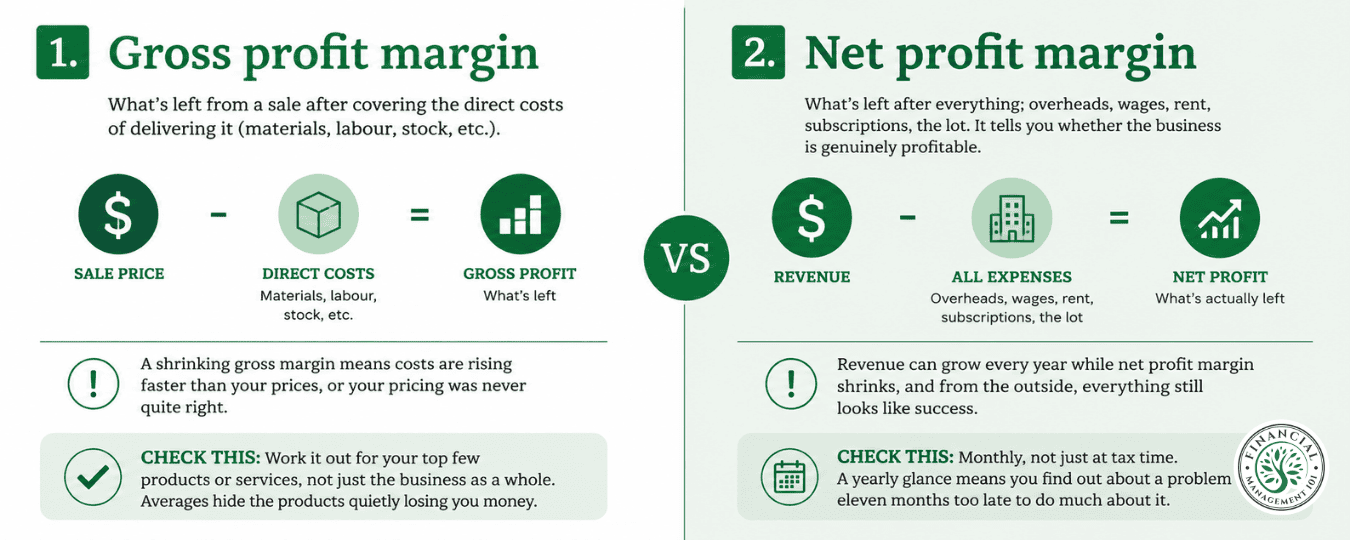
Gross Profit Margin vs Net Profit Margin

3. Cash position versus profit

Your bank balance and your profit are two different stories, even though they feel like they should match. A healthy bank balance can be sitting on unpaid tax, a big supplier bill due next week, or a loan repayment about to land.

We business owners tend to use the bank balance as our main scoreboard, simply because it’s the number we see most often. It’s useful – it’s just not the whole picture.

Check this: look at your profit and loss statement alongside your bank balance, not instead of it.

4. Overheads as a percentage of revenue

Overheads rarely blow out all at once. They creep in like; a new subscription here, a rent increase there, a “temporary” extra cost that becomes permanent.

Tracking overheads as a percentage of revenue, rather than a raw dollar figure, shows you whether your costs are growing in proportion to the business or quietly outpacing it.

Check this: list every recurring cost and total it as a percentage of that month’s revenue. Watch the trend over a few months, not just one snapshot.

5. Debtor days – how long it takes to get paid

This is the one most owners forget to track, and it’s often the one causing the most stress. Debtor days measure the average time between sending an invoice and the money landing in your account.

The longer that gap, the more your own cash is quietly funding someone else’s business while yours waits.

Check this: if your debtor days are creeping up, it’s usually a sign your payment terms, follow-up process, or invoicing timing need a look, not that you need more sales.

The Takeaway

You don’t need to track everything. You need to track the right few things, consistently. Gross profit margin, net profit margin, cash position, overheads as a percentage of revenue, and debtor days together, these five numbers tell you far more about the health of your business than revenue ever will on its own.

Clarity here isn’t about becoming an accountant. It’s about finally being able to see your business as clearly as you run it.

If you’d like these numbers tracked and visible for you automatically, that’s exactly what the CEO Dashboard is built for.

Watch the 2 minute video on how it works HERE

The CEO Dashboard™ gives small business owners a clear, visual snapshot of what’s really happening inside their business – so you can stop operating on gut feel alone and start making confident, data-driven decisions.

#HowToResetMyMoneyMindset #NewYearFinancialMindset #HowToStartFreshWithMoney  emergency fund australia, money management, family savings #SmallBusinessOwner #BusinessGrowth #CashflowManagement #BusinessSuccess #EAP #EmployeeAssistanceProgram
#EntrepreneurMindset

 

Why Is My Business Making Revenue, But No Profit?

Why Is My Business Making Revenue, But No Profit?

Revenue is the headline. Profit is the real story. If your sales are growing but the bank account never reflects it, here’s what the numbers are really telling you and what to do about it.

We hear this from business owners more than almost anything else. The invoices are going out. The sales are climbing. Clients are saying yes.

And yet, at the end of the month, there’s nothing left over. No breathing room. No reward for the hours going in.

If that’s you right now, we want you to hear this first: you’re not behind, and you’re not bad with money. You just haven’t had visibility on what’s actually happening between “money in” and “money left”. That’s a numbers problem, not a you problem and it’s fixable.

By the end of this, you’ll know the five most common reasons revenue and profit stop matching up, and exactly where to look first in your own business.

1. You’re pricing on gut feel, not margin

Most small business owners set their prices once, early on, based on what felt fair or what a competitor charged. Costs have moved since then supplies, wages, software, fuel, but the price hasn’t.

Every sale can look like a win on paper while quietly making you less than you think. Growing revenue with a shrinking margin doesn’t build a more profitable business. It just makes the problem bigger, faster.

Check this first: work out your gross profit margin on your top three products or services. If you don’t know that number off the top of your head, this is where to start.

2. Overheads have crept up quietly

Subscriptions renew. Rent increases. A “temporary” extra cost becomes permanent. None of these show up as one big decision, they show up as a hundred small ones, none of which felt worth questioning at the time.

Revenue can grow 20% while overheads grow 25%, and the business will still feel busier and further behind at the same time.

Check this first: list every recurring cost and ask, honestly, whether it’s still earning its place.

Your Overheads Didn’t Explode. They Quietly Crept Up.

3. You’re paying yourself last, or not consistently

Many owners take whatever’s left after everything else is paid, rather than a set wage. When there’s nothing left, that becomes the norm.

The trouble is, “whatever’s left” isn’t profit. It’s just what happened to survive the month. Without a wage built into your costs, you can’t actually see whether the business itself is profitable, because you’re the buffer absorbing the gap.

Check this first: build a wage for yourself into your cost base, even if you can’t take the full amount out yet. It changes what your numbers are really telling you.

4. Cash flow timing is hiding the truth

Cash in the bank and profit are not the same thing, even though they feel like they should be. A big invoice landing this week can make things look healthy, while a supplier payment or tax bill due next week tells a different story.

We business owners often read our bank balance as our scoreboard. It’s an important number, it’s just not the whole picture.

Check this first: look at your profit and loss statement, not just your bank balance, to see the real trend over the last three to six months.

5. You don’t have regular visibility on your numbers

This is the one underneath all the others. If you’re not reviewing your numbers on a consistent rhythm, small issues stay invisible until they’re big ones. Most owners find out something’s wrong months after it started, simply because nobody was looking.

Clarity doesn’t come from working harder. It comes from a regular, honest look at what the numbers are actually saying.

The Takeaway

Revenue growing while profit stalls is almost never one dramatic mistake. It’s usually five small, ordinary things happening at once; pricing, overheads, your own wage, cash timing, and visibility.

The good news is that each one is a decision you can revisit, not a personality flaw you have to fix. A better business creates a better life, and that starts with seeing clearly what’s really going on in yours.

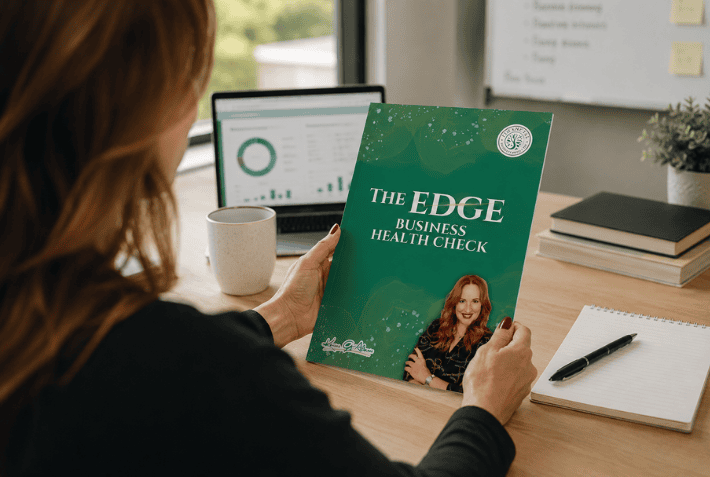
If you want a clear, honest read on where your own numbers stand, that’s exactly what the Business Health Check is for.

The Edge Business Health Check

#HowToResetMyMoneyMindset #NewYearFinancialMindset #HowToStartFreshWithMoney  emergency fund australia, money management, family savings #SmallBusinessOwner #BusinessGrowth #CashflowManagement #BusinessSuccess
#EntrepreneurMindset


Busy Doesn’t Pay the Bills

Busy Doesn’t Pay the Bills

You worked sixty hours last week. So why does the bank account look like you worked twenty?

This is the one nobody wants to say out loud at the barbecue – being busy and being profitable are two completely different things, and most small business owners have spent years chasing the wrong one without realising it, because busy is the one everyone can see and profit is the one hardly anyone talks about.

We wear “flat out” like a badge of honour around here. Full calendar, full inbox, full plate, barely time for lunch, home late again. It’s practically a competitive sport among business owners, whoever’s had the wildest week wins some invisible prize. But a full calendar doesn’t automatically mean a full bank account, and that gap is exactly where the frustration lives, working harder than you ever have and still not seeing it show up where it counts, still lying awake doing mental maths that never quite adds up the way it should.

Busy measures your time. Profit measures your value.

Busy measures your time. Profit measures your value.

You can be fully booked out doing work that barely covers what it costs you to deliver it. Being busy tells you the calendar’s full. It tells you nothing about whether the business is actually working for you, or just working you into the ground while quietly running on thin margins nobody’s checked in a while.

I’ve sat across from business owners who were, by any outside measure, wildly successful booked out months in advance, a great reputation, more work than they could handle. And they were barely paying themselves properly, because nobody had ever sat down and worked out what each job actually needed to cost to make the whole thing worthwhile. Busy had completely disguised the real story, right up until it couldn’t any more.

Why busy feels so convincing

Part of the problem is that being busy comes with all the physical evidence of hard work; the tired legs, the full diary, the late nights. It feels like proof that things are going well, because it’s the same feeling we’ve always associated with success. Profit, on the other hand, is quiet. It doesn’t announce itself the same way. You don’t feel a profitable decision the moment you make it, the way you feel a long day in your bones. So busy wins the argument for attention, even when it’s not actually the one that matters most.

The trap of “just get more clients”

There’s a piece of advice that gets handed around a lot in small business circles – “just get more clients, that’ll fix it.” I’ll be straight with you, it’s tired advice, and it’s rarely true. More clients on top of an unprofitable structure just means more busy, at the same thin margin, with a lot more stress bolted on top. You’ve simply built a bigger version of the same leaky bucket. Fix the structure first. Scale it after, not before, otherwise you’re just working harder to stand still, faster, and wondering why the extra effort never seems to catch up.

What actually moves the needle

It’s rarely one big dramatic change. More often it’s a handful of smaller, unglamorous ones done properly knowing what a job genuinely costs before you quote it, building in a bit of buffer instead of pricing to the bone, saying no occasionally, following up on the money you’re owed without embarrassment. None of these make for an exciting headline. All of them, done consistently, add up to a business that reflects the effort going into it.

A small shift that changes a lot

Before you say yes to the next job, the next client, the next “quick favour” that somehow always turns into three hours of your Saturday, check what it’s actually worth once the real costs are factored in. Time, materials, the admin it drags behind it, the toll it takes on the rest of your week. Sometimes the most profitable move you can make is saying no to something that is busy without adding a cent of real profit, and saying yes instead to fewer things, done properly, priced properly.

You’re not behind, and you’re certainly not lazy. You’ve just never had proper visibility on which parts of the business are working for you and which parts are quietly working against you while you’re too busy to look. Once that becomes clear, the decisions get so much easier genuinely, not in a “just think positive” way, but in a very practical, this-is-what-the-numbers-actually-show kind of way.

The uncomfortable question worth asking

Here’s one worth sitting with for a minute; if your business stayed exactly this busy for the next twelve months, with nothing else changing, would you actually be better off this time next year? Not busier. Better off. More profit in the bank, more breathing room, more choice in what you say yes to.

For a lot of business owners, the honest answer is “not really,” and that’s an uncomfortable thing to admit after all the hours that have gone in. But it’s also the most useful question you can ask, because it points you toward the actual fix, which is almost never “do more of the same, just harder.”

The Edge Business Health Check

Redefining what a good week looks like

We’ve been taught, somewhere along the way, that a good week in business is a full one. Every hour booked, every day accounted for, home late most nights because that’s what commitment apparently looks like. It’s worth challenging that definition, because a genuinely good week isn’t the one with the most hours in it – it’s the one that moved the business forward the most, profitably, without costing you your evenings and your patience along the way.

That might mean fewer hours worked, not more. It might mean turning down the client who’s more trouble than they’re worth, even though saying yes would have made the calendar look fuller. A full calendar looks impressive from the outside. A profitable, sustainable one is the one that actually serves you.

That visibility is exactly what The Edge Business Health Check gives you, in about fifteen minutes flat.

#HowToResetMyMoneyMindset #NewYearFinancialMindset #HowToStartFreshWithMoney  emergency fund australia, money management, family savings #SmallBusinessOwner #BusinessGrowth #CashflowManagement #BusinessSuccess
#EntrepreneurMindset


Father’s Day and the Business Owner Who Can’t Switch Off

Father’s Day and the Business Owner Who Can’t Switch Off

Happy Father’s Day to every business owner who “just needs to check one email” during the barbecue.

You know the scene. Phone face-down on the table, out of principle. Two minutes later, face-up again. “Just checking something quick.” Forty-five minutes later, still checking, while someone’s asking if you want another sausage and you’re not entirely sure you heard them the first time.

Here’s the bit nobody says out loud; if you genuinely can’t switch off for one Sunday, it’s not because you’re dedicated, it’s because something in the business is relying entirely on you being switched on, all the time. That’s not commitment. That’s a business that hasn’t had its systems built yet, quietly telling on itself every time your phone lights up at a family lunch.

I say this with love, because I’ve been that person too. There’s a particular kind of guilt that creeps in when you’re not checking, like something’s about to fall over the second you look away. Sometimes it will. That’s actually useful information, not a personality flaw. It tells you precisely where the weak point is, rather than leaving you to vaguely feel like you should “be better at switching off,” which is advice with nothing practical underneath it.

Happy Father's Day to every business owner who "just needs to check one email" during the barbecue.

It’s not a discipline problem

Most business owners think the fix is “just try harder to unplug.” Buy a nicer phone case, set a screen time limit, promise yourself Sunday is sacred. And then Sunday arrives and none of it holds, because the willpower was never the actual problem.

You can’t discipline your way out of a business with no systems, no visibility, and nobody else who knows where anything lives. If you’re the only one who knows the client’s login, the only one who knows how the invoicing actually works, the only one who can answer “did that order go out,” then of course you can’t switch off – you’re not being undisciplined, you’re being the entire operations department in one exhausted human body.

The phone-checking isn’t the actual problem. It’s just the symptom you can see. Fixing the symptom without fixing the cause is like taking the batteries out of a smoke alarm because the beeping is annoying.

What it costs, quietly

There’s a cost to this that doesn’t show up on the profit and loss but shows up everywhere else. It shows up in the conversation you half-listened to. The moment with the kids you were technically present for but not really in. The mate who stopped inviting you to things because you always seemed distracted, or cancelled at the last minute, or spent the whole time with one eye on your phone. None of that gets tracked anywhere. It just quietly accumulates until one day you notice the gap.

The real question to ask

The more useful question isn’t “how do I switch off more.” It’s “what would genuinely happen today if I didn’t check my phone at all?” If the honest answer is “everything would fall apart”, that tells you exactly where the gaps are. Not a criticism. A map.

Sit with that answer for a second. Is it really everything, or is it one or two specific things? Usually, when people actually write it down, the list is shorter than the panic suggested. There’s something almost funny about how big the fear feels compared to how short the actual list turns out to be once it’s on paper instead of in your head.

Building the buffer, one piece at a time

You don’t need to overhaul the whole business in a weekend to get some breathing room back. Start with the smallest, most repeated interruption, the thing that pulls you out of family time most often and ask what it would take to hand even part of that off. A simple checklist someone else can follow. A shared login instead of a personal one. An automated reminder instead of you personally remembering. None of these are big, dramatic fixes. They’re small, boring, unglamorous changes, and they’re exactly the ones that actually stick.

One small fix before the next family day

Before your next family day, try this. Write down the three things that would actually need you if they went sideways. Then ask yourself, honestly, whether one of those three could be handled by a simple checklist, a bit of automation, or someone else entirely, instead of by you personally, every single time. Fix one. That’s next Father’s Day a little more sorted than this one and the one after that, a little more sorted again. This isn’t a one-weekend fix. It’s a habit of slowly handing things off until your presence isn’t the only thing holding the whole operation together.

A better business creates a better life and a better life includes actually being at the barbecue, present for the conversation, not just physically there while mentally reconciling last month’s invoices.

The version of success worth aiming for

There’s a version of business success that gets celebrated a lot, the one measured in revenue, growth, how many staff you’ve got, how big the operation’s gotten. It’s a fine measure, as far as it goes. But it misses something important, which is whether the person who built all of that can actually enjoy a Sunday without their phone glued to their hand.

I’d argue the better measure of success is this – can you take a full day off, properly off, and come back to a business that’s still standing, without having spent the whole day half-present because part of you never left? That’s a much harder thing to build than revenue, and it’s a much better thing to have.

Building the systems that let you switch off isn't a luxury add-on. It's kind of the whole point of doing this in the first place.

Kids notice more than we think

There’s a particular moment a lot of business-owner parents have at some point; a kid saying something like “you’re always on your phone,” delivered completely matter-of-factly, no drama attached, which somehow makes it land harder than if they’d shouted it. Kids don’t measure your love by how hard you’re working for their future. They measure it by whether you were actually there when they wanted to tell you something, show you something, or just have you sitting next to them doing nothing in particular.

That’s not a guilt trip, plenty of us are working exactly because we want a better life for them. It’s just worth remembering that the “better life” bit doesn’t only mean money down the track. It means you, actually present, more often than not.

Building the systems that let you switch off isn’t a luxury add-on. It’s kind of the whole point of doing this in the first place.

If you want help working out exactly where your business is leaning on you too hard, The CEO Dashboard is built for precisely that, a clear look at what’s actually relying on you, and what could run perfectly well without you for a Sunday afternoon.

The CEO Dashboard

#HowToResetMyMoneyMindset #NewYearFinancialMindset #HowToStartFreshWithMoney  emergency fund australia, money management, family savings #SmallBusinessOwner #BusinessGrowth #CashflowManagement #BusinessSuccess
#EntrepreneurMindset


R U OK? (The Question You Never Ask Yourself)

R U OK? (The Question You Never Ask Yourself)

On September 10, most of Australia will be asking each other “R U OK?” Workplaces will run morning teas. There’ll be yellow everywhere. It’s a genuinely good day, and I’m glad it exists – it’s done a lot for getting these conversations out into the open where they belong, after years of them staying firmly behind closed doors.

But here’s the question I actually want to ask you, business owner to business owner… when’s the last time you asked yourself that?

We’re brilliant at checking in on everyone else. Staff, clients, family, that one supplier who always sounds a bit frazzled on the phone. But most business owners I talk to haven’t had an honest conversation with themselves in months. We’re too busy holding everything together to notice we might not be, ourselves. We’re the ones people come to when something’s gone wrong, which means we’ve quietly trained everyone around us, including ourselves to believe we don’t need checking on.

Running a business is one of the loneliest jobs going, if I’m honest. You’re the one everyone brings their problems to. There’s rarely anyone bringing you theirs, asking how you’re actually tracking underneath it all. Even the people who love you tend to ask “how’s the business going?” rather than “how are you going?” and those are very different questions with very different answers.

The performance of “fine”

There’s a particular skill business owners develop without meaning to, the ability to say “yeah, good, flat out” in a completely convincing tone while privately feeling anything but. It becomes automatic. Someone asks how you’re going at the school pickup, at the football, at a client meeting, and out it comes before you’ve even thought about it. Over time, that automatic answer starts to replace the honest one, even in your own head. You stop checking because you’ve gotten so good at performing that you don’t seem to need it.

So today, let’s flip it. Three questions, and actual permission to answer them properly, without the reflexive “yeah, good, flat out” that we all give without thinking.

Am I okay, or am I just coping?

There’s a real difference. Coping looks like getting through the week in one piece, ticking things off, keeping the wheels on. Okay looks like genuinely enjoying the thing you built, feeling proud of it, curious about where it’s going, energised rather than depleted by it. If you’ve been in coping mode for a while now, that’s worth noticing, not brushing off with “it’s just a busy season,” because busy seasons have a habit of becoming permanent if nobody names them.

There’s no shame in “coping” as an honest answer. It’s often the truest thing a business owner has said about themselves in months, once they finally stop and let themselves say it. The shame only comes from pretending otherwise for too long.

What am I carrying that I haven't said out loud?
For a lot of business owners, it's the money. The gap between what the business brings in and what it feels like it should be bringing in by now, given how hard you're working.

What am I carrying that I haven’t said out loud?

For a lot of business owners, it’s the money. The gap between what the business brings in and what it feels like it should be bringing in by now, given how hard you’re working. That gap is heavy to carry on your own, and you really don’t have to. I’ve had conversations with business owners who’ve been sitting on that particular worry for years, silently, because it felt embarrassing to say out loud, like admitting it meant admitting they’d failed at something. It’s not embarrassing. It’s incredibly common, and it’s fixable once it’s actually spoken about, usually far more fixable than the years of silent worry suggested.

Sometimes what people are carrying isn’t even the money itself, it’s the fear of what the money says about them. That’s a heavier load than the actual numbers ever are.

Who’s actually in my corner?

Not staff. Not clients. I mean the people who ask how you’re going, not just how the business is going. If that list is short, that’s your sign; a mentor, a community, or even just a standing coffee with someone who genuinely gets what this life is like. Business ownership can be surprisingly isolating even when you’re surrounded by people all day, because being surrounded by people isn’t the same as being known by them.

The physical signs worth noticing

Sometimes the “am I okay” question is easier to answer by looking at the body rather than the mind. Are you sleeping properly, or lying awake running through tomorrow’s problems? Are you short-tempered with people who don’t deserve it? Have you stopped doing the small things that used to recharge you – the walk, the round of golf, the Sunday paper, because there’s “no time”? These aren’t small details. They’re often the clearest signal available that the tank’s getting low, well before the mind is ready to admit it in so many words.

It’s okay to not have the answer yet

If you sat with those three questions and didn’t love your answers, that’s not a failure, that’s information. The whole point of asking is so you can actually do something with what you find, rather than carrying it around unexamined for another six months. Awareness on its own doesn’t fix anything, but it’s the step that has to come first, and it’s the step most business owners skip entirely because it’s uncomfortable.

You can’t run a healthy business from an empty tank. Checking in on yourself isn’t soft, whatever the old-school hustle crowd would have you believe, it’s strategy, plain and simple. A business owner who’s running on empty makes worse decisions, snaps more easily, and enjoys less of what they’ve built. None of that helps the business either – it’s not a trade-off between looking after yourself and looking after the business. They’re the same job.

And if part of what’s weighing on you is the money side of things, that’s exactly what The Edge exists for. A place where you’re not carrying it solo, surrounded by other business owners asking each other the real questions instead of the polite ones.

Join The Edge: https://financialmanagement101.com.au/work-with-karen/the-edge/

And if today’s the day you actually need to talk to someone, Lifeline is on 13 11 14, any hour, no appointment needed.

What to do once you’ve asked yourself

Asking the question is the easy part, once you’ve actually made yourself do it. The harder part is what comes next, because most business owners are excellent at identifying a problem and then filing it away under “deal with that eventually.” So if any of the three questions above landed a bit close to home, don’t let it end there.

Pick one small thing. Not a complete overhaul of your life, not a dramatic announcement to everyone that you’re “making changes.” One small thing; a call to a friend you’ve been meaning to make, an actual look at the money situation you’ve been avoiding, a boundary around one evening a week that’s just yours. Small, specific, doable this week, not “someday.”

Business owners checking in on business owners

Business owners checking in on business owners

There’s a particular kind of relief that comes from talking to someone else who genuinely understands what this life involves – the highs that nobody else quite gets excited about the way you do, and the lows that nobody else quite understands the weight of either. Friends and family love you, but unless they’ve run a business themselves, there’s a layer of it they simply can’t relate to, however much they try.

That’s part of why community matters so much here. Not a support group in the clinical sense, just other people in the same boat, who ask “how are you really going” and actually mean it, who’ve had the sleepless nights over cash flow and the quiet pride over a client win, and who get it without you having to explain the whole backstory first.

THE EDGE Membership

#HowToResetMyMoneyMindset #NewYearFinancialMindset #HowToStartFreshWithMoney  emergency fund australia, money management, family savings #SmallBusinessOwner #BusinessGrowth #CashflowManagement #BusinessSuccess
#EntrepreneurMindset