To deal with the top five money worries, you need to learn about money, plan ahead, and use practical solutions.
Here are five ways to help yourself or someone you know who is under a lot of financial stress:
1. DEBT MANAGEMENT
◼️ Debt Consolidation: Look into your options for turning high-interest debts into loans or credit cards with lower rates.
◼️ Budgeting: If you know how to budget well, you can put money toward paying off debt in a planned way. If you do not know how to budget well, you can get help from experts who can teach you how to do it.
◼️ Financial Counseling: Talk to a financial counselor or advisor who can help you come up with a plan to deal with your debts.
2. EMERGENCY FUND BUILDING
◼️ Automated Savings: Set up automatic transfers to a separate savings account where you can build up an emergency fund.
◼️ Changes to your Budget: Look for places in your budget where you can cut back on spending you do not have in order to save money.
◼️ Side Income: Look into part-time jobs, freelancing, and the “gig economy” as ways to earn extra money to add to your emergency fund.
3. SAVING FOR FUTURE GOALS
◼️ Goal Setting: Set specific financial goals, like saving for retirement, buying a home, or paying for your child’s education.
◼️ Financial Literacy: Learning about the various investment vehicles available and the advantages of investing over the long term to build wealth.
◼️ Automated Savings: Consider setting up recurring payments to your retirement account or other investment fund to ensure regular savings.
4. JOB SECURITY AND INCOME STABILITY
◼️ Skills Development: Look for ways to improve your skills and keep learning to make yourself more employable.
◼️ Networking: Build and keep up a professional network, which can be helpful for getting job referrals and opportunities.
◼️ Backup Plan: Have a backup way to make additional income, like freelance work or a side business, as a way to supplement your current income, or, just in case you lose your job.
5. MANAGING LIVING EXPENSES
◼️ Expense Tracking: There are budgeting apps and tools that can assist with tracking your daily expenses and help identify areas where you may need to look at cutting costs.
◼️ Shop Around: Look around for the best deals on things you need, like groceries, insurance, and utilities.
◼️ Housing Options: Consider downsizing, renting a room, or getting a lower interest rate on your home loan, are all viable options for lowering monthly housing costs.
Remember that financial stress relief often requires time and persistence.
Seek professional financial advice as needed, and look for ongoing support and accountability to assist you in effectively implementing these strategies.
Also, learning about money can give you the power to make smart financial decisions and reduce money-related stress over time, that’s where the LEARNING HUB helps you gain more financial knowledge, while providing you with the support and help you need.
Money stress is a common problem for many people, and it can come from a variety of sources.
Here are five of the most common money worries that people face:
1. DEBT
Having a lot of debt, like from credit cards, student loans, mortgages, or personal loans, can put a lot of financial stress on you. Keeping up with monthly payments and interest on debt can be hard for many people and families.
2. EMERGENCY EXPENSES
Worrying about medical bills, car repairs, or home repairs that come up out of the blue can cause a lot of stress. Many people worry about how they would pay for these costs if they came up suddenly.
3. INSUFFICIENT SAVINGS
Not having enough savings for emergencies, retirement, or future goals can be a major source of stress. People may be concerned about their financial security and whether they will be able to meet their long-term financial goals.
4. JOB SECURITY
Concerns about job security and the fear of losing a job can cause financial stress. People may worry about how they will pay their bills if they lose their job or have their income go down.
5. LIVING EXPENSES
The rising cost of living, including housing, healthcare, education, and utilities, can put pressure on people’s finances. Meeting everyday expenses can be challenging, and this can lead to financial stress.
People often have to deal with more than one of these money worries at the same time.
Creating a budget, paying down debt, building an emergency fund, and getting financial advice when needed are common ways to deal with stress related to money.
It is important to deal with these worries ahead of time to improve your financial health and reduce stress.
At Financial Management 101 – we are committed to providing YOU with excellent financial education, training and support so that you can live the life you truly desire. Join our LEARNING HUB today!
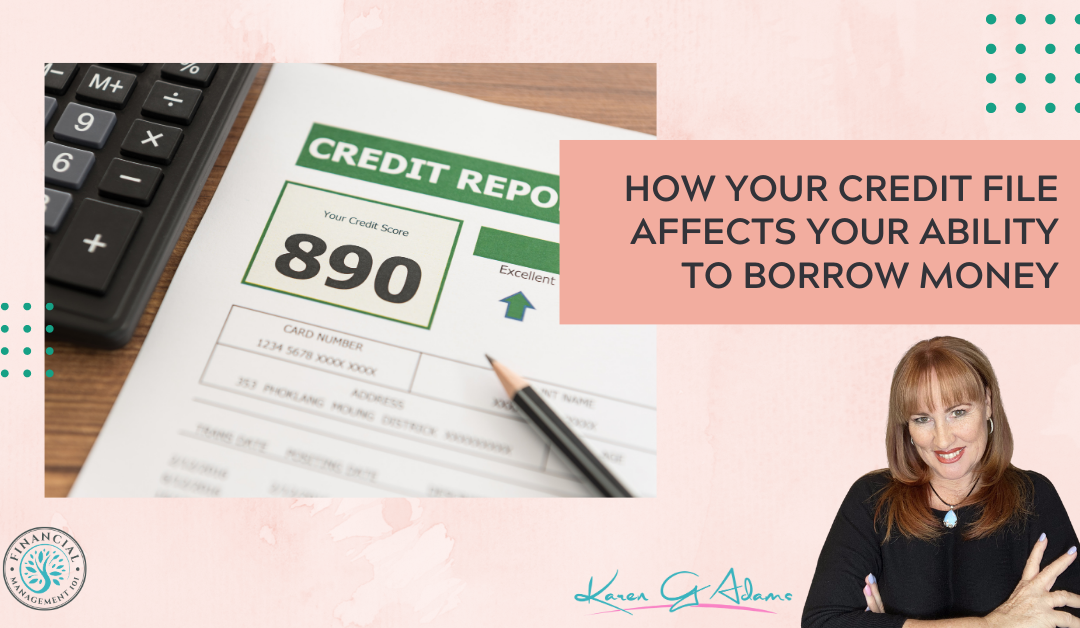
Your credit report is a big part of whether or not you can borrow money from lenders. It gives lenders an idea of how creditworthy you are and helps them figure out how much of a risk it is to lend you money.
Here are some of the most important ways that your credit report affects your ability to borrow money:
1. CREDIT SCORE
Your credit score is based on the information in your credit file. This number shows how good of a credit risk you are. It depends on things like how well you have paid your bills in the past, how much credit you use, how long you have had credit, what kinds of credit you have, and how many new credit accounts you have. If your credit score is higher, it means that you are less likely to have problems with your credit and this makes it easier for you to borrow money on good terms.
2. LOAN APPROVAL
Before deciding whether or not to give you a loan, lenders look at your credit report. They look at your credit history, which includes any missed or late payments, defaults, bankruptcies, or accounts in collections. Lenders are more likely to give you a loan if your credit file shows a history of responsible borrowing and on-time payments.
3. RATES OF INTEREST
Your credit history also affects the rates of interest that lenders may offer you on loans. Lenders look at your credit score to figure out how risky it is to give you money. Most of the time, if you have a good credit score, your interest rates will be lower because you are seen as a more reliable borrower. On the other hand, if you have a low credit score or a history of credit problems, lenders may charge you higher interest rates to make up for the risk they see in you.
4. TERMS
The terms of a loan depend on more than just the interest rate. It can also change how the loan is set up. If your credit report shows that you are a higher risk, the lender may ask for a co-signer, a bigger deposit, or a shorter amount of time to pay back the loan. On the other hand, if you have a good credit history, you might get better terms, like more time to pay back the loan or fewer requirements for security.
5. BORROWING LIMITS
Lenders may also look at your credit report when deciding how much you can borrow. If you have a good credit history and a high credit score, you may be able to borrow more money. But if your credit file shows that you are more of a risk, lenders may limit how much they will lend you or ask for more security.
It is important to keep an eye on your credit file, look over your credit reports from the three major credit bureaus, and fix any mistakes or problems you find. By making payments on time, keeping your credit usage low, and taking care of your debts, you can build and keep a good credit history. This will make it easier for you to borrow money on good terms.
At Financial Management 101 – we are committed to providing YOU with excellent financial education, training and support so that you can live the life you truly desire. Join our LEARNING HUB today!
Changing a money habit is NOT merely a matter of saying… yep, I’m not going to spend everything I earn this payday or I’m not going to overspend on my credit card this month from impulse buying.
Poor money habits I believe come from a deeper concern than just spending on meaningless stuff. Stuff that half of the time we don’t need or even use.
So where do these money habits come from?
Well before I answer this. I want to remind you what an actual habit is.
A habit is a behaviour that is learned when we regularly keep doing the same thing over and over again without even thinking.
Money habits are no different than the habit of brushing your teeth when you first get up in the morning or after breakfast. It’s a behaviour that becomes ingrained in how we treat and respect our money. One that we are fully aware of the consequences that follow if our habits are from poor money decisions.
Is there a cure for our poor money habits?
Yes, I believe there is. However, it takes time, discipline, awareness and mental strength in order for anyone to break this habit.
How long can it take to change a habit?
According to psychologists, while it may take approximately 21 days of conscious and consistent effort to create a new habit, it takes far longer to break an existing habit.
From personal experience in working with clients who want to change their poor money habits – it takes a lot longer.
You see there are deeper issues at play why some of us have poor money habits that can at times border on addiction. Just like any addiction, it’s more often than not about something that’s happened in the past.
A habit is not necessarily an addiction, though the two are strongly linked. A habit is any conscious behaviour you do on a routine basis.
Addiction is more about the behaviour to an excessive degree whereby someone feels unable to stop or control it.
Our self worth is often tied to our poor money habits. Our poor money habits can come from the messages we heard growing up and from the examples, we saw when we were younger.
Some of us spend when we feel low or unhappy to give us the kick “or high” we hope to make us feel good about ourselves. The hope that is supposed to fill the void we’re so looking to fill.
When in fact it’s much like the high you get from either an alcohol or drug addiction. Feels good at the time but hell when coming down from the high.
What’s the price of not changing our money habits?
There’s a high price to pay and that comes in the form of massive debt, poverty, unhappiness, envy & jealousy and often health issues.
So how do you move from poor money habits?
What are some of the ways to transform a poor money situation?
3 ways you can change a money habit is to:
1. First, acknowledge that you have a problem. A problem that you’re spending more than you earn, A problem that sees you with credit card debt, personal debt and other debt that you have no hope in paying off anytime soon. Being aware that you’re deep up to your elbows in debt and it’s time to get out, this is the first step.
2. Get help. Get the support you need to help you move forward. Having someone who understands and willing to help you means you’re not alone. It also gives you someone you can be accountable to. Someone who has a vested interest in seeing you succeed and live a better life without financial worry or stress.
3. And lastly, find your purpose – YOUR why. The reason you want a better life and one that doesn’t include massive debt or poor money habits. Set some goals. Write down how you want your life to be. What you want for your life and keep this at the forefront of your mind.
Writing down your dreams, goals and desires keeps you focussed and helps you work towards the bigger picture and what you want in life.
Breaking a habit takes a lot of willpower and motivation.
Ending the cycle of poor money habits is generally easier when it’s something you want to do rather than something others say you should do.
For anyone looking for coaching, support, education and help in moving towards their goals, then check out my “no lock-in contract” monthly coaching program.
The MONTHLY COACHING PROGRAM provides you with the support you require throughout your financial journey for a fraction of the price for $37 per month.
I’ve just opened up this program, as I’m getting a lot of questions asking if I have a monthly coaching program for a small cost.