
Why Is Cashflow Always Tight?

Why Is Cashflow Always Tight?

The biggest reason small business owners struggle with money has nothing to do with how much they’re earning.

Have you ever looked at your bank account on a Friday afternoon and thought…

“Where has all the money gone?”

It’s one of the most common questions I hear from business owners.

You’ve been flat out.

The phone hasn’t stopped ringing.

The invoices are going out.

Customers are saying yes.

Your accountant tells you revenue has increased.

Yet somehow, you’re still wondering whether there’s enough money to pay wages next week, cover your BAS, replace a piece of equipment or simply pay yourself.

If that sounds familiar, I want you to know something.

You’re not alone.

And more importantly…

You’re probably asking the wrong question.

Most business owners ask:

“Why don’t I have enough money?”

The better question is:

“Where is my cash flowing?”

That one small change in thinking can completely transform the way you run your business. Because cash flow isn’t just about money. It’s about movement. It’s about timing. It’s about decisions.

And ultimately, it’s about the health of your business.

Cash Flow Is the Lifeblood of Every Business

We’ve all heard the saying that cash flow is the lifeblood of a business.

But have you ever stopped to think about why?

Imagine the human body.

Your heart beats around 100,000 times every single day, pumping blood through your arteries and veins.

That blood carries oxygen and nutrients to every organ, every muscle and every cell.

Without healthy blood flow, your body begins to struggle. Your organs don’t receive what they need. Your muscles weaken. Your energy drops.

Eventually, if blood flow stops completely, life stops with it.

Cash Flow Is the Lifeblood of Every Business

Business works exactly the same way:

  • Money is constantly moving.
  • Customers pay invoices.
  • Suppliers need paying.
  • Employees expect wages.
  • The ATO wants its share.
  • Software subscriptions are deducted.
  • Insurance renewals arrive.
  • Equipment breaks down.
  • Vehicles need servicing.
  • Marketing costs money.
  • Rent leaves your account every month whether you’ve had a good month or not.

Your business survives because money is continually flowing through it.

That’s why I prefer to think of cashflow as the circulation system of a business.

Profit is incredibly important.

But profit alone doesn’t keep a business alive.

Cash does.

I’ve seen businesses making healthy profits on paper that still couldn’t pay their bills.

I’ve also seen businesses with modest profits thrive because they managed their cashflow brilliantly.

The difference wasn’t how much they earned. It was how well they managed the movement of money.

The Bucket That Never Fills

One of the easiest ways to understand cashflow is to imagine trying to fill a bucket with water.

Revenue is the hose filling the bucket.

Expenses are the holes in the bottom.

Most business owners focus almost entirely on getting a bigger hose.

They chase more customers.

More advertising.

More sales.

More jobs.

More turnover.

Very few stop to ask:

“How many holes are already in my bucket?”

You can double the size of the hose.

But if the holes are getting bigger too, the bucket never fills.

That’s why so many businesses become busier without becoming wealthier.

The extra revenue simply leaks back out through rising wages, higher overheads, poor pricing, discounts, inefficient systems, rework, overdue invoices and unnecessary expenses.

The answer isn’t always earning more.

Sometimes it’s plugging the leaks.

Your Bank Balance Is Lying to You

This might surprise you.

Your bank account is one of the worst places to judge the health of your business.

I know that’s how many owners make decisions.

“We’ve got money in the bank.” “We’ll be okay.”

But the bank account only tells you one thing. How much money happens to be sitting there today.

It doesn’t tell you:

  • How much GST belongs to the ATO.
  • How much PAYG you’ve collected.
  • Whether your BAS is due next month.
  • How many supplier invoices are waiting to be paid.
  • Whether a major insurance renewal is coming.
  • Whether a customer still hasn’t paid a $20,000 invoice or
  • Whether next month’s payroll has already been committed.

In other words…

Your bank balance is a snapshot.

Cashflow is the movie.

One moment in time can never tell the whole story.

Healthy business owners learn to look ahead instead of only looking at today.

The Feast and Famine Cycle

If you’ve been in business for any length of time, you’ve probably experienced it.

  • One month feels incredible.
  • Money is flowing in.
  • You’re relaxed.
  • Confident.
  • Optimistic.

Then suddenly…

Everything slows down.

  • Invoices aren’t being paid.
  • Quoting becomes quiet.
  • Expenses keep arriving.
  • Stress starts creeping back in.

Welcome to the feast and famine cycle.

The problem isn’t always inconsistent income.

It’s inconsistent planning.

Healthy businesses understand what’s coming before it arrives.

They forecast. They build buffers. They prepare for quieter months. They know seasonal trends. They don’t wait until the bank account is screaming for help. They act before the pressure arrives.

That’s one of the biggest mindset shifts I teach business owners.

Stop reacting.

Start anticipating.

Because anticipation creates confidence.

The Real Job of a CEO

Many business owners believe their primary job is generating revenue.

I disagree.

Your first responsibility as a CEO is protecting cashflow.

Because cashflow gives you options:

  • It allows you to hire.
  • To invest.
  • To upgrade equipment.
  • To market confidently.
  • To survive economic uncertainty.
  • To pay yourself consistently.
  • To sleep at night.

Your first responsibility as a CEO is protecting cashflow.

Every decision you make either strengthens or weakens the circulation system of your business.

And when you begin seeing cashflow this way, something remarkable happens.

You stop chasing money.

You start managing it with intention.

That’s when business becomes less stressful, more predictable and infinitely more enjoyable.

Because healthy cashflow isn’t luck.

It’s a habit.

And like every healthy habit, it begins with awareness.

Want more awareness in your business then take a 20 minute “The EDGE Business Health Check” and see what’s happening with your cashflow.
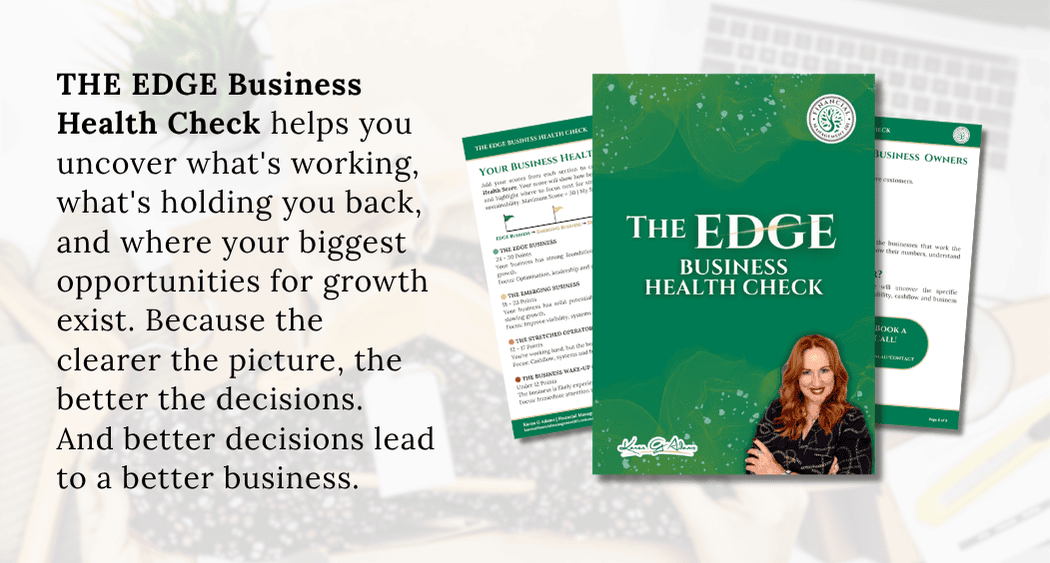
Want more awareness in your business then take a 20 minute “The EDGE Business Health Check” and see what’s happening with your cashflow.

#HowToResetMyMoneyMindset #NewYearFinancialMindset #HowToStartFreshWithMoney  emergency fund australia, money management, family savings #SmallBusinessOwner #BusinessGrowth #CashflowManagement #BusinessSuccess
#EntrepreneurMindset

 

Why Small Business Owners Are Working Harder Than Ever — But Making Less Profit

Why Small Business Owners Are Working Harder Than Ever — But Making Less Profit

The Shift Every Business Owner Must Understand to Survive and Thrive in Today’s Economy

There was a time when hard work almost guaranteed success in business.

If you stayed committed, put in the hours, sacrificed weekends, pushed through exhaustion, and gave your business everything you had, eventually the rewards would come.

At least that’s what many small business owners were taught to believe.

But today?

Things feel very different.

Across Australia, many small business owners are working harder than ever before, yet they’re feeling more stressed, overwhelmed, and financially stretched than they did years ago.

They’re putting in longer hours.

Taking fewer breaks.

Carrying more responsibility.

Worrying more about cashflow.

And despite all the effort… many still feel like they’re not truly getting ahead.

If that sounds familiar, you’re not alone.

Right now, thousands of business owners are quietly asking themselves the same question:

“Why does it feel like I’m working harder than ever… but making less profit?”

The answer is confronting but important.

The old way of doing business no longer works in today’s economy.

And the businesses that will thrive over the next decade will not necessarily be the businesses working the hardest.

They’ll be the businesses operating the smartest.

That’s a massive shift.

Because many business owners were conditioned to believe that success comes purely from hustle.

Work harder.
Push harder.
Do more.
Sacrifice more.

But in today’s world, hard work without systems, visibility, strategy, and leadership often leads straight to burnout.

And burnout is becoming one of the biggest silent killers of small business success.

The Hidden Trap Many Business Owners Fall Into

One of the biggest issues I see with small business owners is that they unknowingly create businesses that rely entirely on them to survive.

They become:

  • the salesperson
  • the marketer
  • the customer service team
  • the accounts department
  • the operations manager
  • the problem solver
  • the social media manager
  • the decision maker

Every problem flows through them.

Every question lands on their desk.

Every fire becomes theirs to put out.

At first, this level of involvement feels normal.

In the early stages of business, most owners wear multiple hats because they have to.

But the problem is many businesses never evolve beyond this stage.

Instead of building scalable businesses, owners end up creating stressful jobs for themselves.

And over time, the pressure becomes exhausting.

The scary part?

Many business owners start believing this level of stress is simply “part of business.”

But it shouldn’t be.

Because while hustle may build a business initially, hustle alone rarely sustains long-term success.

Across Australia, many small business owners are working harder than ever before, yet they’re feeling more stressed, overwhelmed, and financially stretched than they did years ago.

Exhaustion Is Not a Business Strategy

Somewhere along the way, burnout became glorified in business culture.

Working 12-hour days became something to brag about.

Skipping holidays became normal.

Being “busy” became a badge of honour.

But exhausted people do not make powerful business decisions.

When business owners are constantly stressed and overwhelmed, they often begin operating emotionally instead of strategically.

They react instead of lead.

They focus on urgent problems instead of important ones.

They become trapped inside the daily chaos of the business instead of building a business designed for growth.

And eventually, the cracks begin to show.

Relationships suffer.
Health suffers.
Energy drops.
Decision-making weakens.
Creativity disappears.
And often… profitability suffers too.

Because here’s the truth many people don’t want to admit:

You cannot scale chaos.

Revenue Does Not Equal Profit

One of the biggest misconceptions in business is believing that high turnover automatically means success.

It doesn’t.

There are businesses turning over hundreds of thousands, even millions, of dollars that are still struggling financially behind the scenes.

Why?

Because revenue and profit are two very different things.

Turnover is not profit.

Profit is not cashflow.

And cashflow is not personal wealth.

This is where many business owners get caught.

From the outside, the business may appear successful.

The branding looks great.
Customers are coming through the door.
Sales are happening.

But internally, the owner is stressed, overwhelmed, and wondering where all the money keeps disappearing to.

And honestly?

This creates enormous emotional pressure for business owners.

Because when the numbers don’t make sense, uncertainty grows.

And uncertainty creates stress.

Why Financial Visibility Changes Everything

One of the most powerful things a business owner can have is visibility.

Not complicated spreadsheets.

Not confusing accounting jargon.

Real visibility.

Understanding:

  • where your money is going
  • what’s actually profitable
  • what products or services are underperforming
  • where cashflow leaks are happening
  • what your numbers are really telling you

Because numbers tell stories.

They reveal habits.
Patterns.
Blind spots.
Strengths.
Weaknesses.
Opportunities.

And when business owners truly understand their numbers, something powerful happens.

Confidence returns.

Decision-making improves.

Stress reduces.

Growth becomes more strategic instead of reactive.

But many owners avoid looking deeply at their numbers because they feel confronting.

So instead, they rely on gut instinct.

They check the bank account balance instead of understanding the bigger financial picture.

And while instinct matters in business, instinct without data can become dangerous.

The businesses thriving right now are the ones combining intuition with visibility.

Because when you can clearly see what’s happening in your business, you stop operating from fear.

You start operating from clarity.

The Business World Has Changed

Another reason hard work alone is no longer enough is because business itself has changed dramatically.

Consumers have changed.

Technology has changed.

Marketing has changed.

Attention spans have changed.

And artificial intelligence is now reshaping industries faster than many business owners realise.

Yet many businesses are still operating using outdated systems and outdated models.

This creates a dangerous gap between effort and results.

Some owners are working incredibly hard… but inefficiently.

They’re manually doing tasks technology could streamline.

They’re overwhelmed by admin.

They’re spending hours creating content.

They’re reacting to problems all day instead of building systems that reduce problems.

And as a result, they stay trapped in operational overwhelm.

The future belongs to business owners who learn how to combine human leadership with smart systems and modern technology.

This doesn’t mean removing the personal side of business.

In fact, human connection matters more than ever.

But it does mean removing unnecessary friction.

It means creating efficiency.

It means building businesses that don’t completely rely on the owner being “on” 24/7.

The Shift From Operator to CEO

This is one of the most important transformations a business owner can make.

The shift from operator to CEO.

Operators stay trapped in the daily chaos.

CEOs create systems.

Operators react emotionally.

CEOs make strategic decisions.

Operators focus purely on revenue.

CEOs focus on profitability and sustainability.

Operators stay busy.

CEOs stay intentional.

This shift changes everything.

Because the goal of business ownership should not be constant exhaustion.

The goal should be building a business that creates freedom, opportunity, and long-term sustainability.

But that requires leadership.

It requires visibility.

And it requires the willingness to evolve.

The Businesses That Will Thrive in the Future

The businesses that will thrive over the next decade are not necessarily the biggest businesses.

They are the businesses willing to adapt.

The businesses are willing to modernise.

The businesses willing to embrace:

  • financial clarity
  • leadership
  • systems
  • automation
  • smarter decision-making
  • visibility
  • sustainable growth

The future small business owner needs more than technical skills.

They need:

  • emotional resilience
  • financial intelligence
  • strategic thinking
  • leadership capability
  • adaptability
  • communication skills
  • modern business systems

Because business growth is no longer just about effort.

It’s about alignment.

Alignment between:

  • strategy
  • systems
  • leadership
  • financial visibility
  • personal wellbeing
  • and sustainable growth

Success is building a business that supports your life.

Your Business Should Support Your Life – Not Consume It

This is the conversation more business owners need to start having.

Because too many owners are trapped inside businesses that are draining them emotionally, mentally, physically, and financially.

And that’s not success.

Success is building a business that supports your life.

A business that creates opportunity.

A business that allows you to grow financially without destroying your health or relationships in the process.

A business that gives you freedom instead of constant anxiety.

And perhaps the biggest shift of all is this:

The goal was never just to work harder.

The goal was always to build better.

To build smarter.

To build more intentionally.

To create stronger systems.

To understand your numbers properly.

To lead with clarity instead of chaos.

And to create a business that actually works for you – instead of one that constantly burns you out.

Because the businesses that thrive in this new era will not be the businesses grinding themselves into the ground.

They’ll be the businesses willing to evolve.

The businesses willing to simplify.

The businesses willing to lead differently.

And the business owners who understand that shift will create something far more powerful than just revenue.

They’ll create sustainability.

Freedom.

Profitability.

And a business and life – they genuinely enjoy.

Ready to Stop Surviving and Start Leading?

If you’re tired of feeling overwhelmed, financially stretched, or stuck working harder without seeing the results you deserve, maybe it’s time to stop asking:

“How can I work harder?”

And start asking:

“How can I build smarter?”

Because sometimes the biggest breakthrough in business doesn’t come from doing more.

It comes from finally doing things differently.

Take the FREE Business Performance Audit™ and uncover what’s really slowing your business down.

Membership - FM101

#HowToResetMyMoneyMindset #NewYearFinancialMindset #HowToStartFreshWithMoney  emergency fund australia, money management, family savings #SmallBusinessOwner #BusinessGrowth #CashflowManagement #BusinessSuccess
#EntrepreneurMindset

 

Your Team Might Look Fine – But Financial Stress Could Be Costing More Than You Think

Your Team Might Look Fine – But Financial Stress Could Be Costing More Than You Think

“They seem fine.”

It is one of the most common assumptions leaders make.
And to be fair, it is an easy one to make.

Most employees are not walking into work announcing that they are worried about bills, debt, interest rates, or the rising cost of everyday life.

They keep going.
They keep performing.
They keep pushing through.

But financial stress has a way of showing up quietly.

It can look like a distraction.
Low energy.
Mood changes.
Reduced confidence.
Increased absenteeism.
Burnout.
Or eventually, a resignation that seems to come out of nowhere.

The employee looked fine.
But they were not fine.

The silent pressure many employees are carrying

The current financial climate is affecting people in deeply personal ways.
Even capable, high-performing employees can be under enormous pressure.

When money stress builds, people can feel:

  • mentally overloaded
  • emotionally flat
  • ashamed to ask for help
  • trapped in a cycle of stress and avoidance
  • worried about keeping up with household costs
  • fearful about debt, repayments, or unexpected expenses

And because money is still a sensitive topic, many employees suffer in silence.

That silence can be expensive.

The current financial climate is affecting people in deeply personal ways.
Even capable, high-performing employees can be under enormous pressure.

Why this is bigger than employee perks

Free lunches, social events, and workplace rewards all have their place.
But they do not solve financial anxiety.

When someone is lying awake worrying about bills, a pizza party is not going to restore their peace of mind.

This is why financial wellbeing deserves more attention inside workplaces.
It addresses a real problem that affects people’s everyday lives and their capacity to function well at work.

It is practical. It is human. And right now, it is incredibly relevant.

What financial wellbeing support actually does

A strong financial wellbeing approach helps employees move from stress and confusion to clarity and confidence.

That might involve helping them:

  • understand where their money is going
  • create simple systems that reduce overwhelm
  • identify savings opportunities they have missed
  • tackle debt with a clearer plan
  • improve money habits and mindset
  • feel more hopeful and less stuck

Notice that this is not about judgement. It is about support.

Financial pressure can affect anyone. The goal is not to shame people for needing help. The goal is to give them tools that genuinely make life feel more manageable.

What employers gain when they take this seriously

When businesses support staff with financial wellbeing, the impact can ripple through the whole workplace.

You may see:

  • better focus and engagement
  • increased productivity
  • lower staff turnover
  • stronger trust and loyalty
  • reduced burnout risk
  • a more supportive workplace culture

People remember employers who support them through hard seasons.
Not just with words, but with meaningful action.

Reassurance is part of support

Let’s pause here for something important.

If you are an employee feeling the pressure right now, please hear this:

You are not weak.
You are not bad with money just because things feel hard.
You are not the only one feeling stretched.

This season may be challenging, but it does not define you.
With the right support, practical tools, and small consistent changes, things can improve.

And if you are an employer reading this, never underestimate how powerful it is to create a workplace where people feel safe to get support before they hit breaking point.

    Reassurance is part of support

    Support before crisis is the smarter move

    Too often, workplaces respond after the damage is done.
    After the burnout.
    After the resignation.
    After the drop in performance.
    After the personal crisis spills into professional life.

    But early support changes that.

    When businesses proactively offer financial wellbeing resources, they help staff build resilience before the pressure becomes overwhelming.
    That is better for the employee and better for the organisation.

    A more compassionate and practical workplace benefit

    There is a reason financial wellbeing is becoming such an important conversation.
    It sits at the intersection of performance, retention, mental wellbeing, and culture.

    It is not about fixing everything overnight.
    It is about giving people a starting point.
    A plan.
    A sense that they are not alone.
    A pathway back to confidence.

    And in uncertain times, that kind of support matters more than ever.

    My Financial Wellbeing Program helps workplaces support staff with practical money tools, confidence-building education, and real guidance that reduces stress and strengthens wellbeing.

    Because when your people feel better about money, they often feel better at work too.

    And that is good for everyone.

    Financial Wellbeing Program

    #HowToResetMyMoneyMindset #WhyDoIFeelOutOfControlWithMoney #HowToFeelInControlOfFinances #ResetMoneyMindset2025 #NewYearFinancialMindset #HowToStartFreshWithMoney  emergency fund australia, money management, family savings 


    Breaking the Chains: How to Escape the Cycle of Living Paycheck to Paycheck

    Breaking the Chains: How to Escape the Cycle of Living Paycheck to Paycheck

    Do you feel like your money disappears as soon as you get paid? Are you constantly counting the days until your next paycheck? If so, you’re not alone – millions of people find themselves trapped in the cycle of living paycheck to paycheck. But here’s the good news: escaping this cycle isn’t just possible, it’s within your control.

    Let’s break the chains and create a life where money works for you, not the other way around.

    Step 1: Shift from Survival Mode to Financial Strategy

    Most people stuck in the paycheck-to-paycheck cycle don’t have a spending problem, they have a strategy problem. Instead of reacting to financial emergencies, it’s time to start planning proactively.

    Ask yourself:

    • What would financial stability look like for me?
    • How much money do I need to feel secure between paychecks?
    • What’s stopping me from breaking free?

    By shifting your focus from surviving to strategising, you take back control of your finances.

    Shift from Survival Mode to Financial Strategy

    Step 2: Find Your Financial Leaks (and Plug Them!)

    Ever wonder where all your money goes? It’s time to find out. Track your spending for a month and identify the small, sneaky expenses draining your bank account. These could be:

    • Subscription services you forgot about
    • Daily coffee runs that add up to hundreds a month
    • Unused gym memberships
    • Frequent food delivery orders

    Plugging these leaks doesn’t mean cutting out all enjoyment – it means being intentional about where your money goes.

    Small, sneaky expenses might be draining your bank account

    Step 3: Pay Yourself First – Even If It’s Just $10

    The key to breaking the cycle is creating a buffer between you and financial stress. Start by setting aside a small amount from every paycheck – yes, even if it’s just $10. The act of saving builds momentum and rewires your brain for financial growth.

    Open a separate savings account and automate deposits. Over time, you’ll build a financial cushion that prevents you from relying on the next paycheck.

    Step 4: Increase Your Income Without Working More Hours

    If your expenses leave you with nothing to save, it’s time to boost your income. But before you assume that means working more hours, consider these options:

    • Ask for a raise – most employees don’t, and employers often have room to negotiate.
    • Sell unused items – your clutter could be someone else’s treasure.
    • Offer freelance or side gigs – platforms like Fiverr, Upwork, and Etsy offer ways to monetise your skills.
    • Rent out assets – if you have an extra room, parking space, or equipment, consider renting it out.

    Small income boosts can create big shifts in your financial freedom.

    Step 5: Use Your Credit Wisely (Not Recklessly)

    Credit can be a tool or a trap – it all depends on how you use it. Instead of relying on credit cards to cover gaps, use them strategically:

    • Pay off balances in full to avoid high-interest debt.
    • Use credit card rewards for cash back or travel perks.
    • Build your credit score to access lower rates on future loans.

    Mastering your credit is key to long-term wealth-building.

    Step 6: Create a 3-Month Escape Plan

    Breaking free isn’t about overnight miracles, it’s about consistent steps in the right direction. Create a 3-month plan with small, achievable goals:

    • Month 1: Cut financial leaks and save at least $50.
    • Month 2: Increase income by $200 through side gigs or negotiations.
    • Month 3: Use extra income to build a financial cushion and pay off high-interest debt.

    By the end of 90 days, you’ll have proof that escaping the paycheck-to-paycheck cycle is possible.

    FINAL THOUGHTS

    Financial freedom isn’t just for the lucky, it’s for those who take action. You have the power to rewrite your financial story and create a life where money works for you.

    If you’re ready for a deeper transformation and a complete guide to managing your money, my Master Your Money Program will provide the step-by-step tools to take control once and for all.

    You deserve financial peace – start your escape plan today!