
November feels good. The bank balance is healthy, the diary is full, and everyone’s talking about the break. Then the Christmas shutdown arrives, the invoices slow down, wages and super keep going out, and January feels very long. So how much cash should my business keep on hand to get through it calmly?
I’m not going to give you a magic number, because there isn’t one. Instead, I’ll show you how to work out your own cash buffer from your wages, super, fixed costs and your own pay, with an illustrative worked example timed for the shutdown.
THE SHORT ANSWER
How much cash should my business keep on hand?
Enough to cover your essential costs for the weeks when less money comes in. There’s no official figure for how much cash a business should hold. The right number is the one you build from your own costs: wages, super, fixed costs and your own pay, multiplied by the weeks you want covered, less the cash you’re confident will come in. GST and PAYG withholding sit on top of that, in their own account.
12%
super guarantee on qualifying earnings, paid each payday. (ATO)
7 days
business days for super to reach the fund after payday. (ATO)
28 Feb
due date for the October to December quarterly BAS. (ATO)
Why isn’t there a magic number?
Because every business has different costs, different payment terms and a different rhythm through the year. A rule of thumb like “three months of expenses” can’t know that your customers pay in 14 days, or that you close for two weeks over Christmas.
You may have seen that three-month figure on Moneysmart. It’s there as a good target for a household emergency fund (Moneysmart), not as a business rule. It’s still worth checking your own household has a cushion while you’re at it.
For the business, the ATO says the best way to make sure you have enough cash to meet your tax and other obligations is a cash flow budget or projection (ATO). Your buffer comes straight out of that.
What goes into your cash buffer?
Think of your buffer in layers. Each one is a cost that keeps going out whether the work is coming in or not.

1. Wages for the weeks you want covered
If your team takes paid annual leave over the shutdown, you’re still paying wages. And under the National Employment Standards, employees (except casuals) who would normally work on a public holiday are paid their base rate for the ordinary hours they’d have worked (Fair Work Ombudsman).
This year, Friday 25 December and Monday 28 December are public holidays in every state and territory, and Friday 1 January is New Year’s Day (Fair Work Ombudsman). My post on paying staff over the Christmas shutdown covers the notice and leave rules.
2. Super on every payday
Since 1 July 2026, super guarantee is paid for each payday. The rate is 12% of qualifying earnings (ATO), and it’s on time if it’s received by the fund within 7 business days after you pay your employee (ATO).
Annual leave and public holidays not worked both count as qualifying earnings (ATO), so super keeps going out over the break too. My post on Payday Super and your cash flow explains the change.
3. Your fixed costs
Rent, insurance, loan repayments, software, vehicles, phones and utilities. Business.gov.au suggests keeping on top of due dates for things like BAS, licence renewals, supplier invoices, rent and loan repayments (business.gov.au). Look for anything annual that lands in December or January, like an insurance renewal.
4. Your own pay
This one gets left out all the time. Business Queensland says your operating expenses should include the wages or drawings you pay yourself (Business Queensland). If your household needs your pay over Christmas, it belongs in the buffer.
5. The number of weeks to cover
This is your decision. Count the weeks you’re closed, then add the slow start while January’s invoices are being paid. If your customers usually pay in 14 days, the first fortnight back is often thin.
Watch out: GST and PAYG withholding aren’t part of your buffer. The ATO suggests setting them aside from your cash flow, and says a separate bank account for your tax could help (ATO). The October to December quarterly BAS is due on 28 February (ATO), so that money needs to be there when you get back.
How do I work out my number?
Here’s the method I use with owners. Grab your last few months of bank transactions or your profit and loss report.
- List your essential weekly costs: wages, super, fixed costs and your own pay. For monthly bills, multiply by 12 and divide by 52.
- Add them up to get one weekly figure.
- Decide how many weeks to cover: the shutdown, plus the slow start.
- Multiply your weekly figure by the number of weeks.
- Subtract the cash you’re confident will come in over those weeks. Be conservative. The ATO suggests that being more conservative with your income estimate can give you flexibility if unexpected costs come up (ATO).
- What’s left is your buffer. Keep GST and PAYG separate, on top.
What does this look like in dollars?
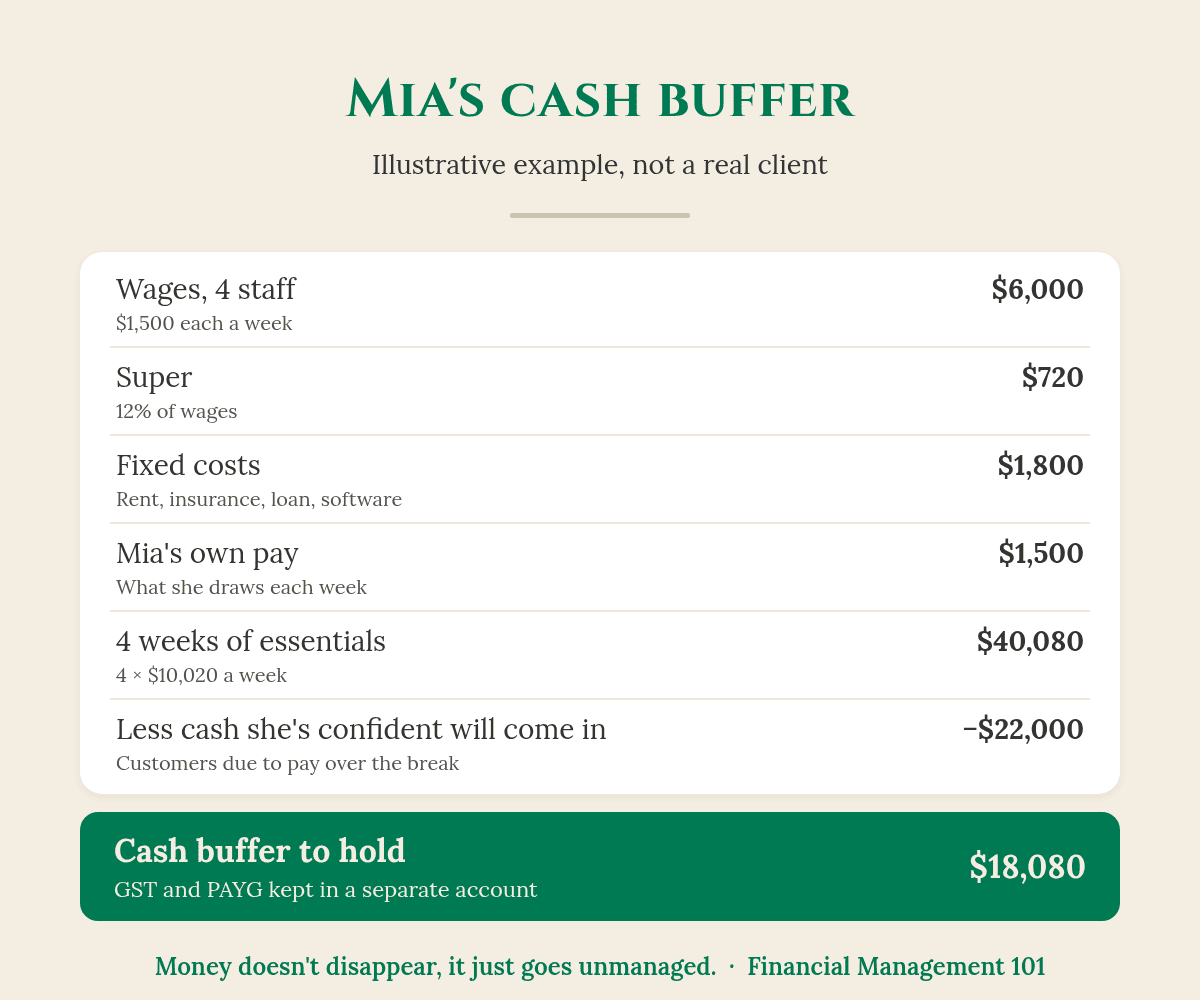
Here’s an illustrative example (made-up numbers to show the method, not a real client). Mia runs an electrical business with 4 employees. She closes from Thursday 24 December and reopens on Monday 11 January, and her team takes paid annual leave.
- Wages: 4 staff × $1,500 a week = $6,000.
- Super: 12% of $6,000 = $720.
- Fixed costs: rent, insurance, the van loan and software come to $1,800 a week.
- Mia’s own pay: $1,500 a week.
- Total essentials: $10,020 a week.
- Weeks to cover: 2 weeks closed, plus 2 slow weeks while January invoices are paid = 4 weeks. 4 × $10,020 = $40,080.
- Cash she’s confident will come in: $22,000 from customers due to pay over the break.
- Her buffer: $40,080 − $22,000 = $18,080.
Her GST and PAYG withholding sit in a separate tax account, so they’re not in that $18,080.
Why it works: Mia isn’t guessing. Every dollar in her buffer has a job, and she can see exactly which week it’s for.
So what does this actually look like?
With five weeks to go before the shutdown, Mia moves about $3,600 a week into a separate buffer account. She sends her final invoices before the break and follows up anything overdue. She asks for deposits on January jobs. She checks her insurance renewal date. And she adds the buffer to her 13-week cash flow forecast, so she can see the dip coming and the money that’s there to meet it.
Check this first: Look at last year’s December and January in your bank account. How low did the balance go, and in which week? That’s your starting point.
Where should I keep the buffer?
Somewhere separate from your everyday account, so it doesn’t quietly get spent. Business.gov.au suggests putting money aside in a separate bank account for ongoing costs like tax and employee super (business.gov.au). Many owners keep two: one for tax, one for the buffer. Your bank or accountant can help you choose the right type of account.
What if I don’t have a buffer yet?
You’re not alone in this, and it doesn’t have to be built in one go. Start with a small weekly transfer, even if it only covers the first week of the break. Then:
- Get paid before Christmas: invoice as soon as the job’s done and follow up overdue accounts early.
- Ask for deposits on work booked for January.
- Check your timing: a cash flow statement helps you predict shortages and plan ahead so you have money to cover payments (business.gov.au).
- Talk early: if you can’t pay the ATO on time, the ATO says to contact it or your registered tax professional before the due date to find out what support is available (ATO).
When should I use it?
Your buffer is for timing gaps: the weeks between the work and the payment, or a quiet patch you can see coming. It isn’t there to fund a business that’s losing money every month.
If you find yourself dipping into it every month, that’s a profit question, not a cash question. Tomorrow’s post shows you how to work out your break-even point, so you know what you need to sell just to cover your costs.
Where your accountant and bookkeeper fit in
Your bookkeeper keeps your records up to date, so the numbers you build your buffer from are right. Your accountant can check your tax set-asides and BAS timing, and how your leave and super obligations land over the break. My job is to help you use those numbers to run the business, so Christmas is planned, not a surprise in January.
There’s no magic number. There’s your number.
Your takeaway
- There’s no official figure for how much cash a business should keep. Build your own.
- Add up your essential weekly costs: wages, super, fixed costs and your own pay.
- Multiply by the weeks you want covered, then subtract the cash you’re confident will come in.
- Super is 12% of qualifying earnings, paid each payday, including on paid leave and public holidays.
- Keep GST and PAYG in a separate account. The October to December BAS is due on 28 February.
- If you’re dipping into the buffer every month, look at profit, not just cash.
Want to see where your cash is going?
Start with The EDGE Business Health Check. It’s a $47 workbook that takes about 20 minutes. You score 30 quick statements across five areas: Profit & Pricing, Cashflow, CEO Visibility, Systems & Freedom, and Growth. Then the Profit Leak Calculator shows where money may be slipping away, and the 7-Day Reset gives you clear next steps.

Rather talk it through first? Get in touch and book a call with me.
Frequently asked questions
How much cash should a small business keep on hand?
There’s no official figure. Work out your essential weekly costs (wages, super, fixed costs and your own pay), multiply by the number of weeks you want covered, and subtract the cash you’re confident will come in. That’s your buffer.
Is three months of expenses the right amount?
Moneysmart suggests three months of expenses as a good target for a household emergency fund. It isn’t a business rule. Your business number depends on your costs, your payment terms and your quiet periods.
Should my GST be part of my cash buffer?
No. GST and PAYG withholding are money you’re holding for the ATO. The ATO suggests setting them aside, and says a separate bank account for your tax could help.
Do I still pay super over the Christmas shutdown?
If your team is on paid annual leave or paid for public holidays, yes. The ATO lists both as qualifying earnings, and under Payday Super, super is due within 7 business days after each payday.
Where should I keep my cash buffer?
In a separate account from your everyday business account, so it isn’t spent by accident. Your bank or accountant can help you choose the right one.
What if I keep dipping into my buffer?
Then the gap is probably about profit, not timing. Check your gross profit margin and your break-even point, and talk it through with your accountant.
You’ve built something real. Give it the cushion it deserves.
Karen G. Adams
Small Business Performance Strategist, Financial Management 101
Too Big To Wing It. Too Small To Need A CFO.
This article is general education only. It isn’t tax or financial advice, and it doesn’t take your circumstances into account. Super, BAS and public holiday details are from ATO, Fair Work Ombudsman, business.gov.au, Business Queensland and Moneysmart pages, as at 10 November 2026. Mia’s business and its figures are illustrative, not a real client. Check your own situation with your registered tax professional or accountant.