If your super used to go out once a quarter, this year feels different. Payday Super started on 1 July 2026, and it changes when super leaves your bank account, not how much you pay. For a trades or service business with a few staff, that timing shift matters more than people expect, especially heading into Christmas.
This post covers what Payday Super is, what counts as qualifying earnings, what it means for your cash flow (with an illustrative example), what happens if super is late, and a simple set-up so payday never catches you short.
THE SHORT ANSWER
What is Payday Super?
Payday Super means you pay your employees’ super guarantee for each payday, instead of quarterly. From 1 July 2026, the contribution must be received by the employee’s super fund within 7 business days after payday. Super is still 12%, now calculated on qualifying earnings (ATO).
7
business days after payday for super to reach the fund. (ATO)
12%
of qualifying earnings. The rate hasn’t changed. (ATO)
20
business days for a new employee’s first contribution. (ATO)
What changed on 1 July 2026?
Here are the changes the ATO lists for employers, side by side with the old quarterly system.
1. The deadline moved from quarterly to every payday
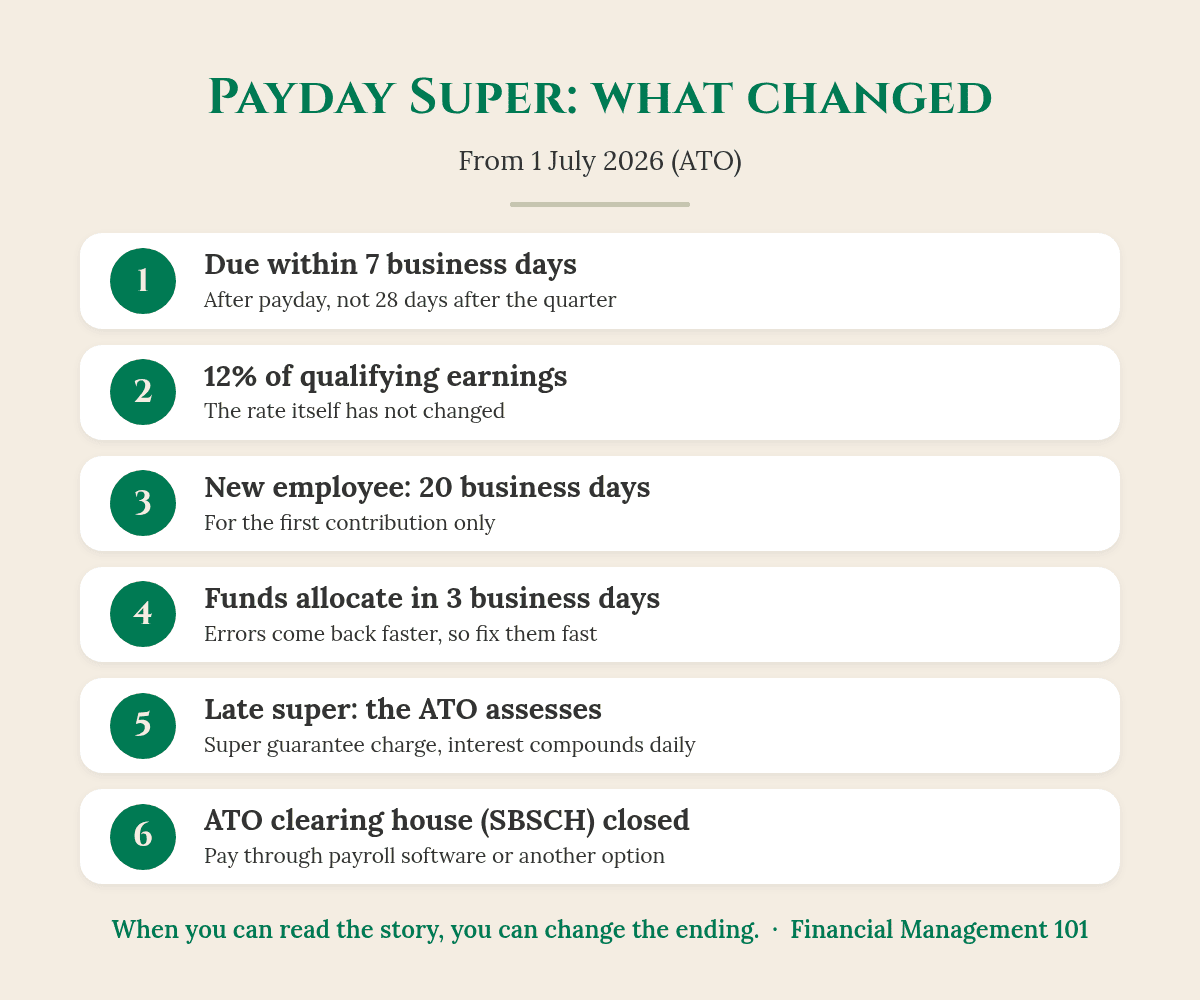
Before 1 July 2026, super had to reach the fund within 28 days of the end of the quarter, with due dates of 28 October, 28 January, 28 April and 28 July. From 1 July 2026, it must reach the fund within 7 business days after you pay your employees, with enough information for the fund to allocate it (ATO).
The ATO’s payment deadlines page adds the detail. A business day excludes weekends and any day that is a public holiday for a whole state or territory, even if you are not in that state. And if you use a clearing house, including one inside your payroll software, you need to allow processing time, which is why the ATO says it’s best practice to pay super on payday (ATO).
2. Super is 12% of qualifying earnings
The super guarantee rate is 12.00%, and the ATO lists it at 12% from 1 July 2025 onwards (ATO). What changed is the base: super is now calculated on qualifying earnings, a new term that brings together ordinary time earnings and some other payments (ATO).
3. New employees get a little longer
For the first contribution for a new employee, or to a new fund for an existing employee, the fund must receive it within 20 business days after payday (ATO). After that first one, the normal 7 business days applies.
4. Late super is assessed by the ATO
Under the old system you self-assessed the super guarantee charge. From 1 July 2026, the ATO assesses it, interest compounds daily at the general interest charge rate, an administrative uplift amount applies, and the charge is tax deductible. Penalties are 25% or 50% of the unpaid charge, depending on prior penalties (ATO).
5. The Small Business Superannuation Clearing House has closed
The ATO’s clearing house closed to new users on 1 October 2025, and it is no longer accessible from 1 July 2026 (ATO). If you were still relying on it, talk to your bookkeeper about paying through your payroll software or another option.
What counts as qualifying earnings?
For most employers, the ATO says the new term doesn’t change the amount of super you pay. Everything you included before is still included (ATO). Qualifying earnings include:
- Ordinary time earnings: pay for ordinary hours, including certain paid leave, some allowances, bonuses and lump sums.
- All commissions: including commissions for work done entirely outside ordinary hours. That one is new.
- Salary sacrificed to super: amounts that would have been qualifying earnings if they had been paid as wages.
- Payments to contractors paid mainly for their labour: they count as employees for super guarantee purposes.
Some things are not qualifying earnings, including overtime where ordinary hours are clearly set out in an award or agreement, expense reimbursements, and tool allowances expected to be spent in full (ATO). The ATO’s tables are detailed, so ask your bookkeeper to check your pay items are mapped correctly.
Good to know: the ATO’s tables list a Christmas bonus as qualifying earnings (ATO). If you pay one this year, super is due on it too.
What does Payday Super mean for my cash flow?
Here’s an illustrative example (made-up numbers to show the method, not a real client). Mia runs a plumbing business in Perth with four employees on fortnightly pay. Together, their qualifying earnings come to $12,000 each fortnight.
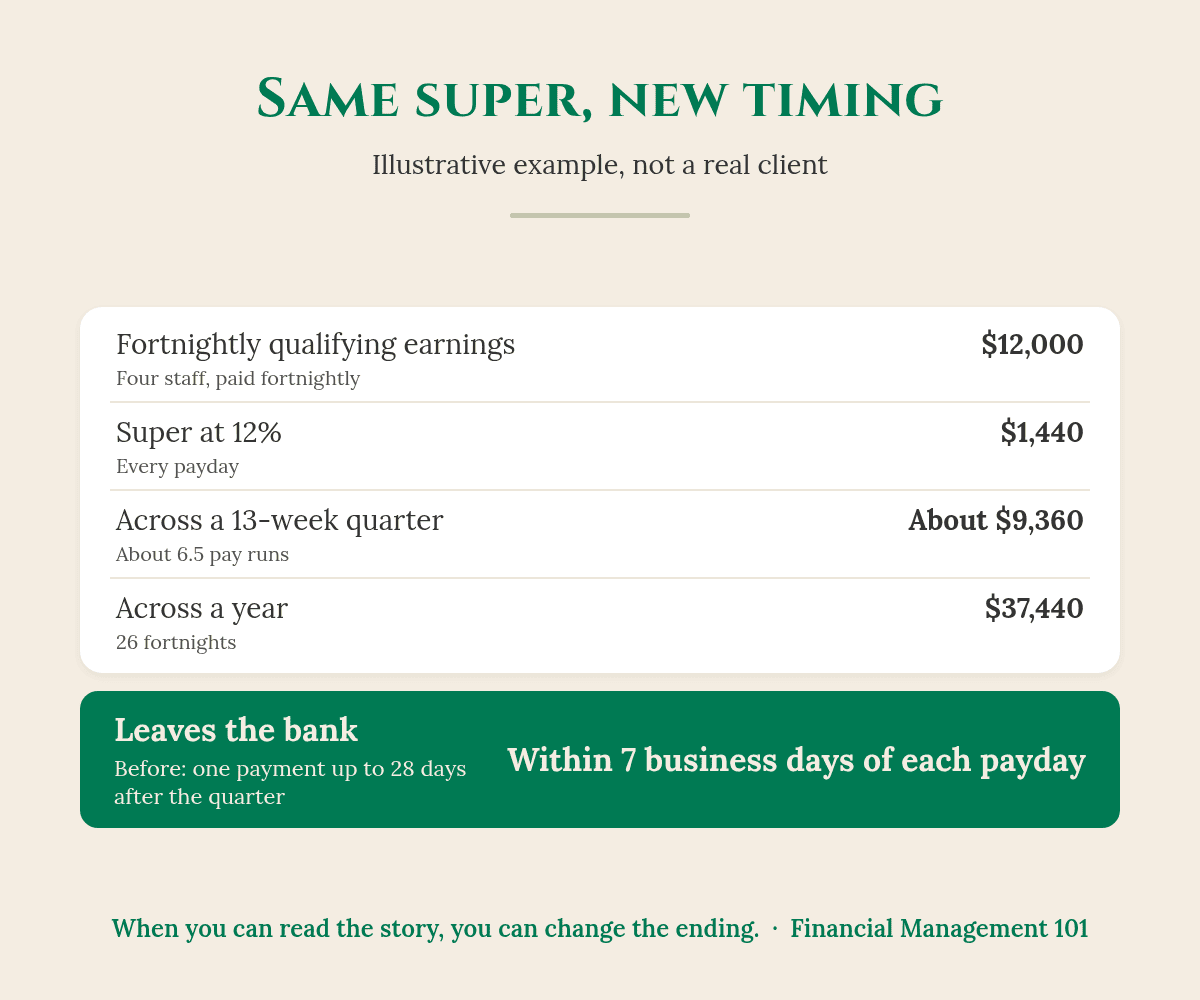
- Super each payday: $12,000 × 12% = $1,440.
- Across a 13-week quarter: about 6.5 pay runs × $1,440 = about $9,360.
- Across a year: 26 fortnights × $1,440 = $37,440.
The yearly total is the same as it was under quarterly super. What changed is the gap. Under the old system, super on Mia’s October to December wages wasn’t due until 28 January. Now, $1,440 has to reach the funds within 7 business days of every payday. That money used to sit in the account for weeks. It doesn’t any more.
Why it works: Treat super like part of the wage, because now it behaves like one. If you budget each pay run as wages plus 12%, there’s no quarterly surprise to save up for.
Watch out: This is the first Christmas under Payday Super. In the past, super on December pay didn’t leave until late January, after the quiet weeks. This year it leaves before the shutdown, alongside wages, leave and the GST building up for your December quarter BAS. Map it in your forecast now.
So what does this actually look like?
The ATO gives a timely example. Virgil pays his employee a $1,000 Christmas bonus on 7 December 2026, and the next regular weekly pay is on 10 December. Because the bonus is an out-of-cycle payment, the super on both the bonus and the 10 December pay is due on 21 December 2026 (ATO).
In cash terms, that’s $120 of super on the bonus (12% of $1,000), leaving the business before Christmas. Small on its own. Across a team, with leave paid and wages still running, it adds up.
How do I set up my cash flow for Payday Super?
This is the simple routine I’d put in place. It takes one conversation with your bookkeeper and a few minutes each pay run.
- Check your payroll is set to pay super on payday. Ask your bookkeeper to confirm super is paid when the pay run is processed, with enough lead time for the clearing house to reach the fund within 7 business days.
- Move 12% into a holding account each payday. If super goes out automatically, still keep wages plus super, plus PAYG withholding, out of your spending money the day you pay.
- Put super into your cash flow forecast. Add it to every pay week, not once a quarter. My post on how to do a cash flow forecast shows a simple 13-week method.
- Get fund details right at onboarding. Funds now have 3 business days to allocate or return contributions, so a wrong member number comes back quickly (ATO). Fix errors the day they arrive.
- Flag out-of-cycle payments. Bonuses, back pay and commissions paid outside the normal cycle are due with the next regular payday’s super. Tell your bookkeeper before you pay them.
Check this first: Look at your last three pay runs. Did the super leave on payday, or did it wait? If it waited, that’s the one change to make this week.
What if I pay super late?
First, fix it quickly. The ATO says the best way to handle a missed payment is to pay the outstanding super to the employee’s fund as soon as possible and keep a record of what happened. Paying before an assessment is issued reduces your super guarantee charge (ATO).
For the first year of Payday Super (1 July 2026 to 30 June 2027), the ATO says it will look at behaviour, not just the mistake: are you trying to pay each payday, and are you fixing issues quickly? It sorts employers into low, medium and high risk. Employers who pay on time but hit an error and fix it promptly are generally low risk. Unpaid super still outstanding 28 days after the end of the quarter puts you in the high-risk group (ATO).
That approach is set out in the ATO’s practical compliance guideline PCG 2026/1. It’s a transition approach for year one, not a reason to relax. Pay on payday and it never becomes your problem.
Where your bookkeeper and accountant fit in
Your bookkeeper keeps the pay items mapped correctly, so the right payments count as qualifying earnings, and watches for fund error messages. Your agent/accountant can help with the tax side, the super guarantee charge if something has gone wrong, and anything unusual like contractors or directors. The ATO also notes a registered tax professional can help with cash flow under Payday Super (ATO). My job is to help you see the cash story, so super is planned rather than a surprise.
Treat super like part of the wage. Now it behaves like one.
Your takeaway
- Since 1 July 2026, super must reach the fund within 7 business days after payday (20 business days for a new employee’s first contribution).
- The rate is still 12%, now calculated on qualifying earnings, which includes all commissions.
- Your yearly super bill hasn’t changed. The timing has, so plan it into every pay week.
- This is the first Christmas under Payday Super: super on December pay leaves before the shutdown.
- Late super is assessed by the ATO, with daily compounding interest. Fix errors fast.
- The Small Business Superannuation Clearing House has closed.
Want to see how ready your cash flow is?
Start with The EDGE Business Health Check. It’s a $47 workbook that takes about 20 minutes. You score 30 quick statements across five areas: Profit & Pricing, Cashflow, CEO Visibility, Systems & Freedom, and Growth. Then the Profit Leak Calculator shows where money may be slipping away, and the 7-Day Reset gives you clear next steps.

Rather talk it through first? Get in touch and book a call with me.
Frequently asked questions
When is super due under Payday Super?
From 1 July 2026, the ATO says your super guarantee contribution is on time if the employee’s fund receives it, with the information needed to allocate it, within 7 business days after payday. The first contribution for a new employee or a new fund has 20 business days.
Has the super guarantee rate changed?
No. The ATO lists the super guarantee at 12% from 1 July 2025 onwards. What changed on 1 July 2026 is the timing (each payday) and the base (qualifying earnings).
What are qualifying earnings?
Qualifying earnings are the payments you use to work out super from 1 July 2026. They include ordinary time earnings, all commissions, salary sacrificed to super, and certain payments to contractors paid mainly for their labour. For most employers the amount of super doesn’t change.
Do I pay super on a Christmas bonus?
The ATO’s qualifying earnings tables list a Christmas bonus as qualifying earnings, so yes. If it’s paid outside your normal pay cycle, the super is due with the contribution for the next regular payday.
Can I still use the Small Business Superannuation Clearing House?
No. The ATO says it closed to new users on 1 October 2025 and is no longer accessible from 1 July 2026. Talk to your bookkeeper about paying through your payroll software or another option.
What happens if I pay super late?
Pay the outstanding super to the fund as soon as you can. If it’s still unpaid, the ATO can assess the super guarantee charge, which includes interest compounding daily and an administrative uplift. In the first year, the ATO says it will focus on employers who aren’t trying to pay each payday or aren’t fixing errors quickly.
You’ve built something real. Financial confidence starts with clarity.
Karen G. Adams
Small Business Performance Strategist, Financial Management 101
Too Big To Wing It. Too Small To Need A CFO.
This article is general education only. It isn’t financial, tax, payroll or accounting advice, and it doesn’t take your circumstances into account. Mia’s plumbing business and its figures are illustrative, not a real client. The Christmas bonus example is the ATO’s own example. Payday Super rules, deadlines, qualifying earnings, the super guarantee rate and the first-year compliance approach are from ATO pages as at 9 November 2026. Your awards, pay items and payroll settings may differ, so check the live ATO pages and your bookkeeper or agent/accountant.