The bank balance looks fine today. But what will it look like in six weeks, after two pay runs, the supplier accounts, your own pay and a quiet fortnight over Christmas? If you can’t answer that with confidence, you’re not alone. A cash flow forecast for small business owners is the simplest tool I know for seeing cash trouble before it arrives.
Xero’s 2026 research with 750 Australian small business decision-makers found plenty of owners are running without a clear view of their numbers (Xero).
35%
of small business owners don’t often know whether they made a profit in the last month. (Xero, 2026)
22%
feel overwhelmed when dealing with business finances. (Xero, 2026)
41%
are too afraid to ask questions about financial management because they feel they should already know the answers. (Xero, 2026)
THE SHORT ANSWER
What is a cash flow forecast?
A cash flow forecast is an estimate of the money you expect to come into and go out of your business over the coming weeks or months. It shows your expected bank balance at the end of each period, so you can see a shortfall coming while you still have time to do something about it.
business.gov.au describes it as an estimate of your future sales and costs that helps you understand whether you’ll have enough income to cover your costs, so you can prevent cash shortages and avoid debt (business.gov.au).
Why does a cash flow forecast for small business matter so much?
Here’s the thing… profit and cash aren’t the same. You can have a profitable quarter on paper and still be short on the day wages are due, because customers haven’t paid yet, the BAS has landed, or you’ve bought materials for a big job. I’ve seen it again and again in my 40 years in financial services.
A forecast turns “I hope it’ll be fine” into “I can see week 7 is tight, so I’ll chase those two invoices now”. That’s the difference between reacting to the bank balance and running the business. If cash always feels tight even when you’re busy, read Why Is Cashflow Always Tight?
Is a cash flow forecast the same as a budget?
No. A budget is your plan for what you want to earn and spend over the financial year. A forecast uses your current figures and recent trends to estimate what’s likely to happen next. business.gov.au suggests writing your budget once a year, with a mid-year review, and updating your forecast more often, monthly or quarterly (business.gov.au).
Good to know: I like a weekly view of the next 13 weeks, which is about one quarter, because cash problems show up week by week, not month by month. That’s my working method, not a rule. The best rhythm is the one you’ll actually keep.
How do I do a cash flow forecast for my small business?
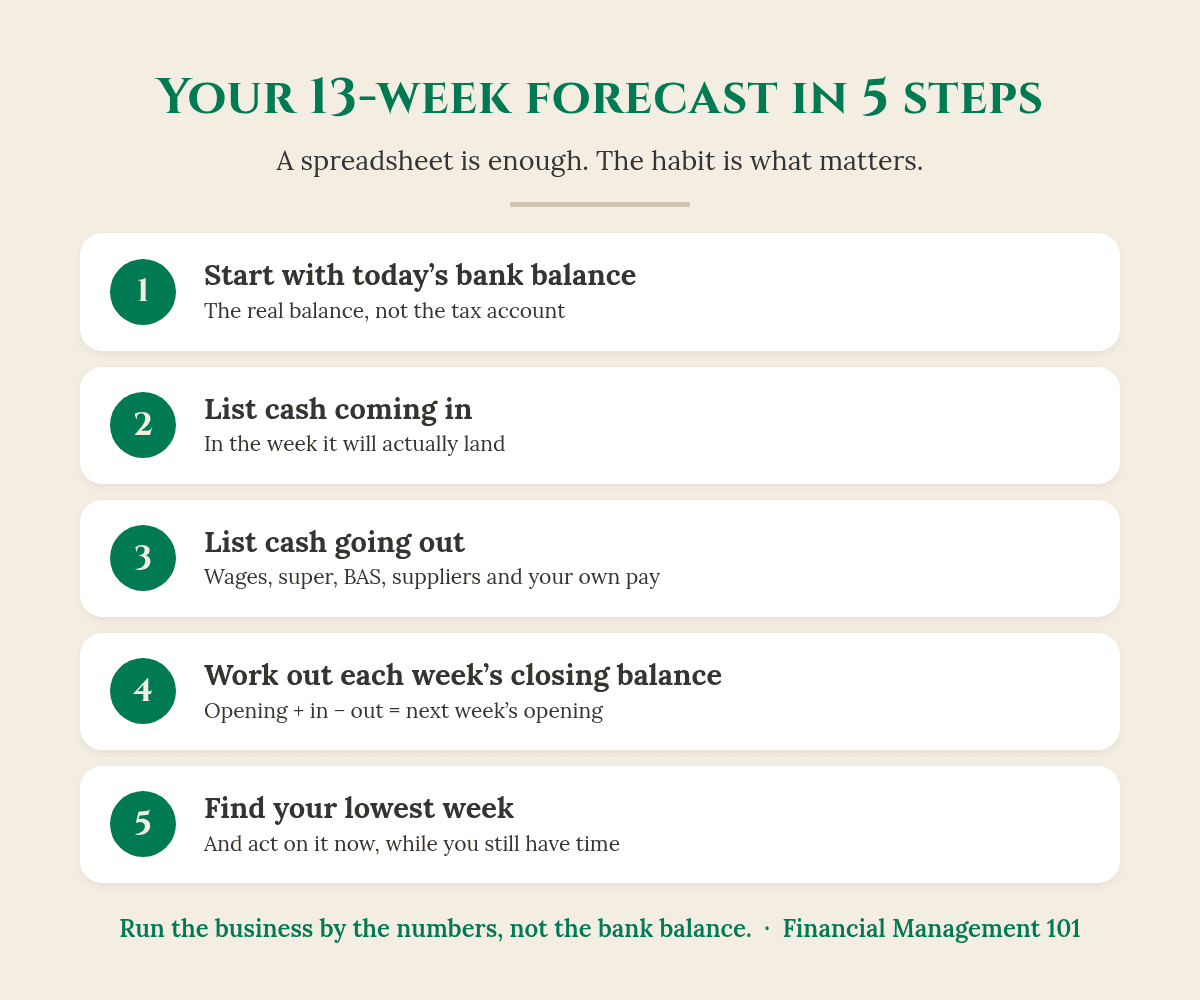
You don’t need fancy software. A spreadsheet, or the business.gov.au cash flow statement template, is enough to start. The template is built around the same structure you’ll use: an opening balance, cash incoming, cash outgoing, the balance for the period and a closing balance (business.gov.au). Here’s how I’d build a 13-week cash flow forecast for a small business.
Step 1: Start with today’s bank balance
Use the real balance of your everyday business account today, not the “available” figure that includes an overdraft. If you keep a separate tax account, leave it out. That money is already spoken for.
Step 2: List the cash you expect to come in, week by week
Put each amount in the week you expect the money to land, not the week you send the invoice. Start with invoices already sent, then work that’s booked, then a careful estimate for new work. business.gov.au suggests forecasting incoming cash by looking at previous years, identifying seasonal trends and accounting for regular sources of income (business.gov.au).
Watch out: If a customer usually pays in 45 days, put their payment in at 45 days, even if your terms say 14. Forecast what really happens, not what should happen.
Step 3: List everything going out, and when
Wages, rent, suppliers, loan repayments, insurance, subscriptions and your own pay. Then the two that catch people out: super and the BAS.
- Super: since 1 July 2026, under Payday Super, an employer’s super guarantee contribution is on time if the employee’s fund receives it within 7 business days after payday. The ATO says it’s best practice to pay it on payday (ATO). So in your forecast, super now sits next to every pay run, not at the end of the quarter.
- BAS: if you report quarterly, the October to December BAS is due on 28 February. Monthly BAS is due on the 21st of the following month (ATO). Put each payment in the week it’s due.
Step 4: Work out the closing balance for each week
Opening balance, plus cash in, minus cash out, equals the closing balance. That closing balance becomes next week’s opening balance. It’s exactly how the business.gov.au template works (business.gov.au).
Check this first: Decide whether your figures include GST or not, and stick to it. business.gov.au asks you to state this clearly on its template (business.gov.au). For a cash forecast, I find GST-inclusive easiest, because that’s what actually hits the bank, as long as the BAS payment is in there too.
Step 5: Find your lowest week, and act on it
Run your eye along the closing balance line and find the lowest number. That’s your pinch point. If it’s below the minimum balance you’re comfortable with, you’ve found the problem early, and early is when you have the most options.
So what does this actually look like?
Here’s an illustrative example (the numbers are made up to show the method, not a real client). An electrical business with 5 staff starts its 13-week cash flow forecast on Monday 2 November with $48,000 in the bank. The owner likes to keep at least $25,000 as a buffer.
- Weeks 1 to 7: about $36,000 a week comes in and about $33,000 a week goes out.
- Week 8 (the week before Christmas): customers pay $20,000, but the last pay run, super, supplier accounts and the owner’s own pay take $58,000.
- Weeks 9 and 10 (the shutdown): only $12,000 comes in, while rent, loans, insurance and early January costs take $30,000.
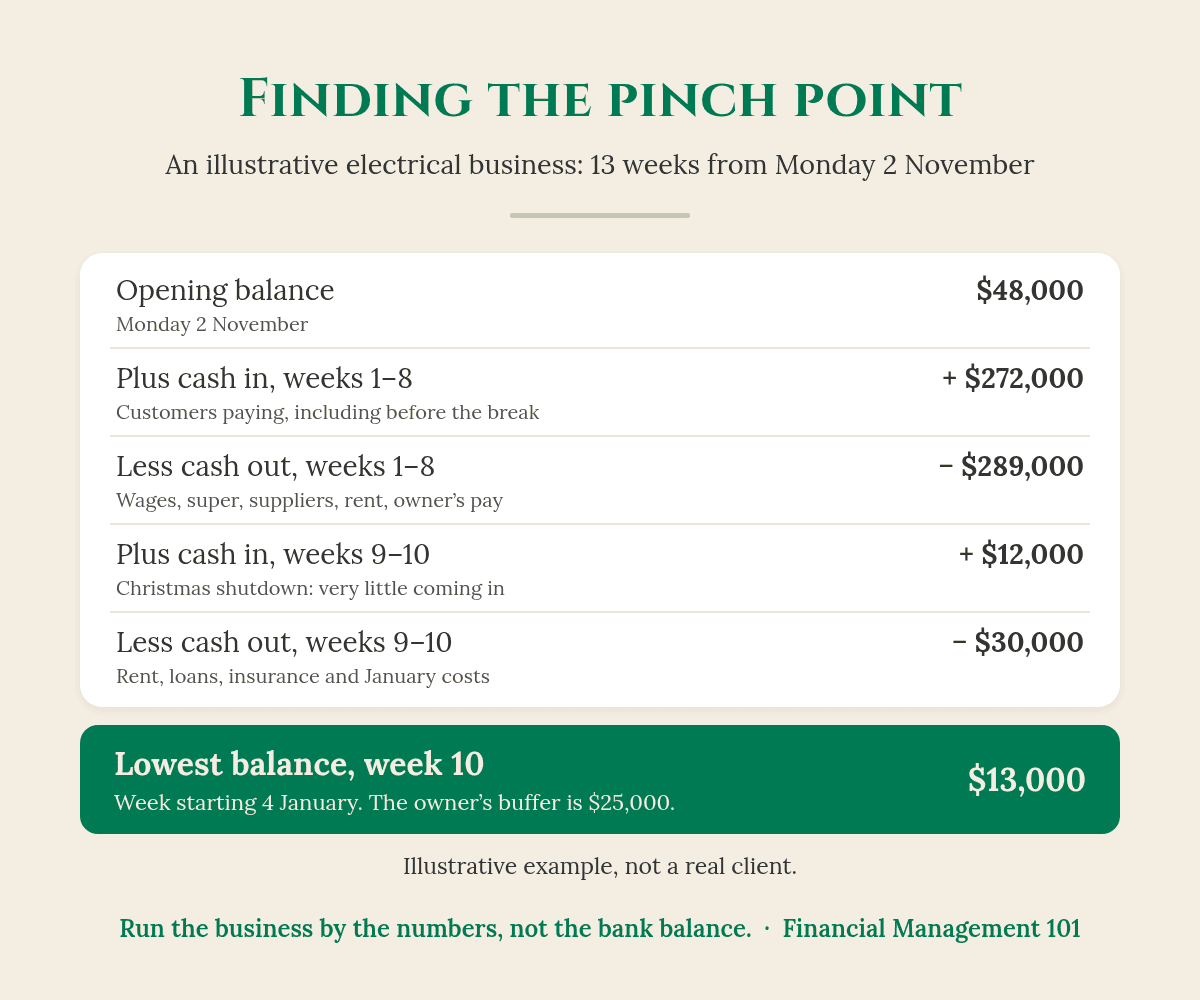
So the business looks healthy in November, with the balance climbing to $69,000 by the end of week 7. But by the end of week 10, the week starting 4 January, it’s down to $13,000, well under the $25,000 buffer.
Because she can see it in early November, she has nine weeks to act. She chases $18,000 of overdue invoices from two builders before the break and moves a $9,000 equipment purchase to February. Her week 10 low point lifts to $40,000. Same business, same work, no January panic.
How often should I update my cash flow forecast?
Weekly, if cash is tight or you’re heading into a big season like Christmas. Monthly at the very least. business.gov.au also recommends updating your cash flow statement regularly so you can spot seasonal trends and cycles (business.gov.au).
Roll it forward every week
Pick a day, say Monday morning, and give it 15 minutes. Replace last week’s estimates with what actually happened, drop the finished week and add a new week 13 on the end. That way you always have a full quarter in view.
Compare your forecast with what actually happened
When the actual numbers are very different from your forecast, ask why. Are customers paying slower? Are costs creeping up? That’s where the real insight is. My post What Numbers Should a Small Business Owner Track? covers the other numbers worth watching each week.
You can’t fix what you can’t see coming.
What should I do if my cash flow forecast shows a shortfall?
First, take a breath. Seeing it early is the whole point. Here are the options I’d talk through with your accountant or bookkeeper:
- Bring cash in sooner: chase overdue invoices, invoice on the day the job’s finished, and ask for deposits or progress payments on bigger jobs.
- Push cash out later: ask suppliers about terms, and time big purchases for after your low point.
- Keep the tax money separate: don’t use GST or PAYG withheld to fill the gap. If you can see you won’t be able to pay the ATO on time, talk to your BAS or tax agent/accountant early about your options.
- Look at the cause: if the same gap shows up every quarter, it usually points to pricing, slow-paying customers or a feast-and-famine workload. Cash Flow Chaos explains how to break that cycle.
Your takeaway
- A cash flow forecast is your expected bank balance, week by week, for the weeks ahead.
- Build it from five things: today’s balance, cash in, cash out, the weekly closing balance and your lowest week.
- Put money in the week it will really land or leave, including super with every pay run and the BAS when it’s due.
- Roll it forward for 15 minutes every week, and act on the low point while you still have time.
Your accountant makes sure the numbers are right. Your bookkeeper makes sure the records are right. My job is to help you know what to do with them.
Want to know where your cash is going before it’s gone?
Start with The EDGE Business Health Check. It’s a $47 workbook that takes about 20 minutes. You score 30 quick statements across five areas: Profit & Pricing, Cashflow, CEO Visibility, Systems & Freedom, and Growth. Then the Profit Leak Calculator shows where money may be slipping away, and the 7-Day Reset gives you clear next steps.

Rather talk it through first? Get in touch and book a call with me.
Frequently asked questions
What’s the difference between a cash flow forecast and a cash flow statement?
A cash flow statement records the money that actually came in and went out over a past period. A cash flow forecast uses estimates for future periods. The business.gov.au template works for both: enter actual figures for a statement, or estimated figures for each future period to make a forecast.
How far ahead should a small business forecast cash flow?
I suggest 13 weeks, rolled forward every week, for day-to-day cash decisions, plus a 12-month view for bigger plans like hiring or buying equipment. Pick the timeframe you’ll actually keep up to date.
Should my cash flow forecast include GST?
It can, as long as you’re clear about it. business.gov.au asks you to state whether your figures include or exclude GST. GST-inclusive is usually simplest for a cash forecast, as long as you also include the BAS payment in the week it’s due.
Can my bookkeeper or accountant help with a cash flow forecast?
Yes, and it’s a great use of their time. They can pull your real figures for what customers owe you and what you owe suppliers, so your forecast starts from accurate numbers. You then own the weekly habit of updating it.
How much cash buffer should a small business keep?
There’s no single number that suits every business. A practical starting point is enough to cover your next pay run, super and fixed costs, so one slow week doesn’t become a crisis. Your forecast shows whether you’re likely to stay above it.
You’ve built something real. Financial confidence starts with clarity.
Karen G. Adams
Small Business Performance Strategist, Financial Management 101
This article is general education only. It isn’t financial, tax or legal advice, and it doesn’t take your personal circumstances into account. The electrical business example is illustrative, not a real client. Check your own obligations and due dates with your BAS or tax agent/accountant or the ATO.