

What Numbers Should A Small Business Owner Track?

What Numbers Should A Small Business Owner Track?

You don’t need a full accounting degree to run a profitable business. But you do need to know which numbers reveal the real story. These are the few that matter most.

We get it, most business owners didn’t start their business because they love spreadsheets. You started it because you’re good at what you do, and somewhere along the way, “run the numbers” got added to the job description without anyone asking if you wanted it.

The good news is you don’t need dozens of reports or a finance degree. You need a small handful of numbers, checked regularly, that tell you the truth about how the business is really going.

By the end of this, you’ll know exactly which numbers to look at first, and why each one matters more than revenue alone.

1. Gross profit margin

This is what’s left from a sale once the direct cost of delivering it is covered; materials, trade labour, stock, whatever it takes to physically deliver your product or service.

It’s the clearest early warning system in your business. A shrinking gross margin means either your costs are rising faster than your prices, or your pricing was never quite right to begin with.

Check this: work it out for your top few products or services, not just the business as a whole. Averages hide the products quietly losing you money.

2. Net profit margin

This is what’s actually left after everything; overheads, wages, rent, subscriptions, the lot. It’s the number that tells you whether the business is genuinely profitable, not just busy.

Revenue can grow every year while net profit margin shrinks, and from the outside, everything still looks like success.

Check this: monthly, not just at tax time. A yearly glance means you find out about a problem eleven months too late to do much about it.
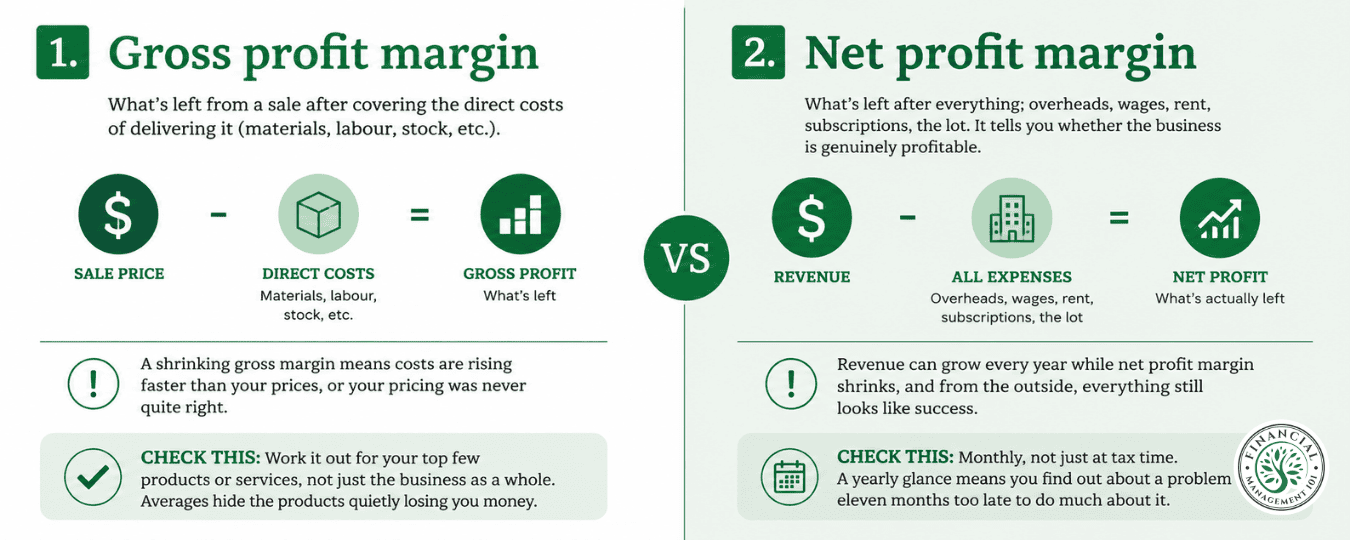
Gross Profit Margin vs Net Profit Margin

3. Cash position versus profit

Your bank balance and your profit are two different stories, even though they feel like they should match. A healthy bank balance can be sitting on unpaid tax, a big supplier bill due next week, or a loan repayment about to land.

We business owners tend to use the bank balance as our main scoreboard, simply because it’s the number we see most often. It’s useful – it’s just not the whole picture.

Check this: look at your profit and loss statement alongside your bank balance, not instead of it.

4. Overheads as a percentage of revenue

Overheads rarely blow out all at once. They creep in like; a new subscription here, a rent increase there, a “temporary” extra cost that becomes permanent.

Tracking overheads as a percentage of revenue, rather than a raw dollar figure, shows you whether your costs are growing in proportion to the business or quietly outpacing it.

Check this: list every recurring cost and total it as a percentage of that month’s revenue. Watch the trend over a few months, not just one snapshot.

5. Debtor days – how long it takes to get paid

This is the one most owners forget to track, and it’s often the one causing the most stress. Debtor days measure the average time between sending an invoice and the money landing in your account.

The longer that gap, the more your own cash is quietly funding someone else’s business while yours waits.

Check this: if your debtor days are creeping up, it’s usually a sign your payment terms, follow-up process, or invoicing timing need a look, not that you need more sales.

The Takeaway

You don’t need to track everything. You need to track the right few things, consistently. Gross profit margin, net profit margin, cash position, overheads as a percentage of revenue, and debtor days together, these five numbers tell you far more about the health of your business than revenue ever will on its own.

Clarity here isn’t about becoming an accountant. It’s about finally being able to see your business as clearly as you run it.

If you’d like these numbers tracked and visible for you automatically, that’s exactly what the CEO Dashboard is built for.

Watch the 2 minute video on how it works HERE

The CEO Dashboard™ gives small business owners a clear, visual snapshot of what’s really happening inside their business – so you can stop operating on gut feel alone and start making confident, data-driven decisions.

#HowToResetMyMoneyMindset #NewYearFinancialMindset #HowToStartFreshWithMoney  emergency fund australia, money management, family savings #SmallBusinessOwner #BusinessGrowth #CashflowManagement #BusinessSuccess #EAP #EmployeeAssistanceProgram
#EntrepreneurMindset


 

Spring Clean Your Numbers (Not Just Your Garage)

Spring Clean Your Numbers (Not Just Your Garage)

Spring’s arrived, and everyone’s suddenly a productivity machine. The garage gets sorted. The wardrobe gets a donation pile. Even the fridge gets a wipe-down it hasn’t seen since Christmas. There’s something about the change of season that makes us want to open cupboards we’ve been quietly avoiding, throw open the windows, and start again with a clean slate.

And then there’s the numbers. Sitting in a folder called “Sort Later” that’s been open since March, quietly judging you every time you open your laptop to do literally anything else.

I get why. Looking at your numbers can feel like opening a drawer you’re half-scared of. But here’s what I’ve noticed after years of doing this with business owners, it’s almost never the bad news people are avoiding. It’s the not knowing. And not knowing is worse than knowing, every single time. Your brain fills in the gaps with worst-case scenarios, and worst-case scenarios are exhausting to carry around, day after day, in the background of everything else you’re trying to do.

So let’s do a proper spring clean. Not the garage. The numbers.

Open the drawer

Pull up your bank balance, your last quarter’s profit and loss, and your list of unpaid invoices. Don’t analyse anything yet. Just look. Genuinely, half the fear disappears the second you actually see it in front of you instead of imagining it in the shower at eleven o’clock at night, which, let’s be honest, is where most business anxiety happens. There’s a strange kind of relief that comes from simply confirming what’s true, even before you’ve decided what to do about it.

Give yourself permission to do this badly the first time. You don’t need the perfect system, the right spreadsheet, or a clear head. You just need ten minutes and a willingness to actually look.

Pull up your bank balance, your last quarter's profit and loss, and your list of unpaid invoices. Don't analyse anything yet. Just look.

Sort it into three piles

Money coming in – is it steady, growing, or a bit up and down? Most business owners have a gut feeling about this already, but the gut feeling and the actual number are often surprisingly different. Sometimes the gut feeling is worse than reality, because a couple of quiet weeks stick in the memory harder than a run of good ones. Sometimes it’s the other way around, and you’ve been coasting on a story of “we’re doing fine” that the numbers don’t quite back up.

Money going out – is there something on there you forgot you were even paying for? There’s always one. Always. I once found a client paying for two versions of the same software because nobody had cancelled the old one when they upgraded. Another had three separate subscriptions doing almost exactly the same job, signed up for at different points over a couple of years, each one seeming small enough on its own to never bother cancelling.

And money you’re owed, that invoice from June isn’t going to chase itself, no matter how much you’d love it to. This is the pile most business owners find hardest, because chasing money can feel awkward, even when it’s entirely yours to be paid. But an unpaid invoice is just a job you’ve already done, for free, until someone follows it up.

Pick one thing to fix

Just one. Not ten. Overwhelm is the fastest way to close the drawer again and not open it until next spring. Maybe it’s finally sending that overdue reminder. Maybe it’s cancelling the software subscription you haven’t opened since winter. Small, done, dusted, next.

The temptation, once you’ve had a proper look, is to try and fix everything at once; set up a new system, rewrite your pricing, overhaul the whole thing in a weekend. Resist it. That kind of burst of motivation rarely survives past Wednesday. One small, completed fix beats five half-started ones every time.

A story worth telling

I had a client tell me once that she’d been avoiding her numbers for so long she’d convinced herself the business was in real trouble. She’d started quietly dreading Mondays because Monday was “numbers day” in her head, even though she never actually looked at them, the dread had become entirely separate from reality. It took her twenty minutes to finally open the drawer. Turned out she was actually doing fine, better than fine, really she’d just never stopped to check. That’s more common than you’d think. The story we tell ourselves about our numbers is very often worse than the numbers themselves, and it’s a story that grows in the dark, the longer it goes unchecked.

Why this matters more in spring than you’d think

There’s a reason I love doing this exercise at this time of year specifically. You’re coming out of the quieter winter months into a run toward Christmas and the end of the calendar year, and whatever shape your numbers are in right now is the shape they’ll carry into your busiest stretch. Fix the leaks now, while things are a bit calmer, and you’re not trying to patch a system while it’s under full load in November, juggling extra stock, extra staff hours, and extra everything.

It’s the same logic as checking your car before a long road trip. You don’t wait until you’re halfway up the highway to notice the tyres are bald. Spring is your service centre stop before the busy season, and it costs you almost nothing but a bit of honesty and twenty minutes.

What “good” actually looks like

A lot of business owners assume a proper handle on their numbers means daily spreadsheets, colour-coded tabs and a finance degree. It doesn’t. Good, for most small businesses, looks like knowing three things at any given moment; roughly what’s coming in, roughly what’s going out, and roughly what’s still owed to you. That’s it. Everything beyond that is a nice-to-have, not a requirement. If you can answer those three things without opening a single file, you’re already ahead of most.

The excuses, and why they don’t hold up

“I’ll do it properly once things quiet down.” Things rarely quiet down on their own, you have to make room for this, not wait for the room to appear. “My accountant handles all that.” Your accountant handles your compliance, not your day-to-day decisions. Very different jobs. 

“I’m not a numbers person.” Nobody is born a numbers person. It’s a skill built through repetition, the same as anything else you’ve gotten good at in your trade or your craft.

A word on the guilt

A lot of business owners feel a flicker of guilt about not having “sorted this ages ago.” I want to gently take that off your hands. Nobody teaches us this stuff. You didn’t start your business because you were desperate to become a numbers person, you started it because you were good at your trade, your craft, your service. Not knowing isn’t a character flaw. It’s just a gap, and gaps are fixable, usually faster than we expect once we actually start.

You don’t need to become a spreadsheet person overnight. You just need to open the drawer, have a look, and tidy up the one thing that’s bugging you most. That’s it. That’s the whole exercise, and it takes less time than most people spend scrolling their phone before bed.

Making it a habit, not a once-a-year panic

Here’s the thing about spring cleaning anything; the garage, the wardrobe, the numbers. If it only happens once a year, it’s always going to feel like a bigger job than it should. The reason the garage feels overwhelming every September is that nothing’s been put back properly in between. The same is true of your numbers.

The real win isn’t the one big spring clean. It’s turning that twenty-minute “open the drawer” exercise into something you do monthly, or even fortnightly, so it never has time to build back up into something you’re avoiding. Put a recurring reminder in your calendar. Pair it with something you already do, a Friday afternoon coffee, the first Monday of the month, so it piggybacks on an existing habit instead of needing willpower of its own.

Businesses that do this well aren’t the ones with the fanciest software. They’re the ones who’ve made looking at the numbers boring and routine, instead of a big, dreaded event.

Boring is good. Boring means it’s not scary anymore.

What spring cleaning your numbers actually gives you

It’s not just about avoiding nasty surprises, although that’s a nice side effect. It’s about heading into the busier end of the year with your eyes open. Knowing which clients or jobs are actually worth chasing more of. Knowing whether you can afford to take on that extra staff member before Christmas, or whether that decision needs another quarter. Knowing, with some confidence, where you actually stand, instead of a vague, gnawing feeling that you should probably check at some point.

That kind of clarity changes how you make decisions. Instead of reacting to whatever’s loudest that week, you’re choosing based on what you can actually see. It’s a completely different way to run a business, and it starts with nothing more complicated than opening a drawer you’ve been avoiding.

If you want a guided version of this, something that actually shows you where your business stands across the areas that matter, not just the bits you’re brave enough to look at – take The EDGE Business Health Check. It takes about 20 minutes, and it’s a much nicer way to spring clean than the garage ever was.

The EDGE Business Health Check helps you identify the areas that are limiting growth - from leadership and systems to cashflow, profitability and visibility.

#HowToResetMyMoneyMindset #NewYearFinancialMindset #HowToStartFreshWithMoney  emergency fund australia, money management, family savings #SmallBusinessOwner #BusinessGrowth #CashflowManagement #BusinessSuccess
#EntrepreneurMindset