Your First Quarter Report Card

Your First Quarter Report Card

July, August, September – done and dusted, more or less. So how’s the new financial year actually going? Not “how busy have you been.” How’s it going?

Most business owners can rattle off exactly how flat out they’ve been since July; the jobs, the clients, the late nights. Fewer can tell you how profitable they’ve been over the same stretch. And that gap between “flat out” and “actually ahead”, is exactly where a quick quarter check-in earns its keep. It’s the difference between a business that feels busy and a business you can actually prove is moving forward.

Nobody waits for the end-of-year school report to find out how a kid’s tracking. You check in along the way – a note home, a parent-teacher chat, a quiet word, and adjust before it becomes a bigger conversation. Your business deserves the same courtesy. Not a full audit, not a forensic dive into every transaction, just an honest look at the first three months of the new financial year, before you’re four quarters deep wondering where it all went and why the number at tax time doesn’t match the effort you know you put in.

Why most business owners skip this

It’s not laziness. It’s usually one of two things, either it feels like it’ll take hours you don’t have, or there’s a quiet fear of what it might show. Both of those assumptions tend to be wrong. This exercise takes less time than a coffee catch-up, and more often than not, the number is somewhere between “not as bad as I feared” and “better than I gave myself credit for.” The dread is almost always worse than the discovery.
Three questions, one cup of tea

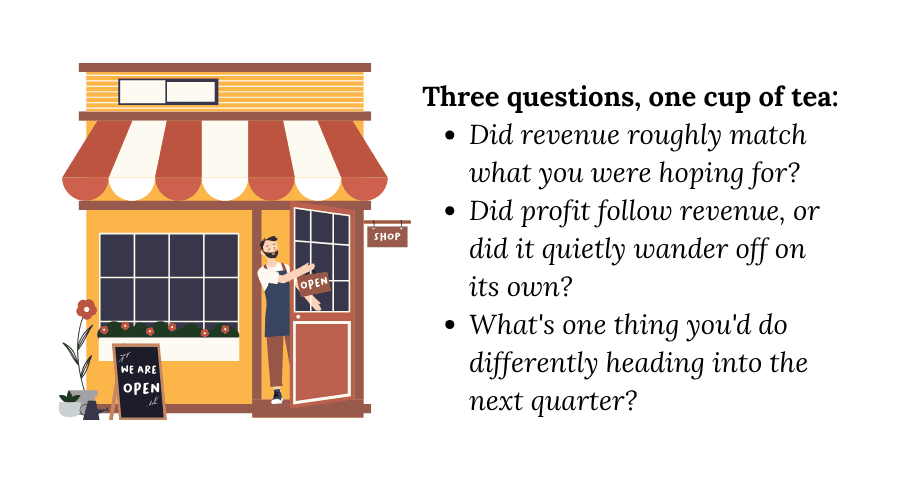
Three questions, one cup of tea

Did revenue roughly match what you were hoping for? Doesn’t need to be precise; ahead, on track, or behind is enough of an answer for now. And if you realise you never actually set a target for the quarter, that’s not a failure, it’s just a perfectly good place to start next time. You can’t be ahead or behind a target that doesn’t exist.

Did profit follow revenue, or did it quietly wander off on its own? This is the one that catches people out most often, and it’s the one I see most in this line of work. Revenue climbs, everyone’s thrilled, the calendar’s fuller than ever and then the bank balance doesn’t quite reflect it, because costs crept up right alongside the growth without anyone clocking it. Materials went up. A subcontractor’s rate went up. You took on a bit more admin help. None of it felt like a big decision at the time, but added together it’s eaten the extra revenue and then some. If you’ve felt busier than ever this quarter but the numbers don’t quite match the feeling, this is usually why.

What’s one thing you’d do differently heading into the next quarter? Not five things, just one! Trying to fix everything at once is how good intentions turn into nothing changing at all. Maybe it’s pricing, which almost every business owner I meet is quietly undercharging on. Maybe it’s chasing invoices a little sooner instead of letting them drift. Maybe it’s finally looking at where the money’s actually going instead of guessing based on vibes and a general sense of dread. Pick the lever that would move things most, and leave the rest for next quarter’s version of this exercise.

What to do with what you find

If the quarter came in ahead, resist the urge to immediately spend the difference on something exciting. Sit with it for a bit. Ask whether it’s a genuine trend or a one-off good stretch before you build plans around it. If it came in behind, resist the opposite urge, the spiral into “the whole business is failing.” One quarter is one quarter. It’s a data point, not a verdict. The value isn’t in the number itself, it’s in what the number tells you to look at next.

Why quarterly, specifically

A quarter is a genuinely good length of time to check in on; long enough to see a real pattern rather than a one-off blip, short enough to actually change course while it still matters. Check monthly and you risk reacting to noise, a slow week that means nothing, a good week that means nothing either. Check yearly and you find out too late to do much about it. Quarterly sits right in the sweet spot, giving you enough information to trust it, and enough time left in the year to actually act on it.

The business owners I see making calmer, more confident decisions are almost always the ones checking in quarterly, not just at tax time when the accountant delivers the number and there’s nothing left to do but accept it. Checking quarterly puts you back in the driver’s seat of your own financial year, rather than a passenger finding out where you ended up after the fact.

If you’d like a proper look under the bonnet, the CEO Dashboard gives you full visibility on exactly how the quarter really went not the guessed version, the real one.

Turning it into a rhythm

The businesses that get the most out of this aren’t doing anything clever, they’ve just made it a rhythm rather than a rescue mission. Same week each quarter. Same three questions. Same short list of actions afterwards. It stops being a big, dreaded event and becomes something closer to a habit, the business equivalent of a regular check-up rather than an emergency room visit.

If this is the first time you’ve done a proper quarter check-in, don’t worry about making it perfect. The value isn’t in precision, it’s in the act of actually stopping to look, on a schedule, instead of only looking when something’s gone wrong enough to force your hand.

Setting yourself up for next quarter

Before you close the laptop on this exercise, write down one number you’ll check again in three months. Just one. Revenue, profit margin, average invoice value, whatever feels most relevant to where you are right now. Having that one number in mind gives the next quarter’s check-in a head start, because you’ll already know what you’re comparing against instead of starting from scratch each time.

Small, consistent check-ins beat big, occasional audits every time. That’s true of your car, your health, and it’s absolutely true of your business.

The CEO Dashboard

#HowToResetMyMoneyMindset #NewYearFinancialMindset #HowToStartFreshWithMoney  emergency fund australia, money management, family savings #SmallBusinessOwner #BusinessGrowth #CashflowManagement #BusinessSuccess
#EntrepreneurMindset


 

Cash Flow is King: Why Every Small Business Owner  Needs a Financial Plan (Not Just More Work)

Cash Flow is King: Why Every Small Business Owner  Needs a Financial Plan (Not Just More Work)

If you’re a tradie, Franchisee or small business owner, chances are you’ve said this before:

“I just need more work.”
“If I can land that next big job, I’ll be sweet.”
“Once I get through this month, I’ll finally get on top of things.”

Sound familiar?

We’ve been sold this idea that working more hours or taking on more jobs is the key to financial stability.

But here’s the truth…

More work won’t fix your money problems if your financial plan is broken.

Let me say that again: More work won’t fix broken cash flow.

In fact, working harder without a system can actually worsen your money stress – leading to burnout, resentment, and a business that runs you, instead of the other way around.

In this blog, I’ll break down why cash flow is king, how small business owners end up in the trap of “more jobs = more chaos”, and what you can do to take control of your money (without working yourself into the ground).

The Myth of “More Work = More Money”

Let’s say you take on 3 new clients this month as a tradie. Awesome, right?
But then:

  • You buy more materials
  • You spend more hours on-site
  • You hire a subbie to help out
  • You juggle more admin
  • You forget to invoice someone
  • And suddenly – you’re busier than ever… but your bank account doesn’t show it

That’s because revenue doesn’t equal profit, and being busy doesn’t equal being financially fit.
You can be flat-out all month and still feel broke.

That’s the trap, and I see it every week with tradies, franchisees and business owners who are absolutely brilliant at what they do… but never learned how to manage the money side of things.

So What’s the Real Problem?

It comes down to one powerful truth:

Cash flow – not just income – is what makes or breaks your business.

Cash flow is the movement of money in and out of your business.

Not just how much you make, but:

  • When you get paid
  • How consistently money comes in
  • What goes out each week
  • Whether you’re left with a profit (or just scraping by)

If you don’t have control over your cash flow, you’re always reacting. You’re playing catch-up. And that stress leaks into everything – your health, your relationships, and even the quality of your work.

Here’s What Cash Flow Chaos Looks Like

If you’ve ever experienced any of these, you’re in a cash flow crunch:

  • You avoid checking your account because you’re afraid of what you’ll see
  • You wait until BAS is due to realise you owe thousands
  • You struggle to pay your own wage regularly
  • You’re always chasing late invoices
  • You can’t take time off because you’re constantly hustling to “keep up”
  • You’ve had to dip into your personal savings more than once

Sound familiar? You’re not alone. But the good news is – it’s fixable.

The Solution: A Simple, Small Business – Friendly Financial Plan

You don’t need a finance degree or a fancy accountant to get this sorted. You just need a clear plan for how money flows through your business. Here’s how to start building one.

1. KNOW YOUR BREAK-EVEN POINT

This is the minimum amount of money you need to earn each month to cover:

  • Business expenses (tools, fuel, phone, materials, subs, etc.)
  • Your personal wage
  • Tax and super
  • Any loan or debt repayments

Without knowing your break-even, you’re guessing. You’re flying blind. Once you’ve nailed this number, everything becomes clearer.

Now, you can set targets based on facts – not hope.

2. PAY YOURSELF A WAGE – YES, YOU!

This is the game changer. Every time income hits your account, it should be split into different buckets. That way, you’re not tempted to spend what should’ve gone to tax, bills, or your own pay.

Here’s a simple version that works great for small business owners:

✅ Income Account
Where all your payments land. This is your holding zone.

✅ Owner’s Pay Account
Your regular wage. Non-negotiable. You work hard, you deserve to be paid consistently.

✅ Expenses Account
Materials, suppliers, fuel, subscriptions, etc.

✅ Tax & BAS Account
Put aside 25 – 30% of every payment for Tax plus the GST portion. No more panic come BAS time.

✅ Profit Account
Even just 5% of each job. This is for rainy days, growth, or peace of mind.

You can set this up in 30 minutes through online banking. Once you do? You’ll sleep better knowing your money is finally working for you.

3. TRACK YOUR MONEY CASH FLOW

Once a week, check in on your numbers. This doesn’t need to be a 2-hour admin marathon. I’m talking 20–30 minutes to:

  • See what came in
  • Check what went out
  • Update your numbers
  • Chase unpaid invoices
  • Move money into your buckets

Make this a weekly ritual (I call it a Money Date) and watch your confidence skyrocket. Because the more you look at your money, the less power it holds over you.

4. TRACK YOUR MONEY CASH FLOW

You can have all the work in the world, but if your prices don’t reflect the true cost of running your business – you’ll never get ahead.

Too many small business owners undercharge because they’re afraid of losing the work.

But if you’re not charging for:

  • Admin time
  • Quote prep
  • Travel
  • Time off tools
  • Overheads
  • Profit margin

…then you’re not building a business. You’re building a time bomb.

You should be pricing with confidence, knowing that it covers everything – not hoping for the best.
Inside The Edge, I teach you a simple pricing calculator so you know exactly what to charge and why.

5. BUILD A BUFFER FUND

We all know some work can be seasonal or unpredictable.

A job gets delayed. A client pays late. You get sick. And suddenly your cash flow takes a hit. That’s why a buffer fund is crucial.

Aim to build up 1–3 months’ worth of business expenses in a separate account. This gives you breathing space and avoids making panic-driven decisions like slashing prices or taking on crappy jobs just for quick cash.

Start small – $50 a week adds up. Automate it. Make it part of your money system. 

Build a Buffer Fund

The Truth? You Don’t Need More Work. You Need a Better Money Plan.

You don’t need to hustle harder. You don’t need to take every job that comes your way. You need to manage your money better so the work you’re already doing actually pays off. Imagine this:

  • Getting paid consistently – even in quiet months
  • No more panicked BAS seasons
  • Knowing exactly what your business needs to earn each week
  • Saying YES to time off without financial stress
  • Watching your bank account grow, not shrink

That’s what happens when cash flow becomes your king, and your systems support you, not sabotage you.

And That’s Exactly What We Do Inside THE EDGE

THE EDGE is a 6-week coaching program for tradies, franchisees and small business owners who are ready to stop guessing and start owning their business money. We’ll help you:

✅ Set up a cash flow system
✅ Price for profit
✅ Get your BAS and tax sorted
✅ Pay yourself consistently
✅ Build a buffer
✅ Plan for growth (without working more hours)

It’s simple, structured, and built for people who are great at their trade, not spreadsheets.

Final Thoughts: Work Smarter. Get Paid Properly. Stress Less.

You didn’t go into business to work 24/7 and still worry about money.

You started your business for freedom, flexibility, and a better life. And the path to that life isn’t more work. It’s better cash flow.

So if you’re ready to take the pressure off and finally feel in control of your business money…

Join THE EDGE: 6-Week Coaching Program

Your business doesn’t need to change, it just needs a plan. Let’s build it together.

THE EDGE - 6-WEEK PROGRAM
Mastering Money with Ease: The Secrets to Financial Flow

Mastering Money with Ease: The Secrets to Financial Flow

What if managing money felt effortless instead of stressful? What if financial decisions felt natural rather than overwhelming? Welcome to the concept of financial flow – where money moves in and out of your life with ease, and you feel confident and in control every step of the way.

Financial flow isn’t about luck, nor is it reserved for the wealthy. It’s about aligning your mindset, habits, and systems so that money becomes a source of empowerment rather than anxiety. Let’s dive into the secrets of mastering money with ease.

Secret #1: Trust That Money Flows to and Through You

One of the biggest money struggles people face is the feeling of scarcity – thinking there’s never enough. But here’s a powerful reframe: Money is energy. It moves, circulates, and returns when managed intentionally.

Rather than clinging tightly to every dollar out of fear, shift your perspective:

    • Trust that more opportunities to earn will come.
    • Believe that when you spend intentionally, money will return in other ways.
    • Recognise that wealth grows when you let money work for you through smart investments and aligned spending.

The key is to create a flow where money moves through your life in a way that serves you, rather than feeling stuck or stagnant.

Secret #2: Design a Financial System That Works for You

Many people resist financial planning because they think it’s restrictive. But the truth is, having a system actually frees you. A good financial system automates the boring stuff so you can focus on what matters. A simple, effective system includes:

    • A Spending Plan (not a strict budget, but a flexible plan for where your money should go each month)
    • Automatic Transfers to savings and investments so they grow without you overthinking it
    • A Guilt-Free Fun Fund so you can enjoy your money without worry
    • A Weekly Money Check-In to keep things on track without stress

When your system is designed for ease, managing money stops being a chore and starts feeling like second nature.

Design a Financial System That Works for You

Secret #3: Align Your Money with Your Joy

Ever notice how some purchases feel amazing while others leave you with regret? That’s because true financial satisfaction comes from spending in alignment with your values and priorities.

Take a look at your expenses and ask:

    • Does this purchase bring me joy, security, or opportunity?
    • Am I spending out of habit, pressure, or impulse?
    • How can I redirect my money toward things that truly enrich my life?

When money is spent intentionally on things that light you up rather than weigh you down, you feel at ease with your financial decisions.

Secret #4: Remove the Money Blocks Keeping You Stuck

Sometimes, it’s not just financial strategies that hold people back – it’s emotional and mental blocks. Thoughts like:

    • “I’ll never get ahead.”
    • “Money is stressful.”
    • “I don’t deserve to be wealthy.”

These hidden money blocks create resistance, keeping you stuck in the same cycles. The key is to identify them, challenge them, and replace them with beliefs that support financial ease.

Instead of “Money is stressful,” try “I am learning to manage money with confidence.” Small shifts in mindset create massive shifts in financial reality.

Secret #5: Surround Yourself with Financial Flow Energy

Just like anything in life, who and what you surround yourself with influences your financial experience. If your circle is always complaining about money or reinforcing scarcity thinking, it’s harder to break free.

Instead, seek out:

    • Books and podcasts that expand your financial knowledge
    • Mentors or communities that uplift and encourage abundance
    • Coaching or courses that provide actionable steps toward financial confidence

This is exactly why I created my Monthly Coaching program, giving you access to THE VAULT – a collection of resources to help you create lasting financial flow. And if you’re ready to take full control of your financial journey, the Master Your Money program will guide you every step of the way.

THE VAULT and Master Your Money Program

Final Thoughts: Financial Flow is a Choice

Mastering money with ease isn’t about earning more, it’s about creating a relationship with money that feels natural and empowering. When you remove resistance, align your money with your joy, and put systems in place, you create a life where money works for you, not against you.


So ask yourself: What’s one step you can take today to step into financial flow? Your money journey is yours to design, and you have everything it takes to make it happen and effortless.

The 90 Day Money Makeover