Your First Quarter Report Card

Your First Quarter Report Card

July, August, September – done and dusted, more or less. So how’s the new financial year actually going? Not “how busy have you been.” How’s it going?

Most business owners can rattle off exactly how flat out they’ve been since July; the jobs, the clients, the late nights. Fewer can tell you how profitable they’ve been over the same stretch. And that gap between “flat out” and “actually ahead”, is exactly where a quick quarter check-in earns its keep. It’s the difference between a business that feels busy and a business you can actually prove is moving forward.

Nobody waits for the end-of-year school report to find out how a kid’s tracking. You check in along the way – a note home, a parent-teacher chat, a quiet word, and adjust before it becomes a bigger conversation. Your business deserves the same courtesy. Not a full audit, not a forensic dive into every transaction, just an honest look at the first three months of the new financial year, before you’re four quarters deep wondering where it all went and why the number at tax time doesn’t match the effort you know you put in.

Why most business owners skip this

It’s not laziness. It’s usually one of two things, either it feels like it’ll take hours you don’t have, or there’s a quiet fear of what it might show. Both of those assumptions tend to be wrong. This exercise takes less time than a coffee catch-up, and more often than not, the number is somewhere between “not as bad as I feared” and “better than I gave myself credit for.” The dread is almost always worse than the discovery.
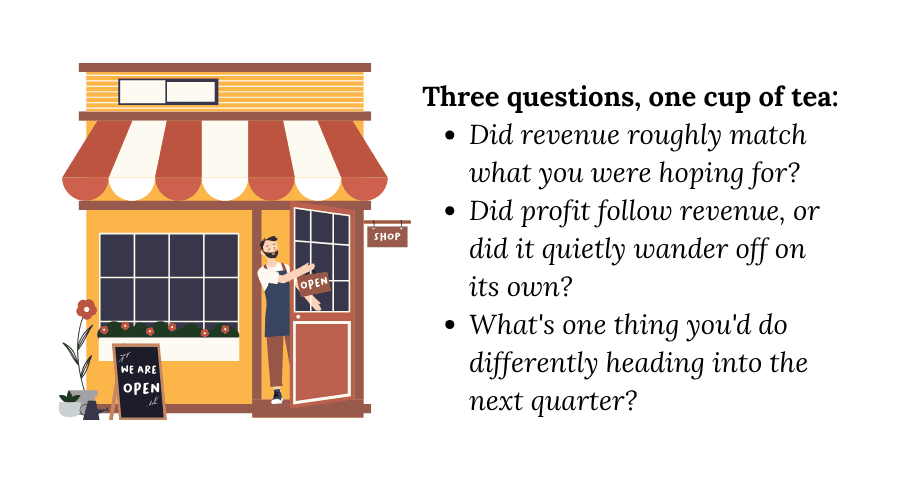
Three questions, one cup of tea

Three questions, one cup of tea

Did revenue roughly match what you were hoping for? Doesn’t need to be precise; ahead, on track, or behind is enough of an answer for now. And if you realise you never actually set a target for the quarter, that’s not a failure, it’s just a perfectly good place to start next time. You can’t be ahead or behind a target that doesn’t exist.

Did profit follow revenue, or did it quietly wander off on its own? This is the one that catches people out most often, and it’s the one I see most in this line of work. Revenue climbs, everyone’s thrilled, the calendar’s fuller than ever and then the bank balance doesn’t quite reflect it, because costs crept up right alongside the growth without anyone clocking it. Materials went up. A subcontractor’s rate went up. You took on a bit more admin help. None of it felt like a big decision at the time, but added together it’s eaten the extra revenue and then some. If you’ve felt busier than ever this quarter but the numbers don’t quite match the feeling, this is usually why.

What’s one thing you’d do differently heading into the next quarter? Not five things, just one! Trying to fix everything at once is how good intentions turn into nothing changing at all. Maybe it’s pricing, which almost every business owner I meet is quietly undercharging on. Maybe it’s chasing invoices a little sooner instead of letting them drift. Maybe it’s finally looking at where the money’s actually going instead of guessing based on vibes and a general sense of dread. Pick the lever that would move things most, and leave the rest for next quarter’s version of this exercise.

What to do with what you find

If the quarter came in ahead, resist the urge to immediately spend the difference on something exciting. Sit with it for a bit. Ask whether it’s a genuine trend or a one-off good stretch before you build plans around it. If it came in behind, resist the opposite urge, the spiral into “the whole business is failing.” One quarter is one quarter. It’s a data point, not a verdict. The value isn’t in the number itself, it’s in what the number tells you to look at next.

Why quarterly, specifically

A quarter is a genuinely good length of time to check in on; long enough to see a real pattern rather than a one-off blip, short enough to actually change course while it still matters. Check monthly and you risk reacting to noise, a slow week that means nothing, a good week that means nothing either. Check yearly and you find out too late to do much about it. Quarterly sits right in the sweet spot, giving you enough information to trust it, and enough time left in the year to actually act on it.

The business owners I see making calmer, more confident decisions are almost always the ones checking in quarterly, not just at tax time when the accountant delivers the number and there’s nothing left to do but accept it. Checking quarterly puts you back in the driver’s seat of your own financial year, rather than a passenger finding out where you ended up after the fact.

If you’d like a proper look under the bonnet, the CEO Dashboard gives you full visibility on exactly how the quarter really went not the guessed version, the real one.

Turning it into a rhythm

The businesses that get the most out of this aren’t doing anything clever, they’ve just made it a rhythm rather than a rescue mission. Same week each quarter. Same three questions. Same short list of actions afterwards. It stops being a big, dreaded event and becomes something closer to a habit, the business equivalent of a regular check-up rather than an emergency room visit.

If this is the first time you’ve done a proper quarter check-in, don’t worry about making it perfect. The value isn’t in precision, it’s in the act of actually stopping to look, on a schedule, instead of only looking when something’s gone wrong enough to force your hand.

Setting yourself up for next quarter

Before you close the laptop on this exercise, write down one number you’ll check again in three months. Just one. Revenue, profit margin, average invoice value, whatever feels most relevant to where you are right now. Having that one number in mind gives the next quarter’s check-in a head start, because you’ll already know what you’re comparing against instead of starting from scratch each time.

Small, consistent check-ins beat big, occasional audits every time. That’s true of your car, your health, and it’s absolutely true of your business.

The CEO Dashboard

#HowToResetMyMoneyMindset #NewYearFinancialMindset #HowToStartFreshWithMoney  emergency fund australia, money management, family savings #SmallBusinessOwner #BusinessGrowth #CashflowManagement #BusinessSuccess
#EntrepreneurMindset


 

Mastering Money with Ease: The Secrets to Financial Flow

Mastering Money with Ease: The Secrets to Financial Flow

What if managing money felt effortless instead of stressful? What if financial decisions felt natural rather than overwhelming? Welcome to the concept of financial flow – where money moves in and out of your life with ease, and you feel confident and in control every step of the way.

Financial flow isn’t about luck, nor is it reserved for the wealthy. It’s about aligning your mindset, habits, and systems so that money becomes a source of empowerment rather than anxiety. Let’s dive into the secrets of mastering money with ease.

Secret #1: Trust That Money Flows to and Through You

One of the biggest money struggles people face is the feeling of scarcity – thinking there’s never enough. But here’s a powerful reframe: Money is energy. It moves, circulates, and returns when managed intentionally.

Rather than clinging tightly to every dollar out of fear, shift your perspective:

    • Trust that more opportunities to earn will come.
    • Believe that when you spend intentionally, money will return in other ways.
    • Recognise that wealth grows when you let money work for you through smart investments and aligned spending.

The key is to create a flow where money moves through your life in a way that serves you, rather than feeling stuck or stagnant.

Secret #2: Design a Financial System That Works for You

Many people resist financial planning because they think it’s restrictive. But the truth is, having a system actually frees you. A good financial system automates the boring stuff so you can focus on what matters. A simple, effective system includes:

    • A Spending Plan (not a strict budget, but a flexible plan for where your money should go each month)
    • Automatic Transfers to savings and investments so they grow without you overthinking it
    • A Guilt-Free Fun Fund so you can enjoy your money without worry
    • A Weekly Money Check-In to keep things on track without stress

When your system is designed for ease, managing money stops being a chore and starts feeling like second nature.

Design a Financial System That Works for You

Secret #3: Align Your Money with Your Joy

Ever notice how some purchases feel amazing while others leave you with regret? That’s because true financial satisfaction comes from spending in alignment with your values and priorities.

Take a look at your expenses and ask:

    • Does this purchase bring me joy, security, or opportunity?
    • Am I spending out of habit, pressure, or impulse?
    • How can I redirect my money toward things that truly enrich my life?

When money is spent intentionally on things that light you up rather than weigh you down, you feel at ease with your financial decisions.

Secret #4: Remove the Money Blocks Keeping You Stuck

Sometimes, it’s not just financial strategies that hold people back – it’s emotional and mental blocks. Thoughts like:

    • “I’ll never get ahead.”
    • “Money is stressful.”
    • “I don’t deserve to be wealthy.”

These hidden money blocks create resistance, keeping you stuck in the same cycles. The key is to identify them, challenge them, and replace them with beliefs that support financial ease.

Instead of “Money is stressful,” try “I am learning to manage money with confidence.” Small shifts in mindset create massive shifts in financial reality.

Secret #5: Surround Yourself with Financial Flow Energy

Just like anything in life, who and what you surround yourself with influences your financial experience. If your circle is always complaining about money or reinforcing scarcity thinking, it’s harder to break free.

Instead, seek out:

    • Books and podcasts that expand your financial knowledge
    • Mentors or communities that uplift and encourage abundance
    • Coaching or courses that provide actionable steps toward financial confidence

This is exactly why I created my Monthly Coaching program, giving you access to THE VAULT – a collection of resources to help you create lasting financial flow. And if you’re ready to take full control of your financial journey, the Master Your Money program will guide you every step of the way.

THE VAULT and Master Your Money Program

Final Thoughts: Financial Flow is a Choice

Mastering money with ease isn’t about earning more, it’s about creating a relationship with money that feels natural and empowering. When you remove resistance, align your money with your joy, and put systems in place, you create a life where money works for you, not against you.


So ask yourself: What’s one step you can take today to step into financial flow? Your money journey is yours to design, and you have everything it takes to make it happen and effortless.

The 90 Day Money Makeover
Breaking Free from Scarcity: How to Step into an Abundant Money Mindset

Breaking Free from Scarcity: How to Step into an Abundant Money Mindset

If you’ve ever felt like no matter how much you earn, it’s never enough, or if you catch yourself worrying about money even when things are going well, you might be stuck in a scarcity mindset. This mindset keeps you feeling like there’s never enough; enough money, enough opportunities, enough security. But the truth is, abundance is everywhere; we just have to shift our perspective to see it.

Breaking free from scarcity thinking doesn’t just improve your finances; it transforms how you approach life. Let’s explore how you can step into an abundant money mindset and start seeing possibilities instead of limitations.

Step 1: Recognise the Signs of Scarcity Thinking

The first step to shifting your mindset is awareness. Scarcity thinking can show up in many ways, such as:

      • Feeling like you never have enough money, no matter how much you make.
      • Being afraid to spend, even on things that align with your values.
      • Hoarding money out of fear rather than saving with intention.
      • Avoiding financial planning because you assume there’s no way to improve your situation.
      • Comparing your financial success to others and feeling discouraged.

If any of these resonate with you, don’t worry – you’re not alone, and these patterns can be changed.

Step 2: Reframe Your Money Beliefs

Scarcity isn’t about how much money you have; it’s about how you think about money. If you believe money is hard to earn or that financial success is only for the lucky few, those beliefs will shape your financial reality.

Start by shifting your internal dialogue. Instead of saying, “I can’t afford that,” try, “How can I afford that?” This simple shift turns money from a limitation into an opportunity for creativity and resourcefulness.

Another powerful reframe is to see money as a tool rather than a source of stress. Money is neutral, it’s how we use it and think about it that determines whether it empowers us or controls us.

The True Cost of Financial Stress

Step 3: Cultivate an Abundance Mindset Daily

Shifting from scarcity to abundance requires daily practice. Here are some ways to rewire your thinking:

      • Gratitude Practice: Take a moment each day to appreciate the financial abundance you already have whether it’s a roof over your head, food in your fridge, or even a steady paycheck.
      • Generosity: Giving, even in small ways, signals to your brain that there’s more than enough to go around. It could be donating a small amount to charity, tipping generously, or even sharing knowledge with someone who needs it.
      • Visualisation: Spend time visualising your ideal financial future. Imagine yourself thriving, making wise financial choices, and feeling completely at ease with money.

Step 4: Take Action Toward Abundance

An abundance mindset isn’t just about thinking differently – it’s also about acting differently. Some action steps include:

      • Investing in Yourself: Whether it’s taking a course, hiring a coach, or developing new skills, investing in yourself creates long-term financial and personal growth.
      • Creating Multiple Income Streams: People with an abundance mindset look for opportunities, not just limitations. Could you start a side hustle? Negotiate a raise? Explore passive income options?
      • Letting Go of Money Guilt: If you’ve been conditioned to feel guilty about spending or earning money, it’s time to release that. Money is simply an exchange of value, and you deserve financial prosperity.

Creating Multiple Income Streams

Step 5: Surround Yourself with Abundance Thinkers

Your environment influences your mindset. If you’re constantly surrounded by negativity about money, it’s harder to adopt an abundance perspective. Seek out people, books, podcasts, and communities that reinforce abundance thinking.

This is exactly why I created my Monthly Coaching program, where you gain access to THE VAULT – a wealth of financial education, tools, and resources to shift your mindset and transform your money habits. And for those ready to take full control of their financial future, the Master Your Money program offers step-by-step guidance on building lasting wealth.

Final Thoughts: Abundance is a Choice

Stepping into an abundant money mindset isn’t about waiting until you have “enough” money – it’s about changing how you view the money you already have. When you see possibilities instead of limitations, you unlock new levels of financial growth and confidence.

You are already capable of abundance. Now, it’s time to claim it.

The Vault
The Financial Confidence Formula: How to Trust Yourself with Money Again

The Financial Confidence Formula: How to Trust Yourself with Money Again

We’ve all had those moments standing at the checkout, second-guessing a purchase, or staring at a bank statement, feeling a wave of regret. Maybe you’ve told yourself, “I’m just bad with money,” or, “I can’t trust myself to make good financial decisions.” If this sounds familiar, you’re not alone. But here’s the truth: you are not inherently bad with money. You just need to rebuild your financial confidence.

Financial confidence isn’t about knowing every investment strategy or becoming a budgeting master overnight. It’s about trusting yourself to make empowered, intentional choices with your money without fear, guilt, or self-doubt.

So how do you start trusting yourself with money again? Let’s dive into the formula that can help you regain control and move forward with confidence.

STEP 1: Reframe Your Money Story

The beliefs you have about money shape how you handle it. If you’ve experienced financial struggles in the past, it’s easy to assume that you’ll always struggle. But that’s not true you are constantly evolving, and your financial reality can evolve with you.

Take a moment to reflect: What are the money stories you’ve been telling yourself? Do you believe money is hard to earn? Do you think you’re destined to be in debt? Once you identify these limiting beliefs, challenge them. Instead of saying, “I’m terrible with money,” try, “I am learning to manage my money with confidence.” Words matter, and so does your mindset.

What are the money stories you’ve been telling yourself? Do you believe money is hard to earn?

STEP 2: Small Wins Lead to Big Confidence

Trust isn’t built overnight it’s created through consistent actions. If you’ve been avoiding your finances out of fear, start small. Set up a weekly “money date” with yourself to review your finances, even if it’s just for 15 minutes. Celebrate the small victories, like paying a bill on time or choosing to cook at home instead of eating out. These small wins add up, reinforcing the belief that you are capable of managing your money wisely.

STEP 3: Shift from Fear to Curiosity

Many people feel anxious when they look at their bank account, but what if you approached your finances with curiosity instead of fear? Instead of saying, “I don’t even want to look at my balance,” try asking yourself, “I wonder what I can learn from my spending habits this month?” By shifting your mindset, you turn financial management into a tool for empowerment rather than a source of stress.

Align Your Spending with Your Values<br />

STEP 4: Align Your Spending with Your Values

One of the fastest ways to feel good about your money is to ensure your spending reflects what truly matters to you. If financial guilt is a recurring theme, it may be because you’re spending in ways that don’t align with your priorities.

Ask yourself: What do I value most in life? If it’s family, are you investing in quality time with loved ones? If it’s health, are you prioritising your well-being over impulse purchases? When your spending aligns with your values, financial confidence follows naturally.

STEP 5: Give Yourself Permission to Learn

No one is born knowing how to manage money perfectly. Mistakes will happen, but they don’t define you. What matters is how you respond. Instead of beating yourself up over a financial misstep, treat it as a learning experience.

Ask: “What can I do differently next time?” This shift in perspective turns every challenge into an opportunity for growth, reinforcing your ability to trust yourself.

STEP 5: Give Yourself Permission to Learn

Confidence grows in the right environment. If you’ve been struggling alone, it may be time to seek out support whether that’s a financial coach, a community of like-minded individuals, or access to the right financial education.

That’s why I created my Monthly Coaching program, giving you access to The Vault a treasure trove of financial resources, courses, and guidance to help you build the skills and mindset necessary for long-term success. And if you’re ready to take full control of your finances, my Master Your Money program will guide you through everything you need to know to transform your financial future.

Master Your Money Program

Final Thoughts

Rebuilding financial confidence isn’t about perfection it’s about progress. Every positive step you take strengthens your trust in yourself. You are fully capable of making empowered financial choices, and your journey starts today.

Take the first step, celebrate your wins, and remember: you are not alone in this. With the right mindset, tools, and support, you can rewrite your financial story and step into a future filled with confidence and abundance.

Are you ready to take control? Let’s do this together!

The 90 Day Money Makeover