

Your First Quarter Report Card

Your First Quarter Report Card

July, August, September – done and dusted, more or less. So how’s the new financial year actually going? Not “how busy have you been.” How’s it going?

Most business owners can rattle off exactly how flat out they’ve been since July; the jobs, the clients, the late nights. Fewer can tell you how profitable they’ve been over the same stretch. And that gap between “flat out” and “actually ahead”, is exactly where a quick quarter check-in earns its keep. It’s the difference between a business that feels busy and a business you can actually prove is moving forward.

Nobody waits for the end-of-year school report to find out how a kid’s tracking. You check in along the way – a note home, a parent-teacher chat, a quiet word, and adjust before it becomes a bigger conversation. Your business deserves the same courtesy. Not a full audit, not a forensic dive into every transaction, just an honest look at the first three months of the new financial year, before you’re four quarters deep wondering where it all went and why the number at tax time doesn’t match the effort you know you put in.

Why most business owners skip this

It’s not laziness. It’s usually one of two things, either it feels like it’ll take hours you don’t have, or there’s a quiet fear of what it might show. Both of those assumptions tend to be wrong. This exercise takes less time than a coffee catch-up, and more often than not, the number is somewhere between “not as bad as I feared” and “better than I gave myself credit for.” The dread is almost always worse than the discovery.
Three questions, one cup of tea

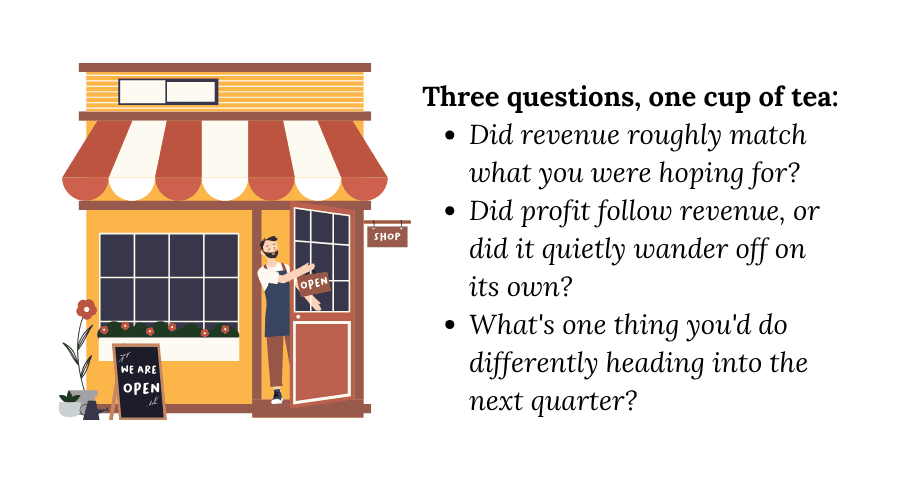
Three questions, one cup of tea

Did revenue roughly match what you were hoping for? Doesn’t need to be precise; ahead, on track, or behind is enough of an answer for now. And if you realise you never actually set a target for the quarter, that’s not a failure, it’s just a perfectly good place to start next time. You can’t be ahead or behind a target that doesn’t exist.

Did profit follow revenue, or did it quietly wander off on its own? This is the one that catches people out most often, and it’s the one I see most in this line of work. Revenue climbs, everyone’s thrilled, the calendar’s fuller than ever and then the bank balance doesn’t quite reflect it, because costs crept up right alongside the growth without anyone clocking it. Materials went up. A subcontractor’s rate went up. You took on a bit more admin help. None of it felt like a big decision at the time, but added together it’s eaten the extra revenue and then some. If you’ve felt busier than ever this quarter but the numbers don’t quite match the feeling, this is usually why.

What’s one thing you’d do differently heading into the next quarter? Not five things, just one! Trying to fix everything at once is how good intentions turn into nothing changing at all. Maybe it’s pricing, which almost every business owner I meet is quietly undercharging on. Maybe it’s chasing invoices a little sooner instead of letting them drift. Maybe it’s finally looking at where the money’s actually going instead of guessing based on vibes and a general sense of dread. Pick the lever that would move things most, and leave the rest for next quarter’s version of this exercise.

What to do with what you find

If the quarter came in ahead, resist the urge to immediately spend the difference on something exciting. Sit with it for a bit. Ask whether it’s a genuine trend or a one-off good stretch before you build plans around it. If it came in behind, resist the opposite urge, the spiral into “the whole business is failing.” One quarter is one quarter. It’s a data point, not a verdict. The value isn’t in the number itself, it’s in what the number tells you to look at next.

Why quarterly, specifically

A quarter is a genuinely good length of time to check in on; long enough to see a real pattern rather than a one-off blip, short enough to actually change course while it still matters. Check monthly and you risk reacting to noise, a slow week that means nothing, a good week that means nothing either. Check yearly and you find out too late to do much about it. Quarterly sits right in the sweet spot, giving you enough information to trust it, and enough time left in the year to actually act on it.

The business owners I see making calmer, more confident decisions are almost always the ones checking in quarterly, not just at tax time when the accountant delivers the number and there’s nothing left to do but accept it. Checking quarterly puts you back in the driver’s seat of your own financial year, rather than a passenger finding out where you ended up after the fact.

If you’d like a proper look under the bonnet, the CEO Dashboard gives you full visibility on exactly how the quarter really went not the guessed version, the real one.

Turning it into a rhythm

The businesses that get the most out of this aren’t doing anything clever, they’ve just made it a rhythm rather than a rescue mission. Same week each quarter. Same three questions. Same short list of actions afterwards. It stops being a big, dreaded event and becomes something closer to a habit, the business equivalent of a regular check-up rather than an emergency room visit.

If this is the first time you’ve done a proper quarter check-in, don’t worry about making it perfect. The value isn’t in precision, it’s in the act of actually stopping to look, on a schedule, instead of only looking when something’s gone wrong enough to force your hand.

Setting yourself up for next quarter

Before you close the laptop on this exercise, write down one number you’ll check again in three months. Just one. Revenue, profit margin, average invoice value, whatever feels most relevant to where you are right now. Having that one number in mind gives the next quarter’s check-in a head start, because you’ll already know what you’re comparing against instead of starting from scratch each time.

Small, consistent check-ins beat big, occasional audits every time. That’s true of your car, your health, and it’s absolutely true of your business.

The CEO Dashboard

#HowToResetMyMoneyMindset #NewYearFinancialMindset #HowToStartFreshWithMoney  emergency fund australia, money management, family savings #SmallBusinessOwner #BusinessGrowth #CashflowManagement #BusinessSuccess
#EntrepreneurMindset


 

Affirm Your Abundance: How to Train Your Brain for Wealth

Affirm Your Abundance: How to Train Your Brain for Wealth

? “I’m terrible with money.”

? “I’ll never be debt-free.”

? “There’s just never enough.”

Sound familiar?

Most of us say things like this without even thinking.
But did you know that every time you repeat these phrases, you’re cementing them into your brain like financial super glue?

? What you speak, you strengthen. What you affirm, you attract.

Welcome to the world of affirmations, visualisation, and neuroplasticity – where your brain is your best financial tool, and your words are the instructions you’re programing it with.

Getting Out of Debt Starts in Your Mind

? What Is Neuroplasticity (And Why Should You Care)?

Let’s break this down, Financial Management 101 style: Your brain isn’t fixed – it’s plastic (not like a credit card ?). It constantly rewires itself based on what you think, feel, and repeatedly say.

This is called neuroplasticity, and it means:

  • You can unlearn bad money habits.
  • You can rewire old beliefs.
  • You can train your brain to support financial growth.

Your thoughts become patterns. Your patterns become habits. Your habits become your bank balance.

? Why You’re Stuck (It’s Not What You Think)

If you’re earning good money but still feel stuck, it’s likely not your income – it’s your internal dialogue.

Every time you say:

  • “I’m bad with numbers.”
  • “I can’t afford that.”
  • “Money is stressful.”

…you’re telling your brain to stay in the struggle cycle.

But here’s the exciting news: You can flip the script. You can literally affirm your way into a wealth mindset. Let’s talk about how.

✅ What Are Affirmations?

Affirmations are positive, present-tense statements that help rewire your subconscious beliefs.

They’re not magic spells. They’re mental training tools. Think of them like push-ups for your mindset. ?

When you repeat an affirmation, you:

  • Interrupt old, limiting beliefs

  • Create new, empowering thoughts

  • Build neural pathways aligned with success

? Repetition creates reinforcement. Reinforcement creates reality.

?️ How to Create Affirmations That Actually Work

Not all affirmations are created equal.
To make them work, follow this formula:

  1. Keep it present-tense.

“I am” instead of “I will.”

  1. Make it believable.

Stretch your mindset – don’t snap it. (Say “I am open to wealth” before “I am a millionaire.”)

  1. Anchor it to your goal.

Affirmations should support your financial intentions.

  1. Add emotion.

Feel it. Say it with conviction.

  1. Repeat daily.

Morning and night are brain-priming gold.

? 15 Empowering Money Affirmations to Try Toda

Pick a few that resonate and start using them now:

  1. ? “I am in control of my financial future.”


  2. ? “Money flows to me with ease and purpose.”


  3. ? “I make wise, empowered money choices.”


  4. ? “I am worthy of wealth and abundance.”


  5. ? “I forgive myself for past financial mistakes.”


  6. ? “I attract opportunities that grow my income.”


  7. ? “I trust myself to manage money well.”


  8. ? “Every dollar I spend returns multiplied.”


  9. ? “I am building a strong financial foundation.”


  10. ? “My savings grow consistently and joyfully.”


  11. ? “I am aligned with financial freedom.”


  12. ? “It is safe for me to be wealthy.”


  13. ? “My income exceeds my expenses.”


  14. ? “I celebrate my financial progress daily.”


  15. ? “I am a magnet for financial abundance.”

Pro tip: Record them in your own voice and listen while driving, walking, or sipping your morning coffee. ☕

? Bonus Tool: Visualisation – Make Your Goals Feel Real

Affirmations are powerful. But when you pair them with visualisation? Next-level transformation.

Visualisation is the practice of mentally seeing your goals as already done.

Your brain doesn’t know the difference between a vividly imagined scenario and reality. So when you visualise success, you’re giving your brain a preview of coming attractions.

Try this:

?‍♀️ Close your eyes for 2 minutes.
? Picture your ideal money life:

  • Debt-free
  • Stress-free
  • Savings growing
  • Confident, calm, in control

✨ Now feel it in your body. Smile. Breathe it in. Say your top affirmation 3 times.

That’s it. That’s the practice.

? The Science Behind “Woo-Woo”

Still skeptical? That’s okay. Here’s the science:

  • Neuroscience confirms that repeated thoughts create new neural pathways.
  • Psychology shows that positive affirmations reduce stress and anxiety.
  • Visualisation is used by elite athletes, CEOs, and high performers globally.

So no – this isn’t magic. It’s mental conditioning. Just like going to the gym, but for your money mindset.

? Real-World Exercise: 7-Day Affirmation Reset

Want to see a shift fast? Try this 7-day challenge:
? Day 1: Write down 3 negative money thoughts
? Day 2: Flip them into positive affirmations
? Day 3: Say them aloud every morning and night
? Day 4: Visualise one financial goal for 2 minutes
? Day 5: Journal your emotions after practising
? Day 6: Add 1 new affirmation to your list
? Day 7: Reflect on how your mindset has shifted

✨ Stick with it, and you’ll notice real changes – in how you think, feel, and act with money.

? From Clients Like You…

? “I used to dread looking at my accounts. After doing daily affirmations for 30 days, I actually enjoy tracking my finances.” – Sarah, 42

? “I never realised how negative I was about money until I heard myself out loud. Repeating affirmations helped me take control – without judgment.” – Dean, 38

? Want to Make This a Habit?

This is exactly what we do in the Master Your Money 30-day program:

✅ Build affirmations that align with your financial goals
✅ Practice daily visualisation and brain rewiring
✅ Replace fear-based thinking with empowering beliefs
✅ Create lasting transformation from the inside out

It’s not about forcing change. It’s about creating an environment where success becomes inevitable.

? “What the mind can conceive and believe, it can achieve.” – Napoleon Hill

? Ready to Train Your Brain for Wealth?

If you’re serious about:

  • Feeling good about your money
  • Attracting more income and opportunity


  • Creating consistent, healthy financial habits


  • And finally breaking free from the old stories that keep you stuck…


Then it’s time to affirm your abundance and live it.

? Click here to learn more about the Master Your Money program.
Or send me a DM if you want to chat about how this could work for you.

? Final Thoughts

You are not behind. You are not broken. You are becoming the kind of person who manages money with confidence, clarity, and joy.

Start speaking that truth today and watch your reality shift.

? “Affirm it until your mind believes it. Then act on it until your life reflects it.”

Let’s go get that abundance. You’re ready.

Your Financial Freedom Breakthrough™